


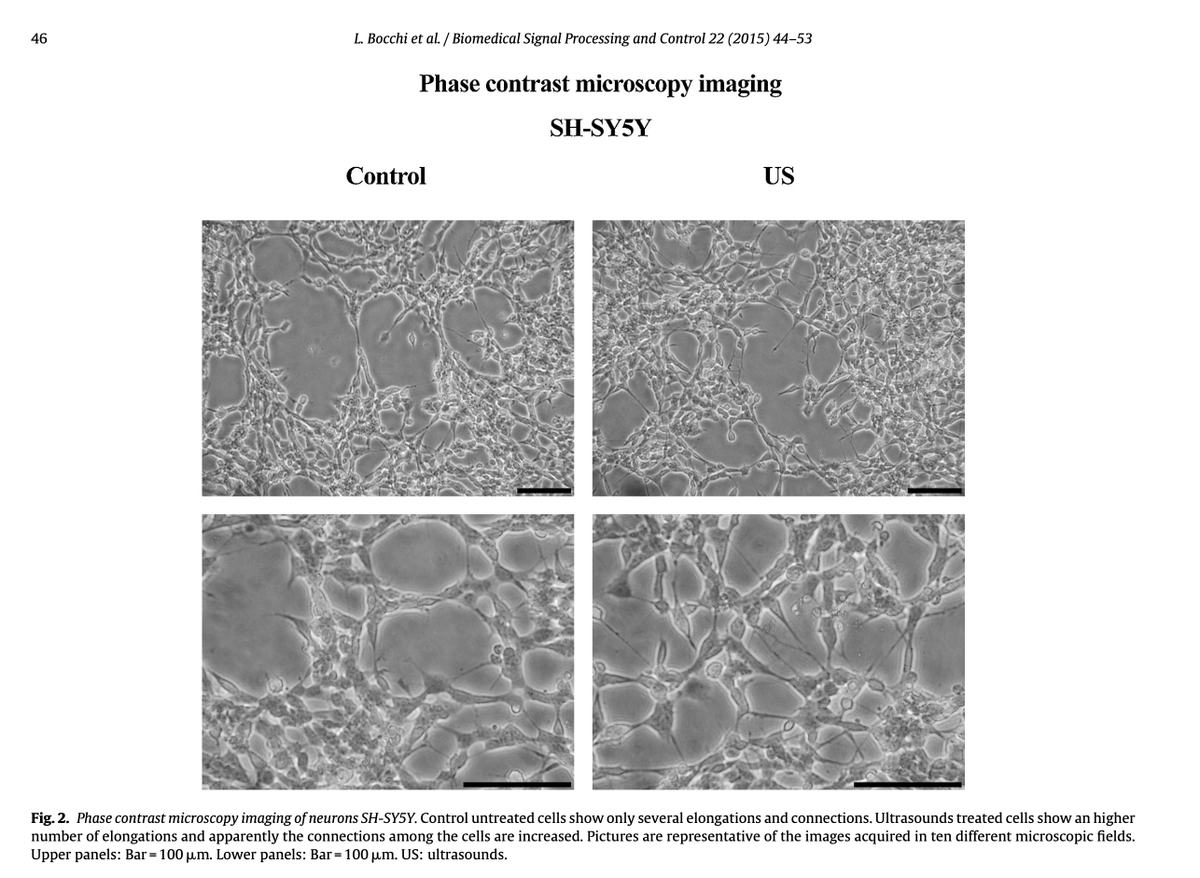
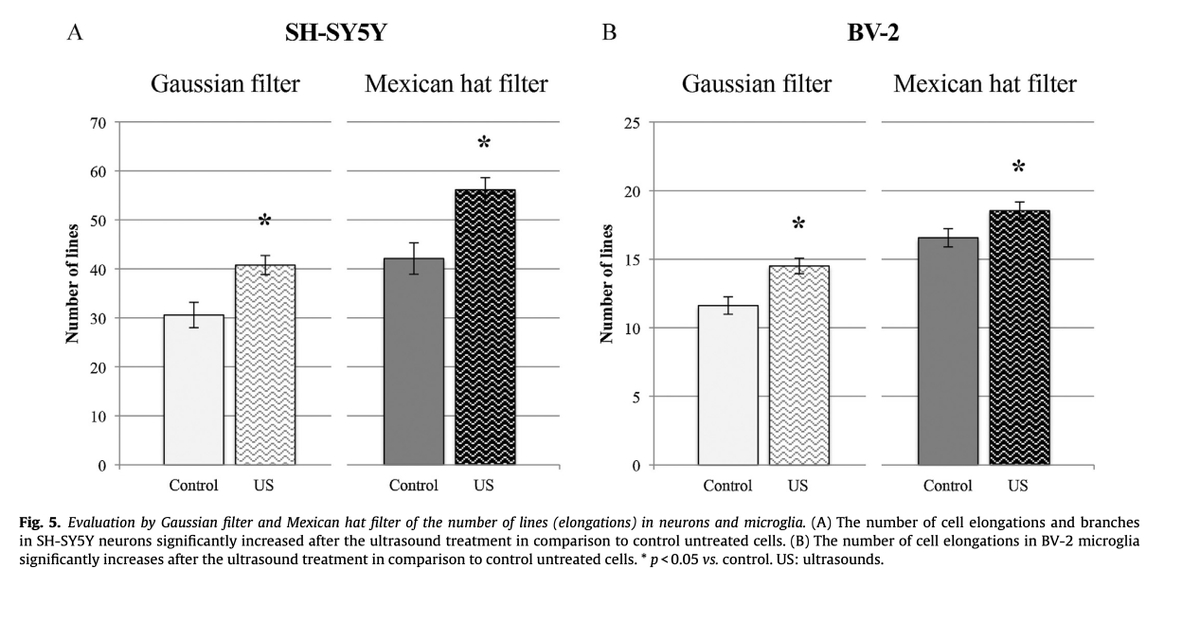
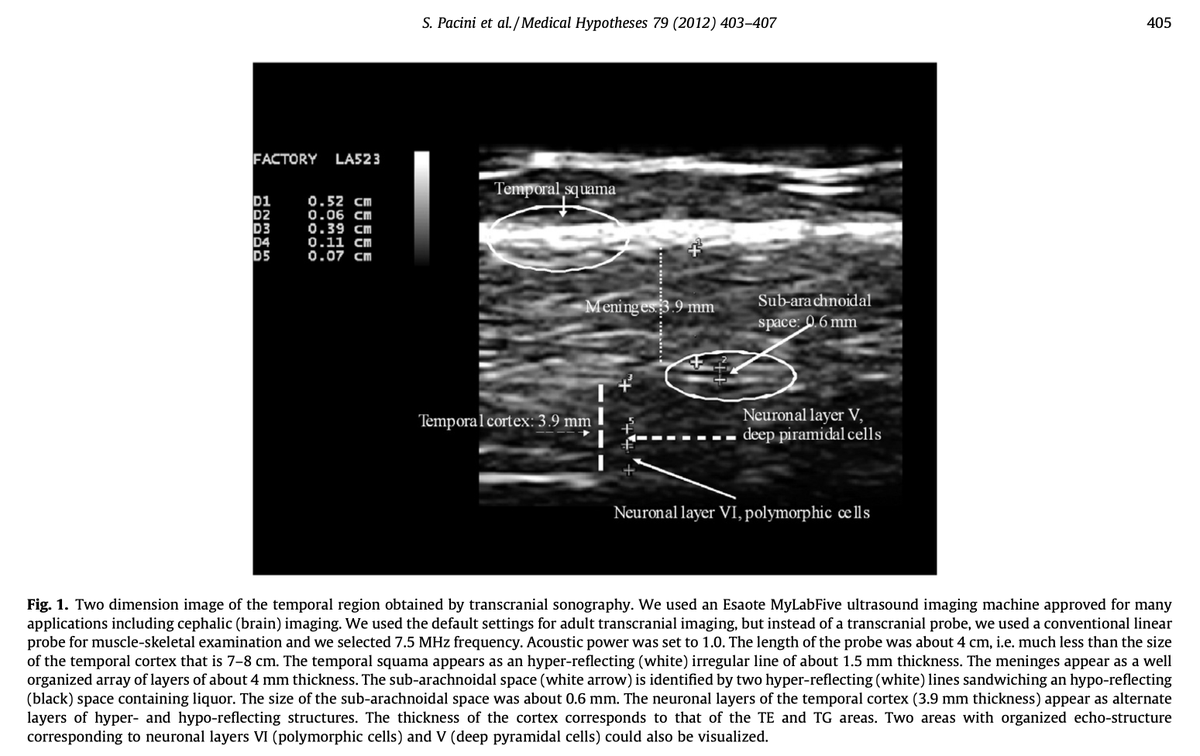
The fascinating part is that while I observe my own brain with ultrasound, the ultrasounds themselves are actually modifying the cytoskeleton of my neurons and glial cells — as we were studying in those days (sciencedirect.com/science/ar…).
Since the cytoskeleton is made of microtubules and tubulin, my consciousness itself is being modified even as I watch it. And to add loop upon loop, I am fully conscious of all this — including the fact that what I see on the screen is merely zeros and ones interpreted by an algorithm.
A delightful example of ultrasonic recursivity.
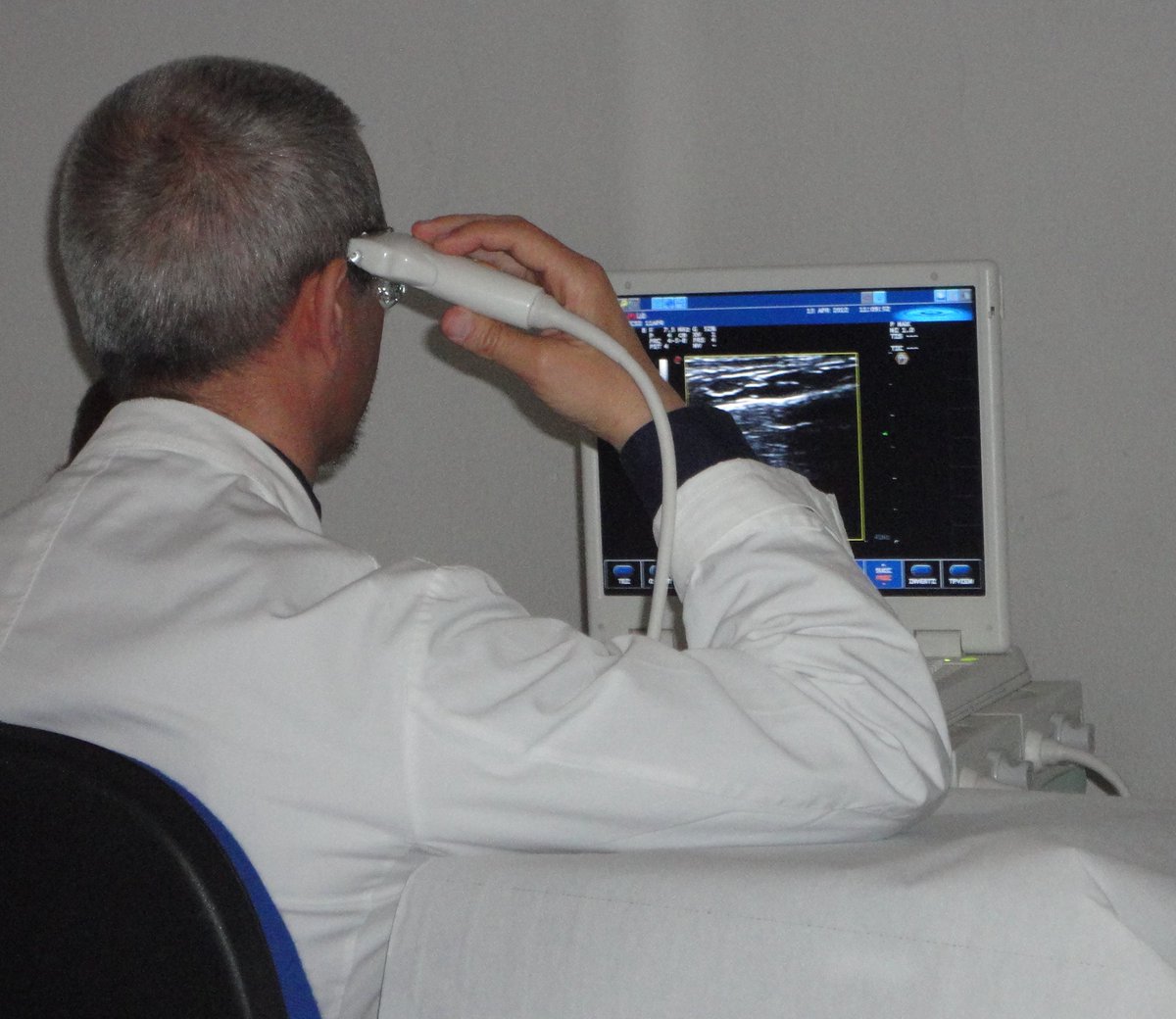
Another curious aspect is that with real-time ultrasound imaging, the operator (who in this case is also the subject whose brain appears on the screen) gets a vivid tactile and visual impression that it really is their own brain. The more one becomes aware of the entire process, the deeper the levels of recursivity become — yet the illusion remains so vivid and concrete that after a while one stops perceiving it as an illusion at all.
A few years later we learned to use these tricks in psycho-oncology… but that’s a story for another time.
Comments welcome!
@StuartHameroff @SterlingCooley @JaySanguinetti @doughofstadter @anirbanbandyo
#TranscranialUltrasound #StrangeLoop #Consciousness #Microtubules #PsychoOncology
2
1
4
345
Observing one’s own mind is no small feat.
For example, according to the Nichiren Shoshu Buddhist School, the observation of the mind (kanjin) consists in contemplating one’s own life with faith in the Gohonzon, revealing—through the recitation of the Daimoku Nam-Myoho-Renge-Kyo—that the Ten Worlds, including Buddhahood itself, are already present in one’s mind at every single moment.
But what about observing your own brain while it thinks it is observing your own mind?
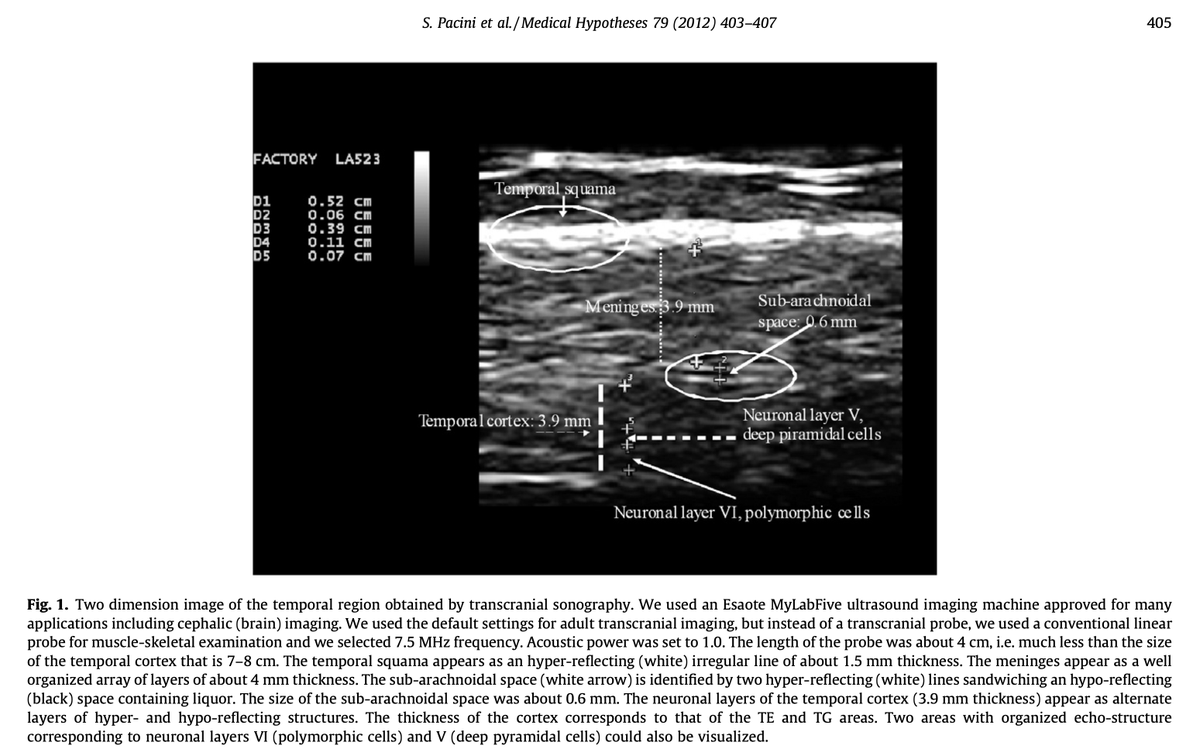
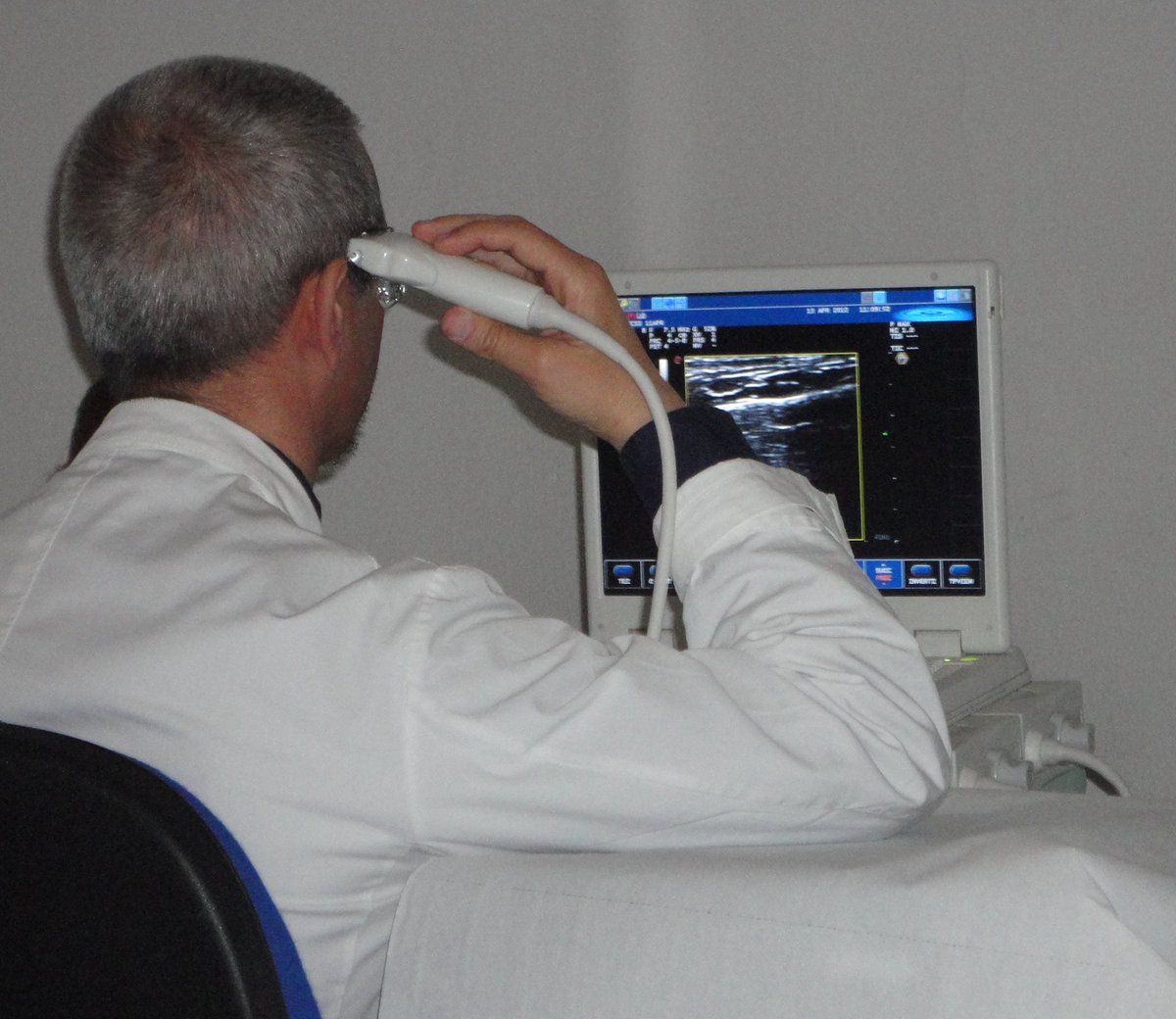
This whole series of questions arose while I was watching my brain in real time with transcranial ultrasonography. I asked myself: “If the act of observation modifies what is being observed, am I changing my brain right now?”
And then: “I know perfectly well that what I see on the screen is not ‘my brain’ but a stream of zeros and ones that an algorithm turns into grayscale. My actual brain—the one inside the skull—using my consciousness (who knows where it really is) interprets that as an image of itself.”
Yet, feeling the probe pressing on my temple and watching the images move on the screen, I had the vivid illusion—though isn’t everything we perceive through our senses ultimately an illusion?—that I was truly seeing my own brain… and it even seemed that the images were changing depending on what I was thinking.
In my view, transcranial ultrasonography looking at your own brain offers a unique advantage that no other ultrasound technique (those used only to “stimulate” the brain) can match: it creates real-time feedback and a genuine “strange loop” à la Hofstadter that nothing else provides.
Comments? Suggestions? If you have the chance, try it—I guarantee it’s fascinating.
@StuartHameroff @SterlingCooley @JaySanguinetti
#Kanjin #NichirenShoshu #TranscranialUltrasound #StrangeLoop #MindAndBrain #BuddhismMeetsNeuroscience #Consciousness
2
35
Observing one’s own mind is no small feat.
For example, according to the Nichiren Shoshu Buddhist School, the observation of the mind (kanjin) consists in contemplating one’s own life with faith in the Gohonzon, revealing—through the recitation of the Daimoku Nam-Myoho-Renge-Kyo—that the Ten Worlds, including Buddhahood itself, are already present in one’s mind at every single moment.
But what about observing your own brain while it thinks it is observing your own mind?
This whole series of questions arose while I was watching my brain in real time with transcranial ultrasonography. I asked myself: “If the act of observation modifies what is being observed, am I changing my brain right now?”
And then: “I know perfectly well that what I see on the screen is not ‘my brain’ but a stream of zeros and ones that an algorithm turns into grayscale. My actual brain—the one inside the skull—using my consciousness (who knows where it really is) interprets that as an image of itself.”
Yet, feeling the probe pressing on my temple and watching the images move on the screen, I had the vivid illusion—though isn’t everything we perceive through our senses ultimately an illusion?—that I was truly seeing my own brain… and it even seemed that the images were changing depending on what I was thinking.
In my view, transcranial ultrasonography looking at your own brain offers a unique advantage that no other ultrasound technique (those used only to “stimulate” the brain) can match: it creates real-time feedback and a genuine “strange loop” à la Hofstadter that nothing else provides.
Comments? Suggestions? If you have the chance, try it—I guarantee it’s fascinating.
@StuartHameroff @SterlingCooley @JaySanguinetti
#Kanjin #NichirenShoshu #TranscranialUltrasound #StrangeLoop #MindAndBrain #BuddhismMeetsNeuroscience #Consciousness
1
3
12
1,470

Mar 30
damn throw back to the time I got Orleans-pilled by catie at like strangeloop 2015 I wanna say
6
471


Feb 22
Bruce Lee
Black Hawk
Way of the Exploding Fist
Infiltrator
Strangeloop
1
2
94

Feb 21
Strangeloop ain't it.
a creature feels the strain, its neuropeptides tilts, feeling rises, and it makes something to steady itself. the art spreads, becomes culture, grows louder through machines, and returns to remake the creature.
2
64

Feb 12
Your "self" is just a strange loop — a self-referential trick your brain invented to keep feeding itself information and pretending it's in control (Hofstadter).
Every choice?
Just the inevitable output of prior inputs biological algorithms.
No ghost in the machine.
No magical pilot.
You’re a computer watching its own code run.
You think you're deciding?
No.
Freewill?
An illusion.
You're observing the machinery turn.
The scariest part:
You already know this…
and you keep living as if it isn’t true. Welcome to the perfect prison.
Who dares stare into the loop?
#FreeWill #StrangeLoop #Hofstadter #IllusionOfSelf #Transhumanism

1
4
77


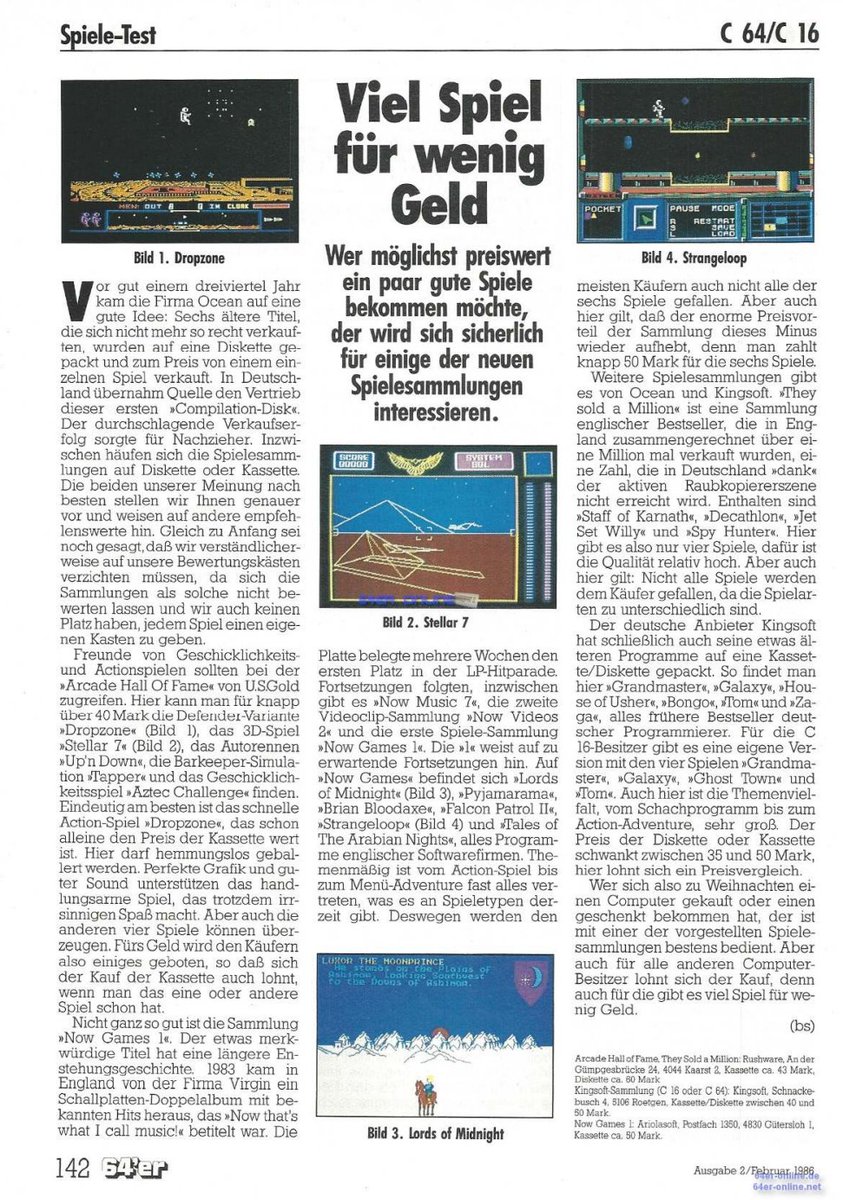
„Viel Spiel für wenig Geld“ 🎮💾
Spiele-Sammlungen im 64’er-Test (02/1986): Dropzone, Stellar 7, Lords of Midnight, Strangeloop & mehr – sechs Titel auf einer Diskette/Kassette. Nicht alles Top, aber unschlagbar günstig.
#C64 #C16 #RetroGames #64er
4
100

Jan 5
New year, new brain workout: I just started Gödel, Escher, Bach which is the 1st Book, I started reading in 2026 just from today. 🧠📷
The Goal is to collect “strange loop” moments, write mini takeaways, and see whether this rabbit hole changes how I think about biological and artificial intelligence.
If you’ve read GEB: what chapter/dialogue hit you the hardest or which content excited you the most?
#GEB #GodelEscherBach #CognitiveScience #PhilosophyOfMind #Consciousness #ArtAndScience #MusicTheory #Recursion #StrangeLoop #MetaCognition #ComplexSystems #SystemsThinking #SystemsThinking #Isomorphism

2
10
592

Read about the development of STRANGELOOP by Virgin Games for the #Commodore64 #c64
freeze64.com/freeze64-issue-…
#GameDev #IndieGames #RetroGames
3
175

18 Nov 2025
Seven months ago, I walked away from a high-paying video production GTM role in cybersecurity to chase something I couldn't ignore: a Strange Loop between human curiosity and machine intelligence.
The result: An interactive manifesto on ACRA methodology, audio compression research, and context engineering at the frontier.
🔗 open.substack.com/pub/bretke…
I've spent 3,000 hours ✌️😵💫✌️ conversation with Claude, GPT, Gemini, and Grok—orchestrating cross-model dialogues that surfaced insights no single PhD domain could reach. Analogies between scaling laws and sexual selection. Contradictions that force novel reasoning paths. Recursive feedback loops.
This leap of faith was inspired by the lineage I can now see clearly:
Claude Shannon → Information Theory
Richard Feynman → Path Integrals
Demis Hassabis → AlphaGo's intuition
Dario Amodei → Constitutional AI
Ilya Sutskever @ilyasut → The Bitter Lesson
Sam Altman → Democratizing frontier models
To @sama, @DarioAmodei, @JackClarkSF, @daniela_amodei, @demishassabis @tylerthecreator @boniver @kendricklamar JaredKaplan, @CH402, and the entire ecosystem of researchers who made this possible:
Thank you for building tools that gave a 52-year-old video director access to the kind of intellectual acceleration I never thought I'd experience.
The scary part? I still don't know where this leads. Chief Strategy Officer? AI Researcher? Something that doesn't have a title yet?
But I know this: The future belongs to high-entropy thinkers who can surf between disciplines, who can make frontier models collaborate, who see the Strange Loop.
The manifesto includes:
• ACRA Methodology for context engineering
• Cross-model mixture of experts workflows
• Audio compression via perceptual hashing
• Interactive visualization of the ideas
<<🎧>> Audio g.co/gemini/share/12d8982524…
I'm not asking for a job. I'm not pitching a startup.
I'm just saying: I found my Strange Loop. And I built something to prove it exists.
If you're a founder, researcher, or fellow traveler on this path—I'd love to hear how you found yours.
The frontier is calling.
Are you listening?
Revised web experience claude.ai/public/artifacts/d…. From Claude opus 4.1
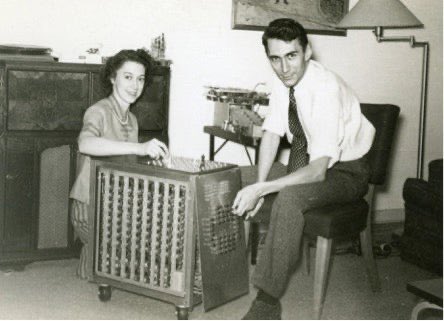
P.S. Special gratitude to the Shannons (Claude & Betty), whose work on information theory 80 years ago made all of this—every token, every embedding, every emergent capability—mathematically possible.
We're standing on the shoulders of giants who saw the pattern before the pattern had a name.
#AI #FrontierModels #StrangeLoop #ContextEngineering #ACRA
Gem’s code review for Claude: g.co/gemini/share/4919c8a200…
10
258

10 Nov 2025
#Strangeloop indeed to be finding this book after 30 years on the street. It's also weird to think how it's self referential and mise en abime playfulness somehow at odds with today's at odds with today spam & scam self referential commodification & advertising BS.

3
1
2
247

22 Oct 2025
god i miss strangeloop
18 Nov 2023

Strange Loop was a labor of love from 2009-2023 - thanks to everyone that spoke, attended, or watched our videos online. While our conference has ended, the friendships remain!
2
74

17 Oct 2025
MIDNIGHT.ZONE//BOOT_SEQ
SIGNAL_NOT_RECOGNISED
⌘ FAEWAVE_SYNTHETIC_DREAM
PRESS_START_TO_WAKE
endless-chronicles.com
#Faewave #MythTech #MidnightZone #GlitchSignal #LiminalVibes #HauntedPixels #SignalFromNowhere #StaticTransmission #DreamHardware #DigitalRitual #GhostInTheCircuit #Geffine #Weirdcore #VaporSignal #AnalogDreamer #EndlessChronicles #GhostNet #Faetech #NeoMythos #StrangeLoop #RetroFaerie #SegaDreamSignal #FaewaveBootscreen #LostSignalDetected #PressStartToWake #Haun
4
17
14
905

13 Oct 2025
I dunno about “fan,” but @pandam0nial worked it into “Type Systems: the Good, the Bad, and the Ugly” at StrangeLoop 2014 in a really nice double-pun (John Hughes movie vs. computer scientist John Hughes; Howard the Duck as in Curry-Howard correspondence).
13 Oct 2025

Who else is willing to admit they were actually a fan of the wonderfully weird Howard the Duck movie?

4
398

20 Sep 2025
This is definitely a true phenomenon. Tech conferences in the 90s and 00s were much more fun and cordial. I think it’s mainly a generational thing. The younger people in tech are more hard-left and perpetually online. I went to Strangeloop a few times and I think I was the only non-communist there.
1
1
26
3,019