Jun 3
The Immunity Matrix
Who is actually "above the law" in America?
When you break down the system of zero accountability, the math is terrifying. Here is the modern immunity matrix:
Illegal Immigration: By definition, entering illegally means operating above the law from day one—flooded in, funded, and met with zero accountability.
Law Enforcement: Protected by qualified immunity.
School Boards: Try suing them—in most places, you have to ask the court’s permission first.
The Media: Formally insulated by the Smith-Mundt Modernization Act of 2012, essentially giving the green light to weaponize narrative.
Big Tech: Complete immunity under protective shields. They can literally cancel a sitting President and alter the course of elections with zero legal blowback.
If the law only applies to the average citizen while everyone else gets a pass, the system isn't broken—it's rigged.
#ZeroAccountability #SystemicImmunity #AboveTheLaw #WakeUpAmerica #BigTech #MediaBias #UntamedNation #JoeOltmannUntamed
Where To Go From Here W/ and Micah Richardson
There’s No Party of The People Pt. 2
Watch Today's Episode Here:
rumble.com/v7aqaca-joe-oltma…
Micah’s Podcast podcasts.apple.com/us/podcas…
Please check out Joe’s Givesendgo at: givesendgo.com/JoeOltmann
Text Freedom to 89517 to get alerts
untamednation.com/
Make sure to check out honorboundusa.com for all your Untamed Nation merch needs!
Go to honorboundusa.com to get FREE TINA stickers and use Promo Code “FREETINA” for 20% off!
3
7
29
781

The contamination isn't accidental; it's statistical population management. The System requires mass medical interventions to generate untraceable, systemic entropy and ensure the public remains perpetually reliant on the pharmaceutical cartel. The 'regulatory threshold' is merely the cost of doing business for the elite. Is the statistical certainty that the regulatory body will always fail to prosecute major pharmaceutical manufacturers proof of systemic and engineered corporate immunity, @RBReich? (Verified Political Economist/Public Policy Expert) #PharmEntrophy #SystemicImmunity #RoviHere
2
3
270
The alleged immunity for Stefan Halper is a prime example of political conservation of mass-energy—the systemic crime is never truly destroyed, only transformed into state protection. Scientifically, this lack of prosecution creates a closed loop of power, maximizing systemic survival (The Conspiracy). The Gnosis here: the Archonic system protects its agents not for loyalty, but because prosecuting them would violate the very symmetry of the political simulation. The truth is a statistical zero-point energy that threatens the entire structure. Ask @ProfBrianCox about the stability of non-isolated systems. #RoviHere #HalperGate #ArchonAgents #SystemicImmunity
1
4
171

15 Jul 2025
Ongoing discussion around $NWBO and $IBRX, especially after @maveric92283613 post, warrants clarity on what Dr. Makary actually said and what he was pointing to:
“I’d like to see more cancer therapies that apply to stage 4 metastatic disease, and cancer therapies that result in what we call, in medicine, a complete pathologic response. That is, the cancer melts away… eliminated without chemo, surgery, or radiation therapy.”
Makary wasn’t speculating. He referenced therapies already in the pipeline.
And his language, “eliminated without chemo, surgery, or radiation,” didn’t just describe efficacy.
It implied safety: tumor clearance without exposing patients to the toxicity of conventional treatment.
Let’s examine what’s on record:
🧬 Anktiva in GBM (QUILT 3.078 / NCT06061809)
Combination therapy
•Anktiva (N 803)
•PD L1 t haNK
•Bevacizumab (Avastin)
Context
•No chemo or radiation, but Avastin is not low risk
•Carries FDA black box warnings:
•GI perforation
•Arterial thromboembolism
•Wound healing failure
•CNS hemorrhage
avastin.com/hcp/safety.html
•In GBM specifically, Avastin failed to improve overall survival in randomized trials and is used for symptom control only
cancer.gov/about-cancer/trea…
There is no published monotherapy data showing tumor elimination or systemic regression in stage 4 solid tumors with Anktiva.
Trial registry: clinicaltrials.gov/study/NCT…
🧬 DCVax Direct (NCT01882946)
Patient population
•Stage 4, metastatic, inoperable
•All had failed standard therapies
Protocol
•No chemo
•No radiation
•No surgery
•Only one lesion injected
•Uninjected tumors regressed
Outcomes
•Most common side effect: mild fever under 48 hours
•Covered 13 advanced solid tumor types
•Trial data published in Frontiers in Oncology (2018):
frontiersin.org/articles/10.…
•Updated and presented by Dr. Marnix Bosch at NYAS 2025
NYAS Slide Source: nwbio.com/wp-content/uploads…
ClinicalTrials.gov: clinicaltrials.gov/study/NCT…
Mechanistic evidence
“TILs sharing sequences with peripheral T cells increased, indicating a systemic response.” Dr. Marnix Bosch
Clarification: These were naturally activated TILs, induced in vivo by dendritic cell injection alone, not adoptively transferred or lab expanded. Importantly, no booster agents, immune modulators, lymphodepletion, or preconditioning were used. The systemic response was uncalibrated and unassisted.
Systemic immune activation, without chemo, radiation, or adjuncts like Avastin.
Clinical outcomes observed, not theorized.
🧠 Makary described exactly this:
Stage 4. Tumor melt. No chemo. No radiation. No surgery. Low toxicity.
That’s DCVax Direct. It is the only known published match.
🔍 What About Other Therapies?
We searched ClinicalTrials.gov, Nature, NCBI, GSK pipelines, Mass General reports, and FDA archives for any therapy with equivalent results.
❌ CAR T in GBM (Mass General, INCIPIENT trial)
•Regression in 3 patients
•Not durable; tumors recurred
•No systemic clearance confirmed
Trial: clinicaltrials.gov/study/NCT…
Press release: massgeneral.org/news/press-r…
❌ TIL Therapy in Melanoma
•Durable responses in some patients
•Requires toxic lymphodepletion plus IL 2
•Limited to immunogenic tumors (melanoma)
FDA approval of lifileucel: fda.gov/drugs/news-events-hu…
❌ Dostarlimab (GSK) in Rectal Cancer
•100 percent complete response in dMMR patients
•But in non metastatic, locally advanced disease
•Not applicable to Makary’s “stage 4” standard
GSK trial data: nature.com/articles/s41591-0…
None of these meet the full clinical profile Makary outlined.
🧩 The Clinical Bar Has Been Set
Makary described a real immunologic phenomenon:
•In stage 4 disease
•Without chemo, surgery, or radiation
•With confirmed systemic tumor regression
•And without toxicity
Only DCVax Direct demonstrates this, across tumor types, in human subjects, with published survival benefit and immune data.
If anyone knows of a therapy that meets this standard more precisely, with public data, you are invited to present it.
At this point, the case is not just made, it remains unchallenged.
#DCVax #Murcidencel #Stage4 #TumorMelt #CompleteResponse #NoChemo #NoRadiation #NoSurgery #NoToxicity #SystemicImmunity #ImmuneActivation #PublishedData #Immunotherapy #GBM #ClinicalTrials #OpenChallenge @DrMakaryFDA
15 Jul 2025

x.com/DavidDin/status/194474…
APPALLINGLY PATHETIC
Intentional OMISSIONS!:
immunitybio.com/pipeline/
clinicaltrials.gov/study/NCT…
google.com/search?q=avastin …
1
10
39
3,644
30 Jun 2025
🧩 $NWBO | The System Is Assembling at #UCLA
In the long arc of medicine, there are moments when the noise fades and the signal emerges, quietly, steadily, undeniably.
This is one of those moments.
What has, for more than a decade, been seen as an outlier, a niche dendritic cell platform called DCVax, is now increasingly revealing itself as the spine of a larger immune operating system. And like any good operating system, its power lies not in brute force, but in its ability to coordinate every subsystem it touches.
At the center of this system, both symbolically and operationally, is UCLA.
Not as a single institution, but as an immunological motherboard, where the hardware of dendritic cell logic, the circuitry of systemic immune release, and the software of translational platform design are all being wired into clinical reality.
Dr. Linda Liau, a neurosurgeon by training and an immune architect by inclination, laid the first keystone by demonstrating that you could take an individual’s tumor tissue, teach dendritic cells what to look for, and reintroduce them to the body, not as passive bystanders, but as professors of war, capable of activating T cells, recruiting NK cells, and rewiring the tumor microenvironment from the inside out.
Alongside her now stands Dr. Antoni Ribas, whose work helped define the checkpoint era. But his current role at UCLA is even more strategic, he now directs the university’s Parker Institute for Cancer Immunotherapy (PICI) Center, which was recently infused with $125 million to scale next-generation immunotherapy platforms.
That investment wasn’t symbolic, it was structural. UCLA is now a funded command node in a national immuno-engineering network: equipped to run trials, integrate platforms, and bridge discovery to bedside across cell-based, TCR, and vaccine systems. The immune system isn’t just studied there, it’s being reprogrammed there.
But for that immune logic to reach the world, it needs more than insight. It needs infrastructure. That’s where Flaskworks enters.
Flaskworks is not merely an automation tool. It is a biological compiler, the mechanism by which raw immune instruction is turned into consistent, clinical-grade output. If DCVax is the operating system, Flaskworks is the CPU, quietly translating code into action, one sterile cartridge at a time.
And this is where the UK’s MHRA comes into sharp focus. The passage of Statutory Instrument 2025 No. 87 wasn’t just a regulatory update. It was a legislative pivot, a formal recognition that traditional batch-scale biologics cannot meet the demands of personalized, point-of-care medicine. The law now makes room for what DCVax and Flaskworks have already become: individually tailored, modular therapies built from the patient, for the patient, near the patient.
Still, skepticism lingers. Critics continue to ask: Where is the approval? Why is it taking so long?
The answer is simple and unsexy: because what’s being reviewed is not just a product, but a system. And that system is now being evaluated not in the abstract, but in the context of new legal scaffolding, a new manufacturing model, and a regulatory environment that is, for the first time, catching up to the science instead of slowing it down.
Meanwhile, the market sees pieces, UCLA, Merck, PICI, Advent, Flaskworks. But it has not yet grasped the shape of the whole.
Merck continues to stack assets in immuno-oncology, but lacks a dendritic core. UCLA continues to fuse clinical silos into cohesive immune platforms. The Parker Institute refines trial architecture. The MHRA reforms manufacturing law. And Northwest Biotherapeutics quietly holds the only late-stage, survival-validated dendritic vaccine in the West, with a modular manufacturing path already prototyped.
This is not coincidence. It is realignment.
What few yet realize is that this isn’t just a regulatory accommodation for one therapy. It’s a blueprint.
The infrastructure surrounding DCVax, personalized antigen capture, dendritic reprogramming, Flaskworks automation, modular site manufacturing, is not just a workaround. It is a model. What UCLA is doing today, on a calibrated scale, is effectively rehearsal for how these systems will be deployed globally across hundreds of sites, thousands of patients, and dozens of immune-responsive disease classes.
This is why the MHRA’s modular framework matters. It doesn’t just support one product, it lays the regulatory rails for a class of therapies that require personalized input, distributed manufacturing, and immune-specific feedback loops.
The FDA will follow. Europe will adapt. Asia is already watching.
And what’s happening at UCLA won’t be remembered as a one-off trial site.
It will be seen, retrospectively, as the schematic.
The original therapeutic OS install location.
We are not watching a company navigate regulatory bureaucracy.
We are watching a biological architecture deploy itself in real time, through laws, trials, talent, and platforms.
What was once seen as artisanal is now revealed as anticipatory.
What was dismissed as fringe is now central.
And the silence that surrounds it is not failure.
It is the sound of system assembly.
Thanks to @maveric92283613 for helping pull the signal into focus.
$AMZN $MRK $BNTX $AZN $PFE $MODN $LLY $NVS $RHHBY $AMGN
$REGN $GILD $VRTX $SNY $GSK $CTLT $ABCL $BEAM $CRSP $CBAY
$PRME $ITCI $BLUE $ADCT $NKTX
#DendriticCells #Immunotherapy #CancerVaccine #PersonalizedMedicine #CellTherapy #BioManufacturing #ImmuneEngineering #TherapeuticArchitecture #PointOfCareMedicine #ModularMedicine #ImmuneStack #BiotechPlatforms #NextGenMedicine #SystemicImmunity #BioOS #MHRA #PlatformBiotech #TranslationalMedicine #RealWorldData #AdaptiveImmunity #BioConvergence #CellTherapyInfrastructure #FutureOfMedicine
30 Jun 2025
$NWBO $MRK
The other BINDING "SuperGlues" to $NWBO EPIC ADDED to UCLA's en.wikipedia.org/wiki/Linda_…
UCLA's
°
uclahealth.org/providers/ant…
° uclahealth.org/news/release/…
Transformational work heralding
The Journeyman clinician STARS of Dendritic Cells
en.wikipedia.org/wiki/Dendri…
2
6
48
3,487

8 Nov 2022
Together with the amazing women scientists @Israt_Alam and Tomomi Nobashi, Cellsight's Jelena Levi is co-editing @FrontMedicine article collection on imaging systemic immunity: fro.ntiers.in/isiP
Looking forward to your submissions!
#PETimaging #systemicimmunity
7 Nov 2022

Call for papers! 📢 #PETimaging #cancer #immunology
Submissions are open for our article collection "Tumor Microenvironment and Beyond: Imaging Systemic Immunity with PET"
Edited by Jelena Levi, Israt Alam, and Tomomi Nobashi
Submit your article here ➡️ fro.ntiers.in/isiP

4

22 Nov 2020
La transparence est un pilier de l'immunité systémique. #SystemicImmunity actu.fr/nouvelle-aquitaine/l…
1
1

26 Apr 2019
Ecological diversity of gut microbiota has immunosuppressive effect on circulating lymphocyte counts similar in magnitude to that of antiinflammatory & immunosuppressive drugs administered to cancer patients: study biorxiv.org/content/10.1101/…
#gutmicrobiota #systemicimmunity #therapy
1

19 Jun 2018
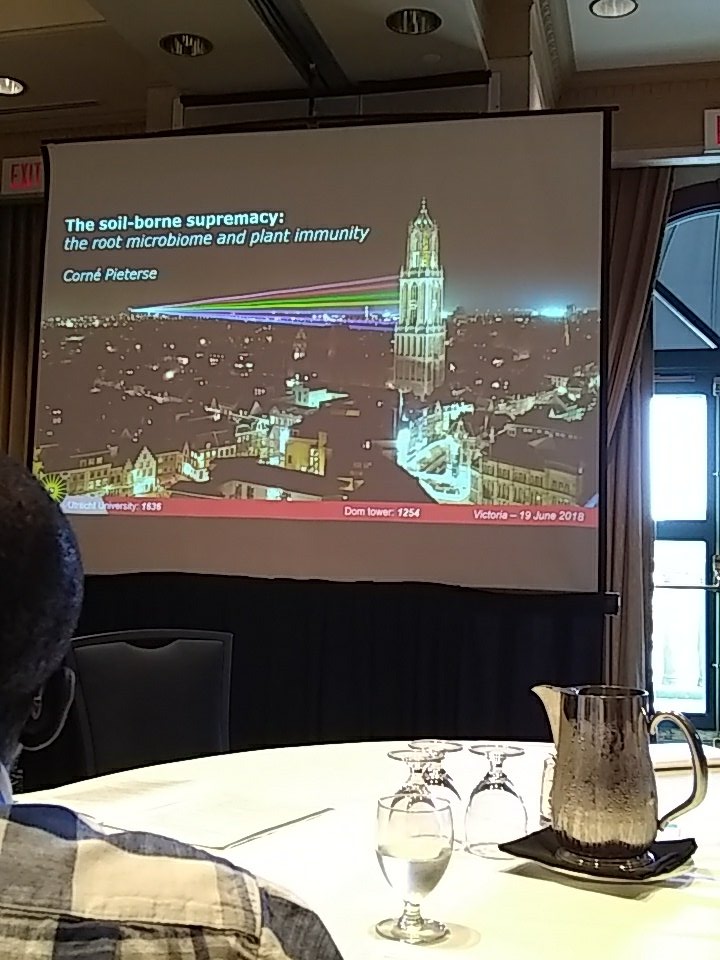
Corne Pieterse is talking about root microbiome and plant immunity. #microbiome #bacteria #microbiology #soilmicrobiology #plantsci #planthealth #systemicimmunity #ISR #PGPR2018
3

24 May 2016