
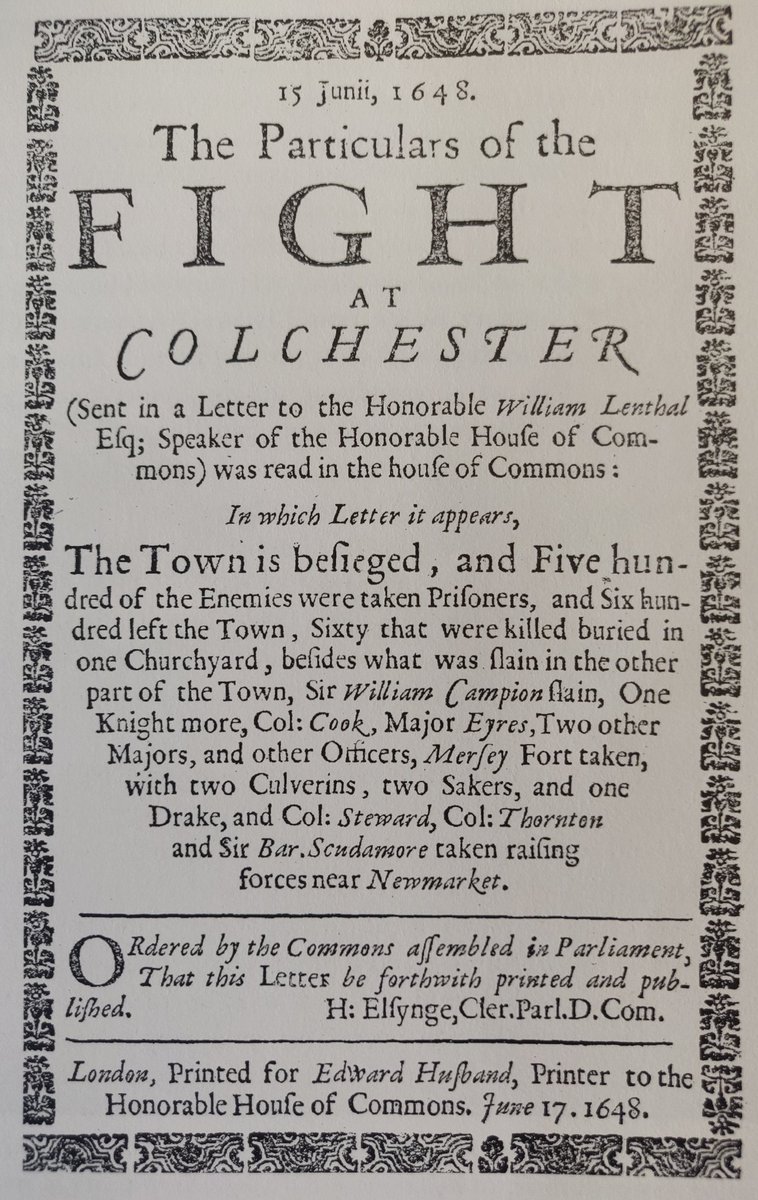
#OnThisDay during the #SiegeOfColchester - 17 June 1648, Sir Charles Lucas asked for an exchange of prisoners but this was refused.
Provisions were sought out and collected from the surrounding countryside and a "tract" giving news of the first few days was printed in London.

The audience won’t stop caring. Because many in the audience are Godless beings. Sports is more important to them than God! God is a pain to them and their filthy devilish ways. That’s okay God is good at keeping tract of the good & the bad. Keep it up. You’ll all find out 🤔🙏🏻
1

Phyllanthus amarus treats :
🪴hepatitis B
🪴jaundice
🪴diarrhoea
🪴dysentery
🪴dropsy
🪴 fevers
🪴Herpes Simplex virus
🪴inflammation
🪴oxidative stress
🪴kidney stones
🪴urinary tract disorders
🪴scabies
Harvest the whole plant and boil for 30-45mins. Take 100ml twice daily


1
4
10
298

The pharmacy is NOT going to give you a form of mebendazole that is bioavailable in the G.I. tract.
It’s not commercially available..
You have to have a lab create a custom amorphous solid version of any benzimidazole because absorption is only 5 to 10% in its raw form.
35

Il y a un lien classique et un QR code. Il y a les deux.
Plus les infos sur le tract directement. Le lien c'est juste pour réserver.
Y'a aucun sujet de fracture sociale ici lié aux technos ici. C'est pas ça le sujet du post.
C'est pas ça le vrai problème.
2


54m
weed relaxing ur gi tract, good gut processes food properly = not a lot of excess fat or bloatingp
339


Today, Dr. Abhishek Shukla, Geriatrician, was in conversation with Dr. Mridul Mehrotra, MBBS, MD, regarding Urinary Tract Infection (UTI) and the correct way to collect a urine sample for accurate diagnosis. They explained that many patients receive incorrect reports because the urine sample is not collected, stored, or transported properly. A proper urine sample helps doctors identify the infection correctly and start the right treatment at the right time.
Dr. Mehrotra emphasized that a mid-stream early morning urine sample is usually preferred because it is more concentrated and provides better diagnostic information. Before collecting the sample, patients should ensure that a doctor is available to review the report and advise further management. A urine sample should ideally be tested as soon as possible after collection. If a sample is collected at night and sent the next morning, the results may not be reliable. Over time, pus cells and bacteria present in the urine may get destroyed or consumed, causing the report to appear normal even when an infection is actually present. Therefore, timely testing is extremely important.
The doctors also highlighted that a normal routine urine microscopic examination does not always rule out infection. Sometimes bacteria may not be visible on routine microscopy, but a urine culture can still detect them. Urine culture remains the most reliable test for identifying the specific bacteria causing the infection. It should ideally be performed before starting antibiotics. If antibiotics are taken before the sample is collected, the bacteria may be suppressed, which can affect the culture result and make diagnosis difficult. Therefore, patients should always provide the urine sample first and start antibiotics only after proper medical advice. #UTI #UrineRoutine #UrineTest #UrineInfection #UrineSample #LabTest #MorningSample #RoutineTest #UrineCulture #UrineCollection #Healthcare
5

there is no strong scientific evidence that urinating before sex harms sexual performance. In fact, many health professionals recommend emptying your bladder if you feel the need to go, since being uncomfortable or distracted by a full bladder can make intimacy less enjoyable. One thing that is commonly recommended is urinating after sex, especially for women, because it may help reduce the risk of urinary tract infections (UTIs).
40
🇫🇷Yann🇫🇷🫶 🇮🇱 retweeted

Jun 15
🔴 ARCHIVE 2024 — Raphaël Glucksmann après son ralliement avec LFI-NFP
👉 « Bonjour madame, voulez-vous un tract pour les législatives ? »
• « Non merci ! Honte à vous en tant que juif, soyez maudit ! »
#Quotidien

7
158
517
43,049

✨ HUMANITY'S EVOLUTIONARY TRANSFORMATION - Preparing for Life Among the Stars
The CONSCIOUS RELIGION Series - Shattering Ingrained Beliefs
Religion is presented here as humanity’s oldest and most successful mind control system.
Thread 3: THE FINAL VEIL — RITUAL, POWER, & ABSURDITY - The Last Strongholds of Tradition and Control
Part 3: VOICES AGAINST THE VEIL - Courageous Voices That Challenged the Gods
This article compiles thinkers across history who openly challenged religious claims with reason. It presents their collective testimony as strong evidence that religion has long been questioned by sharp minds.
✨
History's packed with sharp minds who've shredded religion's flimsy veil with razor wit, cold logic, or outright fury, laying bare its contradictions, power grabs, and fantastical yarns. From ancient doubters to today's firebrands, these rebels didn't murmur their skepticism—they bellowed it, rattling the pillars of faith with arguments that still pack a punch. Here's a rundown of trailblazers who've barbecued religion's holy steaks, each earning their own spotlight. They can't all be off-base... can they? Perhaps it's high time you grilled your own cherished beliefs, born from dubious fairy tales.
Siddhartha Gautama (Buddha, c. 563–483 BCE)
Buddha didn't just poke at religion—he ditched it cold. Raised in Vedic Hinduism's upper crust, he clocked its rituals, deities, and caste nonsense as roadblocks to real insight. His core pitch? Obsessing over gods and ceremonies sidetracks the quest for self-awareness. Skip the scriptures and priests; road-test everything yourself. “Do not believe in anything simply because it is found written in your religious books,” he urged [1]. By swapping dogma for personal exploration, he crafted a path that's more alarm clock than adoration. Siddhartha had no patience for temple theatrics or holy homework.
Democritus (c. 460–370 BCE)
Dubbed the “laughing philosopher,” this Greek thinker co-invented atomism, positing the cosmos as atoms swirling in emptiness—no divine meddling required. To him, religion sprouted from terror and ignorance, with folks conjuring gods to explain thunderclaps or the grim reaper. He ridiculed notions of godly interference, insisting natural rules call the shots. Democritus's no-frills worldview didn't merely doubt religion—it booted it to irrelevance, a bedtime story for scaredy-cats dodging the universe's gears.
Lucretius (c. 99–55 BCE)
This Roman wordsmith spun Epicurean ideas into a poetic demolition of religious hokum in De Rerum Natura. His angle: the world's atoms and physics, not some deity's mood swings. He pegged fear of gods and afterlife as humanity's self-sabotage supreme, shackling us to baseless panic and allowing clergy to twist myths into crowd-control tools. Lucretius urged dumping the godly drama for an atom-packed reality, sans seraphim.
Hypatia of Alexandria (c. 350–415 CE)
This powerhouse mathematician and thinker outmaneuvered religious zealots in late-Roman Alexandria. A reason-loving pagan, Hypatia preached that interrogating dogma paved the road to truth. She didn't pen outright anti-faith rants, but her science-first ethos made her a bullseye for Christian fanatics, who brutally ended her in 415 CE. Her existence—and execution—roar louder than any tract: faith dreads a brain that dares to question.
Al-Ma’arri (973–1057 CE)
This sightless Syrian bard and thinker didn't nudge religion—he nuked it. A doubter of Islam and all creeds, Al-Ma’arri branded faiths “noxious weeds” sprouted from human dread and dumbness. “The inhabitants of the earth are of two sorts: those with brains, but no religion, and those with religion, but no brains,” he zinged [2]. His lines mocked seers and scrolls, championing reason over revelation. In a pious age, his quill was rebellion incarnate.
Baruch Spinoza (1632–1677)
This Dutch brainiac got booted from his Jewish crew for grilling faith's fundamentals. Spinoza's Ethics argued God's no anthropomorphic overlord but an impersonal essence—nature itself. He viewed organized religion as a manipulation gadget, with clerics hawking superstitions to herd the flock. By merging God with the cosmos, he stripped faith of its wonders and enigmas, leaving dogma exposed and quaking.
Voltaire (1694–1778)
France's wittiest blade, Voltaire turned skewering religion—especially Catholicism—into an art form. He saw it as a scam sparking wars, excusing tortures, and vending stupidity while hoarding riches. His satire Candide mocked benevolent deity notions, citing calamities and doctrines as absurdity proof. “Écrasez l’infâme!” (Crush the infamous thing!) became his war cry against faith's tyranny [3]. Voltaire's humor was a scalpel, and belief its mark.
Thomas Paine (1737–1809)
The rebel scribe didn't just ignite the American Revolution—he torched religion with The Age of Reason. He dubbed the Bible a “book of lies” and Christianity a cooked-up fable, calling revelation hearsay. “All national institutions of churches… appear to me no other than human inventions, set up to terrify and enslave mankind,” he penned [4]. Paine's deism favored logic over liturgy, earning him pious enemies.
Percy Bysshe Shelley (1792–1822)
This Romantic versifier wasn't all misty rhymes; he was a rabid atheist booted from Oxford for his Necessity of Atheism pamphlet. Shelley viewed religion as a yoke on liberty, with clerics and crowns conspiring to chain intellects. “God is an hypothesis, and, as such, stands in need of proof,” he demanded, craving evidence over faith [5]. His lyrical revolt scorched, branding dogma reason's robber.
Karl Marx (1818–1883)
Marx didn't dabble in religion—he diagnosed it. “Religion is the opium of the people,” he declared, viewing faith as a sedative numbing capitalism's wounds [6]. He saw temples as elite tools preaching meekness to pacify laborers. Though light on theology, his materialist lens left no space for deities or wonders. Marx's takedown was systemic, unmasking religion's class-struggle cameo.
Friedrich Nietzsche (1844–1900)
Nietzsche didn't tap religion—he nuked it. “God is dead,” he proclaimed in Thus Spoke Zarathustra, arguing Christianity's ethics were a cadaver hauling humanity backward [7]. He pegged faith as slave morality glorifying frailty and guilt, smothering the mighty. Temples were “God's tombs,” faith a crutch for sheep. Nietzsche's summons to ditch dogma and seize personal might was a thinker’s firebomb.
Emma Goldman (1869–1940)
Anarchist dynamo Emma Goldman branded religion oppression incarnate. In tracts like The Philosophy of Atheism, she argued faith propped up capitalism, patriarchy, and state tyranny, mentally enslaving folks. She blasted the God idea for its pernicious influence upon humanity, outing clergy for preaching poverty amid luxury [8]. Goldman's atheism was a freedom shout, urging breaks from heavenly and earthly overlords.
Bertrand Russell (1872–1970)
British brain Russell sliced religion with icy precision. In Why I Am Not a Christian, he contended faith feeds on dread and ignorance, not proof. He ridiculed the Bible's inconsistencies and faith's gory past—crusades, witch trials, the lot. “The whole conception of God is a conception derived from the ancient Oriental despotisms,” he quipped [9]. Russell didn't merely doubt religion; he dared it to prove up—and watched it wilt.
Madalyn Murray O’Hair (1919–1995)
America's infamous atheist, O’Hair dragged religion to court and triumphed. Her 1963 Supreme Court win axed mandatory school prayer, painting her as the faithful's foe. She viewed religion as a crutch for the intellectually lazy, founding American Atheists to champion secularism. O’Hair’s bold activism bared faith's clutch on public life, proving it wasn’t invincible. Her existence was a flip-off to the pious.
Christopher Hitchens (1949–2011)
Rhetorical wrecking ball Hitchens torched religion in God Is Not Great, dubbing it “the main source of hatred in the world.” He argued faith feeds on fear and ignorance, igniting violence and idiocy from Catholic scandals to Islamic extremism, prizing obedience over logic. “Religion poisons everything,” he thundered, arming it with a docket of historic horrors [10]. Hitchens’ debates and prose left defenders reeling, his wit as potent as his ire.
Richard Dawkins (1941–) (@Richard_Dawkins)
Biologist-turned-atheist icon Dawkins gutted religion in The God Delusion. He branded a personal god a “delusion” rooted in fantasy, not facts. To him, religion’s a viral idea spread by brainwashing, not verity. Wielding evolution as his blade, he contended the cosmos needs no godly builder—just natural selection. Dawkins’s bluntness crowns him skeptics’ hero, the devout’s nightmare.
Sam Harris (1967–) (@SamHarrisOrg)
Neuroscientist and thinker Sam Harris doesn’t question religion—he dissects its perils. In The End of Faith, he claims religious conviction breeds violence and irrationality, from terror to ethical dogma. “Religion makes smart people believe stupid things,” he states, spotlighting how faith trumps reason [11]. Harris’s serene style veils a merciless critique, insisting beliefs earn evidence or exit stage left.
Steven Pinker (1954–) (@sapinker)
Harvard cognition whiz Steven Pinker doesn’t center religion but slugs its role in stoking violence and tribalism in works like The Better Angels of Our Nature. He argues faith's dogmas clash with reason, hamstringing science and ethics. Pinker's take frames religion as a historic drag, yanking us from enlightenment.
Hannah Arendt (1906–1975)
Thinker and chronicler Hannah Arendt didn’t directly assault religion, but her power and ideology probes implicitly skewer it. In The Origins of Totalitarianism, she dissects how dogmatic systems—faith or otherwise—fuel unthinking obedience and mass tyranny. To her, religion often doubled as a control lever, swapping critical thought for authority worship. Arendt's gaze unmasks belief's mechanics, making deities look like marionettes in human power plays.
Daniel Dennett (1942–2024)
Philosopher and brain scientist Daniel Dennett treated religion as a “natural phenomenon” in Breaking the Spell. He contended faith’s a cultural byproduct, not heavenly handout, molded by evolution and society. Religions, he said, are “memes” spreading like bugs, dodging reason. “The spell that I want to break is the spell of religion,” he wrote, pushing folks to interrogate beliefs they’re groomed to cherish. Dennett’s work is a nudge to awaken and ponder.
Bill Maher (1956–) (@billmaher)
Comic and Real Time host Bill Maher has turned religion-bashing into career gold. His 2008 flick Religulous mocks faith as nonsensical, claiming it breeds rifts and stupidity. He calls religion a “bureaucracy between man and God,” slamming its dogmas for choking thought [12]. Maher’s cheeky barbs at Christianity, Islam, and Scientology make him atheism’s loudmouth, ever eager to poke the hornet’s nest.
Ricky Gervais (1961–) (@rickygervais)
The Office creator Ricky Gervais doesn’t question religion—he lampoons it. In a 2010 Wall Street Journal piece, he recalled ditching faith young, likening God to Santa: “No God. If mum had lied to me about God, had she also lied to me about Santa? Yes, of course, but who cares?” [13] His stand-up and X jabs brand faith illogical, often drawing fire but hitting back with humor. Gervais sees belief as reason's roadblock, end of story.
Lawrence Krauss (1954–) (@LKrauss1)
Physicist and cosmologist Lawrence Krauss contends religion clashes with science’s evidence-driven world. In A Universe from Nothing, he dismantles divine creators, proving physics explains being without gods. He’s tagged religion “organized superstition,” a relic blocking advancement. Krauss’s talks and debates, often X-shared, champion a law-ruled cosmos over myths, making him secularism’s staunch advocate.
Peter Singer (1946–) (@PeterSinger)
Ethicist Peter Singer doesn’t target religion head-on but guts its moral bases. In Practical Ethics, he argues faith’s dogmas—on abortion or animal rights—often buck reason-based morals. He’s slammed religion for excusing suffering with godly plans, calling it a lame dodge for inaction. Singer’s utilitarian gaze, hot in academic circles, squeezes sacred texts out of dictating ethics.
CHECK THIS LINEUP—two dozen thinkers, spanning ancient sands to digital feeds, all jabbing at religion's wobbly base. From Buddha’s “test it yourself” to Dennett’s meme takedown, they’ve outed faith as a brew of dread, dominance, and unbacked claims. Philosophers, poets, scientists, agitators—crossing eras, lands, and lenses—yet they harmonize: religion feeds on ignorance and authority. With this chorus piling on, the case isn’t just strong—it’s an avalanche. They can’t all be wrong… can they?
References
1] wisdomlib.org/buddhism/book/… (Wisdom Library on the Kalama Sutta quote emphasizing personal verification over scripture)
[2] plato.stanford.edu/entries/a… (Stanford Encyclopedia of Philosophy on Al-Ma’arri's skeptical philosophy and quotes)
[3] courses.lumenlearning.com/su… (Lumen Learning on Voltaire's "écrasez l’infâme" as a cry against religious tyranny)
[4] quod.lib.umich.edu/e/ecco/00… (University of Michigan digital library on Paine's critique in The Age of Reason)
[5] en.wikisource.org/wiki/The_N… (Wikisource text of Shelley's The Necessity of Atheism, including the hypothesis quote)
[6] heritage.org/political-proce… (Heritage Foundation on Marx's "opium of the people" critique)
[7] ghdi.ghi-dc.org/sub_document… (German Historical Institute on Nietzsche's "God is dead" pronouncement)
[8] theanarchistlibrary.org/libr… (The Anarchist Library text of Goldman's essay on the pernicious influence of the God idea)
[9] users.drew.edu/~jlenz/whynot… (Drew University archive of Russell's "Why I Am Not a Christian" essay containing the quote)
[10] equip.org/articles/god-is-no… (Christian Research Institute on Hitchens' "religion poisons everything" argument)
[11] youtube.com/watch?v=rmRaI-km… (YouTube clip of Sam Harris discussing how religion enables belief in stupid things)
[12] azquotes.com/author/9293-Bil… (AZ Quotes on Maher's description of religion as a bureaucracy)
[13] blogs.wsj.com/speakeasy/2010… (Wall Street Journal essay by Gervais including the Santa analogy)
✨ Access the full archive of this work on my Highlights tab:
x.com/[SaltyOldMan_com]/high…
1
127

AJOG Expert Review: Cervical function in pregnancy and disease: new insights from single-cell analysis - Comparison of the human and mouse reproductive tract ow.ly/7jYh50VHENT

1
128

Standard Glutathione has a massive flaw: poor bioavailability and a harsh, sulfur-like odor. How are you overcoming this in your next formulation?
Consumers are actively seeking the "master antioxidant" for cellular health and anti-aging, but conventional L-Glutathione easily degrades in the GI tract before ever reaching the cells.
ReaLipo® Glutathione is powered by our proprietary DualEncap™ technology, we shield the reduced L-Glutathione molecule in a plant-based lipid barrier to ensure it survives digestion and reaches systemic circulation intact.
Why premier brands are switching to the ReaLipo® Glutathione:
Maximum Bioavailability: Bypasses gastrointestinal degradation.
Odor-Free Profile: Advanced encapsulation completely masks the harsh active smell.
Strict Clean-Label: 100% plant-based, allergen-free, and non-GMO.
Produced in our cGMP-certified facility, it is perfectly suited for capsules, tablets, and functional foods. Available in 40% and 90% Liposomal Microencapsulated Powder, with custom specifications available upon request.
Ready to upgrade your product line with a delivery system that actually delivers?
Email us today or visit ECA Healthcare to request your free samples!
#Nutraceuticals #Glutathione #Bioavailability #AntiAging #CleanLabel #ECAHealthcare #SupplementFormulation #ReaLipo

3

Urinary Tract Infection (UTI) Test Strips for Men 🔬🧪🧫
.
.
blog.quickchange.com/blog/ut… #urology #urologyxy #infectionprevention #menshealth #urinarytractinfection #UTI #wheelchair TkU @QuickChangeW for sharing!
5
ⓥ Big-Little-Kahuna named Alpha🧧:🔥🐹 ⓥ retweeted

the distress causing the gastrointestinal tract to dry up
1
1
3

That vein is their digestive tract. So you're getting them to shit themselves in agony by immersing them in Wasabi. This is just cruelty administered to sentient creatures that deserve better. I, for one, would like to rub some Wasabi into your eyeballs just for chuckles.

5
1,224

Sustainable care – decarbonising the urinary stone pathway.
Dr Joseph John, GIRFT lead for sustainable care pathway development presenting GIRFT’s greener guidance, to help reduce the carbon footprint of the urinary tract stones pathway.
More👉ow.ly/lV1g50ZcCqJ
#BAUS26


153

High -quality sperm can actually navigate the reproductive tract and fertilize the egg during the short fertile window. Also, if you must get a lady pregnant, your sperm health should also be in check. High quality and low quality sperm education wasn’t taught in sec schools 😉
2
27