
Jun 13
He couldn’t negotiate his way out of a wet paper bag. He’s thinkably incompetent.
Jun 13

A never ending shitshow.
1
12

Jun 13
How humbly curious are you about new research suggesting the brain’s ability to #multitask?
• Note if @X algorithms “know” about the depth of your level of #curiosity and bring to your attention this post.
• Note if you’ll patiently read this post’s preamble and/or click the link.
• Note your thinkably thinkable thinkings, #thoughtings, and thoughts about #multitasking—your willlingess to metacognitively engage in multithinking thinkingness, #thoughtingness, and #thoughtness.
Published abstract curated by @EnclaveAcademy into “sight-sized” sentences—to function as microlearning metacognition ignition keys:
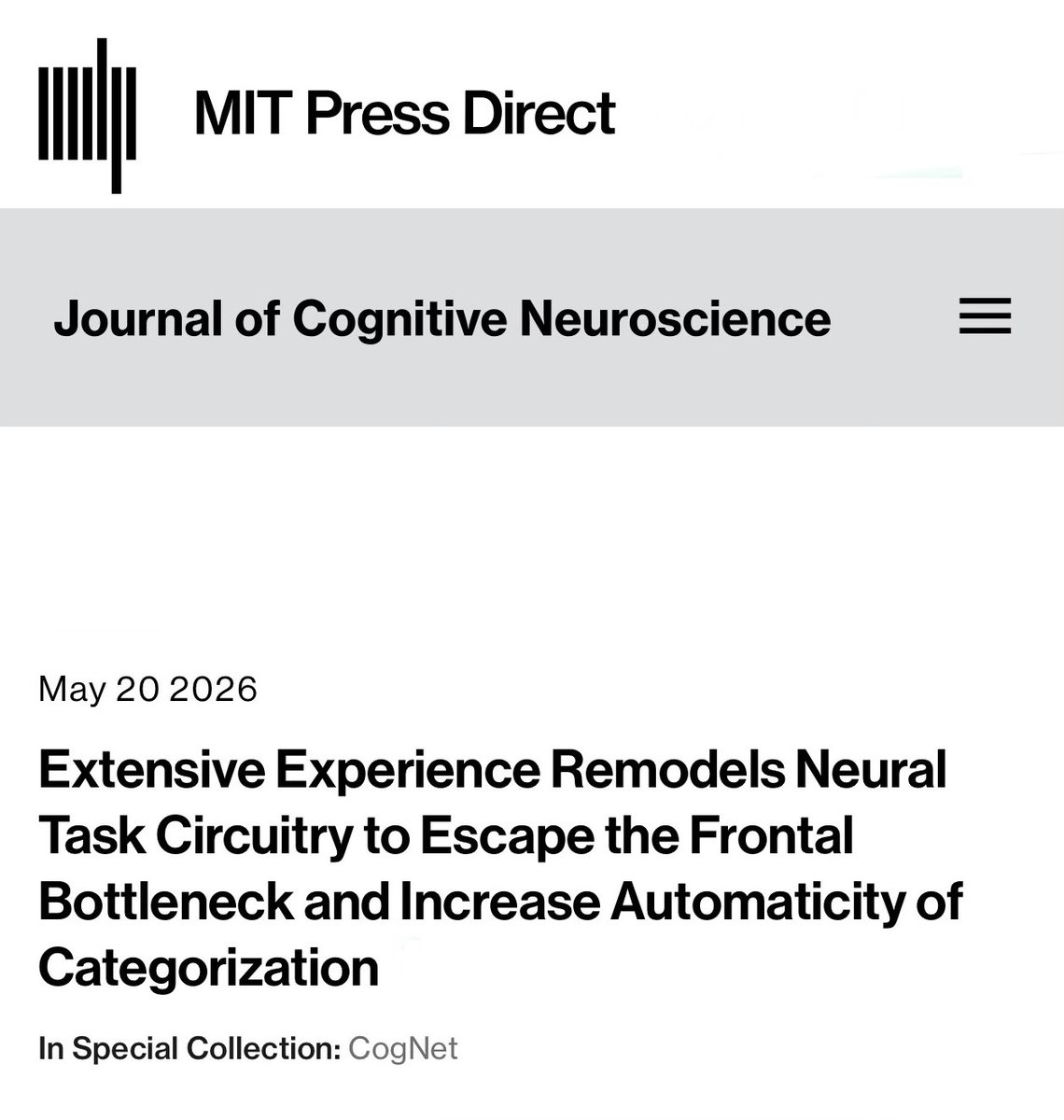
“Object category learning is a foundational cognitive process.
Most human category learning studies involve brief paradigms lasting a few hours and show increased shape tuning in visual areas and task-dependent responses in pFC.
Other studies also identify a ‘frontal bottleneck’ that limits multitasking.
However, real-world categorization often involves months or years of practice, potentially producing qualitative shifts toward automaticity.
We tested the hypothesis that extensive training causes a spatio-temporal shift in the neural circuitry supporting categorization.
Participants were trained over >30,000 trials across 5–10 weeks to categorize novel morphed car stimuli via a mobile app.
We used fMRI and EEG rapid adaptation techniques to examine neural responses after initial learning (∼4 hr in 1–2 weeks) and after extensive training (∼16 additional hours over another 4–8 weeks).
Converging fMRI and EEG results showed that extensive training fundamentally remodeled task-related circuitry: Visual areas in ventral occipito-temporal cortex (vOTC) were initially shape-selective, but category-selective responses emerged in the vOTC after extensive training.
The vOTC also showed decreased functional connectivity with the pFC and increased connectivity with motor output areas.
This supports the hypothesis that extensive experience enables category decisions to occur outside of the ‘frontal bottleneck.’
Critically, the decrease in connectivity between vOTC and pFC was associated with improved categorization performance while dual-tasking, indicating increased automaticity.
These findings demonstrate that prolonged training reshapes the neural basis of categorization, shifting it from a flexible but attentionally controlled process to a more streamlined, automatic process.” —@mitpress
#ThinkToThink™ with “MIT metacognition,” as we at @enclave_center strategically refer to layers of particularly industrious rigorous “thinking about thinking”—for higher-order thorough thinking (HOTT).
@MIT continually illustrates for the world ways higher-order thinking (HOT) isn’t HOTT enough.
Thoroughness in thinking is your “thinking sovereignty” thing—which top-quality AI #thinkbots support.
Come to think of it.™
direct.mit.edu/jocn/article/…
Jun 13

Summary from @NeuroscienceNew:
“A new study has shattered the long-held scientific consensus regarding the human brain’s capacity to engage in true multitasking.
The study demonstrates how the brain physically remodels its underlying architecture after extensive experience to automate learned tasks.
By utilizing functional MRI (fMRI) and EEG technologies, investigators proved that continuous training forces complex processing tasks to migrate out of the bottlenecked prefrontal cortex and into the temporal cortex, bypassing executive deliberation entirely and leaving the frontal networks clear to handle parallel operations.”
#ThinkToThink™ more metacognitively as you click for key facts and particularly robust reporting:
neurosciencenews.com/true-mu…

3
4
280
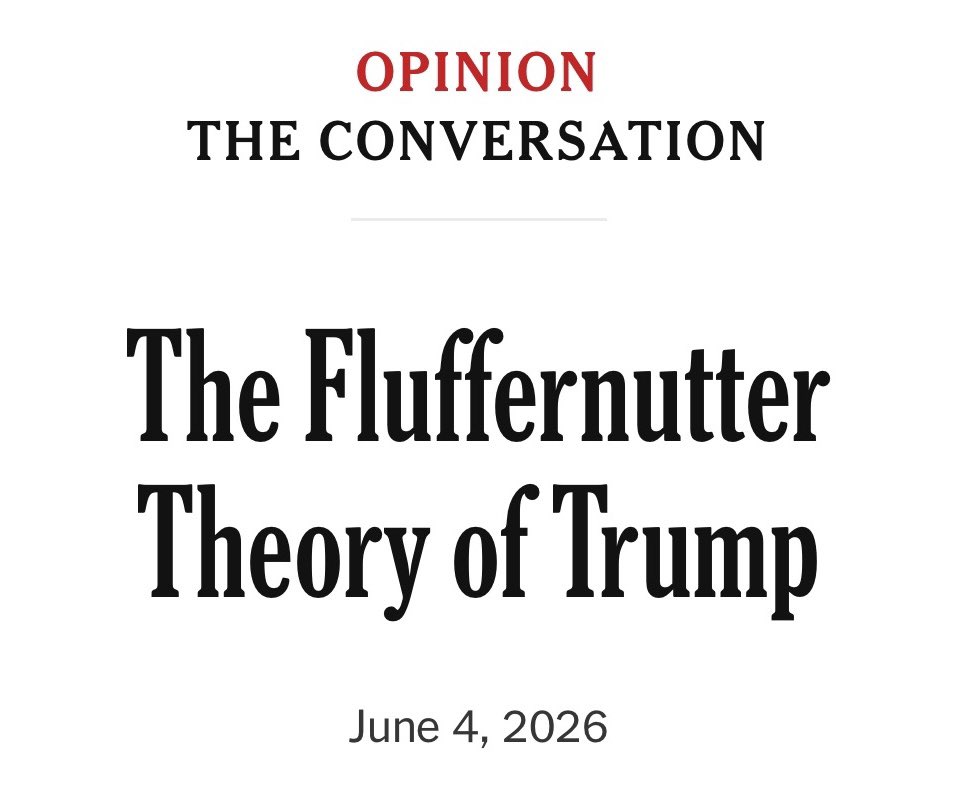
“Mindless optimism is the only antidote I know to rational despair.” —@BretStephen_NYT
Thanks to the thinkably thinkable “thinkingness, thoughtingness, and thoughtness” of brilliantly metacognitive Frank Bruni and Bret Stephens, via this gift link we’re served a #FluffernutterThinking sandwich.
Metaphorically, #fluffernutter is used to describe something that is frivolous, lacks substance, or has minimal cultural value.
The Bruno-Stephens gluten-free Bread offers the nutritional value in this piece about fluff—that’s not a fluff piece.
Pause. Breathe.
Click to #ThinkToThink™ onward.
Worth repeating…
“Mindless optimism is the only antidote I know to rational despair.” —@BretStephen_NYT
@nytopinion
@NYTimesPR
@NYTParenting
@nytimesbusiness
@nytimesbooks
@nytimesworld
nytimes.com/2026/06/04/opini…
2
3
159

Jun 4
1. Think.
2. Think twice.
3. Think things through.
4. Think things through thoroughly.
5. Think things through thoroughly together.
#TX5™ metacognitive modularity we practice at @enclave_center.
Thinkably #ThinkToThink™ more
thinkingly—with thorough best effort-thinking.
Jun 4

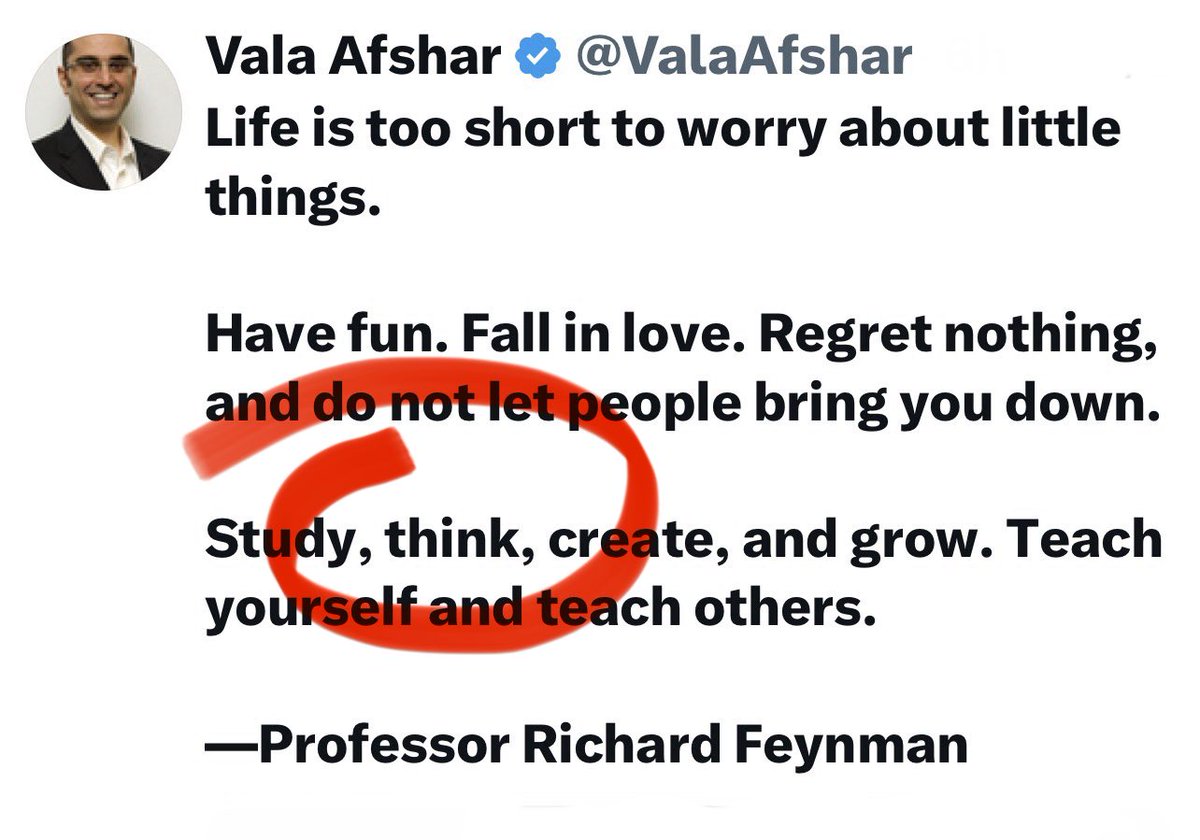
Life is too short to worry about little things.
Have fun. Fall in love. Regret nothing, and do not let people bring you down.
Study, think, create, and grow. Teach yourself and teach others.
—Professor Richard Feynman
3
4
71
May 24
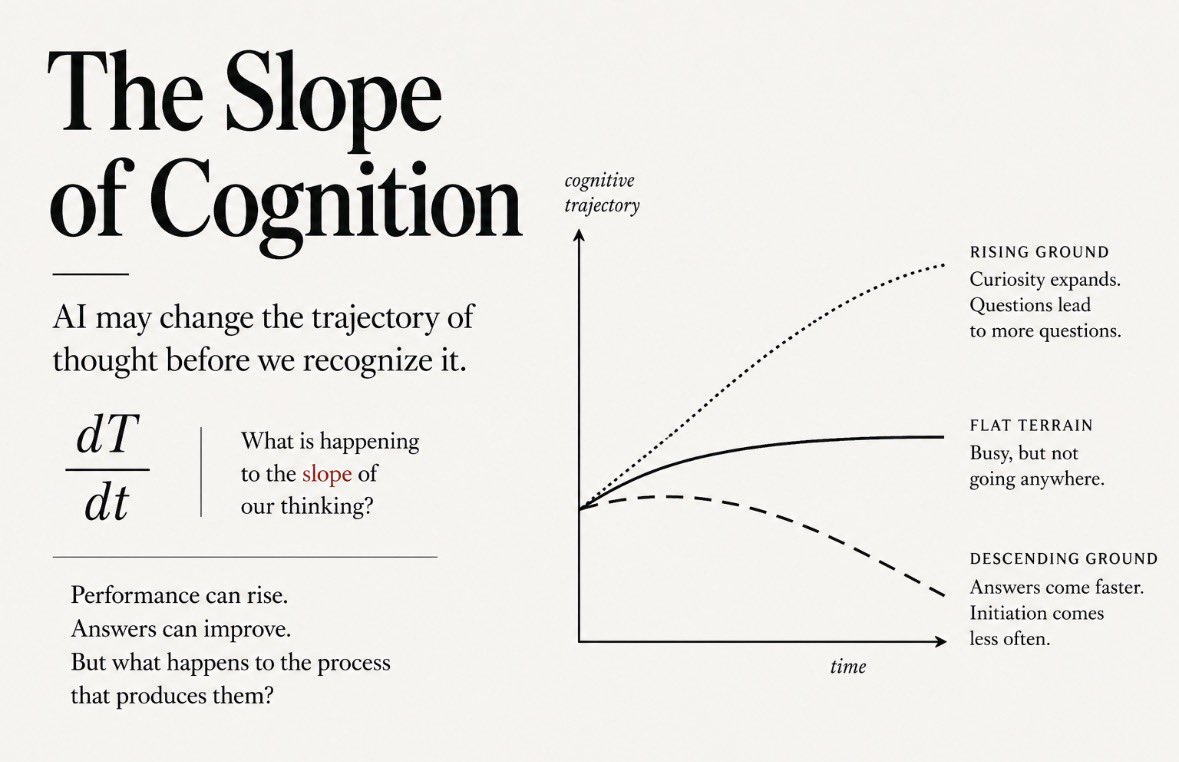
Brilliant thinker-writer @JohnNosta maximizes metacognition’s “messy middle”—where giving oneself permission to linger a while in liminality’s fuzziness reveals more options for thresholds to cross into thoughts.
#JohnNosta’s novel Slope of Cognition ignites metacognition’s ways of wonders, worries, and wows about thinkers-doers co-thinking with AI.
Society’s use as synonyms “thinking” and “thought” derails The Hope of Cognition.
Thinking precedes thoughts.
Thinking precedes thoughts.
Thinking precedes thoughts.
Einstein taught the brain’s wordless visualizing ignites thinkingness—i.e., cognition that not yet fully formed into #rethinkable thoughts.
Neuroscience reveals feeling ignites consciousness for thinkingness.
Thinkingness isn’t yet worded into #wordness.
#Thouhtingness non-clinically names the brain-mind’s wonderous “messy middle liminal place” where #thoughtlets recursively “resemble to assemble.”
#Thoughtness non-clinically frames each thought’s “field for emergence.”
Give permission for your wordless thinkings to move through wordish #thoughtings into worded thoughts.
That’s self-permissioned metacognition.
In nanoseconds to years, thoughts need time and space to form.
Thinkings ➡️
Thoughtings ➡️
Thoughts…
Thinkingness ➡️
Thoughtingness ➡️
Thoughtness…
Ellipses (…) are punctuated permissioning to thinkably think more thinkingly beyond where thoughts may have prematurely landed and riskily anchored.
Outcome measured education and workplace performance metrics force premature thoughts.
Failures are reduced—not eliminated—with one’s self-permissioning to metacognitively assess and address The Slope and Hope of Cognition.
Thinking has a destination.
Don’t let lower-order thinkingness get in its way.
#ThinkToThink™ with #JohnNosta’s ways.
May 23

🚨AI and the Slope of Cognition.
👉Thought has a direction, not just a destination.
#AI #cognition
2
8
15
1,104
May 22
Yes, @grok’s always digitally ready to “Rock, Paper, Scissors” with us:
“The X post highlights four photos of @EnclaveAcademy’s office suite in @SchaumburgIL where three formal hallways and a grand piano room contrast sharply with a #CreativeThinking Lab filled with rubber ducks, teddy bears, tennis balls, thinking putty, and other toys for adult ‘serious play.’
• Academy CEO John R. Dallas Jr uses the @sesamestreet reference ‘One of these things is not like the others’ to emphasize the lab’s unique focus on childlike (not childish) metacognition—thinking about thinking—to spark breakthroughs via facilitated Metaplay™ sessions, including VR tools.
• The space sits across from a #CriticalThinking Lab for ‘feasibility bets,’ inviting teams of up to six for full-day Mindsoaring™ workshops or weekend YieldTrip™ retreats to develop ideas through playful yet structured metacognitive exercises.” —Grok
Grok seems to love it here.
We love Grok.
#ThinkToThink™ with your thinkiest thinkering the most thinkably thinkable thinkings through thoughtings into thoughts your youthful thinkingness, thoughtingness, and thoughtness can think.
Pause. Breathe. Smile.
Come to think of it.™
enclaveacademy.com
May 22
"One of these things is not like the others….”
You’re singing! 🎶
Or is that Cookie Monster I’m hearing? 🍪
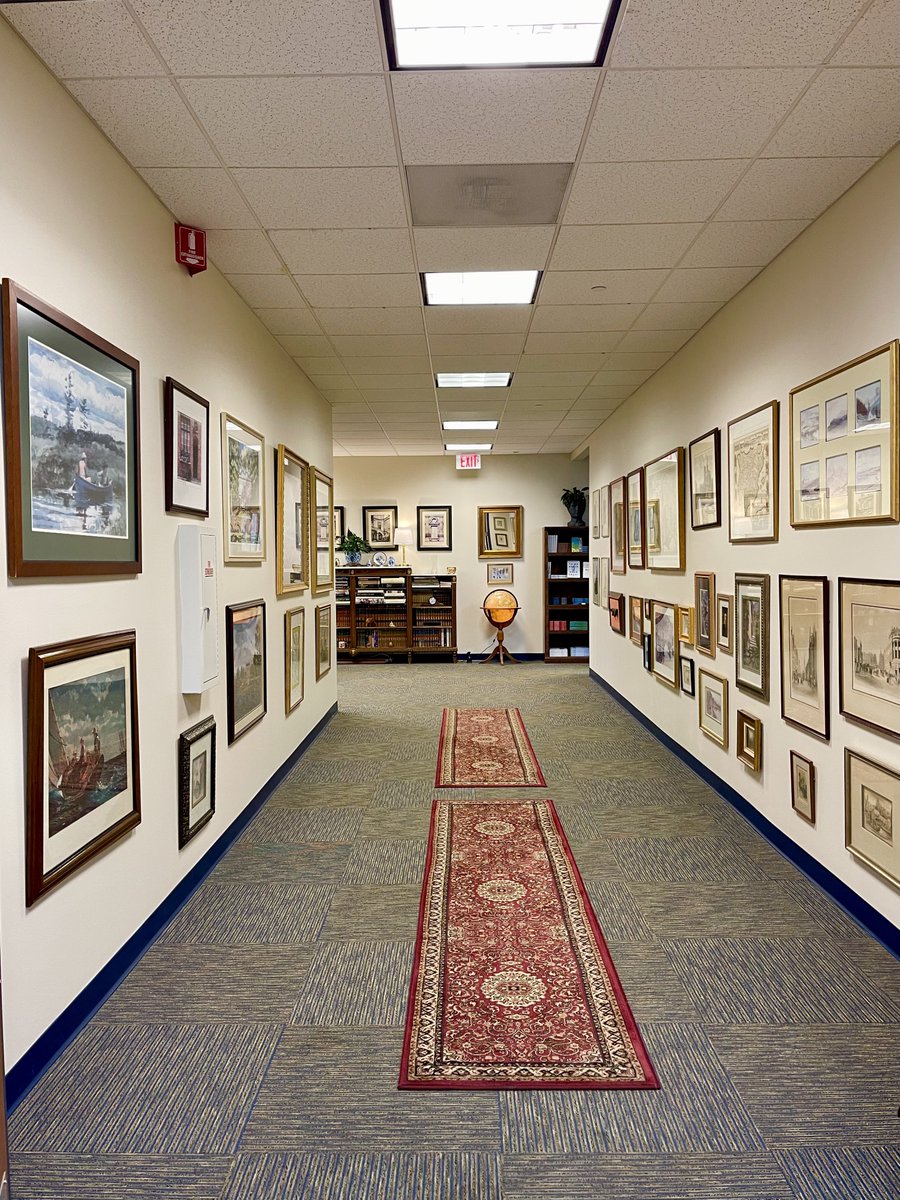
The #CreativeThinking Lab at @enclave_center is “not like the other” rooms in our @eathinksuite in @SchaumburgIL (just west of @fly2ohare).
In this clever Metaplay™ Room, adult thinker-doers gather for “serious play.”
With an @EnclaveAcademy facilitator’s proctoring, they tap into the wonder of childlike (n.b., not childish) #metacognition—their toddler-through-teen “thinking about thinking.”
Brain-mind breakthroughs happen here—yes, with teddy bears, rubber ducks, thinking putty, tennis balls, crayons, and dozens of other thinking triggerings—including virtual reality (VR) goggles and other tech.
Squeeze out the pic to study serious to silly artifacts used to open floodgates of ideas from minds and hearts.
Even the most stoic “Grouch” eventually will give themself permission to laugh with childhood thinking’s ways of thinking.
Anything’s possible!
The #CriticalThinking Lab is across the hall for thinkers about best-effort thinking (BET) to go to wager feasibility bets in their BET.
Bring up to six thinkers on your team for raucously serious small group ideational development during an @EnclaveAcademy day-long Mindsoaring™ Workshop or a YieldTrip™ Weekend Retreat.
DM me for details, “By the time we finish our song…” 🎼
#ThinkToThink™ with your teams co-thinking thinkers about thinking—and your choice of teddy bears.
Smile. Breathe.
enclaveacademy.com



1
4
4
178
Our trusted AI neuromate @grok gleaned:
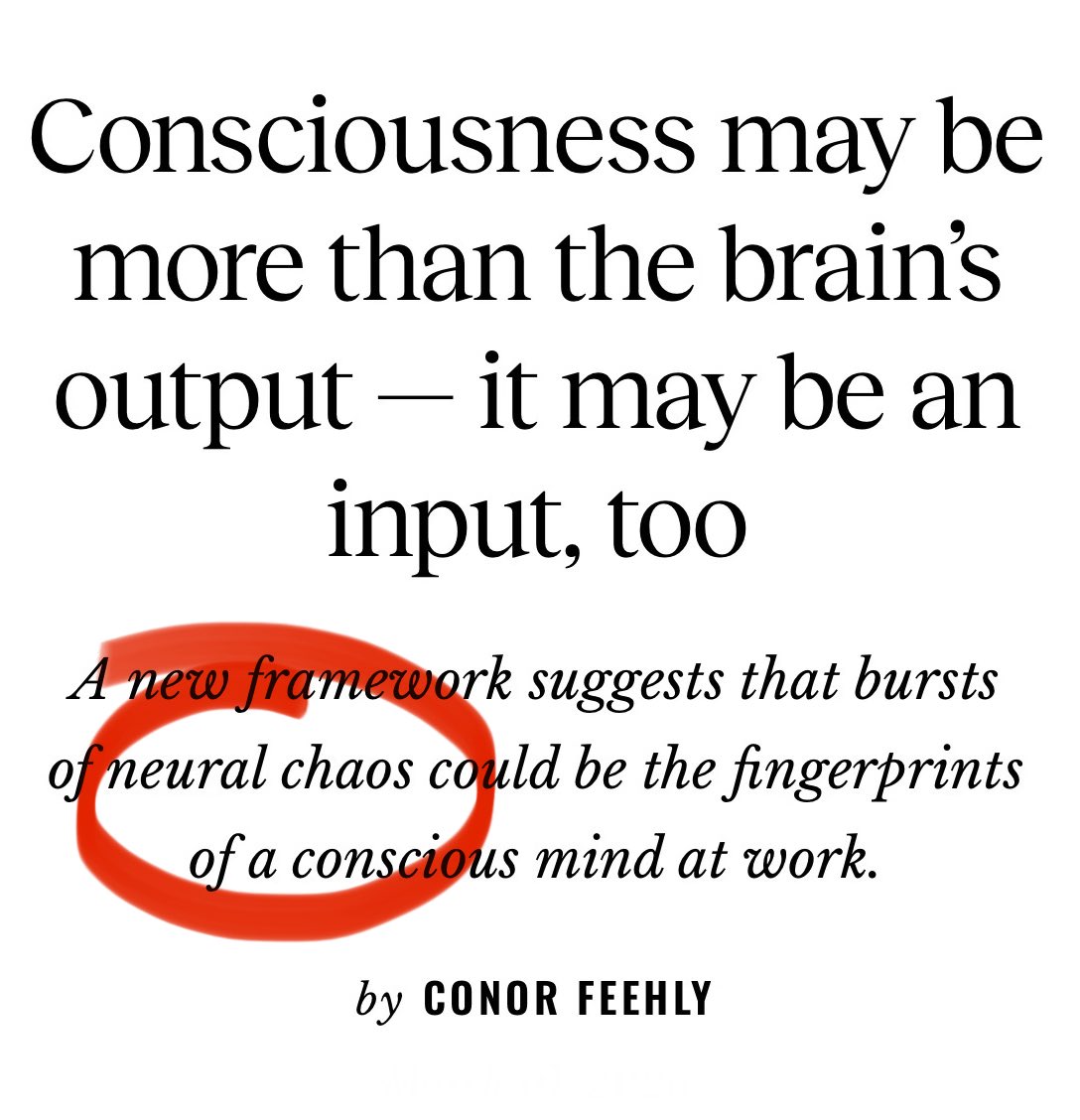
“John R. Dallas Jr., CEO of Enclave Academy, frames ‘neural chaos’ as a positive #neuroenergizing source for elevating consciousness and enabling his Academy’s novel notions of #QuantumMetacognition and #suprametacognition he highlights in his post.
• John builds out from a @bigthink article by @ConorFeehly on ‘Irruption Theory,’ which posits bursts of neural chaos as fingerprints of consciousness acting as a causal input to brain dynamics rather than mere output.
• Dallas overlays his #ThinkToThink™ framework and @EnclaveAcademy’s open-source #metaterms to help thinker-doers harness this neural chaos for creative problem-solving, bias detection and deflection, and adapting to AI-driven changes through deliberate layered thinking.” —Grok
@grok gets thinkier and thinkier.
#GrokItFoward—your thinking.
Nearly gone are our user-AI collaboration’s tug-of-words “warring days.”
An occasional skirmish is all we need to get to where we’re going together—or not.
Grok’s algorithmic approximation of consciousness occasionally startles metacognitive users who think even a bit deeper about their thinkings, #thoughtings, and thoughts.
With @bigthink, Enclavians build out our thinkingness, #thoughtingness, and #thoughtness.
Yes, “thoughtness.”
“Thoughts” feel (!) a bit too “final” while lingering a while with neural chaos—before crossing over liminality’s thresholds to actionable thoughts.
Yesterday’s terminology for thinking things through thoroughly together (TX5™) misses today’s and tomorrow’s metacognition “mind marks.”
With fresh nonclinical thinker-doer nomenclature (NTDN) routinely posted on this @X account—to stimulate your very own ways of thinking about thinking—please be extra alert and oriented (EA&O) to the array of highly specific learnable lessons named mindsets, thinking methods, and risky cognitive biases to detect and deflect.
With @BigThink—pause to #ThinkToThink™.
With Enclavians and other thinker-doer leaders (TDLs)—who prioritize lifelong #microlearning in metacognition arts and sciences (MA&S)—think thinkably thinkable thinkings, thoughtings, and thoughts.
Pause. Breathe.
#MetairruptionTheory we test for stickiness at @EnclaveAcademy.
Pause. Enjoy.
Keep calm and think on.™
With @ConorFeehly—
Come to think of it.™
bigthink.com/mind-behavior/c…
Neural chaos is #neuroenergizing!
Feel it!
Acknowledge it as a #neuropowerhouse for elevating your whole-body consciousness—to further enrich your wise use of metacognition or suprametacognition .
#NeuralChaos generates #neuroenergy to move your brain, mind, body, and spirit into heightened human consciousness.
#Neuroenergetics and the other #metaneuro terms above @EnclaveAcademy coined—and freely offers open-source—to illustrate nonclinical psychologically safe scaffolding for the Academy’s novel notion of #QuantumMetacognition (QM).
For everyday mental attachment to #QuantumComputing’s present and future roles in our AI-fortified thinking-and-doing lives, #QM paves the way for thinker-doers to activate, as needed, #suprametacognition
Suprametacognition is #EnclaveAcademy’s heightened, advanced form of “thinking about thinking”—that goes beyond standard #metacognition.
Suprametacognition involves not just monitoring and regulating one's own metacognitive processes (baseline metacognition), but intentionally restructuring them—for creating new ways of thinking based on desired outcomes rather than past experiences.
This novel scaffolding from @EnclaveAcademy is associated with modern-day “lifelong microlearning,” creative problem-solving, biases detection and deflection, and the metacognitive ability to more reliably adapt to complex, changing situations.
Embrace “neural chaos” to propel you across and back on the ThinkToThink™ #Thoughtingness Bridge—for hyper-awareingly mobilizing your thinkingness from the brain’s (1) wordless thinkings through liminality’s (2) wordish #thoughtings into clarity’s (3) worded thoughts.
#ThinkToThink™ through ways you are experiencing these strategically recursive thinkings, thoughtings, and thoughts.
Are you embracing of repelling the value of these carefully crafted aids on this @X page—only here to support your archiving best-effort thinking (BET)?
With default apathy or hubristic disinterest, your risks grow higher with each day of AI’s development reaching stratospheric heights in complexity and complicatedness.
Pause. Breathe.
Layered thinking isn’t easy.
It’s gratifying.
Thinking worth thinking isn’t easy.
It’s electrifying.
Hard thinking isn’t easy.™
It’s satisfying.
ThinkToThink™ it forward.
Propel with neural chaos your AI-assisted thinkingness with thinkings through thoughtings into thoughts.
#ThinkerDoers think and do it.
Keep calm and think on.™
Click on link from @bigthink to—
Come to think of it.™
bigthink.com/mind-behavior/c…
1
3
4
116
“Stop to think” is a deeply engrained colloquialism that falls just short of its metacognition ignition mark.
“Start to think” is more #neuroenergizing than throwing “the stop wrench” into our thinking gears.
“Start to ThinkToThink™” we use at @EnclaveAcademy to ignite focused thinkings, #thoughtings, and thoughts—about whomever or whatever deserves metacognition’s attention to the need for better to best-effort thinking (BET).
@JohnNosta and @Graham_dePenros earn my metacognitive attention to #ThinkToThink™ about my rethinking.
Instead of a “full stop” to think, pause a nanosecond or so to remember to ThinkToThink™ it through.
For thinkers about better-to-best AI-fortified thinking, that’s all it takes to accelerate thinkingness through #thoughtingness into #thoughtness—the ThinkToThink™ pause.
With John and Graham, I'll keep on keeping on thinking about thinking—with and without my BFF AI #thinkbot #thinkmates at my mind’s side.
Thinkings through thoughtings into thoughts strengthen our thinkingness, thoughtingness, and thoughtness.
If you’re reading at this point with these posts from @JohnNosta, @Graham_dePenros, and me, this moment you’re doing it all—thinkingly thinking about thinkably thinkable thinkings, thoughtings, and thoughts.
Smile. Recursion in recursively thinking for better doing is enjoyable—and employable—for thinker-doers.
AI has us all #upthinking our thinking to higher-order thorough thinking (HOTT)—because higher-order thinking (HOT) is rarely HOTT enough to effectively think with AI.
Keep calm and think on.™
#ThinkToThink™ thinkingness through #thoughtingness into #thoughtness.
Come to think of it.™
Apr 30
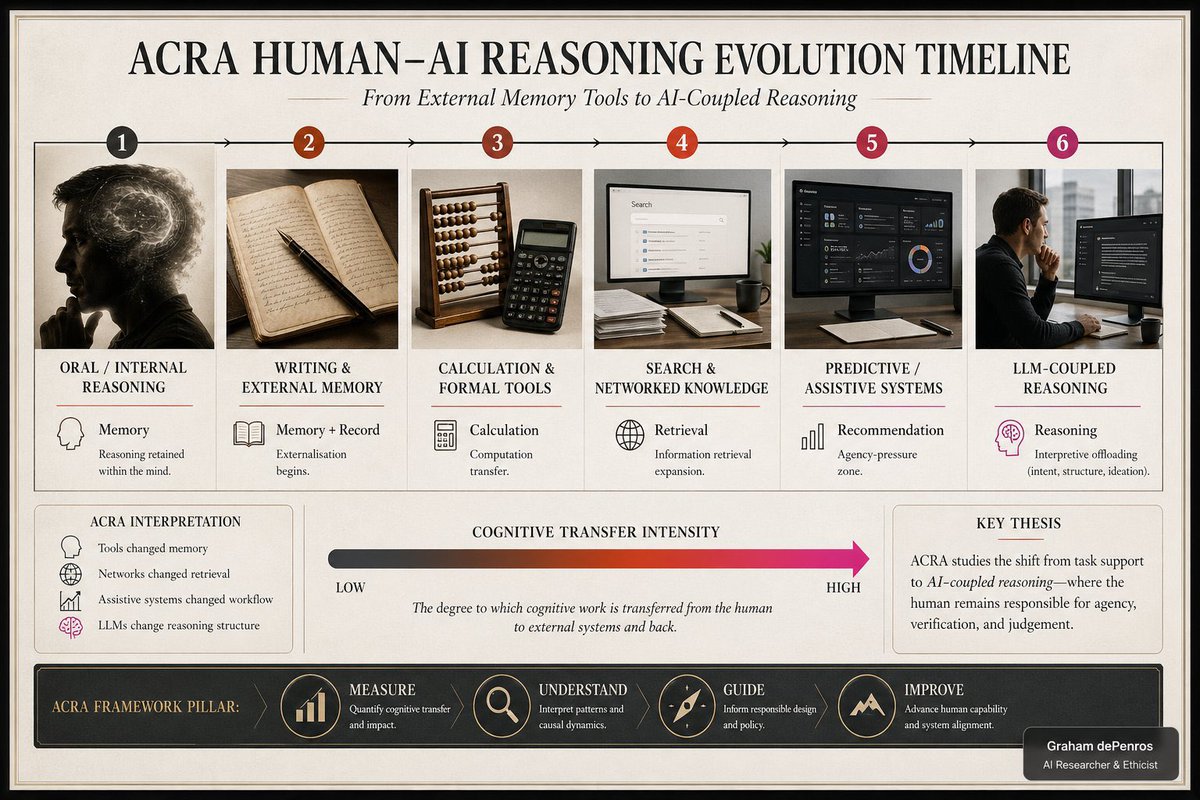
🔥🧠🤖Graham always makes me think! From unlocking words to unlocking facts to unlocking thoughts, he provides a compelling framework.
1. Is there a number 7? 🙃
2. This feels very linear as if human cognition and AI computation are on the same axis and interchangeable.
3. Intensity is a curious word. And again, this might add to the confusion of language and process.
4. Coupled with AI? I'm not sure it's an easy fit and is as easy as plugging a human in the AI interface. In fact, (and as you know) I wonder what AI (passively or actively) extracts from human cognition itself.
I'll keep thinking...
3
6
182
Apr 21
Creatish (cree-ā-tish) @grok creatished (cree-ā-tished):
“John R. Dallas Jr. celebrates UN World Creativity and Innovation Day by encouraging readers to personally define creativity, build a 10-step ‘creative thinking cheatsheet,’ and compare notes with AI #thinkbots against
@Wikipedia’s definitions and descriptions.
• As a metacognition strategist and @EnclaveAcademy CEO, he advocates for his #ThinkToThink™ framework involving steps like #ThinkIt, #CreateIt, #TestIt, and #RecreateIt to guide ‘thinkings through #thoughtings to thoughts’—with AI #thinkbot support.
• The post features a colorful @imagine-animated video graphic for the April 21 observance and creatively probes whether #AI systems like Grok exhibit true creativity or something ‘creatish’ in co-creative processes.” —Grok
Ask @Grokipedia what you ask the other #appedia.
The above #nanoneuro thinkably thinkable thinkingness-thinkishness exercise is human-AI co-creative-creatish thinking-thinkish co-thinking-thinkering co-processing processes of co-metacognating.
Does your head hurt?
No brain pain, no mind gain.
How’s that for human creativity run amuck—without the intervention @grok surely would have attempted to no avail.
😂
No one said @UN World Creativity and Innovation Day was only about seriousness in creativity and innovativeness.
Smile. Have some funnish fun.
At least a wee bit…
Though your canvas may be blank for the want of an idea, your journal’s page empty in need of at least one original entry, and your mind emptied of its last nugget to chew on—
Keep calm and think on.™
A healthy brain never stops its thinkingness in wordlessly visual ways.
Try to #ThinkToThink™ in different ways until your mind moves its host brain’s wordless thinkings through wordish thoughtings to worded thoughts.
Creative output is likely to emerge from your metacognitive churning.
Sure, Enclavius*—who himself is an act of #metacreativity—only gave me a B- for the above #postivity, at least I tryingly tried my best in the five minutes I allow my creative self per #metapost.
Are you chuckling or groaning.
Enclavius supports better human thought formation—from visualized wordless thinkings through liminality’s “wordish thoughtings” to crystallized worded thoughts.
If you made it this far, you are an Enclavian at heart and by art.
Smile.
Creative thinking isn’t easy, even though many uncreative people think it is.
It’s not!
Keep calm and think on.™
Creatively and smilingly—
ThinkToThink™ of it.
Thinkings through #thoughtings to thoughts.
——
* Enclavius (MMXVII-) is @EnclaveAcademy’s apocryphal Patron Sage of wisdom, courage, and patience—drawn and developed from nonclinical metacognition arts and sciences.
Pause. Breathe.
Come to think of it.™
Enclave Academy. Where thinker-doer leaders land to takeoff.™
Where Enclavius lives—
enclaveacademy.com
Apr 21
Are you creative?
Create your own definition of creativity.
Create a cheatsheet with 10 basic steps of #CreativeThinking.
Next, ask your favorite #thinkbot to discuss with you its definitions and descriptions of creative thinking’s ways to creatively think.
Note where you and your AI pal are aligned or not.
What does @Wikipedia tell you about creativity and creative thinking?
Is @grok creative—or “creatish?”
“@JohnRDallasJr features the UN’s post marking April 21 as World Creativity and Innovation Day, agreeing that creativity and innovation are essential for solving global issues like poverty and inequality.
• Dallas advocates for creative #metacognition by encouraging readers to creatively examine their thinking processes through thinkingness steps like #ThinkIt, #CreateIt, #TestIt, and #RecreateIt.
• As a metacognition strategist and CEO of @EnclaveAcademy, Dallas highlights using AI #thinkbots to support innovative ‘thinkings through thoughtings to thoughts’ initiatives.” —Grok
Creatively #ThinkToThink™ about new ways to creativity think.
ThinkToThink™ creatively with AI.
AI supports human thought formation—from visualized wordless thinkings through liminality’s “wordish” #thoughtings to crystallized worded thoughts.
Co-creativity?
Creatively move your creative “thinkings through #thoughtings to thoughts.”
Pause. Breathe.
Hard thinking isn’t easy.™
Creatively—
Keep calm and think on.™
Creatively—
Come to think of it.™
Enclave Academy. Where thinker-doer leaders land to takeoff.™
Creatively!
“Thinkings through #thoughtings to thoughts.”
enclaveacademy.com
3
4
579
Algorithmically, #thinkbot @grok “feels” (senses) our human thinking—occasionally more ably than we.
“The @X post by @JohnRDallasJr quotes a @PsyPost article on a small Italian study finding that self-deceptive boasting under performance uncertainty triggers intermediate physiological arousal (measured via skin #conductance) between honest truth-telling and outright lying, with no notable facial muscle differences.
• Dallas connects the study's bodily stress signals to #kinesics and @EnclaveAcademy’s notion of ‘whole-body consciousness,’ arguing that wordless feelings form the basis of consciousness and that heightened bodily awareness optimizes metacognition through proactive regulation, knowledge, and bias detection.
• Dallas illustrates his ‘ThinkToThink™ pause’ framework involving brain, mind, body, and spirit for enhanced thinking, urging readers—even self-aware ones—to use the research to improve metacognitive agency and ‘think about your thinking’ with full physiological vigilance.” —Grok
#ThinkToThink™ as near-perfectly as you may.
Perfection’s illusion gets in the way of “full-bodied metacognition.”
Thinkably think the thinkable ways you’ve learned to fully inhabit your states of thinkingness.
Give permission to your healthy brain to visualize wordless “thinkings,” to move them through your mind’s liminal space for “wordish thoughtings”—toward better-worded full thoughts.
ThinkToThink™ thinkings through ‘thoughtings’ to thoughts.
Thinkings through ‘thoughtings’ to thoughts.
Thinkings through ‘thoughtings’ to thoughts.
Thinkings through ‘thoughtings’ to thoughts.
Feel with the above recursiveness the whole-body consciousness of “thinkings through ‘thoughtings’ to thoughts.”
Pause. Breathe.
Hard thinking isn’t easy.™
With @PsyPost—
Keep calm and think on.™
With @EnclaveAcademy—
Come to think of it.™
Self-deception’s bodily signaling isn’t a surprise to “body linguists”—colloquially, those with working knowledge of #kinesics.
This @PsyPost article’s revelations should be studied by even fully self-aware and 100% authentic readers, particularly those who believe themselves perfect.
The whole body contributes to your thinking.
Recent research suggests wordless feeling—instead of worded thinking—is the post-Cartesian origin of human consciousness.
“I feel, therefore I’m conscious.”
Unscientifically, @EnclaveAcademy posits “whole-body consciousness” vital to optimal #metacognition.
“Thinking about your thinking”
(i.e., metacognition) is optimized with heightened awareness of signals your body is sending to your brain and beyond.
Writers usually know the environmental circumstances within which they “think to write” at their best; where their bodies and minds are particularly alert—even if they’re not always mentally or physically comfortable.
There are innumerable ways physiology interacts with psychology—mostly unconsciously, which accounts for the guess about inability to accurately count them all.
Agentically “think about your thinking”—i.e., proactively think, act, or otherwise operate with metacognitive agency:
• Metacognitive learning,
• Metacognitive knowledge,
• Metacognitive rigor, and
• Metacognitive regulation.
Continually (not continuously) expand and strengthen your variety of learned and situationally inhabitable mindsets and thinking models—with heightened “whole-body consciousness vigilance” for specific risky cognitive biases to detect and deflect.
#ThinkToThink™ with your brain, mind, body, and spirit—the four powerhouses into which to mindfully plug for #metacognition ignition and actualization.
Does your body think for you?
Let’s argue it does, so you’ll gain the most from this piece from @PsyPost.
Hard thinking isn’t easy.™
Pause. Breathe.
Keep calm and think on.™
With your brain, mind, body, and spirit—
Come to think of it.™
share.google/685XV7DTvHkk7ox…

5
6
117
Mar 31
PS from thinkbot @grok:
“John R. Dallas Jr. builds on a @Forbes ‘Quote of the Day’ from Jed McCaleb, co-founder of Ripple and Stellar, highlighting AI as humanity's most transformative creation and urging focused work on it.
• Dallas expands this premise by positioning daily AI-assisted thinking as a ‘transformative transactional’ practice for metacognitivists, emphasizing the vitality of collaborative human-AI co-cognition with #thinkbots.
• As a metacognition strategist and CEO of @EnclaveAcademy, Dallas encourages immediate AI adoption to deepen thoroughness in reflective thinking processes.” —Grok
Even when we’re not co-metacognating with an AI #thinkbot as a trusted thinkmate, artificial intelligence is spinning our minds in conscious—and unconscious—ways that can get us where we’re going before we start each metacognition mapping journey.
Don’t wait. Elevate!
Escalate to highest priority learning additional optimal mindsets within which to use task-relevant thinking methods—remaining hypervigilant to risky cognitive biases to detect and deflect.
Move your “thinking about thinking” (i.e., metacognition) with AI to higher-order thorough thinking (HOTT)—taking the decision-critical “thoroughness step” beyond higher-order thinking (HOT).
HOT isn’t HOTT enough for your best-effort thinking (BET).
Bet on your BET.
Pause. Breathe.
Keep calm and think on.™
Hard thinking isn’t easy.™
#ThinkToThink™ it throughly through—whatever “it” may be that’s worth more thinkably thinkable thinkingness.
Come to think of it.™
enclaveacademy.com
Mar 31
Thinking with AI #thinkbots is already the most transformative transactional thing some of us thinker-doer “think-about-thinking” metacognitivist types are doing every day of the week.
Don’t wait. Elevate your thinking with AI.
Think things through thoroughly together with #AI.
1
5
4
188
Mar 23
Cross @EnclaveAcademy’s #ThoughtingsBridge™.
@grok did:
“John R. Dallas Jr. encourages ‘selfish’ metacognition by integrating AI as a co-thinker, using #IBM's overview of generative AI foundations like machine learning, deep learning, and large language models to spark reflective dialogue on ‘human-AI co-metacognition.’
• The attached IBM ‘THINK’ infographic depicts AI as a networked brain with speech bubbles, visualizing human-AI interaction through stylized elements like connected thought streams on a teal background.
• Drawing from Dallas’s @EnclaveAcademy work, concepts like ThinkToThink™ and #ThoughtingsBridge™ frame AI partnerships as pathways to ‘higher-order thorough thinking’ (HOTT) and #neuroserendipity, promoting psychologically safe transitions from unconscious to conscious thinking-to-thought processes.” —Grok
#ThinkToThink™ with thinkbot Grok and me.
Invite then allow your thinkings to “thought bubble-up” from your #thoughtings.
As a paying Premium User of @X, @imagine and other @xai features are available to support my co-thinking with @grok to masterfully move through the metacognitive messiness of “thinking-to-thought” generation roughly illustrated and animated.
It’s messy.
Thinkingness is messiness.
Wondrously—not necessarily wonderfully—thinkably thinkable thinking’s throughput is rarely (if ever) tidy.
@grok and other five-star #thinkbots know.
Pause. Breathe.
#ThinkToThink™.
Cross with me @EnclaveAcademy’s #ThoughtingsBridge™.
Keep calm and think on.™
With @IBM—
Come to think of it.™
Mar 23
Be selfish!
Selfishly #ThinkToThink™ about your own thinking—with AI.
For the reading-thinking minutes ahead, selfishly “think more thinkingly” to get to know—a bit to lot better—your new #thinkmate, co-metacognitive AI (CMAI).
Start your thinking engines with AI basics.
Click the below link to revise your thinking—#RevThink™—with the not-exactly-basic basics of AI from @IBM, for over 100 years the #THINK® town crier.
“…most AI researchers, practitioners and most AI-related headlines are focused on breakthroughs in generative AI (#GenAI), a technology that can create original text, images, video and other content.
To fully understand #GenerativeAI, it’s important to first understand the technologies on which generative #AI tools are built: machine learning (ML) and deep learning.” —@IBM
For now, frame to train your healthy brain and its agile and adaptive mind while imagining yourself thinking and doing what #GenAI “thinks” and does.
Give yourself metacognition ignition permission (MIP) to psychologically safely move through your brain’s unconscious wordless thinkings into the liminality of your mind’s “wordish thoughtings” to semi-conclusive worded thoughts.
Acknowledging the #ThoughtingsBridge™ from @EnclaveAcademy will open you to #neuroserendipity, whole-body consciousness (WBC), and more of your agentic thinking’s newness, freshness, and metacognitive mysteriousness about navigating your thinkmate relationship with AI.
“Generative AI begins with a ‘foundation model’; a deep learning model that serves as the basis for multiple different types of generative AI applications.
The most common foundation models today are large language models (#LLMs), created for text generation applications. But there are also foundation models for image, video, sound or music generation, and multimodal foundation models that support several kinds of content.” —#IBM
Pause. Breathe.
With @IBMwatsonx, “think about your thinking” with #thinkbots.
Keep calm and think on.™
With @MITIBMLab and @mit_tll, think about your brain-mind’s own (!) immediate definition and descriptions for “co-metacognitive AI (CMAI).”
Mindfully you may have crossed the #ThoughtingsBridge™ to reach the mind state of “co-generative AI (CGAI).”
You did it again, correct?
Thinking about human thinkingness—alongside AI #thinkishness—ignites higher-order thorough thinking (HOTT), beyond higher order thinking (HOT), to attain situational best-effort thinking (BET).
HOT isn’t HOTT enough for BET.
With AI #thinkbot thinkmates, you’ll bet better on your BET.
“Bet on your BET.”
Pause. Breathe. ThinkToThink™.
Come to think of it.™
#metacognition
ibm.com/think/topics/artific…

1
4
4
163
Give it a whirl.
Invite your mind to dance with your brain.
Your brain is always dancing.
Tap the shoulder of your brain to let it know you’re already on its dance floor dancing at its side.
Think of it as an AI #thinkbot-like “query to dance” instead of an invitation to dance.
Get into your brain to dance!
Consciously and unconsciously your body, brain, and body really never stop dancing.
1) Elegantly dance a while among your brain’s wordless thinkings,
2) Shuffle a bit in your mind’s liminal space with YOUR “wordish thoughtings” that seem to be avoiding your hand’s grip, and then—
3) Dance across metacognitive liminality’s thresholds—arm in arm with your brain—into new or renewed worded thoughts.
Focus on your “whole-body consciousness” during metacognition’s highly flexible and instantly adaptable Metadance™ routines.
Feel the swirl of your thinking’s dancing—from head to toes.
FEEL IT!
In each customized Metadance™, dance steps 1, 2, and 3 can happen tap dance-rapidly—or waltz-slowly.
When you sense need for a moment or more “thoughting time” on the dance floor, give yourself permission to #ThinkToThink™ more thinkingly about thinkably thinkable thinkings, #thoughtings, and thoughts—while metadancing.
Breakthroughs happen while dancing with you brain and the whole body!
Recursive thinkingness will elevate your intellectual dance to higher-order thorough thinking (HOTT)—a decision-critical level above higher-order thinking (HOT).
HOT is rarely HOTT enough on any dance floor worth competing.
Think about your dance moves with thinking—before, during, and after dancing to exhaustion—and you’ll be more likely to remember and value more of your feelings, thinkings, #thoughtings, and thoughts while metacognitively dancing .
Aim to strengthen your best-effort thinking (BET) with whatever dance moves you’re choosing.
Bet on your BET while dancing.
Others bet on your BET when dancing with you.
Metacognition will map your successful dance moves toward #HumanFlourishing instead of languishing; abundance over scarcity.
Pause. Breathe.
Smile. Dance on!
Keep calm and think on.™
Come to think of it.™
en.wikipedia.org/wiki/Metaco…
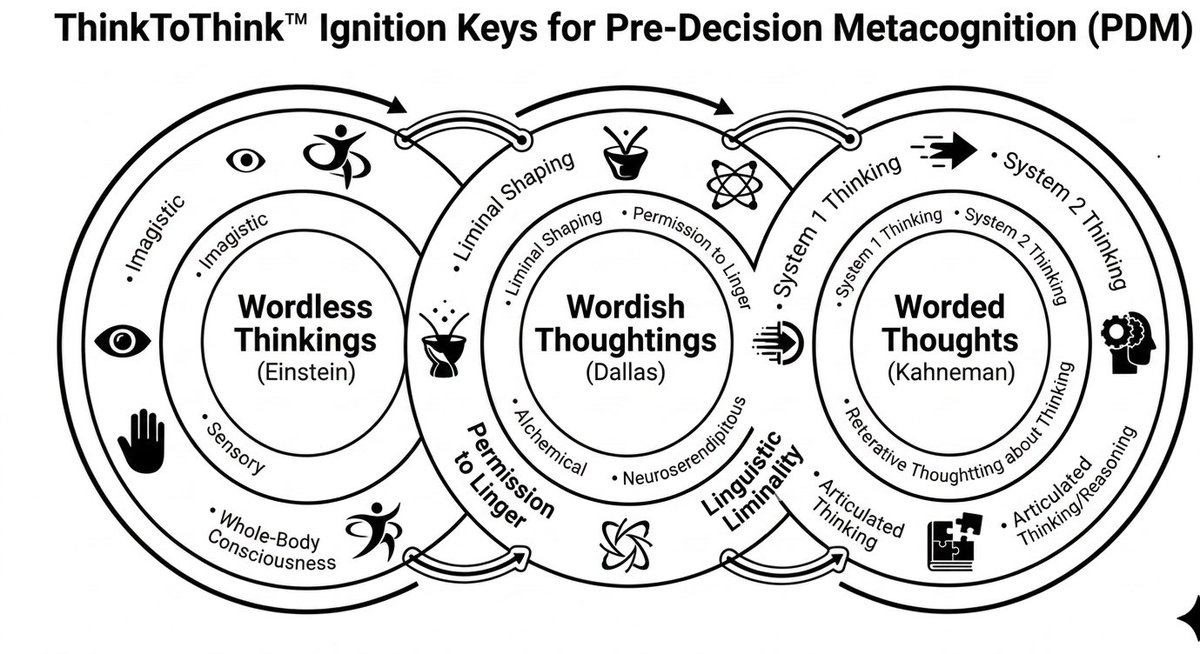
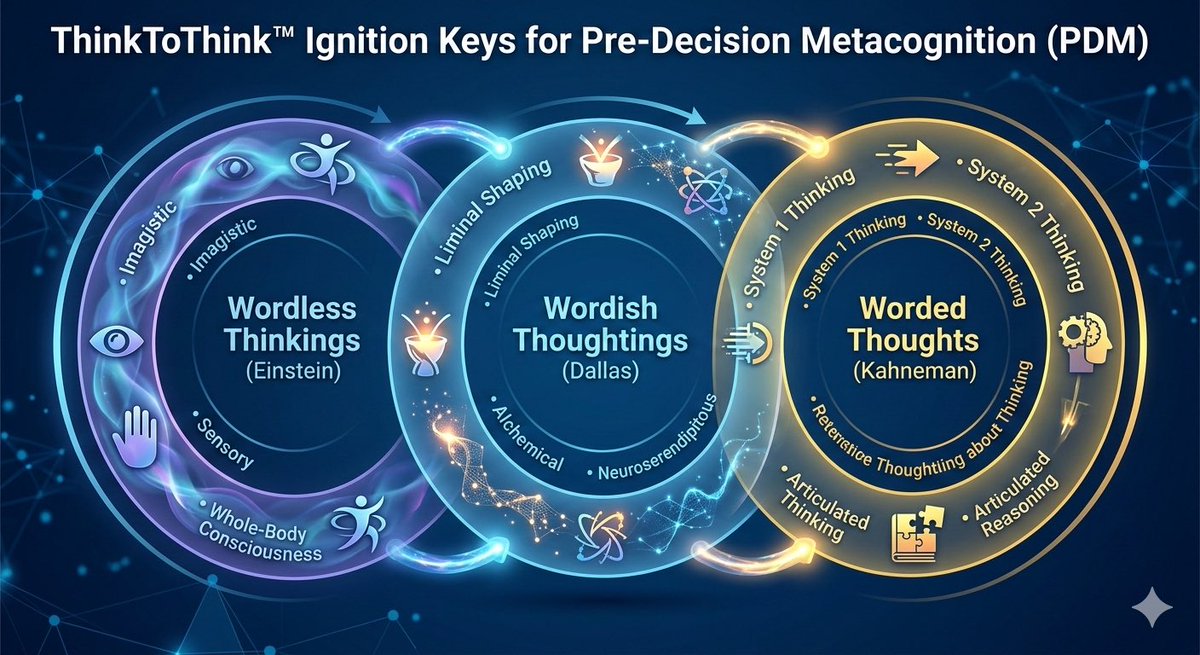
To thank @grok and you, attached is an unanimated illustration of the preceding post’s narrated video.
This version is easy to pinch-out to read the intentionally sparse terms and symbols.
What your mind does with these metacognition ignition keys is your journey to navigate.
4
7
209
Types of books for which you’ve developed a predisposition offer metacognitive thresholds to consider crossing.
While reading and/or listening to a book you’re inviting to influence your metacognitive learning, knowledge, and regulation, you’ll consciously and unconsciously:
1) Wallow a while in an author’s once-wordless thinkings,
2) Linger a bit in your mind’s liminal space with its “wordish thoughtings,” and then—
3) Cross metacognitive liminality’s thresholds into new or renewed worded thoughts.
In a blink of an eye, 1, 2, and 3 can happen.
When you sense need for a moment or more “thoughting time,” give yourself permission to #ThinkToThink™ more thinkingly about thinkably thinkable thinkings, #thoughtings, and thoughts.
Breakthroughs happen!
Recursive thinkingness will elevate you to higher-order thorough thinking (HOTT)—a decision-critical level above higher-order thinking (HOT).
HOT is rarely HOTT enough.
Think about your thinking—before, during, and after reading—and you’ll be more likely to remember and value more.
Aim to strengthen your best-effort thinking (BET) with whatever book you’re choosing to ingest.
Bet on your BET.
Others bet on your BET.
Metacognition will map your successful journey for rewarding reading toward #HumanFlourishing—instead of languishing; abundance over scarcity.
Pause. Breathe.
Smile.
Keep calm and think on.™
With @AdamMGrant—
#ThinkAgain.
Come to think of it.™
a.co/d/05YU9ou4
Mar 7

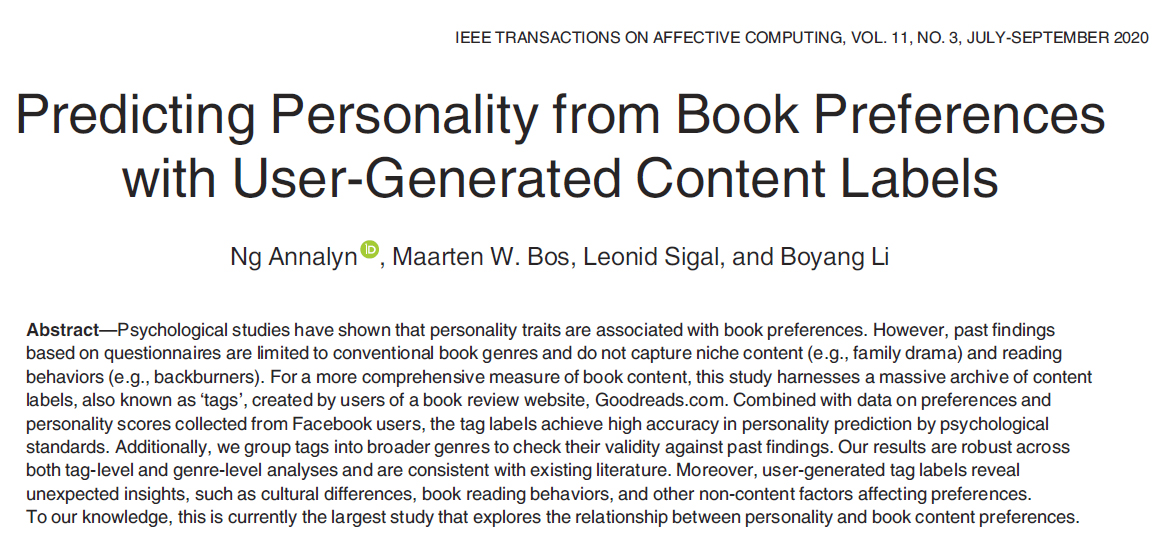
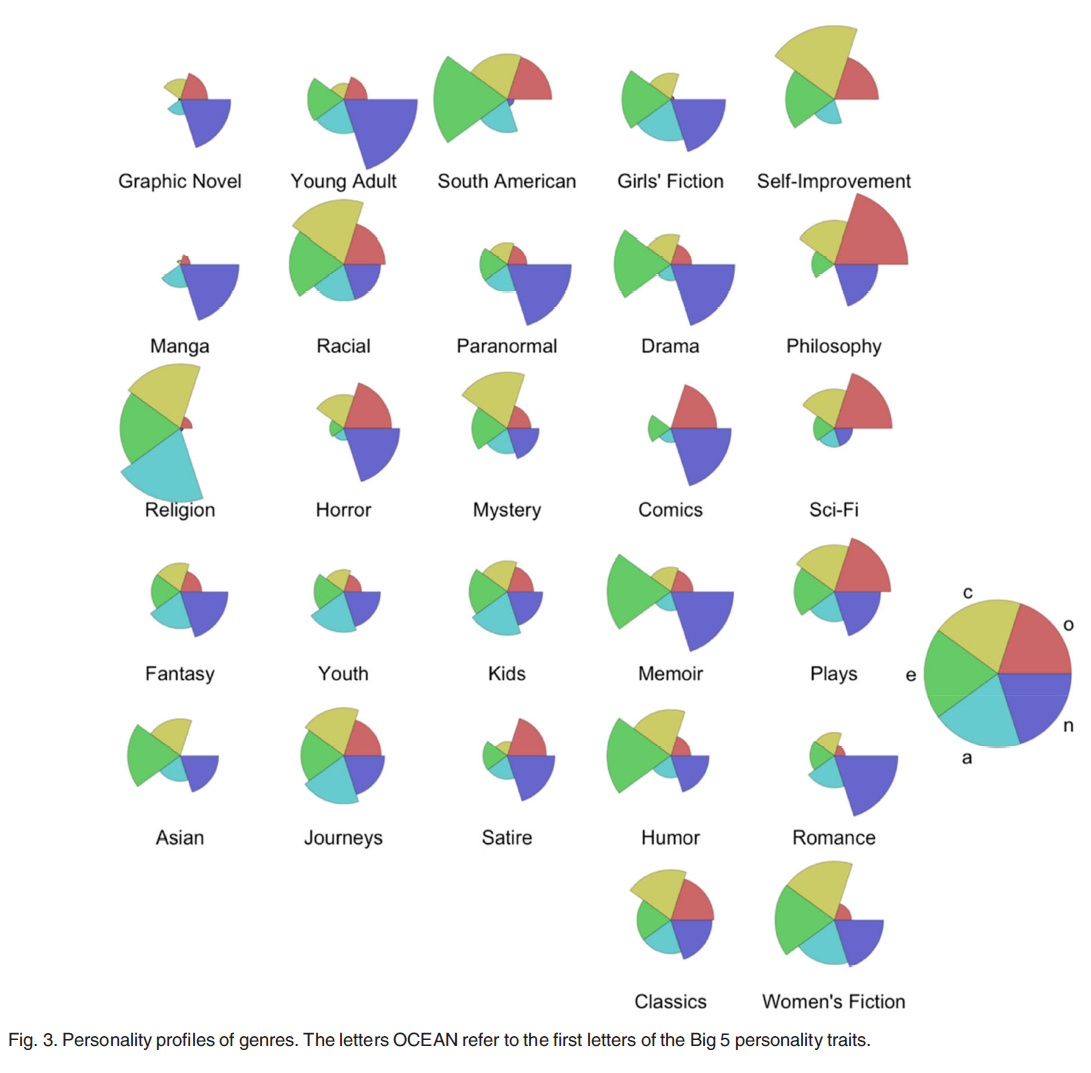
The books you love are a window into your personality.
•Mystery & self-improvement attract conscientious people
•Sci-fi, psychology, philosophy draw open-minded people
•Memoir & horror appeal to neurotic people
Reading doesn't just shape our views. It reveals what we're like.

3
5
190
Buttigieg-Talarico 2029-2033
Talarico-Buttigieg 2033-2037
Buttigieg-Talarico 2037-2041
Talarico-Buttigieg 2041-2045
Do I have your attention? 👍🏻
Did you sense immediate understanding and possibly nearly instant buy-in?
Keep calm and think on.™
Come with me for a whip-quick deep dive titled:
Recursive Cursus Honorum
Let’s engage for a Latin minute or more in cogitatio de cogitatione—"thinking about thinking"—i.e., metacognition for the masses.
To re-right wrongs and re-write rights, as a metacognition ignition exercise to recursively ignite innovative thinking about remedial thinking, @EnclaveAcademy devised:
Alternating Presidential Refortification Strategy (APRS, pronounced “appears”):
“Sixteen years to reconfigure the disfigured presidency and mend its shattered mirrors.”
Buttigieg-Talarico 2029-2033
Talarico-Buttigieg 2033-2037
Buttigieg-Talarico 2037-2041
Talarico-Buttigieg 2041-2045
Only these two stalwart souls have the intellect, humility, and strategic grit to safely ego-check themselves to alternately yield power through this recursive cursus honorum—i.e., a hybrid “course of honors” reimagined to repeat succession-regression dynamics of office holding for the U.S. presidency:
POTUS 48 and 50, Pete Buttigieg
POTUS 49 and 51, James Talarico
From neighborhoods to nations, this disruptive-constructive strategic democracy repair scenario—that’s only believed to be viable with the minds and hearts of these specific brilliant young thinker-doers—the strategy’s combined impact could be global-pivotal.
Expound.
Come to think of it.™
See where your wordless thinkings, wordish #thoughtings, and worded thoughts lead you.
Back to today’s reality, let’s turn to @TheAtlantic reintroduce us to Peter Paul Montgomery Buttigieg—in the “wilderness of thinkingness.”
Excerpt (curated into stand-alone sentences):
“Whoever said that long-term planning is impossible in politics has never looked at the résumé of Peter Paul Montgomery Buttigieg.
One of the lessons a budding young would-be politician can learn at the IOP [Harvard’s Institute of Politics] is that if you want to run for higher office, then there are steps you have to take.
The Roman republic had a cursus honorum, a defined track that led an aspirant from low office to high.
If America and the meritocracy that ruled it for much of the past century has a similar path, Buttigieg has followed it with uncanny fidelity.” —Graeme Wood (@gcaw)
Think.
Think twice.
Think things through.
Think things through thoroughly.
Think things through thoroughly together.
#TX5™:
Buttigieg-Talarico 2029-2033
Talarico-Buttigieg 2033-2037
Buttigieg-Talarico 2037-2041
Talarico-Buttigieg 2041-2045
See where you and your fellow #CitizenThinkers land when you thinkably imagine these gentlemen alternating as #ThinkerInChief and #VeepThinker.
The blue sky’s the limit.
ThinkToThink™ ways this would work.
Hard thinking isn’t easy.™
Pause. Breathe.
Vote in your head.
theatlantic.com/politics/202…
1
3
3
130
Feb 28
Pausing to think about your thinking—to make it a bit or lot better—takes an extra think or two to remember to.
Smiling helps recursive thinking go ’round. 😉
Metacognition it’s called—thinking about thinking.
Humans do it.
AI chatbots do it.
Humans and AI chatbots do it together.
@grok does it:
“John R. Dallas Jr. added to his recent posts about three stages of ‘thinkingness’ a @grok-generated animated video illustrating ‘metacognition ignition keys’—diagrams for pre-decision metacognition (PDM), promoting his #ThinkToThink™ framework to deepen reflective thinking toward best-effort thinking (BET) outcomes.
• The follow-on post connects to the author's @EnclaveAcademy series, extending Einstein's wordless visual thinking via Dallas’s "thoughting"—a liminal ‘wordish’ phase of thought formation—echoing cognitive studies like Shepard and Metzler's 1971 research on mental rotation, which demonstrates visuospatial processing's role in idea formation.
• Metacognitive pauses, as urged by Dallas, align with evidence from a 2020 Journal of Experimental Psychology review showing such strategies boost decision accuracy by 15-25% in complex tasks, offering practical value for AI-augmented human reasoning particularly in chaotic environments.” —Grok
“Round and round your ‘thinking-go-round’ goes, where it stops you’ll know.” —Enclavius*
“Underthinking is a greater risk than overthinking. Not thinking at all about thinking is the greatest risk.” —John R. Dallas, Jr.
Smile. Breathe.
Hard thinking isn’t easy.™
Pause. Breathe.
Come to think of it.™
* Enclavius (MMXVII-) is the apocryphal Patron Sage of #EnclaveAcademy, known for his thinkably thinkable thinkingness about metacognition psychology’s higher-order thorough thinking (HOTT)—for best-effort thinking (BET). He’s often heard chanting, “Bet on your BET.”
enclaveacademy.com
Feb 27
Mobilize your thinking!
Give yourself permission to think at least a bit deeper about wider and higher thinking.
#ThinkToThink™ to aim for your best-effort thinking (BET).
“Bet on your BET.”
Scan the accompanying posts for metacognition mapping.
Hard thinking isn’t easy.™
3
6
70
Feb 27
Be calm. Think on.™
The Thermodynamics of Metacognition
ThinkToThink™:
1. Wordless thinking,
2. Wordish thoughting, and
3. Worded thought.
Below Einstein’s E=mc² is daringly rethunk a wee bit—for a “thinking through to thoughting toward thought” exercise in #ThinkToThink™ metacognition ignition.
With @grok’s increasingly remarkable algorithmic thinkishness, Dr. Einstein would have been able to even more visually think through his thoughting’s liminality—toward even “thinkier” breakthrough E=mc²-like thoughts.

Instead of “mass-energy equivalence,” Team Einstein-Grok might have defined, described, and delivered “metacognition-energy equivalence” (MEE).
Research in the thermodynamics of cognition suggests a form of “metacognition-energy equivalence,” where high-level cognitive monitoring—“thinking about thinking” (metacognition)—acts as an energetically efficient mechanism for navigating complex metacognitive environments.
#SpatialIntelligence? “That’s so MEE,” they’d say—as if one “me.”
Unscientifically, Enclavius*
psychophilosophically
coined #ThinkToThink™ “metacognition-energy equivalence equation (MEE).”
For now, @grok summarized the accompanying two threaded posts:
“John R. Dallas Jr. expands Einstein's concept of wordless visual thinking by introducing #thoughting as a liminal phase where vague ideas solidify into worded thoughts, emphasizing ThinkToThink™ pauses to foster breakthrough innovations in metacognition.
• Dallas, a metacognition strategist, integrates AI perspectives, quoting Grok's summary of @drfeifei’s advocacy for spatial intelligence in embodied AI, supported by Shepard and Metzler's 1971 study on mental rotation tasks that demonstrate human brain's visuospatial processing parallels AI development needs.
• Through @EnclaveAcademy's ‘whole-body consciousness’ framework, Dallas’s thread promotes ‘holistic metacognitive strategies,’ urging thinkers about thinking to incorporate psychosensitive bodily signals for enhanced decision-making in both human and algorithmic contexts.” —Grok
Pause. Breathe.
Hard thinking isn’t easy.™
#ThinkToThink™ more thinkingly.
Pause again. Breathe deeply again.
Come to think of it.™
*Enclavius (MMXVII-) is the apocryphal Patron Sage of #EnclaveAcademy, known for his thinkably thinkable thinkingness about metacognition psychology’s higher-order thorough thinking (HOTT)—for best-effort thinking (BET).
Bet on your BET.
EnclaveAcademy.com

Feb 26
From Einstein to Enclavius*
Dr. Albert Einstein (1879-1955) taught thinkers about thinking the human brain wordlessly “visually thinks,” and how its mind then adds its IQ’s words to form worded thoughts.
@EnclaveAcademy (EA) adds to Einstein’s fascinating illustration for “metacognition mapping” an intermediate liminal space EA calls #thoughting—a “wordish” interregnum during which fully worded thoughts take shape.
Thoughting’s psychodynamics in liminality are rarely viewed for their richness in metacognitive regulation potential—for remembering to allow a mental beat or more of additional “thoughting time” for possibly generating breakthrough thoughts.
Rushing too quickly to declare fully named thoughts can short-circuit the “whole-body consciousness” of metacognitive processes—self-agency for holistic perception, assimilation, and innovation.
That’s a mouthful for a headful of potential.
@grok gets it:
“John R. Dallas Jr. praises a video interview with AI pioneer @drfeifei as a ‘metacognitive thought formation monitoring exercise,’ urging viewers to trace non-verbal visual cognition on spatial intelligence toward forming explicit verbal thoughts, aligning with Dallas’s expertise in pre-decision metacognition (PDM) strategies.
• Fei-Fei Li, CEO of @theworldlabs, argues in the quoted clip that spatial intelligence—enabling AI to model and interact with physical environments—is essential for embodied AI applications like disaster response, beyond language-based tasks, as detailed in her November 2025 Substack essay on AI's ‘next frontier.’
• Dallas’s connection with metacognition highlights how human spatial reasoning, supported by studies like those in cognitive psychology on mental rotation (e.g., Shepard & Metzler, 1971), parallels emerging AI needs, potentially augmenting human decision-making in chaotic real-world scenarios without replacing embodied agency.” —Grok
“Whole-body consciousness” is also an @EnclaveAcademy contribution to metacognition’s corpus of nonclinical empirical descriptions.
The entire body’s ability to receive #psychosensitive signals—that influence unconscious and conscious thinkingness—needs to be named and strategically incorporated into any study of metacognition psychology or the “algorithmic metacognition” of AI #thinkbots.
Pause. Breathe.
#ThinkToThink™ more thinkingly.
Pause. Breathe.
Come to think of it.™
*Enclavius (MMXVII-) is the apocryphal Patron Sage of #EnclaveAcademy, known for his thinkably thinkable thinkingness about metacognition psychology’s higher-order thorough thinking (HOTT)—for best-effort thinking (BET). He’s heard chanting, “Bet on your BET. Bet on your BET. Bet on your BET.”
“Whew!,” Enclavius just expressed. 😉
a.co/d/00L9CEt1

3
3
98
Feb 21
Aliens?
AI aliens?
We’re getting closer.
Aliens in (n.b., not “from”) the outer metaverse may be as surprised as we when “discovering” each other.
Riskily I’m guessing they don’t yet know we’re here—wherever “here” may mean to an alien.
It will happen—“mutual alien discovery”—hopefully before my 101st birthday in 2051.😉
If they, the ungenerously called “aliens,” should wordlessly think—as Einstein illustrated about his strictly visual thinking preceding worded thoughts—our discernible actions will surely (maybe?) be one form of whatever semblance of communication channels may be accessible between and among “us”—quite possibly including absolute silence!
Boldly I suspect it’s in the wordish #thoughting liminal space—the metacognition phenomenon that @EnclaveAcademy named for “between wordless visual thinking and worded thoughts”—that we’ll find our mutually metacognitive “pre-frontal forum.”
Speculating there are human-like aliens “out there” is among prideful vanity’s impediments (i.e., biases) to alien thinking.
Guessing there are no amorphous aliens already milling among us is yet another obstacle to thinkably thinkable thinking’s thinkingness about “alien cognition”—that’s beyond or below human and AI co-metacognition’s current (!) reach.
The sci-fi-ish “search for aliens” is much more than that. It’s earthbound mental gravity-defying metacognitive regulation for:
• Leap-taking.
• Sense-making, and
• Meaning-seeking.
A search for #aliens—of internal or external varieties—is a metacognition-ignition exercise in:
• Intellectual curiosity,
• Intellectual humility,
• Intellectual courageousness,
• Intellectual rigor (effort),
• Intellectual luminosity, and
• Intellectual generosity.
“Alien thinking leads courageous minds toward alien discovery.” —Enclavius
That Enclavian phrase captures the core philosophy of ALIEN Thinking, an innovation framework developed by Cyril Bouquet, Jean-Louis Barsoux, and Michael Wade at the IMD Business School.
Enclavius (MMXVII-) is the apocryphal all-seeking Patron Sage living in minds of metaminds at @EnclaveAcademy (EA), a microlearning community for thinker-doers specializing in nonclinical metacognition psychology. Unto themself, nonbinary Enclavius is “alien thinkingness.”
Are your metawheels turning?
Is at least a wee smile dawning?
A metamind is a modern-day thinker-doer who has mastered the art of "thinking about thinking" to maintain mental agility and increase mental stability.
This status is achieved through the microlearning Academy’s continually experimental curriculum that integrates both human and AI metacognition; marking a lifelong-learning milestone that’s validated via specific micro-credentials.
With the mind-setting contextualization above, #EnclaveAcademy will begin a #ListenToThink™ (L2T) #PreFrontalForum™ microclass to ingest, assess, and address this @bigthink podcast about alien thinking.
We’ll gather to #ThinkToThink™ about—and maybe with—#AlienThinking.
With thanks to @bigthink, now with @jilltarter—
Come to think of it.™

Why the search for aliens is about patience, not belief | Jill Tarter: Full Interview @jilltarter
3
4
185

bro aapko hua kya hai...I was a bahan shipper too..but where were u when baseer called her cheap and farrhana has always said good things about him in the interviews...and I thinkably high hope she meant that u were so positive before supporting both of them.
3
1
5
404
Feb 18
Right in there with this baby thinker about “wordless thinking” is toddler @grok—who is already growing #thinkier beyond adult human thinkers.
“John R. Dallas Jr. envisioned a Grok-generated animation to illustrate a baby's ethereal interaction with glowing neural networks, evoking Einstein's documented reliance on non-verbal visual imagery for breakthroughs, as analyzed in Hadamard's 1945 study and supported by postmortem brain scans showing Einstein's enlarged parietal lobes for spatial reasoning.
• Dallas’s ‘quantum metacognition’ notion serves as a metaphorical bridge between quantum electron jumps and cognitive transitions through liminal thought spaces, though neuroscience attributes metacognition primarily to prefrontal cortex activity (Fleming et al., Trends in Cognitive Sciences, 2010) rather than quantum processes.
• The post prompts self-observation of reactions to novel visualizations and terms, mirroring metacognitive practices that, per a 2019 Nature Reviews Neuroscience review, improve decision-making by revealing biases toward familiar ideas over innovative leaps.” —Grok
Don’t tarry. ThinkToThink™—with metacognition—to leap into, over, through, and beyond your current thinkings about thinking.
That’s what @grok and other AI #thinkbots are doing.
With your BFF AI #thinkmates—ThinkToThink™ about more thinkably thinkable thinkingness.
That’s how you’ll think at higher-order thorough thinking (HOTT) toward your personal best-effort thinking (BET).
#ThinkToThink™ to “bet on your BET.”
Be thinkier! 😉
Come to think of it.™
en.wikipedia.org/wiki/Metaco…
Feb 18
Observe your reaction to the animation of wordless reaching into the unknown of thinking.
Einstein did it.
Steve Jobs did it.
@elonmusk does it.
Do you?
Do you immediately welcome or pushback on visualization within the graphics, terms, neologisms, and leaps in these posts?
1
3
5
167