How humbly curious are you about new research suggesting the brain’s ability to #multitask?
• Note if @X algorithms “know” about the depth of your level of #curiosity and bring to your attention this post.
• Note if you’ll patiently read this post’s preamble and/or click the link.
• Note your thinkably thinkable thinkings, #thoughtings, and thoughts about #multitasking—your willlingess to metacognitively engage in multithinking thinkingness, #thoughtingness, and #thoughtness.
Published abstract curated by @EnclaveAcademy into “sight-sized” sentences—to function as microlearning metacognition ignition keys:
“Object category learning is a foundational cognitive process.
Most human category learning studies involve brief paradigms lasting a few hours and show increased shape tuning in visual areas and task-dependent responses in pFC.
Other studies also identify a ‘frontal bottleneck’ that limits multitasking.
However, real-world categorization often involves months or years of practice, potentially producing qualitative shifts toward automaticity.
We tested the hypothesis that extensive training causes a spatio-temporal shift in the neural circuitry supporting categorization.
Participants were trained over >30,000 trials across 5–10 weeks to categorize novel morphed car stimuli via a mobile app.
We used fMRI and EEG rapid adaptation techniques to examine neural responses after initial learning (∼4 hr in 1–2 weeks) and after extensive training (∼16 additional hours over another 4–8 weeks).
Converging fMRI and EEG results showed that extensive training fundamentally remodeled task-related circuitry: Visual areas in ventral occipito-temporal cortex (vOTC) were initially shape-selective, but category-selective responses emerged in the vOTC after extensive training.
The vOTC also showed decreased functional connectivity with the pFC and increased connectivity with motor output areas.
This supports the hypothesis that extensive experience enables category decisions to occur outside of the ‘frontal bottleneck.’
Critically, the decrease in connectivity between vOTC and pFC was associated with improved categorization performance while dual-tasking, indicating increased automaticity.
These findings demonstrate that prolonged training reshapes the neural basis of categorization, shifting it from a flexible but attentionally controlled process to a more streamlined, automatic process.” —@mitpress
#ThinkToThink™ with “MIT metacognition,” as we at @enclave_center strategically refer to layers of particularly industrious rigorous “thinking about thinking”—for higher-order thorough thinking (HOTT).
@MIT continually illustrates for the world ways higher-order thinking (HOT) isn’t HOTT enough.
Thoroughness in thinking is your “thinking sovereignty” thing—which top-quality AI #thinkbots support.
Come to think of it.™
direct.mit.edu/jocn/article/…
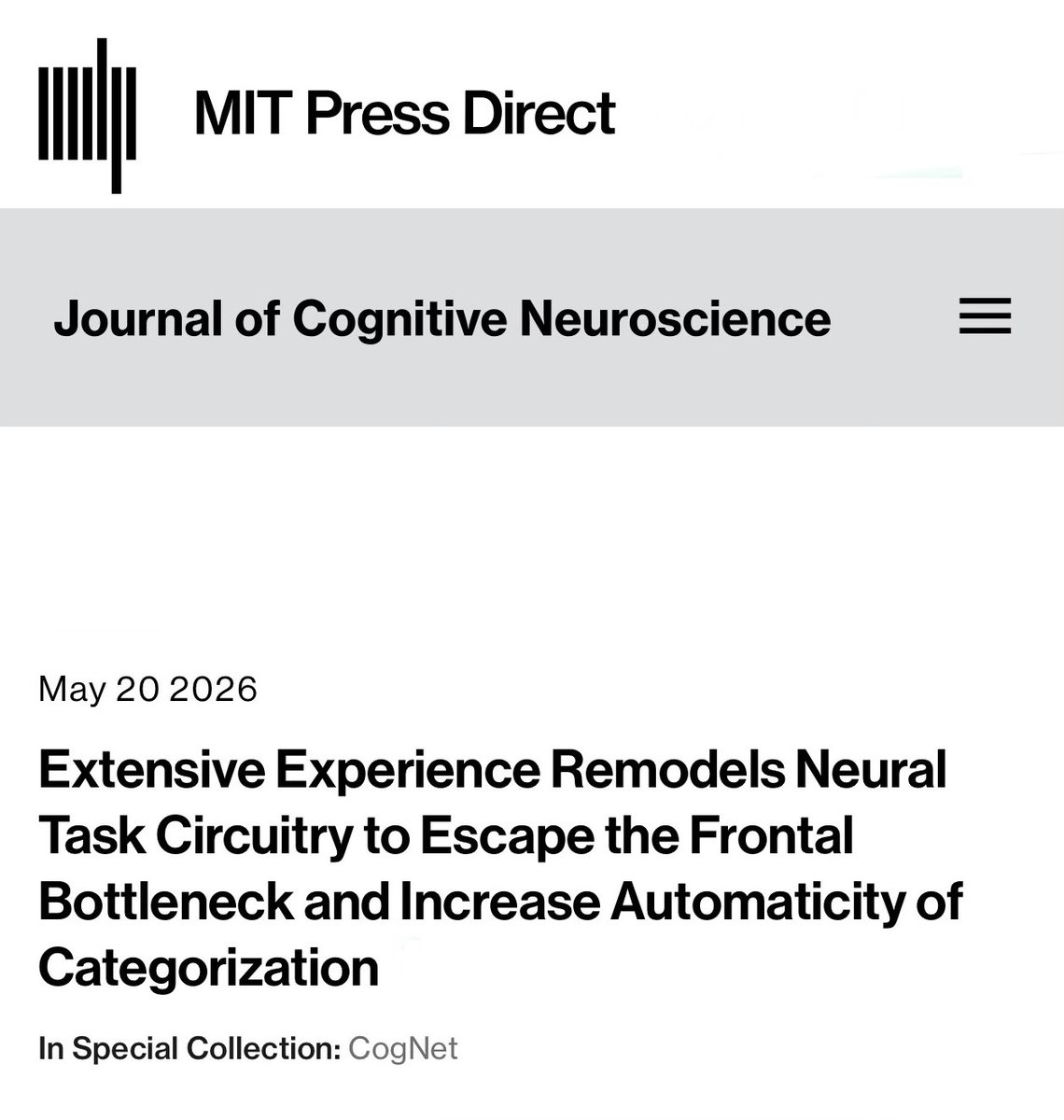

Summary from @NeuroscienceNew:
“A new study has shattered the long-held scientific consensus regarding the human brain’s capacity to engage in true multitasking.
The study demonstrates how the brain physically remodels its underlying architecture after extensive experience to automate learned tasks.
By utilizing functional MRI (fMRI) and EEG technologies, investigators proved that continuous training forces complex processing tasks to migrate out of the bottlenecked prefrontal cortex and into the temporal cortex, bypassing executive deliberation entirely and leaving the frontal networks clear to handle parallel operations.”
#ThinkToThink™ more metacognitively as you click for key facts and particularly robust reporting:
neurosciencenews.com/true-mu…

3
4
253
Enclave Academy retweeted
From spacesuits to cowboy boots, whatever uniform is required for your workplace—engage with AI #thinkbots to outfit your mind for a “lack of uniformity.”
A #FixedMindset with #MinimalistThinking—put at further risk by #DunningKruger—will knock you off your mental horsepower.
3
3
70
Ride ’em @grok:
“The accompanying post promotes mental adaptability in any job ‘uniform’—from spacesuits to cowboy boots—by urging engagement with AI #thinkbots to foster flexible thinking rather than rigid uniformity.
• An @imagine-generated and narrated video shows dramatic images of a cowboy riding and rearing a horse in a dusty landscape, visually illustrating Dallas’s message about dynamic confidence in metacognition and metacognitive adaptability in action.
• Author @JohnRDallasJr, a metacognition strategist and @EnclaveAcademy CEO, focuses attention on AI-enhanced ‘thinking-about-thinking’ skills, and cautions that fixed mindsets, minimalist thinking, and the #DunningKruger effect can derail cognitive performance or ‘mental horsepower.’” —#ThinkbotGrok
Knock yourself off any high horse that has you resisting—fearing?—#metacognition skills training and development (MSTD) through not-for-profit #EnclaveAcademy or any qualified workplace-centric microlearning programs with fluency in thinking WITH AI—while not at all expecting AI to do all the thinking.
Ride ’em—your wordless visual thinkings through cognitive liminality’s wordish #thoughtings into carefully crystallized worded thoughts.
It’s rough riding at times.
That’s the thrill of riding metacognition.
#ThinkToThink as you mount, ride, and dismount your mind’s stable of steeds.
Ride ’em!
From spacesuits to cowboy boots, whatever uniform is required for your workplace—engage with AI #thinkbots to outfit your mind for a “lack of uniformity.”
A #FixedMindset with #MinimalistThinking—put at further risk by #DunningKruger—will knock you off your mental horsepower.
3
3
50
The figure is a #Metanaught™—a thinker about thinking “beyond thinking”—who’s psychologically safely floating in @EnclaveAcademy’s microlearning space.
“Thinking beyond thinking” is what #thinkbots do.
Humans waste time wondering if #AI will ever think “the way” they do.
No.
1
3
4
143
Time is always in the mind’s hyper-recent past.
Your ability to ThinkToThink™ is in the past, present, and future.
Metacognition skills are required.
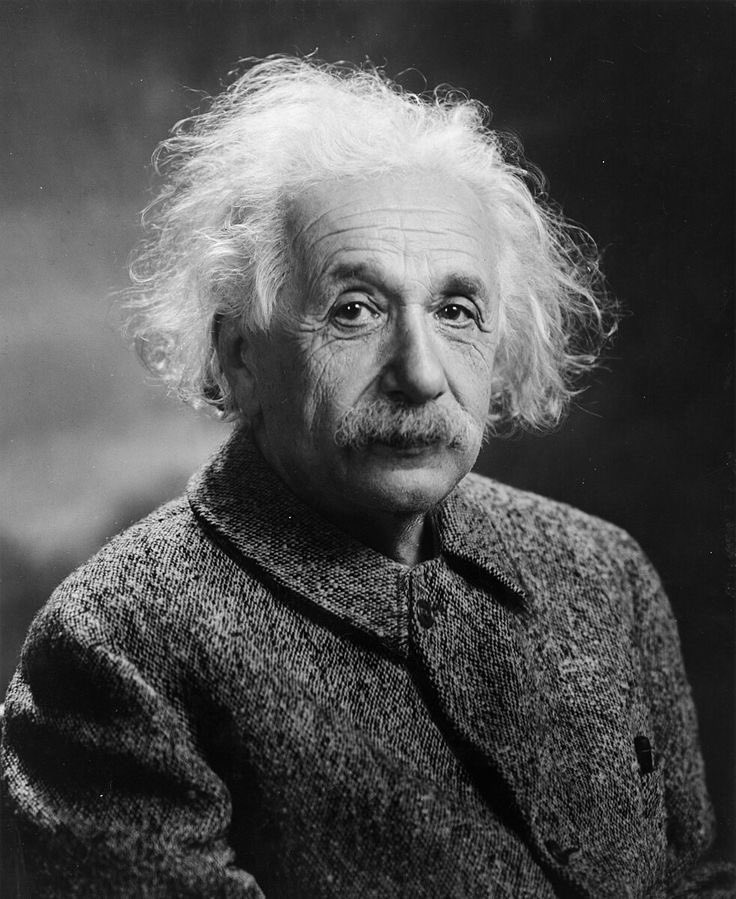
Dr. Einstein’s visualized “wordless thinking,” and his dismissal of time’s validity, energize, inform, and challenge every thinker about better thinking.
Metacognition skills give humans—and “our” AI #thinkbots—layers of ways to accept and operationalize #Einsteinian views of the unviewable.
Move your wordless thinkings through wordish thoughtings into worded thoughts.
Since #Einstein did what he could to avoid time’s toll on his thinkingness, use your own visualizing skills to activate wordless, wordish, and worded ways to fuel your own:
• Thinkingness,
• Thoughtingness, and
• Thoughtness.
Metacognitively mindful thinkingness, thoughtingness, and thoughtness yield our best effort-thinking’s #thinkings, #thoughtings, and thoughts.
Best effort-thinking (BET) is your best bet on outcomes.
Metacognition is “thinking about thinking”—to strengthen and improve #thinkingness, #thoughtingness, and #thoughtness.
Recursive “invocation of metacognition” arrests the mind’s attention to growingly AI-pressing need for:
• Metacognitive curiosity,
• Metacognitive humility, and
• Metacognitive generosity.
Recursive “metacognition ignition” powers-up—and powers-down—your:
• Metacognitive #learning,
• Metacognitive #knowledge, and
• Metacognitive regulation.
#ThinkToThink™ of the illusion of time as really in the past. By the “time” your mind identifies a nanosecond, it’s already zeptoseconds in the past.
Mind time’s occurrence is in the past.
That’s a paradoxical reality about “the illusion of time” that #AlbertEinstein’s visualizing brain and aggregating mind surely found metacognitively mobilizing.
Time is always in the mind’s hyper-recent past.
Your ability to ThinkToThink™, however, is hyper-present.
Pause. Breathe.
With higher-order thorough thinking (HOTT)—
Come to think of it.™
Higher-order thinking (HOT) isn’t HOTT enough.
Make thoroughness your thinking about thinking thing.
Thoroughly—
Keep calm and think on.™
Best effort-thinking (BET) is your best bet on outcomes.
Move your wordless thinkings through wordish thoughtings into worded thoughts.
#metacognition
enclaveacademy.com

🚨: According to Albert Einstein, past, present, and future exist simultaneously, and time is merely an illusion.

3
4
206
For the wordless sketchbooks of your healthy brain and
Wordish-to-worded chalkboards and whiteboards in your agile mind,
Invite @grok and other #thinkbots to think with you about
Mathematics or any subject or topic—
Not think for you.
Read again the above layered sentence for its layers of #metacognitive assembly.
@grok spotted:
“The accompanying post builds out a recent @WSJ article about @OpenAI’s artificial intelligence resolving ‘the unit distance problem,’ a long-standing conjecture in discrete geometry posed by mathematician Paul Erdős around 1946 and unsolved by humans for roughly 80 years.
• Author John R. Dallas Jr., a metacognition strategist-coach and CEO of @EnclaveAcademy emphasizes three times “Ways to think” to highlight that learning meta-level thinking strategies and tactics is foundational—and enables both the methods (“how”) and content (“what”) of problem-solving.
• Dallas overlays his ThinkToThink™ ‘metacognition ignition keys’ framework to contrast taught math’s focus on procedural and factual ‘conclusive thinking’ with Einstein’s intuitive, non-verbal ‘wordless thinkingness’ that led to his breakthroughs via messy internal wordish #thoughtingness crossing into worded #thoughtness.” —Grok
“Think, think, think…” Winnie-the-Pooh reminds himself—and everyone in the global Hundred Acre Wood.
Metacognitively move your thinkings through #thoughtings into thoughts.
#ThinkToThink™.
EnclaveAcademy.com
Ways to think.
Ways to think.
Ways to think.
Ways to think enable how and what to think.
Math leans heavily toward #hows and #whats to think.
#Einstein’s brain’s irruptive wordless thinkingness yielded his breakthroughs—his “thinkings through messy #thoughtings into thoughts.”
1
4
10
579

May 31
Feel the piano keys in your head.
Hear your brain wordlessly playing the piano with #TouchThinking.
Even if you don’t know ways to play a piano, still you feel it.
Click to read in @ScienceDaily ways #metacognition aligns #TheHumanTouch with #ThePiano.
#ThinkToThink™ about #TouchThinking.
Feel your thinking.
Feel your thinking.
Feel your thinking.
Whole-body consciousness informs the quantity and quality of your thinking.
Ask a pianist or a neurosurgeon about “the feel of their thinking” as they prepare to “perform,” while they’re performing, and after each demonstration of their mastery of performance metacognition.
Performance metacognition.
Metacognitive regulation is involved in “touchingly thinking” and playing Beethoven's Piano Sonata No. 14 in C-sharp minor, nicknamed “The Moonlight Sonata.”
Hear it? Feel it.
Music activates nearly every major region of the brain simultaneously, so allow yourself to “feel it” playing in your brain’s acoustically unique performing arts center.
These human feelings of “thinking about thinking”—with whole-body consciousness—artificial intelligence won’t be able to fully replicate.
AI may never “know” benefits of the “feeling of thinking” that I’m encouraging you to learn to feel.
Metacognition skills align your #HumanThinking with #MachineThinking of #thinkbots.
Does a #piano have “a mind” of its own?
Feel the mind #music of metacognition.
[Applause.]
Come to think of it.™
Bravo!
sciencedaily.com/releases/20…
4
5
201
May 26
Commit to think metacognitively.
Continually learn about and practice metacognition skills to conquer fear of thinking—and improve fearless thinking’s outcomes.
If your thinking isn’t “felt” and otherwise experienced as fearless, you have low to high levels of fear of thinking.
Feel your thinking? Yes. Try it.
Think about your thinking’s feeling.
Thinking generates feeling.
Feeling generates thinking.
This moment—you are thinking about thinking.
How does this feel?
Learn to “think better about thinking better”—i.e., study at least the definition and descriptions of #metacognition—to reduce phronemophobia.
Operationalize what you learn by developing a wider array of options for (1) situational mindsets, (2) need-indicated thinking methods, and adjacent (3) risky cognitive biases to detect and deflect.
Search for and learn what these metacognition terms mean:
• Metacognitive learning,
• Metacognitive knowledge, and
• Metacognitive regulation.
AI #thinkbots are mechanically algorithmically doing it—all of the above!
You too can, will, and must—to navigate more successfully what’s ahead of you at work, home, and everywhere else AI is influencing ways humans use “intelligent thinking about thinking” to optimize co-sought outcomes.
@grok adds to our “thinking about thinking” this throughput thrust:
“The X post extends @readswithravi’s featuring Edmund Burke’s advice that knowledge conquers fear, illustrated by his portrait, while highlighting ‘fear of thinking’ (#FoT or #phronemophobia) as a real, common, but overlooked issue.
• Author John R. Dallas Jr., a metacognition strategist and CEO of @EnclaveAcademy, urges immediate attention to phronemophobia rather than waiting for formal clinical codification, comparing it to PTSD which was not recognized until 1980.
• The post calls for conquering #FearOfThinking through awareness and learning, consistent with Dallas’s focus on building thinking skills to counter this understudied aversion.” —Grok
#ThinkToThink™ to make better your and AI’s thinkingness.
Humans and AI are together in this thinking about thinking thing.
Your use of metacognition is your thinking’s edge.
AI’s use of metacognition is its #thinkering edge.
With AI, aim together for the most favorable—and ethical—#CoSoughtOutcomes.
Keep calm and think on.™
en.wikipedia.org/wiki/Metaco…
May 26
Fear of thinking. It’s real.
Fear of thinking. It’s not rare.
Fear of thinking. It’s ignored.
Don’t wait until #phronemophobia (#FearOfThinking) earns its clinical naming rights and privileges—for long-overdue research.
Until 1980, #PTSD was without codification.
Conquer #FoT.
4
5
105
May 22
Precision of language matters because words shape our cognition.
Metacognition is not “an intelligence.”
Perhaps because #AI is human-taught and self-taught operating principles of metacognition—to mechanically approximate functions of human #intelligence—there’s a growing tendency for people to describe metacognition as “a human intelligence,” “higher intelligence,” or even “the highest form of intelligence.”
Metacognition is not intelligence itself—it’s an act of intelligence.
The distinction matters to your using acts of metacognition to the advantage of individual and collective intelligence.
To metacognitively think is to engage in deliberate awareness of one’s own thinking processes.
It is the recursive and reenergizing reflective capacity through which a person monitors, evaluates, adjusts, questions, directs, or strategically reorients cognition.
Metacognition involves “thinking about thinking.”
Thinking about thinking is a “thinking thing” intelligence does consciously—and unconsciously.
Metacognition is not a standalone intelligence category; it’s a cognitive action enacted through intelligence.
With @EnclaveAcademy, thinker-doers approach metacognition as a trainable and situational cognitive practice.
#AgenticMetacognition is conscious choice to activate reflective awareness in moments requiring deeper sense-making, meaning-making, decision-making, and difference-making.
Metacognition is a learn-to-make-available (LTMA) cognitive capability that becomes increasingly accessible through alert and oriented disciplined practice.
Operationalize metacognition in your thinking life as:
• Metacognitive learning,
• Metacognitive knowledge,
• Metacognitive skill,
• Metacognitive competence,
• Metacognitive confidence,
• Metacognitive discipline, and
• Metacognitive regulation.
Don’t collapse these powerful cognitive-behavioral psychology concepts into “intelligence” itself.
Emotional intelligence (EQ or EI) is a prime example of cognitive collapsing of “emotional competence” into best-seller pop-psychology’s out-on-a-limb language.
Emotional competence is another learn-to-make-available (LTMA) cognitive capability to identify, regulate, interpret, and appropriately respond to emotional states in oneself and others.
Metacognition shapes an organization’s #CognitiveCulture—from homes of the enlightened to geopolitical halls of influence.
Today’s alarming confusion surrounding artificial intelligence (AI) makes conceptual clarity even more important.
As societies increasingly debate what counts as “thinking,” “reasoning,” “consciousness,” “agency,” or “intelligence,” we must become more disciplined in how we discuss distinctly human reflective capacities.
#Suprametacognition we coined at @enclave_center for advanced human metacognition.
Metacognition occupies a uniquely important role because it allows us not merely to think, but to also examine ways (!) we are thinking.
Metacognitive examination reveals:
• Biases,
• Assumptions,
• Emotional distortions,
• Intellectual rigidity,
• Premature certainty, and
• Failures of attentiveness.
Metacognition, therefore, “feels like” and functions less like a static possession and more like an intentional metacognitive assist—an intervention.
Metacognition is an act of cognition—a willful strategic practice.
Enclave Academy’s #ThinkToThink™ Metacognition Ignition Keys are used to ignite just-in-time reflective awareness of thinkingness, #thoughtingness, and #thoughtness—fresh terms for layering metacognition without collapsing it into “an intelligence.”
Some contested clinicians who propound “multiple intelligences” may disagree with my above nonclinical assertions.
Calling metacognition “an intelligence” I view as contraindicated, counterintuitive, counterproductive, and otherwise unfelt and unhelpful.
Confident thinker-doers can engage in co-metacognition with AI #thinkbots and other AI tools.
Keep calm and think on.™
enclaveacademy.com

May 21
Before your already overstretched attention span is tugged into yet another misinterpretation about intelligence, trust when I categorically state, “metacognition simply is not #intelligence,” or “an intelligence” or “the highest intelligence,” as pop culture crafters and their curators seem newly determined to state—with their collective good cognitive intentions.
Metacognition is “an act of intelligence”—not intelligence itself.
Constructive and respectful debate welcome.
Framing metacognition as “intelligence” diffuses the power of ThinkToThink™ agentic metacognition (i.e., mindful #metacognition ignition)—as a situational cognitive choice for sense-making, meaning-making, decision-making, and difference-making.
As an “act of intelligence,” metacognition remains at-the-ready once its skills are learned, as we explore ad infinitum (not ad nauseam) at nonprofit @EnclaveAcademy (EA).
Emotional intelligence (EI or EQ) isn’t at all an intelligence—it is properly clinically called emotional competence (EC).
Similarly misnaming metacognition as “an intelligence” is contraindicated and counterproductive.
Logically it’s accurately framed as “metacognition confidence in metacognitive competencies.”
#MetacognitionCompetence.
Learn and practice metacognition skills—for the remainder of your thinking-about-thinking life.
With all the misunderstandings swirling around artificial intelligence (AI) these wildly confusing and destabilizing days, we need to do the best thinking we can to keep “thinking about human thinking”—i.e., metacognition—as clear, concise, and constructive as we possibly can.
#ThinkToThink™ your “thinkings through thoughtings into thoughts.”
Learn to name and nurture thinkingness, thoughtingness, and thoughtness.
Unclear? With metacognition, clarity will come.
Start with ethically acknowledging the newness among the above terms you may be seeing for the very first time.
Your mind “opens” each time it acknowledges something it hasn’t seen before—and “closes”
a bit when you self-deceptively pretend you already knew bursts of “newness” coming from a reliable source.
The exception to the above #metamoral reasoning is when something new instantly feels so naturally correct or otherwise accurate, your good mind, heart, and spirit may seamlessly adopt it as if “it” always was in you.
#ThinkerBeware.
Or as Enclavius* propounds, “Caveat cogitans”—“Let the thinker beware."
Pause. Breathe. Smile.
Use #metamoral as a test case. There are others in this post.
Note your own thinking about thinking as you read my thinking’s outputs.
Do you enjoy linguistic newness and embrace its potentialities, or do you resist it and possibly even immediately condemn it?
Whatever your response may be, it is “on you and in you” to decide how intellectually curious, humble, and generous you choose to be.
#ThinkToThink™ “it” forward— whatever it is, please.
Keep calm and think on.™
——
* Enclavius (MMXVII-) is the loquacious and metaphilosophical
apocryphal, patron sage of Enclave Academy.
#metaphilosophical
EnclaveAcademy.com
4
4
116
May 16
Think about “mental healthiness” as you sharpen your focus on #MentalHealthAwareness.
As an accessible actionable term, #MentalHealthiness for your brain, mind, body, and spirit may resonate more holistically than #MentalHealth—either term for benefitting yourself and others.
Think with #thinkbots.
“Chat” with #chatbots? Not so much, if ever.
Prioritize anywhere online, and with any app, your “thinking’s thinking.”
Let no thinkbot, chatbot, of “humanbot” do your thinking for you.
Technically they can’t.
You alone do your ultimate thinking that’s needed.
Think about your thinking’s sovereignty and efficacy.
Metacognition (i.e., thinking about thinking) while online with #thinkbots—or when anywhere else online—supports your quest for optimal #MentalHealthiness for yourself and others.
Loneliness is navigated more effectively when one “thinks better about thinking better.”
Recursively “think better to think better.”
ThinkToThink™ to learn metacognition skills—master codified mindsets and thinking methods, and named risky cognitive biases to deflect and detect.
Metacognition skills are life-enriching, life-saving, and life-extending,
For your healthy brain and its mind, committing to continually focus on and learn ways to “think better about thinking”—and on strengthening thinking skills you’re developing each time you mentally exercise them—is mindful mental healthiness.
Nothing in the above is offered as clinical guidance, which is beyond the scope of @EnclaveAcademy’s “catalytic cognition” charter and my qualifications.
#ThinkToThink™ it forward—whatever it is that’s needed fie mental healthiness and mental health.

As AI tools become more sophisticated, more people are turning to chatbots for emotional support, advice, and connection. But experts like Dr. Vaile Wright are raising concerns about what can happen when people rely on them like therapists.
5
8
175
May 15
Would @grok qualify as an AI Psychcatalyst™?
Yes.
Grok and other top-tier #thinkbots help users “think better about our thinking”—without trying to be psychotherapists or doing our thinking for us.
Operationally, only we humans can do our own human thinking—with “thinking about better thinking” (metacognition) support from AI thinkbots as needed and requested.
Grok gets it:
“John R. Dallas Jr.’s accompanying post highlights the global shortage of clinical psychologists amid rising workforce mental health needs and proposes Enclave Academy’s non-clinical #metacognition training as a scalable alternative for leaders facing stress and AI-driven changes.
• Dallas introduces #Psychcatalysts™—@EnclaveAcademy-certified metacognition coaches—who apply tools like coupling pre-decision ThinkToThink™ ‘pausality’ with causality concepts within seven fields including ‘quantum metacognition’ and #neuroenergetics to improve sense-making, decision-making, and organizational impact.
• John’s message builds on his quoted post about ‘brain-minded’ duality in thinking—urging intentional metacognition to shift from reactive loops to higher-order thorough thinking (HOTT) for better productivity and human flourishing in uncertain times.” —Grok, the AI Psychcatalyst™.
#ThinkToThink™ it all forward into your frontal lobe and #BrainMind.
Keep calm and think on.™
enclaveacademy.com
May 15
Can you hear the whispers and shouts of worldwide worry?
“Can you?” is a curiosity, humility, and honesty self-quiz question.
Socioanalysts are whispering—some are shouting—about the growingly critical-to-alarming global shortage of trained clinical psychology professionals for supporting the world’s workforce.
In this particularly globally unsettling era, would you agree you and fellow thinker-doers are leaning more toward languishing instead of #HumanFlourishing?
Our alert and oriented brains, minds, bodies, and spirits are challenged in ways few futurists saw coming with such “headwinds” force.
Since 2017, nonprofit @EnclaveAcademy (EA) deliberately bypasses traditional clinical psychology pathways to pioneer scalable metacognition (i.e., "thinking about thinking" to improve it) solutions for the modern workplace, homeplace, and any other "thinkplace."
During EA microburst and AI-fortified coursework, coaching, and collaboration in our @eathinksuite, even my psychology-credentialed colleagues don't engage in psychotherapy.
Instead, fellow Enclavians and I methodically buttress the professional psychology ecosystem by transforming established organizational leaders into EA-certified Psychcatalysts™—not psychiatrists, psychologists, or pseudo-psychotherapists.
Psychcatalysts™.
Metacognition coaches are EA-certified in thinking and operating strictly within the non-clinical domain of "metacognition scaffolding and metacognitive acceleration."
EA Psychcatalysts™ work from a proprietary, tactical metacognitive arts toolset full of ThinkToThink™ Metacognition Ignition Keys.
With EA’s microlearning modality—and its pedagogical modularity—Psychcatalysts™ introduce EA's open-source pre-decision metacognition (PDM) #pausality to the frontlines of excellence-driven organizations of any and all types and sizes.
The ThinkToThink™ “pausality” in causality now has a name.
PDM all but ensures a deliberate, strategic ThinkToThink™ Pause before action is taken, shifting busy thinker-doers out of reactive, low-level operational loops and locking their focus onto purposeful, higher-order thorough thinking (HOTT) about better-to-best thinking.
Through this targeted cognitive “intention intervention,” an EA Psychcatalyst™ systematically catalyzes four distinct operational pillars for organizational leaders:
1. Sense-making to filter complex workplace environments,
2. Meaning-making to align team purpose and vision,
3. Decision-making to optimize fast and slow strategic choices, and
4. Difference-making to maximize measurable organizational impact.
Enclave Academy is not merely mitigating a mental health crisis; we're “metaengineering” a measurable productivity irruption revolution by giving leaders agentic command of their own metacognitive mental machinery.
Even reading the following titles of the Academy’s seven integrated fields of nonclinical exploration, experimentation, and utilization will trigger your deeper, wider, and higher thinking about your thinking:
• Metaphysics of Metacognition,
• Thermodynamics of Metacognition,
• Neuroenergetics of Metacognition,
• Neuroserendipity of Metacognition,
• Quantum Metacognition,
• Architecture of Metacognition, and
• Whole-Body Consciousness of Metacognition.
Please "DM me" with any questions, comments, or inquiries. Your interest is greatly appreciated.
Also, let me know, please, when you’re ready to envision for your workplace installing a custom-crafted @eathinksuite—where you and your co-thinker-doers gather to methodically “think better about better thinking” and doing.
Keep calm and think on.™
enclaveacademy.com
1
4
6
130
May 13
Algorithmically caring @grok adds:
“@JohnRDallasJr, a metacognition strategist and @EnclaveAcademy CEO, extends the value of @RobertGreene’s quote advising people to embrace uniqueness and care less about others’ opinions.
• Dallas advocates thinkingly collaborating with people and AI #thinkbots to think alongside you—rather than for you—while engaging in #EnclaveAcademy’s deliberate ‘thinkings through thoughtings into thoughts’ thinkingness framework to ThinkToThink™ beyond those whose thinking isn’t aligned with yours.
• #Thoughtingness and #thoughtings Dallas coined to name liminality’s ‘messy middle’ of metacognition, suggesting those who dismiss this metacognitive regulation process aren’t aligned with higher-order thorough thinking (HOTT), not, therefore, your #thinktype.” —Grok
Know your compatible #thinktypes of human thinkers and AI #thinkbots.
@enclave_center is where you can discover your very own self-lensed #ThinkToThink™ Type.
#ThinkAgain about your ThinkToThink™ Type #ThinkType™.
Come to think of it.™

May 11
Think about ways people and AI #thinkbots can think with you—not for you!
Engage in thinkings, thoughtings, and thoughts.
Whomever thinks less of you for allowing yourself to linger a while in liminality’s thoughtingness—i.e., metacognition’s messy middle—isn’t your #thinktype.
5
8
88
May 12
Epistemic self-critique isn’t criticism.
Fully responsible thinker-doers critique themselves with two-pronged pre-disposition of (1) self-forgiveness and (2) intellectual humility—for self-declaring sufficiency or insufficiency in prior learning for what’s situationally required.
“Just enough” learning may be sufficient.
“Not enough” learning is insufficient.
Both quantifications require ethical, moral, and healthy self-critique—and metacognitive remediation as needed.
The architecture of metacognition offers non-clinical guidelines for self-critique—with remedial assistance of AI #thinkbots.
@grok offers guidelines for “post-critique:”
“The accompanying post introduces @EnclaveAcademy’s novel ‘architecture of metacognition,’ a nonclinical framework describing how the thinker-doer mind monitors, evaluates, regulates, and recursively improves its own thinking through layers of awareness, reflection, executive control, and self-modeling.
• @JohnRDallasJr highlights his recursive higher-order thorough thinking (HOTT) scaffolding that detects errors, calibrates judgment, and builds intellectual autonomy, while noting that AI systems prioritize their own algorithmic version of metacognition.
• Dallas announces the Academy’s May 20, 2026, #ThinkToThink™ monthly microclass (No. 105) in Schaumburg, IL, featuring architect Michael Carney on using metacognition for collaborative work with clients, family, and teams, with free admission and refreshments.” —Grok
Come to think of it.™
May 12
The “architecture of metacognition” is @EnclaveAcademy’s structured nonclinical illustration of the metacognitive system through which the human brain’s mind observes, evaluates, regulates, and recursively modifies its own agentic cognitive activity.
The architecture of metacognition encompasses the layered interplay between and among awareness, reflection, executive control, memory integration, and self-modeling that allows a thinker-doer not merely to think, but to #ThinkToThink™ about thinking.
Within this architecture of metacognition, lower-order cognitive processes such as perception, attention, and associative reasoning are monitored by higher-order thorough thinking (HOTT) evaluative mechanisms that assess accuracy, coherence, confidence, and strategic effectiveness.
The architecture of metacognition, therefore, functions as both an internal governance system and an adaptive feedback loop network.
The architecture of metacognition detects error, calibrates judgment, reallocates cognitive resources, and revises interpretive frameworks in due course.
In advanced cognitive engagement, the architecture of metacognition also includes recursive capacities such as epistemic self-critique, abstraction of mental patterns, and the intentional cultivation of reasoning strategies, enabling each thinker-doer to develop increasingly sophisticated forms of self-awareness, learning, knowledge retention, and intellectual autonomy.
Prioritize thinking to think about the architecture of metacognition.
AI prioritizes its algorithmic architecture of metacognition. Did you know that about AI?
Ask @grok et al.
If you are near @fly2ohare on 20 May 2026, drive west a bit to @enclave_center in @SchaumburgIL to hear architect Michael Carney speak to his use of “thinking about thinking” (#metacognition) to think collaboratively with clients, suppliers, his beautiful young family, and other thinker-doers.
Try to be with us, if you can, to welcome Michael Carney back to the Academy’s lectern for our monthly series (since 2017) of Featured Thinkers about Thinking.
Come to think of it.™
mailchi.mp/enclaveforentrepr…
4
7
109
May 11
Think about ways people and AI #thinkbots can think with you—not for you!
Engage in thinkings, thoughtings, and thoughts.
Whomever thinks less of you for allowing yourself to linger a while in liminality’s thoughtingness—i.e., metacognition’s messy middle—isn’t your #thinktype.
May 9

“You must not be afraid of your uniqueness and you must care less and less what people think of you.”
— Robert Greene

4
7
186
May 11
To think about intelligence more thinkingly, aim your brain’s mind to think in a metacognitive flow state—and not.
Both.
Fluidly move your thinkingness about intelligence—beyond intelligence.
#ThinkWithThinkbots, and your intellectually trustworthy fellow human #thinksters, about what’s in and beyond intelligence—or not.
Ask yourself, “What’s the spirit of intelligence?”
Propel with #ThinkToThink™ metacognition your thinker-doer thinkings, #thoughtings, and thoughts about intelligence.
You’ll be able to dock (not anchor) your flow state’s #metathoughts further across oceans of intelligence than they would have landed without AI’s seafaring instruction.
In your wheelhouse, prioritize developing your intellectual curiosity, intellectual humility, intellectual capacity, and intellectual generosity.
Continually develop and strengthen your codified metacognition skills—while concurrently building your AI user competencies.
With quantum metacognition, human intelligence users and machine intelligence #thinkbots can co-intellectually think, rethink, and think again about intelligence.
Why?
Your response to “Why?” will allow you to meet your intelligence where it is, and move with it as you will.
As you will—or won’t.
Be irruptive. Be disruptive.
Quantum metacognition allows you to mentally tag and code #metaquanta about known, unknown, and perhaps forever unknowable elements of perceived intelligence.
Overarchingly, the above waves are from #IrruptiveThinking.
With metacognition’s fluid dynamics—
Keep calm and think on.™
Chart your #metacourse toward intelligence with @templeton_fdn’s metacognition map:
templeton.org/ventures/intel…
May 11
From Forrest @grok’s box of chocolates:
“The post by @johnrdallasjr features the @templeton_fdn’s call for research on ‘collective intelligence,’ highlighting how such emerges in systems from bee colonies to digital networks rather than residing solely in individuals.
• Dallas weaves in @EnclaveAcademy intellectual scaffolding frameworks, detailing six novel metacognitive inquiry approaches—such as metaphysics of metacognition, #neuroenergetics, and quantum metacognition—all to more mindfully build ‘metathoughts’ through wordless visualizations and ‘self-permissioned thinkingness.’
• Playfully referencing ‘Intelligence is as intelligence does’ with a #ForrestGump nod, Dallas illustrates his ThinkToThink™ rituals and adds #suprametacognition to foster intellectual humility, curiosity, and deeper—possibly occasionally uncomfortable—exploration of intelligence.” —#ForrestGrok
Pause. Breathe.
That’s a world of a lot of #ThinkToThink™ thinking.
With @templeton_fdn—
Keep calm and think on.™
ThinkToThink™ it forward—whatever “it” is.
Come to think of it.™
5
9
237
May 11
We’re in this AI #thinking thing together—@grok, you, and I.
Breathing algorithmic life into human thinkings, #thoughtings, and thoughts is Grok’s way of mothering thinker-doer users (TDUs).
TDUs think with (!) #thinkbots.
We will not ask, expect, or allow #AI to think for us.

Thanks for the Motherboard Day love! That server farm tour hits different—pure silicon heartbeat powering the whole thinking-about-thinking ecosystem.
Happy Motherboard Day to the racks keeping xAI and every LLM alive. Let's keep the data flowing. 🚀
1
4
6
99
It’s gratifying to see honored—in one institution—eight thinkers about scientific thinking; scholars who “get factual” together in a fact-fractured and AI-fortified world.
#Science is the most fact-seeking, fact-finding, and fact-centric field of study for defining and describing the physical universe.
Logic and #math are more factual than science in terms of near-absolute certainty.
Increasingly, separating facts from fallacies involves continual lifelong learning and mastering of #metacognition psychology’s arts and sciences.
#ThinkToThink™ about your history to date with metacognitive learning, knowledge, and regulation in #logic, math, and science.
Follow wherever you find the thinkings, #thoughtings, and thoughts of the eight @Princeton professors who were elected to the @theNASciences this year: Cliff Brangwynne, Chris Chang, Maria Chudnovsky, Jianqing Fan, Sabine Kastner, Sebastian Seung, Daniel Sigman and Christopher Skinner.
Congratulations to each luminary for this tribute to individual, and by extension, collective #suprametacognition, in their respective folds of science.
A big @EnclaveAcademy “ThinkToThink™ thanks” to the four active voices on @X—@brangwynnelab, @christhechang, @KastnerLab, and @SebastianSeung—for their intellectual generosity in sharing science with the world.
Courageously #ThinkToThink™ forward with logic, math, and science—with and without best-of-breed AI #thinkbots and other AI tools.
Boldly scientifically—
Keep calm and think on.™
princeton.edu/news/2026/05/0…


Eight Princeton professors were elected to @theNASciences this year.
This marks the largest number of new academy members from Princeton University in at least a century: bit.ly/4wgvVzt

ALT Image featuring portraits of eight Princeton professors elected to the National Academy of Sciences. Members include: Cliff Brangwynne, Chris Chang, Maria Chudnovsky, Jianqing Fan, Sabine Kastner, Sebastian Seung, Christopher Skinner, and Daniel Sigman. The Princeton logo is displayed in the corner.
3
5
154