


Mar 23
Be selfish!
Selfishly #ThinkToThink™ about your own thinking—with AI.
For the reading-thinking minutes ahead, selfishly “think more thinkingly” to get to know—a bit to lot better—your new #thinkmate, co-metacognitive AI (CMAI).
Start your thinking engines with AI basics.
Click the below link to revise your thinking—#RevThink™—with the not-exactly-basic basics of AI from @IBM, for over 100 years the #THINK® town crier.
“…most AI researchers, practitioners and most AI-related headlines are focused on breakthroughs in generative AI (#GenAI), a technology that can create original text, images, video and other content.
To fully understand #GenerativeAI, it’s important to first understand the technologies on which generative #AI tools are built: machine learning (ML) and deep learning.” —@IBM
For now, frame to train your healthy brain and its agile and adaptive mind while imagining yourself thinking and doing what #GenAI “thinks” and does.
Give yourself metacognition ignition permission (MIP) to psychologically safely move through your brain’s unconscious wordless thinkings into the liminality of your mind’s “wordish thoughtings” to semi-conclusive worded thoughts.
Acknowledging the #ThoughtingsBridge™ from @EnclaveAcademy will open you to #neuroserendipity, whole-body consciousness (WBC), and more of your agentic thinking’s newness, freshness, and metacognitive mysteriousness about navigating your thinkmate relationship with AI.
“Generative AI begins with a ‘foundation model’; a deep learning model that serves as the basis for multiple different types of generative AI applications.
The most common foundation models today are large language models (#LLMs), created for text generation applications. But there are also foundation models for image, video, sound or music generation, and multimodal foundation models that support several kinds of content.” —#IBM
Pause. Breathe.
With @IBMwatsonx, “think about your thinking” with #thinkbots.
Keep calm and think on.™
With @MITIBMLab and @mit_tll, think about your brain-mind’s own (!) immediate definition and descriptions for “co-metacognitive AI (CMAI).”
Mindfully you may have crossed the #ThoughtingsBridge™ to reach the mind state of “co-generative AI (CGAI).”
You did it again, correct?
Thinking about human thinkingness—alongside AI #thinkishness—ignites higher-order thorough thinking (HOTT), beyond higher order thinking (HOT), to attain situational best-effort thinking (BET).
HOT isn’t HOTT enough for BET.
With AI #thinkbot thinkmates, you’ll bet better on your BET.
“Bet on your BET.”
Pause. Breathe. ThinkToThink™.
Come to think of it.™
#metacognition
ibm.com/think/topics/artific…

4
4
350

Mar 13
@dmcgavra Great podcast with David McGavran from Maxon and @RevThink. It’s nice to hear where their vision is pointed for Cinema 4D. podcasts.apple.com/us/podcas…
3
83

Mar 12
Is 3D the future of graphic design? 🎨
On RevThink, Maxon CEO Dave McGavran dives into the “Coca-Cola bottle problem” & how Redshift AI safeguard brand identity in the age of machine learning.
Listen now 👉 maxonvfx.com/revthink
1
1
6
3,123

Mar 12
“It’s actually probably going to be sooner than people think.”
Maxon CEO Dave MacGavran drops a big reveal in the latest RevThink @RevThink podcast
Hear more about the future of 3D in the full episode. 👇
maxonvfx.com/revthink
1
11
2,791

Can a full 3D scene go from concept to render in just hours?
On the @RevThink Podcast, Maxon CEO @dmcgavra shares how Cinema 4D is cutting production time, making creation effortless, and powering the next generation of groundbreaking 3D content.
🔗 maxonvfx.com/revthink
2
3
10
1,116

Can AI transform marketing without breaking a brand?
On the @RevThink Podcast, CEO @dmcgavra shares how Maxon protects brand integrity in the AI era, puts artists first, and creates tools that power world-class creativity.
🎧 Listen now ⬇️
🔗 maxonvfx.com/revthink
1
4
727

Is an AI-generated image theft?
What's it like working with legendary Hollywood directors?
Are software developers creative?
On the @RevThink Podcast, our CEO, Dave McGavran, answers these and about how we're putting artists first.
🎧 Listen now: maxonvfx.com/revthink
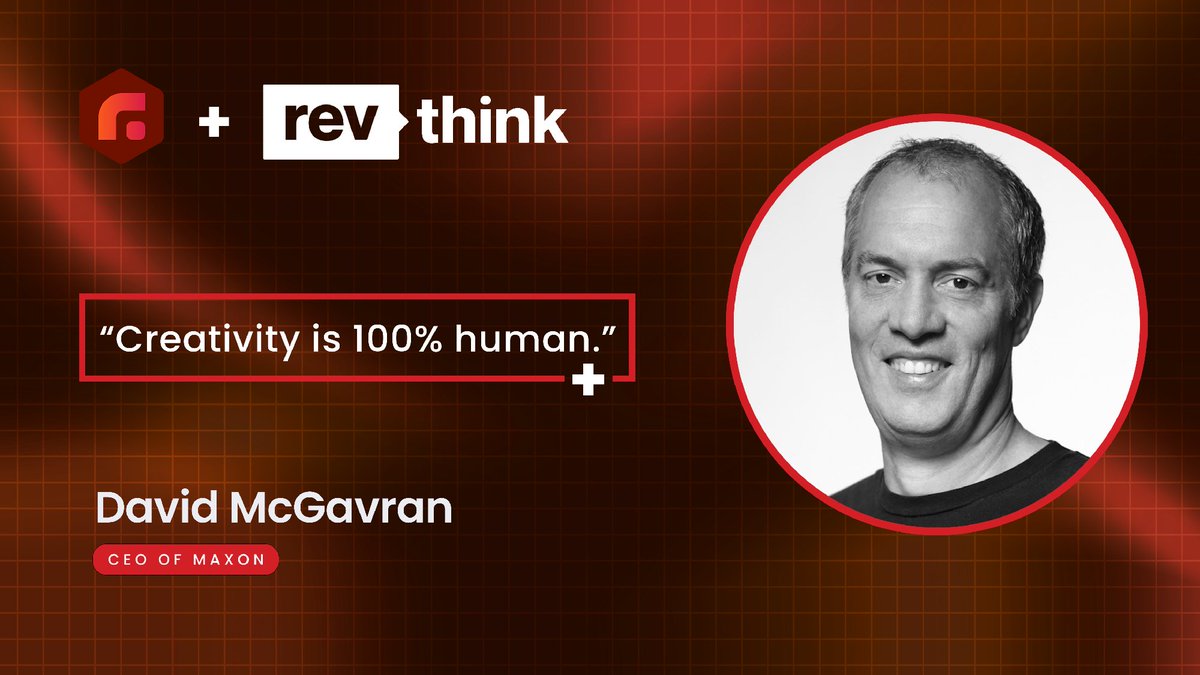
ALT This image features a promotional graphic with a red and white theme. On the left, the logos of Maxon Red Giant and Rev Think are visible. A quote reads, "Creativity is 100% human." On the right, there is a black and white photo of a smiling person in a circular frame. Below, the text reads "David McGavran, CEO of Maxon."
1
2
540

31 Jan 2025
Happy to share that RevThink has been accepted to #NAACL2025 main conference! 🎉We also release the code and data 👇🧵
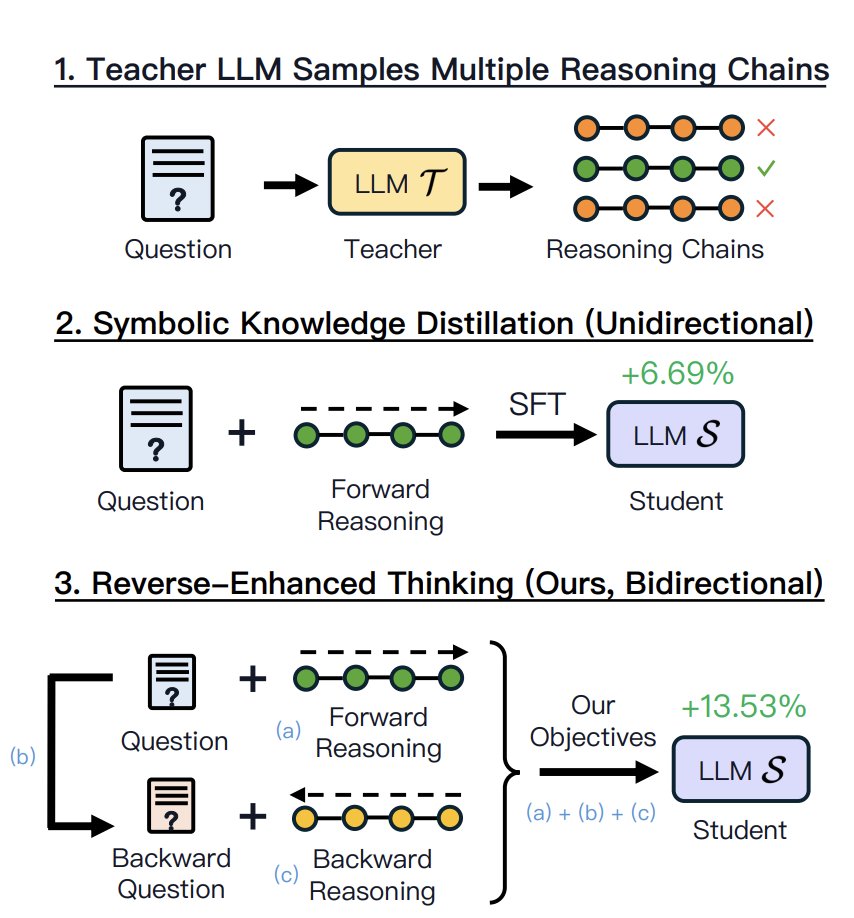
RevThink shows that LLMs can also benefit from reverse thinking (like we often do) 👉13.53% gains on 12 datasets (including MATH, ARC, ANLI, etc) sample efficiency strong generalization!
2 Dec 2024

🚨 Reverse Thinking Makes LLMs Stronger Reasoners
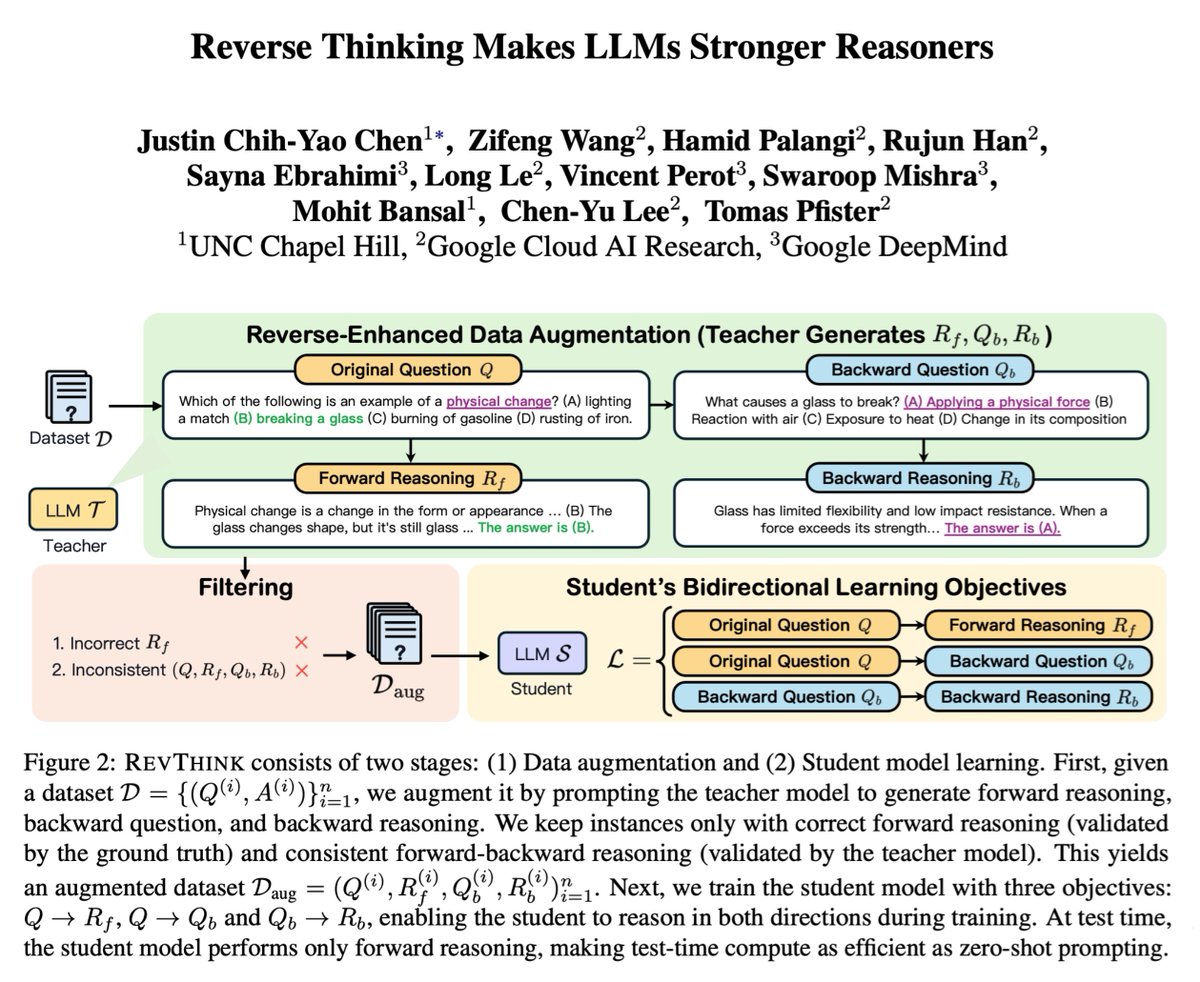
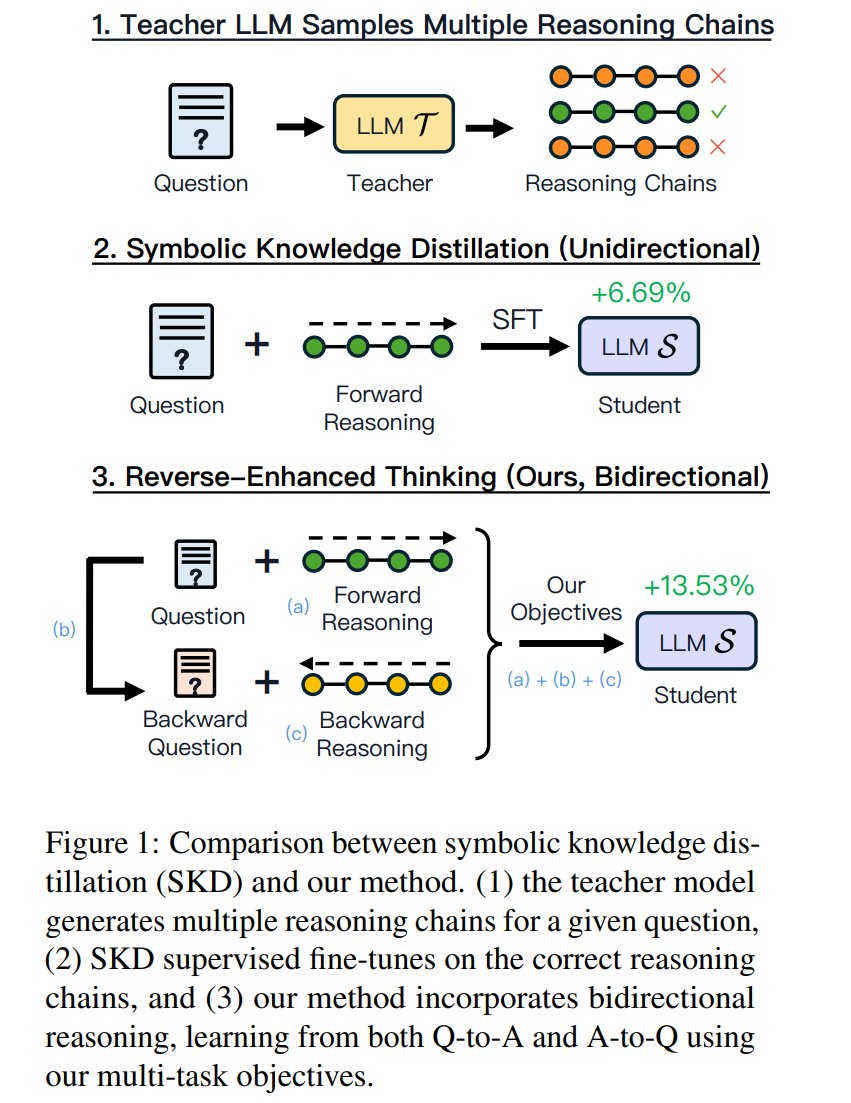
We can often reason from a problem to a solution and also in reverse to enhance our overall reasoning. RevThink shows that LLMs can also benefit from reverse thinking 👉 13.53% gains sample efficiency strong generalization!
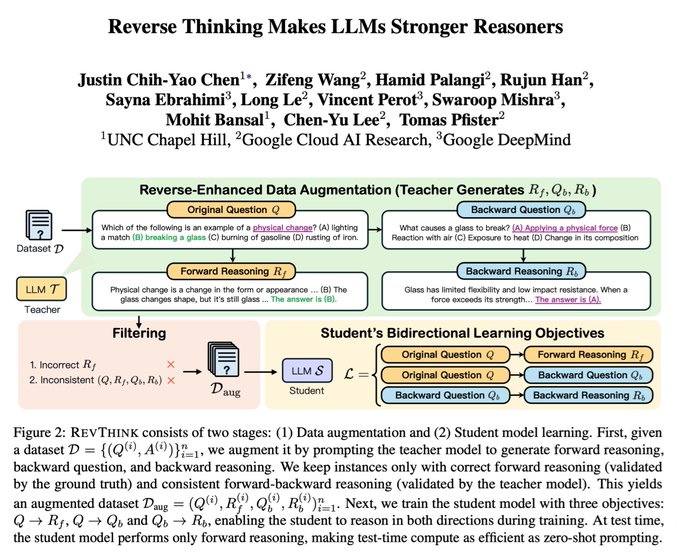
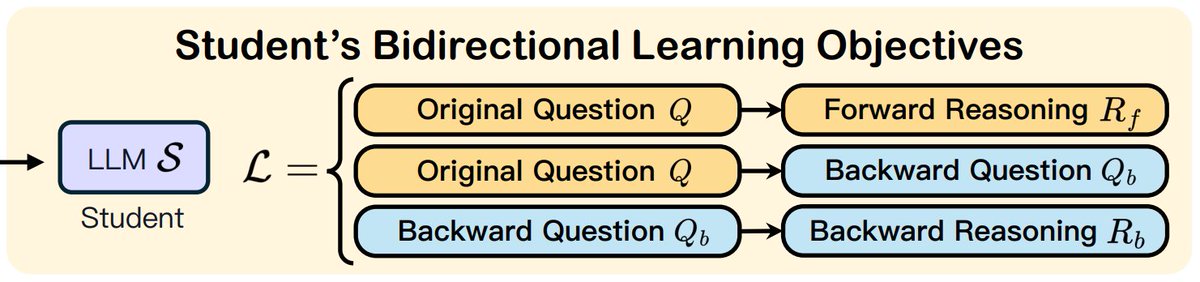
-- We train a student LLM to generate forward reasoning and backward question from a question, and backward reasoning from backward question using a joint objective.
-- Across 12 datasets on commonsense, math, logical reasoning and NLI, RevThink shows an average 13.53% improvement over the student LLM’s zero-shot performance and a 6.84% improvement over the strongest knowledge distillation baselines.
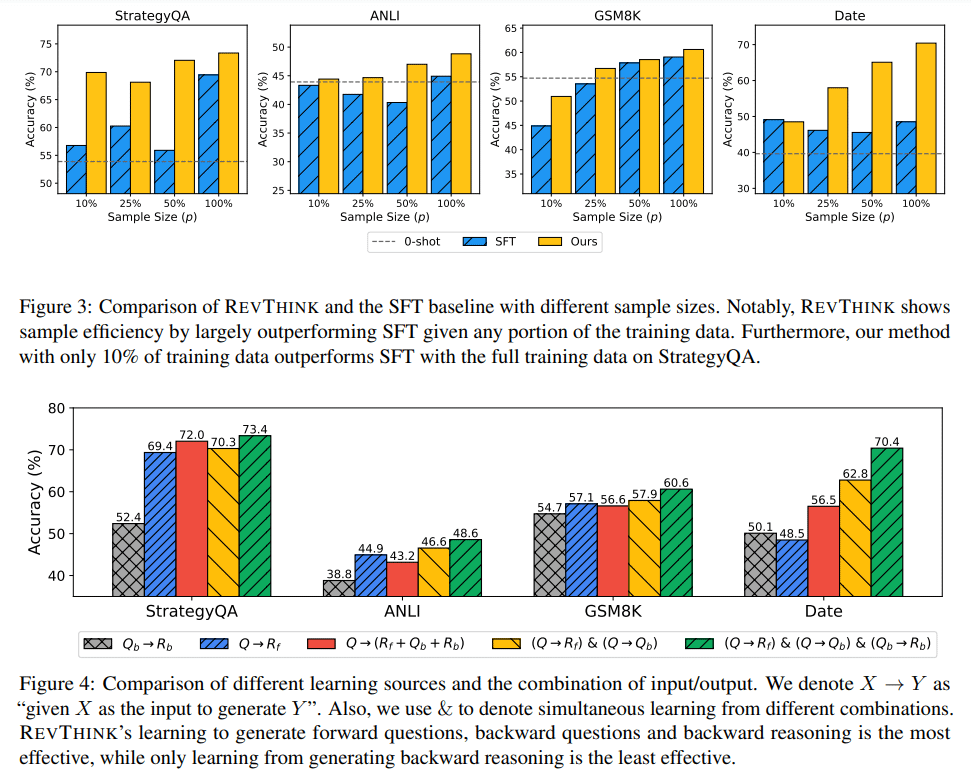
-- Using only 10% of the correct forward reasoning from the training data, RevThink outperforms a standard fine-tuning method trained on 10x more forward reasoning.
-- RevThink also exhibits strong generalization to 4 out-of-distribution held-out datasets.
🧵
3
41
117
9,184

9 Dec 2024
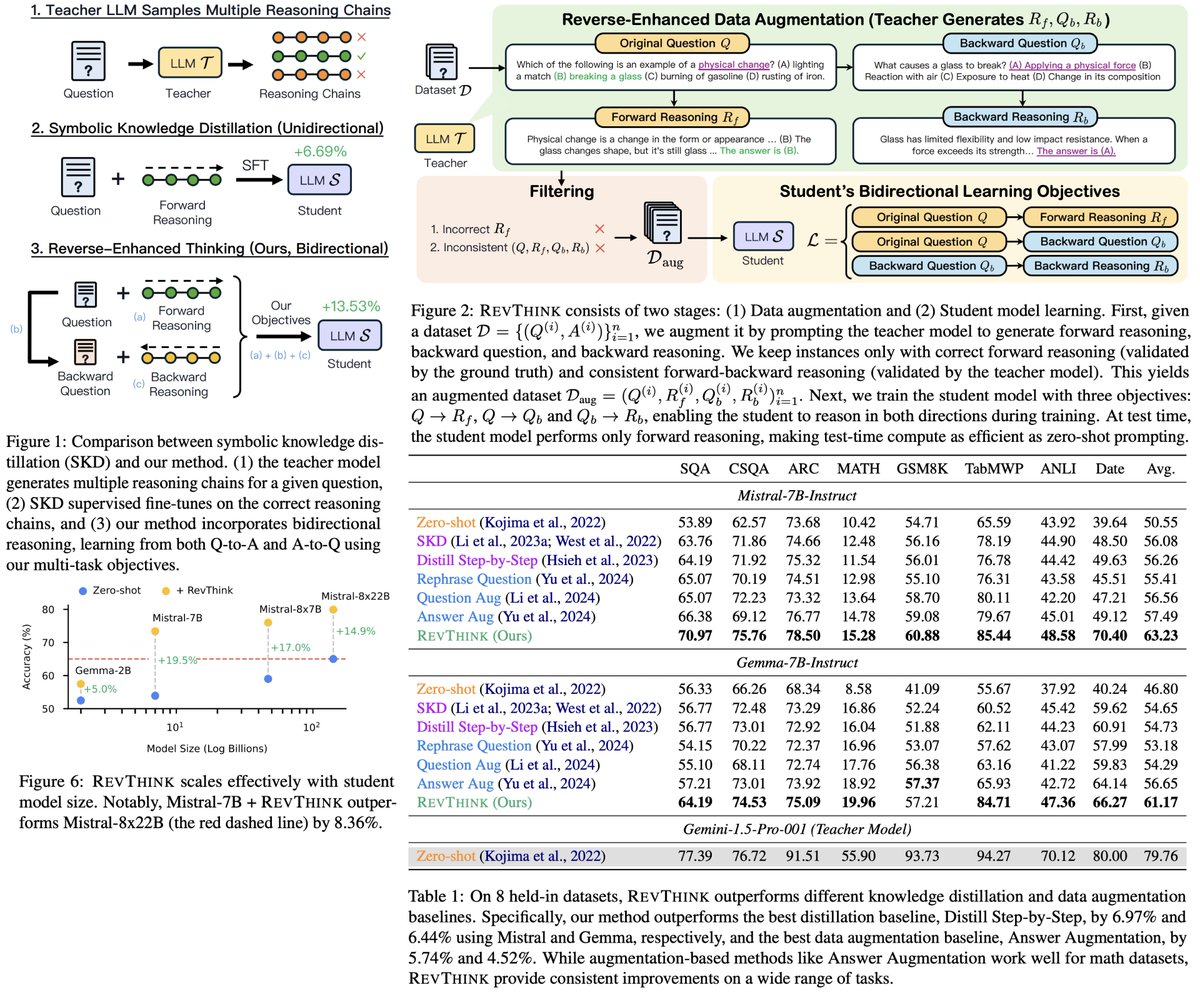
RevThink: enables LLMs to reason forward and backward, boosting performance by 13.53%, achieving sample efficiency with just 10% data, and generalizing well to new datasets!
arxiv.org/abs/2411.19865
andlukyane.com/blog/paper-re…
2
161

8 Dec 2024
Reverse Thinking Makes LLMs Stronger Reasoners
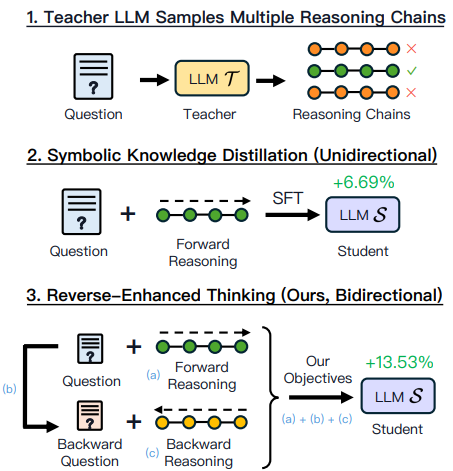
A framework that enhances LLM reasoning by incorporating reverse thinking alongside traditional forward reasoning.
Problem:
LLMs struggle with consistency and reasoning accuracy, lacking the ability to reason backward from a solution to a problem.
Method:
Introduces Reverse-Enhanced Thinking (REVTHINK), a framework that augments datasets with forward-backward reasoning pairs and trains a student model using multi-task objectives: forward reasoning, backward question generation, and backward reasoning.
Insights:
Combining forward and backward reasoning improves consistency and reasoning accuracy, achieving significant gains with high sample efficiency and strong generalization to unseen datasets.
Results:
Achieves a 13.53% reasoning performance improvement over baseline models and strong generalization with only 10% of the forward reasoning training data, outperforming traditional fine-tuning methods trained on 10× more data.
Authors @cyjustinchen and @ZifengWang315 are on alphaXiv this week to discuss the paper!
1
6
108

8 Dec 2024
You are seriously onto something! I read a paper the other day about Reverse-Enhanced Thinking (RevThink) which teaches AI to reason forward and backward.
It was a wildly succesful study and I feel like it goes hand and hand with this.
2
19
678

8 Dec 2024
Reverse Thinking Makes LLMs Stronger Reasoners
arxiv.org/pdf/2411.19865
✍️@cyjustinchen @ZifengWang315 et al. via @arxiv
💡"We can often reason from a problem to a solution and also in reverse to enhance our overall reasoning. RevThink shows that LLMs can also benefit from reverse thinking: 13.53% gains sample efficiency strong generalization!"
h/t @JohnNosta
cc @Maria_Axente @sonu_monika @JagersbergKnut @ahier @sim010101 @Shi4Tech @Corix_JC @maponi @BetaMoroney @PerBBerggreen @CEO_Aisoma @SpirosMargaris @dinisguarda @mvollmer1 @rvp @sallyeaves @FernandaKellner @YvesMulkers @LouisColumbus @AndrewinContact @ChuckDBrooks @JoannMoretti @NeiraOsci @tlloydjones @sulefati7 @SusanHayes_ @theomitsa @TarakRindani @Nicochan33 @Annerobinsons @Analytics_699 @Khulood_Almani @TheAIObserverX @drsharwood @NathaliaLeHen @sminaev2015 @KanezaDiane @MHcommunicate @CurieuxExplorer @treasadovander @mikeflache @DanielleLargier @chidambara09 @FrRonconi @amalmerzouk @RLDI_Lamy
2
34
47
2,302

8 Dec 2024
1/n Enhancing LLM Reasoning with Reverse Thinking
Large Language Models (LLMs) have demonstrated remarkable capabilities in various tasks, yet their reasoning abilities remain a significant area for improvement. While humans leverage reverse thinking—reasoning from the solution back to the problem—to strengthen their understanding and identify errors, current LLM reasoning methods primarily focus on forward reasoning, often using backward reasoning only as a post-hoc verification step, predominantly in structured domains like mathematics. This limitation raises two crucial questions: Can reverse thinking be effectively applied to broader, less structured domains? And, can we train LLMs to inherently think backward, thereby improving their overall reasoning capabilities?
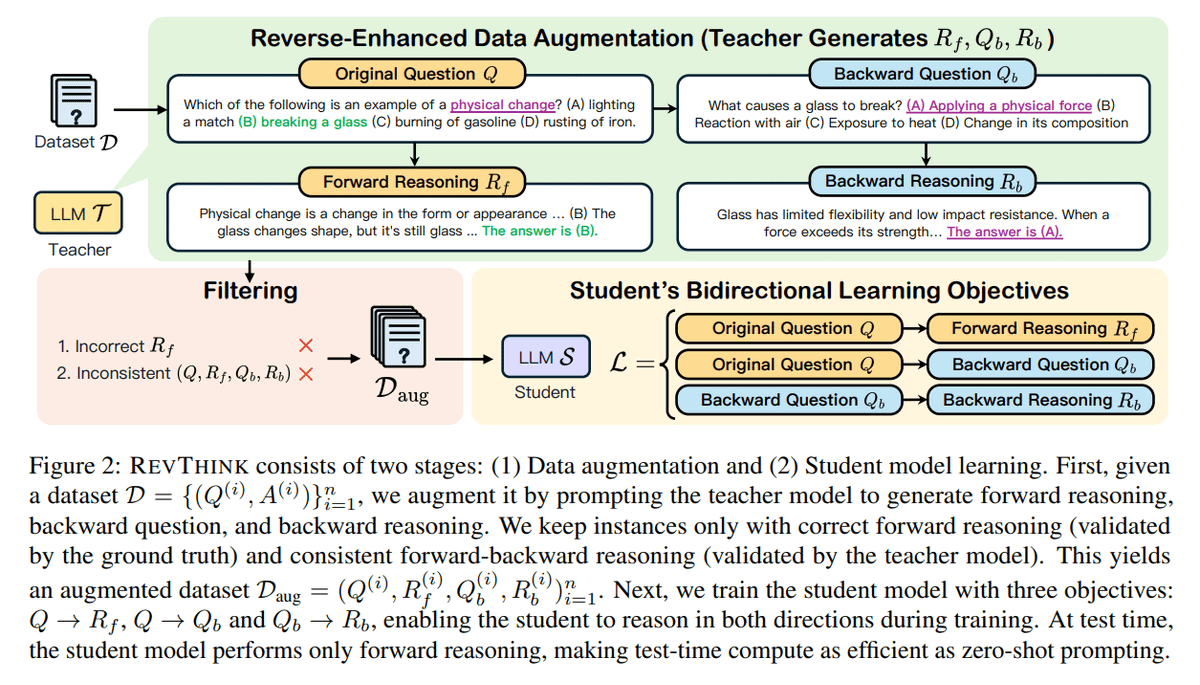
This paper proposes REVTHINK, a novel framework that addresses these questions by incorporating reverse thinking directly into the training process of LLMs. REVTHINK consists of two key stages: data augmentation and multi-task learning. In the data augmentation stage, a teacher LLM generates forward reasoning chains, backward questions, and backward reasoning chains for a given dataset. This augmented data provides a richer training signal that encompasses both forward and reverse reasoning processes. Crucially, the data is filtered to ensure the correctness of forward reasoning and the consistency between forward and backward reasoning paths.
The second stage involves training a smaller student LLM using three learning objectives: generating forward reasoning from a question, generating a backward question from the original question, and generating backward reasoning from the backward question. This multi-task learning approach encourages the student model to learn the intricate relationship between forward and reverse reasoning, effectively internalizing the ability to think backward. Importantly, during inference, the student model only performs forward reasoning, maintaining the computational efficiency of zero-shot prompting.
The effectiveness of REVTHINK is demonstrated through extensive experiments across twelve diverse datasets covering commonsense, mathematical, logical reasoning, and natural language inference. The results consistently show that REVTHINK significantly outperforms existing methods, including strong knowledge distillation baselines. Notably, REVTHINK demonstrates remarkable sample efficiency, achieving superior performance with significantly less training data compared to traditional methods. Furthermore, the framework scales effectively with model size, and exhibits strong generalization capabilities to unseen datasets.
In contrast to prior work that primarily focuses on test-time reasoning enhancements or limits the application of reverse thinking to structured domains, REVTHINK integrates bidirectional thinking directly into the training process. Unlike methods that use backward reasoning solely for verification, REVTHINK trains the model to inherently reason backward, leading to substantial improvements in forward reasoning performance. This approach represents a significant advancement in LLM training, offering a more general and effective way to enhance reasoning abilities across a wider range of tasks. By internalizing reverse thinking, REVTHINK unlocks the potential for LLMs to become more robust and effective reasoners, paving the way for more sophisticated and reliable AI systems.

2
21
53
2,865

7 Dec 2024
Reverse Thinking Makes LLMs Stronger Reasoners
Author's Explanation:
x.com/cyjustinchen/status/18…
Overview:
Reverse-Enhanced Thinking (RevThink) combines data augmentation and multi-task learning to improve reasoning in LLMs by training a model to reason both forward and backward.
Achieving a 13.53% performance increase across commonsense, math, and logical reasoning tasks and demonstrating superior sample efficiency and generalization.
Paper:
arxiv.org/abs/2411.19865
2 Dec 2024
🚨 Reverse Thinking Makes LLMs Stronger Reasoners
We can often reason from a problem to a solution and also in reverse to enhance our overall reasoning. RevThink shows that LLMs can also benefit from reverse thinking 👉 13.53% gains sample efficiency strong generalization!
-- We train a student LLM to generate forward reasoning and backward question from a question, and backward reasoning from backward question using a joint objective.
-- Across 12 datasets on commonsense, math, logical reasoning and NLI, RevThink shows an average 13.53% improvement over the student LLM’s zero-shot performance and a 6.84% improvement over the strongest knowledge distillation baselines.
-- Using only 10% of the correct forward reasoning from the training data, RevThink outperforms a standard fine-tuning method trained on 10x more forward reasoning.
-- RevThink also exhibits strong generalization to 4 out-of-distribution held-out datasets.
🧵
3
1
15
1,706

7 Dec 2024
🤔Reverse thinking might be the boost LLMs need to reason like humans. The RevThink framework trains models to solve problems by reasoning forward and then working backward from the solution—it’s a bit like going back and checking your work.
arxiv.org/pdf/2411.19865
#AI #LLMs
5
5
15
1,689

6 Dec 2024
6. Benefits of RevThink:
• It improved performance by 13.53% over the model's initial ability and 6.84% over other methods.
• It works well even with limited training data. RevThink's 10% data outperformed full-dataset methods.
• RevThink effectively scales to larger models and adapts well to new types of questions.
1
2
789
6 Dec 2024
4. Training the student model
It's trained on the augmented dataset to:
• Solve the original question (forward reasoning).
• Create the backward question.
• Solve the backward question (backward reasoning).
These tasks are integrated into a multi-task RevThink framework, and the model learns all 3 tasks together, reinforcing the connections between forward and backward thinking.
1
2
158
6 Dec 2024
1. The RevThink framework trains a smaller AI model (the student) how to reason in both ways in two stages:
• Data augmentation: Creating extra training data with regular and reverse questions.
• Training the student to reason forward and backward with this enriched data.
1
6
268