

Apr 23
The metacircular evaluator is just a fun demonstration and a good basis for building experimental languages on top of scheme. As for the second question, the greatest benefit is imo enforcing invariant with strong typesystems in FP langs
1
7
784


Jan 17
‘Sound Default-Typed Scheme’ by Jan-Paul Ramos-Davila
janpaul.pl/assets/pdfs/25_sc…
Presentation at ICFP/SPASH’25: youtu.be/VszVHbIX71c
Found via racket-stories.com
#types #typesystems
1
12
1,018

GC is rarely if ever cheaper on average. The cost is not in allocation or even collection but dramatically worse memory locality and cache efficiency, especially with higher level typesystems typically preferred by GC languages so overhead of indirections and headers is large.
3
234

Jan 2
using typesystems properly is one of the best ways to make coding agents effective.
type checking is much faster and (if constructed well) more accurate than running tests
1
18
1,737

25 Nov 2025
Unsound typesystems will consume you whole. Sound, only!
24 Nov 2025

"The fact that there can be runtime type errors that were proven impossible at compile time is why I will never enjoy TypeScript."
This comment reflects my intuition about TS: you can get into a situation where using TS actually makes your code _less safe_ than if you used other mechanisms to guarantee safety.
1
26
2,600

5 Nov 2025
why would u want the compiler to shut up. static analysis is amazing. the best devs i know all appreciate strong typesystems and other tools cos they are aware of how easy it is to mess things up. kotlin is even kind of moving in the direction of result types like rust
2
12
532

8 Oct 2025
What is the origin of Lambda? Why does everything go back to Cadiz?
Only 2 weeks for Lambda World 2025
- October 23-24
- lambda.world/tickets/
#FunctionalProgramming #Lambda #CategoryTheory #TypeSystems #Haskell #Scala #OCaml #Rust #Elixir
3
3
931
1 Oct 2025
The Mastermind behind Refinement Types, at Lambda World 2025!
Have you ever wondered if types in programming languages can do more than just describe data? What if they could think? What if your code could be proven correct before it even runs?
Jorge Luis Mayoral Pérez and Juan José Madrigal Martínez invite you to dive into the fascinating world of refinement types.
Learn more about Jorge, Juanjo, and their talk here: lambda.world/speakers/?speak…
lambda.world/speakers/?speak…
#RefinementTypes #SMTSolvers #FunctionalProgramming #TypeSystems
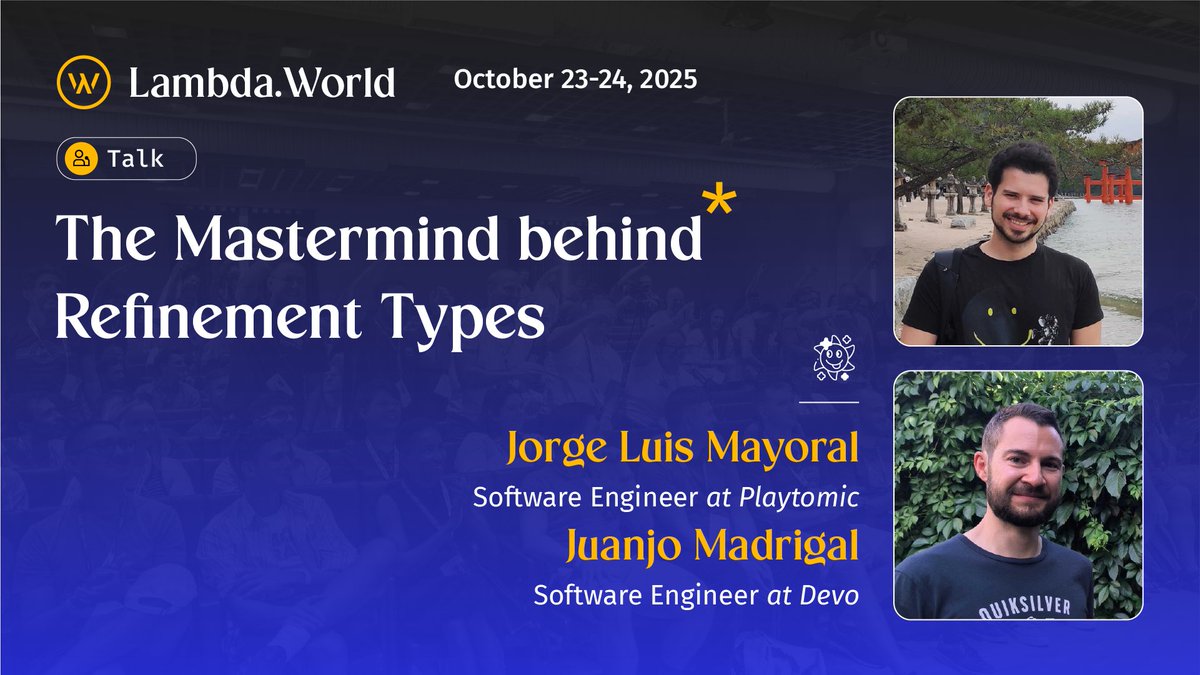
ALT Jorge Luis Mayoral & Juanjo Madrigal talk
4
10
474
22 Sep 2025
LAST DAY 🐟 Standard Tuna Ticket for Lambda World ’25!
Tomorrow: €300. Don’t be the one wishing you’d spent it on cartuchitos de camarones in Cádiz.
Oct 23–24 · Cádiz · lambda.world
#FunctionalProgramming #Haskell #Scala #CategoryTheory #TypeSystems #EffectSystems #Kotlin #Rust #Elixir #Beam

ALT Lambda World sticker looking like Judas Priest album Screaming for Vengeance but here is Screaming for Functors and the fonts of Lambd a WOrld
3
8
413
For OO, I would argue that CLOS (1991) is vastly superior to C-with-classes (1978), yet everyone copies the latter and not the former.
For typesystems, I would say that Fortress (2000s) beats ML (1970s) but languages don't do much better than ML, perhaps bastardized with C .
2
1
19
624
Scheme is relatively simple compared to other languages. It is unencumbered by inexpressive typesystems that prevent you from writing the programs you want in the style you want. It has first class continuations, macros, and lately, a module system and standard libraries.
1
3
91

11 Aug 2025
🚀 Just published a deep dive into Decipad's unit conversion system!
Most programming languages treat numbers as dimensionless, leading to costly errors (remember the $125M Mars Climate Orbiter failure?).
Decipad embeds units directly into the type system, making unit correctness a compile-time concern rather than a runtime risk.
From simple conversions to complex dimensional analysis, see how we handle it all with rational number arithmetic for perfect precision.
Check it out: metaduck.com/units-conversio…
#ProgrammingLanguages #TypeSystems #ScientificComputing #Decipad

3
4
359
30 Jul 2025
IMO one of the hardest open and most valuable problems in databases is how to make the performance of filtering and aggregating dynamically typed JSON approach the performance of a static schema.
It's conceptually similar to the problem of JIT compiling Javascript and making it as fast as native code in the browser.
Here's why:
* In a columnstore, you get to see all the data at ingest time, and can optimize (in large batches) how it's stored. Simple JSON structures that actually have a consistent schema should literally == the performance of a static schema.
* But most databases are quite lazy in their optimizer and query execution engine, both of which are usually designed for static typesystems. Instead of rebuilding those to defer type assumptions to runtime, databases tend to generate slower runtime code (w/ extra branching and so on). The optimal implementation generates perfect static operators per large batch. I'm not aware of any commercial systems that do this.
* And of course, real-world JSON is rarely consistent. At least in Braintrust's workload, we see extremely high cardinality data (e.g. lists of json objects where each object has a unique set of keys). So figuring out how to store that efficiently is wild. I don't want to make fun of commercial systems but if you see things like "JSON is just a string" or "max JSON paths" that means that the system is not going to handle real workloads.
2
1
18
1,674

1 Jul 2025
`LLDB's TypeSystems: An Unfinished Interface`
Rust <> LLDB, making Rust debugging better
walnut356.github.io/posts/ll…
9
318
30 Jun 2025
I think one of the interesting advantages that languages with built-in typesystems in the compiler (C , Golang, Rust, Java) have is that libraries do not (usually) take conflicting dependencies on the type->code generators.
Anyone who has executed a complex update of Pydantic or Zod knows this well, especially if you are a library maintainer...
I hope at least in Typescript that at some point the compiler itself can do code generation.
2
800

7 Apr 2025
9. Walnut wrote LLDB's TypeSystems: An Unfinished Interface, - a deep dive into his experience creating a custom TypeSystem for the LLDB debugger, specifically for improving Rust debugging.
walnut356.github.io/posts/ll…
1
2
324