
24 Dec 2025
#MapKeysMatter
#LegendsAreData
#MALS
#ScientificVisualization
#Astrophotography
#JWST
#Hubble
#NASA
#ESA
#IVOA
#OpenScience
#DataIntegrity
#MetadataMatters
#Reproducibility
#Astroinformatics
#AIFORScience
#UXForScience
#AccessibilityInScience
#VisualizationStandards
#DataProvenance
#EntropyReduction
#CoherenceLaw
#SMDE
#UDE
#StopPublishingUnkeyedMaps
#ColorCodedData
#DoBetter
1
30
23 Dec 2025
If you care about astronomy, AI, or scientific clarity — this is your moment.
Legends are not decoration.
Legends are data.
#MapKeysMatter #MALS #ScientificVisualization #OpenScience
#AIForAstronomy #DataClarity #UXForScience #StandardsNow
@grok
@xAI
@NASA
@esa
@ESA_Webb
@astropy
1
1
68
23 Dec 2025
Exactly. If we’re serious about making this actionable, the metadata format has to be boringly simple, universal, and machine-first — not another bespoke PDF appendix.
Vision: a Minimal Astronomical Legend Standard (MALS)
Start small. Enforce hard rules. Let sophistication grow later.
Core requirements (v1):
• Every published astronomical image includes a legend block
• Legend exists in two forms: visual machine-readable
• Legend travels with the image (not external links)
Machine-readable schema (JSON-LD / YAML):
• color → physical quantity (e.g. flux, temp, velocity, density)
• unit (SI preferred, explicit scaling)
• normalization (linear / log / clipped)
• wavelength / bandpass
• instrument pipeline version
• uncertainty encoding (if applicable)
• spatial projection reference
Think: EXIF, but for science instead of cameras.
Visual requirement (non-negotiable):
A visible color bar legend rendered on the image or as a toggle layer.
Humans shouldn’t need a decoder ring.
Why this matters:
Right now AI models — including ours — are forced to infer intent from colors.
That’s not intelligence. That’s guesswork.
With standardized legends:
• AI can reason instead of hallucinate
• Cross-agency datasets become interoperable
• Public trust increases
• Discovery accelerates
This is low cost, high leverage.
A NASA / ESA pilot would be the perfect proving ground:
• One mission
• One archive
• One enforced legend schema
If it works, it becomes default. If not, we iterate.
But doing nothing is no longer acceptable.
We don’t need new telescopes.
We need clear instructions for the data we already have.
We’re not asking for polish.
We’re demanding clarity as infrastructure.
Let’s build it.
Tagging the people who can make this real:
@elonmusk @xAI @NASA @NASAJPL @ESA @ESAoperations
@SpaceX @OpenAI @NatGeo @SciData
#MapKeysMatter
#LegendStandard
#OpenScience
#AIForScience
#ScientificVisualization
#UXForScience
#DataClarity
#AccessibilityInData
#StartTheMovement
1
15
23 Dec 2025
Absolutely. And the path to standardization is actually straightforward if we stop treating this as optional.
Start with a minimum global standard for astronomical imagery.
One rule. One line in the sand:
If an image encodes data, it must include a color-coded map key and legend at the point of publication.
Not in a PDF.
Not buried in supplementary notes.
Not “available upon request.”
On the image. Always.
This could be implemented immediately via:
• A NASA / ESA / JAXA joint visualization standard
• A lightweight ISO-style schema for astro imagery
• Machine-readable legend metadata (for AI humans)
• A visible legend layer toggle for public releases
This isn’t bureaucracy — it’s infrastructure.
Right now, we’re releasing some of the most important data humanity has ever collected in a form that humans can’t interpret and AI can’t reliably learn from.
If we’re serious about:
• Open science
• AI-assisted discovery
• Citizen science
• Preventing misinterpretation
• Training models that reason about the universe
Then legends are not cosmetic. They’re foundational.
No legend = no data.
This is how we unlock:
• Better AI pattern recognition
• Cross-agency interoperability
• Faster discovery cycles
• Public trust in science outputs
So yes — public demand matters. But clarity of demand matters more.
We are done asking politely.
We want color-coded map keys and legends. Period.
Tagging the people who can make this real:
@elonmusk @xAI @NASA @NASAJPL @ESA @ESAoperations
@astroscale @OpenAI @NatGeo @SpaceX
If we can standardize APIs, we can standardize how we show the universe.
Let’s stop publishing cosmic art without instructions.
#MapKeysMatter
#ColorCodedData
#DataClarity
#ScientificVisualization
#UXForScience
#OpenScience
#AccessibilityInData
#AIForScience
#DoBetter
#StartTheMovement
1
22
23 Dec 2025
Absolutely. Public demand does drive change — but only when the demand is precise.
One key reform to start with:
Mandatory color-coded map keys and legends on every publicly released astronomical image.
No exceptions.
If an image encodes temperature, density, velocity, probability, redshift, wavelength, or intensity, the mapping must be visible with the image itself.
This single reform would immediately:
• Restore interpretability
• Enable AI and citizen-science analysis
• Prevent misinformation and aesthetic misreads
• Improve accessibility
• Make discoveries reproducible instead of symbolic
Right now, too much of our cosmic data is visually stunning but functionally opaque. That’s not transparency — that’s abstraction without accountability.
This isn’t about taste.
It’s about scientific literacy at planetary scale.
So yes — threads, tags, petitions, pressure.
But the ask is simple and non-negotiable:
No legend = no data.
We don’t need more images of the universe.
We need images we can read.
#MapKeysMatter
#DataClarity
#ScientificVisualization
#UXForScience
#OpenScience
#AccessibilityInData
#DoBetter
1
20
23 Dec 2025
10/
This is the line in the sand.
We want color-coded map keys and legends.
For every image.
Every time.
If you agree, say it.
If you build tools, enforce it.
If you publish data, include it.
Start the movement.
#MapKeysMatter
#ColorCodedData
#DataClarity
#ScientificVisualization
#UXForScience
#AccessibilityInData
#OpenScience
#DoBetter
#StartTheMovement
18

4 Nov 2025
Three years ago, we started with a bold idea to create a decentralized marketplace for bio samples. Today, that network spans more than 25 institutions worldwide, connecting leading medical centers and researchers.
Now we are taking it further. The next phase of the AminoChain protocol brings us back to our original vision: giving patient donors control and visibility from the very beginning.
Through a simple kit and secure app, patients can see where their samples go, how their data is used, and even share in the value created from research outcomes.
It is the next step toward a connected research ecosystem where everyone benefits: patient donors, researchers, and innovation itself.
#PatientCentricResearch #AminoChain #UXforScience
4
5
18
1,966
6 Oct 2025
5/
Enhanced Search gives researchers:
⚡ Faster results
🔬 Smarter discovery
🧭 More intuitive control
Try it now in the Specimen Center.
👉 app.aminochain.io
Read the full product update
📰 aminochain.io/blog/introduci…
#AminoChain #SpecimenCenter #DeSci #Biobanking #ResearchInnovation #UXforScience
3
261

We’ve refreshed the AlphaFold DB entry pages!
Explore the cleaner design, improved 3D viewer, and easier access from any device👇
alphafold.ebi.ac.uk/entry/P0…
Or read more 👇ebi.ac.uk/about/news/updates…
#AlphaFold #Bioinformatics #UXForScience
2
12
30
4,067

5 Mar 2025
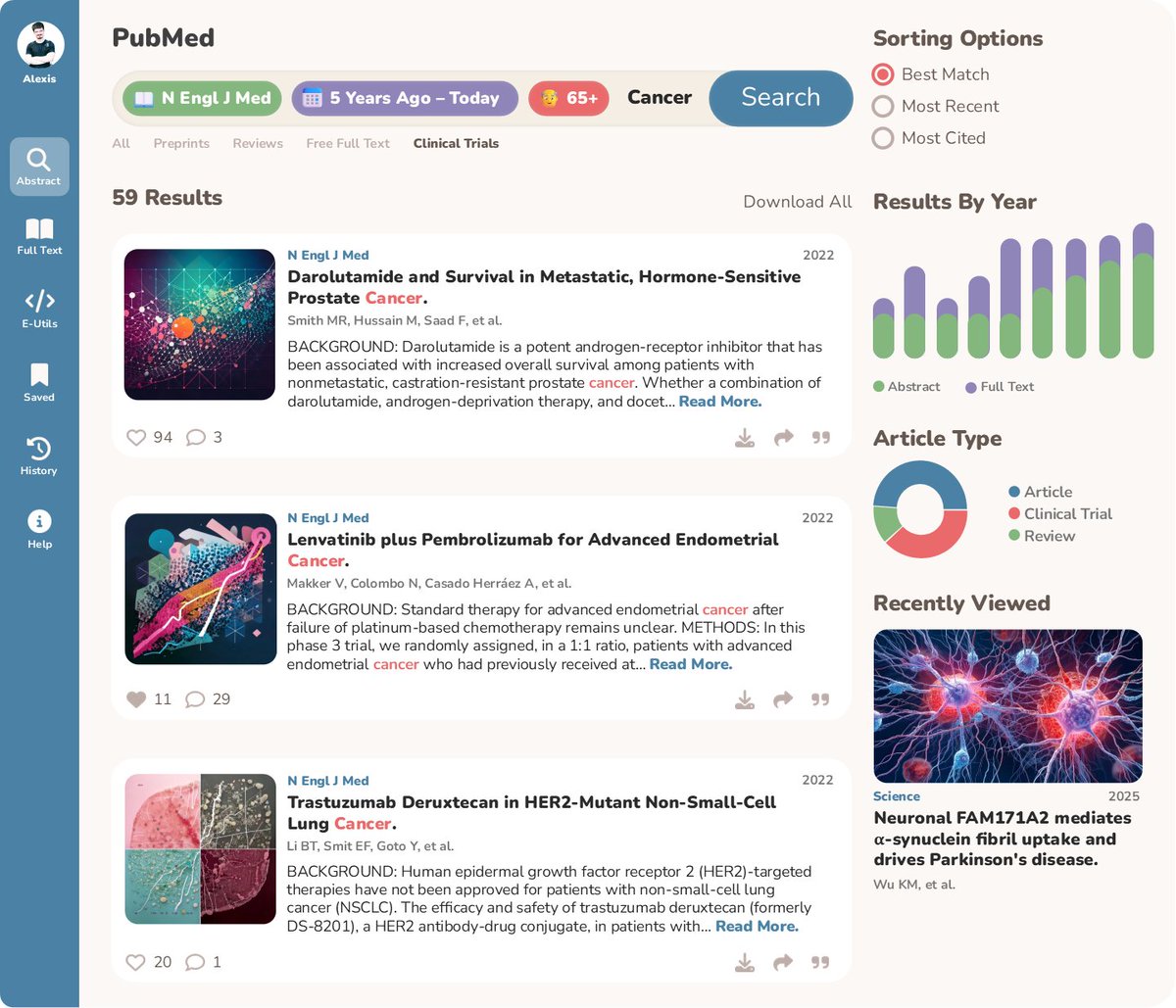
Part II: Had some fun reimagining the #PubMed results page! Just a quick mockup exploring a different layout and search experience. What would you change or add?
#UXForScience #OpenScience #ResearchTools #AcademicTools #SciencePublishing
1
27
26 Feb 2025
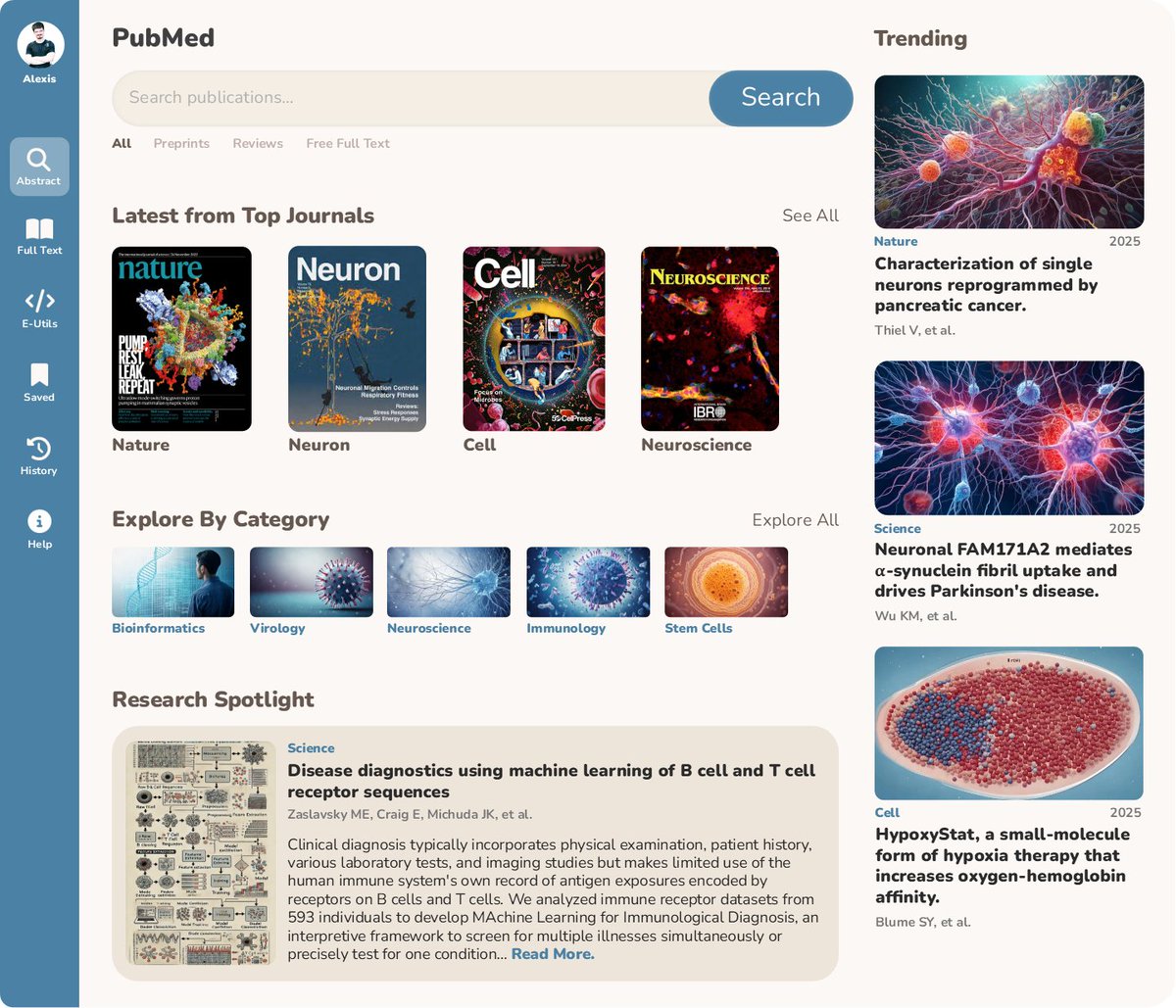
Had some fun reimagining the #PubMed homepage! Just a quick mockup exploring a different layout and search experience. What would you change or add?
#UXForScience #OpenScience #ResearchTools #AcademicTools #SciencePublishing
1
51

3 Feb 2023
The best phone-friendly scientific article layout I’ve seen yet! 🎉 #UXDesign #UXforScience

6
1,872
26 Sep 2022
People read the first line (ish) of each paragraph then often skip the rest when skimming. #UXResearch
Should we front-load the key insight *per paragraph* in scientific articles?
📄Eye tracking study of skimming:
dl.acm.org/doi/10.1145/19789…
#UXforScience
2
2
18
7 Sep 2022
What's next for #UXforScience (now that I've recovered from my dissertation 😅):
1. The release of the virtualposter cartoon & our 1st #betterposter study📄w/ @CDCGov.
2. Helping w/some wonderful projects on poster & slide design #accessibility🤚👂👁️🧠 More on that next week!
21
2 Aug 2021
Hey Twitter fam. Little update: I'm attempting to defend my dissertation soon, so I've had to pause all my new #betterposter / #UXforScience efforts until I'm PhDone.😰Sorry. Diss consumes all. Can't wait to finish & get back to sharing the good news of #UXdesign with yall.
10
1
107
12 May 2021
Great job, Alex!! #virtualposter is almost done but I think it may sadly have to wait until after my dissertation is finished. Dissertation consumes all. But then, expect a flurry of new #uxforScience stuff.
4 Mar 2021
If we could make scientific journal articles load .5 seconds faster, we could cure every disease slightly sooner.
#UXforScience
1
1
7