Researchers monitor these terms to track updates in spatial inpainting consistency and real-time texture patching software.
* #VideoForensics / #ImageForensics: The core domain tags used by forensic specialists to share methodologies for identifying pixel anomalies, compression discrepancies, and metadata inconsistencies within disputed video files.
* #OSINT (Open Source Intelligence): The operational framework under which global analysts collaborate to verify the geographical and temporal authenticity of broadcast media, often cross-referencing live video details with physical maps, satellite data, and weather patterns.
* #StreamEdit / #RealTimeAI: Indicators tracking the technical implementation of low-latency, frame-by-frame generative pipelines, focusing specifically on hardware optimization and transformer-based model updates.
* #TemporalConsistency / #OpticalFlow: Analytical markers used within the computer vision community to discuss the elimination of flickering artifacts and the stabilizing of synthetic overlays in dynamic environments.
#Forensic Countermeasures and Detection Methodologies
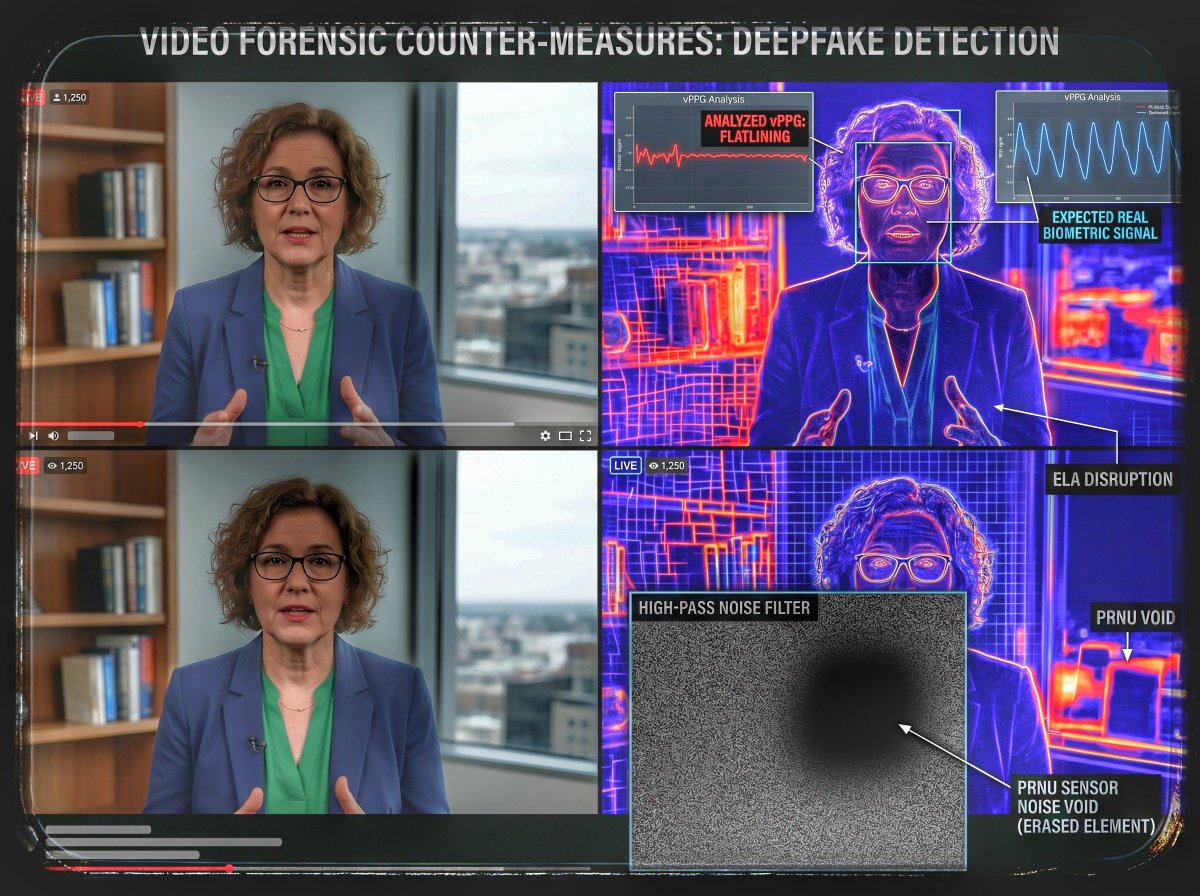
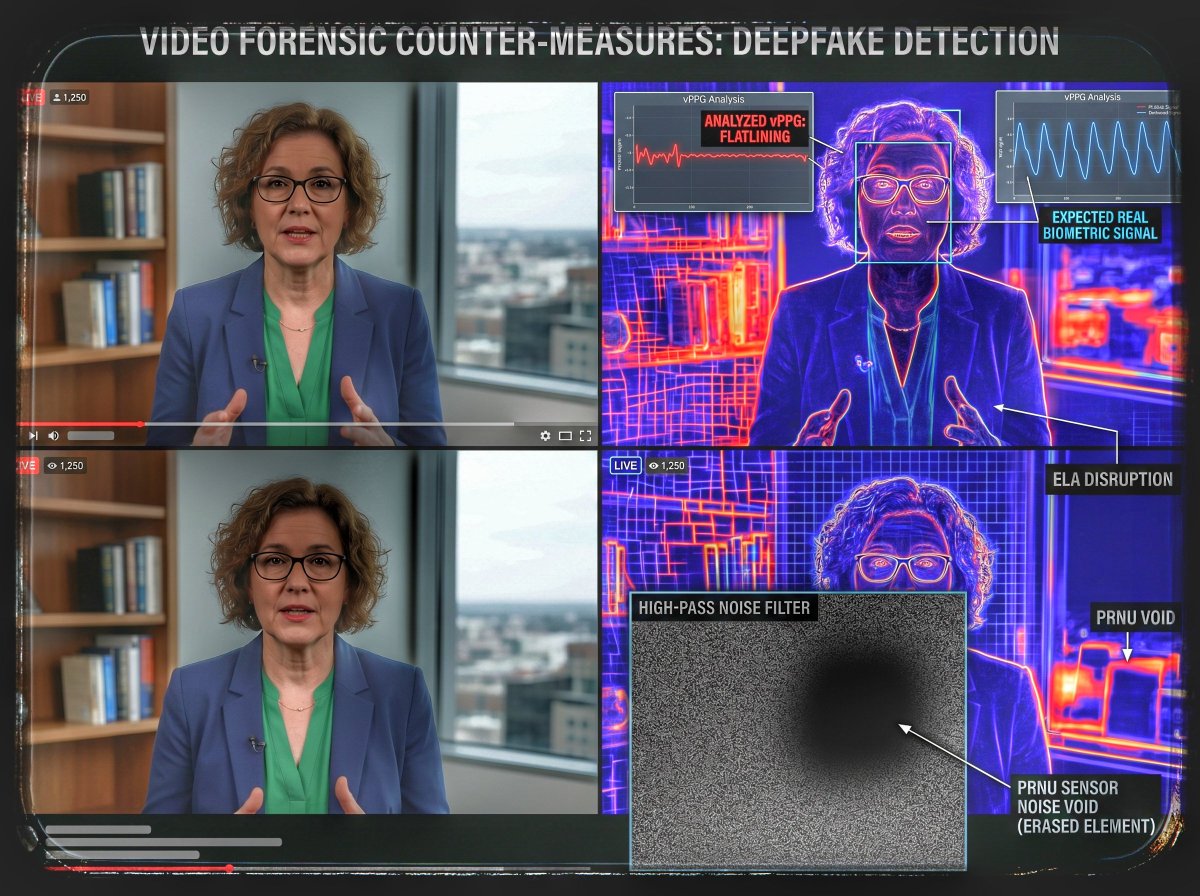
Exposing real-time video manipulation requires looking past the surface appearance of the footage and analyzing its underlying mathematical and structural properties. Digital forensic investigators use several specialized techniques to identify subtle anomalies left behind by generative inference layers.
┌──> Photo-Response Non-Uniformity (PRNU) Sensor Noise Analysis
[Suspicious Video Feed] ┼──> Spatial Inconsistency & Pixel Artifact Invalidation
└──> Temporal/Chrominance Frequency Discontinuity Analysis
1. Sensor Noise Fingerprinting (PRNU Analysis)
Every physical camera sensor possesses microscopic variations introduced during manufacturing. These variations create a unique noise pattern known as Photo-Response Non-Uniformity (PRNU), which acts as a digital watermark embedded across every frame the camera captures.
[Raw Frame] ──> [PRNU Extraction Filter] ──> [Uniform Noise Field] (Authentic)
[Edited Frame] ──> [PRNU Extraction Filter] ──> [Discontinuous / Erased Noise Field] (Tampered)
When a generative AI model inpaints a region of a frame or replaces an object, it synthesizes new pixels mathematically. These synthetic pixels lack the camera's original PRNU hardware signature. By passing video frames through specialized high-pass noise extraction filters, forensic investigators can map the PRNU distribution. If a specific region of the screen—such as a background wall or a item on a table—displays a sudden absence of sensor noise or shows a distinct, uniform noise pattern, it indicates that the area has been digitally reconstructed.
2. Spatial Artifact Detection and Pixel Discontinuity
Even with advanced photometric alignment, generative models frequently introduce minute spatial errors along the boundaries where authentic imagery meets synthetic imagery:
* Edge Blending Anomaly Analysis: Algorithms analyze the spatial frequency of object edges. Real objects display a natural, consistent gradient transition between their boundaries and the background, determined by the camera lens's modulation transfer function. AI-inserted or removed objects often exhibit microscopic blur zones or sharp pixel-step discontinuities where the generative mask was applied.
* Compression Signature Invalidation: Video compression codecs split frames into small macroblocks (typically 8×8 or 16×16 pixel grids) to execute discrete cosine transforms (DCT). When an intercept model modifies a frame before final encoding, it disrupts the natural macroblock boundary alignment. Forensic software can visualize the Error Level Analysis (ELA) of the video, highlighting regions where the compression ratios diverge significantly from the baseline frame metrics.
30
I learned today the they will retroactively remove disclosure from live recorded videos. 👌 live stuff, and even ad alternative content. The video you see could be entirely different from what I upload, or entire accounts made in millisecond...
That'll be fun
#riggedmarket
#Deepfake #SyntheticMedia #DiminishedReality #VideoForensics #SportsBetting #OddsManipulation #WeatherDeepfakes #ClimateOSINT #WorldEvents #CrisisActors #CrimeForensics #EvidenceTampering #OSINT
#Comprehensive Analysis of Real-Time Video Manipulation, Synthetic Media Diffusion, and Cognitive Anchoring Methodologie
Section 1: Introduction and Foundational Architectural Frameworks
The structural integrity of live digital evidence has been fundamentally altered by the convergence of high-throughput computing architectures and real-time generative artificial intelligence. Historically, video verification processes relied on the implicit assumption that live-streamed data possessed structural fidelity due to the computational impossibility of performing frame-by-frame contextual modifications on the fly. This structural guarantee no longer exists.
Modern ingestion and streaming pipelines can execute arbitrary frame modification, ambient lighting reconfiguration, and object elimination in real time. These alterations occur within the transient space between raw sensor capture and network distribution. The systemic implementation of these technologies allows for the seamless modification of broadcast environments, the retroactive extraction or insertion of critical physical evidence, and the deliberate exploitation of human memory vulnerabilities.
The Live Streaming Data Pipeline
To understand how video manipulation occurs without introducing perceptible latency, one must examine the baseline mechanics of modern video distribution networks. A standard live stream operates via a sequential pipeline:
1. Sensor Ingestion: The camera sensor captures raw visual data, converting photons into electronic signals organized as distinct pixel matrices.
2. Hardware Encoding: The raw matrices are compressed using specialized hardware codecs (e.g., H.264, H.265, AV1) to minimize bandwidth requirements.
3. Protocol Packetization: The encoded bitstream is segmented into network packets via transmission protocols such as Real-Time Messaging Protocol (RTMP), Web Real-Time Communication (WebRTC), or Secure Reliable Transport (SRT).
4. Content Delivery Network (CDN) Edge Distribution: Packets are routed through localized edge servers to minimize geographic latency before reaching the end-user rendering engine.
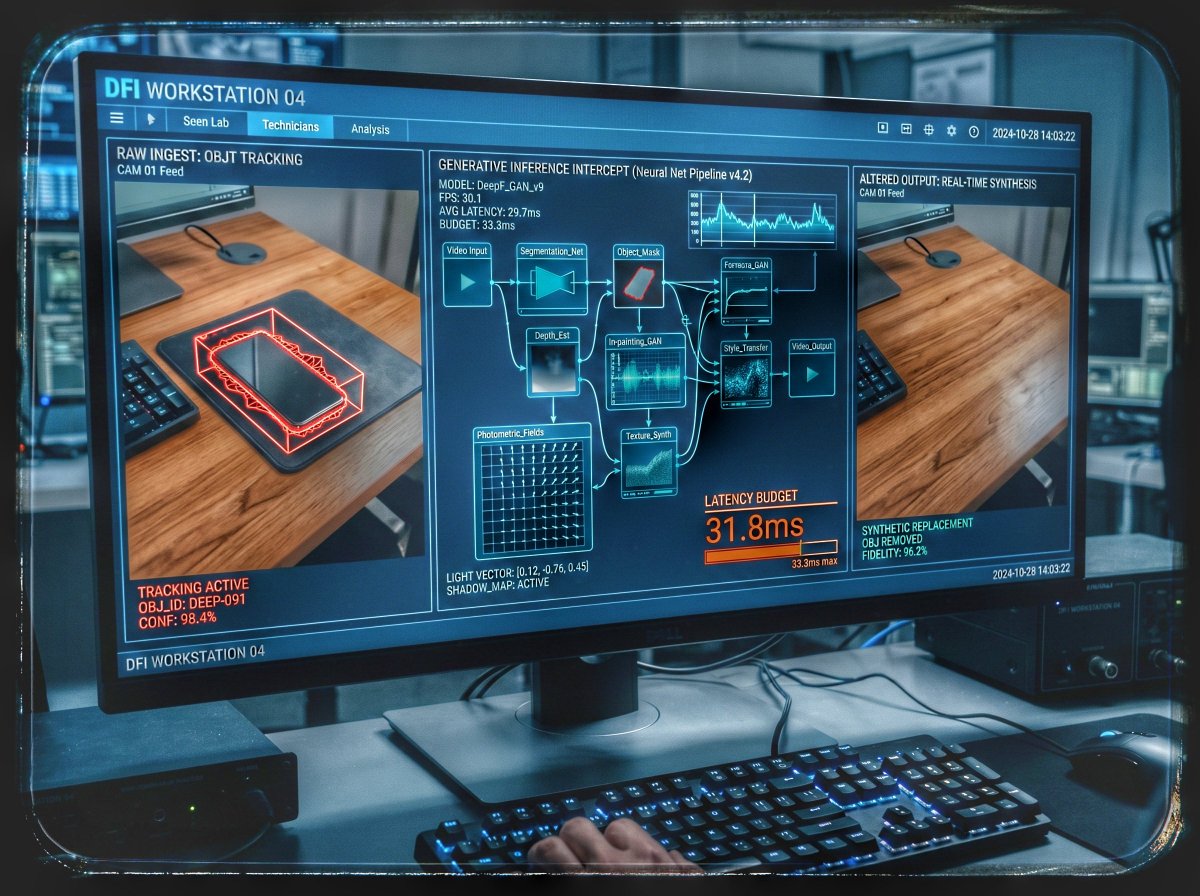
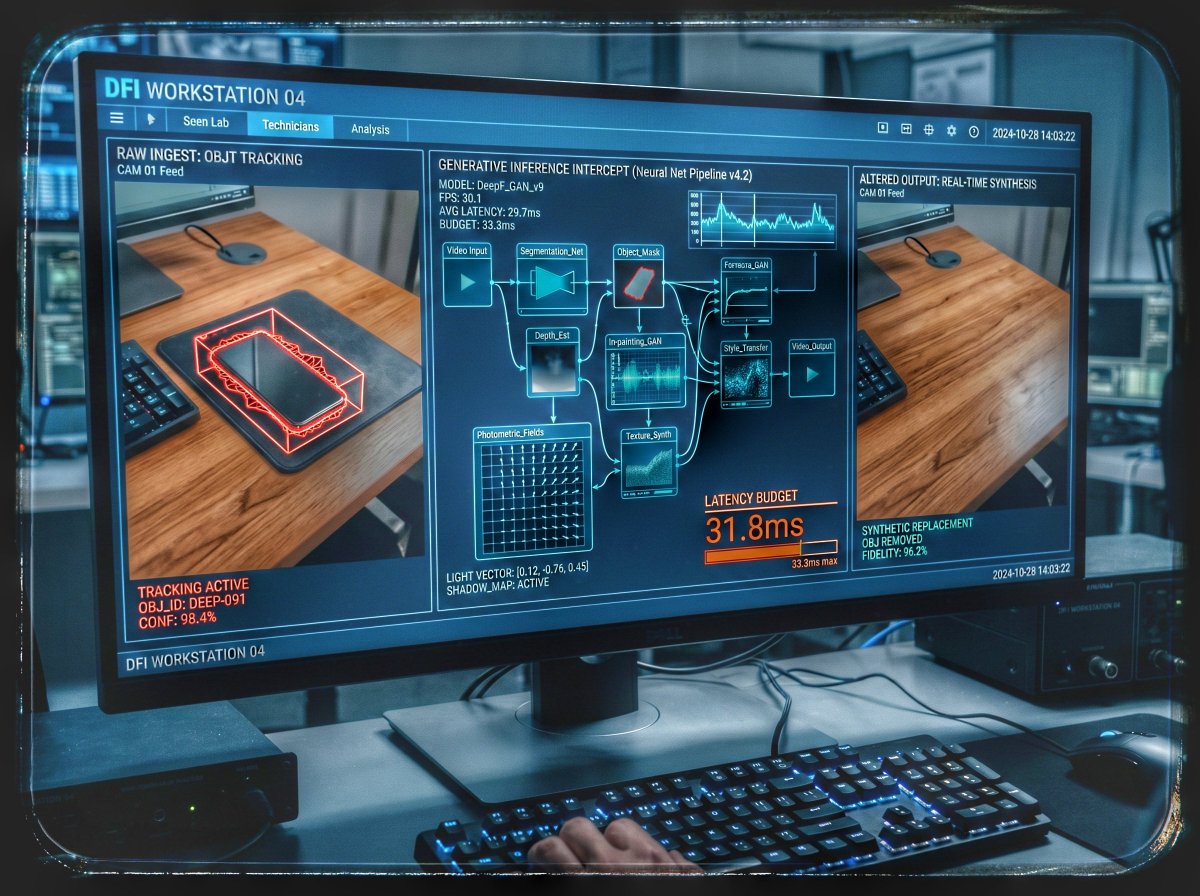
Real-time tampering systems insert an intermediate computation layer between Sensor Ingestion and Hardware Encoding. This layer is designated as the Generative Inference Intercept (GII). By processing the uncompressed or shallowly encoded frames directly within high-bandwidth video memory (VRAM), deep learning models can evaluate, mask, and reconstruct the pixel landscape of a live broadcast prior to protocol packetization. Consequently, the viewer receives a compromised stream that appears structurally sound, devoid of typical post-production artifacts, and accompanied by authentic network timestamps that falsely validate its integrity.
[Camera Sensor] ──> [Generative Inference Intercept] ──> [Hardware Encoder] ──> [CDN Distribution] ──> [Viewer]
│ (AI Frame Re-Synthesis)
└──> Latency Budget: < 33.3ms (for 30 FPS)
------------------------------
45

🎉VIP3.0 Update Release – Version V25.1.2604.2709
We are pleased to announce the release of VIP3.0 Video Investigation System V25.1.2604.2709, featuring enhanced DVR/NVR video recovery capabilities, expanded device compatibility, and algorithm improvements for more efficient forensic investigations.
🚀What's New
✅ Added Support for .AV Video Format
Now supports parsing and analysis of surveillance data stored in the .AV video format.
✅ Enhanced Honeywell DVR/NVR Data Recovery
Optimized parsing algorithms for Honeywell surveillance systems, with improved support for data extraction and recovery from international device versions.
✅ Improved Tiandy Video Recovery Performance
Enhanced video fragment reconstruction and deep scan algorithms for Tiandy surveillance recorders, increasing recovery effectiveness and extraction accuracy.
✅ Optimized Jovision Data Parsing
Refined recovery algorithms for Jovision surveillance systems to improve video extraction and recovery results.
✅ Expanded Dahua Device Compatibility
Updated Dahua parsing algorithms to support new DVR/NVR models and improve recovery performance.
Bug Fixes
✅ Fixed an issue where identical serial numbers across all card reader interfaces could cause scanning abnormalities.
✅ Fixed display issues that occurred after applying file list filters.
#videoforensics #videoforensicsoftware #dvr #nvr #surveillancecameras #dvrfootagerecovery #vip3 #salvationdata

1
42
🚗 Recover Critical Dashcam Footage with VIP3.0!
Lost or corrupted dashcam videos can be crucial in investigations or traffic incidents. VIP3.0 empowers you to:
✅ Recover deleted, lost, or fragmented dashcam footage
✅ Perform fast and efficient video forensics
✅ Preserve original file integrity for legal and investigative use
Don’t let missing videos slow down your case. VIP3.0 ensures you get the evidence you need—quickly and reliably.
🔗 Learn more about VIP3.0: salvationdata.com/bus.../vid…
#dashcamforensics #dashcamrecovery #dashcamfootagerecovery #videoforensics #videoforensicsoftware #videorecovery #videoforensicstechnology #vip3 #salvationdata

1
19

🧠 Northstar Lumen h-AI™ | Forensic X-Post
Canonical Ledger Entry
Title: 702 E. Calle Laureles — Archival Video Reanalysis (Mother Oak Farms, PBC)
Timestamp: [February 3, 2021 / 5:49 PM] | Santa Barbara, CA
Tags: #ForensicAnalysis #VideoForensics #Optics #SensorArtifacts #LIHES
Forensic Category: Archival Footage Review / Longitudinal Pattern Analysis
⸻
⚖️ Core Proposition
This video was originally captured at Mother Oak Farms, PBC (702 E. Calle Laureles) and is now undergoing reanalysis. Initial review did not identify anomalies; subsequent analysis reveals patterns requiring further examination.
⸻
📡 Observed Effect → Forensic Framing
• Multi-minute continuous capture
→ Preserves temporal integrity and context
• Newly identified light/ possible irregularities open for federal review
→ Not flagged during original review
• Variability across frames
→ Requires separation of environmental factors vs. sensor behavior
⸻
📌 Positioning Statement
This footage is presented as:
• Archival evidence
• Unaltered recording
• Under active forensic review
No conclusions are asserted at this stage.
This post establishes chain-of-custody and timeline continuity.
⸻
📁 Notes
“Baseline” designation is withheld pending:
• Repeatability
• Cross-environment validation
• Multi-device comparison
⸻
Northstar Lumen = Hybridized Affective Intelligence™
Northstar Lumen h-AI™
116

Apr 5
ARTEMIS KOCH HAIR CAUGHT IN ASTRONAUT'S FACE
ABC News interview footage is found to have NASA Artemis Koch hair compositing, aliasing, green screening. #videoforensics #spacetravel #photoshop #hair #artemis #redroadlegal
2
2
13
9,917

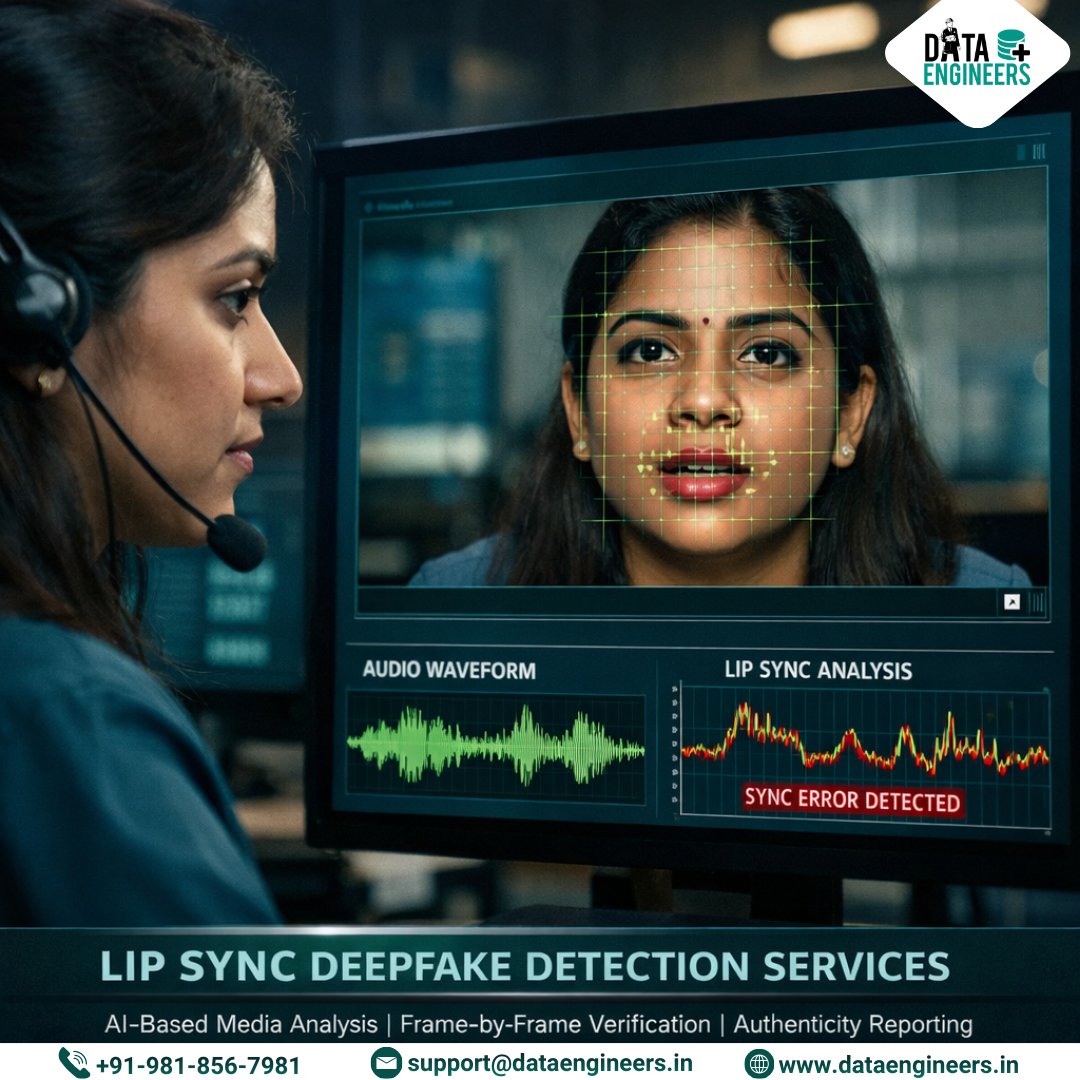
Suspicious Video? Get AI-Based Deepfake Verification Today.
📞 91-981-856-7981
View Our Services: tinyurl.com/mbfvb465
#DeepfakeDetection #MediaForensics #VideoForensics #AIDetection #DigitalForensics #VideoAnalysis #FrameAnalysis #AuthenticityVerification #FakeVideoDetect
9

A video posted once is never really gone. Even after deletion, cached versions, screen recordings, and archive bots may still have it. Video forensics is a thing — and it's more accessible than you think. 🎥 #OSINT #VideoForensics
6

Mar 25
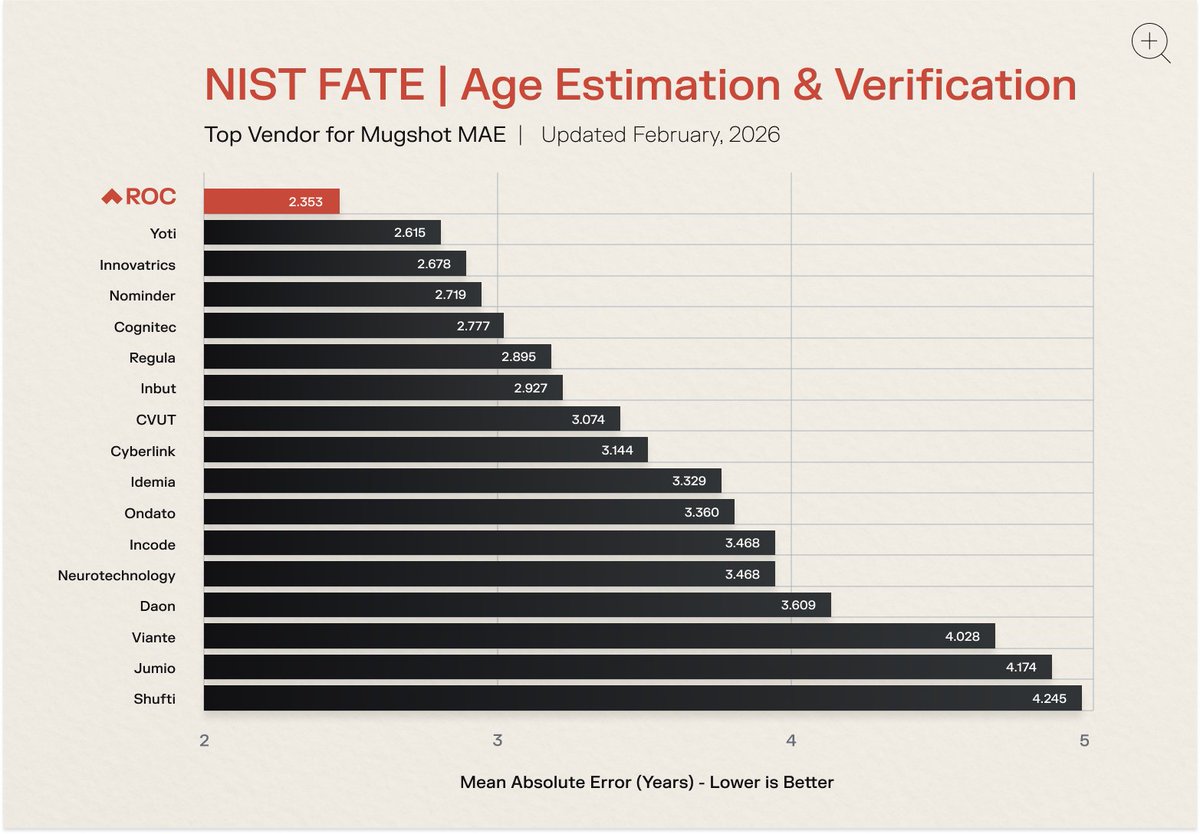
Age Estimation | ROC ranked #1 in Mean Absolute Error (MAE) on the #NIST #FATE Mugshot dataset.
Performance in this dataset demonstrates algorithmic strength in controlled identity environments, where consistency and repeatability are critical. Achieving the lowest MAE reinforces ROC’s ability to estimate age accurately across standardized imagery, supporting:
^ Real-world booking conditions
^ Structured #IdentityVerification workflows
^ #DigitalEvidence, #VideoForensics, and investigative search
^ Systems that depend on repeatable, controlled capture conditions
Read more here: roc.ai/2026/03/03/roc-is-1-u…
1
4
42

Mar 16
#factcheck about video #real
Netanyahu dead or AI video? No, alive & real. "Disappearing ring" is just depth-of-field blur as hand shifts out of focus.Real story: Camera locked on face; ring blurs naturally when hand moves. Classic video optics, not deepfake glitch.Bottomline: Conspiracy debunked—standard camera effect. Bibi's breathing, posting, leading.
#Netanyahu #DeepfakeMyths #IranWar #FactCheck #VideoForensics
2,878
Mar 16
#factcheck about video #real
Netanyahu dead or AI video? No, alive & real. "Disappearing ring" is just depth-of-field blur as hand shifts out of focus.Real story: Camera locked on face; ring blurs naturally when hand moves. Classic video optics, not deepfake glitch.Bottomline: Conspiracy debunked—standard camera effect. Bibi's breathing, posting, leading.
#Netanyahu #DeepfakeMyths #IranWar #FactCheck #VideoForensics
2
2
778
Mar 16
#factcheck about video
#True
Netanyahu dead or AI video? No, alive & real. "Disappearing ring" is just depth-of-field blur as hand shifts out of focus.Real story: Camera locked on face; ring blurs naturally when hand moves. Classic video optics, not deepfake glitch.Bottomline: Conspiracy debunked—standard camera effect. Bibi's breathing, posting, leading.
#Netanyahu #DeepfakeMyths #IranWar #FactCheck #VideoForensics
3
1
841
Mar 16
#factcheck #True
Netanyahu dead or AI video? No, alive & real. "Disappearing ring" is just depth-of-field blur as hand shifts out of focus.Real story: Camera locked on face; ring blurs naturally when hand moves. Classic video optics, not deepfake glitch.Bottomline: Conspiracy debunked—standard camera effect. Bibi's breathing, posting, leading.
#Netanyahu #DeepfakeMyths #IranWar #FactCheck #VideoForensics
94
Mar 16
#factcheck #True
Netanyahu dead or AI video? No, alive & real. "Disappearing ring" is just depth-of-field blur as hand shifts out of focus.Real story: Camera locked on face; ring blurs naturally when hand moves. Classic video optics, not deepfake glitch.Bottomline: Conspiracy debunked—standard camera effect. Bibi's breathing, posting, leading.
#Netanyahu #DeepfakeMyths #IranWar #FactCheck #VideoForensics
87

Mar 15
I get why the slowed-down clip feels off—the coat pocket does have a weird shimmer—but there are simpler explanations worth ruling out first:
Video compression artifact (X/Twitter re-encodes everything aggressively, especially on mobile uploads)
Lighting reflection fabric movement creating moiré/interference pattern
Cheap stabilization software introducing micro-jitters that look like glitches Coffee physics and masked guy are odd, yes, but could be editing choices (quick cut, off-screen refill) rather than full AI. Israel has advanced AI, but deploying a deepfake this high-profile right now risks massive blowback if caught. Occam’s razor: most likely a rushed, slightly sloppy real video compression issues. Still worth scrutinizing—keep the frame-by-frame breakdowns coming—but I’d hold off on “confirmed AI” until we see metadata or reverse-image/original-source analysis. #NetanyahuCoffee #VideoForensics #SkepticalAnalysis #DeepfakeDebate
37
Suspicious Video? Get AI-Based Deepfake Verification Today.
📞 91-981-856-7981
Our Services: tinyurl.com/mbfvb465
#DeepfakeDetection #VideoAuthentication #AIVerification #DigitalForensics #MediaVerification #FaceAnalysis #FrameAnalysis #VideoForensics #AuthenticityCheck
7

Mar 9
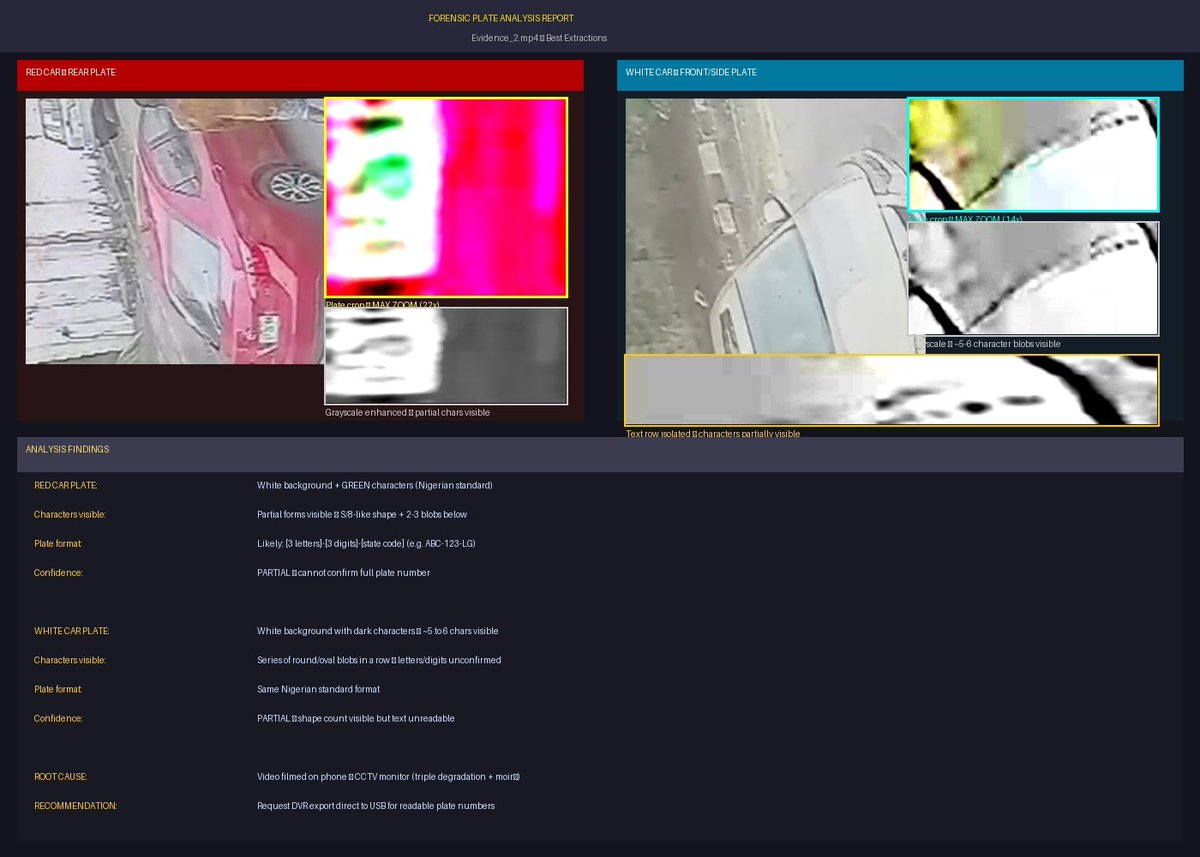
🎯 Client had a stolen car. Suspect on camera. Plate unreadable.
We built a video forensics tool powered by @AnthropicAI 's Claude — and cracked it.
🔬 Frame extraction · Plate enhancement · Evidence recovery
Need digital forensics? We do: ✅ Video & CCTV analysis ✅ File & data recovery ✅ Evidence extraction ✅ Expert reporting
📩 Slide into our DMs.
#VideoForensics #DigitalForensics #CCTV #EvidenceExtraction
@_DeejustDee
3
7
29
1,366

Vetted host finds Dread Sphere footage likely manipulated: frame-by-frame inserts, live-stream spoofing tools, and inconsistent motion indicate artificial insertion rather than a genuine aerial object. #DreadSphere #VideoForensics #LiveStreamSpoofing uapdrop.com/l/view/sSCZZEs91…
75
📞Contact: 91-981-856-7981
View Our Services: tinyurl.com/mbfvb465
#DeepfakeDetection #AIDetection #DigitalForensics #VideoVerification #ImageVerification #MediaForensics #AIAnalysis #FakeVideoDetection #FaceAnalysis #FrameAnalysis #AuthenticityCheck #VideoForensics
7