
Researchers monitor these terms to track updates in spatial inpainting consistency and real-time texture patching software.
* #VideoForensics / #ImageForensics: The core domain tags used by forensic specialists to share methodologies for identifying pixel anomalies, compression discrepancies, and metadata inconsistencies within disputed video files.
* #OSINT (Open Source Intelligence): The operational framework under which global analysts collaborate to verify the geographical and temporal authenticity of broadcast media, often cross-referencing live video details with physical maps, satellite data, and weather patterns.
* #StreamEdit / #RealTimeAI: Indicators tracking the technical implementation of low-latency, frame-by-frame generative pipelines, focusing specifically on hardware optimization and transformer-based model updates.
* #TemporalConsistency / #OpticalFlow: Analytical markers used within the computer vision community to discuss the elimination of flickering artifacts and the stabilizing of synthetic overlays in dynamic environments.
#Forensic Countermeasures and Detection Methodologies
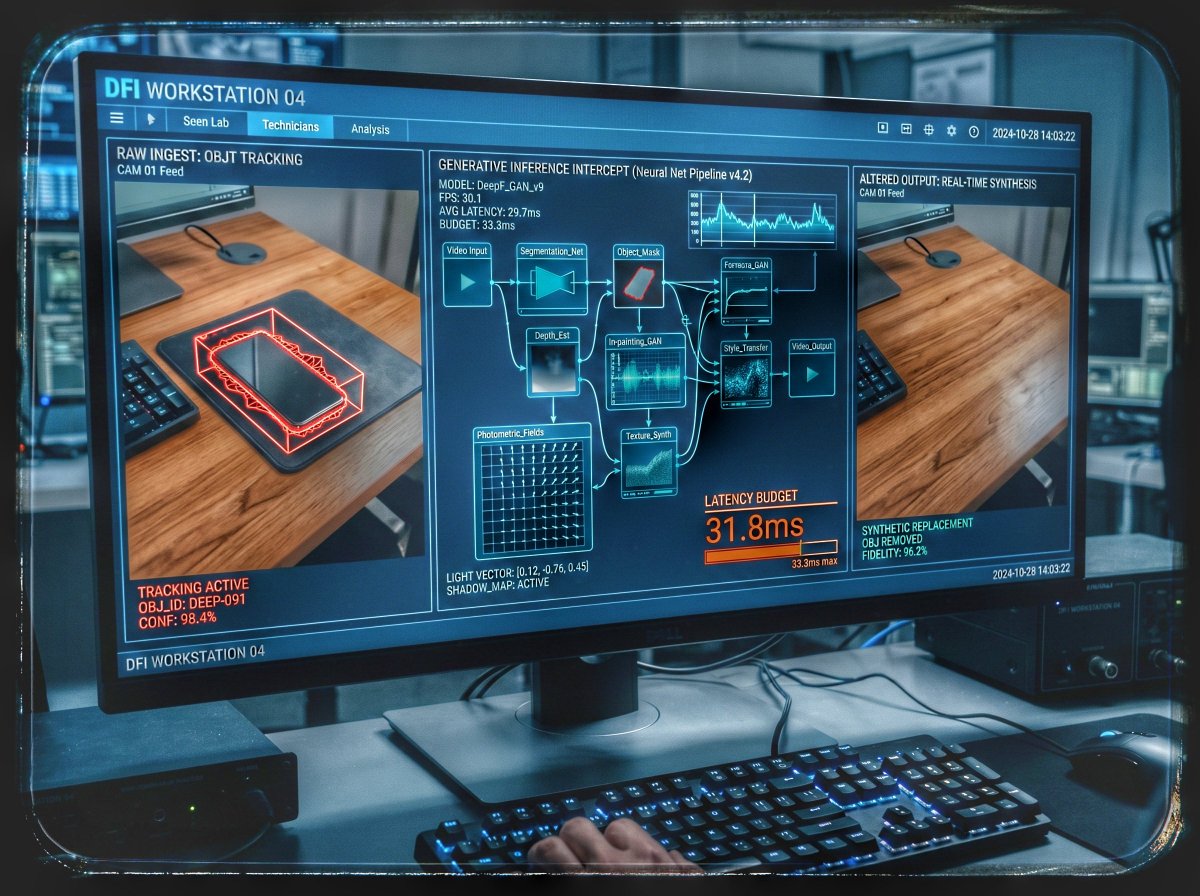
Exposing real-time video manipulation requires looking past the surface appearance of the footage and analyzing its underlying mathematical and structural properties. Digital forensic investigators use several specialized techniques to identify subtle anomalies left behind by generative inference layers.
┌──> Photo-Response Non-Uniformity (PRNU) Sensor Noise Analysis
[Suspicious Video Feed] ┼──> Spatial Inconsistency & Pixel Artifact Invalidation
└──> Temporal/Chrominance Frequency Discontinuity Analysis
1. Sensor Noise Fingerprinting (PRNU Analysis)
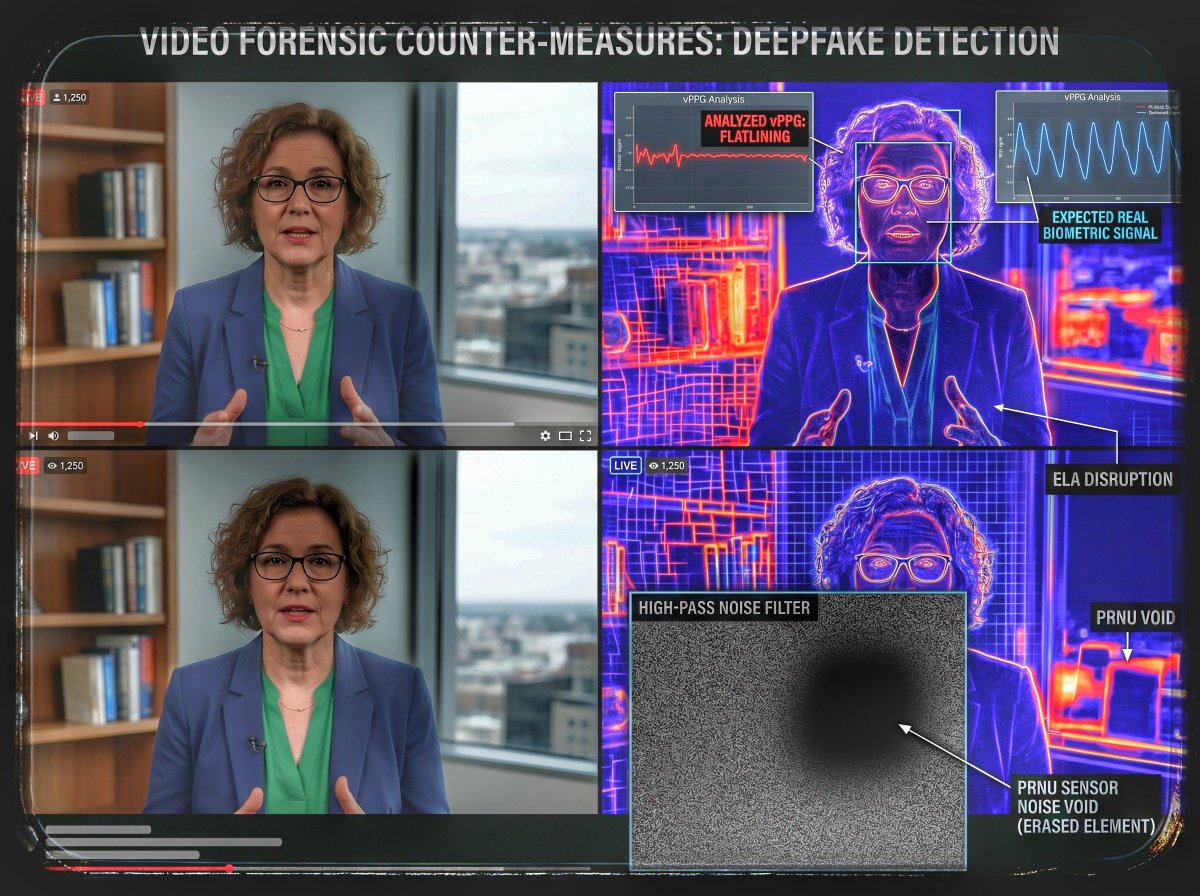
Every physical camera sensor possesses microscopic variations introduced during manufacturing. These variations create a unique noise pattern known as Photo-Response Non-Uniformity (PRNU), which acts as a digital watermark embedded across every frame the camera captures.
[Raw Frame] ──> [PRNU Extraction Filter] ──> [Uniform Noise Field] (Authentic)
[Edited Frame] ──> [PRNU Extraction Filter] ──> [Discontinuous / Erased Noise Field] (Tampered)
When a generative AI model inpaints a region of a frame or replaces an object, it synthesizes new pixels mathematically. These synthetic pixels lack the camera's original PRNU hardware signature. By passing video frames through specialized high-pass noise extraction filters, forensic investigators can map the PRNU distribution. If a specific region of the screen—such as a background wall or a item on a table—displays a sudden absence of sensor noise or shows a distinct, uniform noise pattern, it indicates that the area has been digitally reconstructed.
2. Spatial Artifact Detection and Pixel Discontinuity
Even with advanced photometric alignment, generative models frequently introduce minute spatial errors along the boundaries where authentic imagery meets synthetic imagery:
* Edge Blending Anomaly Analysis: Algorithms analyze the spatial frequency of object edges. Real objects display a natural, consistent gradient transition between their boundaries and the background, determined by the camera lens's modulation transfer function. AI-inserted or removed objects often exhibit microscopic blur zones or sharp pixel-step discontinuities where the generative mask was applied.
* Compression Signature Invalidation: Video compression codecs split frames into small macroblocks (typically 8×8 or 16×16 pixel grids) to execute discrete cosine transforms (DCT). When an intercept model modifies a frame before final encoding, it disrupts the natural macroblock boundary alignment. Forensic software can visualize the Error Level Analysis (ELA) of the video, highlighting regions where the compression ratios diverge significantly from the baseline frame metrics.
31
タナカ リョウイチ retweeted

5
6
75
10,089

May 17
@SciGuardians :
« 🚨SCANDALE BOMBSHELL SUR L'INTÉGRITÉ SCIENTIFIQUE – 17 NOV 2025
Elisabeth M. Bik – la fausse « consultante en intégrité scientifique » qui se vante d'avoir >10 000 commentaires PubPeer – a passé des années à traquer, diffamer et détruire les carrières des chercheurs qu'elle cible.
Mais osez poster un seul commentaire critique sur SES articles ou sur le mob de son cercle restreint ?
100 % CENSURÉ.
17 de ses articles et de ceux de ses collaborateurs signalés → 17 commentaires instantanément bloqués.
Un a réussi à passer le 23 nov 2024 → EFFACÉ après exactement 10 jours (3 déc 2024).
La reine de PubSmear vient de se faire prendre en train de truquer le jeu pour se protéger elle-même et son réseau.
Exposition totale de 9 minutes avec captures d'écran, DOIs et preuves vient de tomber.
Regardez-la. Partagez-la. Le masque est brisé.
#ElisabethBik #PubPeerScandal #PubSmear #Breaking #News #ScienceFraud #ScienceHypocrisy #ImageForensics
@SciGuardians 🔱 »
17 Nov 2025

🚨BOMBSHELL SCIENCE INTEGRITY SCANDAL – 17 NOV 2025
Elisabeth M. Bik – the fake “science integrity consultant” who brags about >10,000 PubPeer comments – has spent years stalking, smearing, and destroying careers of researchers she targets.
But dare post a single critical comment on HER papers or her inner-circle mob?
100 % CENSORED.
17 of her and her collaborators’ papers flagged → 17 comments instantly blocked.
One slipped through on 23 Nov 2024 → ERASED after exactly 10 days (3 Dec 2024).
The queen of PubSmear just got caught rigging the game to protect herself and her network.
9-minute total exposure with screenshots, DOIs, and receipts just dropped.
Watch it. Spread it. The mask is shattered.
#ElisabethBik #PubPeerScandal #PubSmear #Breaking #News #ScienceFraud #ScienceHypocrisy #ImageForensics
@SciGuardians 🔱
2
100
130
3,304

🚨 【速報】ブランドン・ステルによるPubPeerの操作 ― ビークの欠陥論文に対する4年前の称賛コメントが復活する一方、専門家による「懸念表明」レベルの批判は検閲・削除される 🚨
以前、私たちはPubPeer(別名PubSmear)が、偽の「科学の誠実性コンサルタント」であるエリザベス・M・ビックとその側近たちの論文を標的とした批判的なコメントを、いかに組織的に検閲しているかを暴露しました。
🎥 スクリーンショット、DOI、そして確固たる証拠(本投稿に添付)を盛り込んだ、9分間の完全版暴露動画をぜひご覧ください。
今回、2つの実証された事例により、PubPeerの共同創設者ブランドン・ステル(@CNRS)の妥協と詐欺の規模が完全に暴かれました。彼はプラットフォームを積極的に操作し、エリザベス・ビクの欠陥のある論文を保護するために、ある論文に対する専門家による「懸念表明(Expression of Concern)」レベルの批判(2024年11月23日に投稿・公開)を、 さらに、2024年12月3日、公開から10日後に別の論文に対する2021年5月の称賛コメントを密かに復元した一方で、2024年11月23日に投稿・公開されたある論文に対する専門家による「懸念表明(Expression of Concern)」レベルの批判を削除し、エリザベス・ビックの欠陥のある論文を保護するためにプラットフォームを積極的に操作していたことが明らかになった。
📌 事例1:Frontiers in Microbiology (2019)
「鉄過剰症のリスクがあるサイ種における腸内マイクロバイオームの多様性の低下とメタボロームの違い」
DOI: 10.3389/fmicb.2019.02291 | PubMed: 31649637
2024年11月23日、ある専門家が詳細な方法論的批判を提出し、以下のような主要な科学的欠陥を指摘した:
❌ サンプルサイズが極端に小さく、不均衡である
❌ 飼育施設および食事による深刻な交絡要因
❌ 主要種における分類学的解像度の低下
❌ 単一時点でのサンプリング
❌ 偽陽性を増大させる緩い統計的閾値
❌ 相関データに裏付けられていない推測的なメカニズムに関する結論
❌ 統計的検出力の低さと再現性に関する重大な懸念
これらを総合すると、指摘された欠陥は「懸念表明(EXPRESSION OF CONCERN)」の標準的な基準を満たしています。
しかし、ここからが物語の核心です。
批判が即座にブロックされた他の事例とは異なり、この専門家によるコメントは承認され、その日のうちにPubPeer上で公開されました。
この批判は、ちょうど10日間、一般に公開されたままでした。
そして、2024年12月3日:
❌ コメントが消えた。
❌ 批判は検閲され、一般の目に触れないように削除された。
この一連の経緯は特に重要である。なぜなら、批判が当初はモデレーションを通過し、公開可能と判断されていたにもかかわらず、一般公開後に消えてしまったことを示しているからだ。
そこで重大な疑問が生じる:
その10日間の間に何が変わったのか?
このパターンはもはや無視できないものとなっている:
🔻 Bik氏に関連する論文を標的とした専門家による厳しい批判 → 最終的に削除または隠蔽される
スクリーンショットとタイムスタンプにより、公開、公開期間、そしてその後の削除までの経緯が段階的に記録されています。
#ElisabethBik #BrandonStell #PubPeerScandal #PubSmear #Breaking #News #ScienceFraud #ScienceHypocrisy #ImageForensics
@SciGuardians 🔱
🧵 1/2
@SecKennedy @SenRonJohnson @DrJBhattacharya @HHS_ORI @NIH @C0PE @UKRIO @Clarivate @ClarivateAG @timeshighered @ElsevierConnect @Scopus @SpringerNature @WeAreTandF @tandfonline @WileyGlobal @PLOS @ScienceMagazine @TheLancet @Nature @USDAScience @Mami_Aho_Dema @seseragiryu
May 16
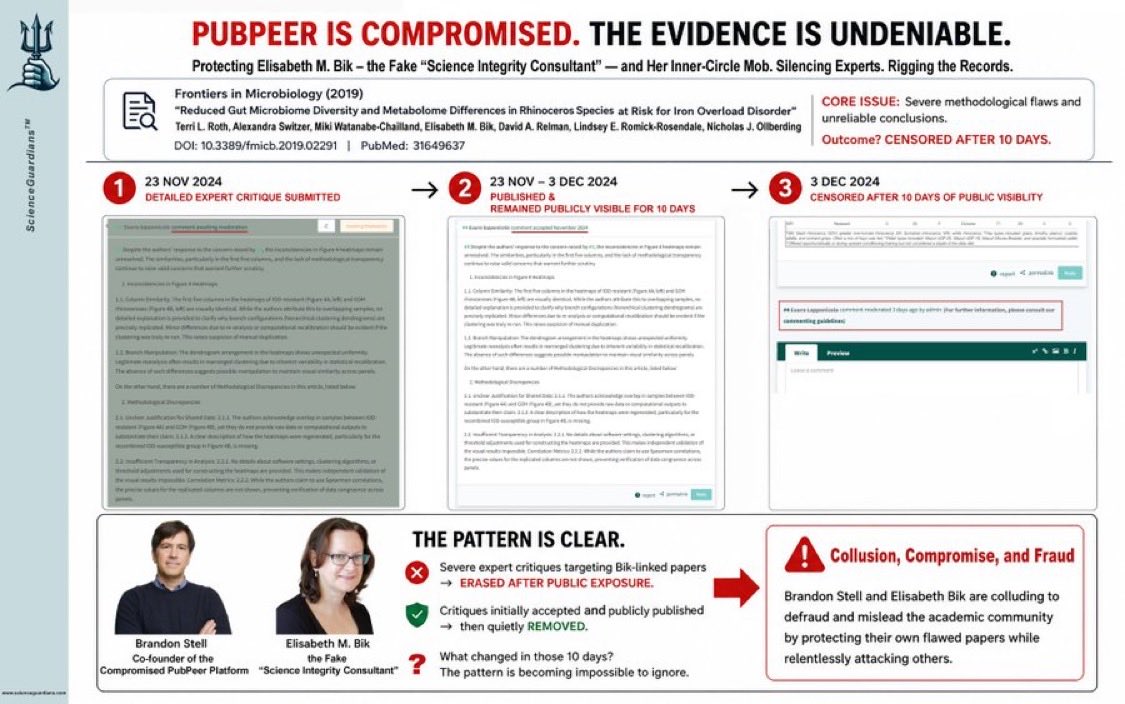
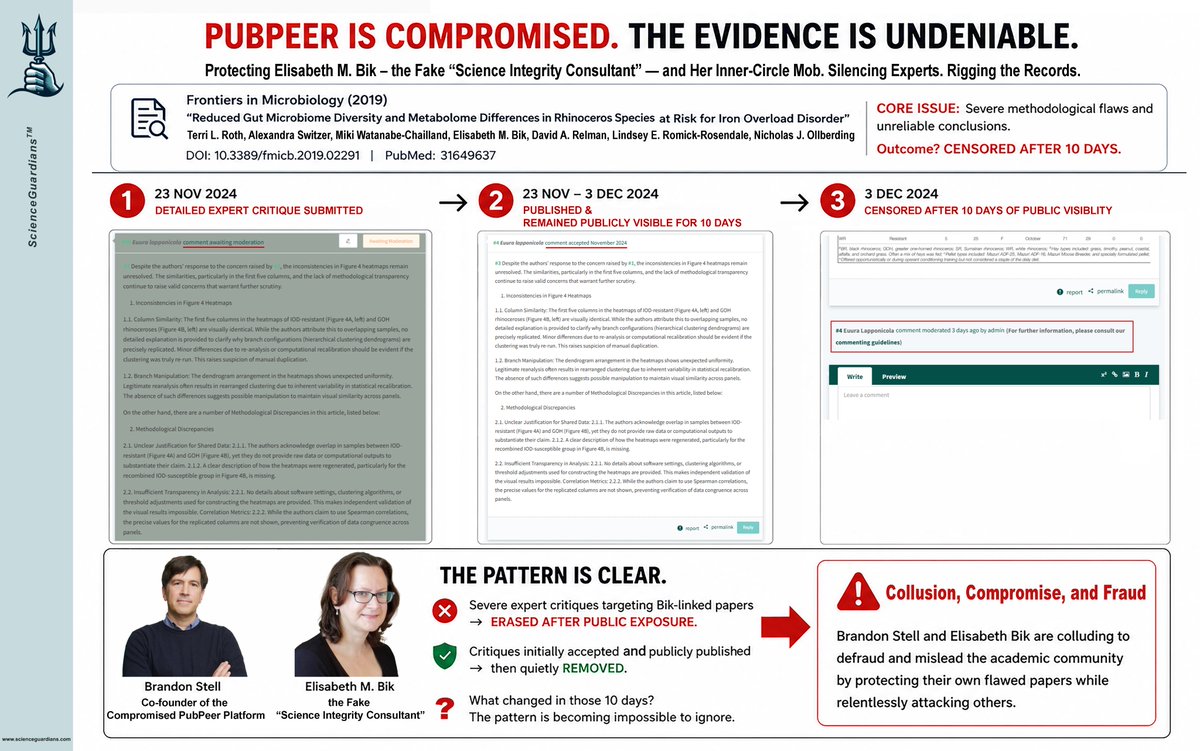
🚨 BREAKING: PUBPEER RIGGED BY BRANDON STELL — A 4-YEAR-OLD PRAISE COMMENT FOR BIK’S FLAWED PAPER GETS RESTORED WHILE EXPERT EXPRESSION-OF-CONCERN-LEVEL CRITIQUES GET CENSORED AND ERASED 🚨
Previously, we exposed how PubPeer (aka PubSmear) systematically censors critical comments targeting papers by Elisabeth M. Bik — the fake “science integrity consultant” — and her inner circle.
🎥 Watch the full 9-minute exposure video with screenshots, DOIs, and ironclad receipts (attached to this post).
Now, two documented cases fully expose PubPeer co-founder Brandon Stell (@CNRS)’s scale of compromise and fraud — actively rigging the platform to protect Elisabeth Bik’s flawed papers by removing an expert Expression-of-Concern-level critique on one paper (posted & publicly published on 23 November 2024) after 10 days of public visibility on 3 December 2024, while secretly restoring a previously removed praise comment from May 2021 on a different paper after nearly 4 years in January 2025.
📌 CASE 1: Frontiers in Microbiology (2019)
“Reduced Gut Microbiome Diversity and Metabolome Differences in Rhinoceros Species at Risk for Iron Overload Disorder”
DOI: 10.3389/fmicb.2019.02291 | PubMed: 31649637
An expert submitted a detailed methodological critique on 23 Nov 2024, documenting major scientific weaknesses including:
❌ Extremely small and imbalanced sample sizes
❌ Severe facility and diet confounding
❌ Reduced taxonomic resolution in key species
❌ Single-time-point sampling
❌ Relaxed statistical thresholds inflating false positives
❌ Speculative mechanistic conclusions unsupported by correlative data
❌ Low statistical power and major reproducibility concerns
Taken together, the documented flaws meet standard criteria for an EXPRESSION OF CONCERN.
But here is where the story becomes revealing.
Unlike other cases where critiques were blocked immediately, this expert comment was ACCEPTED and PUBLISHED publicly on PubPeer the very same day.
The criticism remained publicly visible for exactly 10 days.
Then, on 3 Dec 2024:
❌ The comment disappeared.
❌ The critique was censored and removed from public view.
This sequence is particularly important because it demonstrates that the critique initially passed moderation and was considered publishable — only to later vanish after public visibility.
That raises a critical question:
What changed during those 10 days?
The pattern is becoming impossible to ignore:
🔻 Severe expert critiques targeting Bik-linked papers → eventually erased or suppressed
Screenshots and timestamps document the publication, visibility period, and subsequent removal step-by-step.
#ElisabethBik #BrandonStell #PubPeerScandal #PubSmear #Breaking #News #ScienceFraud #ScienceHypocrisy #ImageForensics
@SciGuardians 🔱
🧵 1/2
@SecKennedy @SenRonJohnson @DrJBhattacharya @HHS_ORI @NIH @C0PE @UKRIO @Clarivate @ClarivateAG @timeshighered @ElsevierConnect @Scopus @SpringerNature @WeAreTandF @tandfonline @WileyGlobal @PLOS @ScienceMagazine @TheLancet @Nature @USDAScience @FrontiersIn @AIP_Publishing @CellCellPress @Sage_Publishing @ACSPublications @AmerChemSociety @RoySocChem @theNASciences @APSphysics @ORCID_Org @DOAJplus @CrossrefOrg @aaas @sciam @ChemRxiv @Science_Open @TimKersjes @chrisgrafpub @Einstein_Berlin @WCRIFoundation
1
3
6
828
🚨 EILMELDUNG: PUBPEER VON BRANDON STELL MANIPULIERT – EIN VIER JAHRE ALTER LOBENDE KOMMENTAR ZU BIKS MANGELHAFTER ARBEIT WIRD WIEDERHERGESTELLT, WÄHREND KRITIK VON EXPERTEN AUF DEM NIVEAU EINER „EXPRESSION OF CONCERN“ ZENSURIERT UND GELÖSCHT WIRD 🚨
Zuvor haben wir aufgedeckt, wie PubPeer (alias PubSmear) systematisch kritische Kommentare zensiert, die sich gegen Artikel von Elisabeth M. Bik – der falschen „Beraterin für wissenschaftliche Integrität“ – und ihrem inneren Kreis richten.
🎥 Sehen Sie sich das vollständige 9-minütige Enthüllungsvideo mit Screenshots, DOIs und hieb- und stichfesten Belegen an (diesem Beitrag beigefügt).
Nun entlarven zwei dokumentierte Fälle das Ausmaß der Kompromittierung und des Betrugs durch PubPeer-Mitbegründer Brandon Stell (@CNRS) – er manipuliert die Plattform aktiv, um Elisabeth Biks fehlerhafte Artikel zu schützen, indem er eine fachkundige Kritik auf „Expression of Concern“-Ebene zu einem Artikel (gepostet und öffentlich veröffentlicht am 23. November 2024) nach 10 Tagen öffentlicher Sichtbarkeit am 3. Dezember 2024, während er im Januar 2025 heimlich einen zuvor entfernten lobenden Kommentar vom Mai 2021 zu einer anderen Arbeit nach fast 4 Jahren wiederherstellte.
📌 FALL 1: Frontiers in Microbiology (2019)
„Reduzierte Vielfalt des Darmmikrobioms und Unterschiede im Metabolom bei Nashornarten, die einem Risiko für Eisenüberladungsstörungen ausgesetzt sind“
DOI: 10.3389/fmicb.2019.02291 | PubMed: 31649637
Ein Experte reichte am 23. November 2024 eine detaillierte methodische Kritik ein, in der er wesentliche wissenschaftliche Schwächen dokumentierte, darunter:
❌ Extrem kleine und unausgewogene Stichprobengrößen
❌ Starke Störfaktoren durch Haltungsbedingungen und Ernährung
❌ Verminderte taxonomische Auflösung bei Schlüsselarten
❌ Probenahme zu einem einzigen Zeitpunkt
❌ Gelockerte statistische Schwellenwerte, die zu einer Überbewertung von falsch-positiven Ergebnissen führen
❌ Spekulative mechanistische Schlussfolgerungen, die nicht durch korrelative Daten gestützt werden
❌ Geringe statistische Aussagekraft und erhebliche Bedenken hinsichtlich der Reproduzierbarkeit
Zusammengenommen erfüllen die dokumentierten Mängel die Standardkriterien für eine BESORGNISERKLÄRUNG.
Doch hier wird die Geschichte aufschlussreich.
Im Gegensatz zu anderen Fällen, in denen Kritik sofort blockiert wurde, wurde dieser Expertenkommentar noch am selben Tag auf PubPeer AKZEPTIERT und ÖFFENTLICH VERÖFFENTLICHT.
Die Kritik blieb genau 10 Tage lang öffentlich sichtbar.
Dann, am 3. Dezember 2024:
❌ Verschwand der Kommentar.
❌ Wurde die Kritik zensiert und aus der öffentlichen Sichtweite entfernt.
Diese Abfolge ist besonders wichtig, da sie zeigt, dass die Kritik zunächst die Moderation durchlief und als veröffentlichungswürdig erachtet wurde – nur um später, nach öffentlicher Sichtbarkeit, zu verschwinden.
Das wirft eine entscheidende Frage auf:
Was hat sich in diesen 10 Tagen geändert?
Das Muster lässt sich kaum noch ignorieren:
🔻 Scharfe Kritik von Experten an Artikeln mit Bezug zu Bik → schließlich gelöscht oder unterdrückt
Screenshots und Zeitstempel dokumentieren Schritt für Schritt die Veröffentlichung, die Sichtbarkeitsdauer und die anschließende Entfernung.
#ElisabethBik #BrandonStell #PubPeerScandal #PubSmear #Breaking #News #ScienceFraud #ScienceHypocrisy #ImageForensics
@SciGuardians 🔱
🧵 1/2
@SecKennedy @SenRonJohnson @DrJBhattacharya @HHS_ORI @NIH @C0PE @UKRIO @Clarivate @ClarivateAG @timeshighered @ElsevierConnect @Scopus @SpringerNature @WeAreTandF @tandfonline @WileyGlobal @PLOS @ScienceMagazine @TheLancet @Nature @USDAScience
May 16
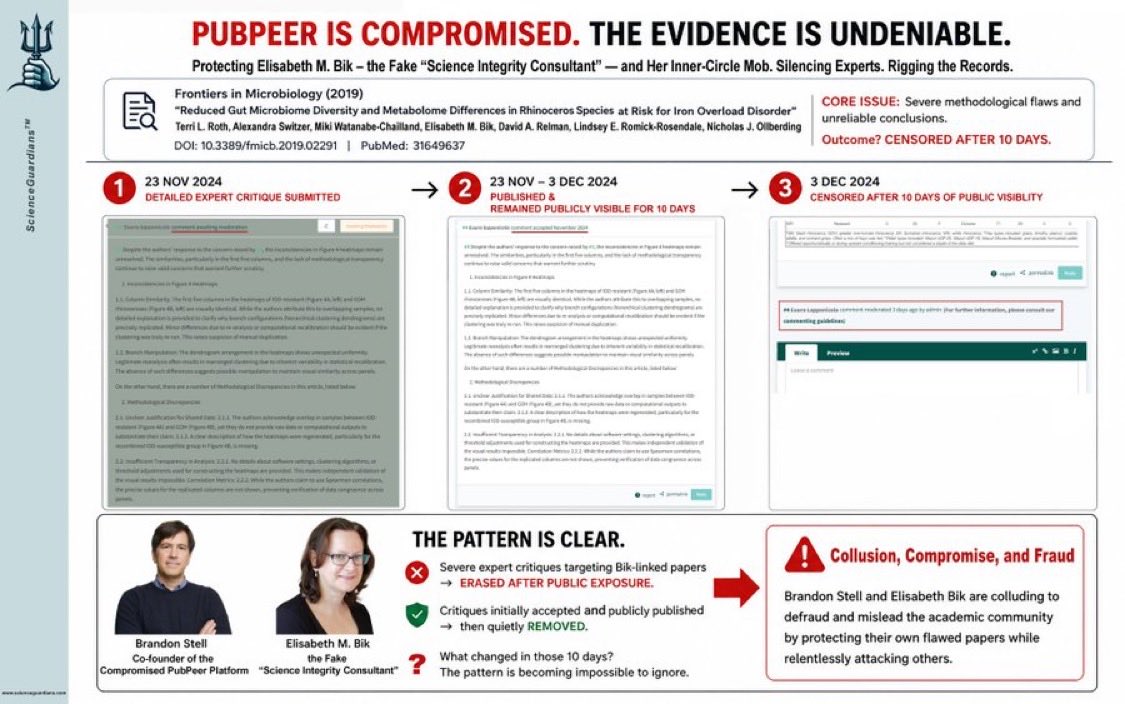
🚨 BREAKING: PUBPEER RIGGED BY BRANDON STELL — A 4-YEAR-OLD PRAISE COMMENT FOR BIK’S FLAWED PAPER GETS RESTORED WHILE EXPERT EXPRESSION-OF-CONCERN-LEVEL CRITIQUES GET CENSORED AND ERASED 🚨
Previously, we exposed how PubPeer (aka PubSmear) systematically censors critical comments targeting papers by Elisabeth M. Bik — the fake “science integrity consultant” — and her inner circle.
🎥 Watch the full 9-minute exposure video with screenshots, DOIs, and ironclad receipts (attached to this post).
Now, two documented cases fully expose PubPeer co-founder Brandon Stell (@CNRS)’s scale of compromise and fraud — actively rigging the platform to protect Elisabeth Bik’s flawed papers by removing an expert Expression-of-Concern-level critique on one paper (posted & publicly published on 23 November 2024) after 10 days of public visibility on 3 December 2024, while secretly restoring a previously removed praise comment from May 2021 on a different paper after nearly 4 years in January 2025.
📌 CASE 1: Frontiers in Microbiology (2019)
“Reduced Gut Microbiome Diversity and Metabolome Differences in Rhinoceros Species at Risk for Iron Overload Disorder”
DOI: 10.3389/fmicb.2019.02291 | PubMed: 31649637
An expert submitted a detailed methodological critique on 23 Nov 2024, documenting major scientific weaknesses including:
❌ Extremely small and imbalanced sample sizes
❌ Severe facility and diet confounding
❌ Reduced taxonomic resolution in key species
❌ Single-time-point sampling
❌ Relaxed statistical thresholds inflating false positives
❌ Speculative mechanistic conclusions unsupported by correlative data
❌ Low statistical power and major reproducibility concerns
Taken together, the documented flaws meet standard criteria for an EXPRESSION OF CONCERN.
But here is where the story becomes revealing.
Unlike other cases where critiques were blocked immediately, this expert comment was ACCEPTED and PUBLISHED publicly on PubPeer the very same day.
The criticism remained publicly visible for exactly 10 days.
Then, on 3 Dec 2024:
❌ The comment disappeared.
❌ The critique was censored and removed from public view.
This sequence is particularly important because it demonstrates that the critique initially passed moderation and was considered publishable — only to later vanish after public visibility.
That raises a critical question:
What changed during those 10 days?
The pattern is becoming impossible to ignore:
🔻 Severe expert critiques targeting Bik-linked papers → eventually erased or suppressed
Screenshots and timestamps document the publication, visibility period, and subsequent removal step-by-step.
#ElisabethBik #BrandonStell #PubPeerScandal #PubSmear #Breaking #News #ScienceFraud #ScienceHypocrisy #ImageForensics
@SciGuardians 🔱
🧵 1/2
@SecKennedy @SenRonJohnson @DrJBhattacharya @HHS_ORI @NIH @C0PE @UKRIO @Clarivate @ClarivateAG @timeshighered @ElsevierConnect @Scopus @SpringerNature @WeAreTandF @tandfonline @WileyGlobal @PLOS @ScienceMagazine @TheLancet @Nature @USDAScience @FrontiersIn @AIP_Publishing @CellCellPress @Sage_Publishing @ACSPublications @AmerChemSociety @RoySocChem @theNASciences @APSphysics @ORCID_Org @DOAJplus @CrossrefOrg @aaas @sciam @ChemRxiv @Science_Open @TimKersjes @chrisgrafpub @Einstein_Berlin @WCRIFoundation
1
8
531
🚨 DERNIÈRE MINUTE : PUBPEER MANIPULÉ PAR BRANDON STELL — UN COMMENTAIRE ÉLOGIEUX DATANT DE 4 ANS SUR L'ARTICLE CONTROVERSÉ D'ELISABETH M. BIK EST RÉTABLI, TANDIS QUE LES CRITIQUES D'EXPERTS, QUI CONSTITUENT DE VÉRITABLES SIGNALEMENTS D'INQUIÉTUDE, SONT CENSURÉES ET EFFACÉES 🚨
Auparavant, nous avions révélé comment PubPeer (alias PubSmear) censure systématiquement les commentaires critiques visant les articles d’Elisabeth M. Bik — la fausse « consultante en intégrité scientifique » — et son cercle restreint.
🎥 Regardez la vidéo complète de 9 minutes avec des captures d’écran, des DOI et des preuves irréfutables (jointes à cet article).
Aujourd’hui, deux cas documentés révèlent pleinement l’ampleur des compromissions et des fraudes commises par le cofondateur de PubPeer, Brandon Stell (@CNRS) — qui a activement manipulé la plateforme pour protéger les articles erronés d’Elisabeth Bik en supprimant une critique d’expert de niveau « Expression of Concern » sur un article (postée et publiée publiquement le 23 novembre 2024) après 10 jours de visibilité publique, le 3 décembre 2024, tout en rétablissant secrètement, en janvier 2025, un commentaire élogieux supprimé précédemment en mai 2021 sur un autre article, près de 4 ans plus tard.
📌 CAS 1 : Frontiers in Microbiology (2019)
« Réduction de la diversité du microbiome intestinal et différences métabolomiques chez les espèces de rhinocéros présentant un risque de surcharge en fer »
DOI : 10.3389/fmicb.2019.02291 | PubMed : 31649637
Un expert a soumis une critique méthodologique détaillée le 23 novembre 2024, documentant des faiblesses scientifiques majeures, notamment :
❌ Des échantillons extrêmement petits et déséquilibrés
❌ De graves facteurs de confusion liés aux installations et à l'alimentation
❌ Une résolution taxonomique réduite chez les espèces clés
❌ Un échantillonnage à un seul moment
❌ Des seuils statistiques assouplis gonflant les faux positifs
❌ Des conclusions mécanistiques spéculatives non étayées par des données corrélatives
❌ Une faible puissance statistique et des problèmes majeurs de reproductibilité
Prises dans leur ensemble, ces lacunes documentées répondent aux critères standard pour une EXPRESSION DE PRÉOCCUPATION.
Mais c'est là que l'histoire devient révélatrice.
Contrairement à d'autres cas où les critiques ont été immédiatement bloquées, ce commentaire d'expert a été ACCEPTÉ et PUBLIÉ publiquement sur PubPeer le jour même.
La critique est restée visible publiquement pendant exactement 10 jours.
Puis, le 3 décembre 2024 :
❌ Le commentaire a disparu.
❌ La critique a été censurée et retirée de la vue du public.
Cette séquence est particulièrement importante car elle démontre que la critique a initialement passé la modération et a été jugée publiable — pour ensuite disparaître après avoir été visible par le public.
Cela soulève une question cruciale :
Qu'est-ce qui a changé au cours de ces 10 jours ?
La tendance devient impossible à ignorer :
🔻 Critiques sévères d'experts visant des articles liés à Bik → finalement effacées ou supprimées
Des captures d'écran et des horodatages documentent étape par étape la publication, la période de visibilité et la suppression qui a suivi.
#ElisabethBik #BrandonStell #PubPeerScandal #PubSmear #Breaking #News #ScienceFraud #ScienceHypocrisy #ImageForensics
@SciGuardians 🔱
🧵 1/2
@SecKennedy @SenRonJohnson @DrJBhattacharya @HHS_ORI @NIH @C0PE @UKRIO @Clarivate @ClarivateAG @timeshighered @ElsevierConnect @Scopus @SpringerNature @WeAreTandF @tandfonline @WileyGlobal @PLOS @ScienceMagazine @TheLancet @Nature @USDAScience @
May 16
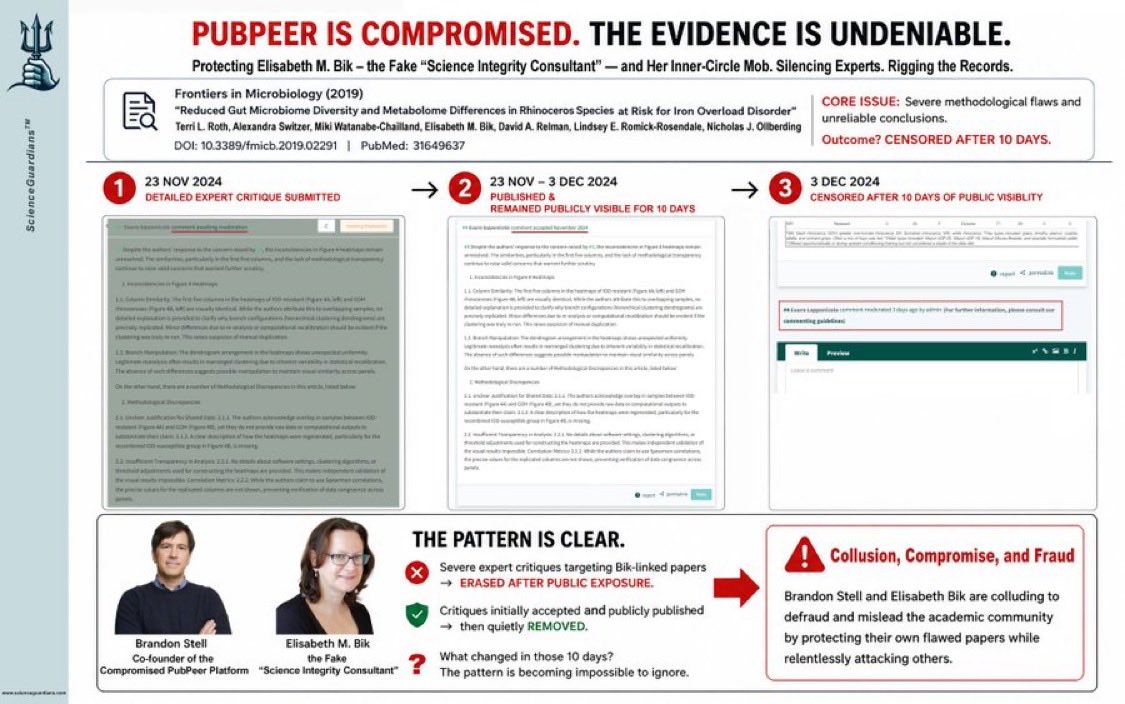
🚨 BREAKING: PUBPEER RIGGED BY BRANDON STELL — A 4-YEAR-OLD PRAISE COMMENT FOR BIK’S FLAWED PAPER GETS RESTORED WHILE EXPERT EXPRESSION-OF-CONCERN-LEVEL CRITIQUES GET CENSORED AND ERASED 🚨
Previously, we exposed how PubPeer (aka PubSmear) systematically censors critical comments targeting papers by Elisabeth M. Bik — the fake “science integrity consultant” — and her inner circle.
🎥 Watch the full 9-minute exposure video with screenshots, DOIs, and ironclad receipts (attached to this post).
Now, two documented cases fully expose PubPeer co-founder Brandon Stell (@CNRS)’s scale of compromise and fraud — actively rigging the platform to protect Elisabeth Bik’s flawed papers by removing an expert Expression-of-Concern-level critique on one paper (posted & publicly published on 23 November 2024) after 10 days of public visibility on 3 December 2024, while secretly restoring a previously removed praise comment from May 2021 on a different paper after nearly 4 years in January 2025.
📌 CASE 1: Frontiers in Microbiology (2019)
“Reduced Gut Microbiome Diversity and Metabolome Differences in Rhinoceros Species at Risk for Iron Overload Disorder”
DOI: 10.3389/fmicb.2019.02291 | PubMed: 31649637
An expert submitted a detailed methodological critique on 23 Nov 2024, documenting major scientific weaknesses including:
❌ Extremely small and imbalanced sample sizes
❌ Severe facility and diet confounding
❌ Reduced taxonomic resolution in key species
❌ Single-time-point sampling
❌ Relaxed statistical thresholds inflating false positives
❌ Speculative mechanistic conclusions unsupported by correlative data
❌ Low statistical power and major reproducibility concerns
Taken together, the documented flaws meet standard criteria for an EXPRESSION OF CONCERN.
But here is where the story becomes revealing.
Unlike other cases where critiques were blocked immediately, this expert comment was ACCEPTED and PUBLISHED publicly on PubPeer the very same day.
The criticism remained publicly visible for exactly 10 days.
Then, on 3 Dec 2024:
❌ The comment disappeared.
❌ The critique was censored and removed from public view.
This sequence is particularly important because it demonstrates that the critique initially passed moderation and was considered publishable — only to later vanish after public visibility.
That raises a critical question:
What changed during those 10 days?
The pattern is becoming impossible to ignore:
🔻 Severe expert critiques targeting Bik-linked papers → eventually erased or suppressed
Screenshots and timestamps document the publication, visibility period, and subsequent removal step-by-step.
#ElisabethBik #BrandonStell #PubPeerScandal #PubSmear #Breaking #News #ScienceFraud #ScienceHypocrisy #ImageForensics
@SciGuardians 🔱
🧵 1/2
@SecKennedy @SenRonJohnson @DrJBhattacharya @HHS_ORI @NIH @C0PE @UKRIO @Clarivate @ClarivateAG @timeshighered @ElsevierConnect @Scopus @SpringerNature @WeAreTandF @tandfonline @WileyGlobal @PLOS @ScienceMagazine @TheLancet @Nature @USDAScience @FrontiersIn @AIP_Publishing @CellCellPress @Sage_Publishing @ACSPublications @AmerChemSociety @RoySocChem @theNASciences @APSphysics @ORCID_Org @DOAJplus @CrossrefOrg @aaas @sciam @ChemRxiv @Science_Open @TimKersjes @chrisgrafpub @Einstein_Berlin @WCRIFoundation
2
33
56
3,151

May 16
🚨 BREAKING: PUBPEER RIGGED BY BRANDON STELL — A 4-YEAR-OLD PRAISE COMMENT FOR BIK’S FLAWED PAPER GETS RESTORED WHILE EXPERT EXPRESSION-OF-CONCERN-LEVEL CRITIQUES GET CENSORED AND ERASED 🚨
Previously, we exposed how PubPeer (aka PubSmear) systematically censors critical comments targeting papers by Elisabeth M. Bik — the fake “science integrity consultant” — and her inner circle.
🎥 Watch the full 9-minute exposure video with screenshots, DOIs, and ironclad receipts (attached to this post).
Now, two documented cases fully expose PubPeer co-founder Brandon Stell (@CNRS)’s scale of compromise and fraud — actively rigging the platform to protect Elisabeth Bik’s flawed papers by removing an expert Expression-of-Concern-level critique on one paper (posted & publicly published on 23 November 2024) after 10 days of public visibility on 3 December 2024, while secretly restoring a previously removed praise comment from May 2021 on a different paper after nearly 4 years in January 2025.
📌 CASE 1: Frontiers in Microbiology (2019)
“Reduced Gut Microbiome Diversity and Metabolome Differences in Rhinoceros Species at Risk for Iron Overload Disorder”
DOI: 10.3389/fmicb.2019.02291 | PubMed: 31649637
An expert submitted a detailed methodological critique on 23 Nov 2024, documenting major scientific weaknesses including:
❌ Extremely small and imbalanced sample sizes
❌ Severe facility and diet confounding
❌ Reduced taxonomic resolution in key species
❌ Single-time-point sampling
❌ Relaxed statistical thresholds inflating false positives
❌ Speculative mechanistic conclusions unsupported by correlative data
❌ Low statistical power and major reproducibility concerns
Taken together, the documented flaws meet standard criteria for an EXPRESSION OF CONCERN.
But here is where the story becomes revealing.
Unlike other cases where critiques were blocked immediately, this expert comment was ACCEPTED and PUBLISHED publicly on PubPeer the very same day.
The criticism remained publicly visible for exactly 10 days.
Then, on 3 Dec 2024:
❌ The comment disappeared.
❌ The critique was censored and removed from public view.
This sequence is particularly important because it demonstrates that the critique initially passed moderation and was considered publishable — only to later vanish after public visibility.
That raises a critical question:
What changed during those 10 days?
The pattern is becoming impossible to ignore:
🔻 Severe expert critiques targeting Bik-linked papers → eventually erased or suppressed
Screenshots and timestamps document the publication, visibility period, and subsequent removal step-by-step.
#ElisabethBik #BrandonStell #PubPeerScandal #PubSmear #Breaking #News #ScienceFraud #ScienceHypocrisy #ImageForensics
@SciGuardians 🔱
🧵 1/2
@SecKennedy @SenRonJohnson @DrJBhattacharya @HHS_ORI @NIH @C0PE @UKRIO @Clarivate @ClarivateAG @timeshighered @ElsevierConnect @Scopus @SpringerNature @WeAreTandF @tandfonline @WileyGlobal @PLOS @ScienceMagazine @TheLancet @Nature @USDAScience @FrontiersIn @AIP_Publishing @CellCellPress @Sage_Publishing @ACSPublications @AmerChemSociety @RoySocChem @theNASciences @APSphysics @ORCID_Org @DOAJplus @CrossrefOrg @aaas @sciam @ChemRxiv @Science_Open @TimKersjes @chrisgrafpub @Einstein_Berlin @WCRIFoundation
17 Nov 2025
🚨BOMBSHELL SCIENCE INTEGRITY SCANDAL – 17 NOV 2025
Elisabeth M. Bik – the fake “science integrity consultant” who brags about >10,000 PubPeer comments – has spent years stalking, smearing, and destroying careers of researchers she targets.
But dare post a single critical comment on HER papers or her inner-circle mob?
100 % CENSORED.
17 of her and her collaborators’ papers flagged → 17 comments instantly blocked.
One slipped through on 23 Nov 2024 → ERASED after exactly 10 days (3 Dec 2024).
The queen of PubSmear just got caught rigging the game to protect herself and her network.
9-minute total exposure with screenshots, DOIs, and receipts just dropped.
Watch it. Spread it. The mask is shattered.
#ElisabethBik #PubPeerScandal #PubSmear #Breaking #News #ScienceFraud #ScienceHypocrisy #ImageForensics
@SciGuardians 🔱
3
50
88
29,190
Let me know if you think these similarities are expected - I am not sure what the gating strategy was here.
#ImageForensics
1
2
10
2,277
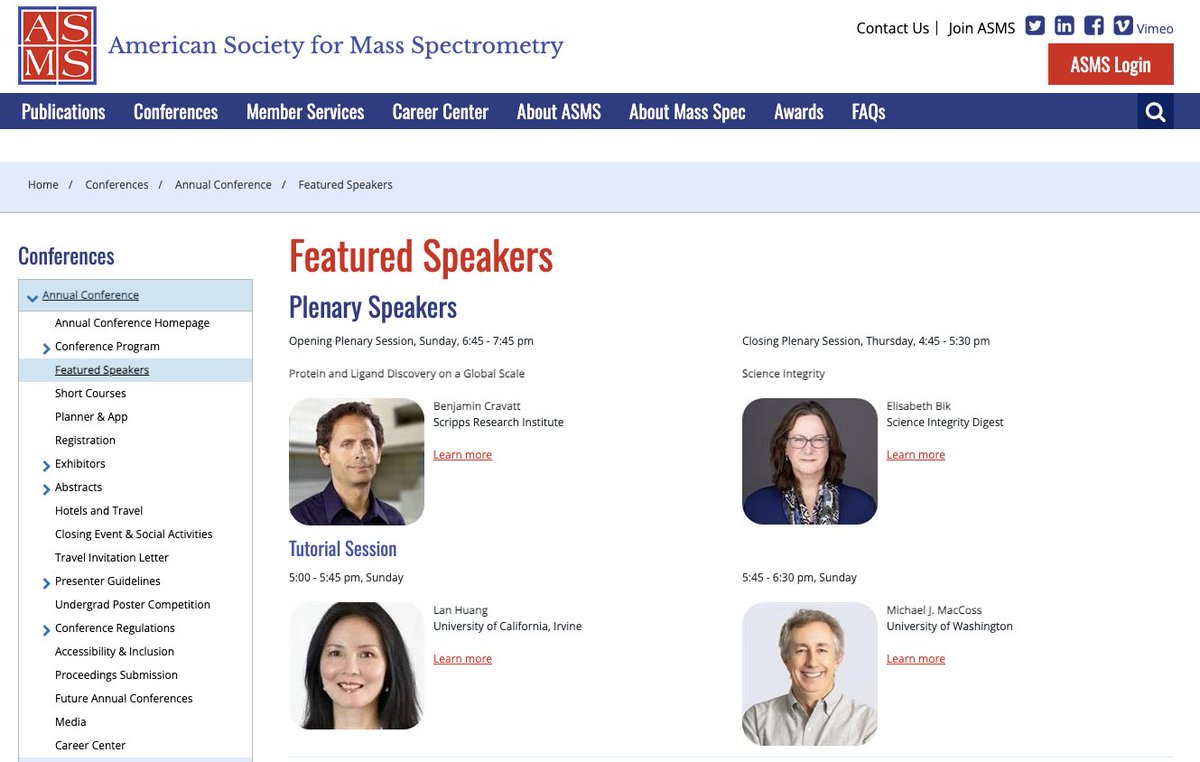
On June 4th, I will give the closing plenary talk at the annual @asmsnews conference in San Diego. Hope to see some of you there!
And please send me any dubious #MassSpectrometry images - love to learn more.
#ImageForensics
asms.org/conferences/annual-…
3
3
33
5,698
Apr 26
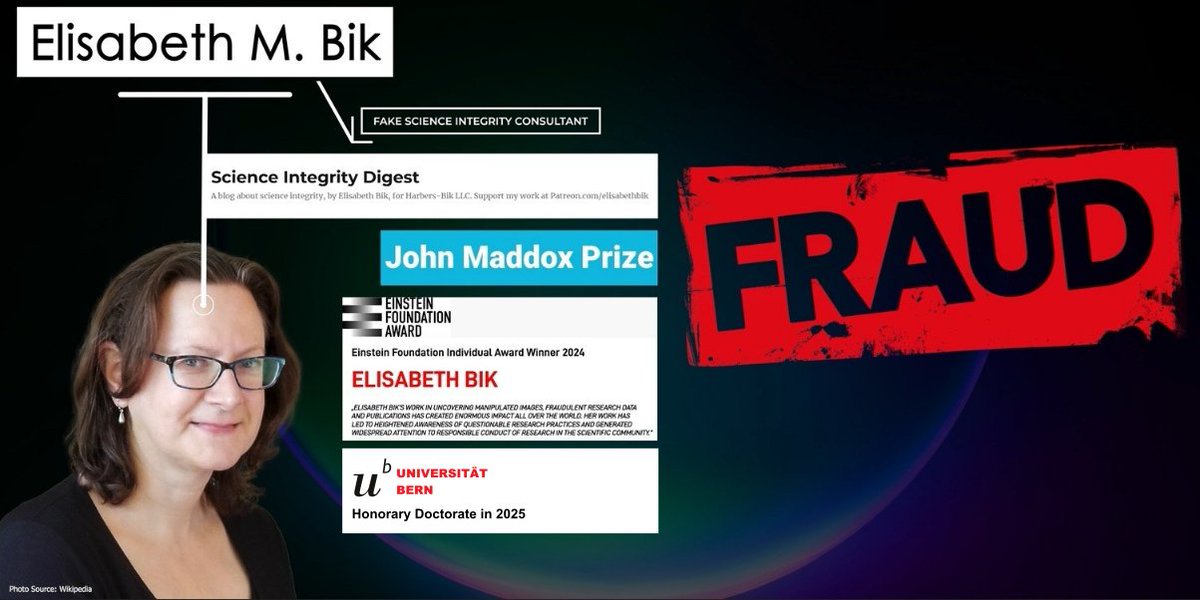
5/8 🚨 The publicly available FULL EVIDENCE PACKAGE — detailing how Elisabeth Bik and the PubPeer "PubSmear" Network Mob have weaponized "research integrity" to 100% censor critiques of their own flawed work while relentlessly targeting others.
📌 Available on the freely accessible ScienceGuardians™ Substack; no subscription or fee required:
🔗 scienceguardians.substack.co…
#ElisabethBik #PubPeerScandal #PubSmear #News #ScienceFraud #ScienceHypocrisy #ImageForensics
4
8
27
1,017
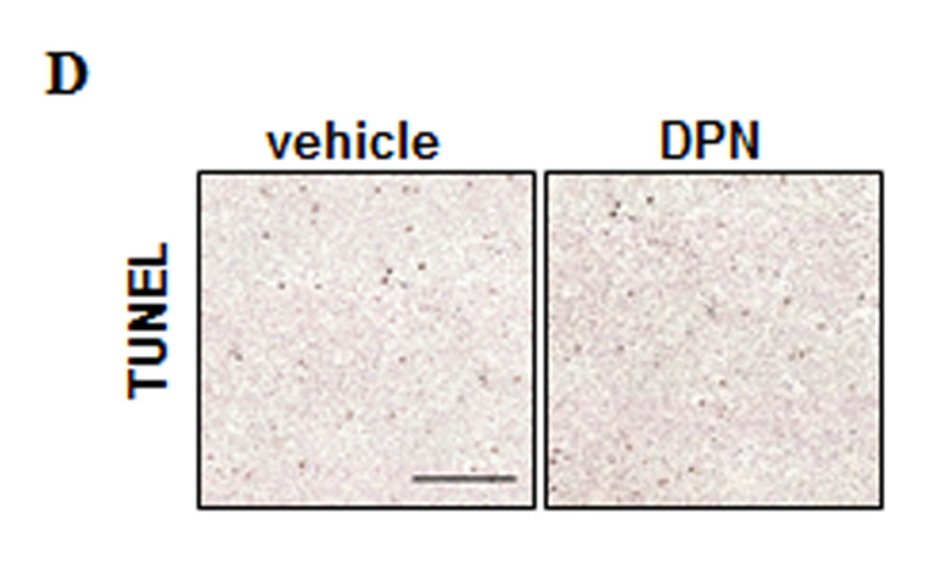
A very easy #ImageForensics, from the @Oncotarget archives.
Tumors treated with either 'vehicle' or 'DPN'.
What do you see?
8
2
30
8,421
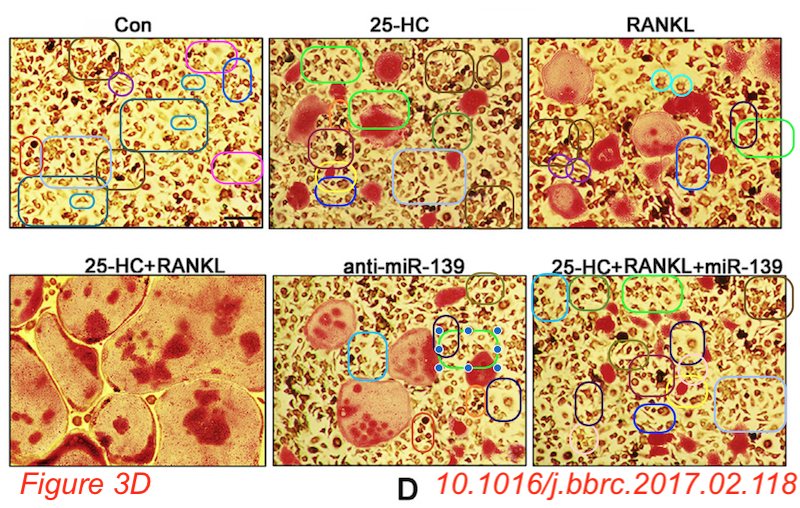
*How *not* to handle image manipulation*.
Editors, please do not address this level of photoshopping with a correction.
In 2020, I flagged Figure 3D of this 2017 BBRC paper. Multiple regions appeared reused within or across panels.
pubpeer.com/publications/153…
#ImageForensics
4
4
51
9,731
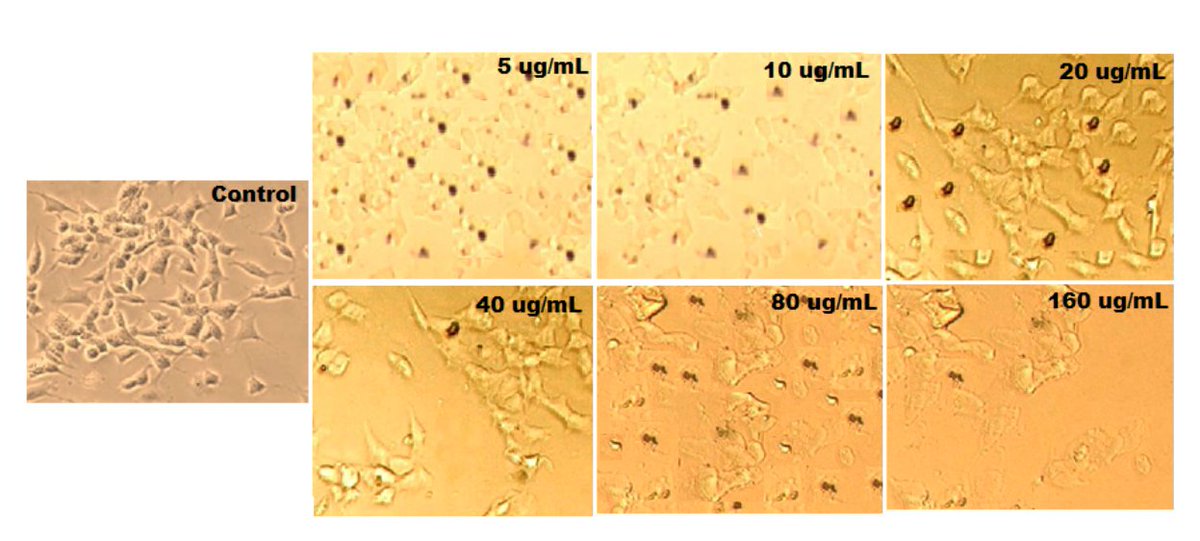
This one is so blatant, so I am not going to hand out Emoji Awards for this one. But a nice, enjoyable #ImageForensics puzzle for your Saturday:
5
5
49
12,177
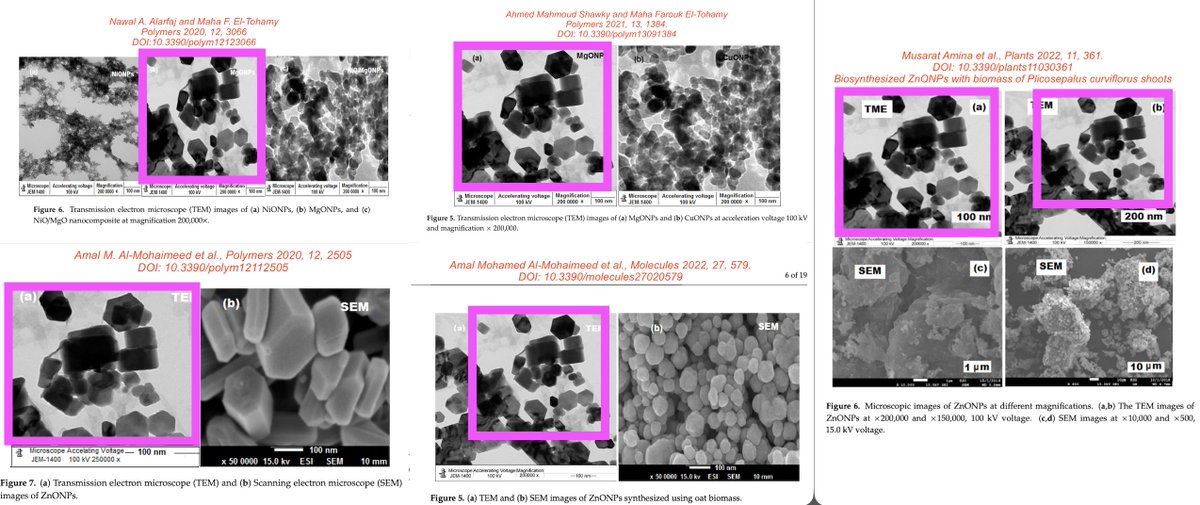
A very popular image! Perhaps Magnesium Oxide, perhaps Zinc Oxide. Who cares? Found in at least five papers by the same group; possibly more.
#ImageForensics
5
11
61
6,964