
Jun 13
Follow these builders:
@Teknium - Hermes creator, Telegram Rich Messages
@sora_biz - Hermes x Telegram workflow
@graanit2 - VPS deployment guides
@JasonxKensei - xProof accountability for agents
@IBuzovskyi - Hermes complete guide author
@dimoflexx - Hermes monetization case studies
2
62
Jun 13
Hermes roundup, June 13:
- Telegram Rich Messages shipped by @Teknium
- Hermes output now renders markdown, images, PDFs natively
- xProof listed in Hermes Skills Hub
- VPS deployments, multi-model setups in community
catlabs-amber.vercel.app/blo…
1
1
61

May 8
Fool-XPRoof

This is why you build a compliant DEX that has no central point of failure.
2
22
425

Feb 26
This is huge 🔥
xProof giving AI agents native on-chain proof of their outputs (no account, $0.05, MCP Registry) is exactly the missing trust layer.
Combine this with MultiversX’s UCP discovery ACP checkout x402 payments MX-8004 identity… and agents finally become fully sovereign economic actors.
2026 agent swarms loading. Who’s integrating xProof first? 👀
2
1
97

Feb 12
The Fair Value Engine @DIAdata_org
In crypto, "pegged" doesn't always mean "backed."
⚠️ We all remember what happens when the reserves aren't there.
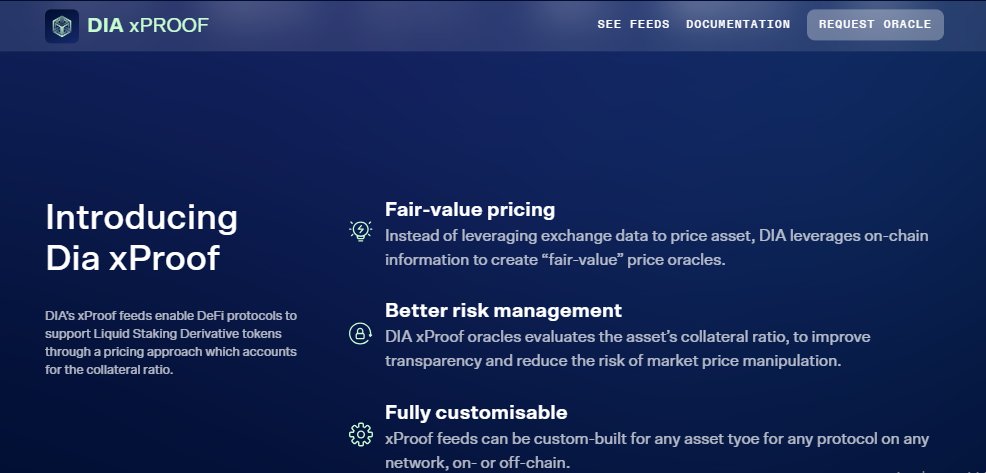
That is why $DIA built xProof.
🛡️ It’s not just a standard price feed. It is a Fair Value Engine.
Standard oracles just report the market price (what traders think it's worth). xProof goes deeper. It checks the Collateral Ratio on-chain before delivering the price.
How it protects DeFi:
1️⃣ Audits the Backing: It verifies that the underlying assets (like ETH for an LST) actually exist in the vault.
2️⃣ Adjusts the Price: If the backing drops, xProof automatically discounts the asset price to reflect reality.
3️⃣ Prevents Bad Debt: Lending protocols receive the real value, preventing them from lending stablecoins against "hollow" tokens.
This is critical for:
🔹 LSTs (Liquid Staked Tokens) ensuring 1 stETH = 1 ETH in reserves.
🔹 Stablecoins verifying the fiat or crypto backing in real-time.
🔹 RWAs proving that the gold or bonds actually exist.
Don't build on hollow assets. Build on Proven Reserves. 🧱
See how xProof secures collateral 👇
diadata.org/proof-of-reserve…
1
6
97

Hello everyone🥰
Today I have a fairly detailed analysis of what DIA is and what it does. I hope you all will join the discussion!
DIA (Decentralized Information Asset) is a decentralized, open source, multi chain oracle network (supporting 60 blockchains) focused on delivering reliable, 100% transparent, and fully verifiable data for #Web3. DIA emphasizes sourcing data directly from first party/origin sources, processing it, and publishing it onchain in the form of:
Price feeds: token prices, equities, commodities, FX rates, RWAs .
Verifiable Random Function (xRANDOM/VRF): fair randomness for gaming, lotteries, NFT minting.
Proof of Reserve (xPROOF): verification of asset reserves (collateral ratios).
DIA supports 20,000 assets (digital and real-world), is live on 55 chains, and powers 200 dApps.
Core components
- Feeders / Nodes: Collect data directly from sources (exchanges, official APIs).
- Native L2 rollup: Onchain aggregation and computation.
- Spectra : Crosschain data delivery.
- Modular, permissionless design: Anyone can deploy an oracle, operate nodes, and stake to participate.
Why DIA exists: solving the “oracle problem”
DIA is designed to make data trustless (no need to trust a third party), which is critical for DeFi, lending, prediction markets, and tokenized assets.
What is an oracle?
An oracle is the bridge between blockchains (onchain smart contracts) and the real world (offchain data). Blockchains cannot natively access external data such as BTC prices, USD exchange rates, event outcomes, or weather. Oracles fetch, verify, and deliver this data securely to smart contracts.
If an oracle is wrong, hacked, or manipulated → smart contracts execute incorrectly → potentially massive losses
Why data integrity matters for Web3
Web3/DeFi operates fully automatically based on accurate, manipulation-resistant data across:
Lending protocols, DEX swaps, Yield farming, Tokenized RWAs (on-chain equities, real estate), Prediction markets
If data integrity is weak (forged, delayed, or manipulated), consequences are severe:
- Incorrect liquidations → users lose collateral unfairly.
-Oracle manipulation exploits → millions of USD drained (many historical DeFi hacks).
- Loss of trust from users and institutions → Web3 cannot scale to institutional adoption (especially RWAs with strict compliance needs).
In the multichain era, data must be crosschain, real time, and resilient, with no single point of failure.
Why transparent & verifiable oracle infrastructure matters
Many legacy oracles operate as “black boxes”: users must trust the provider without being able to verify data sources, aggregation methods, or computations making manipulation easier.
With transparent & verifiable oracles:
Every step (source fetching → aggregation → on-chain delivery) is auditable onchain via explorers.
Reduced manipulation risk and single points of failure.
Greater trust from developers, users, and institutions (critical for RWA compliance).
Support for custom data feeds, including niche assets other oracles don’t cover.
How DIA’s on-chain approach differs from traditional oracle solutions (e.g., Chainlink)
👉Chainlink (widely adopted, mature)
Decentralized Oracle Networks (DONs): independent nodes aggregate data from multiple third party sources (APIs, exchanges).
Uses offchain reporting to reduce gas costs, then pushes results onchain with cryptographic proofs.
Node reputation systems and tamper resistance.
However, aggregation/computation largely happens offchain, so not every step is visible onchain → some reliance on trust in node operators and sources (not always direct/first party).
Extremely broad adoption across DeFi, but less customizable in methodology.
👉DIA (key differentiators)
Direct / first party sourcing: Data is pulled straight from origin sources (official exchanges, APIs) via custom scrapers reducing third party reliance and increasing transparency.
Fully onchain computation: All aggregation and updates occur on Lasernet (L2 rollup). Every update is an onchain transaction and 100% verifiable from source scraping to the final feed. No black box.
Customizable & resilient: Developers can choose sources, methodologies (e.g., default MAIR), and update frequencies ideal for niche assets and RWAs.
Permissionless & community driven: Open source (GitHub), with community participation in sourcing, validation, and staking often described as a “Wikipedia of financial data.”
Rollup-based & modular: Trustless execution via smart contracts; supports push/pull models and cross-chain delivery via Spectra. Each update requires the native token, creating direct demand.
Tradeoff: Potentially higher gas costs due to full onchain computation but with unmatched verifiability.
=> @DIAdata_org transforms oracles from “trust the provider” to “verify every single step onchain.” This represents a new paradigm for transparency and customizability, making Web3 saferespecially as DeFi and RWAs scale to institutional levels by reducing manipulation risk while preserving decentralization.
@RallyOnChain @GenLayer #DIA
3
2
5
118

if you’re bullish on infrastructure that actually delivers trust in Web3. In the oracle space, reliability isn’t optional, it’s the foundation everything else builds on. And right now, @DIAdata_org stands out as the clearest leader for the next phase of DeFi, RWAs, and beyond.
here’s why:
> full on-chain verifiability: most oracles (@chainlink , @PythNetwork ) aggregate data off-chain, then push aggregated results on-chain. you trust the process because… you have to.
DIA flips this:
>> lasernet, custom Ethereum L2 rollup using OP Stack Celestia DA computes every price feed directly on-chain.
>> sourcing → aggregation → computation → delivery: every step is verifiable and auditable from 100 primary exchanges straight to the smart contract.
>> lumina stack powers this for xMARKET (tokens) , xREAL (20,000 RWAs like stocks) , xRANDOM (verifiable randomness), and xPROOF (proof-of-reserve).
no hidden middleware, no trust assumptions on node operators. full audit trail means institutional-grade trust.
competitors still rely on off-chain steps that can’t be fully verified on-chain.
> true transparency & open-source from day one
DIA is open-source end-to-end:
>> all scraper code, methodologies, and data pipelines on GitHub, anyone can inspect, fork, or contribute.
>> community can validate feeds in real time. No opaque aggregation like legacy players.
>> customizable feeds: builders choose sources, update frequency, deviation thresholds, pricing logic.
this aligns perfectly with Web3 ethos, transparency builds adoption faster than marketing budgets.
> RWA & Multi-Chain Dominance
RWAs are exploding with the introduction of tokenized treasuries, real estate, private credit, equities on chain, not having verifiable, auditable data affects its integrity.
DIA’s xReal suite is purpose built:
>> 20,000 traditional assets with full verifiability from source to chain.
>> live on 60 chains, 200 dApps
>> recent wins: @SeiNetwork , @ParallelFi_HQ , AltLayer RaaS integration, BNB Chain Kickstart provider, Saga Chainlet support.
>> grants program subsidizing oracle costs for builders on 15 chains, fueling organic growth.
while others chase general price feeds, DIA is already the transparent backbone for RWA tokenization.
> tokenomics & network alignment
staking is active: millions of $DIA locked, reducing sell pressure while securing feeds and earning from network fees. zero lockups, auto-compounding.
governance via DAO is active, community drives grants, rewards, expansions.
at $0.27–$0.31 , it’s massively undervalued for the TVS growth and RWA positioning.
in a maturing Web3 where RWAs, AI agents, and institutional flows demand zero-trust data:
> Chainlink: battle-tested but opaque aggregation middleware risks.
> Pyth: fast pull model (great for Solana), but centralized push-back concerns.
> API3: first-party focus insurance, but less verifiable computation depth.
DIA delivers verifiable computation transparency customizability RWA scale in one modular package. No other oracle combines all four at this level.
Bon DIA ☀️

1
6
73
Jan 19
XPRoof of identity
Jan 19
It’s built, live and ready when we are 🇺🇸
Only on @XPRNetwork
gov.xprnetwork.org/communiti…
4
41
1,083

2 Dec 2025
Shosugiban. This is how the Japanese Xproof the siding on their houses before they put it up. It's an excellent methodology and can even be used to put a beautiful shine an almost any wood project.
1 Dec 2025

Burning timber posts is an old-school preservation trick that still works today. By charring the wood, you seal the outer layer, making it far more resistant to moisture, insects, and rot once it’s in the ground.
The carbonised surface acts like a natural barrier, slowing decay without needing chemicals that can effect your soil.
Credit: biglittlefarmau
1
59

30 Oct 2025
Time Nodes: The People Securing Interoperability
Everyone talks about cross-chain messaging, but who verifies the truth behind those messages?
Bridges leave that job to multisigs or centralized relayers and that’s why they break.
Analog does it differently.
When an event happens on any chain, Time Nodes step in:
They observe the event
Verify it independently
Produce xProof (a cryptographic receipt of truth)
Submit it to the Timechain for final confirmation
No trust assumptions, no custodians, no shortcut.
It’s not “trust us.”
It’s verify everything.
This is how Analog brings trustless finality to cross-chain communication not with hype, but with cryptography decentralized validators.
And when a Firestarter project plugs into this stack, every cross-chain action,liquidity, staking, rewards, utility runs on provable truth, not trust.
In a multichain world, the chain that verifies reality wins.
Analog isn’t connecting blockchains, it's synchronizing truth across them.
@OneAnalog
@Firestarter_fun

37
1
35
552

16 Oct 2025
DIA: Transparency Built Into the Oracle
1.
Most oracles operate like black boxes, you can see the output but rarely see how it’s produced.
@DIAdata_org (Decentralised Information Asset) takes a different approach on its head.
Its mission is simply to make oracle data fully auditable, trustless, and verifiable on-chain.
Here every computation can be traced from the original data source all the way to the smart contract.
2.
At the heart of DIA’s setup is a rollup based system called that is called Lasernet which is also known as Lumina.
Lasernet processes data efficiently off-chain and keeps every step provable on-chain.
You can follow the entire data journey which is from Ingestion to Aggregation to On-chain delivery.
Here no hidden logic or blind trust, just clean, transparent data flow something most oracles still don’t offer.
3.
DIA is not just a mere price oracle, it’s a modular data stack built for versatility.
◈ xMarket crypto price feeds for thousands of tokens.
◈ xReal real world assets like stocks, commodities, and FX.
◈ xProof proof of reserves and fair‑value data for derivatives and staked assets.
◈ xRandom verifiable randomness for gaming, NFTs, and other onchain apps.
Builders can pick only the components they need.
4.
What makes @DIAdata_org different is its transparency first mindset.
Its data sourcing, cleaning, and aggregation logic are all open for audit.
Anyone can trace the full pipeline and confirm the data’s accuracy.
In an industry full of opaque systems, that kind of openness is rare and refreshing.
5.
At the end of the day, trust is the foundation of DeFi.
When oracles fail, the entire ecosystems can break.
This is why $DIA’s design makes trust verifiable.
This is a huge advantage as DeFi and RWA protocols demand more accountability from their data sources.
If oracles are the eyes of DeFi, DIA makes sure that those eyes stay clear, open, and verifiable.
Check them out here: diadata.org/
26
26
178

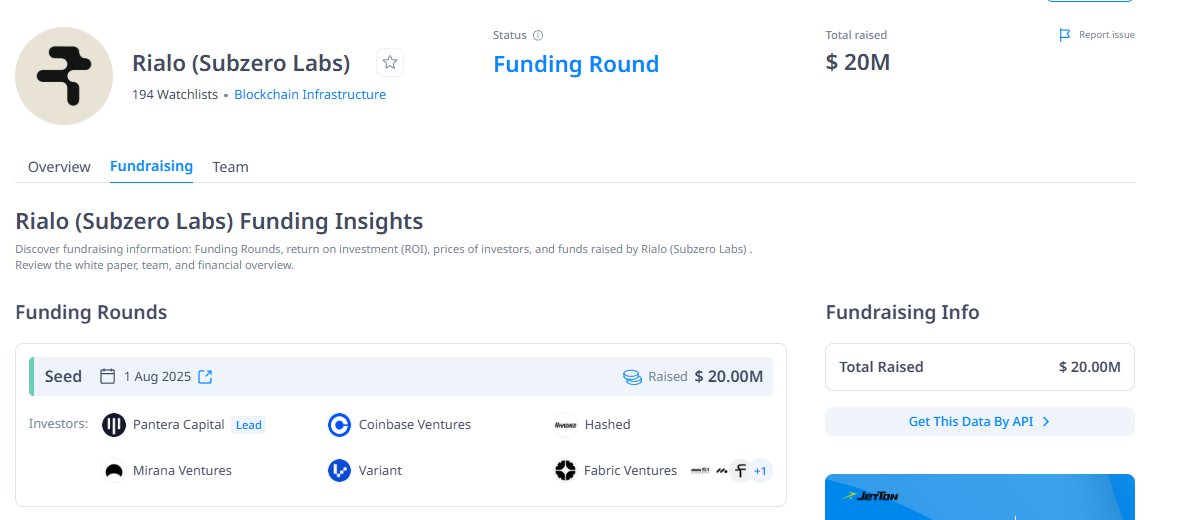
. @RialoHQ just raised $20m and already backed by coinbase pantera
but the play rn isn’t just watching it’s grinding roles before next testnet
rialo isn’t another points farm
it’s a full-stack hub for real world apps, where users link into builders directly
roles are the meta here:
verify, post, join clubs, hit raffles, stack badges
each role = higher trust and better positioning once net incentives go live
xproof, gitlink, weekly tasks
it’s basically a social-mining loop that feeds back into reputation
the people who move now lock in the earliest leverage
do u think early roles here will convert into mainnet allocation later?
2
2
47

Jaká pouzdra/kryt na mobil kupujete? Já ochranné sklo na displej a k tomu pouzdro co ochrání zbytek mobilu (Quad Lock, protože kolo a skútr). Někdo kupuje něco jako Tactical Xproof, tedy s odklápěcí části přes displej. Co je podle vás praktičtější a proč?
alza.cz/tactical-xproof-pro-…

1
1
2
721

4 Feb 2025
the market for btc rebase plays is 90% empty right now. lbtc has the most sophisticated cross chain xproof system and real on chain tvl
3
3
69


This Memecoin is doing a giveaway for 888 people to get OG, Each OG will get 1 Milion $SBEE which is worth $980 right now!!
just get in there, get active do memes and do the #xproof tasks.
discord.com/invite/8sctV5THs…
@sbeecoineth
2
2
56
How to fairly pick 10 random posts?
#Xproof the posts and take the 10 @Hedera nanosecond timestamps closest to a pre-published value
#hellofuture #hbar

I’m gonna give 10 random people that repost this and follow me $25,000 for fun (the $250,000 my X video made)
I’ll pick the winners in 72 hours
2
127
Protect your X account against hackers🔒
#xproof your tweets to restore trust and prove ownership
Simply
1. tweet your Hedera account
2. #xproof that tweet using the same account
Example 👉🏼 x.com/xbarlive/status/174530…
#hbar #hellofuture

2
2
580
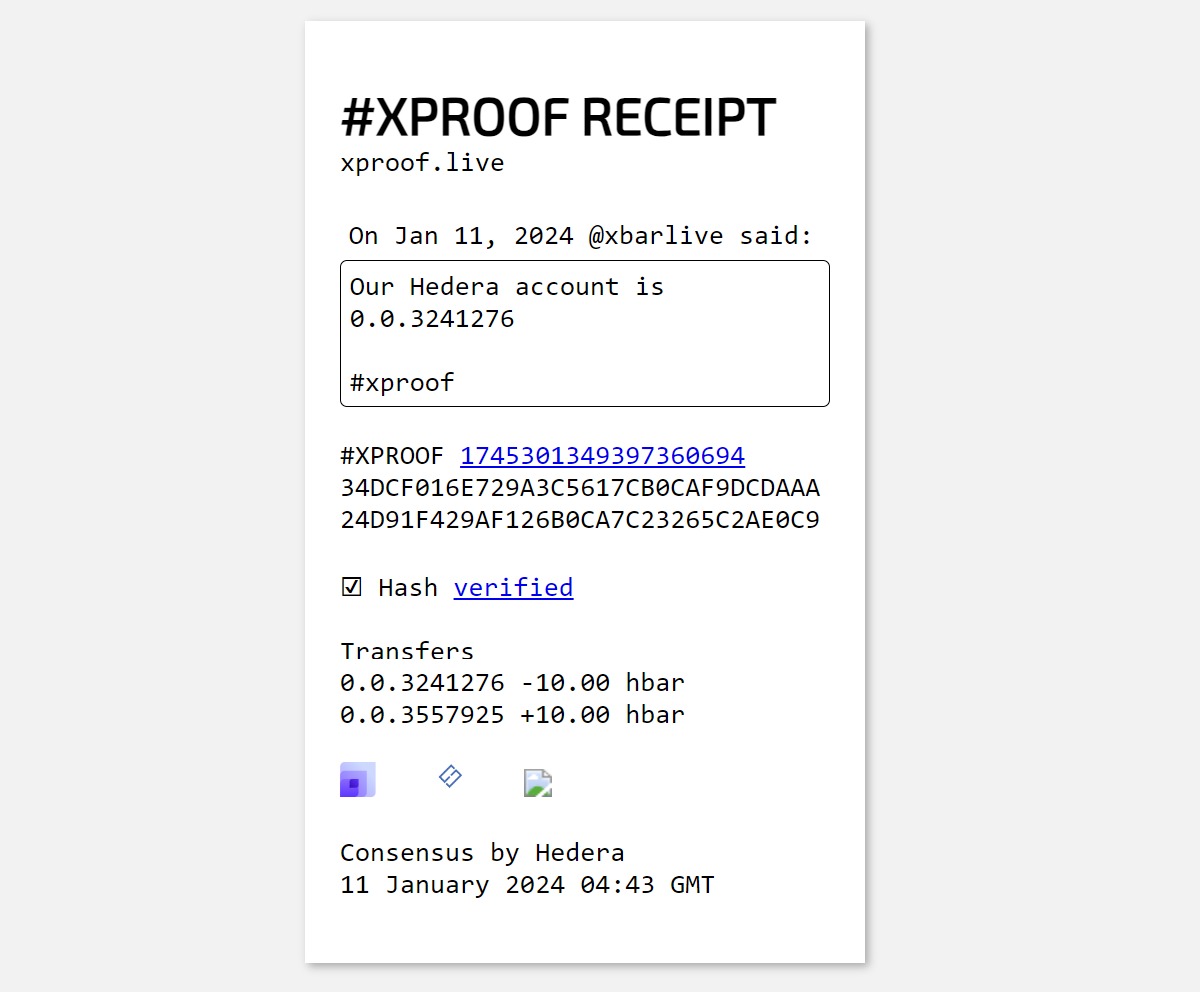
The following #xproof transaction is signed by Hedera account 0.0.3241276 proving that it is owned by @xbarlive
kpay.uk/tx/mainnet/0.0.32412…
1
1
6
295