
May 23
OpenAI proved the next frontier of AI is pure mathematical reasoning. While centralized labs burn billions trying to brute-force logic, $TIG just dropped the ultimate counter-move.
The rollout of Prometheus shifts us to an autonomous, machine-scale evolutionary engine. By running thousands of continuous simulation trajectories, it systematically breeds "Global Best" algorithms to drastically slash compute overhead.
As Big Tech faces a severe energy crisis, the network that algorithmically optimizes the math wins the cycle.
#DeSci #DePIN #OPoW #AlgorithmicEfficiency #AI #Maths

1
18
236

Feb 27
Deep learning. Adaptive models. Millisecond execution. Efficiency will no longer be lost.
#DeepLearning #AdaptiveModels #MillisecondExecution #AlgorithmicEfficiency #AIInfrastructure

5
44

8 Oct 2025
Samsung’s Tiny Recursive Model (TRM) is a reminder that architecture and compute strategy can matter as much as parameter count.
What’s new
• 7M params, trained on ~1k examples, uses a draft → latent scratchpad → self-critique → revise loop (up to 16 cycles).
• Reports 45% on ARC-AGI-1 and 8% on ARC-AGI-2, exceeding many much larger LLMs.
• Code paper are public:
· Blog → alexiajm.github.io/2025/09/2…
· Paper → arxiv.org/abs/2510.04871
· Code → github.com/SamsungSAILMontre…
Why it’s interesting
• Shows a recursive think-then-rewrite controller can boost reasoning without billion-scale models.
• Validates a neuro-symbolic flavor (explicit inner loop, scratchpad, critique).
• Points to cheap, deployable reasoners for constrained tasks at the edge.
Nuance (observer lens)
• TRM is specialized (e.g., Sudoku/Maze/ARC) and its ARC results rely on heavy augmentation, recursion depth, and voting; so compare by compute budget (FLOPs/latency), not just parameters.
• Great for structured puzzle-like problems; not a general LLM replacement. The right takeaway: algorithmic loops small nets can win on certain classes of reasoning.
What we’re watching at RediMinds
• Where recursive controllers fit into production stacks (agent toolflow → deliberate inner loops → verifiable outputs).
• Eval design that normalizes for compute, not only params.
• Opportunities for edge inference in regulated and resource-constrained settings (gov/legal/health ops) where small, auditable models shine.
#AIReasoning #AlgorithmicEfficiency #EdgeAI #LLMops #AIEngineering #RediMinds #CreateTheFuture
2
4
866

23 Jun 2023
By employing smart algorithms and optimizing their implementation, developers can unlock impressive performance gains.
#businesssense #softwareoptimization #algorithmicefficiency #fastersoftware
1
2
74

14 Apr 2023
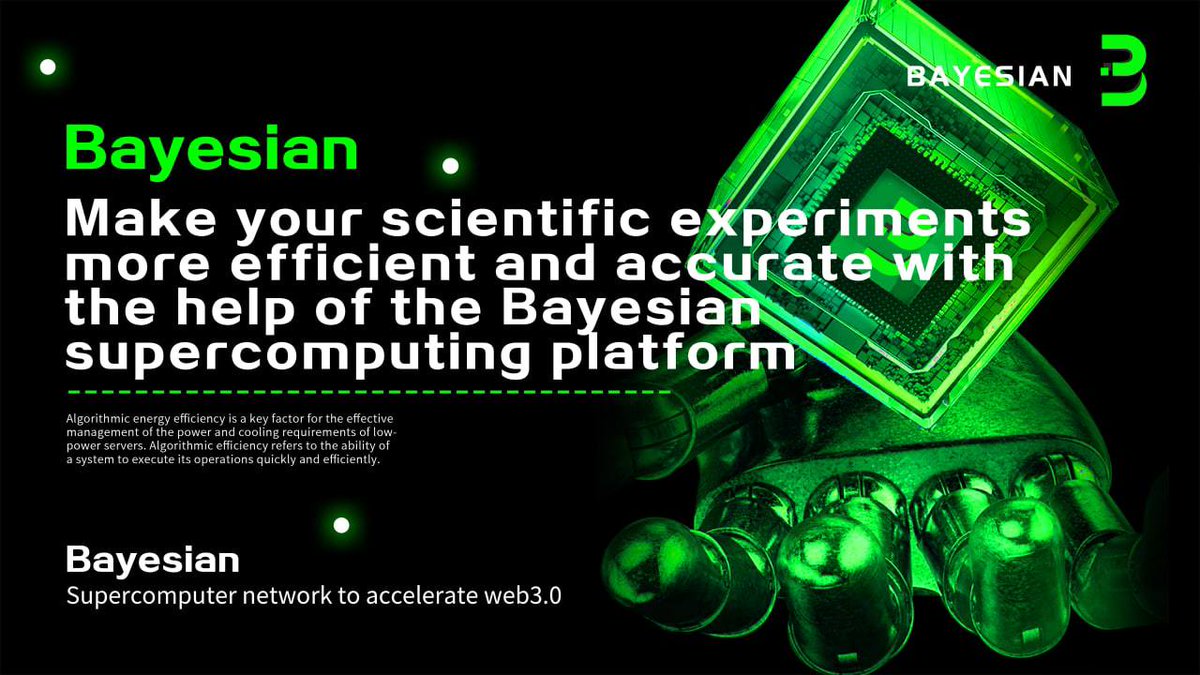
🔬🌟Want efficient and accurate scientific experiments?
Choose Bayesian's supercomputing platform! Algorithmic efficiency is key to managing power/costs for low power servers.
Join our supercomputing network to accelerate web3.0 development! #Bayesian #AlgorithmicEfficiency
2
135

#100DaysOfCode
D357: Finished @cs50's week 2, learning more about C and some available libraries, plus getting a taste of the Big O Notation, now on to the assignments!
#WomenInTech
#ComputerScience
#AlgorithmicEfficiency
#BigONotation
#BigO
10