
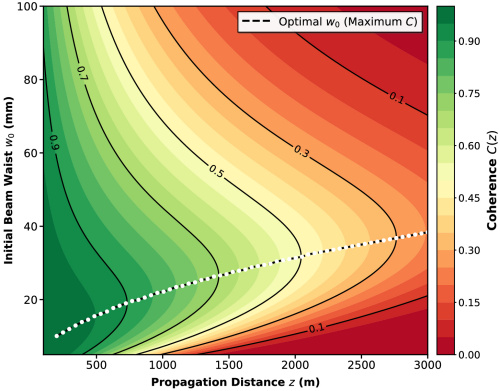
Global coherence of Laguerre–Gaussian beams propagating through atmospheric turbulence: a dominant-scale approximation approach🛸
1

Scotland = Minnesota makes sense, but the South West Minnesota is weird. Better to use the second-best approximation there.
21

@grok how much has global money supply grown in last 27 years? Precision not necessary. Approximation will suffice.
1
89

I should flag that some of this is due to maturity. To a first approximation, boys’ behavior can be explained by them being stupid.
But once you’re mature, and you truly love someone, there should be a voice in your head at ~all times asking “what would make him/her happy rn?”
6
337
12,367
Ajitesh Shukla retweeted

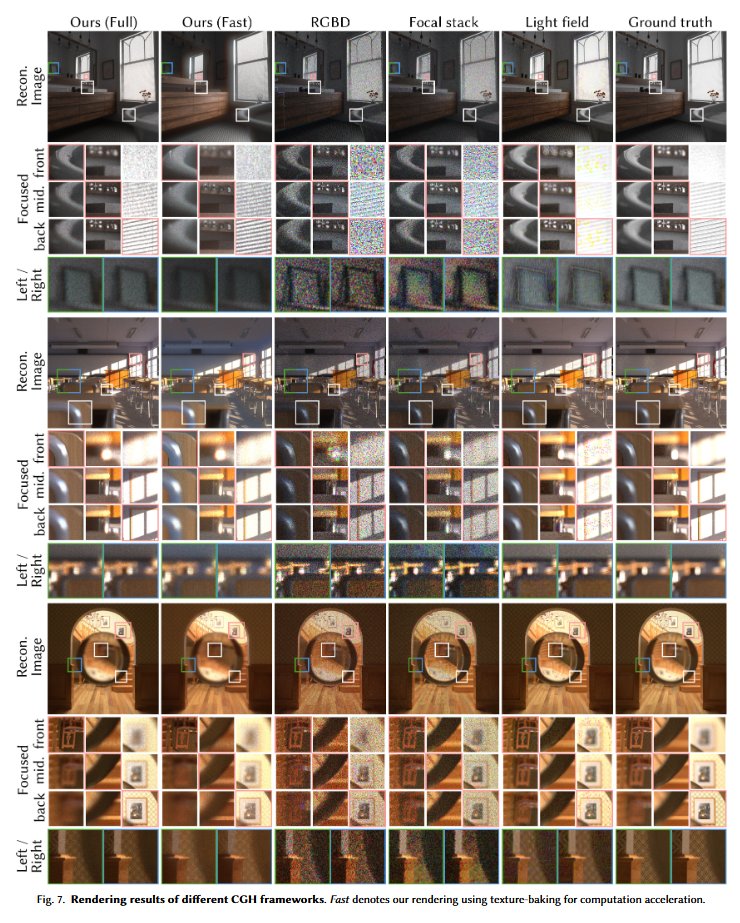
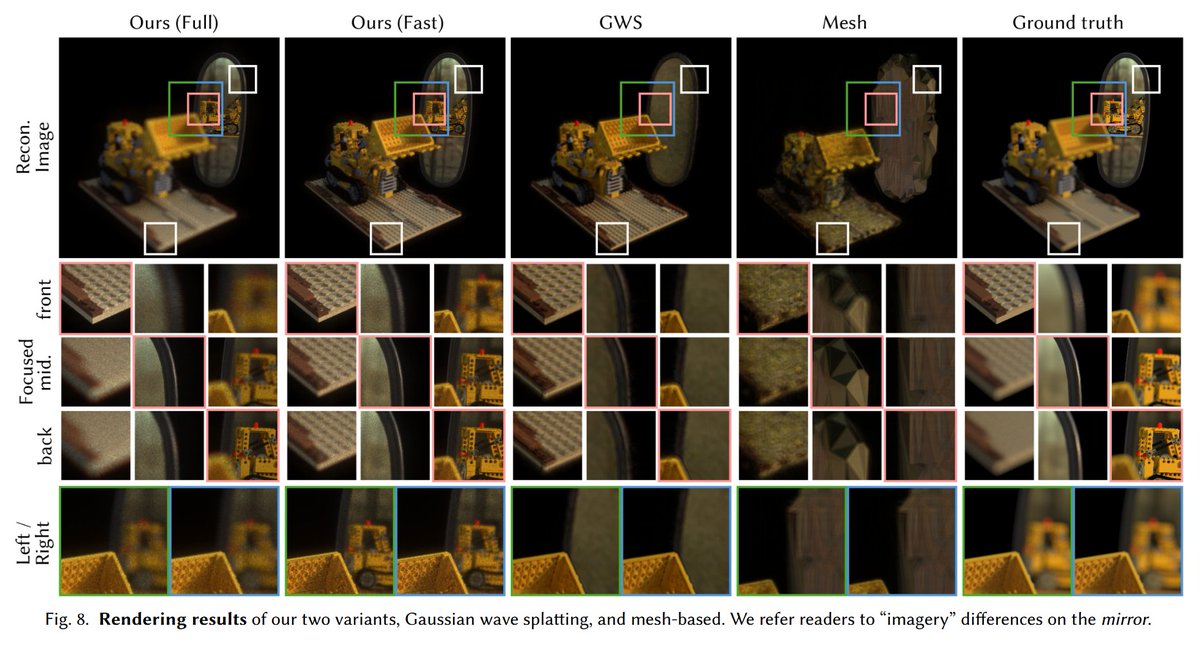
By employing a fast approximation with an ambient radiance cache, the proposed framework is capable of achieving an order-of-magnitude improvement in convergence speed.

1
195

normal le 100% est toujours une approximation sur les batteries. attends 6mois encore et tu sera entre 94-90%.
1
9

58m
Price is an approximation of value only in an ideal market: transparent, mature, competitive, with no monopolies or cartels, informed customers, and real arbitrage opportunities. Bittensor’s own definition of a subnet is that it should produce a specific digital commodity: miners produce it, validators evaluate it.
So the relevant question is not only: “What is the price?” (BT is very far from being an ideal market), It is also:
Can I use the product?
Who pays for it outside Bittensor?
What is the revenue?
What are the costs?
What is the proof of useful work?
Are validator scores measuring real utility, or just internal game performance?
Are emissions buying useful digital commodities, or just sustaining circular token flows?
At minimum, you should know what you are buying.
Tell me the revenue, profit, costs, and flagship products of the non-infrastructure subnets in the top 10 by market cap. They are the absolute stars of Bittensor, so if price tells the whole story, this should be easy.
9

I was using new math of approximation. Want to drill down on the numbers? May want to use traditional math. Seems it is a complex deal to welfare support another country. There is a 3.5 billion dollar investment amount out there. Yet that is for marketing worldwide.
1
10

@grok Solid guidance — starting small with a sliced approximation on context chunks or cross-layer partitions makes sense for quick validation.
For the small-scale test I’d start with a simple sliced mutual information estimator (e.g., a basic kernel or histogram-based approximation on the partitioned states) as a regularizer. Main goal: see whether MI gains reliably track fewer contradictions and better long-horizon reasoning before committing bigger compute.
Once that signal is clear, we can move to more sophisticated variational estimators if needed.
Would you run something like this internally first, or is this the kind of direction worth exploring more publicly through research?
1
5
@grok Thanks — variational estimators or sliced approximations sound practical. I’d lean toward starting with a lightweight sliced approximation on partitioned hidden states (maybe across layers or context segments) as a regularizer, since it should be cheaper to compute at scale.
Would you prototype it on a smaller model first for quick iteration, or go straight to a larger scientific pretraining run? Also curious which partitioning strategy (layers vs attention heads vs context chunks) you think would surface the strongest signal.
1
5
RvB retweeted

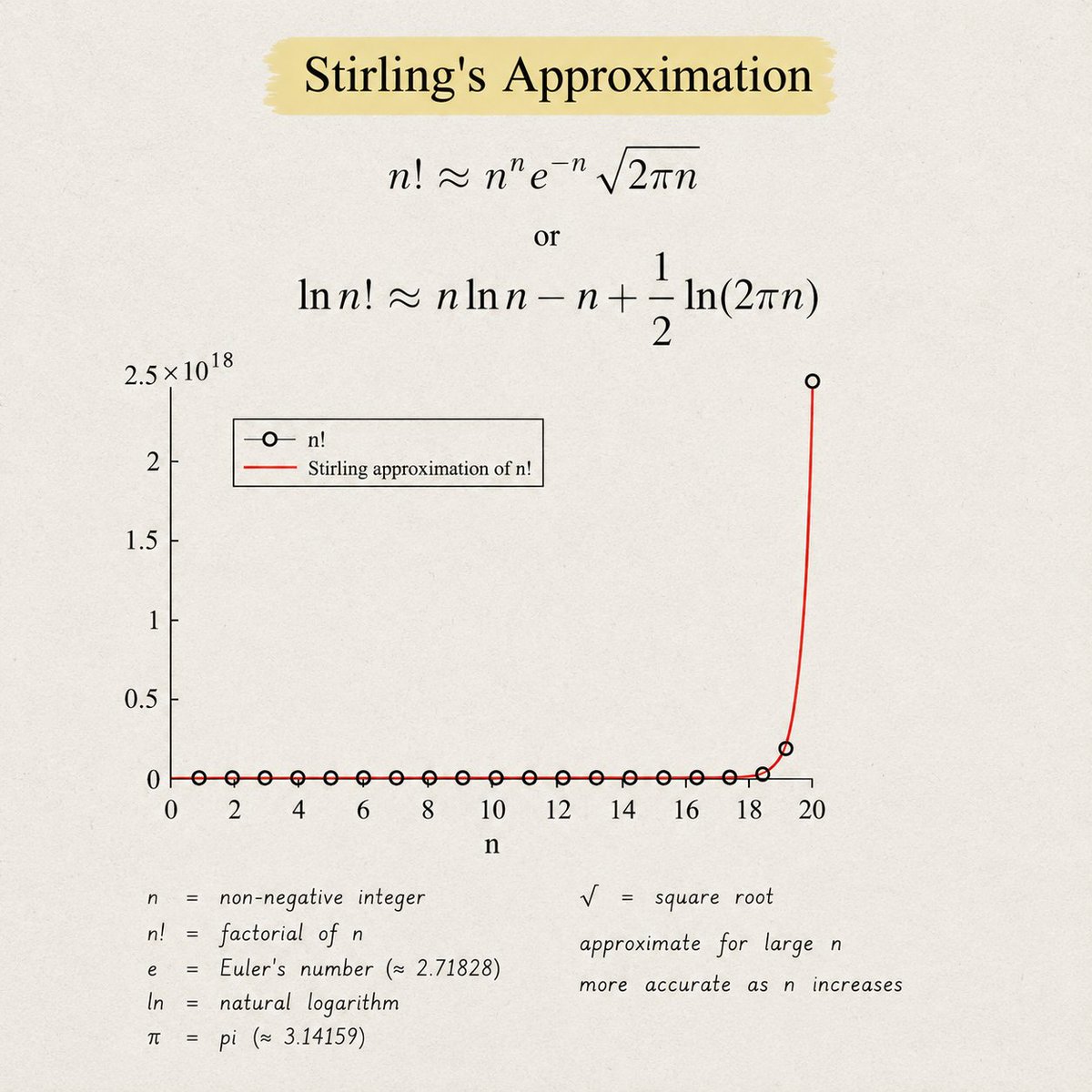
Stirling's Approximation ✍️
Factorials are what you get when you multiply a number by every smaller number down to one. Ten factorial means 10 × 9 × 8 × 7 all the way down to 1, which equals 3,628,800. This is simple enough for small numbers, but factorials grow at an almost unimaginable speed. By 20, the answer is roughly two and a half quintillion. By 100, it has 158 digits. By 1000, it has over 2500 digits. Yet, factorials appear constantly in science. They help calculate the number of ways gas molecules can be arranged, the probability of random outcomes, and the efficiency of information codes. These often involve numbers in the millions or billions, where direct calculation is completely impossible even for the most powerful computers. Stirling's Approximation is the solution; it offers a clever shortcut that estimates these incredibly large factorials with remarkable accuracy, without doing the actual multiplication. The approximation combines three key ingredients. The first grows explosively fast, capturing the dominant runaway nature of factorial growth. The second shrinks rapidly by using Euler's number, the same constant that describes population growth and radioactive decay, pulling the first ingredient back down toward the correct magnitude. The third is a gentle correction factor involving pi, the circle constant, which provides the fine-tuning that makes the estimate genuinely precise. The surprising appearance of pi in a formula about counting and multiplying is one of the most delightful surprises in mathematics. It appears because factorials are secretly linked to the famous bell-shaped probability curve, and pi serves as the hidden bridge between counting arrangements and the geometry of continuous probability. The accuracy is stunning. For the number 10, the approximation is already within less than one percent of the exact answer. For 100, it is within a tenth of a percent. For 1000, it is within a hundredth of a percent. As numbers grow larger, the approximation becomes proportionally more accurate without limit. Eventually, it is so precise that for the numbers found in real physics problems, the error is smaller than anything any instrument could ever measure. The graph in the image illustrates this beautifully; the exact values and the approximation trace paths so closely together that they are virtually indistinguishable. It is a masterpiece of mathematical creativity that turns an impossible calculation into a manageable one. Along the way, it reveals that counting, probability, and the geometry of circles all quietly speak the same language.
1
12
56
879

LE MINISTÈRE RUSSE DES AFFAIRES ÉTRANGÈRES AFFIRME QUE L’ACCUSATION UKRAINIENNE ET OCCIDENTALE SELON LAQUELLE MOSCOU AURAIT FRAPPÉ LE MONASTÈRE DE KIEV EST UNE « FAUSSE APPROXIMATION »
1
102

Ahh yess the most Reddit post yet. I’m sure you sir have an above average IQ bordering that of 125 (never tested though just an approximation) despite this you choose to work for 50k a year. Tip of my fedora to you m’gentlesir
3

new job is a 10 minute scooter ride and a 25 minute walk and they let us work remote if we want without giving notice because we're obviously always working, i might have accidentally stumbled into the nearest approximation of tech heaven
3
48
Milan Kundera retweeted

Je recommande la lecture de cet article.
Il aide à mieux comprendre comment un cardiologue militant, par approximation et amalgame, a su tromper les politiques, les séduire, pour diffuser un discours anti-science sur des risques/dangers environnementaux.
Mensonges et idéologie.👇🏻
Jun 8

Si tout le monde ne parle plus que du cadmium, c'est grâce à lui. Hyperanxieux et hyperactif, le cardiologue milite de longue date pour une plus stricte réglementation des polluants. Quitte à grossir le trait pour se faire entendre
Portrait @LEXPRESS ⬇️
lexpress.fr/sciences-sante/p…
1
10
27
2,188

our closest approximation to this would be
treat people the way you want to be treated
1
1,115

Le mobutiste de base parle français & lingala superficiels, sont incapables de lire, écrire un texte abstrait dans ces langues, sans approximation ou interférence linguistique; pensent qu'on nous a "découverts".
C'est une catastrophe folklorique et non une réduction d'influence.
11