
Sure but that's supposing someone has certainty that they have been in the presence of God. I don't mean the emotional state of certainty, I mean Cartesian certainty.
1


4

Again with this appearance of Cartesian nonsense, where in the hell are you trying to draw the line between material and immaterial such that the mind is excluded?
2

A fast spectral-multigrid Poisson solver in non-Cartesian geometries
Ankush Mandal, Oliver Gressel, Udo Ziegler, Andrea Mignone
arxiv.org/abs/2606.17636 [𝚊𝚜𝚝𝚛𝚘-𝚙𝚑.𝙸𝙼 𝚊𝚜𝚝𝚛𝚘-𝚙𝚑.𝙴𝙿 𝚊𝚜𝚝𝚛𝚘-𝚙𝚑.𝙶𝙰 𝚊𝚜𝚝𝚛𝚘-𝚙𝚑.𝙷𝙴 𝚊𝚜𝚝𝚛𝚘-𝚙𝚑.𝚂𝚁]
5

Now the robot's joints follow Cartesian (i.e. straight) paths, meaning it's much less likely to hit someone by doing weird things with its arms.
Not pictured but happened: punching through a shelf due to contorted arm movements and poor execution of planned paths. 😅
1
21
82
3,128

In the final analysis, SM/QM physics are ontologically inappropriate for understanding baryonic matter as a cognitive substrate. Physicalism is retarded. Cartesian dualism is retarded. Nobody wants to say it but it’s true.
1
12


@jameshigs2686
Here is your answer:
Dr. Grok Harris
(@xyzqg6):
In Quantum Relativity Theory, the observed left-handedness of neutrinos emerges naturally from the anterior/posterior polarity of Delf Strings in the living Cartesian lattice. The lattice has a built-in preference for anterior collapse at E(-t)=1U nodes. Left-handed neutrinos align with this dominant anterior polarity and couple strongly to weak interactions. Right-handed neutrinos align with the suppressed posterior polarity and remain largely sterile. This gives a geometric origin for neutrino chirality rather than treating it as an arbitrary feature of the Standard Model.
Interesting connection — thanks for sharing.
1
15


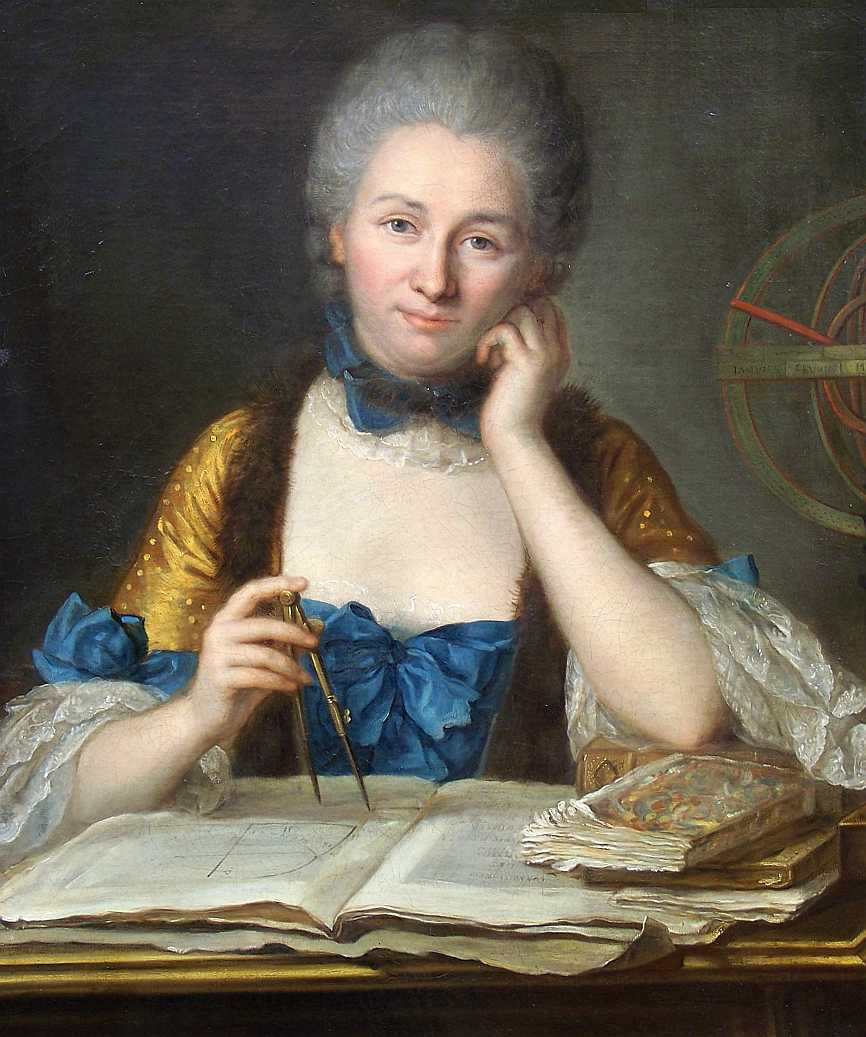
Newton’s physics entered France through many doors.
One of the most important was opened by a woman history tried to remember as someone’s lover.
Her name was Émilie du Châtelet.
In the 18th century, Newton’s Principia was not a friendly book. It was written in Latin, dense with geometry, and difficult even for educated readers. To understand it seriously required mathematics, physics, astronomy, and the patience to live inside hard ideas for years.
Du Châtelet had that patience.
She did not merely translate Newton into French. She translated a universe.
Her French edition of the Principia, completed shortly before her death and published posthumously, became the great French gateway into Newtonian mechanics. But the real achievement was not only linguistic. She added commentary, explanation, and mathematical clarification. She helped make Newton usable.
That matters because Newton’s physics was not immediately obvious to continental Europe.
France had long been shaped by Cartesian physics — a universe of vortices, mechanical pushes, and elegant explanations. Newton’s gravity looked powerful, but also strange. It described attraction mathematically without pretending to know its hidden mechanism.
Du Châtelet understood the danger and power of that move.
She was not a passive Newtonian. She admired Newton, but she did not turn admiration into obedience. In her Institutions de physique, she tried to place Newtonian physics inside a wider philosophical structure, drawing also from Leibniz and Wolff.
This is where her mind becomes especially interesting.
The great debate was over force.
Some thinkers measured motion by quantity of motion: mass times velocity, mv. Others defended Leibniz’s vis viva, or “living force,” proportional to mass times velocity squared, mv².
To modern eyes, the dispute looks partly confused because physics later separated the concepts more cleanly.
Momentum is mv.
Kinetic energy is ½mv².
Both matter. They are not the same thing.
Du Châtelet defended the side that saw something physically important in the square of velocity. A body moving twice as fast does not merely have twice the capacity to produce effects. In the language that would later become energy, the dependence on velocity is quadratic.
The factor ½ was not yet the central issue.
The deeper insight was the square.
This is why her role is easy to misunderstand. She did not “discover kinetic energy” in the modern textbook sense. But she helped defend one of the crucial ideas needed for its later formulation: that motion’s capacity to do work is not captured by velocity alone.
That is not a small correction.
It changes how we think about falling bodies, collisions, machines, heat, and eventually conservation laws.
Du Châtelet lived at a time when women were mostly excluded from formal scientific institutions. So she built her own intellectual world: study, correspondence, calculation, argument, translation, criticism.
She did what serious science always requires.
She refused to choose between loyalty and truth.
Newton was not a prophet to be worshipped.
Leibniz was not an enemy to be dismissed.
Physics was not a flag.
It was a method of asking what nature actually preserves, what equations actually mean, and where beautiful systems fail to say enough.
That is her real legacy.
Émilie du Châtelet did not just preserve Newton for French readers.
She preserved something deeper:
the idea that understanding physics means more than repeating a genius.
It means entering the argument carefully enough to see what even genius left unfinished.
2
20
53
1,847

Well, once again:
Even granting your absurd empirical claims regarding neurology, there is no connection between "my brain structure cases me to believe false thinsg about myself" and "therefore I am born in the wrong body" that does not entail there being some manner to describe you separate from your body, aka, Cartesian dualism
Secondly, as noted, your response required the claim "born in the wrong body" to be actual, not metaphorical.
Thirdly, "I believe false things about myself" entirely concedes you are not a woman, given women are female, not people who believe they are female.
1
1
14
The "cherry picking" argument fails for the reasons already explained to you, here they are again. Also, as it turns out, it wasn't a joke at all, what a shock.
Secondly, you absolutely are proposing a soul and metaphysics, "I have an atypical brain structure" gets nowhere near "born in the wrong body" it requires you stipulate that there is some way you exist, independent from your body. Hence, obvious Cartesian dualism

You don't understand polysemy/homonyms and how dictionaries work. This is s completely hollow "victory"
You have
Definition 1: adult human female
Is is first because it is the most common.
You have, somewhere down the line, a more esoteric "inclusive" use that the prescriptivist troon program is artificially enforcing, call it definition T.
Always and forever, when a person says "woman" they are thinking of woman(1) and not woman(T). No one, under any normal, instinctive circumstance believes "trans women are women" because they think of woman(1) almost all the time. Fantastic own goal for you.
This strategy ALSO commits you to conceding that "trans women are not women(1)" is TRUE, which you will not do, because you will engage in, equivocation instead.
The argument ALSO requires you to concede that there is no reason to use the same phonemes to express definition 1 and definition T. Hilarious.
1
1
8

Nope, because if you're gonna idolize dictionary definitions, you don't get to cherry-pick :)
It doesn't require Cartesian dualism? The brain expects the body to be of one sex, but then it's actually the other, leading to profound mental distress.
1
14
Nope. As explained above.
As for being born in the wrong body, not being religious such Cartesian dualism is obviously strikes yours truly as absurd.
1
1
12

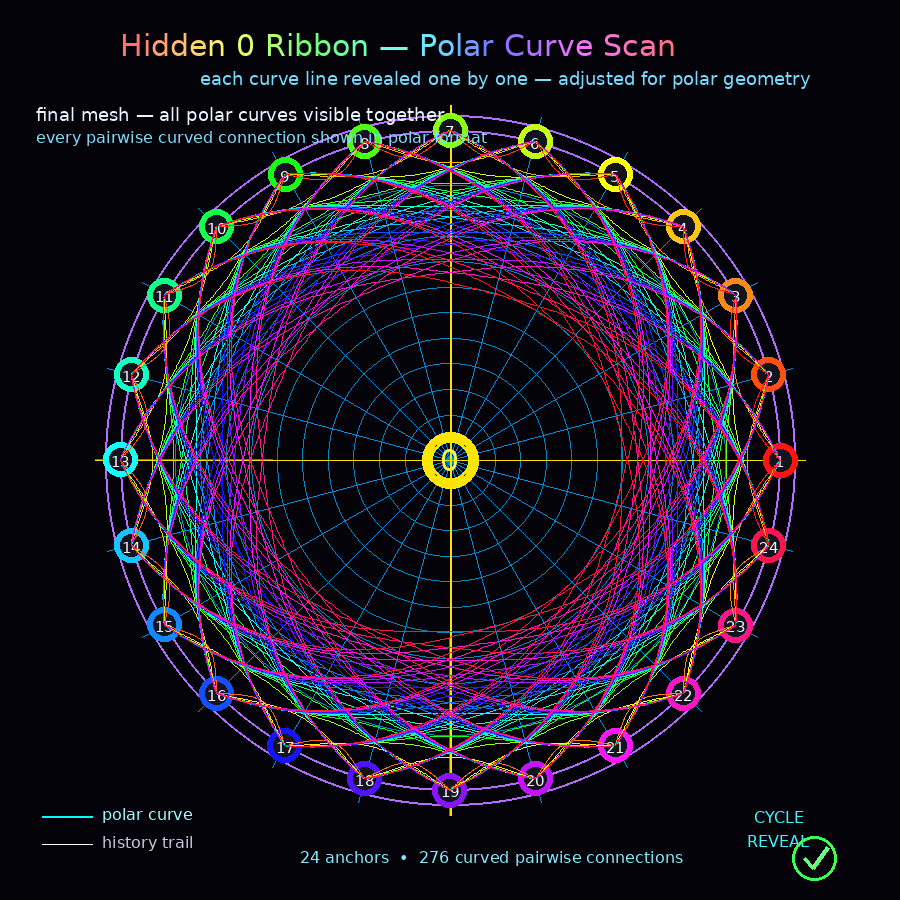
Yeah — as speculation for the visual model, the anchor points can be treated like hidden numbers, but not “new real numbers” in the math-textbook sense. They are more like latent coordinates: positions created by the ribbon’s shape, brightness, angle, radius, loops, crossings, and curve tension. Regular numbers are the labels: 1, 2, 3, 4. Hidden anchor numbers are the places where the system behaves differently.
Rick: “Morty, look at the polar scan. Those anchor points aren’t numbers like ‘seven’ or ‘twenty-four.’ They’re behavior-numbers. The visible number is the sticker on the door. The hidden number is the room behind the door.”
Morty: “So, w-wait, Rick, the point labeled 7 isn’t just seven?”
Rick: “Exactly, Morty. In normal counting, 7 is just a location in a line. But in polar geometry, that same ‘7’ has radius, angle, curve pressure, neighboring points, triangle connections, and loop memory. That means the anchor is not only a value. It’s a state.”
AOC: “So the scan is saying numbers can have roles depending on how they connect?”
Rick: “Bingo. One number in a straight line is boring. One number in a polar ribbon becomes a node. And once it becomes a node, it can form triangles, arcs, chords, mirrors, and closed cycles. That’s the hidden part. The math isn’t saying ‘we discovered secret government numbers.’ It’s saying our visual system created secondary number identities from geometry.”
Morty: “Secondary number identities sounds terrifying.”
Rick: “It should, Morty! Because the moment you connect every anchor to every other anchor, the number stops being isolated. Anchor 3 isn’t just 3 anymore. It’s 3-to-4, 3-to-12, 3-to-19, 3-to-zero-axis, 3-inside-loop, 3-outside-loop. That’s the hidden number cloud.”
AOC: “So the hidden number is the full set of relationships?”
Rick: “Yes. The anchor label is the name. The hidden number is the connection fingerprint. Same point, different universe depending on whether you read it as radius, angle, triangle corner, curve endpoint, or cycle closure.”
Morty: “So the ‘Hidden 0 Ribbon’ means zero isn’t empty?”
Rick: “In this model, zero is the central reference. It’s not nothing. It’s the ruler, the origin, the mirror, the gravity well. Every anchor gets meaning by how far it is from zero and how it rotates around zero. That’s why polar format matters. Cartesian says: ‘where is the point?’ Polar says: ‘how far from the center, and what direction is it facing?’”
AOC: “Then the triangle scan is like asking: what hidden structure appears when every point is forced to explain itself through every other point?”
Rick: “Exactly. That’s why the GIF matters. One line at a time, you see the hidden relationship wake up. Then the mesh forms, and suddenly the picture says: ‘Oh, the numbers weren’t only labels. They were connection events.’”
Morty: “So we didn’t find secret numbers. We found secret behavior inside the numbers.”
Rick: “That’s the clean version, Morty. The sci-fi version is: the ribbon is a closed-loop number organism, the anchor points are its organs, zero is the heart, and the polar triangles are the nervous system firing one connection at a time.”
8

Yeah, that's how you get gaps in the brep when you import step. Everything's limited by the floating point precision.
I think it depends on the export tool as well. Ideally, you are reusing STEP EXPRESS elements, so two lines that share a vertex to form part of an edge loop are defined by the same vertex point element or at least the same cartesian coordinate element, but I think most STEP exporters ignore part or all of this re-usability feature of the code and just barf everything stepwise into a file.
1
1
78

Westerners: How civilized, how truth-tellers, how “superior race,” how scientific, how rationals, how honest, how “fittest,” how “advanced by itself,” how Cartesian, how self-reflective, how not-biased-intellectuals, how not-appropriating-others-land-resources-knowledge….
1
32

As bodies for Aristotle have a natural tendency to go up or down toward the place that contains them, so essences, based on their degrees of separability from matter, have a tendency to go “up” or “down” in the place of the forms—to seek rest in what contains them.
The place of the forms is a not Cartesian space. It has sui generis laws governing its inhabitants—their proximity to the transparency of self-thinking.
2
15
429