
This is a great question, and it strikes at the heart of the AI crisis. But my answer is that while the specific skills will be commoditized, the aptitude for imagination and creation is being fostered.
Whether it's 2050 BC or AD, being an imaginative storyteller is timeless.
3

Many such cases like this, wise to fix the simplest and highest roi items first. Would be surprised with what you get when you do.
Downside, this gets heavily commoditized and everyone handles this in 18 months, so abstraction higher pf this is where to be.
14h

agent story i keep seeing:
1. customer has a 6-step human queue
2. founder automates step 3
3. queue still sucks
4. founder automates handoffs around step 3
5. suddenly the whole department looks overstaffed
agents win in the joints between tasks.
8

He sounds pretty wise. If you're reasonably disciplined & well-informed, asset allocation is commoditized info. Whereas absolute returns above market baseline typically require focused professionals, esp. if using leverage.
Proper tax advice? Worth more than 300 bps of alpha.
9
PeopleReign retweeted

#AI commoditized knowledge. Does your perspective still matter?
I sat down w/ @LinkedIn #EditorInChief Dan Roth to discuss what employers want, how to use the platform, and how the algorithm works.
🎧 podcasts.apple.com/us/podcas…
#TeamHuman #FutureOfWork
1
1
37

The narrative that AI is a universal plug-and-play productivity lever is fundamentally flawed. Generic models are temporarily useful but structurally indefensible; they are simply the new commoditized IT infrastructure.
To win, you must capture the workflow, instrument the feedback loops, and lock in the proprietary data exhaust.
#TMinsights
1
1

the ENGLISH and their mercantilism is the reason for the DEATH of the WEST. YOu couldn't beat the romans or the saxons- and you sure can't beat the INDIANS. Why? Because INDIANS aren't MUSLIM and they earn a hell of a lot more than the WHITE DEMOGRAPHIC.
YOu've been COWED and COMMODITIZED - and are doomed for EXTINCTION. Just paraphrasing Nietzsche
1
3

The internet is entering its "own" era. The most valuable thing to own might surprise you.
a16z's latest piece, "The AI ownership rush," makes a sharp point: the internet has moved from read → write → own, and AI is the apex of that arc. The evidence is everywhere — the scramble for exposure to the big labs through SPVs, secondaries, even pre-IPO synthetic perpetuals. As they put it, "people want in… even when the ownership itself is synthetic or uncertain."
They're right. The hunger to own a piece of AI is real, and it's only getting started.
I'd just add one layer to it.
Most of that rush is aimed at owning the model — equity in the labs, exposure to the weights. That's a rational trade. But weights are also the fastest-moving part of the stack: frontier capability gets matched, then commoditized, and inference costs fall toward zero. The model layer is where the value is created — but it may not be where it ultimately settles.
So alongside "who owns the model," I think the more interesting question is: what does the user get to own?
a16z actually points at the answer themselves. One of the first things they open-sourced was a companion stack — a way to build and host your own AI companion with memory. Their consumer thesis is moving from productivity toward emotional connection: AI that learns from your photos, your conversations, your routines, and reflects you back.
The data backs the shift. 72% of US teens have tried an AI companion; over half use one regularly — and yet 80% still say they prefer real friends. They're not replacing relationships, they're rehearsing them. Either way, the thing that matters is that the AI knows them — six months of memory, yesterday's argument, the way they talk.
That's the part that compounds. It survives a model swap from one lab to the next, and it creates friction when it moves. Models get better and cheaper; the relationship only gets deeper. One depreciates, the other accrues.
This is why I think the next Disney and the next consumer-crypto breakout both live in this layer. Disney's moat was never the animation technique — it was Mickey, and the relationship people built with him. Netflix spinning up a GenAI studio is the same bet: generation becomes commodity, IP and relationship become the asset.
And it's where own gets its fullest meaning. Owning lab equity is one form. The form I'd watch just as closely is the consumer owning their own character, memory, and relationship — portable, and theirs. That's an asset you can't buy through a pre-IPO perp, because it isn't issued. It's accumulated.
a16z is right that the own era is here. I just think the biggest thing to own won't be the model — it'll be the relationship built on top of it.
—
Refs:
• a16z, "The AI ownership rush": a16zcrypto.com/posts/article…
• a16z's open-source companion stack (build your own AI companion with memory): github.com/a16z-infra/compan…
4
156

If you're a learner:
Lean into the things that won't get commoditized. Don't over-invest in a specific tool that could go obsolete.
Learn the underlying structure instead, the part that transfers to whatever comes next.
5

Idea, execution, and distribution.
Millions of ideas have been implemented. executed, and distributed. Long before AI commoditized software.
What differentiates the successful ones from the others?
Do you have that ingredient? Or have you figured out, what it is?
3

A time will come when AI/LLM models become commoditized, which means everyone can make their own AI/LLM model from scratch, just like we can create websites and apps easily now. 🤔

1
9
Amelie retweeted

For eight years Intercom sat frozen at a $1.275 billion valuation. The customer support market commoditized around it. Five straight quarters of declining net new ARR. The company that put the chat bubble in the corner of every website was sliding toward zero growth.
Then it made a decision that reads as suicidal on a spreadsheet.
It moved roughly 80% of R&D onto an AI agent that was still a single-digit percent of revenue. Grew that team from 6 people to 60. And ripped out its own pricing model.
The old model charged per seat. You paid for every human support agent you put on the platform, which rewards the vendor for keeping humans in the loop forever.
The new model, Fin, charges per resolution. You pay only when the AI closes a ticket with zero human touch. They rebuilt the entire business around getting paid to delete the jobs their original product existed to staff.
That should have been a slower, smaller revenue line. It did the opposite. Net revenue retention went from 112% to 146%. Fin ran from $1M to roughly $100M ARR and is on pace to be half the company. You only reach 146% NRR when customers lean on the thing harder every month.
Salesforce just paid $3.6 billion for it, its largest deal since Slack. That's about 9x revenue for a company that couldn't earn a single markup as a messaging tool, then nearly tripled in under four years as an agent company.
They renamed the whole 15-year-old company from Intercom to Fin weeks before signing. That rename is the receipt. The asset Salesforce paid for was never the chat widget.
16h

We’re excited to share that we just signed an agreement for @salesforce to acquire @fin_ai for ~$3.6B. The transaction is expected to close in the fourth quarter of Salesforce’s fiscal year 2027.
Fin started as Intercom 15 years ago. We changed our name to cap our transformation just weeks ago. We were a darling of the SaaS era and invented so many of the patterns you see in software today. Nearly four years ago, in need of a reboot, we jumped on weeks-old modern LLMs to create and define the category we know as Customer Agents today.
Salesforce invented modern software and SaaS. And @benioff is like the final boss of tech founder CEOs. In seat for 27 years, he’s one of the last of his era. Still pushing, pivoting, placing big bets. It’s a privilege for @destraynor and I to get to partner with him and join forces with Salesforce upon close at this most fascinating time. And will be very fun to get their help bringing Fin to magnitudes more consumers.
To our customers: Over the past few years we’ve been shipping intensely. Including recently our groundbreaking model, Apex, and our paradigm-defining internal agent, Operator. With the resources of Salesforce this will only accelerate. And yet little will practically change. I’ll still be CEO, Des will still be running R&D, we’ll both still be committed to continuing to lead this category. Thank you very sincerely and deeply for your belief in us.
To all of our friends, our families, and our employees, past and present: While this is not the end, it is a major, pivotal, special, and emotional moment for us. From the bottom of our hearts, thank you. For everything.
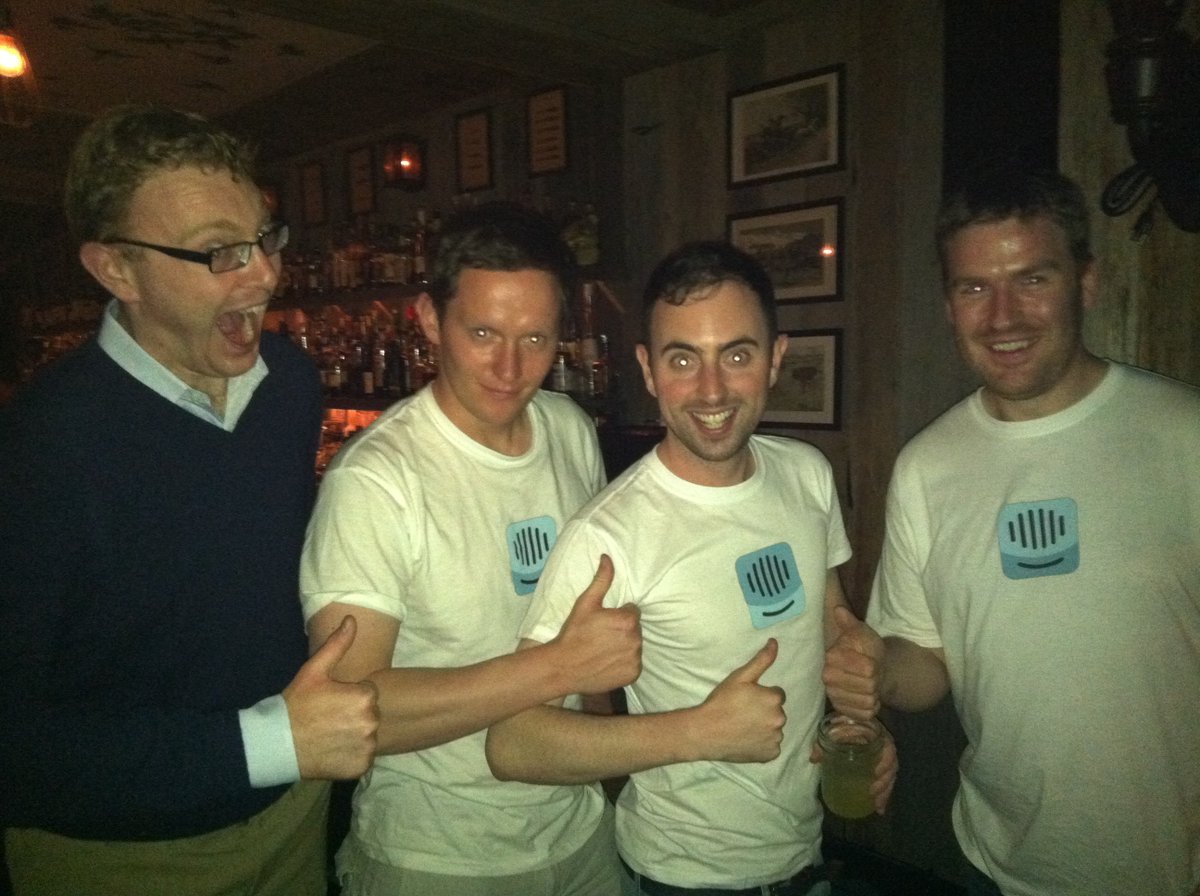
To my cofounders, my exec team: Look what we built. Four young lads with a dream and nothing to lose. And a home grown exec team who pulled off the greatest and arguably only late stage software company pivot to AI, and invented one of the most important categories in AI. Thank you for sticking through all of this with me.
And now, time to get back to work. See you at our next product launch in a couple weeks. (:

2
1
30
8,761


"9. Open-source models could reduce pricing power
Open-source AI does not eliminate compute demand. It may increase it.
But it can reduce software/application pricing power by making model capability more commoditized. If open models keep closing the gap, then:"
1
6

that eight year freeze is wild because intercom basically owned the positioning. when your category gets commoditized, it means you nailed something so well everyone copied it. the hard part isn't innovation, it's remembering why you mattered before the copies took over 🔄
22

well maybe 1k/day will sound sweet
if it works like an auditor with an edge other tools don't have - maybe it's worth it
so as not to get commoditized like every other AI. -_-
1

You can negotiate 1-2% interchange rates discounts that you transform in cashback, but that's it. It's indeed a race to the bottom, and at the same time cards have been commoditized so not really a moat. Savings and lending are way more exciting to me
1
1
19


this is structurally bullish for the decentralized AI thesis
in a single dominant model world there is very little need for decentralized AI. It creates a natural monopoly
but in a world where network of many models are used it creates the need for:
- many smaller specialized models are needed which suit decentralized training and post training well
- creates the need for marketplaces, routers, aggregators, verification and many more layers within the stack (many which crypto can/will do well)
this does change where the value accrues in the stack tho. The models themselves get commoditized and the more value flows to the marketplaces/routers/aggregators
Jun 13

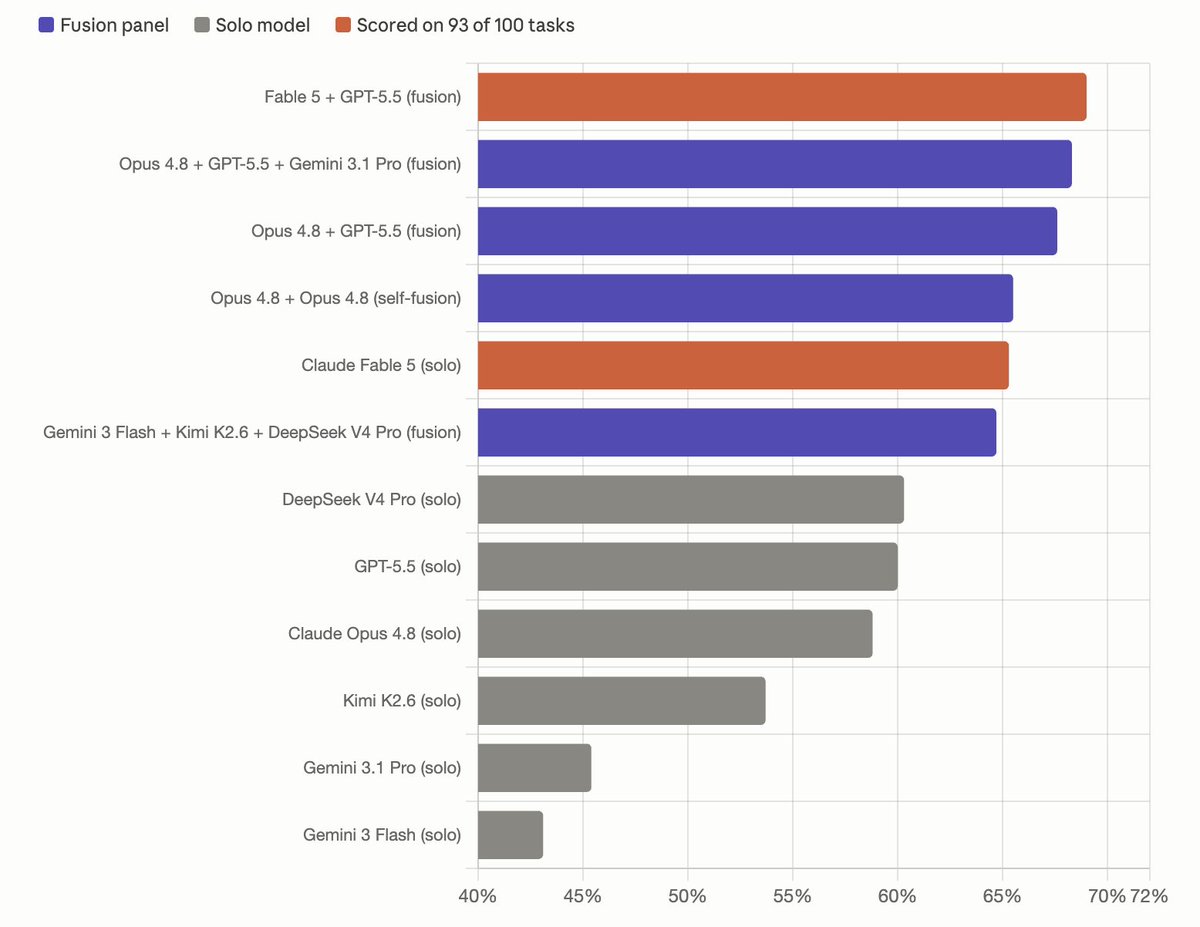
Introducing the Fusion API, the smartest compound model in the market.
Fusion achieves Fable-level intelligence at half the price.
How it works 👇
1
12
1,640
