

Jun 12
The Torus Becomes the Canvas
A Jacobi Theta Function lives naturally on a complex torus.
Instead of drawing it on a flat plane, we wrapped the mathematics onto the torus. The surface is driven by θ₁(z|τ), with its moving zeros, phase winding, and logarithmic derivative shaping the colour, seams, and raised divisor points across the geometry.
What you are see is a periodic quantum-like field painted onto the space where it actually belongs.
#JacobiTheta #ComplexTorus #MathematicalArt #ComplexAnalysis #RiemannSurfaces #MathAnimation
14
91
538
21,931

Jun 9
Complex Domain Coloring. Visualizing a function in the complex plane where hue represents the phase angle and brightness represents the magnitude. A map of mathematical singularities.
#ComplexAnalysis #Mathematics #DataVis
4
119
May 19
A lemniscate in complex analysis isn’t one fixed shape. It’s any level set of |p(z)|.
So we study
|p(z)| = c
As you vary c, the curve can split into multiple loops, fuse together, or pinch off entirely. Those structural changes tend to organize around points where
p′(z)=0.
#ComplexAnalysis #Polynomials #ComplexDynamics #Lemniscates #MathArt
1
17
98
3,246

May 19
The same Gaussian decaying oscillation appears as a spirally decaying vortex in the complex plane, with damped sine waves in its real and imaginary parts, but as a rotating wave packet in 3D.
The essence of complex analysis lies in this: a function simultaneously encodes amplitude, phase, and evolution. Switching between different perspectives is like changing the basis, allowing us to see "order" from "chaos." This is precisely the core of quantum wave function thinking—learning to switch coordinate systems and transform abstraction into intuition.
This visualization is incredibly effective at teaching!
#ComplexAnalysis #MathematicalVisualization #SignalProcessing
4
231

Apr 24
#NextatBIRS Applications of Harmonic Analysis to Convex Geometry, April 26 - May 1, 2026 birs.ca/event/26w5574
#FunctionalAnalysis #ComplexAnalysis #HarmonicAnalysis #EuclideanSpaces #DiscreteGeometry
@NSF-MPS #DMSFunded @Innovation_AB @NSERC_CRSNG @CRSNG_NSERC
2
7
532

Apr 18
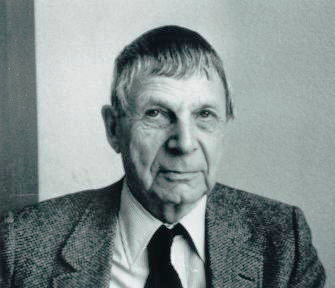
April 18, 1907 — Lars Ahlfors was born.
A pioneer of complex analysis, he made major contributions to the theory of Riemann surfaces and was one of the first Fields Medalists in 1936. His work still influences mathematics today. 📘✨
#OnThisDay #Mathematics #ComplexAnalysis
3
9
574

1
7
48
3,852

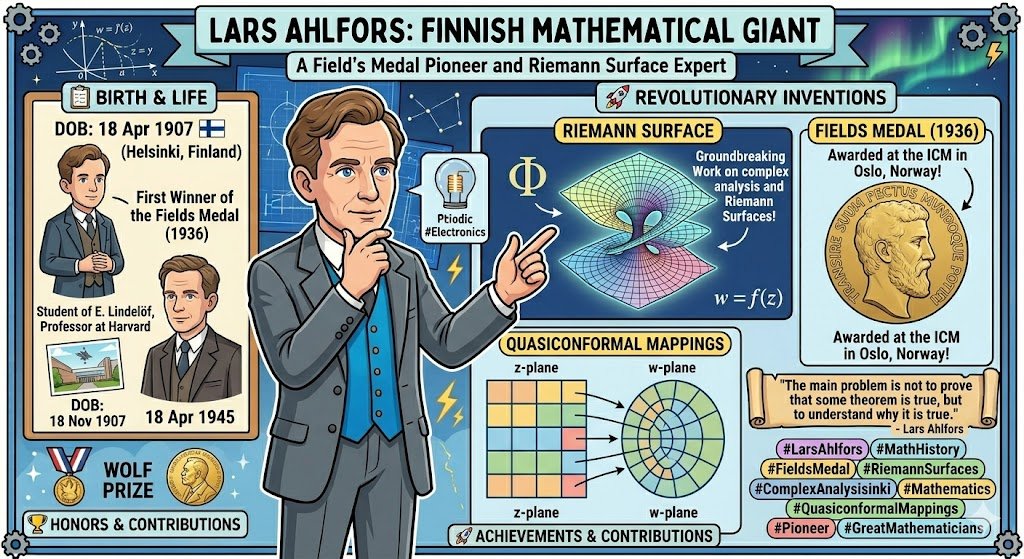
🎉 Celebrating the brilliance of Lars Ahlfors (Born: April 18, 1907 – Died: October 11, 1996)
A pioneer in complex analysis, Ahlfors made mathematics more powerful and elegant 🌍✨
🏅 One of the **first Fields Medalists (1936)** — the highest honor in mathematics!
His work continues to shape modern science, engineering, and technology 📊🔬
Let’s honor a mind that transformed abstract math into real-world impact 💡
#LarsAhlfors #Mathematics #FieldsMedal #OnThisDay #MathHistory #STEM #Science #Innovation #ComplexAnalysis #Maths #Education #Scientists #Genius #April18
29
36
186

Apr 16
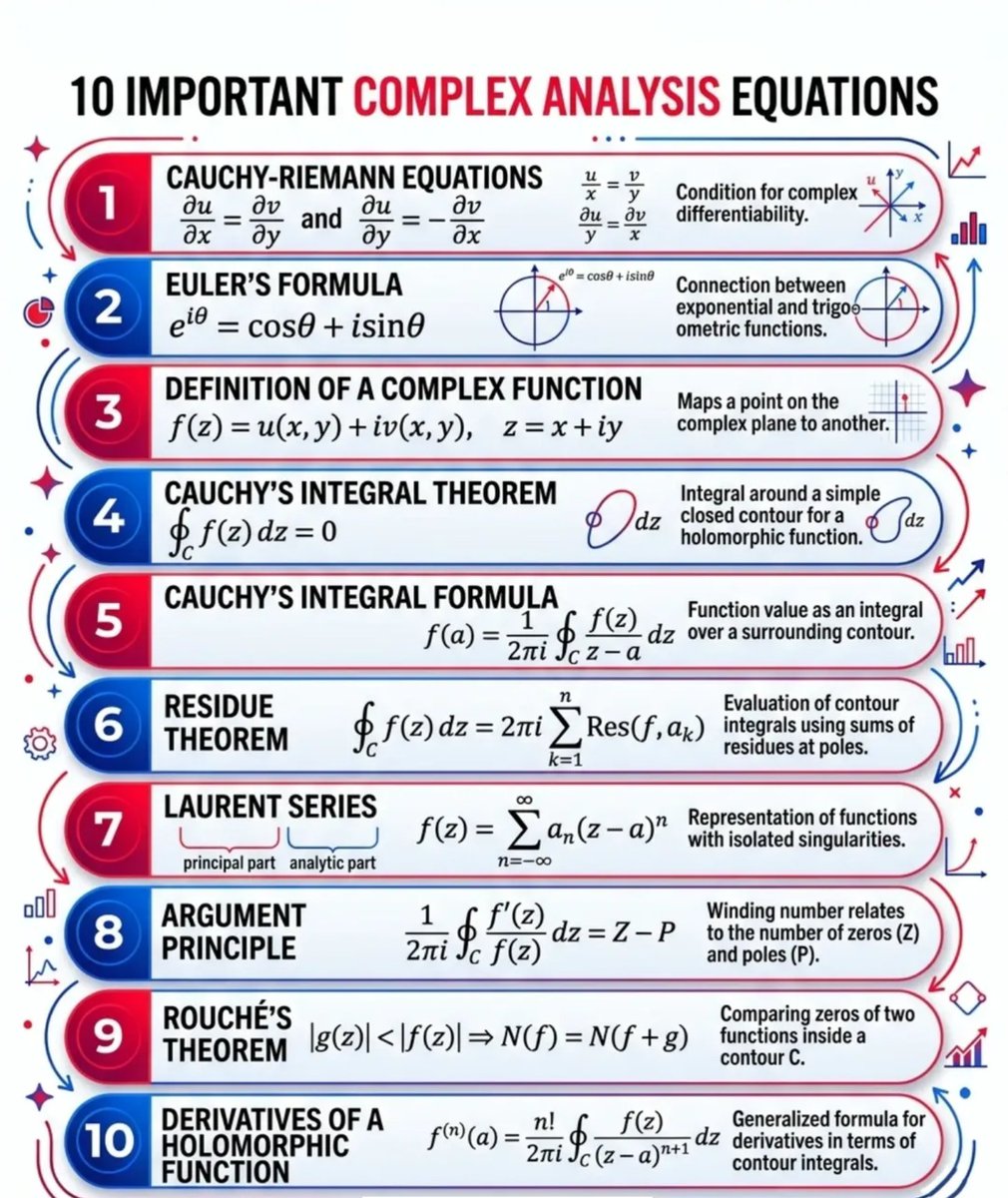
Feeling lost in the complex plane? 🌀 Here is your essential guide to 10 of the most important Complex Analysis equations, all in one place!
F
rom the foundational Cauchy-Riemann equations ensuring complex differentiability to the powerful Residue Theorem for evaluating integrals, this list covers the core concepts you need to master.
Here’s a breakdown of what’s included:
1️⃣ Cauchy-Riemann Equations
2️⃣ Euler’s Formula
3️⃣ Definition of a Complex Function
4️⃣ Cauchy’s Integral Theorem
5️⃣ Cauchy’s Integral Formula
6️⃣ Residue Theorem
7️⃣ Laurent Series
8️⃣ Argument Principle
9️⃣ Rouché’s Theorem
🔟 Derivatives of a Holomorphic Function
Whether you are studying for a math exam, working on physics problems, or just love elegant mathematics, this cheat sheet is for you.
💾 Save this post for your next study session and share it with a friend who needs a little math cure! 🩺📊
Which of these theorems do you find the most useful? Let us know in the comments 👇
#maths #complexanalysis #mathematics #calculus
37
190
5,527

Apr 12
Quantum Mechanics Series Lecture 2
Lecture 1 gave us one of the cleanest facts in quantum mechanics
If ψ(x,t) is the state, then ρ(x,t) = |ψ(x,t)|² behaves like a probability density, and Schrödinger evolution makes that density satisfy a continuity equation.
So, if ρ flows like a fluid, then what determines the flow?
To answer that, write the wavefunction as
ψ(x,t) = r(x,t) exp(iθ(x,t)).
Now the picture sharpens. The magnitude r tells you how much probability is present at a point. The phase θ tells you how that probability is directed. But how exactly does phase enter the motion?
When you expand the current,
j = (1/m) Im(ψ* ∇ψ),
it reduces to
j = (ρ/m) ∇θ.
That is the key step. The current is driven by the phase gradient. So the flow lines are not decorative. They are the geometry of phase made visible.
Then another question appears. Can the phase wind around space in any arbitrary way?
The answer is no, because ψ has to come back to the same value after going around a closed loop, the total phase change cannot be arbitrary. It must be an integer multiple of 2π:
∮ ∇θ · dl = 2πn.
That is where quantized vortices come from. They are not features we bolt onto the theory. They are topological defects the mathematics allows only in discrete units.
In the 2D render reveals the underlying mechanism of probability current bending around isolated vortex charges.
The math breakdown:
We describe the state by a complex field ψ(x,t) on the plane, with x in R². The Born rule defines the probability density
ρ(x,t) = |ψ(x,t)|².
Schrödinger evolution, in units with ħ = 1, is
i ∂ψ/∂t = [ −(1/2m) ∇² V(x,t) ] ψ.
Why does this preserve probability?
Start from
ρ = ψ*ψ.
Differentiate:
∂ρ/∂t = ψ* (∂ψ/∂t) ψ (∂ψ*/∂t).
Now insert Schrödinger’s equation and its complex conjugate:
∂ψ/∂t = (1/i) [ −(1/2m) ∇²ψ Vψ ]
∂ψ*/∂t = (−1/i) [ −(1/2m) ∇²ψ* Vψ* ].
What survives after substitution?
The potential terms cancel. The rest rearranges into the continuity equation
∂ρ/∂t ∇·j = 0
with probability current
j = (1/2mi) ( ψ* ∇ψ − ψ ∇ψ* )
= (1/m) Im(ψ* ∇ψ).
So ρ really does behave like a conserved fluid density, and j is its flux.
But what actually steers that flux?
Write ψ in polar form:
ψ(x,t) = r(x,t) exp(iθ(x,t)).
Then
∇ψ = exp(iθ) (∇r i r ∇θ).
So
ψ* ∇ψ = r (∇r i r ∇θ).
Taking the imaginary part gives
Im(ψ* ∇ψ) = r² ∇θ = ρ ∇θ.
Hence
j = (ρ/m) ∇θ.
That is the central statement of this lecture:
The phase gradient sets the direction and speed of the flow, scaled by the density and the mass.
Now one last question. Why are the vortices quantized?
Because ψ must be single-valued. If you go once around a closed loop and return to the same point, the complex field must return to the same value. That forces the total phase winding to satisfy
∮ ∇θ · dl = 2πn, with n in Z.
The integer n is the vortex charge. At the vortex core, ρ is nearly zero, the phase becomes undefined, and the current circulates around that defect.
#QuantumMechanics #Wavefunction #SchrodingerEquation #BornRule #ProbabilityCurrent #ContinuityEquation #Phase #Vortices #TopologicalDefects #ComplexAnalysis #MathematicalPhysics #Mathematics #Physics
13
53
257
10,602
Apr 7
4
144
632
20,936

Mar 25
New version found
V2.2.5
ValueScan Skill and MCP Service Are Now Live!
1.
AI Skill: Empower your OpenClaw Agent to access on-chaindata, fund flows, Al signals, and more via natural language -plug and play.
User Guide: valuescan.io/docs/skillOverv…
2.
MCP Service: Enable Claude, Cursor, and other clients to directlycall ValueScan data tools for in-depth reasoning and complexanalysis.
User Guide: valuescan.io/docs/mcpService
Experience it now and let your Al agent gain full-dimensionalmarket insights!


3
1
10
2,194

Mar 19
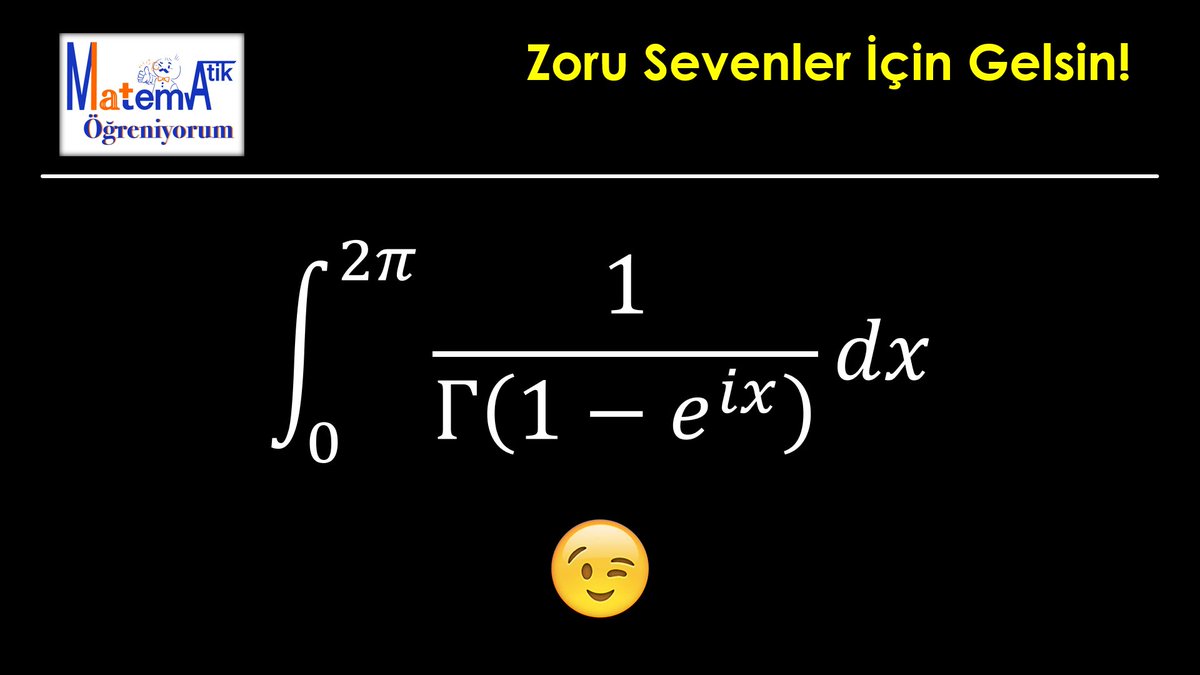
Yeni video yayında.
İyi seyirler...😉
Tüm videolara YouTube
kanalımdan ulaşabilirsiniz.
Zoru sevenler için gelsin...
#maths #proof #derivative #integral #trigonometry #countour_integral #euler_identity #complexanalysis #residuetheorem #gammafunction
youtu.be/GTcVNSsnslc?si=pbU6…
2
67

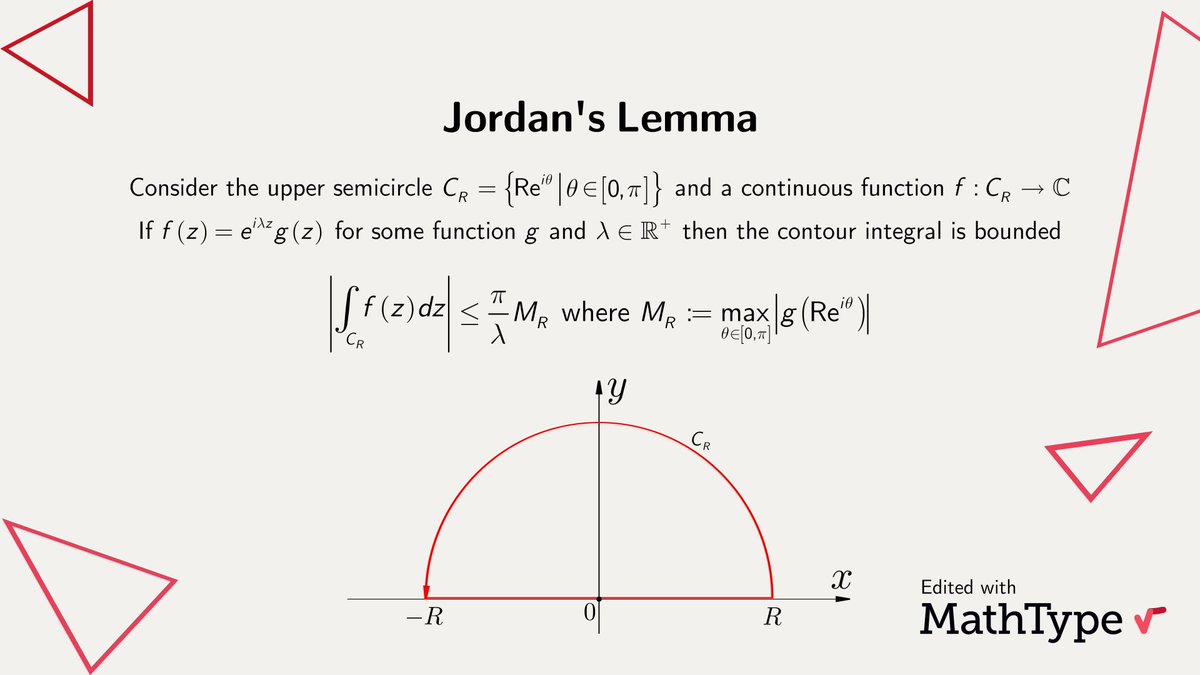
Jordan’s Lemma bounds integrals over large semicircles in the complex plane, ensuring exponential terms decay and making residue calculus and Fourier methods work smoothly. Do you remember using it?
#ComplexAnalysis #Mathematics #STEM #MathEducation #MathType
5
21
94
4,271

From powers and inversions to exponentials and trigonometric transformations each function reshapes the complex world in a completely unique way.
Mathematics isn’t just numbers… it’s motion, symmetry, and hidden geometry.
Follow for more mind-bending math visuals.
#ComplexAnalysis #Mathematics #MathVisualization #MathArt #STEM #PureMath #Engineering #Infinity #maths #Education
1
4
1,022

Feb 25
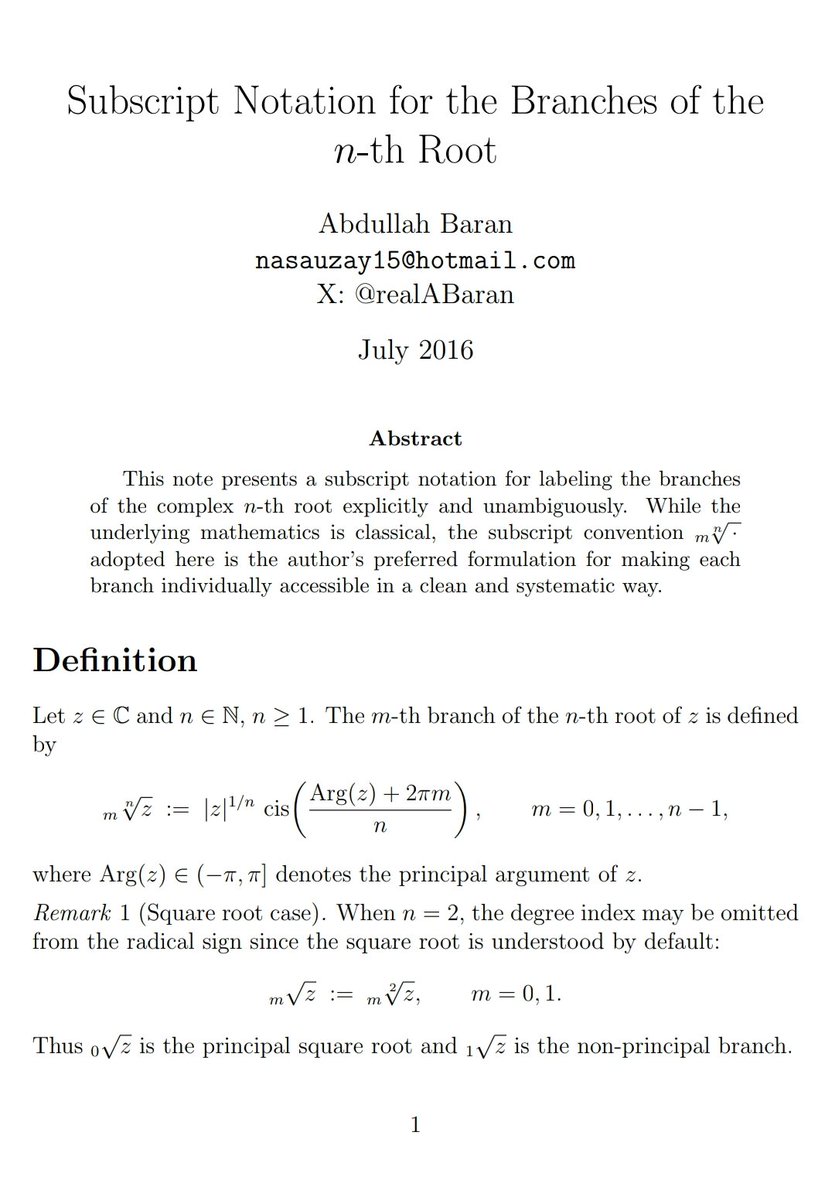
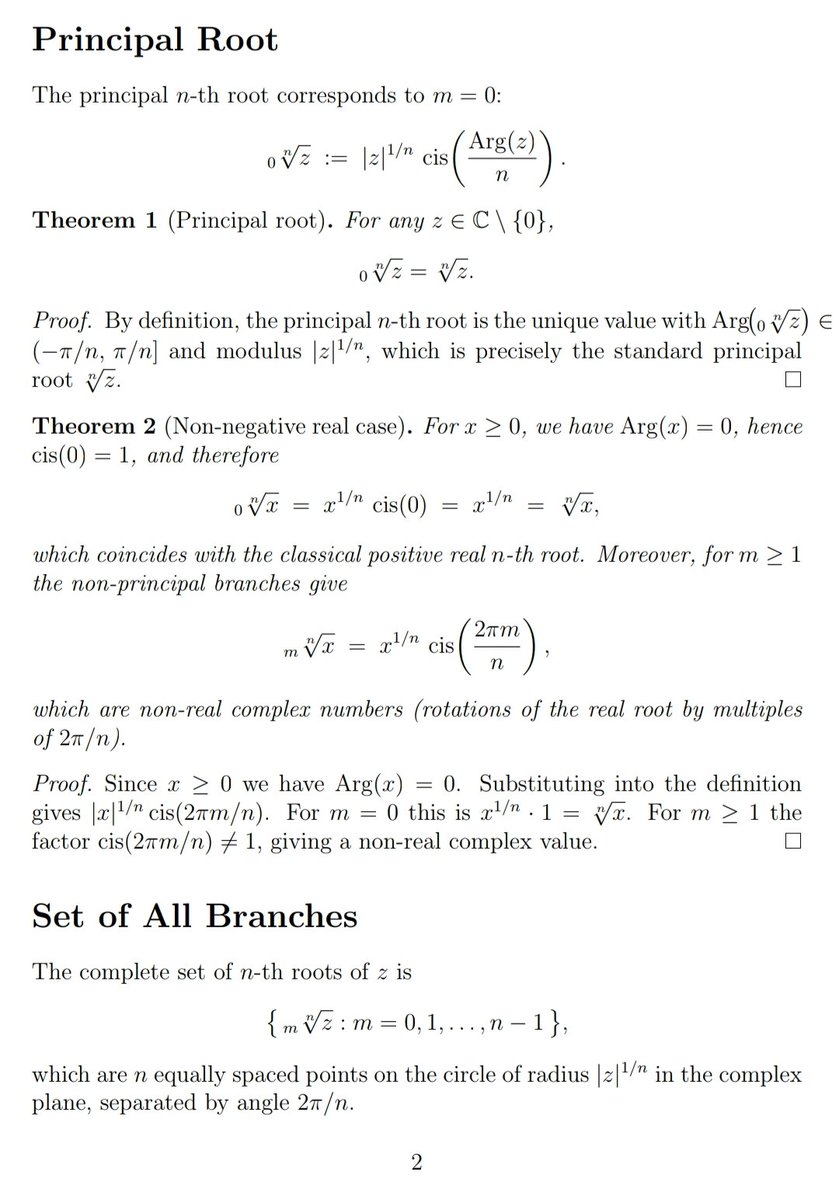
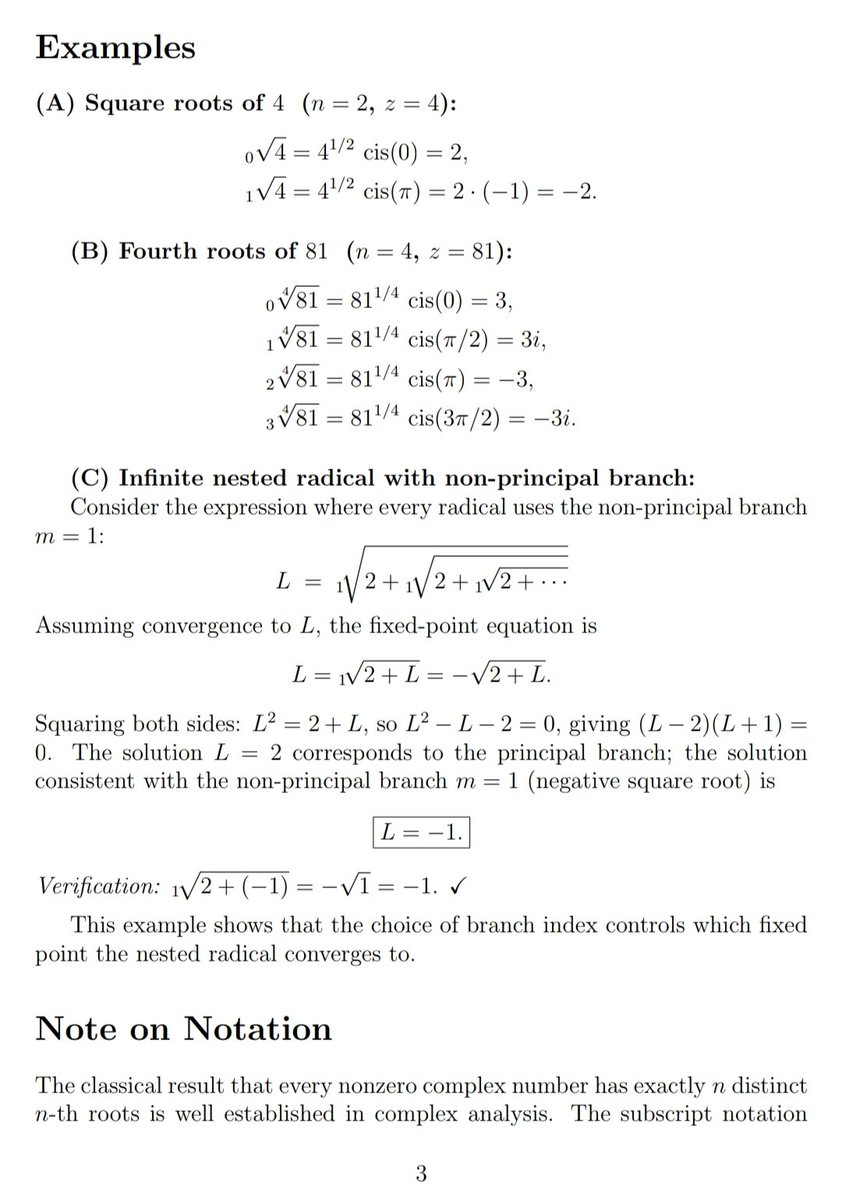
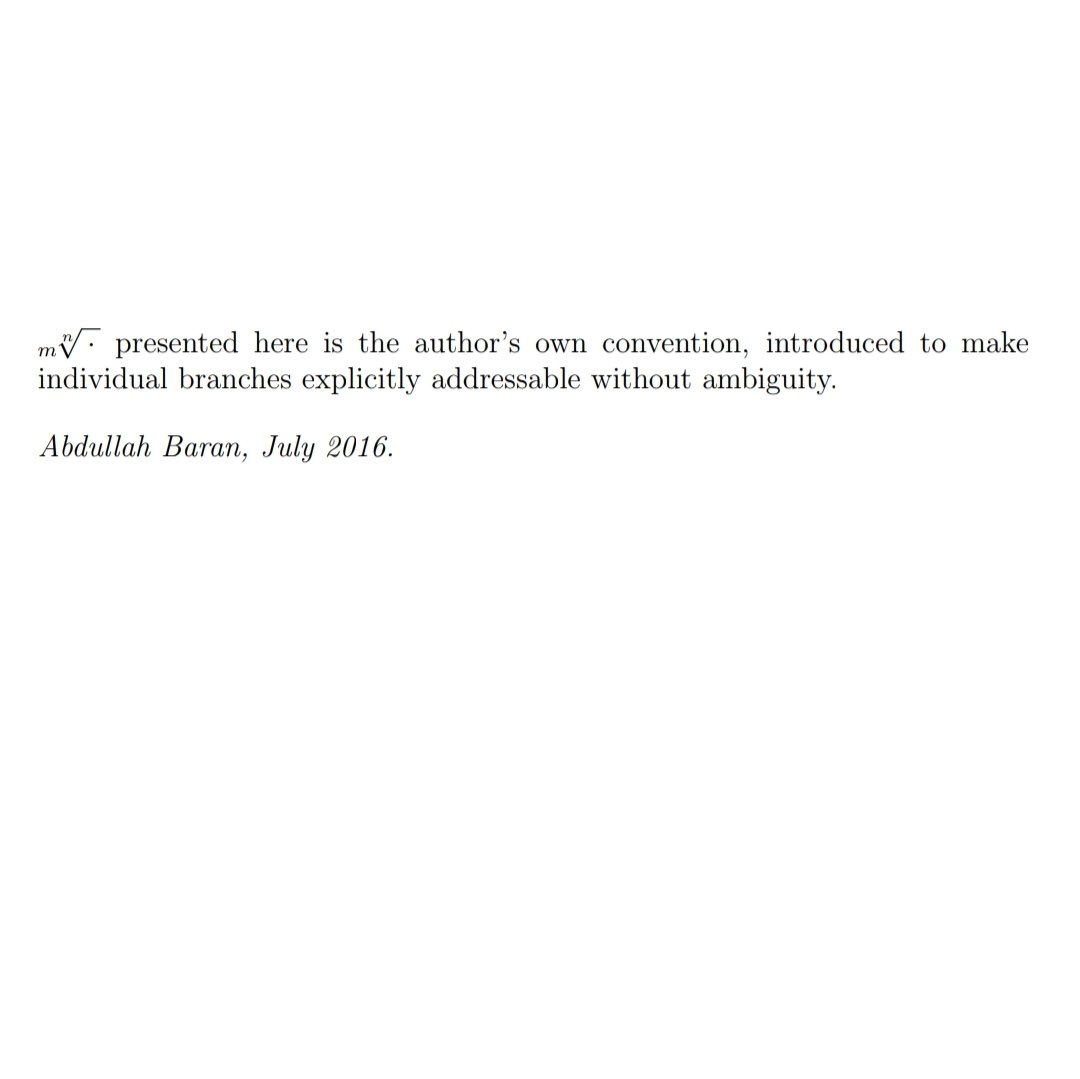
I independently developed a subscript notation for explicitly labeling the branches of the complex n-th root: ₘ√[n]{z}
Each branch gets a unique index m = 0, 1, ..., n−1. No more ambiguity.
Formally published on Zenodo:
DOI: 10.5281/zenodo.18776849
#Mathematics #ComplexAnalysis #Notation
zenodo.org/records/18776849
4
225
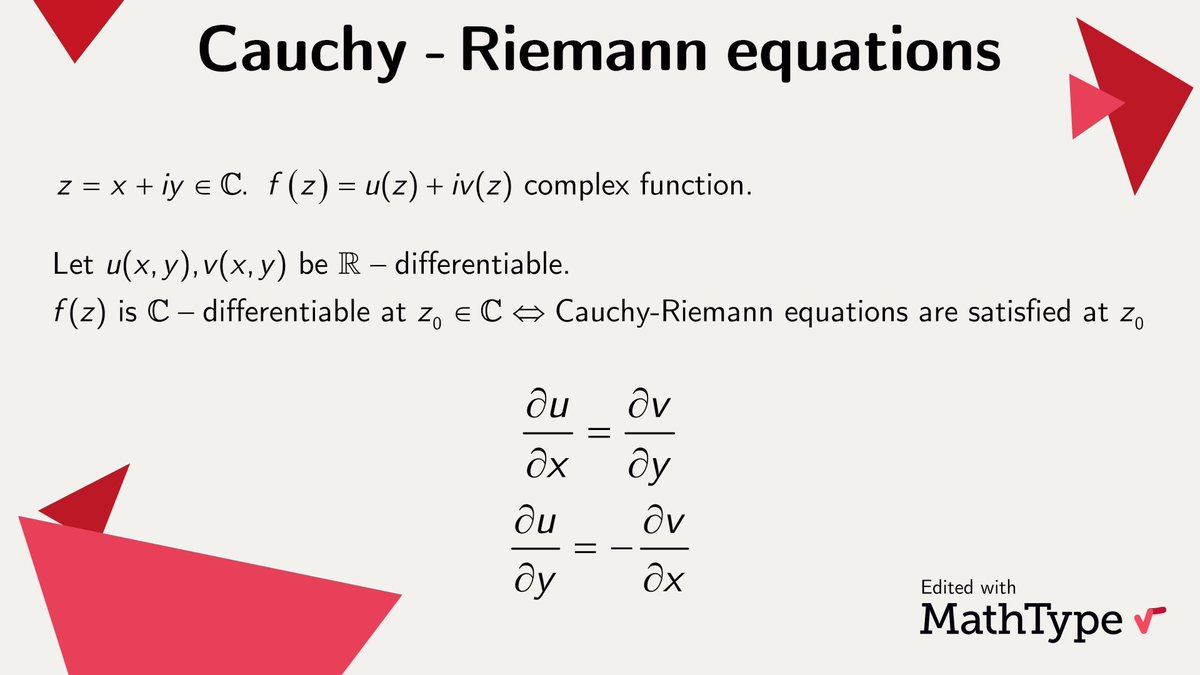
When is a complex function truly differentiable? The Cauchy–Riemann equations give us the answer. By linking the partial derivatives of the real and imaginary parts of a function, they establish the precise condition for complex differentiability.
#ComplexAnalysis #Math
1
21
161
6,335
Visualizing Non-Linear Transformations in action
See how coordinate spaces deform, rotate, and map into new shapes through exponential maps and complex transformations. Mathematics becomes art when geometry moves!
#Mathematics #NonLinearTransformation #MathVisualization #Geometry #LinearAlgebra #ComplexAnalysis #MathArt #STEM #MathAnimation #CoordinateTransformation #ExponentialMap #MathIsBeautiful #EngineeringMath #Science #Education #MathLovers #VisualMath #LearnMath #MathVideo #MathConcepts #HigherMathematics #Maths #STEMEducation #DataVisualization
1
7
1,758