

5 Jun 2025
I'll elaborate... I've on many occasions clicked OK on any number of EApplication or whatever exception message windows and had the program still "running" but it is in an unstable state and had no idea where the problem is and what it was doing at the point of failure. Then had ten more until the app could be closed. That's unacceptable user experience.
If an ERROR that would otherwise raise an exception doesn't tell my user what my application was attempting to do (and the module/procedure it is in) and where to report the error, and recommended course of action something like "The system will likely be in an unstable state you should close and try again or get technical support," then the error isn't "handled."
Leaving it up to exceptions is sloppy - and depending on how much extra "just in case" try-except noise you want to pepper your code with: you'll likely have either very little to absolutely no idea where to start looking for the bug--it is almost guaranteed to be on another level than where the exception got caught.
1
18

2 Jun 2025
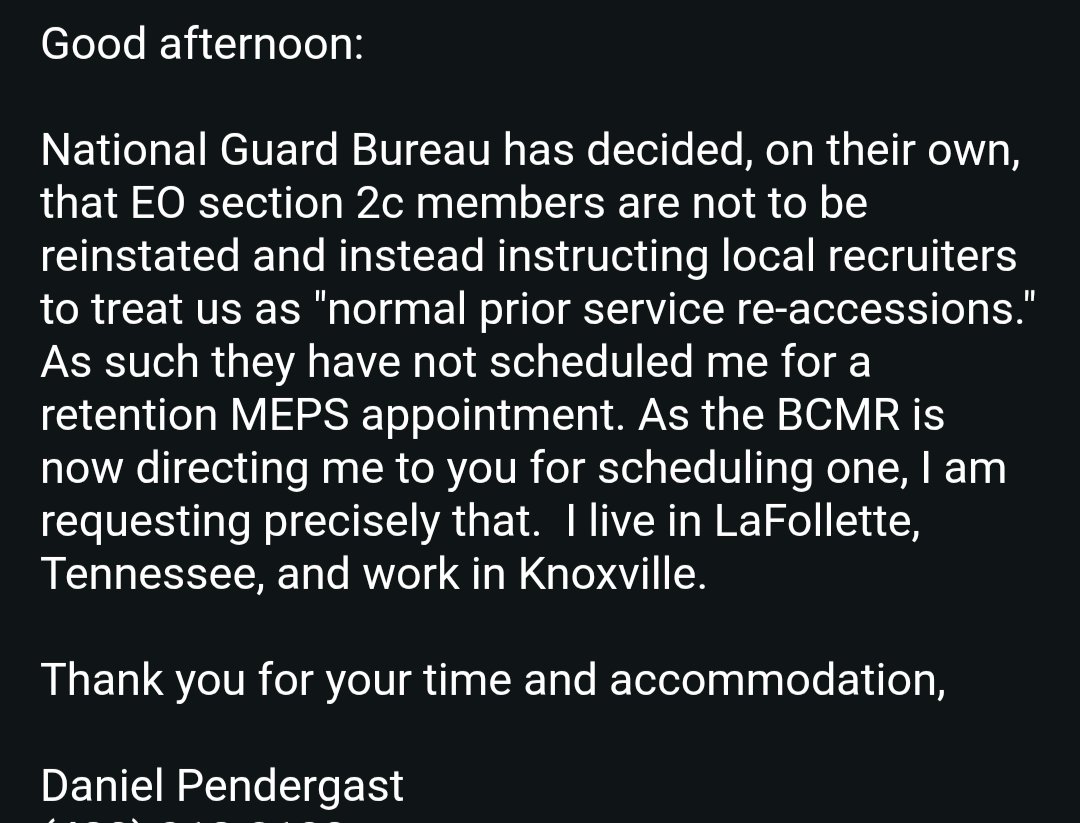
It's not an outright no. Email has been sent to AFRS as, currently, local recruiters continue to follow the NGB's insubordinate guidance.
2 June 2025
SAF/MRBC (AFBCMR)
3351 Celmers Lane
Joint Base Andrews NAF Washington, MD 20762-6435
Dear Applicant:
Docket #: xxxx eApplication #: xxxx
This is in response to your recent application to the Air Force Board for Correction of Military Records (AFBCMR). We thoroughly review all applications and recognized your request is based on the January 27, 2025, Presidential Executive Order 14184, “Reinstating Service Members Discharged under the Military’s COVID-19 Vaccination Mandate” and the April 1, 2025 guidance published by the Undersecretary of Defense for Personnel and Readiness (OSD (P-R)) on the implementation of the President’s Executive Order. This letter is to acknowledge that we have received your request; however, per the OSD (P-R) guidance, service members who wish to be reinstated or re-accessed, must complete medical and physical pre-screening at their nearest Military Entrance Processing Station (MEPS). Once complete, the MEPS liaison will provide you a “Medical Certification Letter” verifying eligibility for reinstatement or re-accession. If you have already completed the pre-screening process, please provide a copy of the letter using the instructions at the bottom of this letter. If you still need to schedule a pre-screening appointment, please contact Air Force Recruiting Service (AFRS) at AFRS.HQRSOPA.AccessionsStandards@us.af.mil.
In order to ensure expeditious processing of your case, you have 90 days from the date of this letter to provide a copy of the “Medical Certification Letter.” If the letter is not received within 90 days, we will temporarily close your case; however, once you obtain the “Medical Certification Letter,” you may provide a copy of it and request that your case be re-opened.
In addition, if you voluntarily separated in lieu of the vaccine and are seeking re-accession into the Air Force both the January 27, 2025, Presidential Executive Order and OSD (P-R)’s additional implementation guidance of April 1, 2025, provide that service members who voluntarily separated or allowed their enlistment to lapse, in lieu of receiving the COVID-19 vaccination, while the vaccine mandate was still in effect, be offered a path to re-accessing into the Air Force with no impact to their service status, rank, or pay. Accordingly, re-accessing will entail:
Contacting AFRS at: AFRS.HQRSOPA.AccessionsStandards@us.af.mil, to be scheduled for pre-screening at their nearest MEPS;
Completion of the Department of the Air Force’s Attestation Memo; and
Working with a recruiter, members with no limiting factors being offered the opportunity to re-access into the force, under the Prior Service Program, for a minimum of 2-years.
Please note, nothing in the OSD (P-R) policy prevents individuals seeking re-accession from requesting additional relief through the AFBCMR; however, for both reinstatement and re-accession requests, medical pre-screening is necessary for Board consideration. Once you have taken the required action and received your “Medical Certification Letter,” please go to the AFBCMR via the Online Portal at afrba-portal.cce.af.mil/#sup… and submit the document using your eApplication number. Please include your docket number with all future correspondence.
For further information on COVID Reinstatement or Re-Accession eligibility and for up-to-date guidance, please visit the following web site: af.mil/COVID-Reinstatement/.
Board Analysis Division
AFBCMR
2
2
176
6 May 2025
"It may take up to 10 BUSINESS DAYS for the Board intake staff to review your application and supporting documents, validate your email address, and send you a confirmation with your docket and eApplication numbers." Is the only timeline I can find offhand. That would have been April 30th, and nothing.
8

30 Apr 2025
📢Wichita National Life Insurance implements FireLight to power annuity sales and market expansion. hexure.com/press-releases/wi…
Welcome to the FireLight carrier family, Wichita National Life Insurance!
#wichitanationallife #hexure #myga #eapplication #digitalsales
41
20 Mar 2025
Who's hitting 95% in-good-order applications in today's annuity market? AuguStar Retirement!
See how in their success story: hexure.com/success-stories/s…
#InsuranceTech #AnnuitySuccess #AuguStarRetirment #Hexure #eApplication #InGoodOrderSales
1
19

I Turbo turbocharged every apps building on the @EclipseFND ecosystem, making it the best place for developing eApplication.


1
12
113


Consider this applied to enslavement of millions of infant Africans:
The DOJ's handling of the Sackler family case, particularly regarding Purdue Pharma's role in the opioid crisis, provides a framework for analyzing corporate versus individual liability in historical contexts like the enslavement of infant Africans by colonial settlers, church fathers, and American founders. This analysis can be extended to include the decision not to prosecute Confederate leaders, highlighting similar themes of accountability, reparations, and public honor.
1Corporate vs. Individual Liability
2
aSackler Family and Purdue Pharma: The corporation was held liable with a significant financial penalty, but individual members of the Sackler family were not criminally charged despite evidence of their involvement. This reflects a strategy where the corporate entity bears the brunt of legal action while individuals gain a degree of protection from personal accountability.
b
cConfederate Leaders: After the Civil War, Confederate leaders were not prosecuted for their roles in the rebellion, choosing national reconciliation over legal retribution. This mirrors the Sackler situation where individual accountability was sidestepped for broader, systemic considerations.
d
eApplication to Historical Enslavement: In the context of those involved in slavery, the "corporation" could be likened to the collective entities (colonies, states, or institutions like churches) that benefited from or sanctioned slavery. The individuals would be the settlers, founders, or religious leaders directly involved. By these precedents, there might be a focus on condemning the system of slavery through historical acknowledgment, reparations, or educational reforms, rather than posthumously prosecuting individuals, which is legally and practically impossible.
3
4Evidence and Accountability
5
aEvidence: In both the Sackler and Confederate cases, there was clear evidence of wrongdoing, yet legal accountability was not pursued in the same manner. For the Sacklers, internal documents and testimonies were pivotal, while for Confederate leaders, historical records were available but not used for prosecution.
b
cHistorical Accountability: The lack of legal prosecution for Confederate leaders was paralleled by a form of public "prosecution" through the removal of honors like statues, renaming of public spaces, and a reevaluation of their legacy. This is similar to how the Sackler name has been stripped from institutions, reflecting public demand for accountability where legal systems fell short.
6
7Financial and Moral Reparations
8
aSackler Settlement: The Sacklers agreed to contribute to a fund for opioid crisis abatement, offering a form of reparative justice without criminal liability.
b
cSlavery and Confederacy: Discussions around reparations for descendants of enslaved infant Africans or for the legacy of slavery and racial injustice are analogous to how society might address the Sackler case's fallout through systemic change and funding for affected communities. The Confederacy's case also involves reparative moves through cultural and symbolic gestures.
9
10Public and Legal Backlash
11
aOpioid Crisis and Confederacy: Both situations have seen significant public backlash for not matching the scale of harm with the scale of justice. This has led to public actions like renaming buildings or removing symbols of honor, reflecting societal judgment where legal systems were lenient or silent.
12
13Policy and Precedent Setting
14
aDOJ's Strategy and Confederate Amnesty: Both cases illustrate a pattern where legal accountability for individuals is sidestepped in favor of broader societal healing or financial settlements. The Confederate case set a precedent for national reconciliation over punishment, echoed in the corporate settlement approach of the Sackler case.
1
46


10 Dec 2024
Streamline your life insurance process with Quote & Apply, the first multi-carrier consumer-facing quoting & eApplication software. Easily quote various product types and finalize applications with DocuSign integration.
Access Quote & Apply for free!
lnkd.in/dUs42Re

1
13

27 Sep 2024
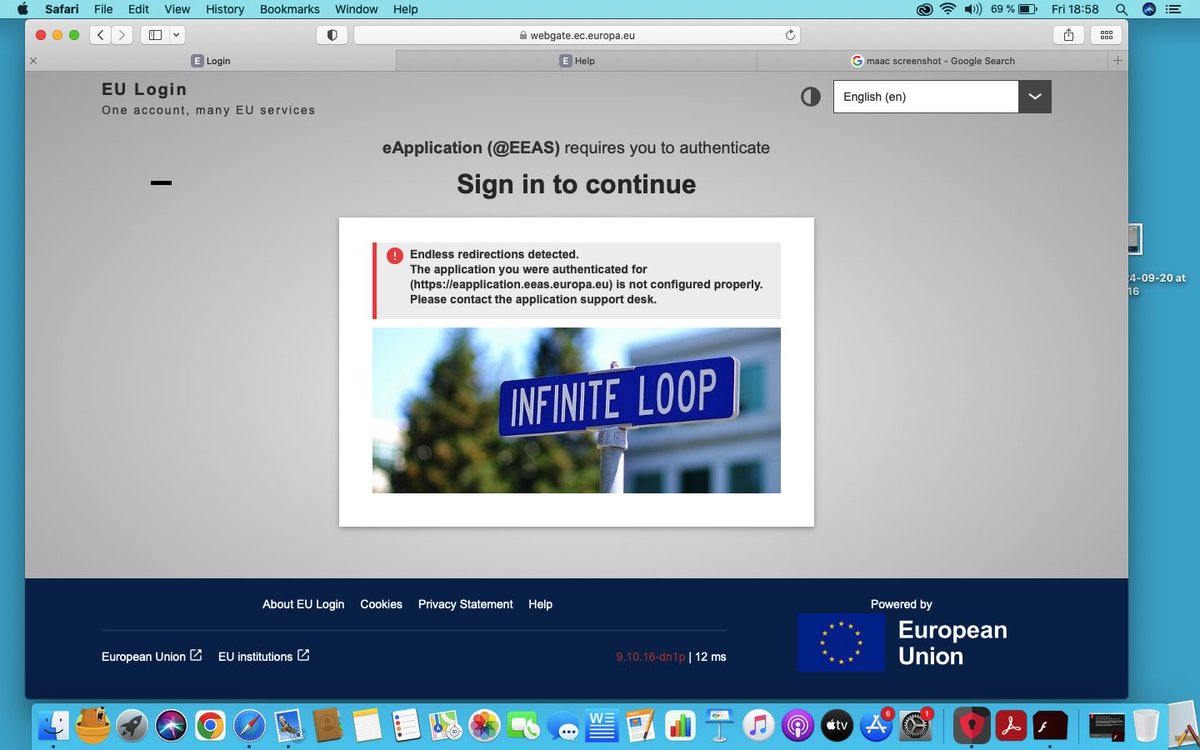
@eu_eeas your eu login eApplication site cannot be entered for a week or more already. Pls advise whom to contact
28

10 Sep 2024
เคทีซีเปิดตัว E-Application สมัครสินเชื่อบัตรกดเงินสดได้เอง อนุมัติไวใน 30 นาที รองรับความจำเป็นเร่งด่วน
successchannel.co/post_news?…
#เคทีซี
#KTC
#KTCPROUD
#EApplication
#สินเชื่อบัตรกดเงินสด

229


21 Dec 2023
The 150 in addition to 35 that requires eApplication (which is what's needed to come to Nigeria) brings it to about 186 Countries.
1
4
2,946

Our new EasyA-Z eApplication makes the process that much simpler!
Contact your Regional Vice President for more details.
23

24 Oct 2023
DISS and eQIP give way to the National Background Investigation Services (NBIS) eApplication & (eApp) for the initiation and submission of standard investigative forms.
dvidshub.net/news/456298/fed…
38
Our new reflexive EasyA-Z eApplication provides a better experience for you and clients!
Contact your Regional Vice President for more details.
31

10 Oct 2023
DCRUST eApplication for Admission
#Deenbandhu Chhotu Ram University #Science and Technology #Murthal #Haryana #Engineering college #Public university #Sir Chhotu Ram #Peasants' movement @Undergraduate programs #Postgraduate programs #Doctoral programs #Applied Sciences

ALT Deenbandhu Chhotu Ram University of Science & Technology, also known as DCRUST, is a renowned institution located in Murthal, Haryana, India. Established in 2006, the university has quickly gained recognition for its excellence in science and technology education. With a sprawling campus and state-of-the-art facilities, DCRUST offers a wide range of undergraduate and postgraduate courses in various fields of study. The university is known for its strong emphasis on research and innovation, fostering an environment where students can explore their intellectual curiosities and contribute to the advancement of knowledge in their respective fields. Web Site:- www.dcrusm.org.in
20

8 Aug 2023
ABB have a new eApplication Note for RPPs where you can learn about the importance of power supply at IT rack level, challenges such as continuous operation & energy efficiency and how RPPs can make the installation smart and fully connected.
explore.abb.com/rpp-applicat…
#abbireland
1
38