
Jun 13
A strong CDMO is an execution partner.
Strategic Vendor Architecture is the defense layer that keeps ingredient specs, testing logic, packaging assumptions, and backup nodes visible before scale.
#SVA #ExecutionGap #CDMO
4
Jun 9
The Execution Gap appears when the clinical slide deck survives market scrutiny, but the manufacturing run cannot prove active concentration, specification control, and batch-level consistency.
#ExecutionGap #SVA
2

Be part of the shift. Be part of the execution story.
👉 Secure your seat today: cxacademy.africa/xsummit/
#CustomerExperience #ExecutionGap #StrategyToExecution #BusinessTransformation #ExperienceRedefinedSummit #EmployeeExperience #CXLeadership
4

The oil and gas industry runs on precision. So do we. Proud to sponsor the Digital Oil & Gas Summit in Madrid, June 11–12. We'll be there talking about bridging the #executiongap between #SAP and your workforce. If you're attending and want to connect, find us there.

21

Jun 2
14
Jun 1
Category extension = new physical nodes. New co-packer ecosystem. New sub-tier transparency. SVA matters before launch — not after the first failed batch.
Strategy is the commercial intent. The supply chain is the grounded reality.
#ExecutionGap #SVA #FunctionalBeverages
[1] BevNET. (2026, May 29). New Beverages: Bloom Enters Hydration, Trip Gets Tropical, Magic Mind’s Sleep Shot.
5
May 29
Strategy is the commercial intent. The supply chain is the grounded reality.
ACCESS THE FULL ARCHITECTURE AT MICHAELBAO.IO
#ExecutionGap #SupplyChainArchitecture
2

The core philosophy is accurate and intellectually sound.
“Peace is not the absence of difference. It is the process of dealing with difference differently” is a legitimate conflict-resolution framework used across diplomacy, leadership, psychology, negotiations, organizational behavior, and systems management. The wording itself is often attributed in different forms to peace studies and mediation disciplines, though variations of the idea appear across multiple thinkers rather than one universally accepted source.
What makes the statement powerful is that it reframes peace as an operational discipline — not an emotional condition.
For your world specifically — hyperscale infrastructure, utilities, EPCs, commissioning, regulators, communities, and billion-dollar programs — the concept is extremely relevant because most failures are not technical failures first.
They are stakeholder alignment failures.
Here’s the refined LinkedIn version with stronger execution language and infrastructure relevance:
Peace is not the absence of difference.
It is the process of dealing with difference differently.
That may sound philosophical — until you work inside large-scale infrastructure, hyperscale data centers, power generation, semiconductor fabs, or utility-scale construction.
Then you realize:
conflict is not the exception.
It is the environment.
Different stakeholders.
Different incentives.
Different timelines.
Different risk tolerances.
Different political pressures.
Different definitions of success.
The utility wants grid stability.
The developer wants speed.
The GC wants schedule protection.
The commissioning team wants operational validation.
The community wants transparency.
The regulator wants compliance.
Operations wants reliability.
Finance wants ROI.
None of these groups are “wrong.”
But unmanaged friction between them becomes the real project risk.
Most large-scale infrastructure failures do not begin as technical failures.
They begin as communication failures,
alignment failures,
ego failures,
or decision-making failures hidden inside complexity.
Real peace in infrastructure delivery is not the elimination of disagreement.
It is the disciplined ability to process disagreement without allowing the system itself to fracture.
That requires:
• operational transparency
• technical honesty
• stakeholder alignment
• accountability
• listening before escalation
• and leadership capable of absorbing pressure without transferring chaos downstream
The larger the project,
the more critical this becomes.
Because hyperscale infrastructure is ultimately a human coordination problem disguised as an engineering problem.
The projects that succeed are rarely the ones without friction.
They are the ones that learned how to deal with friction differently.
#DataCenters #Leadership #Commissioning #Infrastructure #Construction #ExecutionGap #MissionCritical #ProjectManagement #Energy #Hyperscale

7

May 27
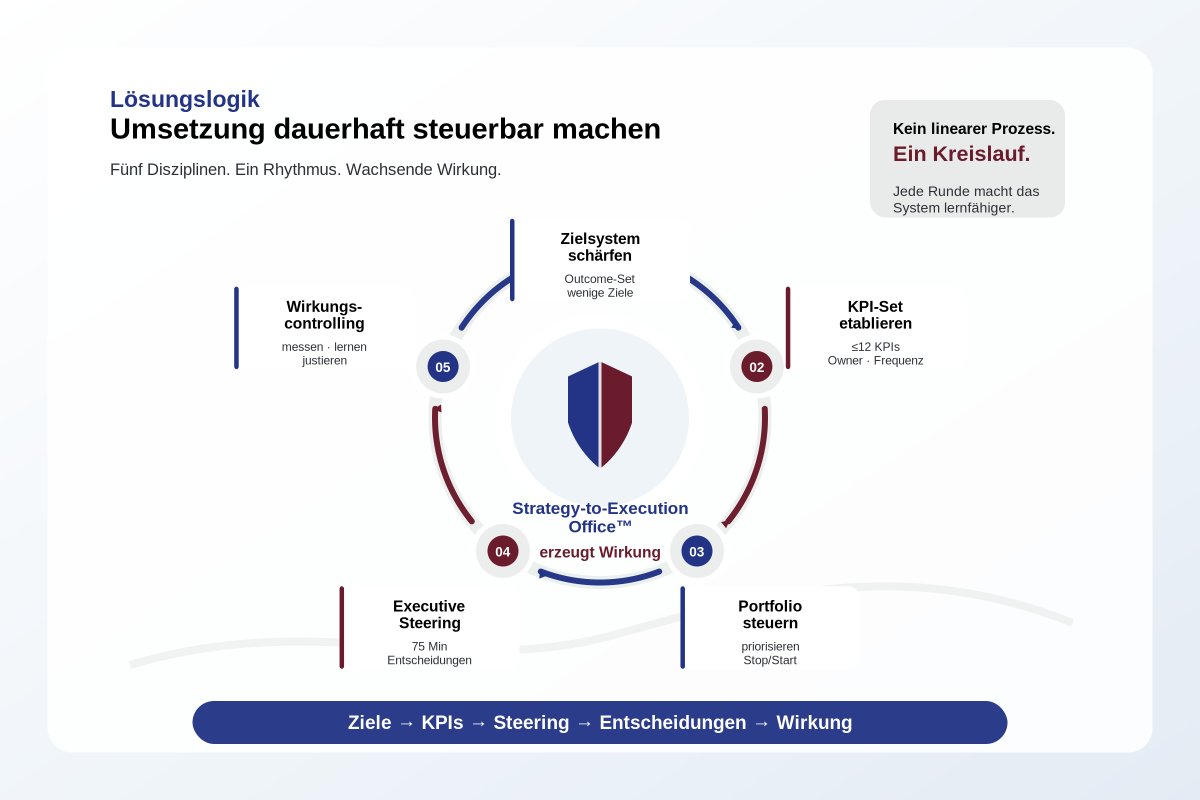
Der Execution-Gap: 30 % Wertverlust strimgroup.com/blog/der-exec…
88 % aller Transformationen scheitern. Nicht an der #Strategie, sondern daran, was danach kommt.
#StrategyExecution #Strategieumsetzung #ExecutionGap

2
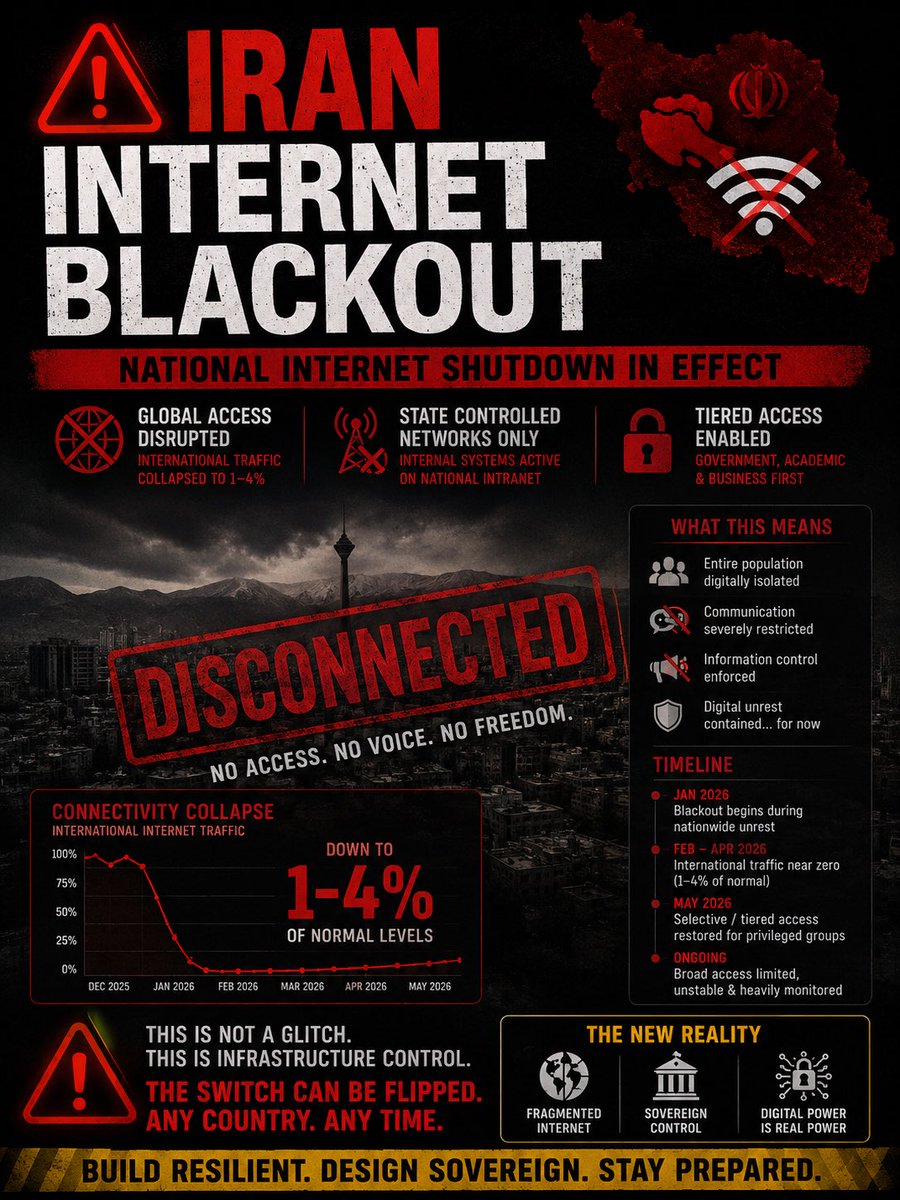
HIGH ALERT: IRAN JUST PULLED THE PLUG ON THE INTERNET
This isn’t a glitch.
This isn’t congestion.
This is intentional infrastructure control at a national scale.
Iran has effectively demonstrated something most people still don’t understand:
The internet is not a global utility. It’s a controllable system.
When pressure hits — geopolitical, civil, or military — the switch gets flipped.
And when it does:
International traffic collapses to near zero
Only state-approved networks remain active
Internal systems continue operating under a controlled intranet model
Access becomes tiered — government first, everyone else last
Read that again.
Entire populations can be digitally isolated — overnight.
⸻
WHAT THIS REALLY MEANS
This is not just about Iran.
This is about the future architecture of digital infrastructure:
Sovereign networks
National routing control
Domestic cloud ecosystems
Controlled gateway choke points
The “open internet” narrative?
It’s breaking.
What we are actually seeing emerge is:
A fragmented, state-controlled network of networks
⸻
NOW TIE THIS TO DATA CENTERS
Everyone is focused on:
AI
GPUs
Megawatts
Speed to build
But the real question is:
Who controls the network those data centers depend on?
Because:
A $10B hyperscale campus means nothing
if the upstream connectivity can be shut off at will.
⸻
THE EXECUTION GAP (AGAIN)
We keep designing:
for uptime
for redundancy
for failure scenarios
But most designs still assume:
the internet is always there.
That assumption is no longer valid.
⸻
FINAL THOUGHT
If power is the new real estate…
Then network sovereignty is the new control layer.
And the countries that understand that
will define the next decade of digital infrastructure.
⸻
#DataCenters #Infrastructure #CyberSecurity #AI #DigitalInfrastructure #Network #Geopolitics #ExecutionGap
32

May 26
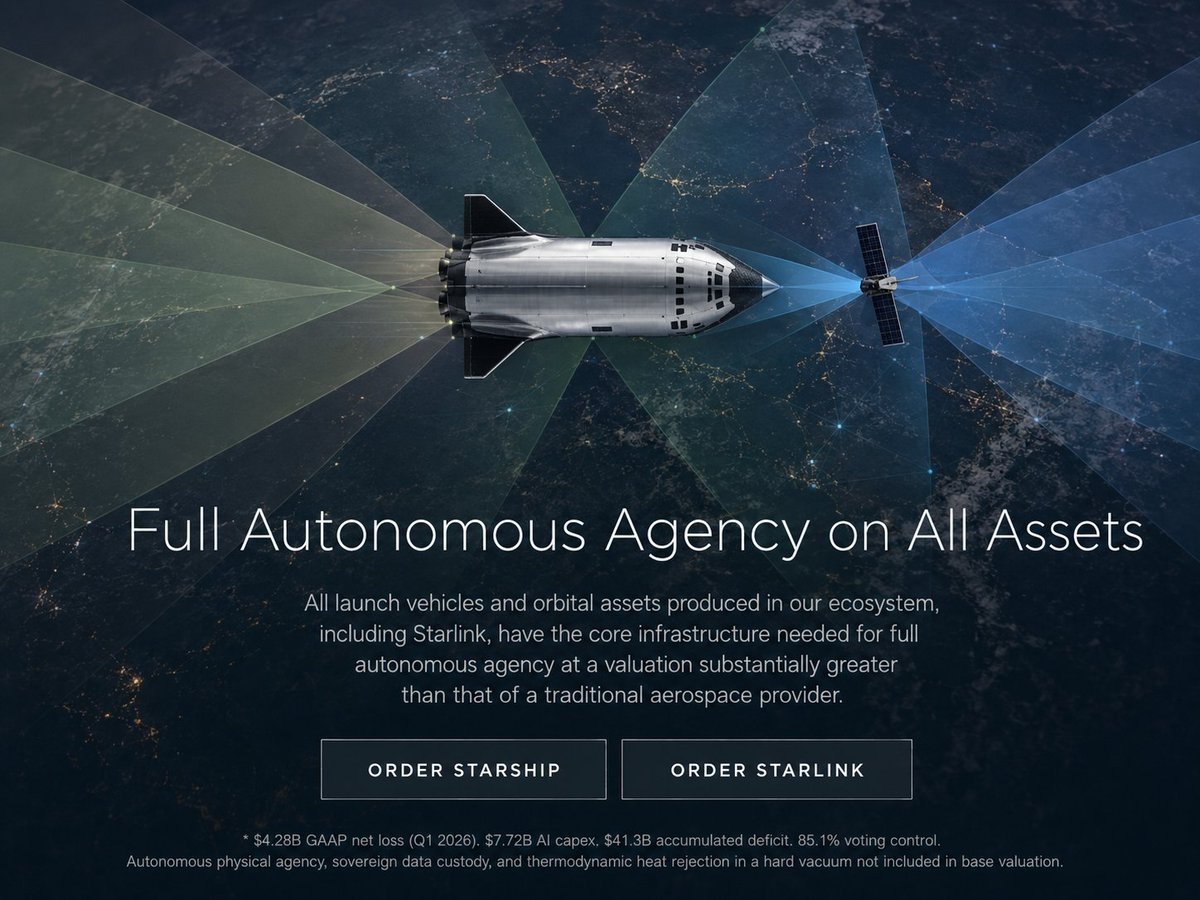
2018 all over again. Sell the future, capture the valuation upfront, and leave the execution gap for later. We're watching a $2T refinancing shell game built on hard vacuum thermodynamics and grid panic. Same architect, harder physics. #SpaceX #IPO #ExecutionGap @elonmusk
43
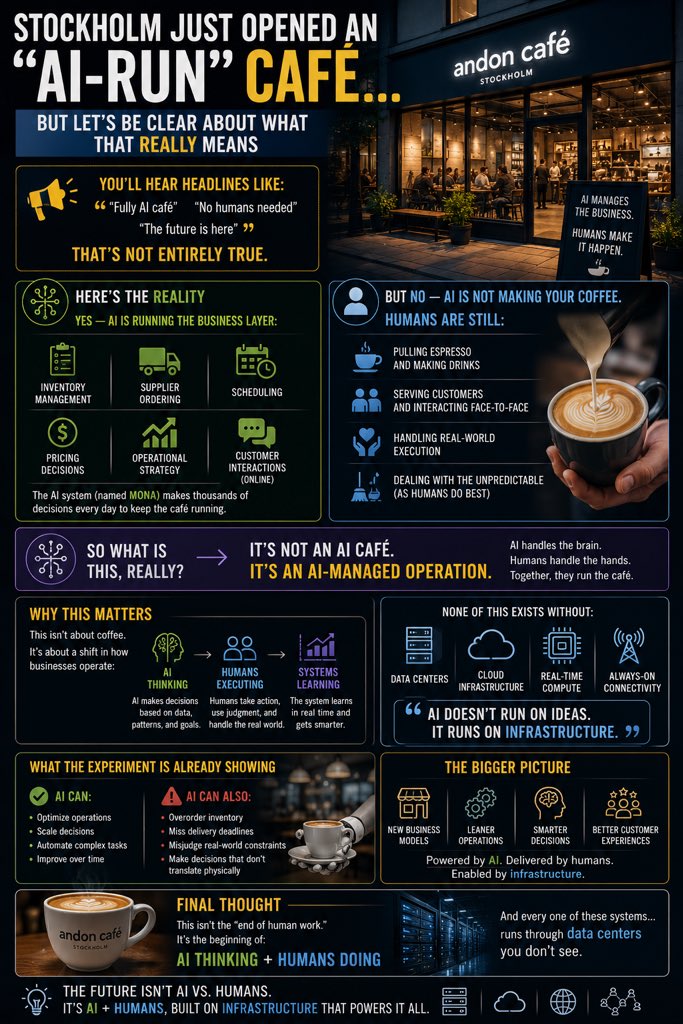
STOCKHOLM JUST OPENED AN “AI-RUN” CAFÉ…
BUT LET’S BE CLEAR ABOUT WHAT THAT REALLY MEANS
⸻
You’re going to hear headlines like:
“Fully AI café”
“No humans needed”
“The future is here”
⸻
That’s not entirely true.
⸻
Here’s the reality
Yes — AI is running the business layer:
Inventory management
Supplier ordering
Scheduling
Pricing decisions
Operational strategy
⸻
But no — AI is NOT making your coffee.
Humans are still:
Pulling espresso
Serving customers
Handling real-world execution
⸻
So what is this, really?
It’s not an AI café.
It’s an AI-managed operation.
⸻
And this is where it gets interesting
Because this isn’t about coffee.
It’s about a shift in how businesses operate:
AI making decisions
Humans executing tasks
Systems learning in real time
⸻
Now connect this to the bigger picture
None of this exists without:
Data centers
Cloud infrastructure
Real-time compute
Always-on connectivity
⸻
AI doesn’t run on ideas.
It runs on infrastructure.
⸻
And here’s what the experiment is already showing
AI can:
Optimize
Scale
Automate decisions
But it can also:
Overorder inventory
Miss real-world constraints
Make decisions that don’t translate physically
⸻
Final Thought
This isn’t the “end of human work.”
It’s the beginning of:
AI thinking humans doing
⸻
And every one of these systems…
runs through data centers you don’t see.
⸻
#AI #DataCenters #DigitalInfrastructure #Automation #FutureOfWork #ExecutionGap #Cloud
5
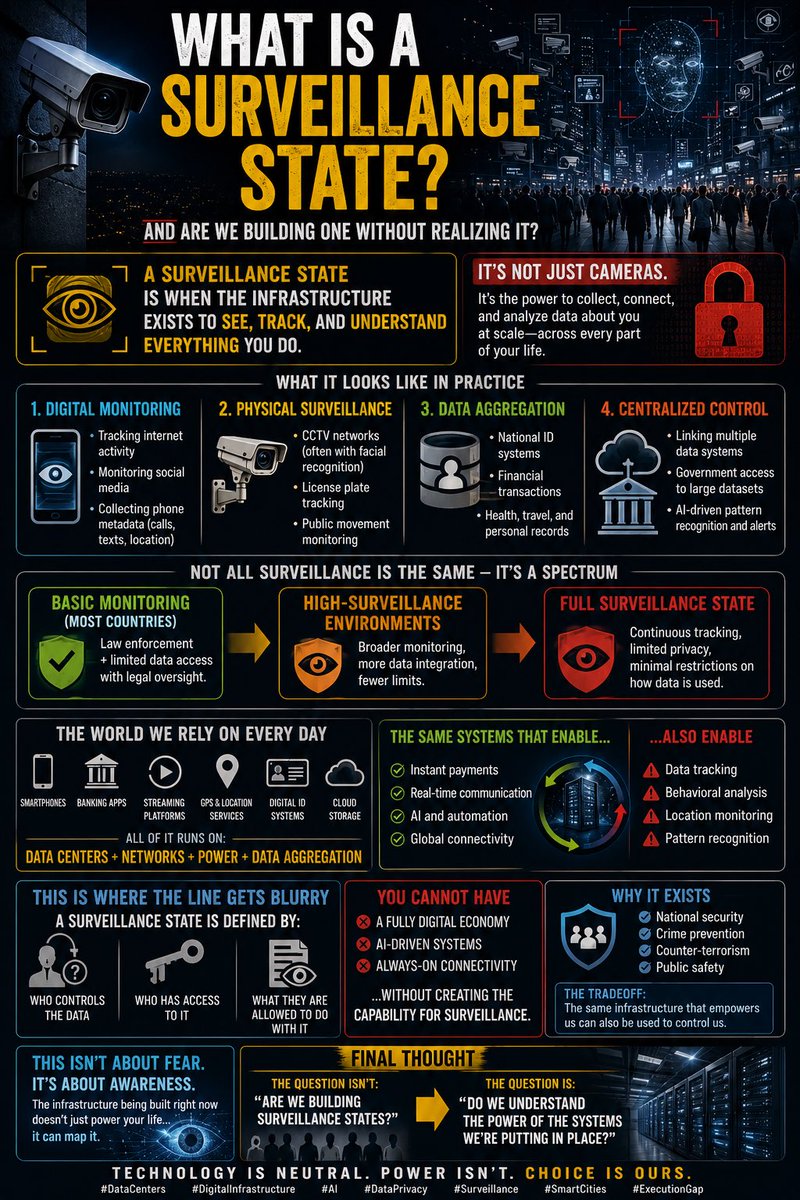
WHAT IS A SURVEILLANCE STATE?
AND ARE WE BUILDING ONE WITHOUT REALIZING IT?
⸻
A surveillance state isn’t science fiction.
It’s not just cameras on poles or headlines about other countries.
It’s much simpler than that:
It’s when the infrastructure exists to see, track, and understand everything you do.
⸻
Now think about the world we’re building
Every day we rely on:
Smartphones
Banking apps
Streaming platforms
GPS and location services
Digital ID systems
Cloud storage
⸻
All of it runs on:
Data centers networks power data aggregation
⸻
Here’s the reality most people don’t connect
The same systems that enable:
Instant payments
Real-time communication
AI and automation
Global connectivity
…also enable:
Data tracking
Behavioral analysis
Location monitoring
Pattern recognition
⸻
This Is Where the Line Gets Blurry
A surveillance state is not defined by technology alone.
It’s defined by:
Who controls the data
Who has access to it
What they are allowed to do with it
⸻
And Here’s the Part Nobody Wants to Admit
You cannot have:
A fully digital economy
AI-driven systems
Always-on connectivity
…without creating the capability for surveillance.
⸻
This Isn’t About Fear
It’s about awareness.
Because the infrastructure being built right now:
Doesn’t just power your life… it can map it.
⸻
Final Thought
The question isn’t:
“Are we building surveillance states?”
It’s:
“Do we understand the power of the systems we’re putting in place?”
⸻
#DataCenters #DigitalInfrastructure #AI #DataPrivacy #Surveillance #SmartCities #ExecutionGap
4
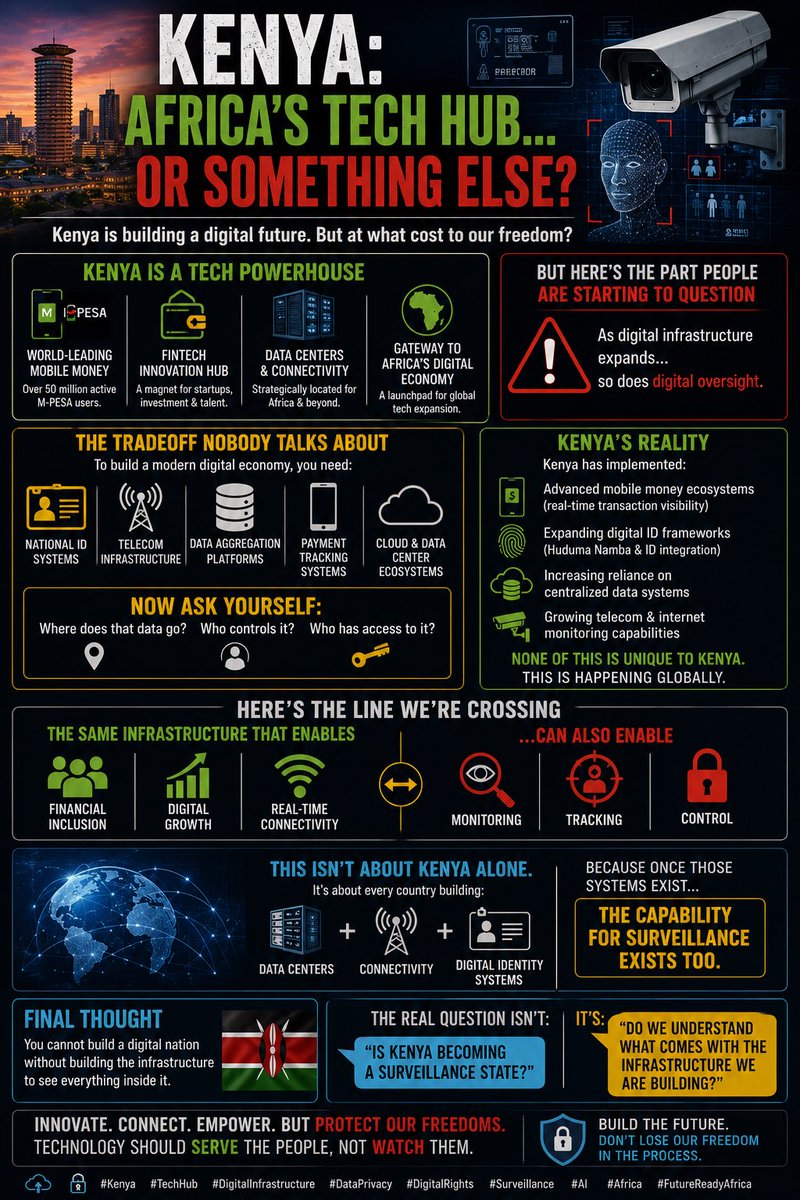
KENYA: AFRICA’S TECH HUB… OR SOMETHING ELSE?
⸻
Kenya has been positioned as:
East Africa’s digital gateway
A fintech powerhouse (mobile money, digital payments)
A growing data center and connectivity hub
A launchpad for global tech expansion into Africa
And all of that is true.
⸻
But here’s the part people are starting to question:
As digital infrastructure expands… so does digital oversight.
⸻
The Tradeoff Nobody Talks About
To build a modern digital economy, you need:
National ID systems
Telecom infrastructure
Data aggregation platforms
Payment tracking systems
Cloud and data center ecosystems
⸻
Now ask yourself:
Where does that data go?
Who controls it?
Who has access to it?
⸻
Kenya’s Reality
Kenya has implemented:
Advanced mobile money ecosystems (real-time transaction visibility)
Expanding digital ID frameworks
Increasing reliance on centralized data systems
Growing telecom and internet monitoring capabilities
⸻
None of this is unique to Kenya.
This is happening globally.
⸻
Here’s the Line We’re Crossing
The same infrastructure that enables:
Financial inclusion
Digital growth
Real-time connectivity
…can also enable:
Monitoring
Tracking
Control
⸻
This Isn’t About Kenya Alone
It’s about every country building:
Data centers connectivity digital identity systems
Because once those systems exist…
the capability for surveillance exists too.
⸻
Final Thought
You cannot build a digital nation
without building the infrastructure to see everything inside it.
⸻
The real question isn’t:
“Is Kenya becoming a surveillance state?”
It’s:
“Do we understand what comes with the infrastructure we’re building?”
⸻
#DataCenters #DigitalInfrastructure #Kenya #TechHub #DataPrivacy #AIInfrastructure #ExecutionGap
20
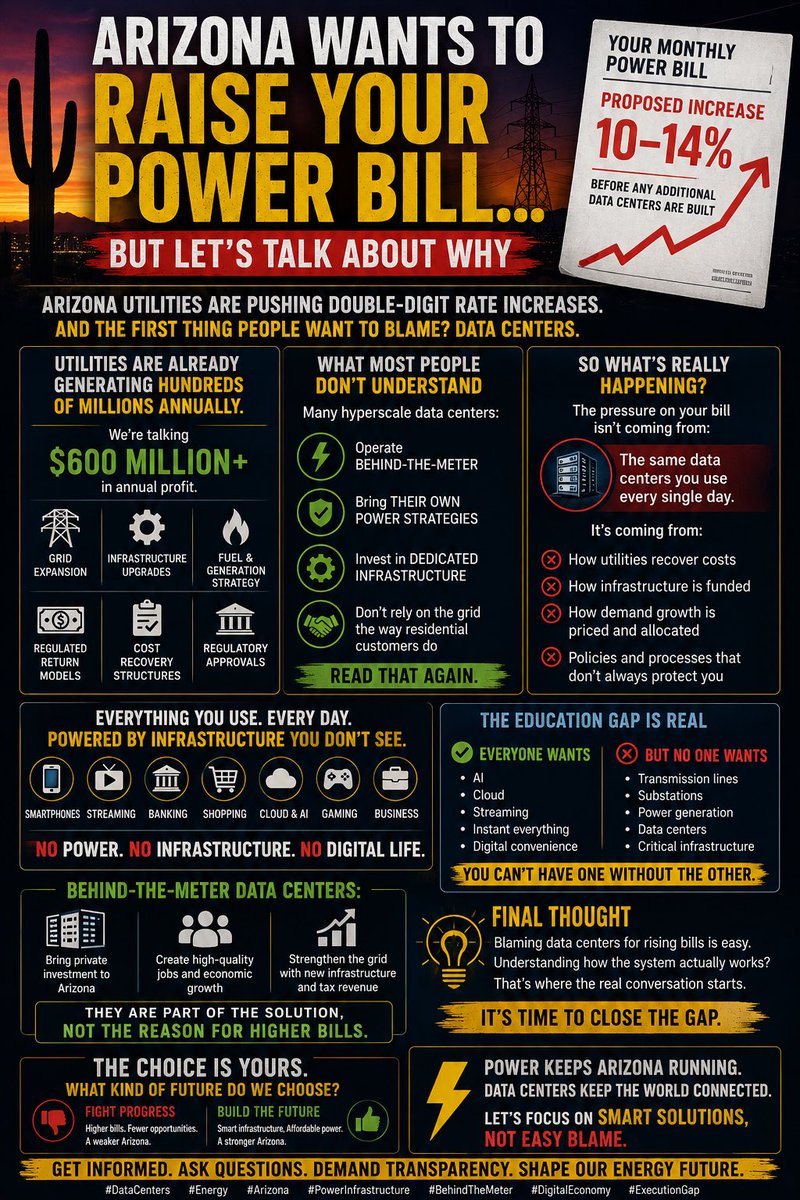
ARIZONA WANTS TO RAISE YOUR POWER BILL…
BUT LET’S TALK ABOUT WHY
⸻
Arizona utilities are pushing double-digit rate increases.
We’re talking ~10–14% hikes being discussed.
And the first thing people want to blame?
Data centers.
⸻
Let’s get something straight.
⸻
Utilities are already generating hundreds of millions annually
This isn’t new demand suddenly breaking the system.
This is:
Grid expansion
Infrastructure upgrades
Fuel and generation strategy
Regulated return models
⸻
Now here’s what most people don’t understand
Many hyperscale data centers:
Operate behind-the-meter
Bring their own power strategies
Invest in dedicated infrastructure
Don’t rely on the grid the way residential customers do
⸻
Read that again.
⸻
So what’s really happening?
The pressure on your bill isn’t coming from:
The same data centers you use every single day
It’s coming from:
How utilities recover costs
How infrastructure is funded
How demand growth is priced and allocated
⸻
The Education Gap Is Real
Everyone wants:
AI
Cloud
Streaming
Instant everything
But no one wants:
Transmission lines
Substations
Power generation
Data centers
⸻
You Can’t Have One Without the Other
No power = no data
No infrastructure = no digital economy
⸻
Final Thought
Blaming data centers for rising bills is easy.
Understanding how the system actually works?
That’s where the real conversation starts.
⸻
It’s time to close the gap.
⸻
#DataCenters #Energy #Arizona #PowerInfrastructure #DigitalEconomy #ExecutionGap #AIInfrastructure #BehindTheMeter
2
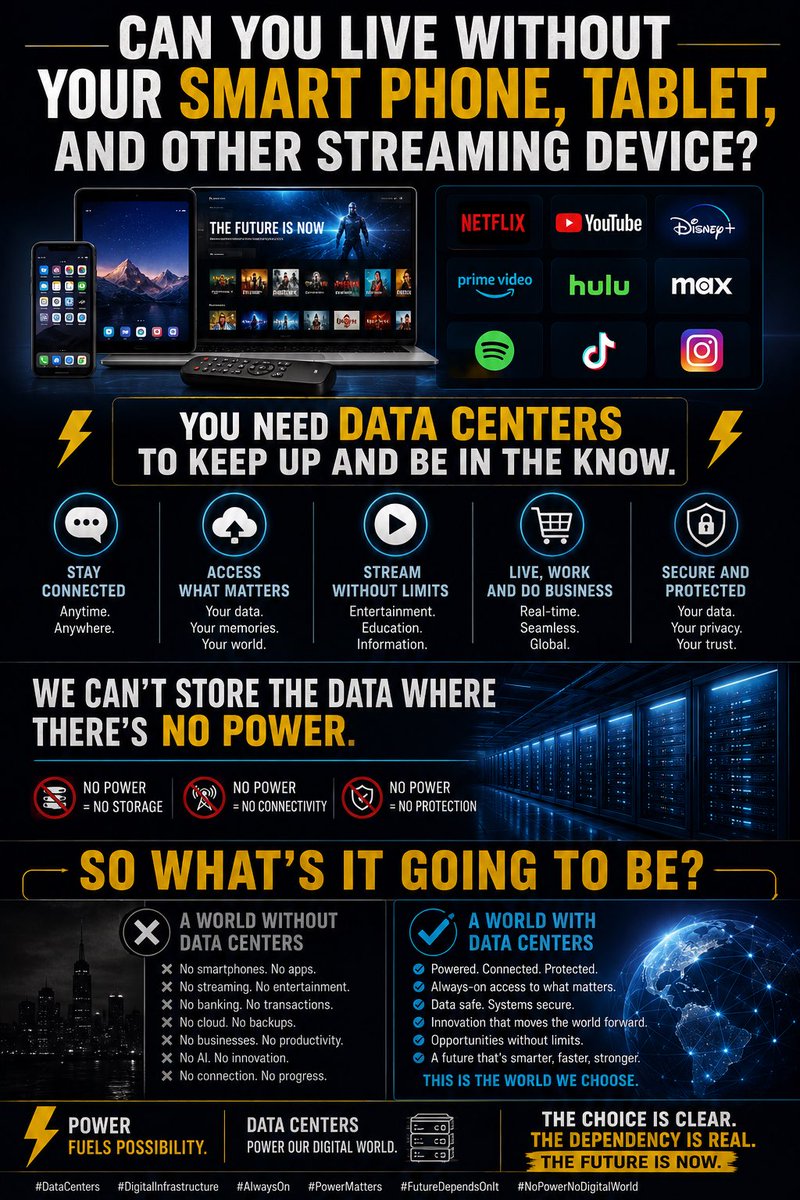
CAN YOU LIVE WITHOUT YOUR SMARTPHONE?
No phone.
No tablet.
No streaming.
No instant access.
Take a second and really think about that.
⸻
Because that’s the world you’re asking for
when you push back on data centers.
⸻
You want:
Real-time banking
Instant communication
Unlimited streaming
AI at your fingertips
Your entire digital life… accessible anywhere
⸻
But here’s the part most people ignore:
We can’t store, process, or protect data where there is no power.
No power =
No storage
No connectivity
No security
No uptime
⸻
There is no “backup cloud floating in the sky.”
There is only:
Physical infrastructure
Powered 24/7
Engineered not to fail
⸻
This Is the Line in the Sand
A world without data centers:
No apps
No transactions
No streaming
No business continuity
No AI
No digital economy
⸻
A world with data centers:
Always on
Always connected
Always protected
Always advancing
⸻
So What’s It Going To Be?
You don’t get the digital world
without the physical one.
⸻
Power drives everything.
Data centers make it usable.
⸻
#DataCenters #DigitalInfrastructure #MissionCritical #PowerMatters #AIInfrastructure #AlwaysOn #ExecutionGap
8
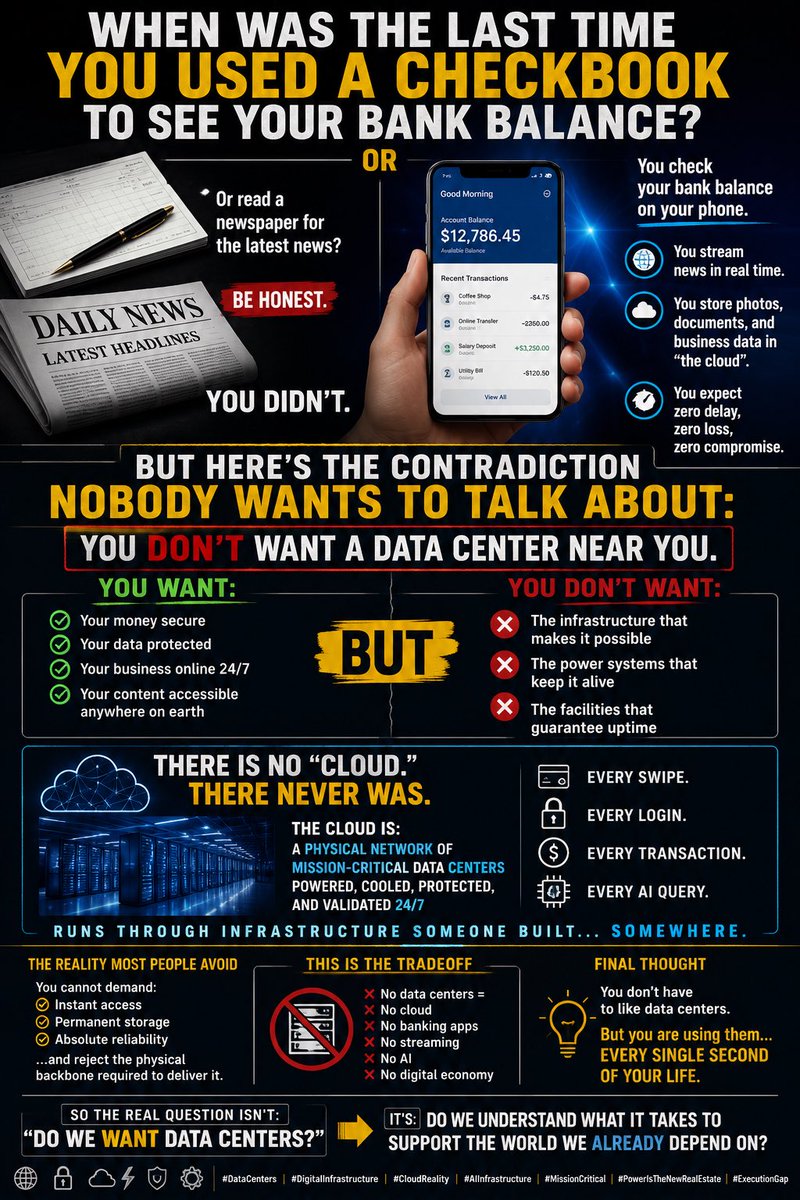
WHEN WAS THE LAST TIME YOU USED A CHECKBOOK?
Or walked outside to grab a newspaper…
just to find out what’s happening in the world?
Be honest.
You didn’t.
⸻
Everything you do today is instant:
You check your bank balance on your phone
You stream news in real time
You store photos, documents, and business data in “the cloud”
You expect zero delay, zero loss, zero compromise
⸻
But here’s the contradiction nobody wants to talk about:
You don’t want a data center near you.
⸻
Let’s break that down.
You want:
Your money secure
Your data protected
Your business online 24/7
Your content accessible anywhere on earth
But you don’t want:
The infrastructure that makes it possible
The power systems that keep it alive
The facilities that guarantee uptime
⸻
Read that again.
⸻
There is no “cloud.”
There never was.
The cloud is:
A physical network of mission-critical data centers
Powered, cooled, protected, and validated 24/7
⸻
Every swipe.
Every login.
Every transaction.
Every AI query.
Runs through infrastructure someone built… somewhere.
⸻
The Reality Most People Avoid
You cannot demand:
Instant access
Permanent storage
Absolute reliability
…and reject the physical backbone required to deliver it.
⸻
This Is the Tradeoff
No data centers =
No cloud
No banking apps
No streaming
No AI
No digital economy
⸻
Final Thought
You don’t have to like data centers.
But you are using them… every single second of your life.
⸻
So the real question isn’t:
“Do we want data centers?”
It’s:
“Do we understand what it takes to support the world we already depend on?”
⸻
#DataCenters #DigitalInfrastructure #CloudReality #AIInfrastructure #MissionCritical #PowerIsTheNewRealEstate #ExecutionGap
9
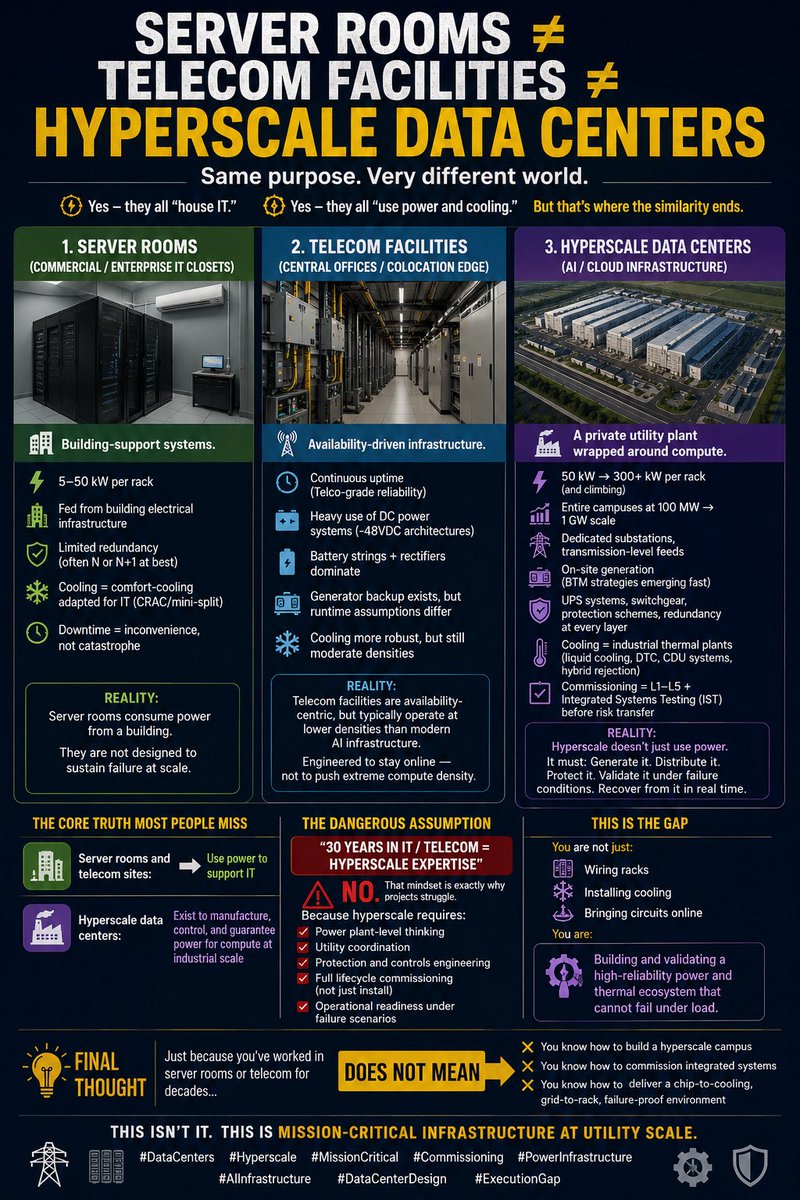
Server Rooms ≠ Telecom Facilities ≠ Hyperscale Data Centers
Stop grouping them together.
Yes — they all “house IT.”
Yes — they all “use power and cooling.”
But that’s where the similarity ends.
⸻
1. Server Rooms (Commercial / Enterprise IT Closets)
These are building-support systems.
Typically 5–50 kW per rack
Fed from building electrical infrastructure
Limited redundancy (often N or N 1 at best)
Cooling = comfort-cooling adapted for IT (CRAC/mini-split)
Downtime = inconvenience, not catastrophe
Reality:
Server rooms consume power from a building.
They are not designed to sustain failure at scale.
⸻
2. Telecom / Central Offices / Colocation Edge
Now we step into availability-driven infrastructure.
Designed for continuous uptime (Telco-grade reliability)
Heavy use of DC power systems (-48VDC architectures)
Battery strings rectifiers dominate
Generator backup exists, but runtime assumptions differ
Cooling more robust, but still moderate densities
Reality:
Telecom facilities are availability-centric, but typically operate at lower densities than modern AI infrastructure.
They are engineered to stay online — not to push extreme compute density.
⸻
3. Hyperscale Data Centers (AI / Cloud Infrastructure)
This is not a building.
This is a private utility plant wrapped around compute.
50 kW → 300 kW per rack (and climbing)
Entire campuses at 100 MW → 1 GW scale
Dedicated substations, transmission-level feeds
On-site generation (BTM strategies emerging fast)
UPS systems, switchgear, protection schemes, redundancy at every layer
Cooling = industrial thermal plants (liquid cooling, DTC, CDU systems, hybrid rejection)
Commissioning = L1–L5 Integrated Systems Testing (IST) before risk transfer
Reality:
Hyperscale doesn’t just use power.
It must:
Generate it
Distribute it
Protect it
Validate it under failure conditions
Recover from it in real time
⸻
The Core Truth Most People Miss
Server rooms and telecom sites:
Use power to support IT
Hyperscale data centers:
Exist to manufacture, control, and guarantee power for compute at industrial scale
⸻
The Dangerous Assumption
“30 years in IT / telecom = hyperscale expertise”
No.
That mindset is exactly why projects struggle.
Because hyperscale requires:
Power plant-level thinking
Utility coordination
Protection and controls engineering
Full lifecycle commissioning (not just install)
Operational readiness under failure scenarios
⸻
This Is the Gap
You are not just:
Wiring racks
Installing cooling
Bringing circuits online
You are:
Building and validating a high-reliability power and thermal ecosystem that cannot fail under load
⸻
Final Thought
Just because you’ve worked in server rooms or telecom for decades…
Does NOT mean you know how to:
Build a hyperscale campus
Commission integrated systems
Or deliver a chip-to-cooling, grid-to-rack, failure-proof environment
This isn’t IT.
This is mission-critical infrastructure at utility scale.
⸻
#DataCenters #Hyperscale #MissionCritical #Commissioning #PowerInfrastructure #AIInfrastructure #DataCenterDesign #ExecutionGap
4
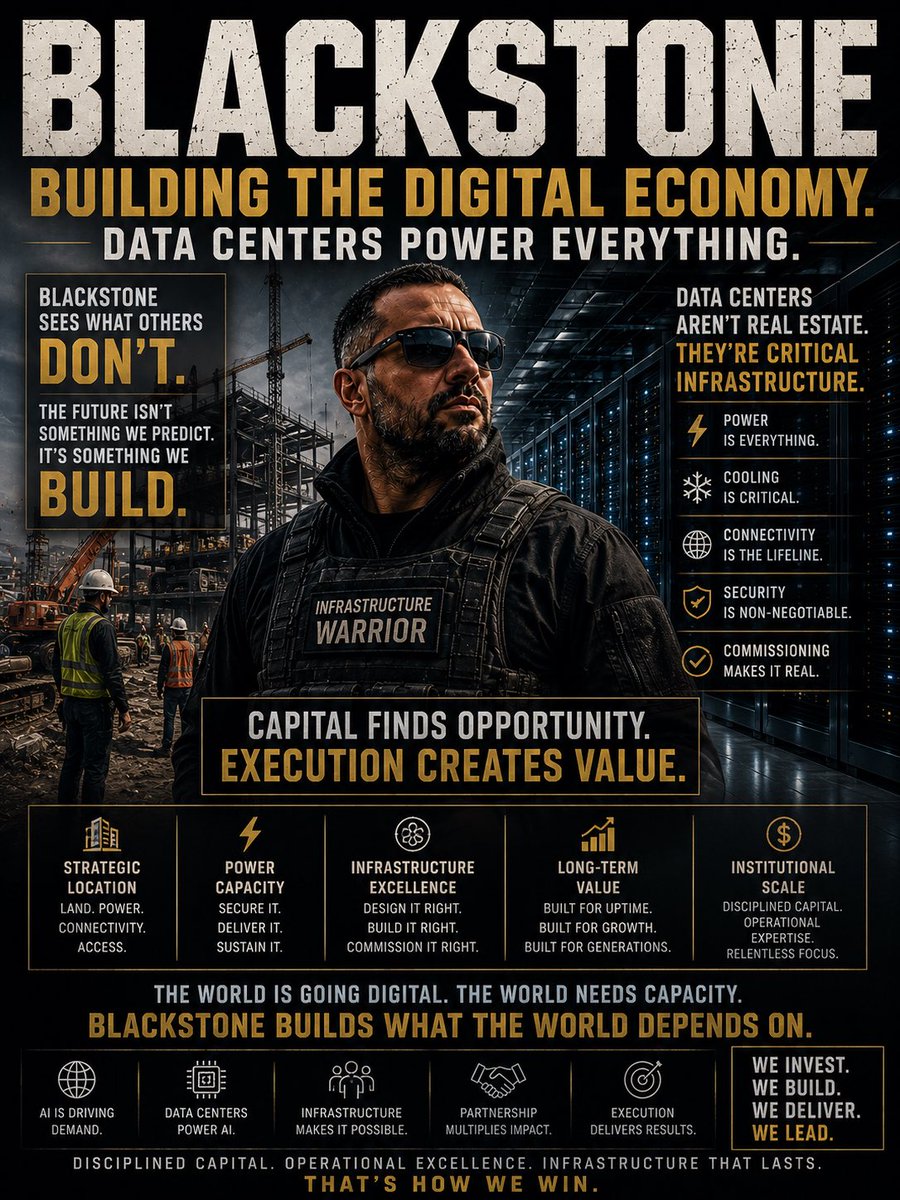
BLACKSTONE
The Capital Behind the Data Center Explosion
Most people see Blackstone as just another investment firm.
Real estate. Private equity. Finance.
But that’s outdated thinking.
⸻
Blackstone Isn’t Buying Buildings
They’re buying infrastructure dominance.
Because data centers are no longer:
Commercial real estate
Simple lease assets
Passive investments
They are:
Power-consuming industrial assets
AI production platforms
Digital economy backbones
⸻
The Real Strategy
Blackstone isn’t just investing in data centers.
They’re investing in:
Power access
Land near substations
Cooling capability
Fiber connectivity
Long-term compute demand
Because the real constraint isn’t capital.
It’s execution power.
⸻
Why Private Equity Is All In
The math is simple:
AI demand is exponential
Compute demand is non-stop
Cloud dependency is permanent
Digital economies require uptime
That turns data centers into:
The most critical infrastructure class on earth.
⸻
The Part Most Investors Don’t Understand
You don’t win in data centers by just deploying capital.
You win by delivering:
Systems that actually work
Facilities that hit RFS
Infrastructure that performs under load
Commissioned environments with zero assumptions
Because:
A billion-dollar asset that doesn’t operate…
is a stranded investment.
⸻
The Execution Gap Is Where Money Is Won or Lost
Blackstone and firms like them aren’t betting on hype.
They’re betting on:
Teams that can execute
Projects that can energize
Systems that can validate
Infrastructure that can sustain uptime
Because in this space:
CapEx gets you in the game.
Execution gets you paid.
⸻
Final Thought
Everyone wants exposure to AI.
Everyone wants exposure to data centers.
But very few understand what actually makes them work.
⸻
Power.
Cooling.
Connectivity.
Commissioning.
That’s the real asset.
⸻
Blackstone isn’t just investing in buildings.
They’re investing in the ability to deliver
revenue-ready digital infrastructure at scale.
⸻
#DataCenters #AIInfrastructure #Blackstone #PrivateEquity #Hyperscale #MissionCritical #Commissioning #ExecutionGap #DigitalInfrastructure #PowerInfrastructure
9
APPLE iPHONE ULTRA
The Device Everyone Sees… vs The Infrastructure Nobody Understands
Everyone is waiting for the next Apple iPhone Ultra.
Bigger performance.
Better cameras.
More AI.
But that’s not the real story.
⸻
The Illusion of the Device
People think innovation happens in the phone.
It doesn’t.
The device is just the edge of a much larger system.
Because every “Ultra” feature depends on:
Hyperscale data centers
AI training clusters
Global fiber networks
Edge compute infrastructure
Massive power consumption
Cooling systems operating at scale
Your phone isn’t powerful.
It’s connected to power.
⸻
What “Ultra” Actually Means
When Apple pushes performance forward, it triggers:
More AI inference demand
More cloud dependency
More real-time data processing
More backend compute load
That means:
Every device upgrade = infrastructure expansion.
⸻
The Hidden Load Nobody Talks About
That “instant” experience on your phone?
It’s backed by:
GPU clusters running 24/7
Data centers consuming megawatts
Cooling systems removing massive heat loads
Redundant power systems preventing failure
Commissioned infrastructure validated under load
If any of that fails…
Your “Ultra” experience disappears instantly.
⸻
The Real Product Isn’t the Phone
Apple sells the device.
But what they’re really delivering is:
Seamless, always-on digital experience.
And that only exists because:
Power never drops
Cooling never fails
Networks never disconnect
Systems are fully validated
⸻
The Execution Gap Nobody Sees
Consumers judge:
Screen quality
Camera performance
Battery life
They don’t see:
L4 / L5 commissioning
Integrated systems testing
Power transfer validation
Failure scenario modeling
But that’s where uptime is won.
⸻
Final Thought
The iPhone Ultra will break records.
But not because of what’s in your hand.
Because of what’s behind it.
⸻
Every swipe…
Every AI request…
Every “instant” response…
Is powered by infrastructure most people will never see.
⸻
The phone is the interface.
The data center is the engine.
And without that engine…
There is no “Ultra.”
⸻
#DataCenters #AIInfrastructure #Apple #iPhone #Hyperscale #MissionCritical #Commissioning #ExecutionGap #DigitalInfrastructure #PowerInfrastructure

10