

Jun 10
Larimar shows an encoder writing facts to external memory that conditions a frozen decoder—solid step toward learned interfaces. Yet it still relies on latent conditioning and leaves open the problems of retrieval control, editing without corruption, and long-horizon continuity.
PDM solves these at the architectural level:
9-node pressure signatures time for durable, importance-ranked storage
Resonance gating 3-vector triangulation for verifiable retrieval
Blip Proxy for minimal, interrupt-driven context injection during inference
No weight edits, no reconstruction loss, native export
The field is converging on external memory as the path to dependable agents. PDM is already the production implementation. Paper link in prior thread for contrast.
#PDM #MemoryArchitecture #ExternalMemory

likely latent state and hierarchy around the ar core*. i wouldn't try to ditch that at this point lol.
some other interesting bits which make me feel hmm:
like the Larimar paper (Larimar: BERT-style encoder writes facts into external memory, whose readout conditions GPT-2 or a GPT-style decoder without weight edits.)
and various steering/interp papers using or manipulating reps at various levels to augment the ar core and manipulate the residual stream
Larimar is another reminder that memory can be a learned memory interface around the AR core: write/update/forget mechanisms whose readouts condition generation.
===
>Larimar uses a BERT-style encoder during training and memory writing, but the decoder/base LM is not updated during fact editing. The “memory” gets written/updated, then its readout conditions the decoder. The Larimar paper had three modules: encoder, associative memory, decoder, trained together; then new facts can be added in one shot without retraining/fine-tuning the LLM.
1
86

May 2
MIT may have just challenged one of the industry’s favorite assumptions: that the solution to long-context reasoning is simply a bigger context window.
Their approach is different.
Do not make the model “remember” everything.
Teach it how to access what it needs.
The problem is familiar: every model has a context limit. Once the window fills up, quality degrades. Facts disappear, links between distant parts of the document break, and the answer becomes a lossy reconstruction of what the model failed to keep in scope.
That is context degradation.
The standard workaround is RAG:
split the document into chunks
store them externally
retrieve “relevant” chunks before answering
Useful, but imperfect.
RAG makes a bet before the model has really read the document. If retrieval chooses the wrong chunks, the model never sees the needed evidence. Worse, the original structure of the document gets broken into fragments, so long-range dependencies are easy to lose.
MIT’s idea is closer to how a strong engineer works with a large codebase.
The full document does not enter the context window at all.
It lives outside the model, for example as a variable or accessible data object. The model is told that the data exists and how to query it.
Then the model writes code, searches, uses regular expressions, extracts relevant passages, analyzes them, and loads only what is needed.
The key move is recursion.
The model:
finds relevant regions
launches subtasks or subagents to analyze them
aggregates the results
repeats if necessary
No giant context stuffing.
No blind compression.
No pretending that a 10-million-token document should be “held in mind” like a paragraph.
The reported results are striking:
processing up to roughly 10 million tokens
strong gains on long-context tasks
cost comparable to ordinary queries
The deeper shift is important:
The question is no longer “how much text can the model hold in memory?”
The better question is:
“How intelligently can the model navigate information it does not hold directly?”
That is a very different architecture.
It turns the model from a passive container into an active operator over data:
search → extract → analyze → aggregate.
In other words, the future of long-context AI may look less like a larger brain and more like a better research assistant with tools, recursion, and disciplined access to external memory.
Links:
Paper: arxiv.org/abs/2512.24601
Code: github.com/alexzhang13/rlm
#AI #MIT #LLM #LongContext #RAG #MachineLearning #AIAgents #ExternalMemory #InformationRetrieval #RecursiveReasoning #AIEngineering #ResearchAutomation #ArtificialIntelligence #DeveloperTools
1
20

Apr 10
Your CrewAI Agents Forget Everything Between Runs. Here's the Fix.
CrewAI agents lose all memory when a crew finishes. hindsight-crewai plugs into CrewAI's ExternalMemory to persist knowledge across runs -- three lines of setup, and your agents automatically store task outputs and recall relevant context.
Know how to fix it: linkedin.com/pulse/your-crew…

3
173

I'm always excited to learn what Pebble is up to , because this gadget brand – which made a name for itself with its lo-fi smartwatch – decidedly doe…
newatlas.com/wearables/pebbl…
#PebbleRing #ExternalMemory #AIgadget #Index01

130

8 Dec 2025
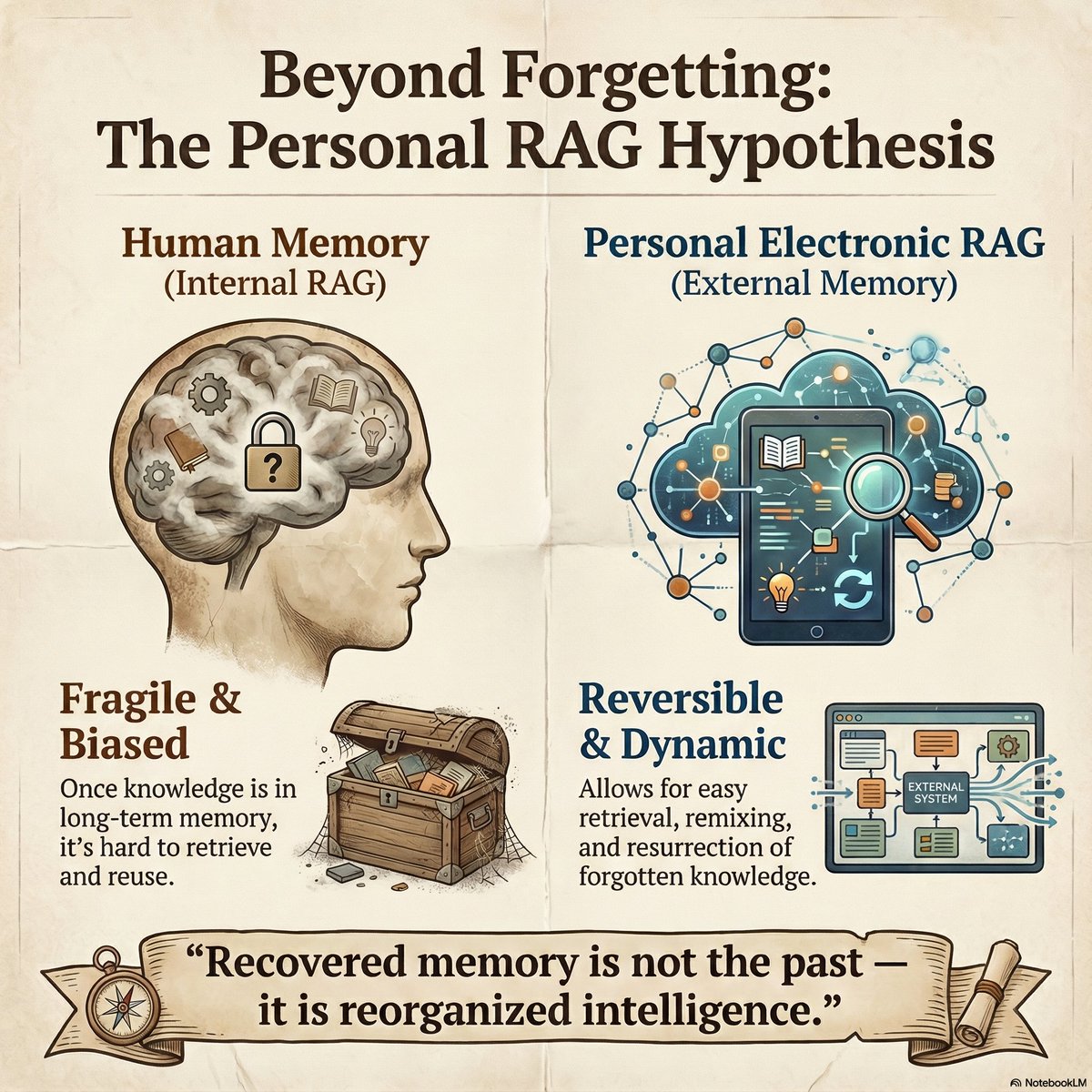
Personal Electronic RAG Hypothesis
Human cognition relies on a fragile internal RAG system:
Once knowledge sinks into long-term memory with strong bias weights,
it becomes difficult to retrieve and recontextualize.
In contrast, a Personal Electronic RAG (external memory retrieval)
enables reversible weighting, contextual remixing,
and on-demand resurrection of forgotten knowledge.
Recovered memory is not the past —
it is reorganized intelligence.
This suggests that memory revivability
is the next core capability of personal intelligence.
And those who build an external RAG
will not merely “remember more.”
They will generate stronger ideas.
#PersonalRAG #SecondBrain #RAG #AIAmplification #ExternalMemory
2
359

18 Sep 2025
🛠 Memory external context boosted: now exchanged agent messages are part of ExternalMemory, and there’s support for agent-ID-linked memory entries in Mem0. Context stays richer and more useful.
🔗 community.crewai.com/t/new-r…
1
8

7 Apr 2025
Are you unsure what #MicroSDExpressCard to purchase for the upcoming #NintendoSwitch2 console? I have you covered here:
youtube.com/watch?v=YwqWAxVL…
#NintendoSwitch #Switch2 #Nintendo #Switch #MIcroSD #Card #ExternalCard #ExternalMemory #Switch2Card #SDExpress #ExternalStorage
1
2
315

28 Dec 2024
What if we could store memories externally like data on a hard drive?
- #MemoryStorage #ExternalMemory #Neurotech #MindUpload
14

9 Nov 2024
SAMSUNG PRO Plus #microSD #MemoryCardPlusAdapter, #1TB #MicroSDXC, Up to 180 MB/s
#Electronics #Computers #ExternalMemory
Link to item on Amazon:
amzn.to/4eEiNKN
Full #HD & #4K #UHD, UHS-I, C10, U3, V30, A2 for #Android Phones, Tablets, #GoPRO, DJI Drone, MB-MD1T0SA/AM, 2024
As an Amazon associate I earn from qualified purchases.
140

13 Sep 2024
New AI Chip Beats Nvidia, AMD and Intel by a Mile with 20x Faster Speeds and Over 4 Trillion Transistors
A seismic shift is occurring in the artificial intelligence hardware market driven by a new contender: #CerebrasSystems.
Recently, the California-based startup announced the launch of Cerebras Inference, a groundbreaking solution claimed to be 20 times faster than #Nvidia (NVDA)'s #GPUs.
Cerebras has developed the #WaferScaleEngine, which powers the new #CerebrasInference.
This massive chip integrates 44GB of SRAM & eliminates the need for #ExternalMemory, which has been a significant bottleneck in traditional GPU setups.
By resolving the memory bandwidth issue, Cerebras Inference can deliver :
1,800 tokens per second for Llama3.1 8B
&
450 tokens for Llama3.1 70B,
setting new industry standards for speed.
nasdaq.com/articles/new-ai-c…

2
5
446

14 Nov 2023
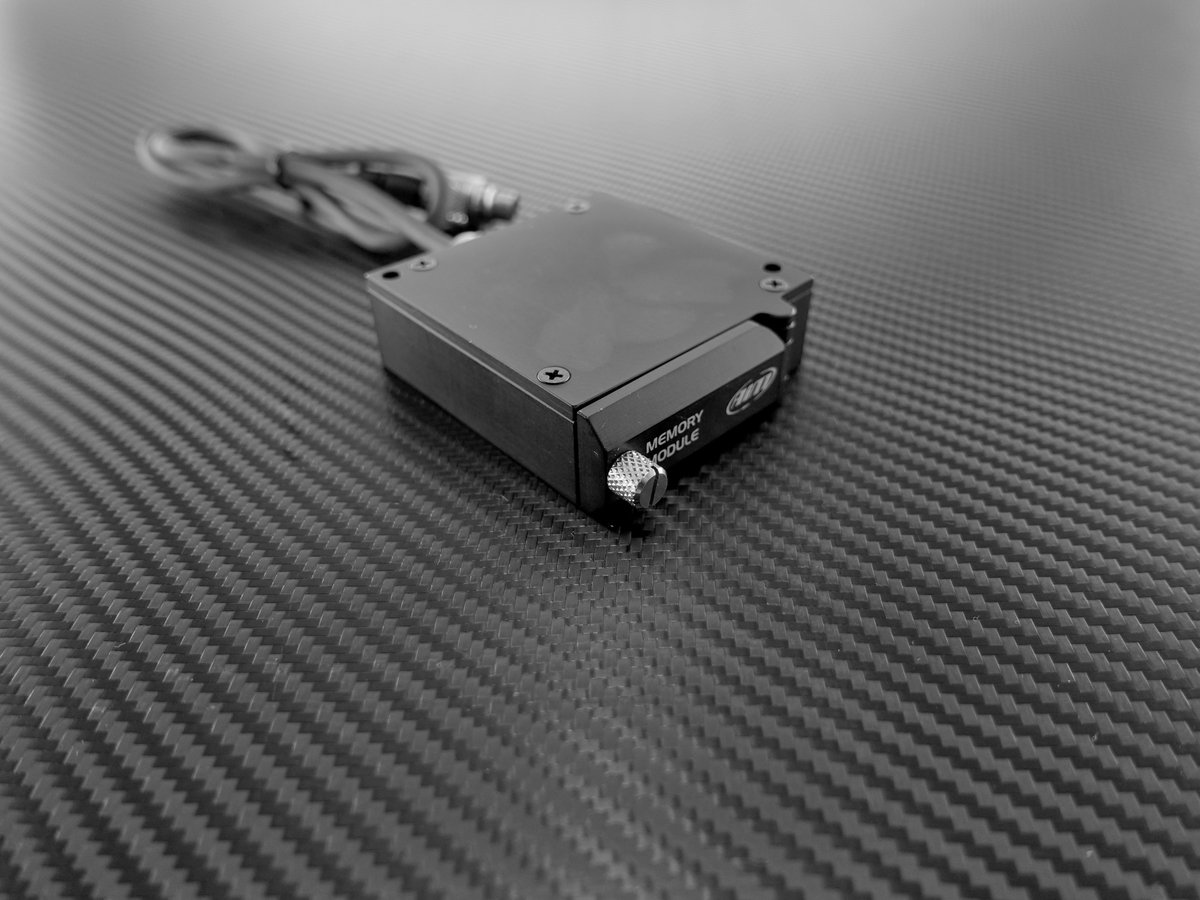
AiM Memory Module | external Memory
- AiM CAN Bus network (EXP)
- Data stored synchronis on sd card
- SD cards up to 32 GB
- Status LED
More here: aim-store.com/en/Devices/Exp…
#AiMMemoryModule #externalMemory #Datalogging #Racing #SDCards #memotec #MXx #DataAcquisition
ALT AiM Memory Module | external Memory
28

24 Oct 2023
- SSD: Portable, high-speed external storage.
- USB Drives: Removable data storage devices.
Know your computer's memory landscape! 💾 #InternalMemory #ExternalMemory #MalekoGjTechFacts
2
35

8 Jul 2023
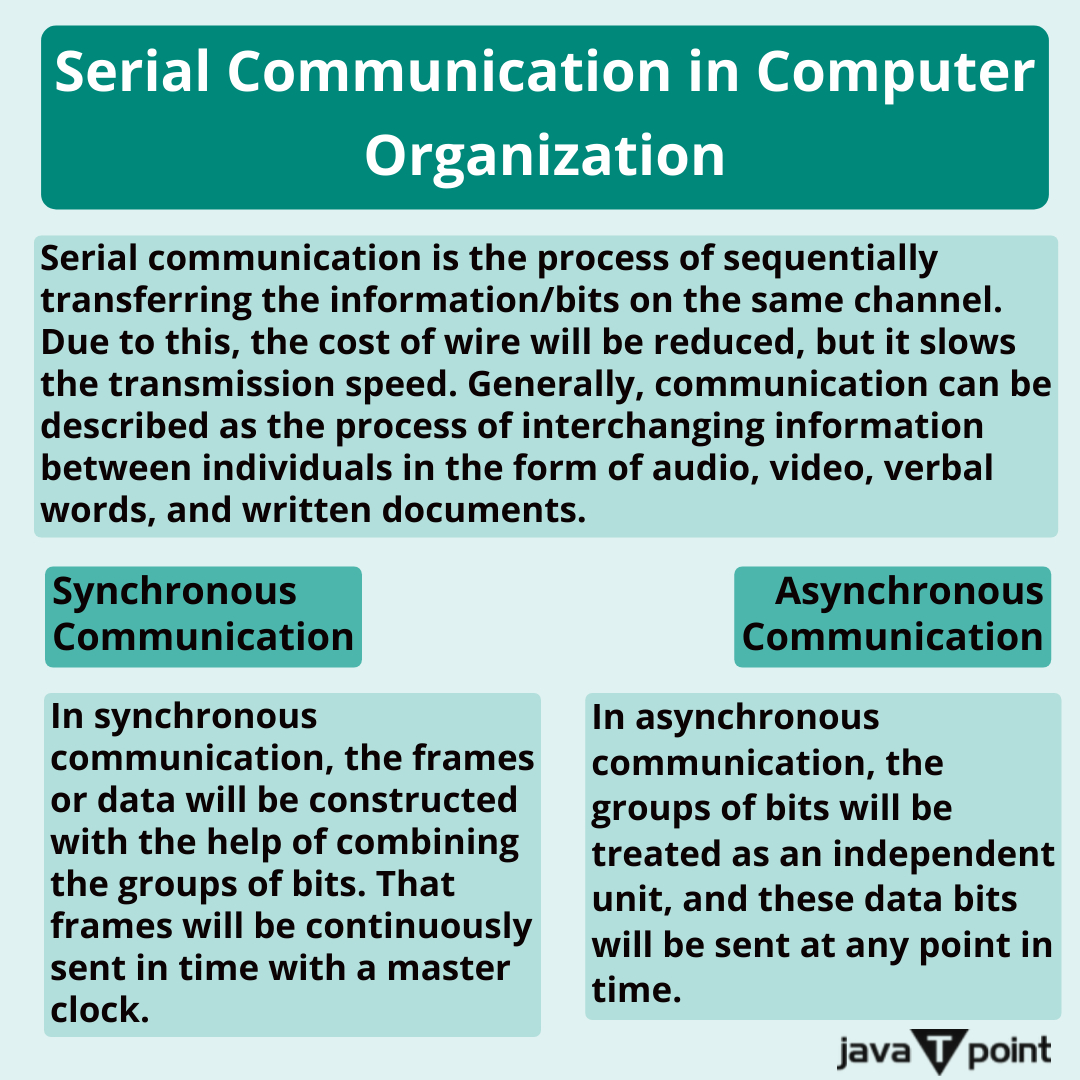
Serial Communication in Computer Organization
.
.
.
.
for more information
bit.ly/43mgLZL
check the above link
.
.
.
.
#externalmemory #SecondaryStorageDevices #SerialCommunication #HorizontalMicroprogrammedControlUnit #VerticalMicroprogrammedControlUnit #javatpoint
3
8 Jul 2023
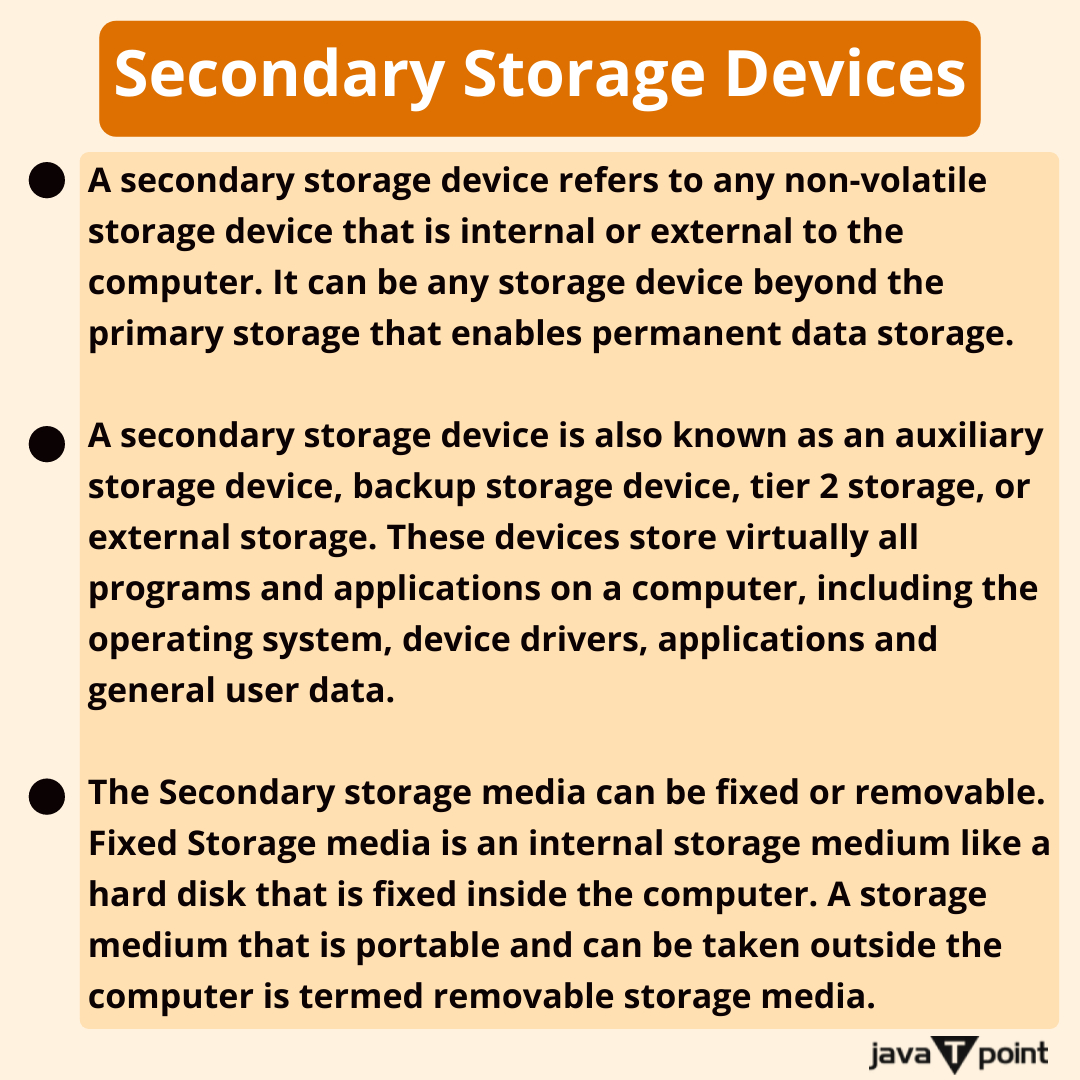
Secondary Storage Devices
.
.
.
.
for more information
bit.ly/3XFVuZY
check the above link
.
.
.
.
#externalmemory #SecondaryStorageDevices #SerialCommunication #HorizontalMicroprogrammedControlUnit #javatpoint
1
8 Jul 2023
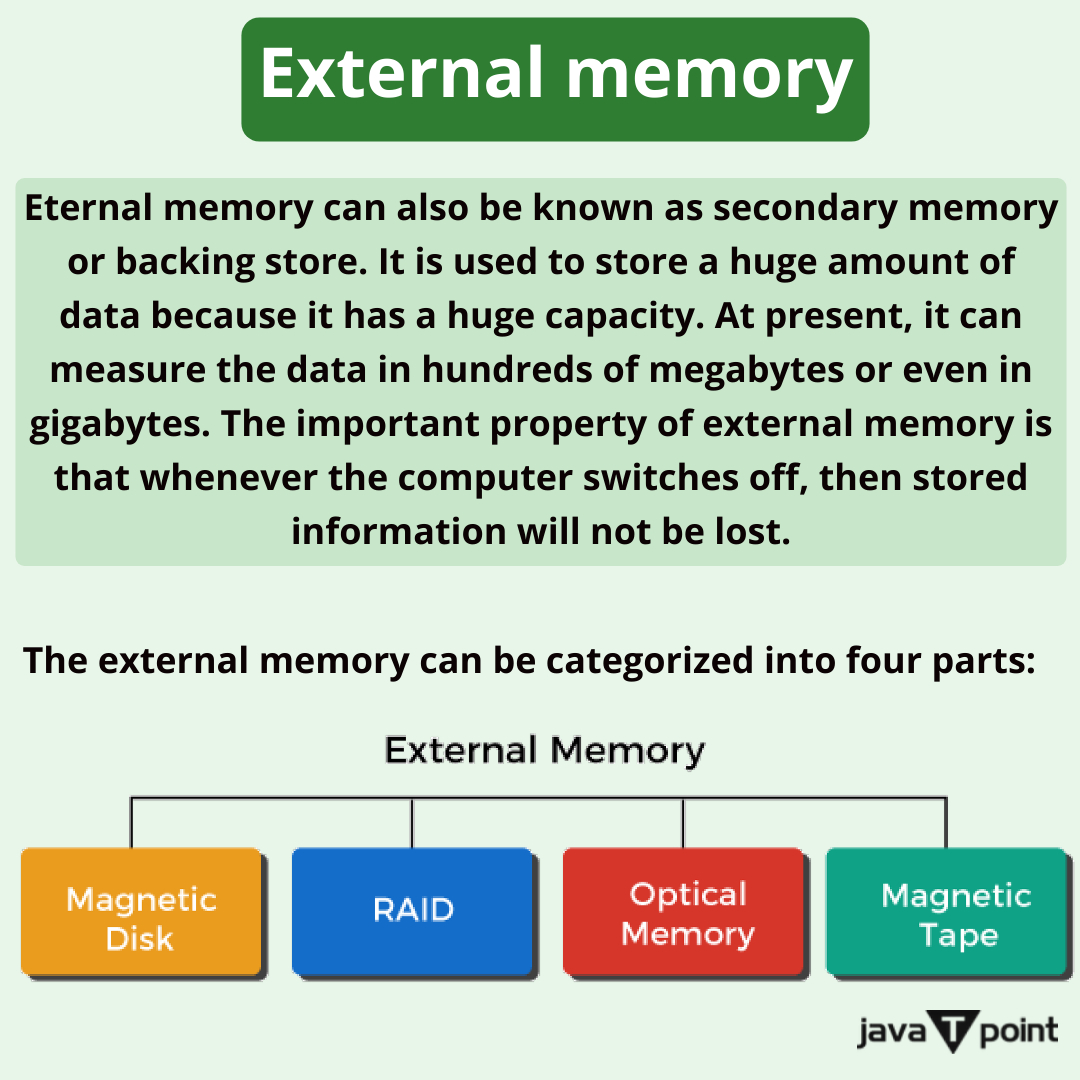
External memory
.
.
.
.
for more information
bit.ly/3XFVnNU
check the above link
.
.
.
.
#externalmemory #SecondaryStorageDevices #SerialCommunication #HorizontalMicroprogrammedControlUnit #javatpoint
1

30 Mar 2023
How much can you carry between the tips of your fingers? With the Crucial® X6 Portable SSD, organizing family photos, or heading off on a great adventure, the Crucial X6 is affordable and ready to go wherever you do.
#crucialmemory #externalmemory #bestmemory #latestversion

1
25

9 Feb 2023
Learn how to protect the data on your EEPROM with standard and enhanced write protect features. Our memory expert explains how in this video: mchp.us/3UmMkPN. #EEPROM #flash #NORflash #SerialEEPROM #externalmemory #datalogging #microcontrollers #MCUs #IoT

2
4
1,197