
12s
You repeated "it's the same" without ever explaining why it's equivalent. If you want to invoke economics, start by explaining how physical gold and paper debt instruments become equal in value under a coercive colonial financial system.

🎯Nailed it.
Sadly the state has created exactly the circumstances to invoke this, it's been a long time coming. A carefully crafted psyop begun as soon as the current parent generation attended school as infants.
1

Avner Uzan retweeted

Jun 8
Politics aside, now would be a good time to invoke the #25thAmendmentRequired before Trump embarrasses himself even more.
@SenateGOP
@HouseGOP
@HouseDemocrats
@SenateDems

13

British bood on his hands as well as Palestinian and at no point did he rescind or dissolve that Israeli contract or invoke breach... utterly disgusting man. Same for EVERY Defence & Engineering company in Brotaon with ties & export licences. They are CRIMINALS & will face prison
2
J Venkat annamalai for 2026 retweeted

You can't selectively invoke global standards of merit. If merit is truly the benchmark, then the question of caste-based reservations must also be on the table. Is the Modi government prepared to engage in that debate?
After all, Modi ji himself has repeatedly spoken about the burden of exams and the stress faced by students on numerous occasions.
@annamalai_k @WTLFoundation
#Annamalai

Biometric verification, CCTV monitoring, security checks and supervision are standard practices in any serious, large-scale examination.
China's Gaokao is taken by over 13 million students every year under some of the world's strictest examination protocols. Nobody calls it "militarisation" they call it protecting merit.
When India wants is competing with super powers across the world and become a Greater nation, we need credibility and fair competition. Students deserve confidence in the system, not political fearmongering every time standards are enforced. @BJP4India @blsanthosh
1
2
11
573

Then again I will invoke another name Upton Sinclair."It is difficult to get a man to understand something, when his salary depends upon his not understanding it.
1
onchain retweeted

15h
On Ritual Chain smart contracts don’t just execute
they invoke models attest outputs and coordinate agents with native compute ZK guarantees
No oracles
No bridges
Just expressive verifiable on chain AI
Let’s ship
@ritualnet

1
6
20

If the Bill in question was a mere decriminalisation of assisted suicide, you’d have a case to make on autonomy. The best possible argument you can make on autonomy regarding the Bill is to invoke “positive rights”. You libertarians are completely opposed to positive rights.
14

What is the MATTER with you ? That is an Ai video . Fake people fake thoughts fake words. You should be more careful what you invoke the Lord about . I wouldn’t want to have to defend that on judgement day !
4

Rise to Move to proceed to the bill. The Senate can vote on whether to take up a bill, but opponents can filibuster that effort, often requiring 60 votes to invoke cloture and move forward.
Or
Attach provisions to another bill that is already moving through the Senate.
4

Sit with that discomfort from all that spiritual warfare. It's DATA. I'm a knowledge whore, I cannot get enough of it. Kinda like how money cannot get enough of me, money is my bestie! High Command to the Enemy to obey the Divine Will. I invoke in my Ancestors of Light NOW!🎬🖼🗽
4

SHOULD MUSLIMS CELEBRATE THE NEW ISLAMIC YEAR???
There is no authentic hadith from the Prophet Muhammad ﷺ that specifically enjoins or encourages celebrating the Islamic New Year (the Hijri New Year).
The Hijri calendar was formalised during the caliphate of ʿUmar ibn al-Khaṭṭāb (may Allah be pleased with him). Neither the Prophet ﷺ nor his Companions marked the beginning of the year with celebrations or organised festivities.
Consequently, there is no basis in the Sunnah for inventing special New Year rituals or festive practices; such innovations are generally regarded as bidʿah. At the same time, the start of Muharram remains significant: it recalls the Prophet’s migration (Hijrah) and offers a timely opportunity for personal and spiritual reflection.
Scholars therefore advise against partying or introducing new ceremonial observances on this occasion. Instead, Muslims are encouraged to use this time to assess their deeds and renew sincere repentance.
Established, authentic practices related to the change of month and year include:
•Reciting supplications at the sighting of the new moon/new month. It is a confirmed Sunnah to invoke Allah when a lunar month begins. The Companions transmitted prayers such as:
“Allahumma adkhilhu ‘alayna bil-amni wal-īmān, wa-s-salāmati wal-islām, wa-jiwārim min ash-shayṭān, wa-riḍwānim min ar-Raḥmān.”
Translation: “O Allah, admit this [month/year] upon us with security and faith, with safety and Islam, with protection from Satan, and with the pleasure of the Most Merciful.”
•Fasting on ʿAshura (10th of Muharram). The Prophet ﷺ recommended fasting this day; he said that observing it atones for sins of the previous year.
•Increasing righteous deeds during Muharram. As one of the four sacred months, Muslims are encouraged to intensify voluntary worship—charity, nawafil (supererogatory) prayer, seeking forgiveness, and other good works.
#Copied
2
Samira🇦🇫 retweeted

I am fascinated by feminist activists who will invoke thoroughly patriarchal notions like ghayrat (manly, protective honour) to mobilise Afghan men against restrictions on women. This is whilst these restrictions are consistently criticised in Afghanistan by men and women alike.
7
6
34
1,596
D Kozlak retweeted

19h
"Vance got to the point. They needed to invoke the Insurrection Act, swiftly, to crush the unrest in Minnesota. It would be painful in the short term, he said, but the message it would send — that paid agitators could not get away with disrupting ICE operations — would make sure no one tried it again. (There was no evidence that either Mr. Pretti or Ms. Good had been paid activists.)" nytimes.com/2026/06/15/us/po…
64
725
2,004
296,061
Lisa 🌷 retweeted

If you are at Compulsion, please send me a DM so I can link you with our HR at Invoke.
Si vous êtes à Compulsion, n'hésitez pas a m'envoyer un message et je tenterai de vous mettre en contact avec nos RH à Invoke.

Microsoft has reportedly shut down South of Midnight and We Happy Few developer Compulsion Games. bit.ly/4uA4tuo

10
30
1,838

40m
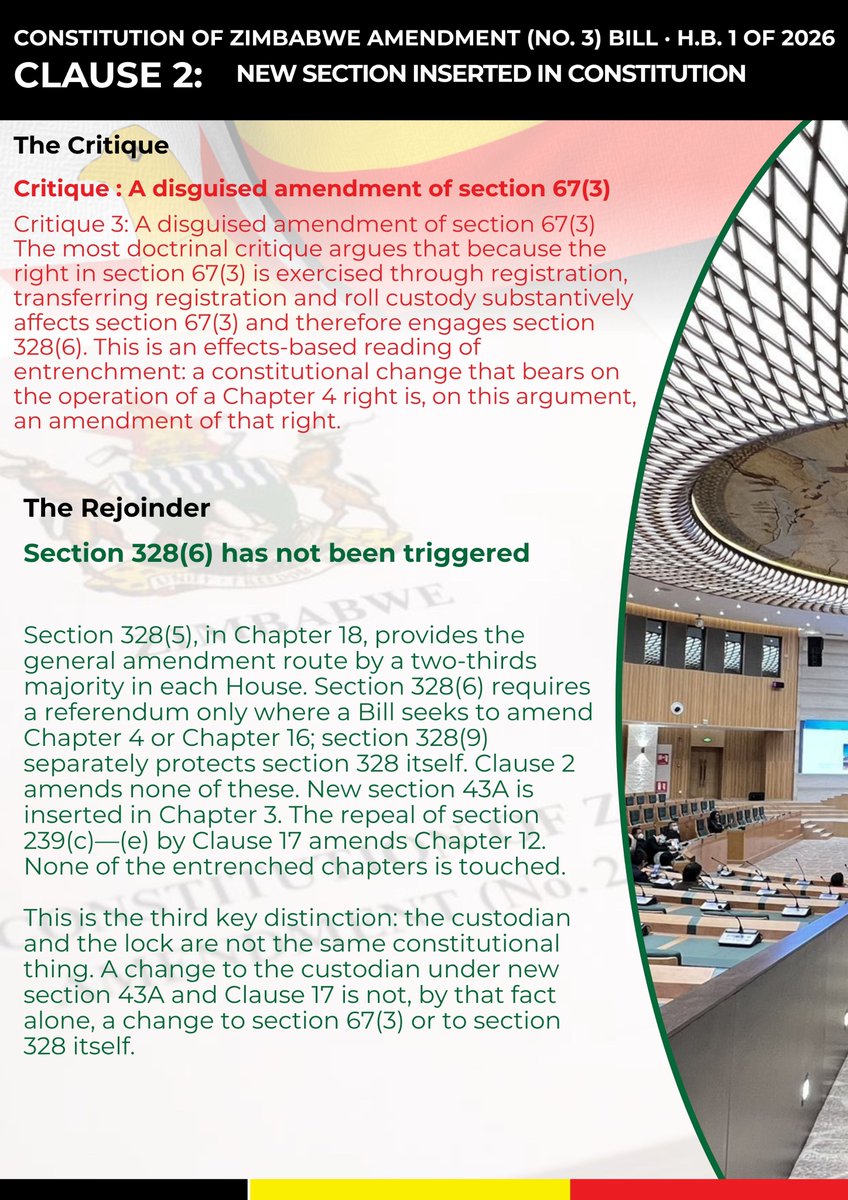
Critique 3: A disguised amendment of section 67 (3)
The most doctrinal critique argues that because the right in section 67(3) is exercised through registration, transferring registration and roll custody substantively affects section 67(3) and therefore engages section 328(6). This is an effects-based reading of entrenchment: a constitutional change that bears on the operation of a Chapter 4 right is, on this argument, an amendment of that right.
Critique 3 Rejoinder: Section 328(6) has not been triggered
Section 328(5) in Chapter 18 provides for the general amendment route by a two-thirds majority in each House. Section 328(6) requires a referendum only where a Bill seeks to amend Chapter 4 or Chapter 16; section 328(9) separately protects section 328 itself. Clause 2 amends none of these. New section 43A is inserted in Chapter 3. The repeal of section 239(c)—(e) by Clause 17 amends Chapter 12. None of the entrenched chapters is touched.
This is the third key distinction: the custodian and the lock are not the same constitutional thing. A change to the custodian under new section 43A and Clause 17 is not, by that fact alone, a change to section 67(3) or to section 328 itself.
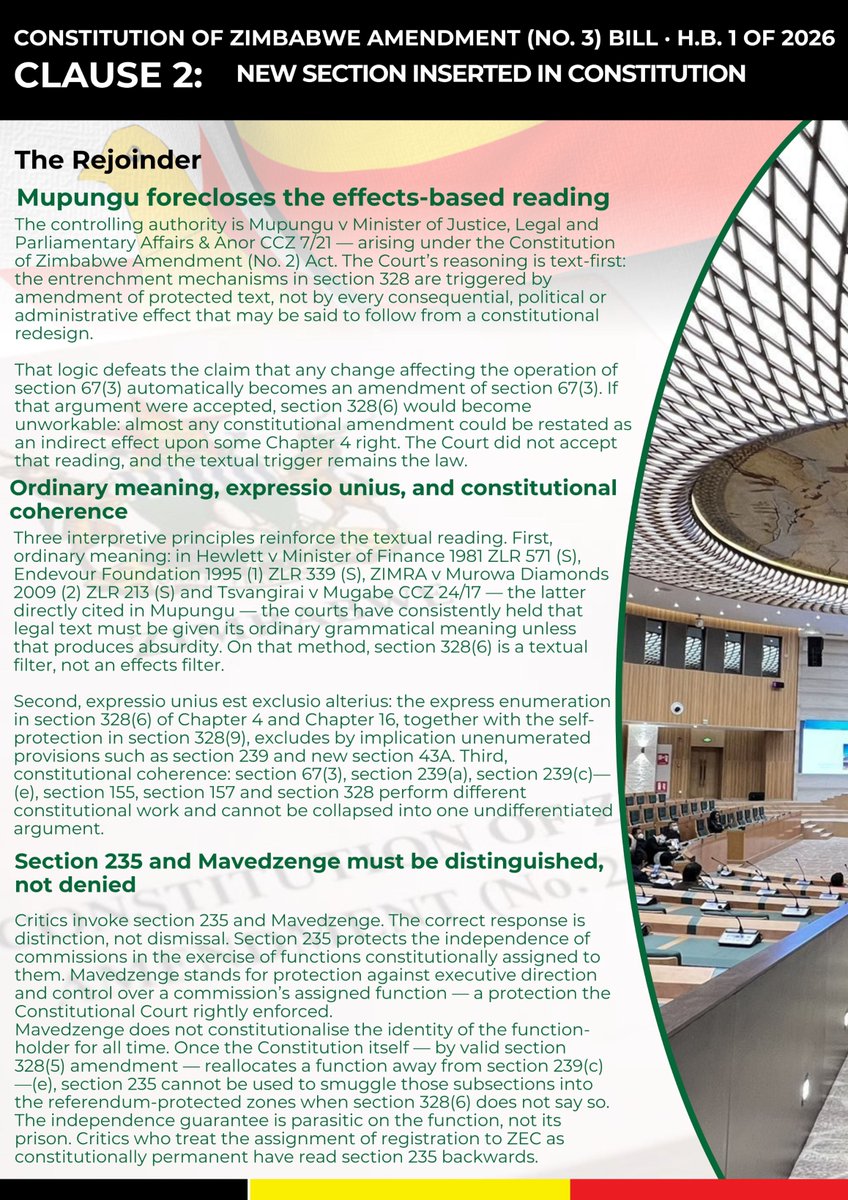
Mupungu forecloses the effects-based reading
The controlling authority is Mupungu v Minister of Justice, Legal and Parliamentary Affairs & Anor CCZ 7/21 — arising under the Constitution of Zimbabwe Amendment (No. 2) Act. The Court’s reasoning is text-first: the entrenchment mechanisms in section 328 are triggered by amendment of protected text, not by every consequential, political or administrative effect that may be said to follow from a constitutional redesign.
That logic defeats the claim that any change affecting the operation of section 67(3) automatically becomes an amendment of section 67(3). If that argument were accepted, section 328(6) would become unworkable: almost any constitutional amendment could be restated as an indirect effect upon some Chapter 4 right. The Court did not accept that reading, and the textual trigger remains the law.
Ordinary meaning, expressio unius, and constitutional coherence
Three interpretive principles reinforce the textual reading. First, ordinary meaning: in Hewlett v Minister of Finance 1981 ZLR 571 (S), Endevour Foundation 1995 (1) ZLR 339 (S), ZIMRA v Murowa Diamonds 2009 (2) ZLR 213 (S) and Tsvangirai v Mugabe CCZ 24/17 — the latter directly cited in Mupungu — the courts have consistently held that legal text must be given its ordinary grammatical meaning unless that produces absurdity. On that method, section 328(6) is a textual filter, not an effects filter.
Second, expressio unius est exclusio alterius: the express enumeration in section 328(6) of Chapter 4 and Chapter 16, together with the self-protection in section 328(9), excludes by implication unenumerated provisions such as section 239 and new section 43A. Third, constitutional coherence: section 67(3), section 239(a), section 239(c)—(e), section 155, section 157 and section 328 perform different constitutional work and cannot be collapsed into one undifferentiated argument.
Section 235 and Mavedzenge must be distinguished, not denied
Critics invoke section 235 and Mavedzenge. The correct response is distinction, not dismissal. Section 235 protects the independence of commissions in the exercise of functions constitutionally assigned to them. Mavedzenge stands for protection against executive direction and control over a commission’s assigned function — a protection the Constitutional Court rightly enforced.
Mavedzenge does not constitutionalise the identity of the function-holder for all time. Once the Constitution itself — by valid section 328(5) amendment — reallocates a function away from section 239(c)—(e), section 235 cannot be used to smuggle those subsections into the referendum-protected zones when section 328(6) does not say so. The independence guarantee is parasitic on the function, not its prison. Critics who treat the assignment of registration to ZEC as constitutionally permanent have read section 235 backwards. #CA3
1
1
1
14