
Jan 26
BIOS optimized for reliability
BIOS INT 15h/84h: 16–32 samples/axis averaging INT overhead checks ~15–25 ms for 4 axes.
Direct 0x201 port: single tight in al,dx /
test / loopnz per axis 1–6 ms total.
Elon traded noise rejection for low latency controls
10
556

13 Nov 2024
Detailed Roadmap to become exceptionally Great at "X86 assembly programming" from 0 to exceptional level,👇👇
Even a 5 year old kid can follow this, it's my promise.
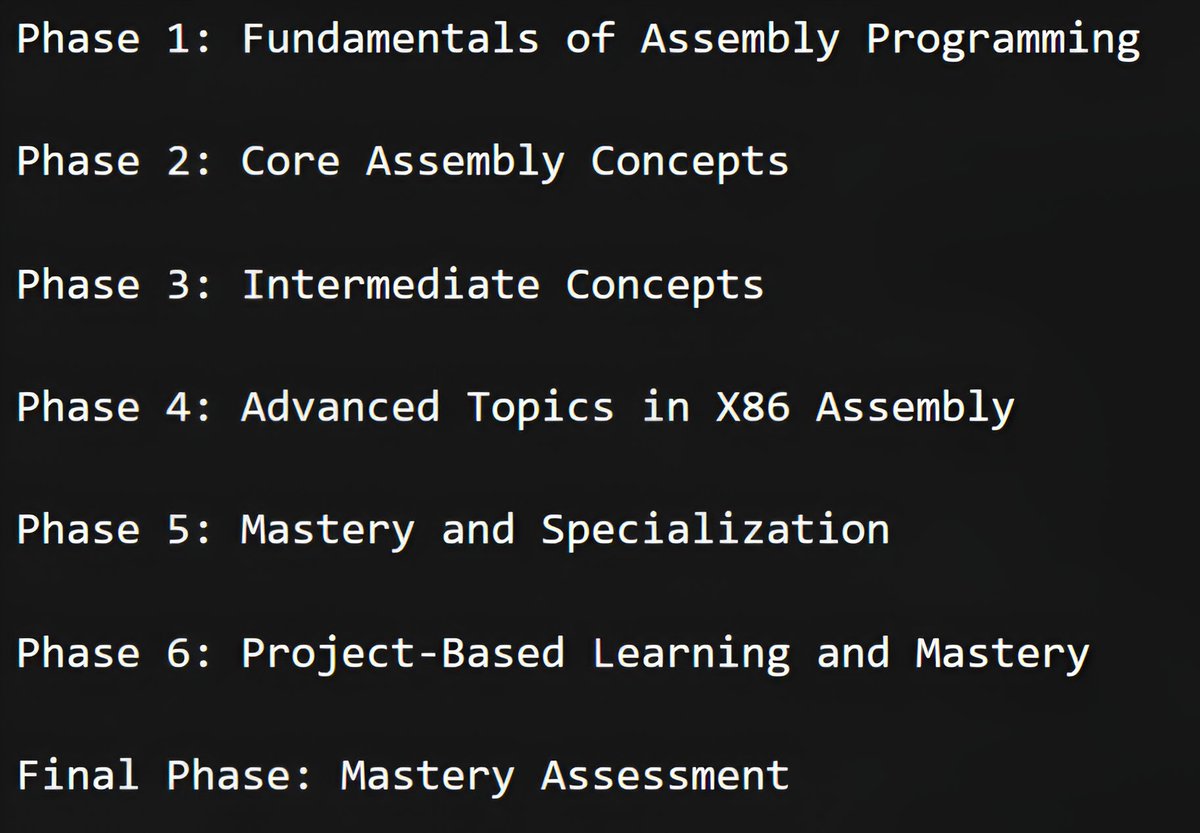
Phase 1: Fundamentals of Assembly Programming
1. Introduction to Assembly Language
a. Understanding low-level programming concepts
b. Differences between high-level and assembly language
c. Introduction to machine code and assembly language
d. Assembler, linker, and loader: their roles in generating executable programs
e. Assembly development environment setup (MASM, NASM, or GAS)
2. Basic Assembly Language Structure
a. General structure of an assembly program
-Segment registers: .data, .text, .bss, .rodata
-Assembly directives (section, global, etc.)
b. Assembler syntax (Intel vs. AT&T syntax)
c. Basic syntax: instructions, labels, comments
3. X86 Architecture Overview
a. Introduction to x86 architecture
-CPU registers (General Purpose Registers: EAX, EBX, ECX, EDX, etc.)
-Segment registers (CS, DS, SS, ES, FS, GS)
-Special registers (Flags, Instruction Pointer EIP, Stack Pointer ESP, Base Pointer EBP)
b. 16-bit, 32-bit, and 64-bit differences
c. The x86 memory model (little-endian, memory segmentation, and paging)
Phase 2: Core Assembly Concepts
1. Instruction Set Architecture (ISA) Basics
a. Introduction to x86 instruction set
-Data transfer instructions (MOV, XCHG, PUSH, POP)
-Arithmetic operations (ADD, SUB, MUL, DIV, INC, DEC)
-Logic and bitwise operations (AND, OR, XOR, NOT, SHL, SHR)
-Control flow instructions (JMP, CALL, RET, JZ, JNZ, JE, JNE, LOOP)
2. Memory Addressing and Data Handling
a. Memory addressing modes
-Direct, indirect, register indirect, indexed, and base-indexed addressing
-Immediate, direct, and register addressing modes
b. Working with memory: load and store operations
-Accessing data in memory using registers and effective addresses
c. Stack operations
-Using the stack (PUSH, POP, CALL, RET)
-Stack frame and stack management
3. Branching and Control Flow
a. Conditional jumps (JZ, JNZ, JL, JG, etc.)
b. Loop constructs (LOOP, LOOPZ, LOOPNZ)
c. Function calls (CALL, RET) and stack frame organization
d. Procedures and recursion in assembly
Phase 3: Intermediate Concepts
1. System Programming with Assembly
a. Working with the system: Interrupts and traps
-Using software interrupts (INT instruction)
-Handling hardware interrupts and exceptions
-DOS and BIOS interrupts (INT 21h, INT 10h)
b. Interaction with operating system services
-Using system calls in Linux (int 0x80, syscall)
-Assembly in Windows environment (Win32 API)
2. Advanced Data Manipulation
a. Advanced arithmetic instructions
-Multiplication and division (IMUL, IDIV, DIV)
-Extended precision operations
b. Bit manipulation and logical instructions (ROL, ROR, BT, BTS, BTC)
c. Working with floating-point numbers (FPU, FLD, FSTP, SSE)
3. Macros and Procedures
a. Writing and using macros in assembly
b. Defining and calling procedures
c. Parameter passing (registers vs stack)
d. Local variables and managing stack frames (using EBP)
4. Assembler Directives and Advanced Features
a. Common assembler directives (section, global, extern)
b. Conditional assembly (IF, ELSE, ENDIF)
c. Defining and using macros and constants (EQU, DEFINE)
d. Creating modules and linking assembly code
Phase 4: Advanced Topics in X86 Assembly
1. Optimizing Assembly Code
a. Code optimization techniques for speed and size
-Register allocation and instruction scheduling
-Reducing memory access and branching
b. Writing highly efficient loops and minimizing pipeline stalls
c. Optimizing for modern CPU architectures (superscalar, out-of-order execution)
2. Floating-Point and SIMD Programming
a. Floating-point operations (x87 FPU)
b. Advanced SIMD instructions (SSE, SSE2, AVX, AVX2)
c. Using SIMD for vectorized operations and parallelism
3. Memory Management
a. Segmentation and paging in detail
b. Understanding protected mode and real mode memory access
c. Virtual memory and paging mechanisms (32-bit vs 64-bit paging)
d. Memory protection: rings and privilege levels
4. Multithreading and Concurrency
a. Writing thread-safe assembly code
b. Using atomic operations (XCHG, LOCK prefix)
c. Working with hardware-level synchronization (spinlocks, barriers)
d. Assembly-level optimization for parallelism
5. System-Level Programming
a. Writing device drivers in assembly
b. Working with hardware directly (ports, I/O, memory-mapped I/O)
c. Direct interaction with peripherals (keyboard, display, etc.)
d. Low-level interaction with BIOS and UEFI
Phase 5: Mastery and Specialization
1. 64-bit Assembly Programming (x86-64)
a. Differences between x86 and x86-64 architectures
b. Register extensions (RAX, RBX, RCX, RDX, etc.)
c. 64-bit addressing and relative addressing
d. Calling conventions in 64-bit mode (Windows vs Linux)
2. Operating System Development with Assembly
a. Writing bootloaders
-BIOS boot sector, loading the OS kernel
b. Kernel programming in assembly
-Writing low-level OS components (interrupt handling, task scheduling)
-Memory management and process management in assembly
3. Reverse Engineering and Security
a. Introduction to reverse engineering techniques
-Analyzing binaries, disassemblers (Ghidra, IDA Pro)
-Working with obfuscated code
b. Writing shellcode
-Understanding buffer overflows, writing exploit code
c. Malware analysis and debugging assembly code
-Using tools like OllyDbg and WinDbg for analyzing assembly
Phase 6: Project-Based Learning and Mastery
1. Small Projects
a. Implement basic utilities (calculator, file reader) in assembly
b. Create a simple x86 emulator
c. Build a bootloader that prints "Hello, World!"
2. Medium Projects
a. Implement a basic real-mode or protected-mode operating system
b. Write an efficient assembler or disassembler
c. Create an assembly-level debugger for x86
3. Large Projects
a. Contribute to open-source projects that involve assembly (e.g., GRUB, Linux kernel low-level components)
b. Write your own JIT (Just-In-Time) compiler
c. Create a fully functional real-time operating system (RTOS)
Final Phase: Mastery Assessment
1. Build a complete operating system kernel or virtual machine in assembly.
2. Contribute to low-level assembly projects and reverse-engineering challenges.
3. Teach or mentor or help others in assembly language.
For learning purpose use these two websites (it is really-really great for learning, especially for beginner):👇👇
a. mycompiler.io/online-assembl… (this one is great)
b. godbolt.org/ (this one is also great)
My point of view: Also you can do phase 5 and 6 simultaneously, because it will be useful for you, it would give project based learning experience.
[Note: But I would recommend to learn this after having some fundamental knowledge of "C programming", it's just my experience.]
For appreciation:
1. Like
2. Bookmark it
3. "Repost" for more reach
4. Comment your genuine feedbacks, suggestions etc.
🧠Note: Follow everything sequentially to get the benefits and it is absolutely from 0 and make you exceptionally great at it, even if you are a five year old kid.
5
53
297
22,040

25 Oct 2024
ADD dest, source
SUB dest, source
MUL source
DIV source
IDIV source
MOV dest, source
AND dest, source
OR dest, source
XOR dest, source
SHL dest, count
SHR dest, count
SAR dest, count
CMP operand1, operand2
SETL dest
SETB dest
SETLE dest
SETBE dest
MOV dest, [source]
MOV [dest], source
MOVZX dest, source
MOVSX dest, source
JMP label
JE label
JNE label
JL label
JGE label
JB label
JA label
CALL label
RET
INT n
HLT
PUSH value
POP dest
XCHG dest, source
INC dest
DEC dest
NEG dest
NOT dest
TEST dest, source
LEA dest, [source]
CMOV dest, source
SETE dest
SETNE dest
SETG dest
SETGE dest
SETA dest
SETAE dest
LOOP label
LOOPZ label
LOOPNZ label
1
12
2,712

19 Nov 2015
The brand new LOOP Cross SX meets a South Island brown trout #loopnz #bloodtypeL #sx @Aussie Fly Fisher © Joshua... fb.me/7BVDOr8tM
18 Oct 2015
1