

Mar 9
My recent work ordered-action-tokenization.… (OAT) was featured on @RoboPapers, where I discussed the motivation and ideas behind the project with @micoolcho and @chris_j_paxton, as well as my perspective on action token modelability and what it means to make robot actions more “language-like” for large models. The full episode will be released soon!
Mar 9

Full episode dropping soon!
Geeking out with @liu730chaoqi on OAT: Ordered Action Tokenization ordered-action-tokenization.…
Co-hosted by @micoolcho @chris_j_paxton
2
2
27
4,529

Liquidity is not the same as credibility.
In climate markets, activity can be mistaken for maturity. Trades execute. Credits move. Volume appears.
But liquidity without underwriting discipline is fragile.
If data inputs are inconsistent, performance metrics are non-standardized, risk transfer mechanisms are unclear then liquidity is momentum, not conviction.
Institutional capital does not allocate because something trades. It allocates because something is modelable.
Modelability requires:
• Transparent methodologies
• Quantified reversal risk
• Clear liability frameworks
• Standardized reporting
Markets deepen when risk is structured.
They scale when trust is systemic.
CCLX focuses on converting climate exposure into structured, analyzable assets because durable liquidity follows credible pricing.
Probability first.
Allocation second.
Scale last.
8
149

Jan 29
Clarifying the $FUBO setup, because this gets mixed up:
The stock is not cheap because of fear.
It’s cheap because the business is not modelable.
Post Disney–FuboTV Inc. deal, investors still don’t have:
• Combined Hulu Live Fubo run-rates
• Steady-state subs / churn
• Programming cost structure under Newco
• Ad revenue splits
• Forward EBITDA
No model → no multiple.
That’s the primary issue.
So where does the antitrust case fit?
The remaining case, Unger v. The Walt Disney Company isn’t driving downside. It’s an invisible ceiling.
Not because it’s likely to break the deal.
But because it removes urgency to force clarity.
When structure isn’t fully settled:
• Guidance stays limited
• Synergies aren’t underwritten
• Analysts wait
• PMs don’t press
That’s why this case isn’t talked about on X:
• It’s procedural
• It’s slow
• It’s not earnings-linked
• It doesn’t scream “risk”
But it helps explain why the modelability problem persists.
Bottom line:
$FUBO isn’t discounted for disaster.
It’s discounted for opacity under control.
When disclosure normalizes and structure risk fades re-rating isn’t gradual.
It’s step-function.
#FUBO #Disney #MediaStocks #Streaming #SpecialSituations #EventDriven #Equities #Antitrust #Valuation
5
13
1,198

25 Nov 2025
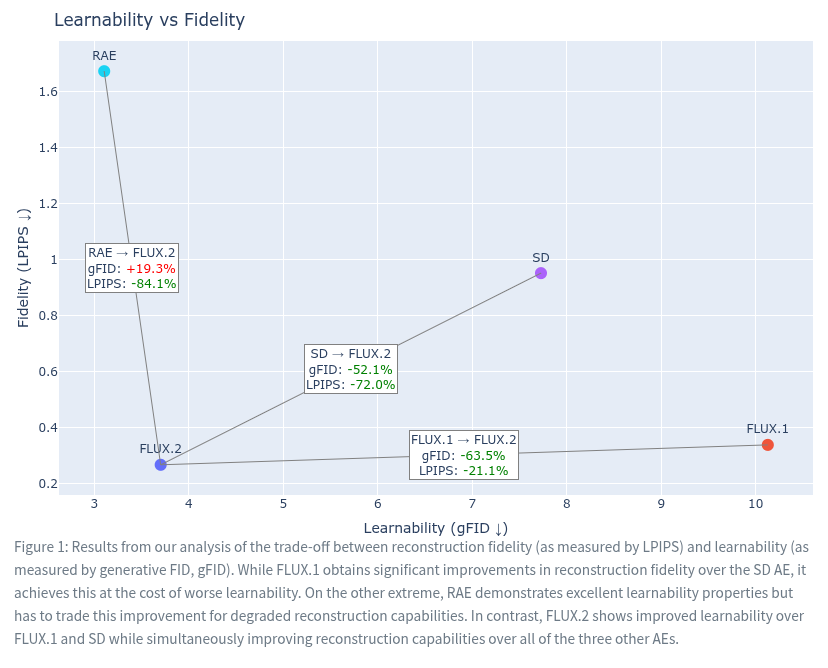
Check out @bfl_ml's deep dive on the rate-distortion-modelability trade-off in diffusion latent space design.
I previously discussed this in my blog post on latents. Here's amazing practical demonstration, taken directly from the development of FLUX.2!
bfl.ai/research/representati…
5
13
138
18,966


28 May 2025
Yes! We are actually always “perceiving” or put differently “experiencing” the full extent of reality in some way but we can’t perceive that we are perceiving/ experiencing it until we can model it! Many invisible (to us) things are happening to us all the time.
This isn’t static tho and the upper limit of perceptability/ modelability is very far away from where we are now even given potential hardcoded constraints of our biological hardware and we have the capacity for continual self-improvement of our own modeling capacities! More of reality that we are always experiencing but don’t know it becomes perceivable with self and world and awareness model improvements.
1
2
23
16 Apr 2025
Thanks! I think I mentioned it briefly in the context of regularising for modelability :)
1
3
957

16 Apr 2025
Fantastic blog post! Concerning the reconstruction - modelability tradeoff, there is this interesting paper that shows that less compression may lead to worse generation:
arxiv.org/abs/2501.01423
1
1
12
1,377

15 Apr 2025
Great write-up! I don't think enough people appreciate the three-way "rate-distortion-modelability" trade-off, and how it manifests in subtle ways: e.g. the need for larger diffusion models with increasing number of VAE channels in SD3, etc.
6
416

22 Feb 2025
One of the most fascinating things is being aware of your developmental jumps and changes in personality aspects as you age.
It's funny that in your early twenties this seems so foreign, until you hit those milestones in your late twenties, early thirties and mid thirties.
It's astounding that so many things I worried about in my twenties disappeared completely.
And the, let's call it, opening of the scope on the upcoming developmental phases and their changes, has a tangible modelability to it (the ability to cognitively model these phases).
20 Feb 2025

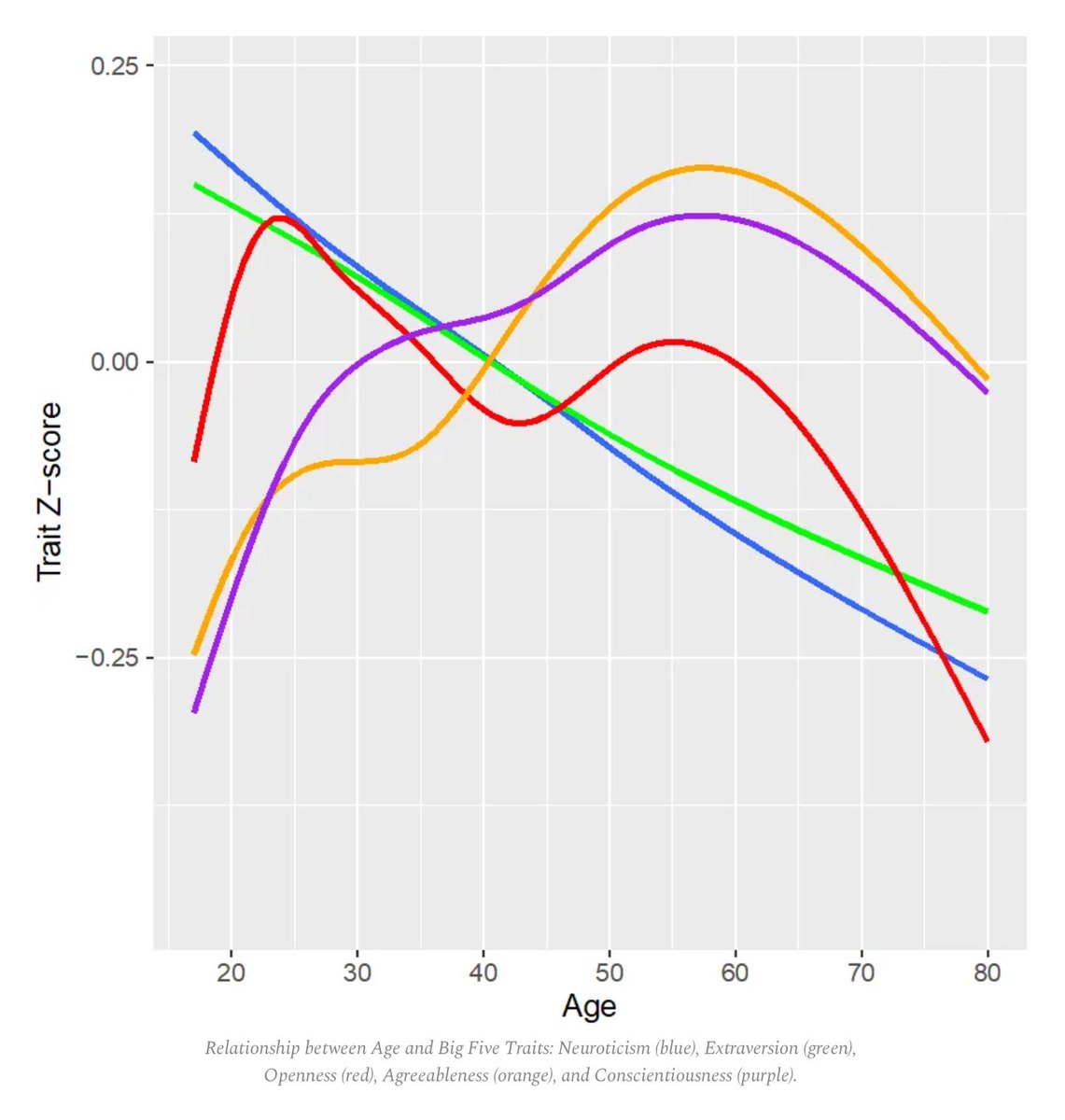
How personality changes with age.
-Blue: Neuroticism
-Green: Extraversion
-Red: Openness to experience
-Orange: Agreeableness
-Purple: Conscientiousness
[Link below.]
1
7
309
25 Jan 2025
Could you elaborate on how training dynamics factor into this, and how modelability affects our ability to do post-training in pixel space?
2
2
528

25 Jan 2025
It’s quite clear from the information-theoretic perspective, but it’s still unclear from the training dynamics. Moreover, for image/video generation, we can still do pixel-space post-training as long as the modelability is good enough.
1
8
578
25 Jan 2025
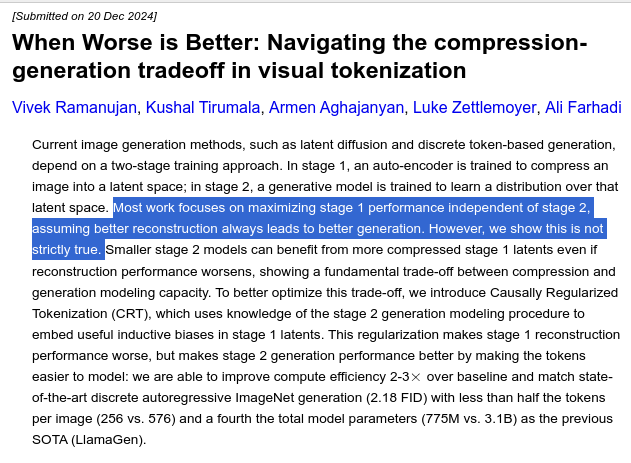
Nice paper on the trade-off between decoding quality and modelability in 2-stage generative models.
I disagree with this framing though: the trade-off is quite clear from an information-theoretic perspective. Do most people really believe this? Maybe it's time for a blog post🤔
24 Jan 2025

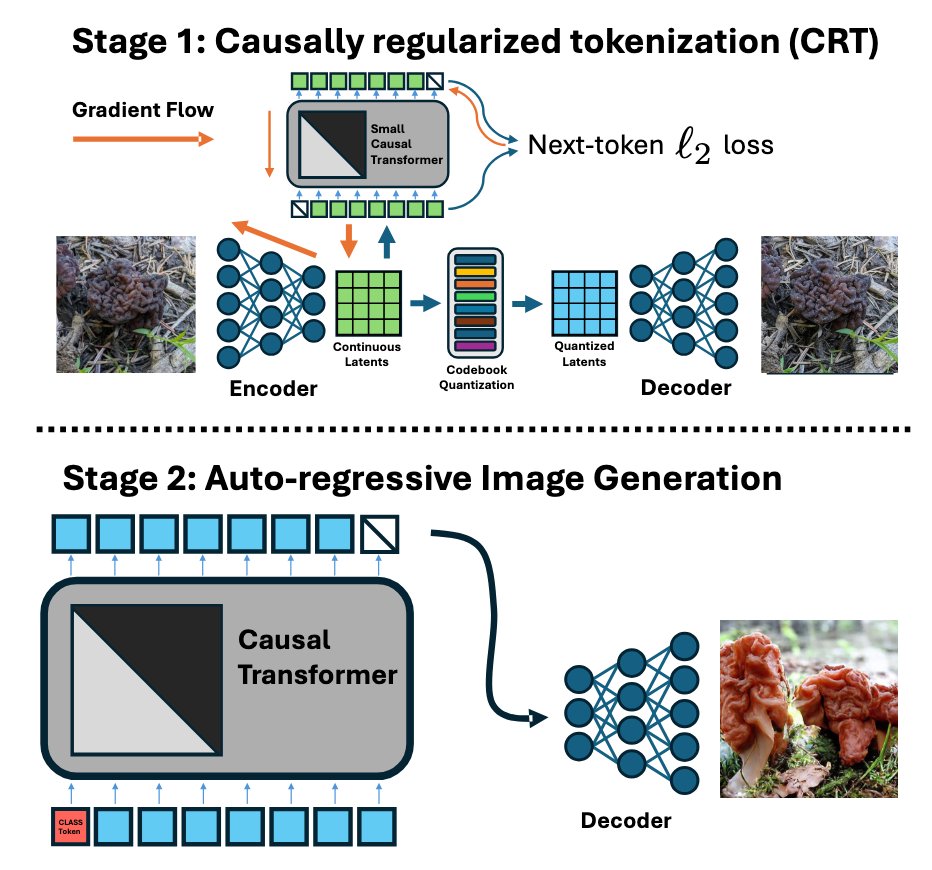
Happy to (belatedly) share our recent work introducing Causally Regularized Tokenization 📺, matching LlamaGen-3B generation performance with 0.5x the number of tokens/image (256 vs 576) and 0.25x the number of params (770M vs 3B) on ImageNet.
arxiv.org/pdf/2412.16326
1/n
16
15
188
25,511

5 Oct 2024
Artificial Intelligence, Physicalism, and Consciousness
AI is all over the news these days, but many people who are new to the topic are unfamiliar with the decades of discussions that have been had about the possibility of truly general AI, its relationship to human intelligence, and the nature of consciousness. Here, I'll try to summarize the most relevant scientific and philosophical considerations.
First, we will consider intelligence. This is about the ability of a system to perform a wide range of complex tasks, solve problems, build models of the world, etc. It does not relate to the internal conscious states of such a system, which we will address later.
One of the first people to seriously consider the possibility that digital computers could eventually have the same kind of intelligence as humans was Alan Turing. The argument is this:
1. All the known laws of physics are analytic. We don't need to get into exactly what this means, but it is a property shared by the equations of Newtonian physics, special and general relativity, and quantum mechanics.
2. Analytic functions can be modeled to arbitrary precision on a digital computer.
3. Human beings exist within physics.
Conclusion: all human behavior can in principle be modeled on a digital computer. Of course, actual implementations of AI are unlikely to be direct physical simulations of brains at the particle level, but this serves as an existence proof for the possibility of human-level AI.
How might these assumptions be violated, such that AGI is impossible? 2. is a straightforward fact of mathematics, so we will address 1. and 3.
For the assumption of analyticity (and thus, computer-modelability) in physics to be violated, whatever deeper paradigm of physics underlies and unifies quantum mechanics and general relativity must contain very mathematically strange behavior, AND this strange behavior must be relevant in the brain. Given that our particle colliders have verified the predictions of quantum field theory to an extreme degree of numerical precision, this is a high bar. It's not plausible that higher energy densities are at play inside our heads than are at play in the Large Hadron Collider, so the only alternative is extremely low temperatures. This is the premise of Roger Penrose's theory that so-called microtubules in the brain provide channels with the extremely low level of thermal disturbance necessary for these nuanced effects to play a role in cognition. This theory is very contentious, and has had to be revised several times as its predictions have been violated by experiments. The fact is that the brain is wet, warm, and noisy.
Suppose this theory or another theory relying on novel physics were true as an explanation of human intelligence. This would not rule out machine intelligence, it would only rule out machine intelligence implemented on digital computers. We could then focus our efforts on building devices that take advantage of the same exotic physical principles as the brain.
A violation of assumption 3. would be some kind of dualism or supernaturalism. The idea of an immaterial soul fits the bill. But of course, the belief that what human brains do is not reducible to physics is testable: we could, in principle, run a simulation of a human brain based on physical models, then look for deviations from predicted behavior in a real brain. For dualism to be true, the ectoplasm or soul or whatever must be pushing around particles such that the distribution of actual outcomes does not match the distribution of physically predicted outcomes. Otherwise, the soul isn't changing our behavior. Such a discovery would be a revolutionary scientific breakthrough, and I would be the first to want to explore its implications, but I'm not holding my breath. Physicalism (the belief that all outcomes in the universe are reducible to mathematical laws governing basic constituent elements) has an extremely strong track record, despite countless attempts to prove it wrong.
Thus, the case for the possibility of artificial intelligence looks quite solid. What about artificial consciousness?
The nature of consciousness is one of the most highly disputed topics in all of philosophy, religion, and science. It refers to the fact that it "feels like something to be you". The perception of redness, the smell of the ocean, the touch of clean sheets. Not the information gained from these sensory experiences, but the subjective experience of gaining that information. Assume an AGI with sensors could touch a sensor to a pillow and gain all the practical information you gain from such a contact. Would it, by doing so, be having a subjective experience of softness?
Philosophers have debated this endlessly, and seem no closer to a resolution. But modern technology may bring the question within the purview of science. As BCIs (brain-computer interfaces) become more sophisticated and more widely deployed, we may indeed have the opportunity to test this within ourselves. Imagine a brain chip that could replace the functionality of your brain with respect to one of your senses (for example, the sense of smell), without disturbing the rest of your cognition. You undergo a surgery to replace your inborn smell neurology with this chip. You could then smell something, and experience directly whether you feel the part of your cognition happening inside the chip, or whether it feels as if you sent off a request and received a verbal response like "this smells of roses". Assuming a positive result, assuming the computation happening inside the chip truly becomes part of your consciousness, you could then replace more functions one by one until you are fully artificial, stopping if at any point subjectivity doesn't carry over into the chip.
Artificial intelligence is one of the most fascinating developments in the history of humanity, and it is a joy to live in this time of unprecedented scientific progress.
2
30
8,481

“ARKA” on the Spotlight………..
The DTC Laboratory Lab research on RSC Journal Back Cover (ESPI, June 2024 issue)
pubs.rsc.org/en/content/arti…
@EnvSciRSC
#ARKA #dtclab #JadavpurUniversity #activitycliff #modelability #Cheminfomatics #CompChem #MachineLearning #Environmental

1
1
185

11 Aug 2023
Song: Genesis of Modelability = Vector Equilibrium
Post on X August 11, 2023
1
2
55
7 Aug 2023
Planet Utopia Episode 50 08-06-23 Evolved Human Mentality Will Supercede AI Robots
#PlanetUtopia #Structure #Systems #metaphysical #conceptual #modelability #vectorequilibrium #Zerotetrahedron #PRJWBCHM #EISEDP #UEOM #IVOFCHM #humancomputerbrain #mosteconomical #quantummodule #energyquanta
1
4
65

10 Feb 2023
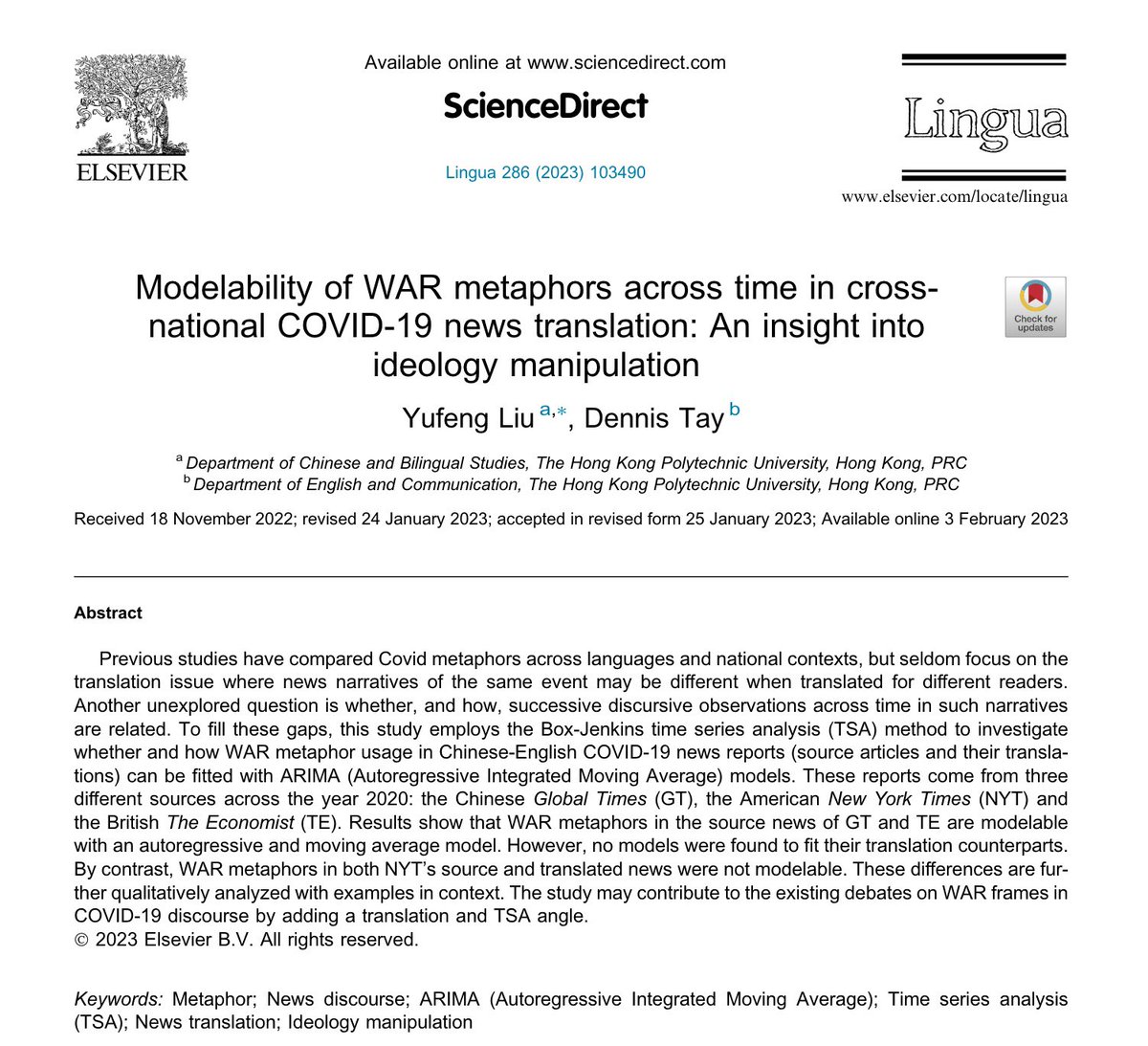
I am happy to share that our paper “Modelability of WAR metaphors across time in cross-national COVID-19 news translation: An insight into ideology manipulation” is out in Lingua. @DennisTay5 and I applied TSA to study WAR metaphors in news translation. authors.elsevier.com/a/1gZu-…
2
2
16
3,004