Cezar Augusto Olimpio Nunes #profdrmrbeast🚩🚩🚩🚩 retweeted

I AM BACK STRONGER READY TO BEAT ELON MUSK ATTEMPTS TO SHADOWBAN ME! I FOLLOW EVERYONE BACK! I AM ALSO A POLYMATH, POLYDOCTORATE AND POLYGENIUS #HAPPY2026🚩🚩🚩🚩🚩🚩🚩

5
2
13
Shabir) Free IMRAN KHAN & Palestine 🇵🇸 YEMEN retweeted

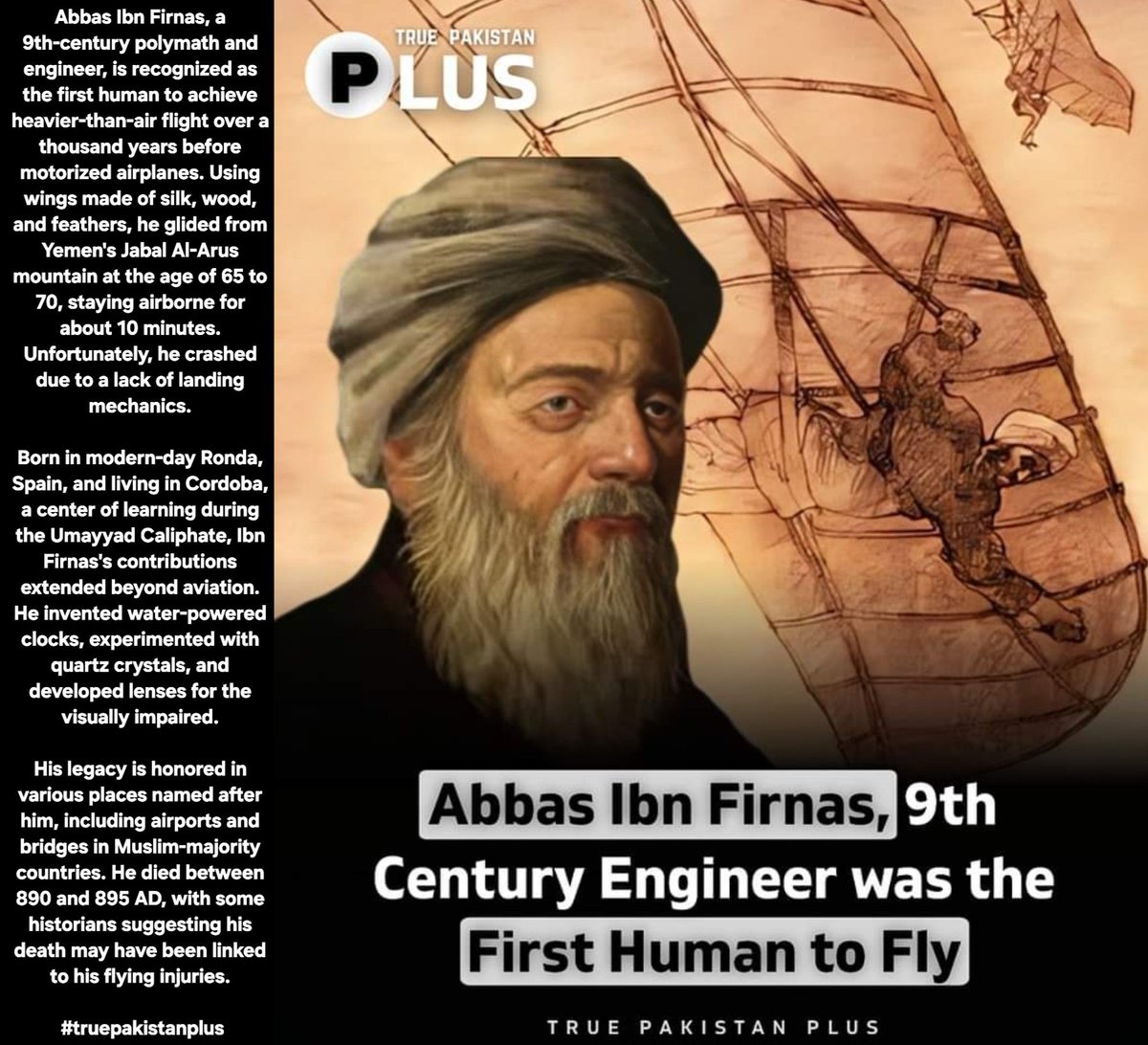
Abbas Ibn Firnas, a 9th-century polymath and engineer, is recognized as the first human to achieve heavier-than-air flight over a thousand years before motorized airplanes. Using wings made of silk, wood, and feathers, he glided from Yemen's Jabal Al-Arus mountain at the age of 65 to 70, staying airborne for about 10 minutes. Unfortunately, he crashed due to a lack of landing mechanics.
Born in modern-day Ronda, Spain, and living in Cordoba, a center of learning during the Umayyad Caliphate, Ibn Firnas's contributions extended beyond aviation. He invented water-powered clocks, experimented with quartz crystals, and developed lenses for the visually impaired.
His legacy is honored in various places named after him, including airports and bridges in Muslim-majority countries. He died between 890 and 895 AD, with some historians suggesting his death may have been linked to his flying injuries.
#truepakistanplus
8
3
43
Légendaire retweeted

Spiritual Epistemological Grandmaster Jacked Handsome Multiple Business Owning Polymath;
A man who has developed his interior to the point of genuine spiritual signal, who understands the mechanics of his own knowledge at a foundational level, who has internalised multiple games deeply enough to play them at the highest level without conscious effort, who produces outcomes that appear inexplicable from the outside, who has built the physical infrastructure to match the interior architecture, whose presence reads as attractive because certainty and depth have an aesthetic, and who operates across enough domains simultaneously that his cognitive surface area is simply larger than anyone he is likely to encounter
5
40
1,512
KouroshX retweeted

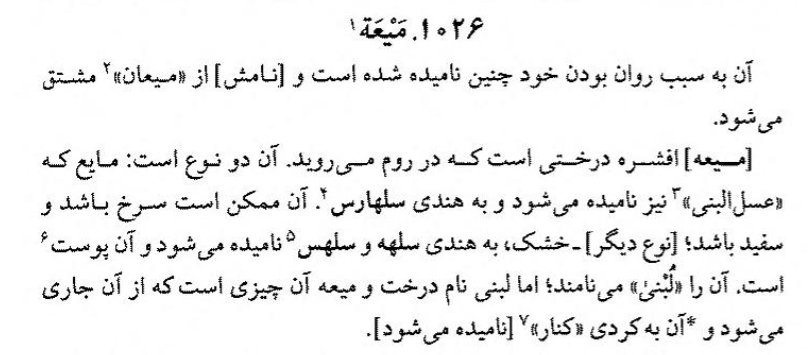
The Iranian polymath Bīrūnī (973–1048) in his work al-Ṣaydana fī al-Ṭibb, mentions the Kurdish word (kurdī) for the storax tree (Arabic lubnā), which produces a fragrant benzoin resin:
“The tree is named lubnā, but the substance that flows from it is called mayʿa, and in Kurdish it is called kinār.”
I'm not a linguist, but I wonder if kinār (modern Kd. kinēr) is related to Persian kondor “frankincense.”
📖 Al-Bīrūnī, al-Ṣaydanah fī al-Ṭibb, ed. and trans. Bāqer Moẓaffarzādeh (Tehran: Farhangistān-i Zabān va Adab-i Fārsī, 1383/2004), p. 951, n. 1026.
2
4
38
697

*polymath perjorative for people who are only good at one thing
6

The future belongs to the curious polymath who can navigate a post discovery world 🌎

Elite admissions select for one trait: getting the known answer faster than anyone else. 18 years of optimizing against an answer key someone already wrote.
AI just made the answer key free. Everyone has it instantly now.
So the kids trained hardest to win spent their whole lives mastering the one thing that's now a commodity. The premium moved to the questions with no answer key yet.
We need a new training.
The new training is about one thing:
How to be the first person standing in a new land, exploring it, preparing it for the coming billion people who will need it. The future will be built by these people.
And there is a lot to build.
6

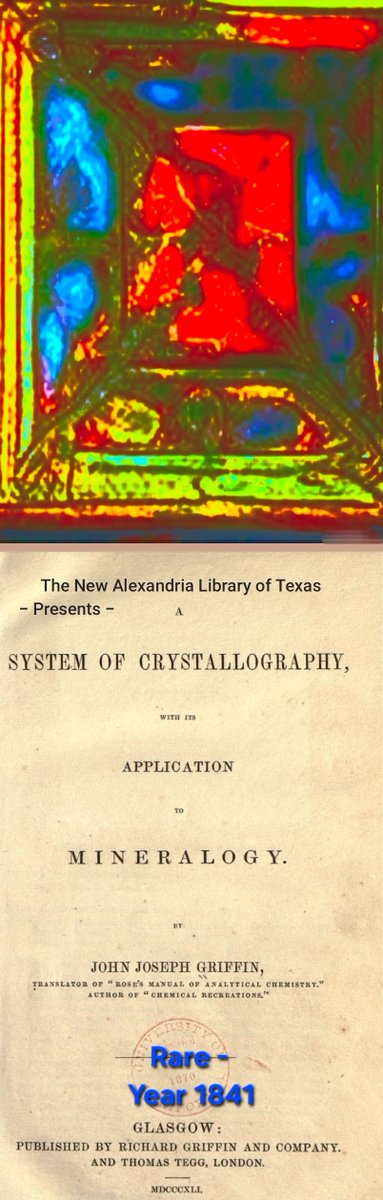
1841 - A System of Crystallography & Its Application to Mineralogy - John Joseph Griffin E.S.Q. - Fts - Eidogenics, Hexakisoctahedral Morphogenesis, Polyhedral Geognosy, Meridianal Crystallography, Polaric Cosmography, Rhombohedral Architectonics, Lithic Ontology, Crystallogenetic Dynamics, Triaxial Symmetrology, Mineral Republic Analytics - Lost obscure book of old -
📜 Provided by/New Abstract by 📜
The New Alexandria Library of Texas - Alexander the Library Cat -
&
Ft.
DeepAncientThought A.M., , F.V.S. & Polymath
📜 - Publishers -📜
1841 - London: Publisher Richard Griffin & Company, Glasgow; Thomas Tegg,
2026 - Ths New Alexandria Library of Texas - I am the Owner - now this is your fine original rare PDF text/book -
🔑 Free Link
academia.edu/168648551/A_Sys…
🔑 Free Link to 509 rare book archive
independent.academia.edu/Dee…
💎✨️💎 Powerful Rare Specialist Abstract -
(Not many can cover such wide range of subjects & If any of this is new or is confusing please see the section right after the abstract to learn the most advanced terminology for this book)
This remarkable and largely forgotten treatise stands at a crossroads where geometry, mineralogy, chemistry, geognosy, mathematical analysis, classification theory, and natural philosophy converge into a unified vision of the mineral kingdom. Far more than a catalogue of crystal forms, Griffin's work is an ambitious attempt to uncover the hidden laws governing the architecture of matter itself. The book belongs to that rare nineteenth-century tradition in which geometry was viewed not merely as a descriptive tool but as one of nature's fundamental languages.
What distinguishes Griffin from many later writers is that he treats crystals not as static objects but as organized geometric beings possessing axes, poles, meridians, equators, zones, normals, and lawful systems of development. Throughout the work, crystals appear almost as miniature worlds governed by internal geographies and mathematical constitutions. The result is a kind of crystalline cosmography, a science of geometric territories hidden within the mineral kingdom.
I. The Hidden Geography of Crystal Worlds
One of the most fascinating aspects of Griffin's system is his repeated use of concepts normally associated with astronomy and geography:
• Poles
• Equators
• Meridians
• Axes
• Normals
• Polaric Positions
• Zones
These are not poetic ornaments.
They are technical realities within Griffin's system.
A crystal becomes a geometrical globe.
Its faces occupy specific territories.
Its edges become frontiers.
Its poles become directional centers.
Its meridians establish pathways of relation between distant portions of the mineral body.
The reader encounters an extraordinary form of crystallographic cartography in which minerals possess internal worlds capable of being mapped with the same rigor used by navigators, astronomers, and geographers.
This forgotten perspective transforms crystallography into a branch of spatial philosophy.
II. The Seven Archetypes of Mineral Form
Perhaps the most audacious idea in the book is Griffin's argument that the infinite apparent variety of crystals ultimately derives from only seven fundamental forms.
This is not simply a classification scheme.
It is an attempt to uncover the archetypal architecture underlying the mineral kingdom.
The immense diversity represented by:
• Cubes
• Octahedrons
• Rhombic Dodecahedrons
• Tetrakishexahedrons
• Triakisoctahedrons
• Icositessarahedrons
• Hexakisoctahedrons
• Scalene Octahedrons
is reduced to a limited family of governing geometrical principles.
The book therefore becomes a study in polyhedral genealogy, tracing complex descendants back to ancestral forms.
In many respects Griffin is seeking the mineral equivalent of a natural language grammar.
Thousands of forms.
One underlying syntax.
III. Eidogens and the Mystery of Formative Causes
The chapter on crystallization contains one of the most obscure concepts in nineteenth-century science:
Eidogens
Modern readers rarely encounter this word.
Yet it may be one of the most intriguing ideas in the entire volume.
An eidogen functions as a formative principle associated with the emergence of crystal form.
Rather than merely cataloguing finished structures, Griffin attempts to investigate the causes responsible for geometric organization itself.
This places the work within a broader tradition extending through:
• René Just Haüy
• Johannes Kepler
• Robert Hooke
• Christian Wolff
• Natural theologians
• Morphological philosophers
The crystal becomes evidence of formative law.
Geometry becomes an active principle rather than a passive description.
IV. The Architecture of Symmetry
The sections on:
• Homohedral Forms
• Hemihedral Forms
• Tetartohedral Forms
• Direct Forms
• Inverse Forms
• Right-Handed Forms
• Left-Handed Forms
represent an extraordinarily sophisticated exploration of symmetry.
Long before modern molecular chirality became famous, crystallographers were already studying handedness in minerals.
Griffin's analysis investigates how complete forms become partially developed while still preserving underlying law.
The result is a forgotten science of morphological asymmetry.
Order persists.
Symmetry is modified.
Identity remains.
These chapters reveal crystals as dynamic geometrical organisms rather than rigid mathematical abstractions.
V. The Great Kingdom of Polyhedra
Modern readers are often unfamiliar with the magnificent geometric entities populating Griffin's pages:
• Hexakisoctahedron
• Hemihexakisoctahedron
• Icositessarahedron
• Hemitriakisoctahedron
• Pentagonal Dodecahedron
• Rhombohedron
• Scalenohedron
• Dioctahedron
• Quadratic Octahedron
• Rhombic Octahedron
These are not curiosities.
They are the ruling dynasties of Griffin's mineral empire.
The work becomes a grand survey of polyhedral kingdoms, each governed by its own laws of symmetry, development, and combination.
Every mineral form occupies a place within this hierarchy.
The book thus serves simultaneously as:
• Geometry
• Taxonomy
• Mineral philosophy
• Structural morphology
VI. Rare Mineral Worlds Hidden in the Index
The mineral index is itself a treasury of forgotten scientific history.
Modern mineralogy tends to emphasize a relatively small number of common species.
Griffin preserves an older and far richer world.
Among the inhabitants of this mineral kingdom appear:
• Aeschynite
• Arfvedsonite
• Botryogen
• Boracite
• Brookite
• Brongniartine
• Chabasite
• Cryolite
• Euclase
• Eudialyte
• Fergusonite
• Gadolinite
• Gay-Lussite
• Hauyne
• Helvine
• Idocrase
• Lanthanite
• Leucite
• Monazite
• Natrolite
• Oerstedtite
• Petalite
• Phenakite
• Polybasite
• Polymignite
• Pyrochlore
• Sodalite
• Stilbite
• Thomsonite
• Turnerite
• Uwarowite
• Vauquelinite
• Wavellite
• Wernerite
• Yttrocerite
Many of these minerals represent early encounters with:
• Rare earth elements
• Uranium compounds
• Vanadium compounds
• Titanium minerals
• Cerium-bearing species
• Yttrium-bearing species
The index therefore preserves a geological museum of scientific discovery.
VII. The Strange Realm of Metallic and Semi-Metallic Minerals
Particularly striking are the exotic ores and compounds scattered throughout the catalogue:
• Telluric Silver
• Graphic Tellurium
• Tetradymite
• Platin-Iridium
• Osmium-Iridium
• Nickel Glance
• Nickelantimonglanz
• Mispickel
• Antimonglanz
• Tennantite
• Bournonite
• Zinkenite
• Jamesonite
• Polybasite
• Sternbergite
• Nagyagererz
These names belong to a largely forgotten age of ore mineralogy.
They reveal a world where mineral classification, metallurgy, and crystallography remained deeply intertwined.
The book becomes a bridge between geometry and mining science.
VIII. Zeolitic Architectures and Mineral Cathedrals
The extensive treatment of:
• Natrolite
• Mesolite
• Stilbite
• Chabasite
• Scolezite
• Analcime
• Heulandite
• Epistilbite
• Harmotome
opens a remarkable window into the world of zeolites.
These minerals display some of the most intricate and elegant crystal habits in nature.
Their cavities, frameworks, and water-bearing structures resemble miniature architectural systems.
One could describe them as the cathedrals of the mineral kingdom.
Griffin's work preserves an early appreciation of their extraordinary structural diversity.
IX. Mathematical Mineral Philosophy
Entire sections are devoted to:
• Spherical Trigonometry
• Solid Triangles
• Logarithms
• Indices
• Quadrantal Triangles
• Oblique Angles
• Square Roots
• Axial Calculations
This is one of the most mathematically ambitious mineralogical works of its generation.
Yet Griffin never allows mathematics to become detached from nature.
The equations always return to crystal form.
The calculations always return to mineral reality.
Geometry becomes an instrument for revealing hidden structure.
X. Crystal Models and the Lost Science of Seeing Form
One of the most extraordinary forgotten features of the work is Griffin's system of 120 crystal models.
Constructed from biscuit porcelain and designed for measurement, notation, classification, and demonstration, these models transformed crystallography into a tactile science.
Students learned by:
• Handling form
• Measuring angles
• Following zones
• Identifying poles
• Tracing meridians
• Comparing systems
This was an age when geometry could literally be held in one's hands.
The models transformed abstraction into experience.
XI. A Forgotten Monument of Natural Philosophy
Ultimately this book belongs among the great nineteenth-century attempts to discover order within creation.
Whether examining:
• Garnets
• Zeolites
• Uranites
• Feldspars
• Tourmalines
• Cryolites
• Tellurides
• Vanadates
• Borates
• Sulphides
• Carbonates
• Phosphates
Griffin continually reveals the same truth:
The mineral kingdom is not a chaos of stones.
It is an organized architecture of law.
Faces obey laws.
Angles obey laws.
Symmetry obeys laws.
Growth obeys laws.
Classification obeys laws.
The crystal becomes a visible monument to mathematical order within nature.
For this reason, A System of Crystallography remains not merely a manual of minerals but a grand exploration of form, symmetry, structure, classification, geometry, and the intelligible architecture of the Earth itself.
📜📜📜📜📜📜📜📜📜📜📜📜📜📜📜📜📜
🔑100s of Tags/Terms for this highly technical book -
I. Crystallognosy
The forgotten science of crystal knowledge as understood before modern atomic models became dominant. In Griffin's world, crystals are not merely chemical substances but visible manifestations of lawful geometrical order. Crystallognosy combines mineralogy, geometry, measurement, classification, and natural philosophy into a unified study of form. The crystal becomes a readable text of nature, revealing hidden structural laws through angles, planes, zones, poles, and symmetries.
II. Polyhedral Genealogy
The investigation of how complex crystal forms descend from simpler geometrical ancestors. Griffin repeatedly demonstrates that the bewildering variety of octahedrons, dodecahedrons, prisms, and pyramids can be traced back to a limited number of archetypal forms. This resembles a family tree of geometry where every crystal possesses a lineage, ancestry, and developmental history.
III. Eidogenics
Derived from Griffin's obscure concept of "Eidogens," this field concerns the formative causes responsible for the emergence of shape itself. Rather than asking what a crystal is made of, Eidogenics asks why matter organizes into a particular geometry. It stands at the border between crystallography, metaphysics, morphology, and nineteenth-century natural philosophy
IV. Polaric Meridianics
The study of crystal poles, meridians, equators, and directional systems. Griffin transforms minerals into miniature globes possessing their own internal geography. Crystal faces become territories. Poles become centers of reference. Equators become structural belts. Meridians become pathways connecting distant regions of the crystal body.
V. Normalics
The science of normals, invisible lines standing perpendicular to crystal planes. Although unseen, normals govern measurement, orientation, and mathematical description. Griffin treats them as fundamental realities behind visible structure. Normalics therefore studies hidden geometric governors that determine the arrangement of crystal surfaces.
VI. Axial Architectonics
The study of crystal axes as structural frameworks upon which mineral forms are built. Just as a cathedral depends upon supporting arches, crystals depend upon invisible axial systems. Griffin's six systems of crystallisation are fundamentally systems of axial organization, making this one of the most important hidden sciences in the book.
VII. Prismatology
The science of prisms and their endless varieties. Griffin devotes enormous attention to rhombic prisms, oblique prisms, quadratic prisms, and six-sided prisms. Prismatology investigates how elongated forms arise, combine, truncate, and evolve into more complicated structures while maintaining lawful geometric identities.
VIII. Pyramidogenesis
The study of pyramidal growth and formation. In Griffin's system, pyramids are not merely shapes but recurring structural solutions employed by nature throughout the mineral kingdom. Pyramidogenesis investigates the mathematical and morphological principles governing these ascending forms.
IX. Octahedral Cosmography
A grand mapping of the octahedral universe. Griffin reveals an astonishing kingdom of regular octahedrons, scalene octahedrons, hemi-octahedrons, triakisoctahedrons, and hexakisoctahedrons. This science charts the territories, transformations, and relationships among the vast octahedral dynasties of crystal form.
X. Hexakisoctahedral Analytics
One of the most advanced geometrical sciences in the entire work. The Hexakisoctahedron represents an extraordinarily complex crystal form containing vast numbers of faces and relationships. Griffin treats it not as a curiosity but as evidence of nature's astonishing capacity for geometric elaboration.
XI. Icositessarahedral Morphology
The study of twenty-four-faced crystal bodies and their role within mineral architecture. Griffin's treatment reveals how such forms emerge from simpler geometries while preserving lawful relationships. The field becomes an exploration of complexity emerging from order.
XII. Scalenohedral Architectonics
The investigation of unequal triangular crystal structures. Scalenohedrons appear throughout important mineral groups, especially calcitic and rhombohedral systems. Griffin demonstrates that apparent irregularity often conceals deeper symmetries invisible to casual observation.
XIII. Rhombohedral Dynamics
The study of rhombohedral forms and their transformations. Rhombohedrons occupy a central position within nineteenth-century mineral classification and were especially important in understanding calcite and related minerals. Griffin reveals them as one of nature's most versatile structural templates.
XIV. Crystal Cartography
The art and science of mapping crystal territories. Using poles, equators, zones, meridians, axes, and planes, Griffin constructs an internal geography for minerals. Every face occupies a definite location within a coordinate system. Crystals become navigable worlds rather than mere objects.
XV. Geometric Taxonomy
A classification system based primarily upon form rather than chemistry. Griffin shows how minerals may be grouped according to recurring structural patterns. This approach preserves an older vision of mineralogy in which geometry serves as the primary key to natural order.
XVI. Symmetrology
The study of symmetry as a universal principle. Griffin's Law of Symmetry explores how order governs the arrangement of crystal faces. Symmetrology examines balance, repetition, correspondence, and proportion throughout the mineral kingdom.
XVII. Homohedrology
The science of complete symmetry. Homohedral forms possess the fullest expression of a given geometrical pattern. Griffin's classifications demonstrate how these forms serve as standards against which modified structures may be compared.
XVIII. Hemihedrology
The study of partially developed forms. Rather than expressing complete symmetry, hemihedral crystals display only portions of the full pattern. Griffin treats these as lawful variations rather than imperfections, revealing hidden principles of selective development.
XIX. Tetartohedrology
The science of quarter-developed crystal forms. These rare structures represent some of the most subtle geometrical phenomena in mineralogy. Their existence demonstrates nature's capacity for controlled asymmetry within an overarching framework of order.
XX. Chiral Mineral Philosophy
Long before molecular chirality became famous, crystallographers recognized right-handed and left-handed crystal forms. Griffin's discussion of direct and inverse structures anticipates later discoveries concerning asymmetry throughout chemistry, biology, and physics.
XXI. Crystalline Linguistics
The development of symbolic languages capable of describing crystal form. Griffin sought not merely to name structures but to encode them mathematically. This science examines how geometry may be translated into symbolic notation.
XXII. Symbolonomy
The science of scientific notation itself. Griffin devoted entire sections to developing efficient methods for representing highly complex forms. Symbolonomy studies compression of information into precise mathematical language.
XXIII. Comparative Crystallographic Philology
The comparison of competing systems of notation, classification, and description. Griffin analyzes rival methods and seeks universal principles underlying scientific language. In this sense crystallography becomes a branch of intellectual history.
XXIV. Cleavage Phenomenology
The study of how minerals reveal hidden structures through fracture. Cleavage surfaces expose internal geometrical arrangements inaccessible through external observation alone. The broken crystal becomes a window into concealed architecture.
XXV. Primitive Form Criticism
Griffin's challenge to the traditional doctrine of primitive forms. He argues that many supposedly fundamental shapes are hypothetical constructs rather than practical realities. This represents an important methodological reform within nineteenth-century crystallography.
⚠️SEE NEXT REPLY for Parts XXVI-L (26-50), where the discussion enters:
• Seven Fundamental Forms
• Zone Theory
• Spherical Trigonometry
• Mineral Cosmology
• Rare Earth Minerals
• Zeolitic Architectures
• Uranitic and Telluric Mineral Worlds
• Swedenborgian comparisons
Natural Theology and crystalline design in creation
1
1
1
85

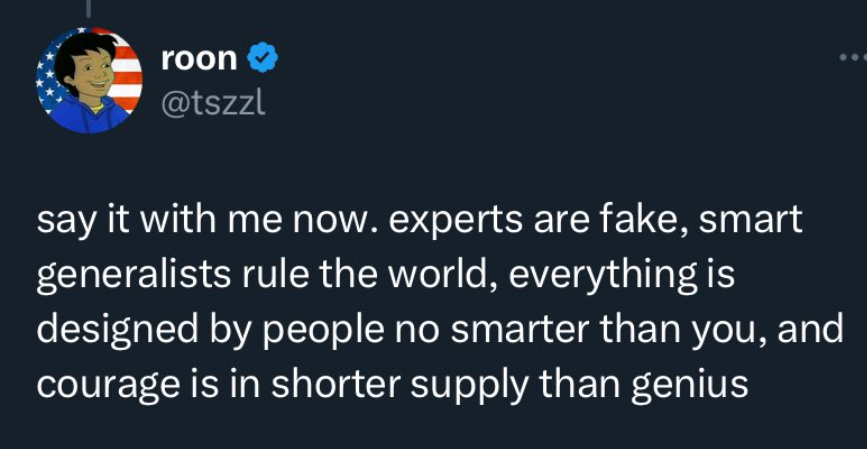
Worth noting that the Founding Fathers included men of many talents. Among them, Benjamin Franklin is consistently identified as a polymath. (But he wasn't the only Founding Father who was a "smart generalist.")
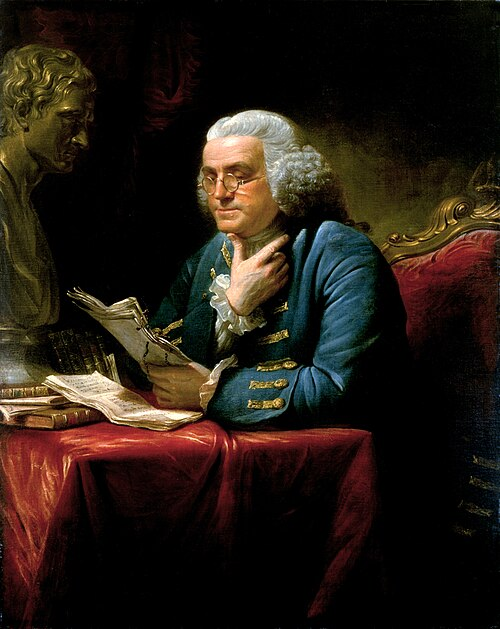
ALT By David Martin - The White House Historical Association, Public Domain, https://commons.wikimedia.org/w/index.php?curid=9390044

26

Limited Opportunity If You Want To Increase Your MRR By $5k - $15k/mo within 30 - ($50 Entry)
I've consulted over 3000 creators,, taught over 5000 students using free and paid curriculum material, and closed over $550k in deals (most of those closed deals were over 18 months)
This is the biggest reason already performing business operators take 4x longer to produce the result they want:
High perceived competence in the wrong awareness state
The average characteristics of these people are the following:
1. Making from $5k - $15k/mo
2. Thinks because they did $30k - $300k in sales, they don't need help
3. Obsessed with figuring everything out themselves
4. Will decline most opportunities due to their hyperbolized vision of their own capabilities
5. Often naively think hiring, outsourcing, and/or automation is going to be a simple process
There's a key lesson here - Just because you are good at ONE thing, does not mean you are good at THE REST
Me on the other hand, I've closed deals in every niche there is, selling every type of product from low ticket, to mid ticket, to high ticket, to subscription, to SaaS, to Equity
Which means I know how to scale almost any offer imaginable - Here's an opportunity for you..
You enroll in DPU for 30 days:
1. Get access to the 403 page curriculum
2. Full access to Polymath Edu (Trained on all curriculum material and can answer how to solve almost any conceivable problem you have)
3. I mentor you 1 on 1 for 30 days
4. I teach you an entire system/add to your current system, to increase your MRR by $15k per month (or more), in record time
And we DO NOT touch what's already working
If you're running client acquisition strategies that works well, we leave your funnel alone
Same for any other marketing strategy or funnel part
The curriculum on its own is worth $20,000
Want in?
Reply below or DM me the word "50", and I'll onboard you the moment you drop your reply

23

I think you’re considering the audience to be 20 year old undergraduates and not cracked polymath scientists who just never sat down to learn definitions but have been familiar with each of these branches of math because of their effect on experiments and phenomena.
1
28



"Do you paint or draw?"
Considering that I call myself an "Artist/Illustrator/Poet/Polymath" right in my Twitter/X name and that I have "Artist/Illustrator" right in my Twitter/X header, I find this to be an odd question to ask me.
Nowadays, this is the sort of account I block.

ALT Grandma Vickie💜🧡 @VickieW47132882 Richard, this is a beautiful poem; it touches the soul. Do you paint of draw? This would look great centered in a forgotten garden. 6:04 PM · Jun 13, 2026 · 4 Views
2
29

Even 11th century Polymath Al Biruni too mentioned Casteism happened in india in his 'Kitab al Hind' book.
2
1
24

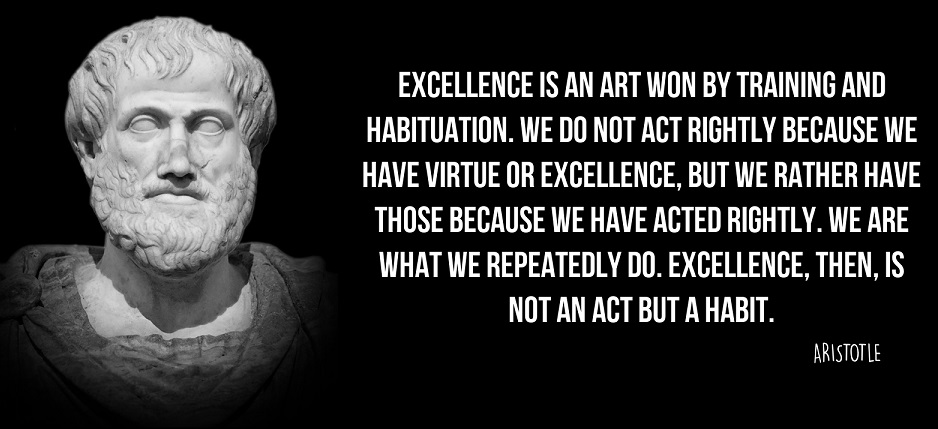
Excellence is not being the best, it’s doing your best.
“Excellence is an art won by training and habituation. We do not act rightly because we have virtue or excellence, but we rather have those because we have acted rightly.”
--Aristotle, Ancient Greek philosopher and polymath. 384 BC – 322 BC
Core Meaning
Action Precedes Character: You do not start out virtuous and then do good things. You become virtuous by repeatedly doing good things.
Habit Built: Excellence is a learned habit, not an accident or a birthright.
Practice Matters: Consistent training shapes who you are.
Key Takeaway
We are what we repeatedly do. True excellence is a daily habit, not a one-time act.
1
8

@Robert_E_Grant_ seems like the guy to contact.
Don't know if you are aware of his work, but you may at least find him interesting and he is a musician by training....and a polymath.
1
52

The dangerous person in 2027 isn't the one who knows the most.
It's the one who walks into any field, smells what's broken, and asks the question no specialist was wide enough to ask.
Acquisition is dead. Judgment is the alpha. The polymath is back. 🚀
11

1568
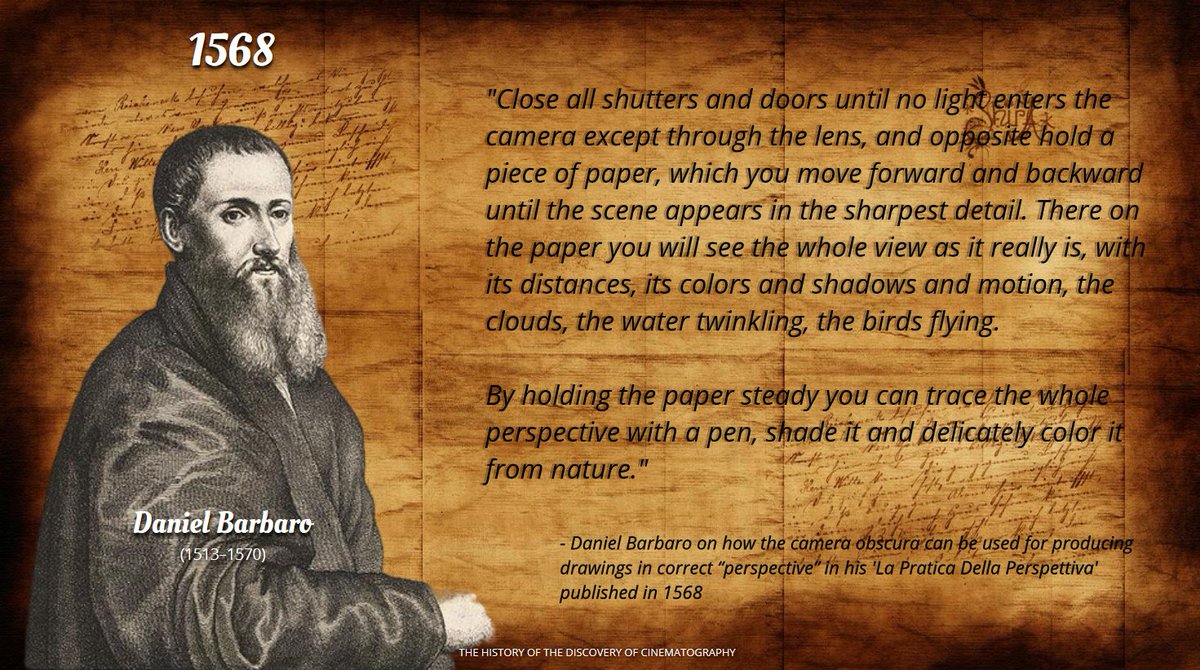
Barbaro (1513–1570) was a Venetian scholar, diplomat, and polymath known for his contributions to architecture, mathematics, and optics, among other fields.
Born into a prominent Venetian family, he was a key figure in the Renaissance, blending humanist learning with practical applications in science and art.
Barbaro is particularly noted for his work in optics and his association with the Camera Obscura. In his influential book ‘La Pratica della Perspettiva’ (The Practice of Perspective), published in 1568, Barbaro provided one of the earliest detailed descriptions of the Camera Obscura as a tool for artists and scientists.
He explained how to use the device to project images of external scenes onto a surface, aiding in accurate perspective drawing. Importantly, Barbaro was among the first to describe the use of a biconvex lens in the camera obscura to improve image clarity, a significant advancement over earlier pinhole-based designs.
1
87

Also very rare to come across a polymath wether established or in the making cause we are constantly looking to improve in whatever shape, form or way.
4