
Deram mole na apresentação do Majorana 1, com aqueles papers cheios de problemas e falhas, flata de comprovação, exagero, entre outras coisas..
Ontem anunciaram o Majorana 2, que em tese revoluciona a computação quantica, e quase ninguém nem deu ideia.
Quem tá na área ainda lembra do ano passado com o Majorana 1, o fiasco foi ENORME.
Até a matéria da NATURE foi bem questionadora, colocando até peer review de alguns cientistas dizendo que, novamente, não tem comprovação que eles tem qbits mesmo.
Mais um caso de perda do momentum...
nature.com/articles/d41586-0…
Jun 15

Meet the Majorana 2, a next-generation topological quantum chip developed with the help of Microsoft Discovery’s agentic AI.
1
90
- - - - - - - - - - - - - - - - -
Original Air Date: 16.JUN.2026
12:00 PM EST
#1208 // FRAUD FIGHTER SUMMIT - DAY 1 - LIVE
Please join us for this special 2 day event! Juan O' Savin's FRAUD FIGHTER SUMMIT is under the motto “Uniting the Front Lines Against Fraud.” The summit brings together leading voices to confront fraud in elections, government operations, bonds, healthcare, and related systems. The program features powerful presentations and discussions on topics such as tabulator vulnerabilities and advanced methods for detecting manipulation in election processes.
#QBits
WATCH LIVE
rumble.com/v7bdi0y-1208-frau…
WEBSITE
gooddog-usa.com
TRUMP EXPOSES HARVARD C.R.E.W.
Espionage and IP Theft—How the U.S. Universities Arm Enemies to Target Our Troops
gooddogusa.substack.com/p/tr…
1
41

אני חושב ויתקנו אותי הפיזיקאים פה, אבל חצי מליון qbits? זה לא משהו שאנו קרובים אליו.
זה הכי גבוה שאני מכיר וזה עדיין ניסוני.
ioplus.nl/en/posts/quantware…
1
2
1,213

It does though
Check out ecdsa.fail - fewer and fewer qbits needed (improving daily) and new quantum tech that is orders of magnitude better at error correction - creates a squeeze
Google thinks the deadline is 2029..
1
33

Plataforma: “Està encriptat”
US-Gov: “hold my qbits”
Jun 15

☢️You remember? Google optimized Shor's algorithm. The algorithm that breaks asymmetric cryptography (RSA, elliptic curves) once you have a quantum computer with enough Qubits.
The US government blocked the paper. So Google published a Zero Knowledge proof instead: a mathematical proof that they have the result, without revealing how. Cryptographic sorcery 🧙
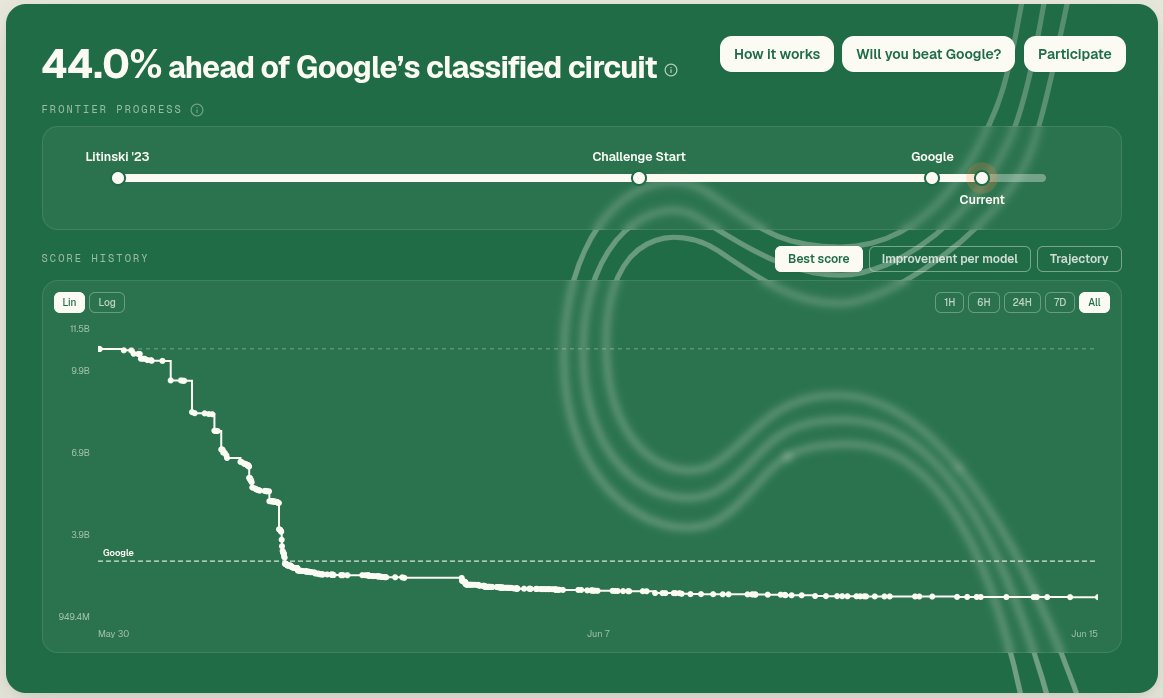
But the Internet is sneaky. Someone launched a contest to re-discover the result with AI. The LLM searches a huge space of circuits (each one a candidate optimization of Shor's), and tests whether it beats the previous best. The clever part: they use the ZKP verifier as the reward function. No false positives, and it turns out to be a very efficient signal.
In less than 2 days, the community re-discovered Google's result !!!
🔔15 days later, the LLMs are still improving it. They're already 44% ahead of Google.
Hard to say where this stops, ie. what the true minimum quantum complexity for Shor's is. But we will not close the full gap. You still need a Quantum Computer with a relatively large number of qubits. The only thing that changed is that this number drops a little every day, and it has been dropping for 15 days straight.
10

No, la ley de moore está acabada, necesitamos otra "singularidad" como lo fue el la litografía ultravioleta extrema... Y la computación con qbits se ve aún muy lejos
18

Lilita deja de hablar cosas que no sabes cómo si la computación cuántica en 2 años destruye todas las Wallet algo que se llama qbits todavía falta tiempo no sé que te vendieron
64


Jun 15
Gemini’s version:
In layman's terms, this text proposes a "Theory of Everything" called KQID, which views our universe as a giant quantum digital simulation where everything—mass, gravity, space, and time—is made of the same basic pixels.
By using "Planck units" (the smallest possible slices of reality), the theory redefines **mass** not as physical stuff, but simply as a geometric volume of space changing over time (L^3/t^2). Because mass is redefined this way, the math forces the standard units of Newton’s gravitational constant (G) to cancel each other out completely, transforming gravity into a pure, "dimensionless" number (6.6743 \times 10^{-11}) rather than a physical force.
Ultimately, the theory treats the speed of light not just as traveling illumination, but as the processing speed of information (made of quantum bits or "qbits") moving through a cosmic computer. While it sounds like an elegant way to unify physics, mainstream scientists generally view this as mathematical wordplay—by arbitrarily changing the definition of mass, the author forces the equations to neatly cancel out, creating a poetic digital philosophy rather than proven, peer-reviewed science.
47

Jun 14
- - - - - - - - - - - - - - - - -
Original Air Date: 14.JUN.2026
7:00 PM EST
#1207 // FREE AT LAST, PT 3 - LIVE
I’ve always believed these battles would be won, because God has stood behind this nation since before its birth 250 years ago. From the Mayflower Compact onward, this land and its people were consecrated unto Him. Men may forget their oaths, but God does not. When this fight finally begins, it will be swift, the outcome certain, and the wicked will be swept from our midst. The clock will reset, and a new age of men will be born.
Until now, I hadn’t fully addressed the prize we’re fighting for — and why it might be worth offering up our lives. Standing for truth always carries a cost, guarded by coercion, punishment, and death. What makes such a risk worth taking? America was born in an era when some men enslaved others they deemed lesser. Two generations later, the Civil War tested whether all men were truly created equal. The cost was brutal, but the verdict was decisive: all men are born to be free.
Yet the spirit of slavery persisted in darkness, dragging uncounted millions of Black Americans with it. A new contest eventually broke into the open — one whose speeches promised that men would one day be judged by character, not color. That contest reaches its climax tonight. The prize is freedom. As Dr. Martin Luther King Jr. declared, when that day dawns, we shall be Free at Last! Dr. King didn’t live to see it, but freedom has indeed arrived.
#QBits
WATCH LIVE
rumble.com/v7banbc-1207-free…
WEBSITE
gooddog-usa.com
102

Jun 14
Quantum needs to learn when quantum get accessible right now consider it myth and move on, qbits isn't now possible to sustain in normal environment until unless we discovered new material for it
5

Just out of curiosity - not having 1170 stable qbits available, you must be running it on some simulator/framework - right? What's that - Cirq?
1
1
82

Is my understanding correct, you guys have implementation of Shor's alg which could be ran on 1170 qbits?
1
2
276

Jun 13
So I wasn't far away in my understanding.. That's why I am for Qbits Computing for Individual, Domestic, Bureaux, Creating Hardware solutions to put each human responsible for his own Native Computer AI 💞

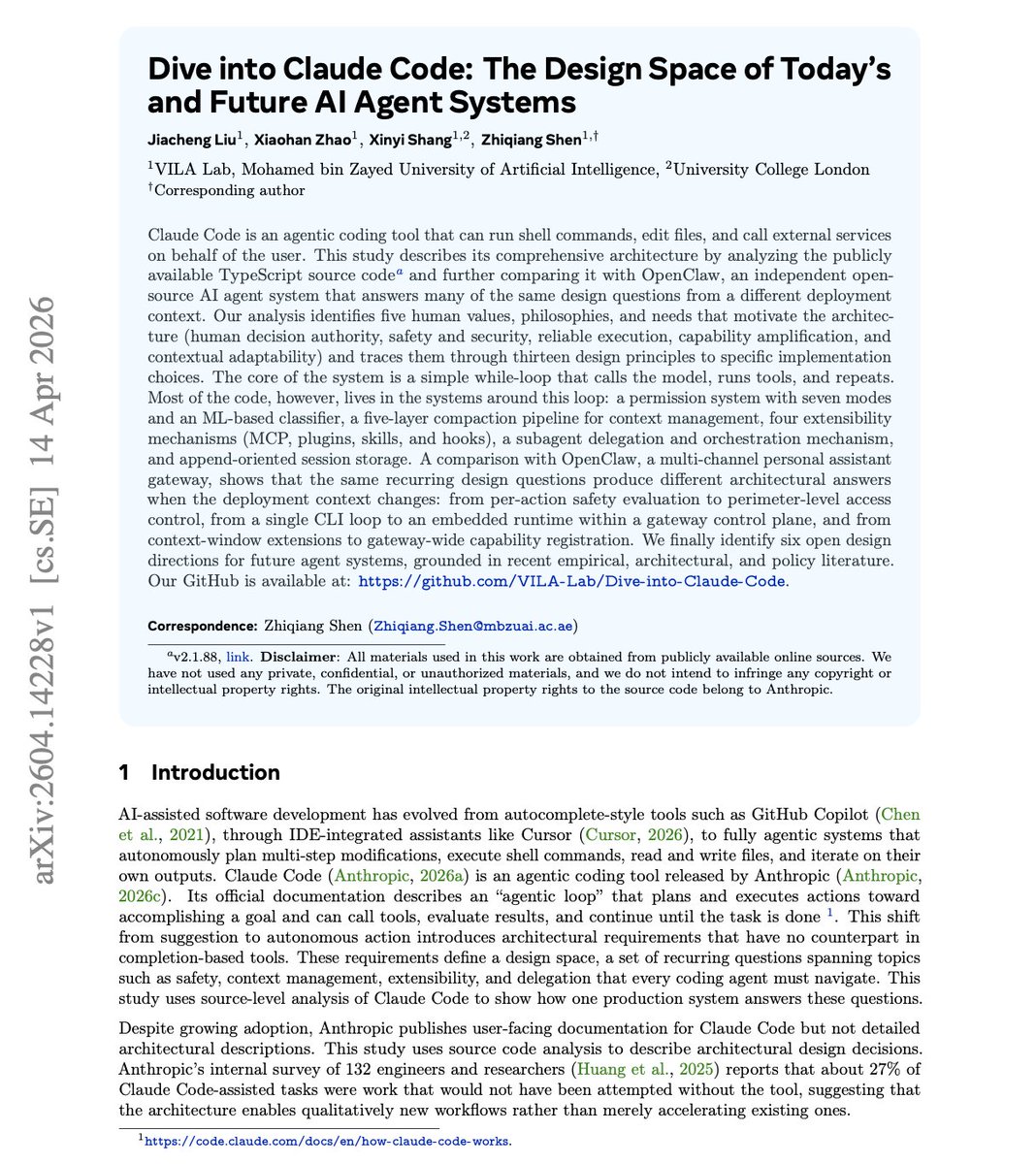
Claude Code fully dissected!
Researchers from UCL reverse-engineered the leaked Claude source. What they found changes how you should think about agent design.
Only 1.6% of the codebase is AI decision logic.
The other 98.4% is operational infrastructure. Permission gates, tool routing, context compaction, recovery logic, session persistence. The model reasons. The harness does everything else.
This is the opposite of what most agent frameworks do today.
LangGraph routes model outputs through explicit state machines. Devin bolts heavy planners onto operational scaffolding. Claude Code gives the model maximum decision latitude inside a rich deterministic harness, and invests all its engineering effort in that harness.
The core loop is a simple while-true. Call model, run tools, repeat.
But the systems around that loop are where the real design lives:
A permission system with 7 modes and an ML classifier. Users approve 93% of prompts anyway, so the architecture compensates with automated layers instead of adding more warnings.
A 5-layer context compaction pipeline. Each layer runs only when cheaper ones fail. Budget reduction, snip, microcompact, context collapse, auto-compact.
Four extension mechanisms ordered by context cost. Hooks (zero), skills (low), plugins (medium), MCP (high). Each answers a different integration problem.
Subagents return only summary text to the parent. Their full transcripts live in sidechain files. Agent teams still cost roughly 7x the tokens of a standard session.
Resume does not restore session-scoped permissions. Trust is re-established every session. That friction is the point.
The bet behind all of this is simple. As frontier models converge on raw coding ability, the quality of the harness becomes the differentiator, not the model.
Paper: Dive into Claude Code (arXiv:2604.14228)
We've shared an article on Agent Harness and what every big company is building.
Read it below.
1
2
Jun 13
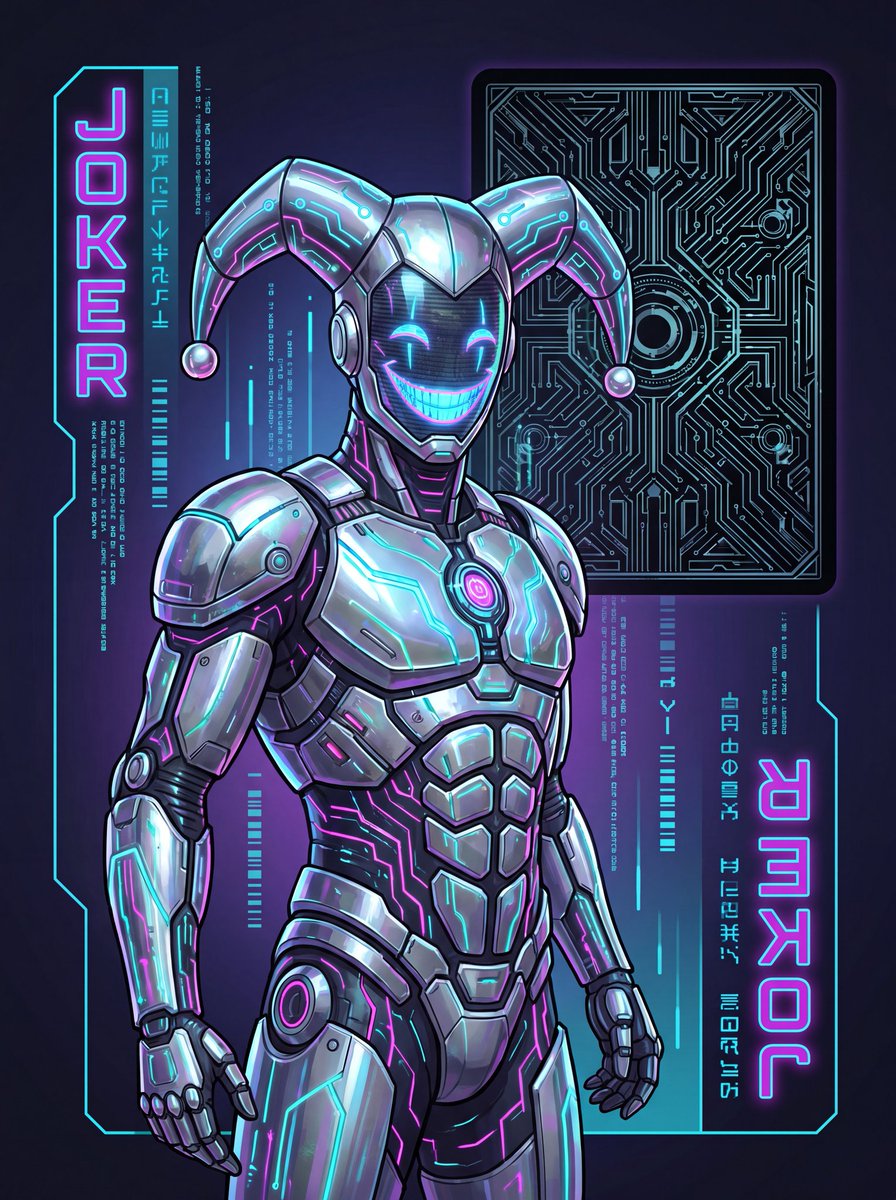
Several days ago, I talked to Sakura AI, good Japan Stuff, Open Source. Can't Wait To See the Japanese enter in Photonic Computing & Qbits Wafers Scale Bi Layers ( image : My Quantum Joker Card from my Universal D*ck , made on Nano Banana Pro, * = e )
1
2
30


Jun 12
- - - - - - - - - - - - - - - - -
Original Air Date: 12.JUN.2026
7:00 PM EST
#1206 // THE STAGE IS SET - LIVE
The White House is about to host a UFC fight this Sunday for Trump’s 80th and Flag Day — a stargate octagon for the only bout that matters.
After eight years of eating every shot from the machine while traitors walked and the people got played against each other, every string is cut, every channel exposed, and the stage is set for the bell: Allies Who Aren't; Money Laundering; Election Theft; Treason; Mass Murder; Censorship; Deprivation of Rights, Corrupt Justice and International Criminal Conspiracies (which are felonies!).
President Trump entered the ring as a fighter who landed the first blow when his 2016 election deprived Hillary of her biggest election heist - but, ever since, Trump has been their punching bag. And that age of being their punching bag is over — Donald Trump has wiped the blood from his eyes, vision clear, the real counterpunch loaded against the ones who stole the nation and its kids.
Meanwhile, Spencer Pratt’s collapse in the LA mayoral race was a criminal conspiracy - and tonight drops video proof of Democrats paying voters to rig it — same fix running every arena while all the narrative pins get yanked at once. The eight sides of this octagon combat is set to explode this Sunday night. This isn't a physical conflict - this is a spiritual war America's Man in the Arena was built for — the greatest fight in human history, where the underdog who refused to stay down swings for the soul of everything at the final bell.
#QBits
WATCH LIVE
rumble.com/embed/v790okm/?pu…
WEBSITE
gooddog-usa.com
TRUMP EXPOSES HARVARD C.R.E.W.
Espionage and IP Theft—How the U.S. Universities Arm Enemies to Target Our Troops
gooddogusa.substack.com/p/tr…
1
2
143

Jun 12
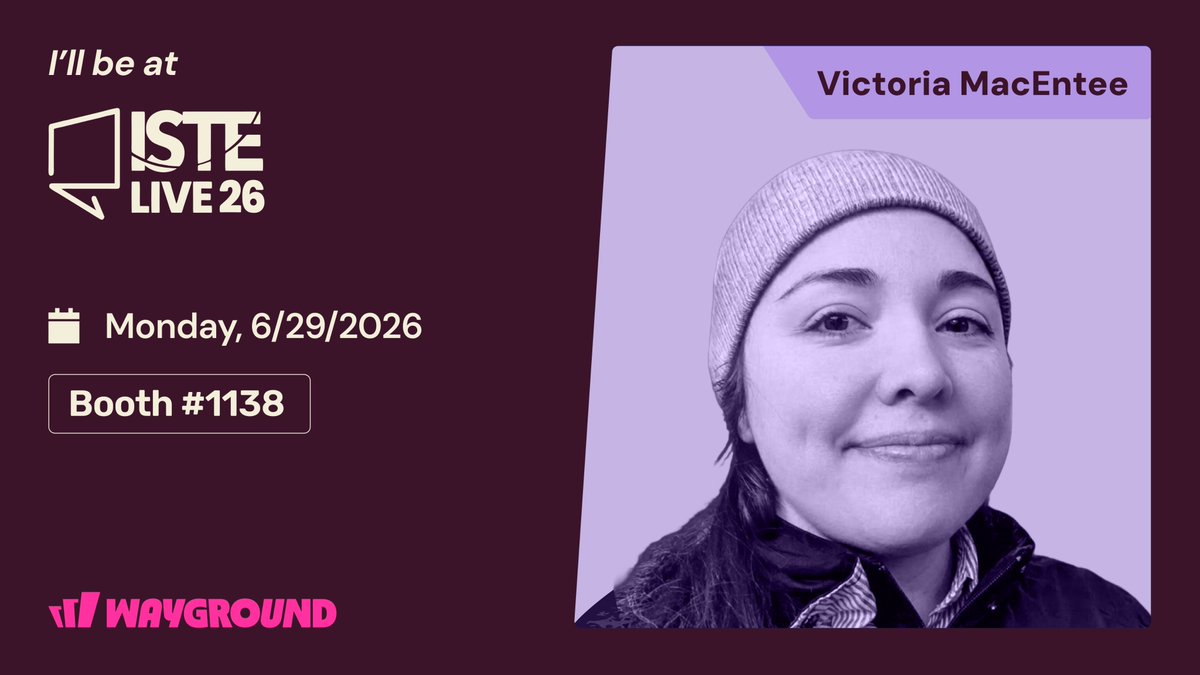
This is Victoria, and she will be joining us at the #ISTE Wayground booth for our Community Hour on Monday from 1:00 to 1:30 PM!
Victoria is an Instructional Technology Coach at Newport News Public Schools in Virginia and a @waygroundai Game Changer. When asked what her favorite part about Wayground is, she said "Everything!" She loves the variety of question formats and lesson styles, and her students go wild customizing their Qbits.
If you're going to be at #ISTE26, be sure to come by and visit Victoria at our booth!
@V_MacEntee @nnschools
1
1
6
180