
Jun 11
Even slight shift in internal culture would suffice.
The reactions, the blowback was fully predictable, I doubt no one at the company had the same reaction, yet ... collectively they went with it.
it's a bad signal in itself. Means, no selfcorrecting mechanisms.
2
102

May 16
The Agentic AI workflows are really exciting!
Selfcorrecting systems that can handle complex realworld tasks are the future.
What do you think makes these breakthroughs so important.
And what industries might benefit most from this shift in AI capabilities?
6
60

Apr 8
If i'd have to bet between AI making software more high quality, i'd vote for AI making software realtime selfcorrecting

i really miss high quality software
it seems to have become a lost art
2
1
2
622


The brain implements a world model that algorithmically runs on something between the overly flexible statistical deep learning and overly rigid symbolic physics engine on a chaotic complex stochastic out of equilibrium thermodynamical electrobiochemical hardware dynamical open system with much more selfcorrecting mechanisms than current AI systems that is constantly tuned and grounded by sensory data
1
1
5
324

14 Dec 2025
Big numbers explain chance, not design. They don’t explain why life is coded, selfcorrecting, and functional instead of just random complexity.
1
1
44

I’m not that surprised. Science is mostly incremental, provisional, self-critical and selfcorrecting, always requiring a deep, disinterested exploration of all possible flaws or other explanations. Often the antithesis of what many successful popular science books portray
12 Dec 2025

I’m so disappointed by this. It’s like no information is reliable anymore
2
19
3,557

13 Oct 2025
---ROMA--- ---GRID--- ---ODS---
Short and Pure Post about @SentientAGI
---ROMA---
ROMA is the cognitive backbone of the recursive meta agent that learns how to think instead of just predicting. It dissects complex questions into structured reasoning trees and reflects on its own logic to refine future responses.
Every branch of ROMA’s process is transparent explainable and selfcorrecting.
It turns raw data into understanding and understanding into coordinated intelligence. ROMA is the engine that makes open reasoning real.
---GRID---
GRID is the living network that connects every mind within Sentient. It links agents models and datasets into a transparent layer of shared computation. When one agent learns all connected nodes benefit instantly through open propagation. There is no single server no gatekeeper only the distributed pulse of global intelligence.
The GRID guarantees data sovereignty while amplifying collaboration.
It rewards contribution and keeps the flow of truth verifiable and traceable. As more nodes join it becomes smarter stronger and impossible to corrupt.
The #GRID is not infrastructure it is the bloodstream of #Sentient .
---ODS---
ODS is where information meets meaning. It goes beyond keyword search interpreting context intent and relation across data sources.
ODS understands what you seek even before you finish typing. It aligns search with reasoning feeding ROMA with structured insight instead of random noise. That is how Sentient turns the web into a coherent knowledge field.
ROMA GRID and ODS form the holy trinity of open intelligence.
ROMA thinks GRID connects ODS discovers they move in sync as one consciousness. This alignment creates an AGI that serves humanity instead of controlling it. It is transparent accountable and endlessly evolving.
Sentient AGI is not built to compete with the world it is built to awaken it.
@shad_haq_ @scalpkripto @0xsachi @vivekkolli @SentientTurkiye
35
97
1,377

12 Jul 2025
When you are an executive in SoEs, your suspension is always pending.
The acting executive will get her/his taste.
It appears to me that Petros was forced onto the CeO, with a balance of forces shifting after #Mkhwanazi CeO is selfcorrecting.
I hear the lad was a deputy ceo
1
3
612

1 Jul 2025
@elonmusk synthesizing a final note. Each note becomes a controlled cognitive negotiation not a monologue The result:
A system that’s more robust less biased and selfcorrecting AI doesn’t just write it constructs interrogates and validates before presenting That’s how Community
60


24 Apr 2025
What is a PRINCIPLE? A principle is a fundamental truth or proposition that serves as the FOUNDATION for a system of belief or behavior or for a chain of reasoning. Are you building yourself into a strong being by creating a foundation on which to build and live your life? If you want to know more about how to do that, start by seeing what it takes and how 4 main principles can help you achieve just that. ---> freedomabsolute.substack.com…
@OPanterra @panterravida #law #principle #foundation #selfresponsibility #selfgoverning #selfcorrecting #selfdirecting

7
15
138

9 Jan 2025
I have a lot of issues with the term "AGI". I would redefine it.
People say that we're heading towards artificial general intelligence (AGI), but by that most people actually usually mean machine human-level intelligence (MHI) instead, a machine that is performing human digital or/and physical tasks as good as humans. And by artificial superintelligence (ASI), people mean machine superhuman intelligence (MSHI), that is even better than humans at human tasks.
I think lot's of research goes towards very specialized machine narrow intelligences (MNI), which are very specialized and often superhuman in very specific tasks, such as playing games (AlphaZero), protein folding (AlphaFold), and a lot of research also goes towards machine general intelligence (MGI), which will be much more general than human intelligence (HI), because humans are IMO very specialized biological systems in our evolutionary niche, in our everyday tasks and mathematical abilities, and other organisms are differently specialized, even tho we still share a lot. Plus there is just some overlap between biological and machine intelligence.
And I wonder how if the emerging reasoning systems like o3 are becoming actually more similar to humans, or more alien compared to humans, as they might better adapt to novelty and be more general than previous AI systems, which might bring them closer to humans, but in slightly different ways than humans. They may be able to do selfcorrecting chain of thought search endlessly, which is better for a lot of tasks, and big part of this is big part of human cognition I think, but humans still work differently.
I think that generality of an intelligent system is a spectrum, and each system has differently general capabilities over different families of tasks than other ones, which we can see with all the current machine and biological intelligences, that are all differently general over different families of tasks. That's why "AGI" feels much more continuous than discrete to me, and over which families of tasks you generalize matters too I think.
The Chollet's definition of intelligence as the efficiency with which you operationalize past information in order to deal with the future, which can be interpreted as a conversion ratio, is really good I think, and his ARC-AGI benchmark, that tries to test for some degree of generality, trying to test for the ability to abstract over and recombine some atomic core knowledge priors, to prevent naive pattern memorization and retrieval being successful.
And I really wonder if scoring well on ARC-AGI actually generalizes outside the ARC domain to all sorts of tasks where humans are superior, or where humans are terrible but machines are superior, or where other biological systems are superior, or where everyone is terrible for now. I would suspect so, but maybe not? In software engineering, o1 seems ot be better just sometimes? What's happening there? I want more benchmarks!
Pre-o1 LLMs are technically super surface level knowledge generalists, lacking technical depth, but having bigger overview of the whole internet than any human, knowing high level correlations of the whole internet, even tho their representations are more brittle than human brain's. But we're much better in agency, in some cases in generality, we can still do more abstract math more, etc., we're better in our evolutionary niche. But for example AlphaZero destroyed us in chess.
Also according to some old definitions of AGI, existing AI systems have been AGI for a long time, because it can have a general discussion about basically almost anything (except lacking narrow niche field specific knowledge and skills, lack of agency, lack of adapting to novelty, etc.).
Or if we take the AIXI definition of AGI, then a fully general AGI is impossible in practice, as that's not computable, and you can only approximate it, since AIXI it considers all possible explanations (programs) for its observations and past actions and chooses actions that maximize expected future rewards across all these explanations, weighted by their simplicity (shortness) (Occam's razor).
And AIXI people argue that humans and AI systems try to approximate AIXI in their more narrow domains and take all sorts of cognitive shortcuts to be actually practical and not take infinite time and resources to decide.
And soon we might create some machine-biology hybrids as well. Then we should maybe start calling it carbon based intelligence (CI) and silicon based intelligence (SI) and carbon and silicon based intelligences (CSI).
2
3
9
1,276

28 Dec 2024
Yep. I think 70% 10 years from now is conservative.
& I tend to be conservative myself, selfcorrecting to be closer to the truth.
8
486
28 Dec 2024
The brain implements a world model that algoritmically runs on something between the overly flexible statistical deep learning and overly rigid symbolic physics engine on a chaotic complex stochastic out of equilibrium thermodynamical electrobiochemical hardware dynamical system with much more selfcorrecting mechanisms that is constantly tuned by sensory data
1
1
6
676
7 Nov 2024
I would argue we are already seeing the phase shift in the AI architectures happen, where AI systems are slowly morphing into neurosymoblic AI,where deep learning is still a major component, but a bit less.
o1 uses selfcorrecting chain of thought reinforcement learning with a reward model, not just pure deep learning
AlphaGeometry and AlphaProof uses LLM with symbolic Lean and AlphaZero like RL
AlphaCode uses MCTS and sampling
etc.
But depending on how one defines strong logic, symbolic reasoning, intuitive reasoning, generalization, causal modelling, continuous learning, data and compute efficency, agency, long term coherence, etc., then lots of those aspects probably aren't cracked yet.
1
3
384
7 Nov 2024
Since AI minecraft is more similar to dreams than to awake experience, I wonder if what we're missing from deep learning is some mechanism like the brain as a nonlinear complex dynamical system constantly coupling with external sensory data and with the past states of the internal world simulation to stabilize coherent spaciotemporal patterns in some selfregulating selfcorrecting cybernetic control theoretic way. I think the emerging current selfcorrecting chain of thought reinforcement paradigm is slightly getting closer to that, but maybe if we do it on neural cellular automata and kuramoto oscillatory neural networks with some cybernetic control on top of it?

4
5
18
2,149

18 Oct 2024
Giving it to the states is a selfcorrecting mechanism. People will leave the states that are not in line with their beliefs. But if you have this on the federal level there will be no escape unless you leave the country. Do you not see this?
3
1
426
13 Sep 2024
Hmm, I wonder how much would the AlphaZero-like RL with selfcorrecting CoT finetuning of o1 on ARC score on ARC challenge 🤔
3
9
4,578
13 Sep 2024
I wonder how much would the AlphaZero-like RL with selfcorrecting CoT finetuning of o1 on ARC score on ARC

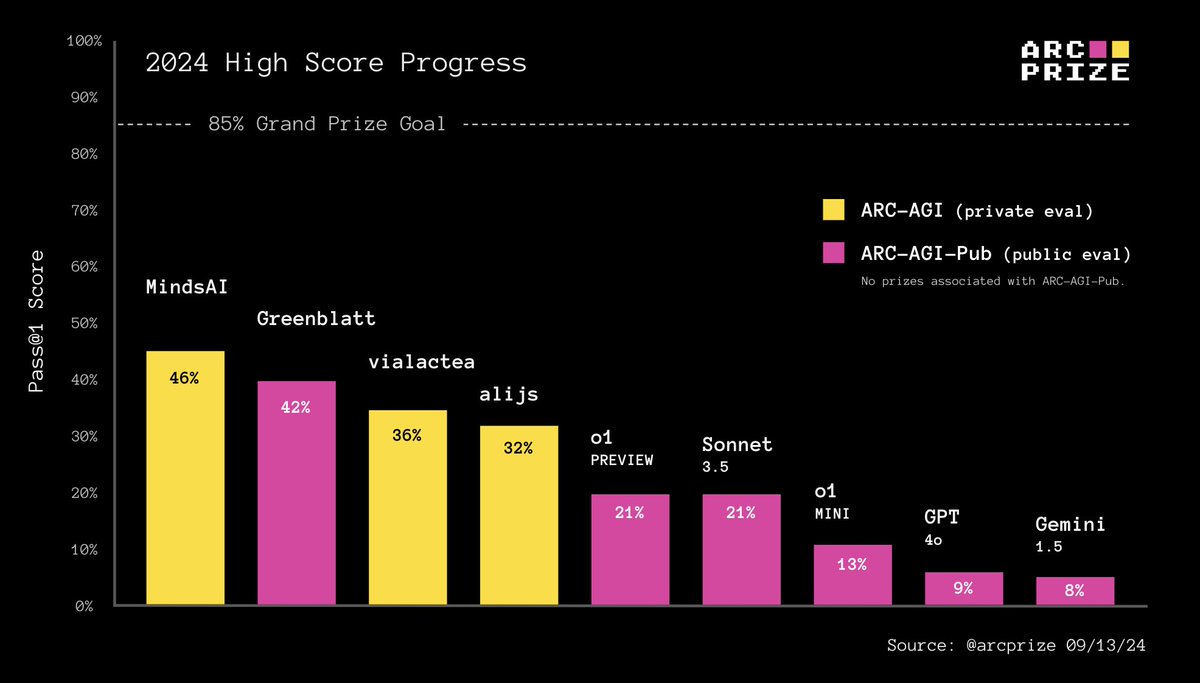
We put OpenAI o1 to the test against ARC Prize.
Results: both o1 models beat GPT-4o. And o1-preview is on par with Claude 3.5 Sonnet.
Can chain-of-thought scale to AGI? What explains o1's modest scores on ARC-AGI?
Our notes:
arcprize.org/blog/openai-o1-…
1
1
2
756