
4/
Why “Kaspa as sequencer” is powerful:
✅ Fully decentralized sequencing (miners order txs via GhostDAG)
✅ No single point of failure or trusted sequencer
✅ Strong MEV & censorship resistance at the protocol level
✅ Inherits Kaspa’s speed (10 blocks/sec), low fees & PoW security
✅ Sub-second probabilistic finality
Ethereum L2s are still mostly stuck with centralized sequencers in 2026. Kaspa flips that script.
1
1
1
40

I’m old enough to remember the days when cried about centralised sequencers. You are as bad as Hoffman
2
1
62

Meta Earth’s Epic Evolution: From Day 1 to ME 730
1/8 🌍 Exactly 730 consecutive days ago, a vision launched to build a network anchored to actual humans rather than anonymous bots. Today, we celebrate the Meta Earth 2nd Anniversary and the massive momentum behind the global ME 730 milestone. Let’s look back at this incredible Web3 journey. 👇Link: invite.mec.me/?c=q6x6jnaj
2/8 🚀 The Start of Meta Earth History
On Day 1, the core mission was set: create a high-performance modular public blockchain tied to a fairer digital economy. Instead of focusing on insider pre-mines, the foundation was laid to protect data sovereignty and establish a new digital social contract.
3/8 🆔 Igniting the Meta Earth Ecosystem
True crypto community growth requires real identity. Meta Earth introduced the ME ID, using Zero-Knowledge Proofs (ZKP) to deliver a secure "Proof of Humanity." Paired with the user-friendly ME Pass wallet, it successfully lowered barriers to onboard over 6 million verified global citizens.
4/8 🔍 The Power of Transparency
For anyone tracking the data, transparency is everything. Through the ME Explorer, anyone can transparently monitor the network’s health, blocks, and on-chain metrics, validating that tokenomics stay sustainably tied to genuine user growth and UBI rewards.
5/8 🤝 A Mission-Driven Meta Earth Community
What makes this network unique is its pulse. During the "From E to Emergency" relief initiative in the Philippines, the Meta Earth Community proved its utility goes far beyond speculation, translating on-chain ecosystem support into real-world emergency aid.
6/8 📈 My Personal View
Let’s be real—the space is often trapped in a loop of short-term speculative hype. What makes Meta Earth a breath of fresh air is execution. They didn't just build another fast layer-1 chain; they built an inclusive financial framework where millions of real people align daily.
7/8 🎯 Why ME 730 Matters Today
At Day 730, this milestone stands as a proven model for sustainable Web3 infrastructure. It bridges the gap between regulatory-friendly decentralized identity, a carbon-credit conscious economy, and active Wasm smart contract utility.
8/8 🔮 The Next Chapter
ME 730 isn't a finish line—it’s a launchpad. With the network moving into modular AI integrations, decentralized sequencers, and RWA scaling, the era of verified digital citizenship has officially arrived. 🌐✨
theblock.co/press-releases/3…
mec.me/en-US?hl=id-ID
techpoint.africa/brandpress/…
medium.com/@MetaEarth/300-mi…
@_MetaEarth_ #ME730 #Web3 #ModularBlockchain
18

8h
Two sequencers. Same lead. Both enroll them.
Your prospect gets hit twice. Reply rate drops. Sender rep takes damage.
Before enrolling, call @iqpipeapp Overlap Check API:
active: true → skip
active: false → safe
One IF node. Done.
1
1
10

Hyperliquid isn’t just another decentralized exchange. It’s a purpose-built Layer 1 blockchain designed from the ground up for on-chain perpetual futures trading, with a fully native order book that operates at speeds typically reserved for centralized platforms.
Here are the key pillars that make Hyperliquid a distinct layer in the DeFi stack:
**1. On-Chain Central Limit Order Book (CLOB)**
Most DEXs use Automated Market Makers (AMMs). Hyperliquid chose a different path: a full CLOB where every order, cancellation, and fill is recorded directly on its own L1. No sequencers, no liquidity pools prone to impermanent loss — just a transparent, auditable, and efficient matching engine.
**2. Sub‑second Finality & Low Fees**
By building its own consensus and execution environment, Hyperliquid achieves block times under one second with negligible transaction costs. This enables retail and institutional traders to execute high‑frequency strategies without the friction of gas auctions or mempool front‑running common on general‑purpose chains.
**3. Native Oracle System**
Instead of relying on third‑party oracles, Hyperliquid operates its own integrated price feed, aggregating data from major CEXs and directly writing it to the blockchain. This reduces latency and eliminates dependence on external infrastructure, a critical factor for perpetual swaps where pricing delays can lead to liquidation inefficiencies.
**4. HYPE Token & Ecosystem Incentives**
The native HYPE token powers staking, fee discounts, and governance. Early participants in the ecosystem benefit from a structured emissions schedule designed to bootstrap liquidity while aligning long‑term incentives. The tokenomics are transparent and verifiable on‑chain.
**Why does this matter for ETF investors?**
Traditional ETF structures have historically lacked direct exposure to on‑chain trading activity. HYPE‑ETF bridges this gap by packaging Hyperliquid’s growth into a regulated financial product. Investors gain access to the performance of the Hyperliquid ecosystem — including trading volume, fee revenue, and staking yields — without needing to manage private keys or navigate unregulated platforms.
Hyperliquid is one of the fastest‑growing ecosystems in DeFi by total value and daily volume, and its architecture is setting a benchmark for what a dedicated trading blockchain can achieve. As institutional adoption of crypto‑native infrastructure accelerates, understanding the underlying technology becomes essential for informed allocation.
Stay tuned as we continue to break down the components that make Hyperliquid a foundational layer for the next generation of on‑chain finance.
1
46

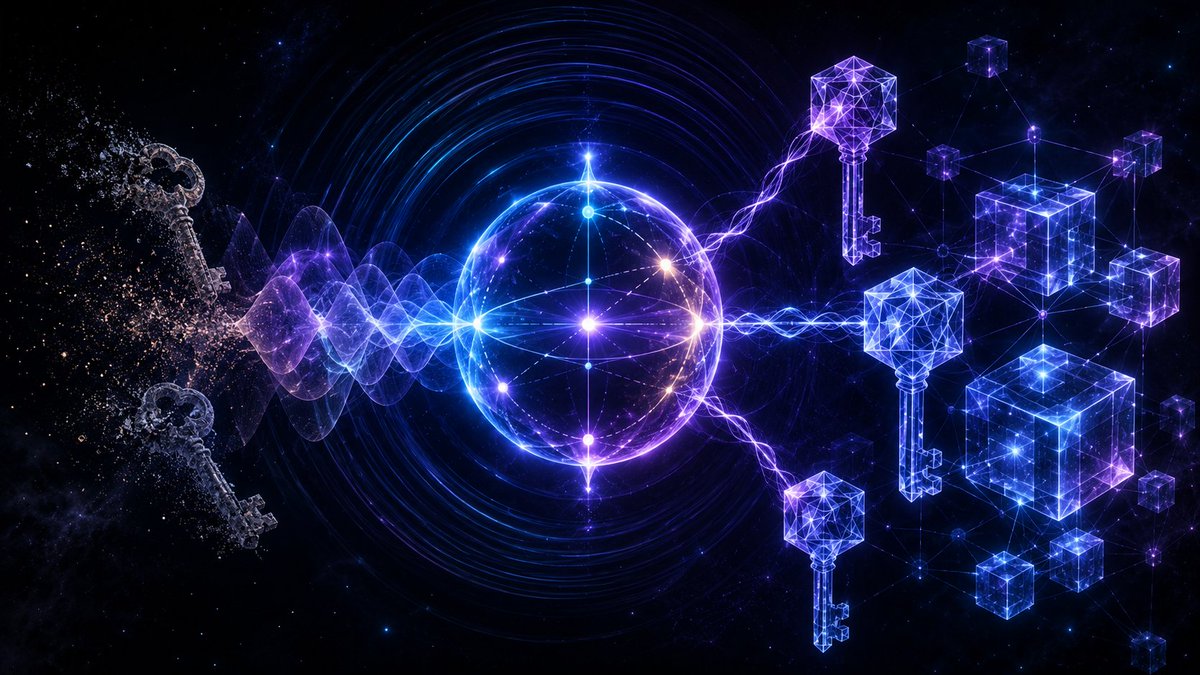
The post-quantum race in crypto will not be won by the chain with the loudest “quantum-proof” label.
It will be won by the ecosystem with the cleanest key rotation path.
That distinction matters.
A blockchain is not quantum-ready just because one primitive is post-quantum.
It becomes quantum-ready only when the broader control surface can migrate:
→ user accounts
→ wallets
→ validators
→ bridges
→ custodians
→ stablecoin issuers
→ oracles
→ sequencers
→ governance multisigs
🧵 👇
1
1
17

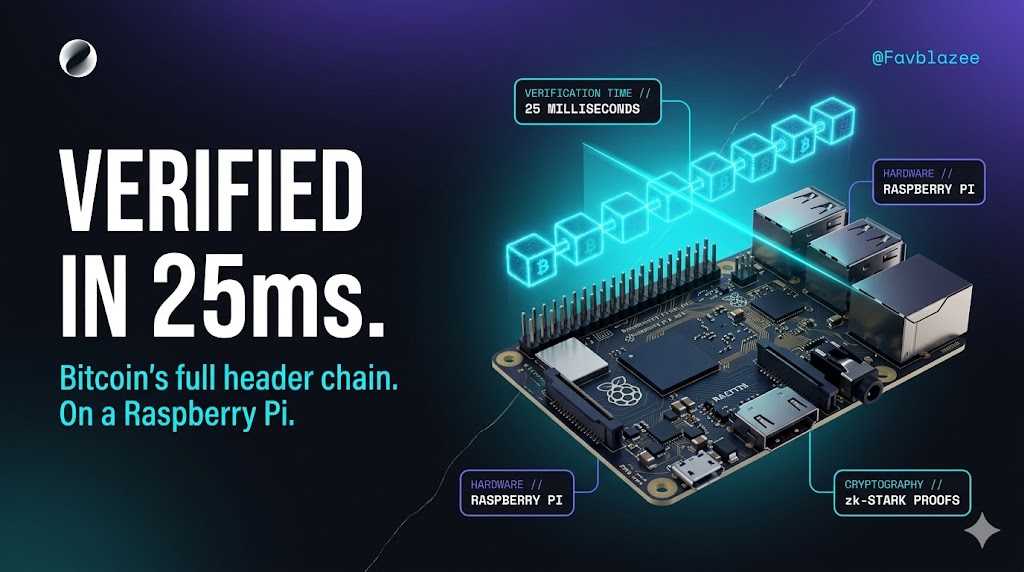
Starknet's endgame isn't just yield.
They verified Bitcoin's FULL header chain in 25ms on a Raspberry Pi using Circle STARKs.
Decentralized sequencers: live
BTC now part of Starknet's consensus security
YieldStark is where you plug into this future
Not a protocol. A position
1
1
21


How badly you need institutional resources to do your job as a professor is correlated with how authoritarian and cooperative you are: if you need big ticket capital resources like telescopes or sequencers you will cooperate with the institution to maintain access.
1
18


You want proof these bacteriophages are gonna be used in the upcoming plandemics?
PHA4GE field "fasta filename".
Public Health Alliance for Genomic Epidemiology (PHA4GE)
PHA4GE, a global network, also develops tools and resources, such as standardized data specifications for pathogen monitoring, to support effective genomic epidemiology.
github.com/pha4ge
Public Health Alliance for Genomic Epidemiology (PHA4GE)
pha4ge.org/
THEY USE MINION TO TRANSFER INFORMATION !!!!
That microbit is important. Look at their data transfer.
They use bacteria !!!!!!
Minion Data Transfer
Script to handle uploading minion fast5 files to a server for further processing
github.com/Public-Health-Bio…
MinION FAST5 files are the primary raw data output from Oxford Nanopore Technologies' MinION sequencers, stored in the hierarchical HDF5 binary format, which allows for the storage of complex and large datasets.
timkahlke.github.io/LongRead…
MinION
The MinION can sequence entire bacterial genomes in a single run, with improved accuracy using newer R9.4 flow cells and base-calling software like Dorado, facilitating the assembly of complete bacterial genomes
pubmed.ncbi.nlm.nih.gov/3954…
They created the SARS-COV-2 TEMPLATE
SARS-CoV-2 Contextual Data Specification - Collection template and associated materials for SARS-CoV-2 metadata
github.com/pha4ge/sars-cov-2…
THIS TIES INTO UPCOMING PLANDEMICS !!!!!
Remember Minion is the Infected Trigger !!!!!!!!
Microbit Infection
Public Events Microbit Epdemic: Preparation
github.com/mrc-ide/public-ev…
The term "Infected Minion Microbit" could refer to different concepts based on the context. Here are the relevant details:
Microbit Zombies:
This is a project where microbits are programmed to simulate a zombie outbreak. Each microbit has a health value, and if it gets too close to an infected microbit, it loses health.
web.archive.org/web/20200810…
If the health reaches 0, the microbit becomes infected and displays a skull icon.
The infection is random, with a 1 in 100 chance of a microbit being infected at the start of the game.
jbcstudios.miraheze.org/Infe…
Infected Minion:
This refers to a game mechanic in a game where minions can be infected. These infected minions have reduced health and can be spawned by certain actions, such as Dock hitting a corpse.
makecode.microbit.org/projec…
Infection Game:
This is a distributed game that simulates the spread of an illness using microbits. The game involves a master microbit that infects a player, and the infection spreads when microbits are close enough.
makecode.microbit.org/course…
The game has different states, such as healthy, incubating, sick, and dead, and the goal is to stop the outbreak before all players die.
support.microbit.org/support…
Microbit & Viruses:
It is important to note that the microbit cannot be infected by a virus or malware. The microbit is a virtual device used to copy programs or firmware updates, and it only recognizes .hex and .bin file types.
learn.microsoft.com/en-us/ar…
Bacteriophages Are Viruses by Definition.
sciencedirect.com/topics/med…
They are a specific type of virus that infects and replicates within bacteria. According to the legal and scientific consensus, bacteriophages (or phages) are classified as viruses because they:
Consist of a nucleic acid genome (DNA or RNA) enclosed in a protein capsid.
Depend entirely on a host cell's machinery to replicate.
Are obligate intracellular parasites.
pmc.ncbi.nlm.nih.gov/article…
47

If it's a lie the lie won't hold. Open source DNA sequencers and AI makes this a short lived deception.
1
2
478

Jun 15
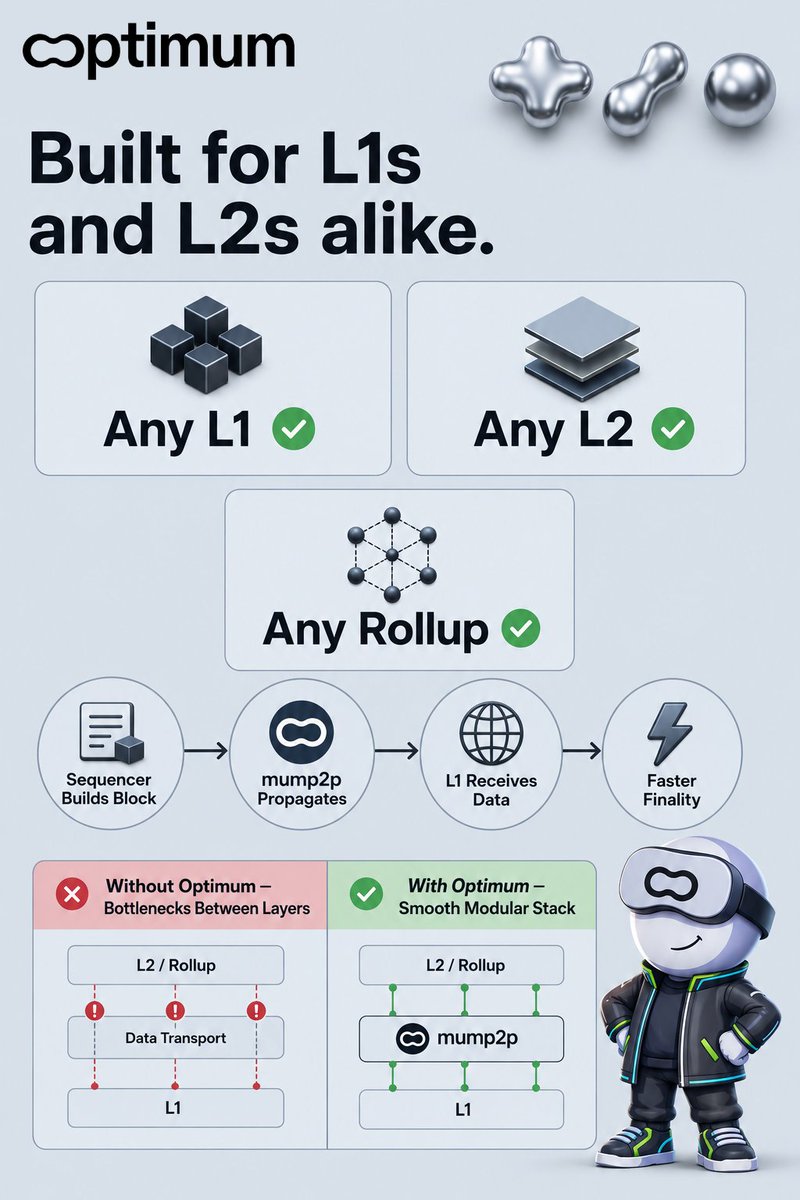
Most "Layer 2" conversations focus on rollups, sequencers, and proof systems.
Nobody talks about how data gets to those rollups in the first place.
@get_optimum works for L1s AND L2s — because propagation matters everywhere.
2
4
28
Hyperliquid isn’t just another Layer 1—it’s a purpose-built, decentralized trading engine. Designed from the ground up to solve the latency and liquidity bottlenecks that plague on-chain derivatives, Hyperliquid achieves CEX-level order matching without sacrificing self-custody.
For the uninitiated: Think of Hyperliquid as the infrastructure layer where perpetual swaps, spot trading, and native yield infrastructure converge on a single, fully on-chain order book. No off-chain sequencers. No trusted intermediaries. Just speed—currently processing thousands of orders per second with sub-second finality.
Why does this matter for HYPE-ETF? Because we are not tracking a random token. We are backstopping the network effects of a blockchain that is already processing billions in volume monthly. The HYPE token is the economic heartbeat of this ecosystem: used for gas, staking, and—critically—as the primary collateral across Hyperliquid’s liquidity pools.
For ETF investors, this structure introduces a novel risk/reward profile:
- **Income component**: Staking rewards and protocol fees accrue to HYPE holders, creating a yield-bearing asset class more akin to a cash-flowing equity than a pure utility token.
- **Demand driver**: As Hyperliquid’s order book deepens, more traders require HYPE for margin and trading privileges—creating organic, non-speculative buying pressure.
- **ETF wrapper**: HYPE-ETF packages this exposure into a regulated, dividend-eligible structure, eliminating the need for self-custody, wallet management, or navigating CEX compliance.
The Hyperliquid thesis is simple: the next phase of DeFi will look less like DeFi 1.0’s fragmented AMMs and more like a centralized exchange’s order book—but fully on-chain. HYPE-ETF is the vehicle to access that thesis without touching a hot wallet.
We are not here to speculate. We are here to participate in the infrastructure migration.
Know the layer. Own the wrapper.
1
15

Jun 15
The current rollup monopolies just lost their technical moat
6 million dollars of institutional validation was just aggressively absorbed into a completely different consensus architecture
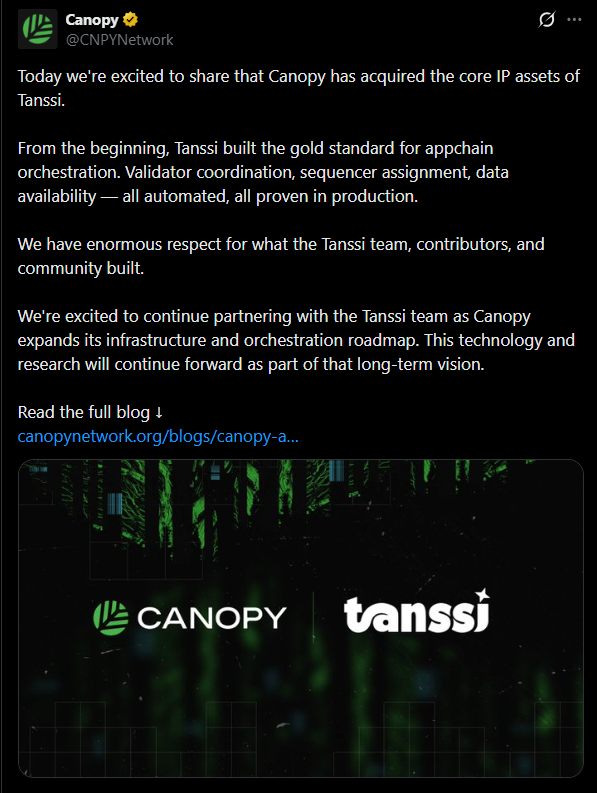
@CNPYNetwork merging Tanssi ContainerChains into their NestBFT consensus completely overwrites the standard infrastructure playbook
It cannibalizes external sequencers to natively streamline network validation
The heavy computational lifting of data availability is now entirely abstracted away from developers
The standalone rollup model is dead
Competing against Canopy and its native aggregation is absolute financial suicide
Extracting value from disjointed execution layers remains a terrible long-term capital strategy
Allocating resources into ecosystems that natively unify their child chains generates massive asymmetric upside
Base layers must become unified infrastructure hubs
What happens to disjointed modular chains when builders realize they are paying rent for nothing?
30
1
33
257

Jun 15
I wasted months bootstrapping validators
Modular scaling just collapsed into a single base layer because isolated networks fail at scale
@CNPYNetwork just acquired the Tanssi intellectual property
They hardcoded decentralized sequencers into their parallel execution environment using the new Vibe Code architecture
Developers can now spin up fully functional independent appchains in 20 minutes without touching consensus
Infrastructure as a service is obsolete
Modular isolation is a technical trap
Routing capital through these native child chains captures synchronous liquidity across the entire base ecosystem
Participants deploying custom execution environments will completely dominate the incoming unified fee market
Blockspace aggregation is happening right now
Why pay external relays when the base layer natively handles your entire node distribution?

40
47
260

Jun 15
People keep saying $ETH value capture is broken because L2s ate mainnet fees, but I don't think that's totally true.
It just moved to the layer that secures the whole rollup economy and becomes the collateral underneath it.
Okay, I agree the numbers make the bear case pretty easy to see tho.
– $207B mcap, 39.23M ETH staked, 898K validators, staking ratio ~32.5%.
– 20K ETH burned annually, 0.82% yearly inflation.
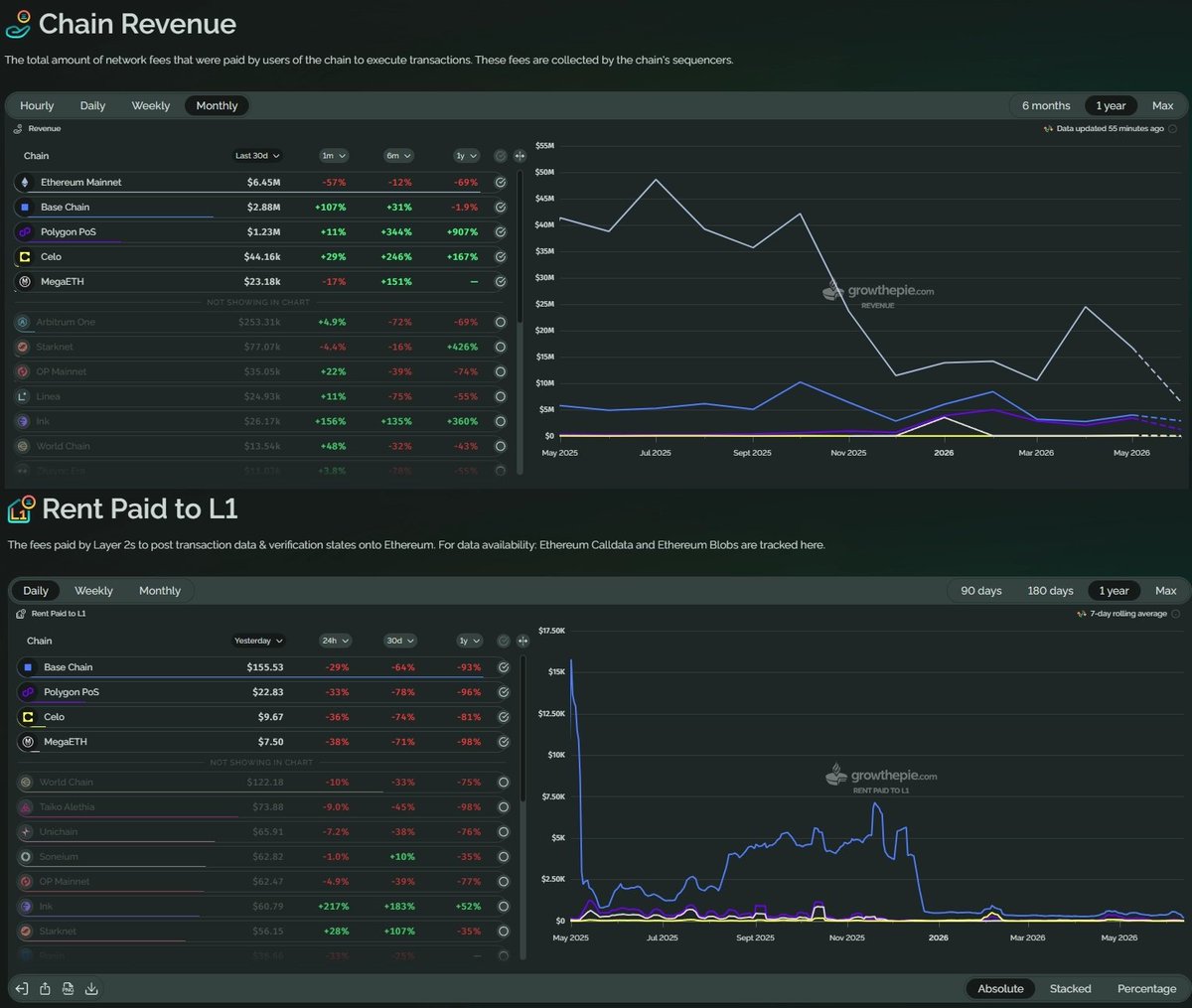
– ~$100K daily chain revenue while apps are making $1.1M
So the ultrasound money thesis is kinda cooked.
Dencun made blob data cheap on purpose, Pectra pushed the architecture even further, and rollups now keep most of the immediate cash flow.
L2s now only send around 0.3% of their chain fees back to L1.
Ethereum provides the trust anchor, rollups rent it cheaply, apps and sequencers monetize the user flow, and ETH holders don't see much direct burn.
But I think the market is confusing weak fee capture with a weak strategic position.
Ethereum is now selling settlement, DA, neutrality, censorship resistance, liquidity, and the security budget of 39M staked ETH.
Even the biggest L2 right now, Base still settles on Ethereum because the liquidity is there, the stablecoins are there, and the neutrality premium is still hard to copy.
Leaving Ethereum means taking liquidity fragmentation risk, weaker trust assumptions, worse market perception, and maybe losing the default settlement layer everyone already accepts.
ETH value capture could be less direct and slower than CT wanted.
The Foundation roadmap is now focused on scaling, improving UX, and hardening L1.
More blobs, PeerDAS, higher gas limits, Open Intents, account abstraction, ePBS, faster finality, statelessness, zkEVM work, native rollups, post-quantum stuff.
Ethereum wants to be the base layer where all the important L2s still want to live in the future.
Next upgrades that matter:
– EIP-8079: pulls more rollup verification closer to the protocol and reduces how much value leaks to external rollup stacks.
– EIP-7918: blob base fee changes could make DA less free if demand gets crowded.
So my mental model is ETH value capture may become more direct again if native rollups, ePBS, blob repricing, and L1 scaling actually land.
The endgame is L2s fighting for users while ETH becomes the neutral asset underneath the fight.
Jun 8

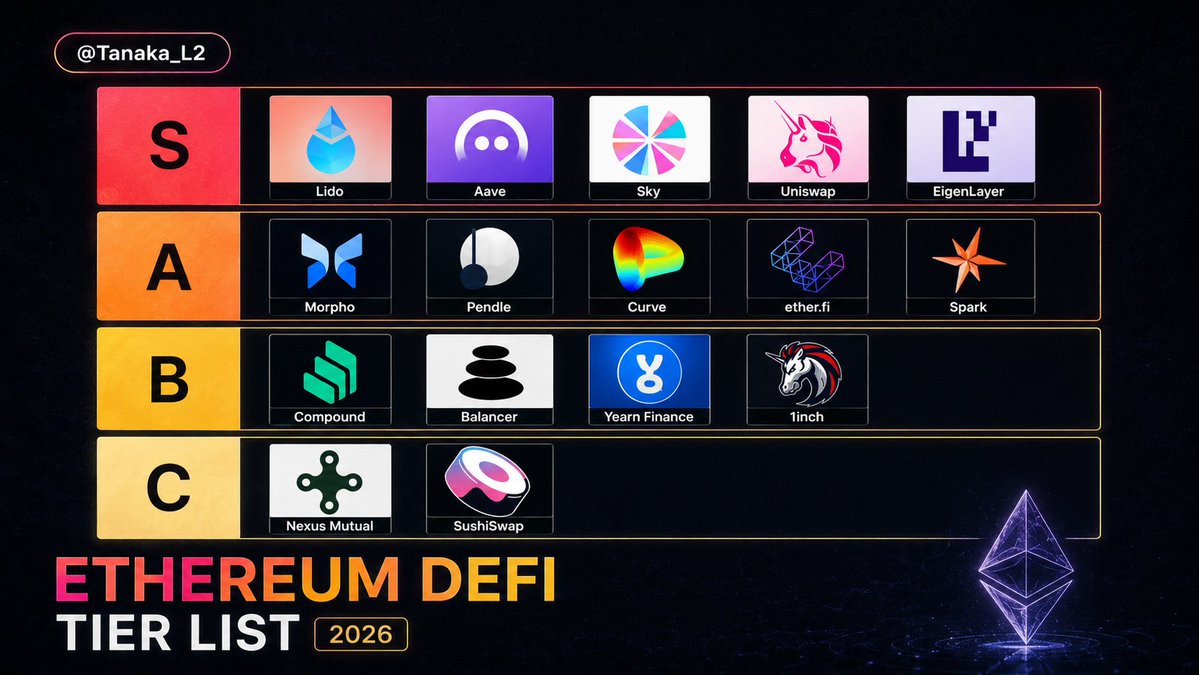
DeFi on Ethereum Tier List 2026, practical view 🧵
Lots of FUD around @ethereum recently, so let’s look at Ethereum DeFi through a simple Tier List.
[1] S Tier: Core Ethereum DeFi infra
– @LidoFinance: liquid staking, with stETH becoming a base asset across DeFi.
– @aave: blue-chip lending, flashloans, multi-chain, but still ETH-dominant.
– @SkyEcosystem: CDP/stablecoin infra, with DAI/USDS still highly relevant.
– @Uniswap: the leading DEX by mindshare, volume, and DeFi Lego position.
– @eigenlayer / @eigencloud: restaking leader and one of the strongest 2025–2026 growth pieces.
I see this group as the backbone of Ethereum DeFi.
[2] A Tier: Strong performers
– @MorphoLabs: optimized lending, competing directly with Aave in some markets.
– @pendle_fi: yield trading leader, benefiting from fixed yield and points trading demand.
– @CurveFinance: stablecoin DEX, still important for low-slippage swaps.
– @ether_fi: liquid staking/restaking competitor to Lido
– @sparkdotfi: lending/stablecoin infra within the Sky ecosystem.
This group may not always be the biggest, but the product-market fit is clear.
[3] B Tier: Solid mid-tier
– @compoundfinance: classic lending protocol with loyal users
– @Balancer: weighted pools and multi-asset AMM
– @yearnfi: legacy yield aggregator
– @1inch: high-volume DEX aggregator, even if TVL is not the main strength
I don’t see this group as hype-driven, but they still play real roles in DeFi.
[4] C Tier: Niche / Emerging active
– @NexusMutual: smart contract insurance
– @SushiSwap: older DEX, still active
– Smaller Ethereum RWA protocols
– Niche yield optimizers or CDP protocols
This group can be interesting if the niche is strong, but I would check TVL, revenue, and user growth carefully.
Bear markets are when people try hardest to find reasons to FUD projects and give up.
But after all the noise, $ETH will still exist because Ethereum still holds many of the most important DeFi layers: lending, DEXs, staking, stablecoins, restaking, and yield.
I still hold $ETH and believe in the future of decentralized financial infrastructure.
What DeFi protocol would you move up or down in this tier list?
31
5
150
14,374


Jun 15
This is actually one the harder ones to determine because truthfully both these sequencers a clunky & not ideal, somewhat surprised nobody has gtm with something better yet.
1
1
43

Jun 15
RT @toly: Ethereum will be fine. DA roadmap will actually achieve trust minimized bridging into high tps sequencers, one of which may even…
28