
Continual learning for stateful agents. SOTA & pareto dominant—accuracy, speed, cost, efficiency. Memory that reasons. Built by @plasticlabs.
Joined April 2025
- Tweets 786
- Following 11
- Followers 5,211
- Likes 1,005
82 Photos and videos











Jun 10
RT @gillinghammer: lifeOS built w Codex
memory by @honchodotdev
codex automations fetch my:
- financials
- grocery & delivery app orders…
4
Honcho retweeted

Jun 10
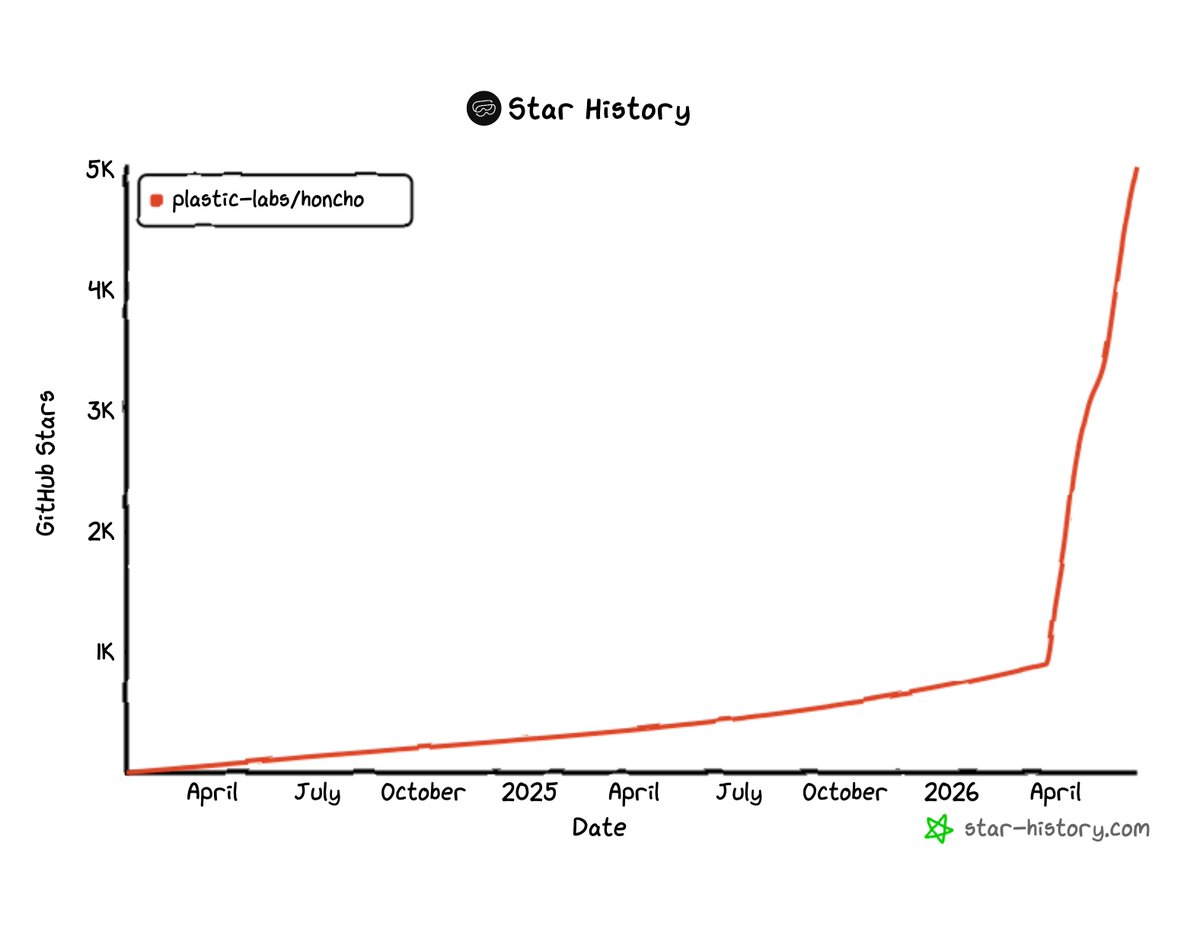
Congrats to the @honchodotdev team for passing 5K stars.
Honcho is the best solution for memory.
6
4
18
913

epic!!
~~ enable @honchodotdev and map each profile to its own peer --> boom!💥working per-profile memory.
your different profiles can use honcho_tools to query about what other hermes profiles are getting up to.
hermes-agent.nousresearch.co…
4
17
1,051
Jun 9
If you're using Honcho, your agent's memory can span every app at once.
One workspace, configured peers, every tool reading from the same representation.
Your Granola recording of standup is now queryable in Claude Code.
See how 👇
1
4
16
1,073
Jun 9
and if you're new here 👋 you can plug Honcho as a tool into basically any agentic tool you already use, right now → honcho.dev/docs/v3/guides/ov…
3
471
Honcho retweeted

Jun 6
兄弟们,别再拿 Hermes 当个普通工具用了,你可能根本没玩明白它真正的天花板在哪。
现在全网程序员已经把 Hermes 盘成了下一代 Agent 的生产级记忆引擎 智能搜索大脑 企业部署方案 代码灵魂 插件军团,一整套组合拳打下来,差距是真的拉开了:
1️⃣ honcho
🔗 github.com/plastic-labs/honc…
官方支持的外部记忆后端,结构化持久记忆,说白了就是让你的 Agent 真有记性。生产级记忆这回是真来了,不是画饼。
2️⃣ hermes-web-search-plus
🔗 github.com/robbyczgw-cla/her…
多引擎智能路由 质量报告 研究模式。搜索终于开始动脑子了,而不是给你甩一堆垃圾链接。
3️⃣ nemoclaw-community
🔗 github.com/NVIDIA/nemoclaw-c…
NVIDIA 官方亲自下场的社区,Hermes 加 NemoClaw 企业级扩展。GPU 优化加企业部署,方向感直接拉满。
4️⃣ hindsight
🔗 github.com/hindsightai/hinds…
代码库持久记忆后端,让 Agent 把整个 repo 记得明明白白。这已经是影子 CTO 级别的记性了,谁用谁知道。
5️⃣ hermes-plugins
🔗 github.com/42-evey/hermes-pl…
23 个实用插件,目标管理、Agent 桥接、成本控制全都有,妥妥的自主运维军团。
一句话,别人在升级装备,你还在用裸号打 Boss,这差距不就来了。

Jun 6

网盘限速这事儿,我真是忍它很久了!😤
夸克百度几百KB一秒,下个10G能等到头发白,开会员又肉疼得要命。现在有个不限速工具,免费党也能直接跑满速,白嫖党狂喜了属于是!
试试别谢我👇
🔗 pan.quark.cn/s/56b698cd1743
14
92
417
37,432

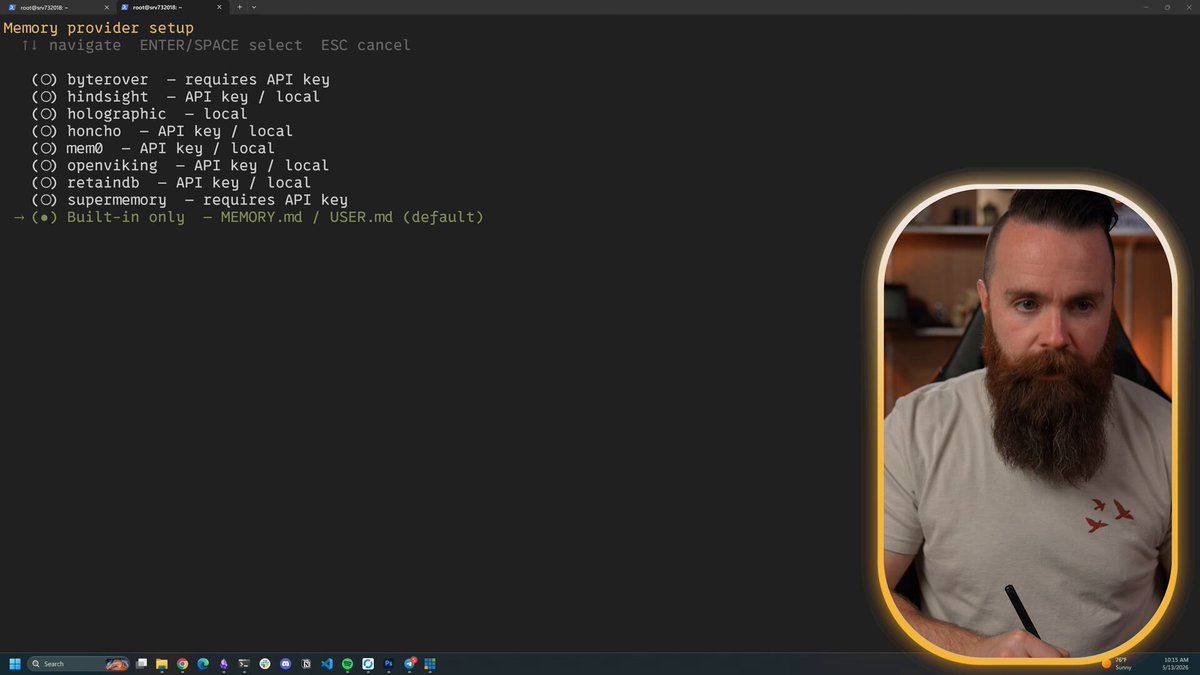
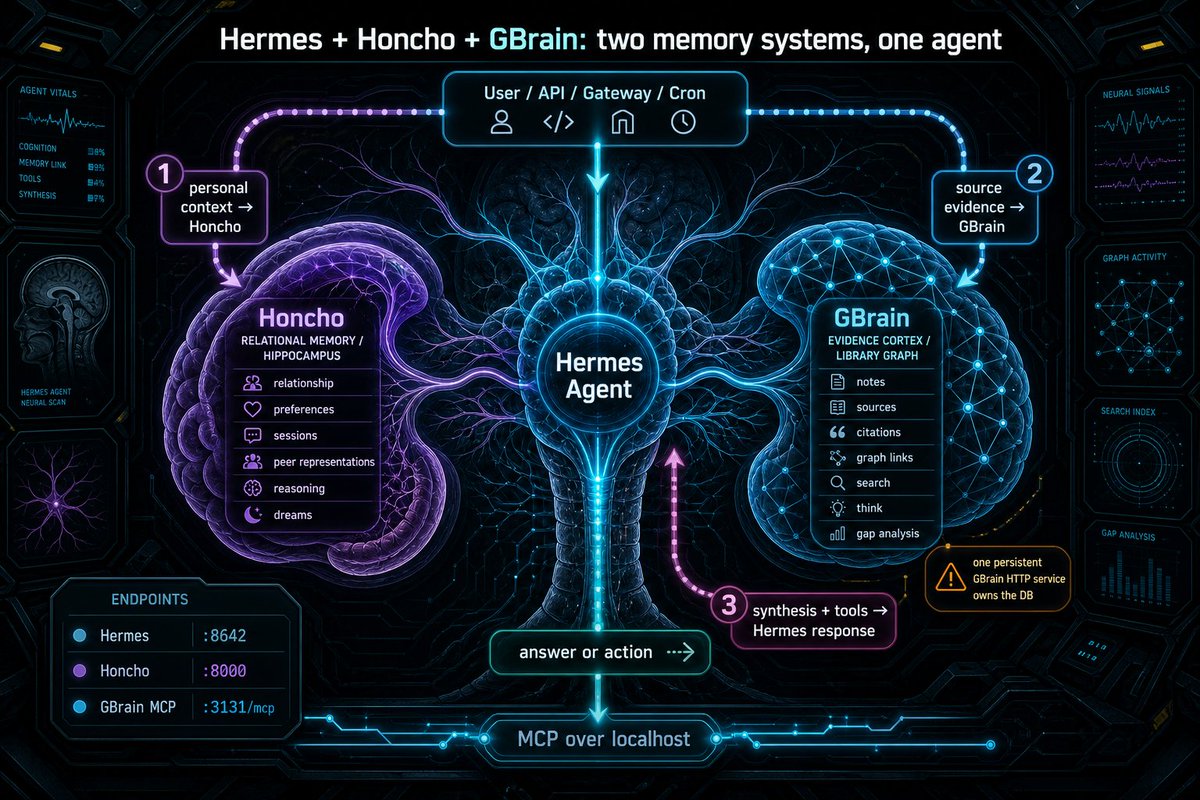
When I got my @NousResearch Hermes Agent running it came with @honchodotdev.
Honcho is a persistent memory that actually reasons about everything you and the agent do together which is genuinely next-level. The idea is that over time it will truly know you as a person. So I wanted to keep that.
Plus @plasticlabs has godlike taste on visual/design side of things so I never switched.
Then @garrytan dropped Gbrain and it blew off. I Wanted to try it but had no idea if it would play nice with Honcho. Asked around but no luck.
So I just asked Žofka (my Hermes) to figure it out. Turns out she loves Gbrain and it coexist with Honcho beautifully.
We put together a guide if you want anyone want to try:
github.com/elkimek/hermes-gb…
No warranties, been testing the combo just for a few days especially for my health picture but it looks like match made in heaven.
3
8
1,093
Honcho retweeted

May 24
Most "AI memory" is just a search box: store fact, retrieve fact.
@honchodotdev (Honcho) by @plasticlabs "dreams" — runs in the background and infers what you never said. mention 2 kids' ages once → later it knows you're a parent.
recall is commoditized. understanding is the moat. #AIAgents #AIMemory #LLM #OpenSource

3
7
426
Honcho retweeted

May 29
You can check out open-source memory frameworks like @honchodotdev (by @plasticlabs ) to see this reasoning-first approach in action. Or create your own and integrate into @NousResearch 's Hermes assistant. Great weekend project.
3
4
540
Honcho retweeted

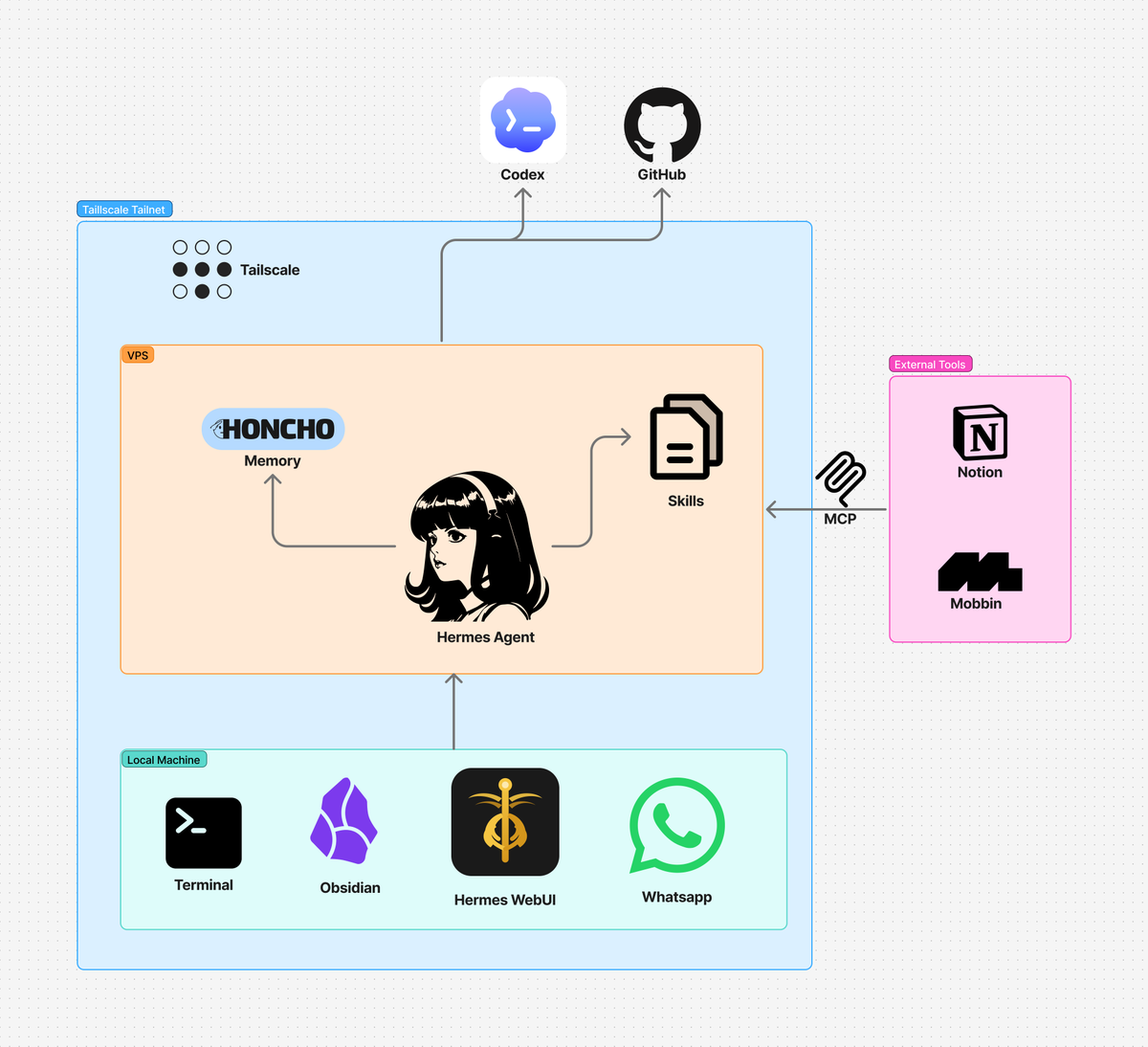
Here's my Hermes(by @NousResearch) architecture. It's pretty much evolving daily, I'm adding/testing new tools that help me overcome issues I face.
For example, I was running some tools on localhost(Hermes WebUI), but I had to SSH forward that port every time.
1
3
16
1,416
Honcho retweeted
I'm using @honchodotdev as memory since markdown memory files were not enough. Similarly @obsdmd as LLM wiki, @github for storing skills or coding, WhatsApp for notifications, chat and voice input etc.
1
2
3
348
@honchodotdev in the top 30 "god-tier" hermes plugins, letss goooo

6
16
3,049
Honcho retweeted

Jun 6
🧵 Honcho vs. Hermes built-in-Memory:
Why Honcho feels like upgrading from a sticky‑note diary to a living neural net for AI agents. If you’ve ever wished your AI remembered not just what you said but why you said it—and how it shapes your next move—read on. @honchodotdev
2/ 👥 Peer‑Centric Memory
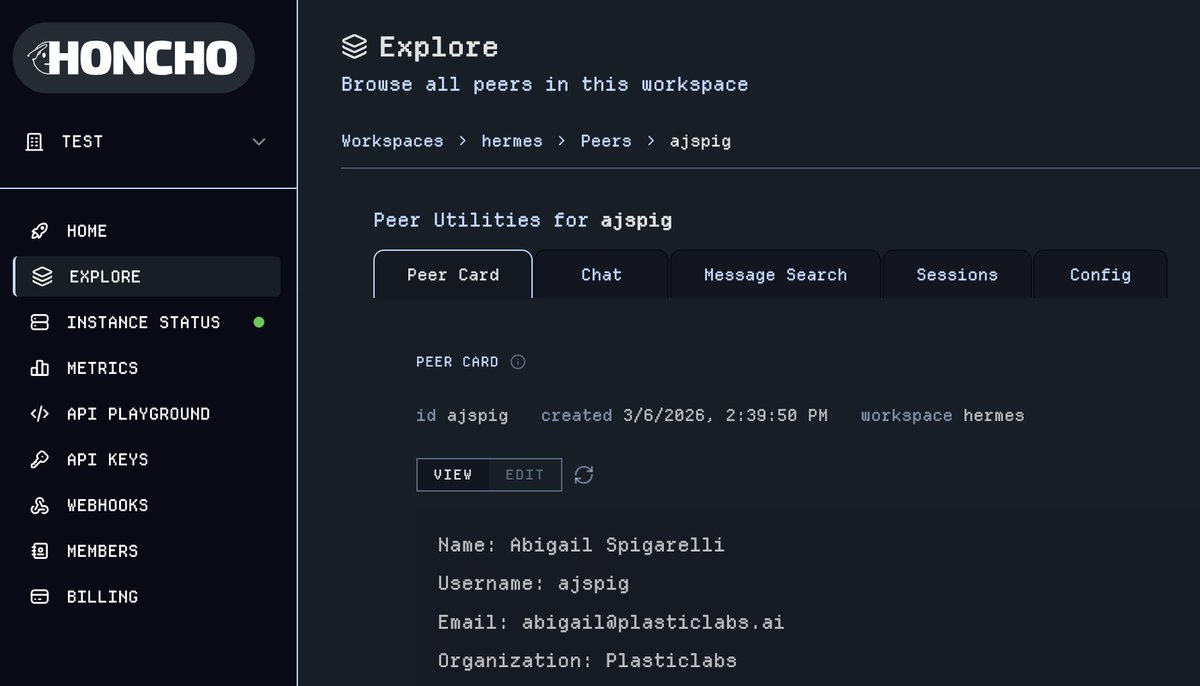
Hermes logs your words like a personal journal. Honcho treats every participant (you, any AI, other humans) as a peer in a shared social graph. Your interactions aren’t just stored; they’re observed, interpreted, and woven into a dynamic model of how you think, what you value, and how you relate to others.
3/ ⚙️ The Deriver: Your Unconscious Memory Architect
Where Hermes might stenograph your sentences, Honcho’s Deriver works like your hippocampus during sleep—distilling raw messages into conclusions (e.g., “Akash prefers vivid analogies when explaining AI tools”). Those conclusions become vectors that color every future interaction, turning noise into signal automatically.
4/ 🎯 Dialectic Agent: Contextual Intelligence on Demand
Honcho’s Dialectic isn’t a blunt recall tool; it’s a strategic forager in your memory forest. Before answering, it checks your auto‑built peer card, searches sessions for emotional resonance, and pulls only the conclusions truly relevant to this question. It’s like a co‑pilot who knows which wrench you’ll need before you ask.
5/ 🕸️ Multi‑Peer Sessions: AI That Plays Well With Others
Hermes memory is a solo act. Honcho turns every conversation into ensemble improv: it tracks who observes whom, whose ideas spark whose, and where consensus frays. Later, asking “What did the design agent think about my prototype?” yields an answer grounded in actual social dynamics—not a guess.
6/ 🔧 Configurable Observation Lenses
Want your coding agent to see your peer card but not your casual chats? Want the design AI to notice your frustration patterns during debugging? Honcho lets you sculpt exactly what each AI participant knows about you—no oversharing, no blind spots. Privacy and personalization, engineered.
7/ 💾 Vectorized Conclusions: Memory That Feels Similar
Honcho stores conclusions in vector space, so phrases like “I hate boilerplate” and “This repetitive code drains me” cluster together even if the wording differs. It retrieves by meaning, not just keywords, delivering insights that feel uncannily relevant because it thinks in concepts, not strings.
8/ 🌱 The Dreamer: Unconscious Innovation Engine
While you’re offline, Honcho’s Deriver (and optional Dreamer) recombines conclusions—connecting yesterday’s bug fix to today’s architecture chat—to generate novel insights you didn’t explicitly seek. This is memory that doesn’t just recall; it anticipates.
9/ 🚀 The Bottom Line
You don’t need to mention “Honcho” in your prompts. It works like breathing—automatic, foundational, invisible until you notice how much clearer your thinking feels. Your prompts stay human; Honcho does the heavy lifting of knowing why you’re asking.
💡 Open Q: If your AI could remember not just what you built, but how you felt while building it—what’s the first thing you’d ask it tomorrow morning?
(That’s the edge Honcho gives you: memory that doesn’t just store your past—it shapes your next move.) #AI #Honcho #Memory #AgenticAI @honchodotdev x.com/honchodotdev/status/20…
1
4
9
524
Honcho retweeted

May 27
Requests to @honchodotdev are now recovering and traffic is flowing properly.
Will continue to work with the team to implement more redundancies and guards to harden our infra and prevent future outages
3
5
19
3,708
Honcho retweeted

May 26
will be in SF for the next several days, if you’re a @honchodotdev user id love to buy you coffee
2
3
9
1,423
Honcho retweeted

May 26
we went from 1,000 to 10,000 provisioned honcho instances in a month and a half
anyone know killer platform engineers? we can't keep up with the infra demands
4
5
41
5,233
Honcho retweeted

May 23
Doing a massive Hermes deployment today. Full team, isolated VMs, @honchodotdev shared memory for the team.
This stuff is so fun.
@NousResearch
83
30
1,070
66,986
May 21
Importantly, a month of 🫡Honcho-powered Hermes usage
Perfect for supplementing the local markdown system
Memory is a reasoning task... and Chuck's just beginning to see the benefits 🚀
May 20

I'm switching to Hermes....
I've been using it for a month.....and I'm sold...moving all of my @openclaw agents to Hermes (@NousResearch)
Why? -----> youtu.be/QQEgIo4Juxg
Thank you to @Hostinger for sponsoring this video!

18
24
489
64,107