
BioTech - AI - Host of Latent Space AI for Science podcast
Joined April 2009
- Tweets 146
- Following 234
- Followers 155
- Likes 85
27 Photos and videos


Pinned Tweet

Jun 4
So much exciting news coming out of Axiom! So glad we got to sit down with you! @axiommathai @CarinaLHong
Jun 3

🆕Scaling Past Informal AI
latent.space/p/axiom
@axiommathai founder & CEO @CarinaLHong explains why math may be the missing path from code agents to AGI, why verified AI is about scaling brilliance not just fixing hallucinations, how Lean and formal proofs turn reasoning into a stronger reward signal, why Axiom sees the TAM as all AI-generated code, what it means to prove research conjectures in a self-verified way, and why the next bottleneck for AI may be not generation but verification.
3
170
RJ Honicky retweeted

Jun 11
A spicy podcast.
In the movie The Man Who Knew Infinity, Ramanujan became a much stronger mathematician after the Hardy made him write proofs.
Verification is for better generation, for optimal design.
Verified AI accelerates superintelligence, esp agentic superintelligence.
Jun 11

This past March, @CarinaLHong sat down with @latentspacepod for an episode on the Series A announcement.
"Verified AI sounds like eating broccoli and paying taxes, but to Axiom it's about scaling brilliance, compounding brilliance."
Agentic superintelligence needs Verified AI.
6
9
93
11,564
RJ Honicky retweeted

Jun 4
Our paper on ESMC, ESMFold2, and mechanistic interpretability for proteins is up on @biorxivpreprint!
We've made a few changes since the initial version went online last week.
1. We found an issue in the way we provided MSAs to OpenFold3. This led us to report lower performance of OpenFold3 on some benchmarks. This issue does not affect any of the other models evaluated.
2. We updated how we report results on Runs N' Poses to more closely match the original paper (counting only ligands with valid SuCOS similarity score). We also add a bar plot to the supplement that stratifies performance by similarity. This mostly changes the absolute values of the pass rate, not the relative performance of models.
3. Added some more BLI data to the supplement.
4. Added some missing citations, fixed typos, etc.
Check out the preprint here: biorxiv.org/content/10.64898…
2
25
144
12,210
Jun 5
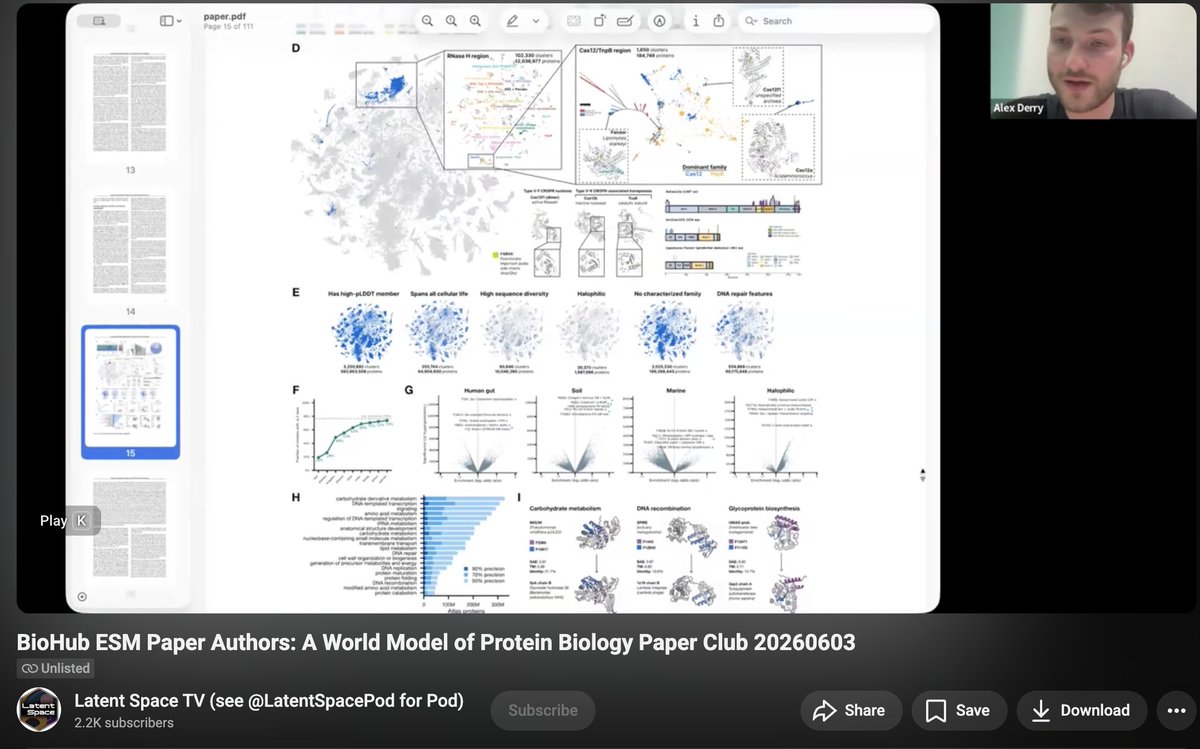
Thanks 1M to BioHub team for their awesome presentation of ESMC/ESMFold2/ESM Atlas paper at Latent Space Paper Club. @proteinrosh @THayes427 @awfderry @biohub
YT link in the comments 👇
3
2
39
3,081
Jun 2
ESMC/ESMFold2 authors to present at Latent Space Paper Club tomorrow!
Links in the comments. @alexrives @THayes427 @proteinrosh @biohub
2
5
32
2,539
Jun 2
I love it when a plan comes together! Congrats Ron, this is a huge milestone.

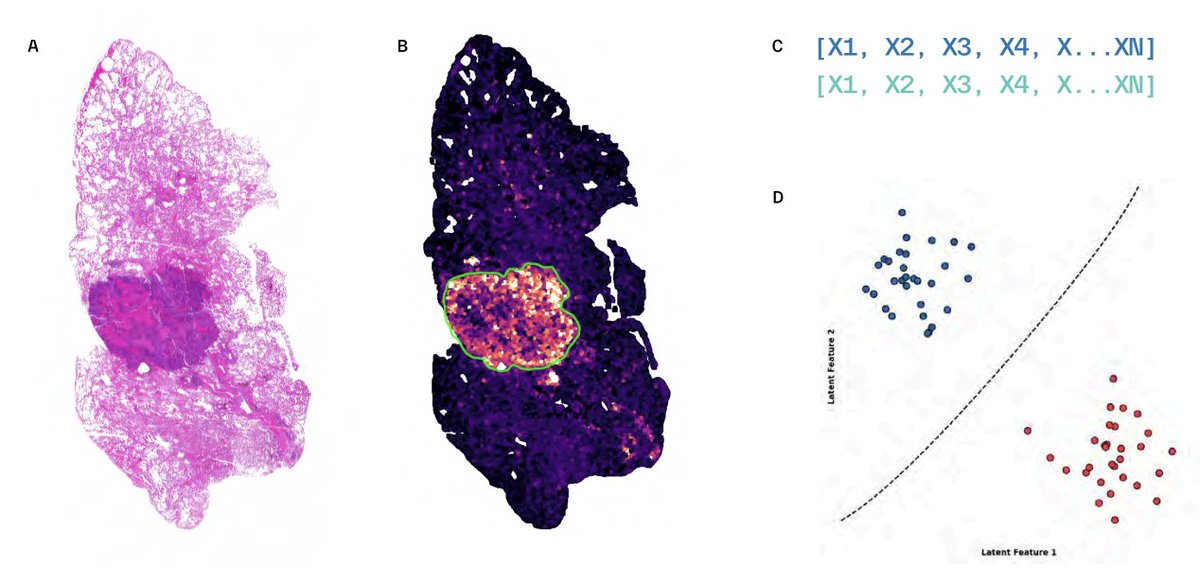
This weekend at ASCO, we shared first results using @NOETIK_ai TARIO-2 foundation models to predict patients likely to benefit using pre-treatment H&E alone (from actual clinical trial data with @Agenus_Bio!).
Some highlights below!
1
7
1,559
May 28
"genes are code" is always vague
I like:
cell nucleus → storage device / storage controller
ribosome → JIT-compiler and runtime
features from a world model (use a SAE) → functions
Proteins → processes
signaling pathways → workflows
Phenotypes → behaviors / outputs
@biohub
1
6
15
1,946
May 28
The ESMC/ESMFold2 release also includes ESM Atlas, which makes me very happy :). @biohub team delivers the data!
May 27
🆕Biohub’s Protein World Model: ESMC-6B, ESMFold2, 6.8B proteins, 1.1B structures, antibody design, SAEs, & the bitter lesson for biology latent.space/p/esmfold2
@biohub Head of Science @alexrives explains why biology may scale like language modeling, how metagenomics unlocked the next ESM scaling curve, why protein LMs can learn structure/function from sequence alone, how sparse autoencoders reveal biology inside the model, why ESMFold2 can beat specialized systems on antibody-antigen prediction, and how Biohub’s $500M Virtual Biology Initiative aims to build predictive models of cells, disease, and eventually physiology.
2
92
May 27
Love this summary of the paper. The paper is definitely worth the read!
May 27

I'm so excited to show the world what we've been working on the for the past months!! I'm going to highlight some of the fun results from this paper that I find particularly exciting.
2
62
RJ Honicky retweeted

May 5
🔬Doing Vibe Physics
The full story of how GPT‑5.x derived new results in theoretical physics and quantum gravity, live on our Science pod today!
latent.space/p/lupsasca
our conversation with @ALupsasca, an award winning theoretical physicist on his AGI-pilling journey applying GPT5 to physics problems (with a nudge from @markchen90)!
Timestamps
0:00 Introduction to Al's impact on physics research
0:43 Guest introduction: Alex Luposka
2:49 Alex joining OpenAl and the shift in physics research
4:08 The release of GPT-5 and the shift in capabilities
10:05 Explaining Quantum Field Theory and amplitude calculations
14:20 Overview of gluons and the strong force
14:38 Discussing the first research paper on single-minus gluon tree amplitudes
20:56 How ChatGPT helped solve a year-long physics puzzle
23:02 Complexity of manual calculations in physics
26:12 The history and mechanics of Feynman diagrams
27:44 The Parke-Taylor formula and the quest for simplification
31:26 Using ChatGPT to find the simplification in the special phase space region
38:07 Proving the formula from scratch to ensure validity
41:00 Determining the scientific impact and future research
42:27 Introduction to the second paper on graviton amplitudes
45:41 |
Defining particles, irreducible representations, and symmetry
47:46 How GPT Pro generalized the research to gravity
53:57 The epistemological shift: Is this a new way of doing physics?
59:27 The use of Al as a 'scout' for research directions
1:01:44 The role of 'taste' and collaboration with Al
1:10:23 Personal evolution from Al skeptic to resident scientist
1:12:46 Solving a black hole perturbation problem with GPT-5
1:16:34 Discussing whether Al can make original, conceptual leaps
1:20:09 Challenges of 'Al slop' and the future of academic publishing
1:23:13 The bottleneck of writing academic papers
1:30:19 Final takeaways and looking ahead to the next year

GPT-5.2 derived a new result in theoretical physics.
We’re releasing the result in a preprint with researchers from @the_IAS, @VanderbiltU, @Cambridge_Uni, and @Harvard. It shows that a gluon interaction many physicists expected would not occur can arise under specific conditions.
openai.com/index/new-result-…
3
4
13
21,182
Apr 29
Noetik’s AI value proposition: “cohort selection”
“When I do my drug’s clinical trials, who should participate?”
Obviously, if you get that wrong, then your drug won’t “work,” even if it actually works!
Ron Alfa explained to us how they do this using cheap imaging
1/
2
3
12
7,105
Apr 29
SubStack: latent.space/p/noetik
YouTube: youtube.com/watch?v=uqM8qjbL…
Spotify: open.spotify.com/episode/0tZ…
Apple: podcasts.apple.com/us/podcas…
108
RJ Honicky retweeted
Apr 20
🔬 Training Transformers to solve 95% failure rate of Cancer Trials
the AI for Science pod is back with @RonAlfa, CEO of @NOETIK_ai, and Daniel Bear, VP Research at Noetik, explaining exactly how their team of top AI x Bio researchers and engineers (shoutout @owl_posting) will use AI to cure cancer, by focusing on key bottlenecks like patient selection, and training large cancer foundation models like TARIO-2, an autoregressive transformer trained on one of the largest sets of tumor spatial transcriptomics datasets in the world... which first required years of blind faith in collecting good data to even get going:
1
4
21
18,246
Mar 31
Heather Kulik from @KulikGroup makes an subtle point here about building models based on literature.
Graphs and author interpretation can give different numbers. Heather's team built a model to predict the temperature at which a MOF breaks apart based on experiment reports,
1/n
3
52
Mar 31
SubStack: latent.space/p/materials
YouTube: youtube.com/watch?v=KSCCKCz2…
Spotify: open.spotify.com/episode/42R…
Apple: podcasts.apple.com/us/podcas…
1
32
Mar 31
@andrewwhite01/@EdisonSci- I know you just released a new literature agent. Does it read graphs?
@wellingmax/@cusp_ai - I think your agents use literature too. What are you doing?
3/n
30
Mar 31
but found a big discrepancy between the plots in the reports and the interpretation.
This is a good 60 seconds for anyone building scientific models based on literature.
2/n
19