
Software company advisor. Engineering trained in AI from get-go. Interests in ERP. Be excellent to each other #certacito
Joined July 2007
- Tweets 18,845
- Following 2,575
- Followers 1,508
- Likes 60,353
1,377 Photos and videos








clive boulton retweeted

18h
The stupidity of these @Stanford students to take the greatest opportunity for equality in humanity ever and to really free humanity and go walk out on @google and @sundarpichai that's pioneered that. Biased, idiotic, short-sighted and very selfish. Selfish because they ignored the bottom 3 billion people on this planet that could benefit from AI and they are worried about their misinformed selfish self-interest.
youtube.com/watch?v=wf74VXKT…

Stanford grads walk out as Google CEO Sundar Pichai takes the stage as commencement speaker. No mention of AI, unlike other uni speakers getting booed down this year. Story for @sfgate shortly
753
509
6,411
1,404,804


clive boulton retweeted

Jun 12
1
3
55

Jun 12
Jun 11

JEFF BEZOS JUST EMERGED FROM STEALTH WITH A $41 BILLION AI STARTUP CALLED PROMETHEUS
$12 billion raised. Valued at $41 billion. Coming out of stealth today.
The backers: Bezos personally, JPMorgan, BlackRock, Goldman Sachs, DST Global, and Arch Venture Partners.
The mission: do for engineering and manufacturing what large language models did for text.
Bezos is calling it an "artificial general engineer." Instead of training on words from the internet, Prometheus ingests data from the physical world to accelerate the manufacturing of skyscrapers, smartphones, jet engines, and everything in between.
In Bezos' own words: "Something that today was going to take 100 engineers 10 years to build, if you can change that to taking 10 engineers one year to build, you're just going to get way more things built."
This is Bezos' first CEO role since stepping down from Amazon in 2021. He's co-leading it with Vik Bajaj, former Google X executive.
(Source Semafor)

1
2
269
clive boulton retweeted

Jun 11
Taylor Swift can’t believe it. Larry David can’t believe it. Jerry Seinfeld can’t believe it. You better believe it. The Knicks just completed the greatest comeback in NBA Finals history.



3
4
25
4,377
clive boulton retweeted

Jun 11
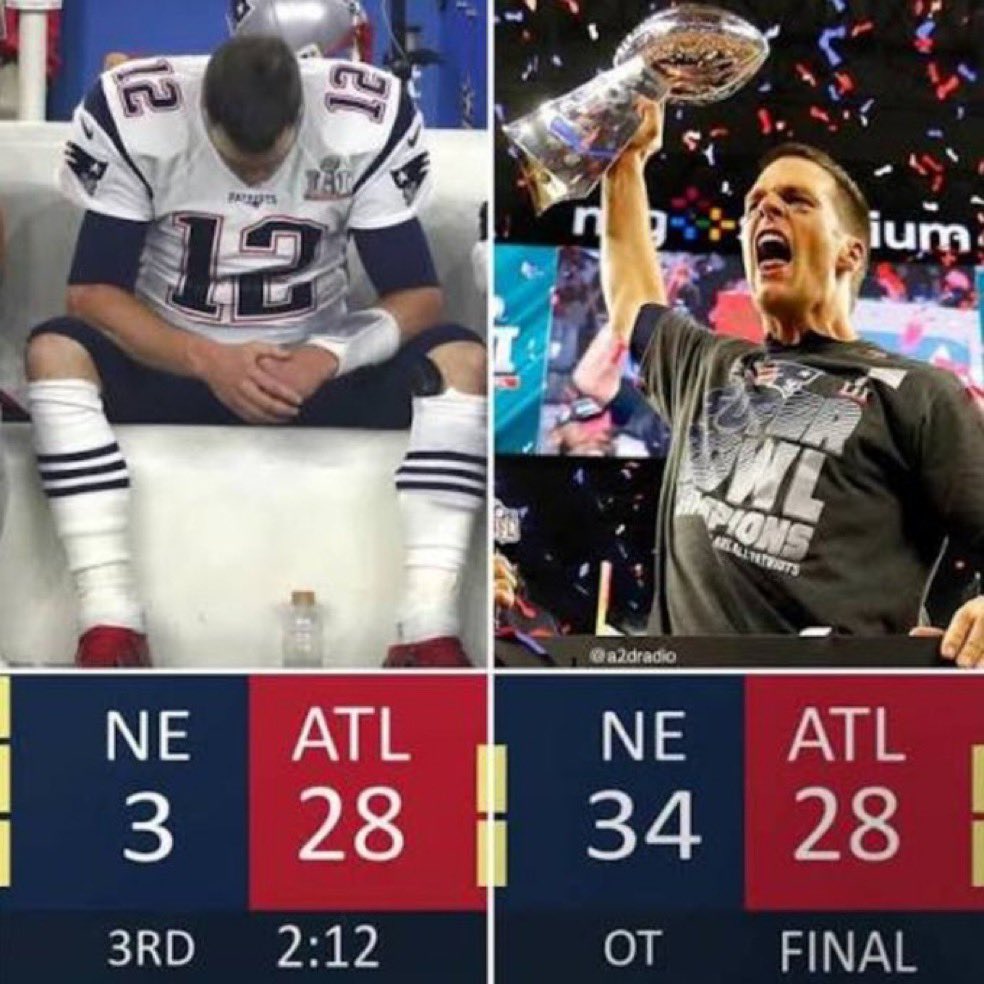
The Knicks wiping out the Spurs’ 29 point third-quarter lead was the NFL equivalent of:
638
2,243
26,735
1,214,196
clive boulton retweeted

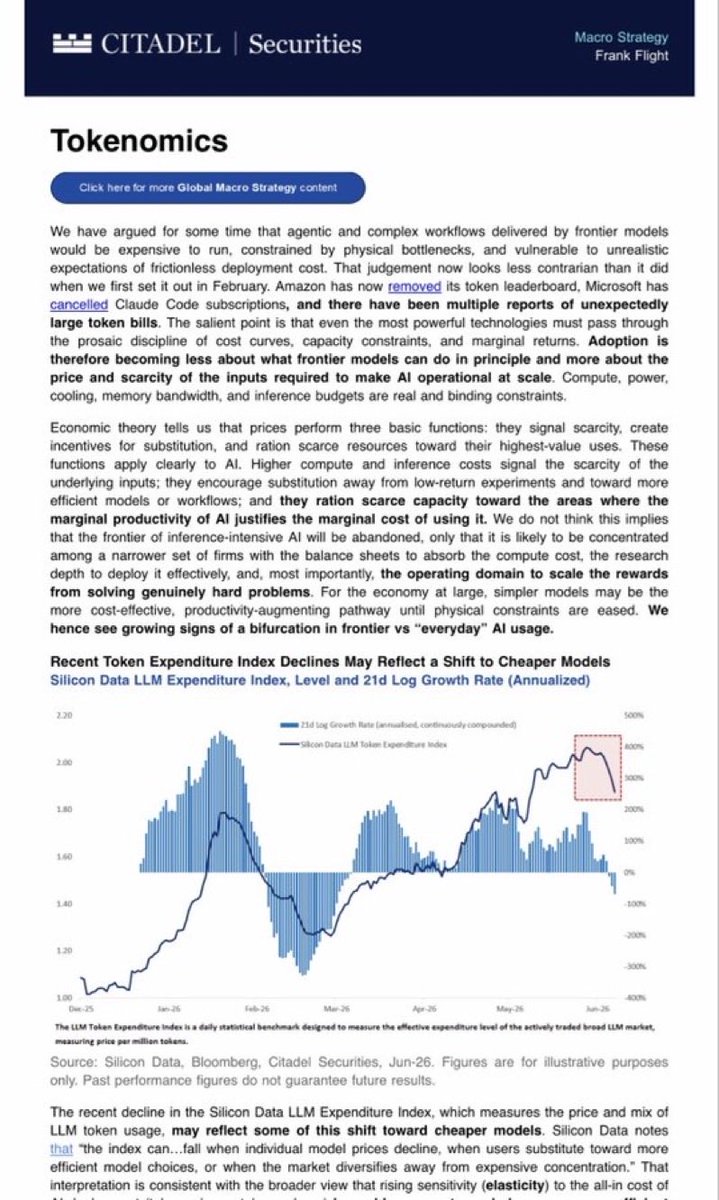
Citadel Securities just put institutional weight behind what the AI bulls won't say out loud.
In a new macro note titled "Tokenomics," Citadel makes the argument plainly: even the most powerful technology on earth still has to pass through the boring discipline of cost curves, capacity limits, and marginal returns.
The evidence is piling up:
– Amazon removed its token usage leaderboard
– Microsoft cancelled Claude Code subscriptions
– Multiple companies reporting unexpectedly massive token bills
Their conclusion is the part that matters.
Adoption is no longer about what AI can do in principle. It's becoming about the price and scarcity of the inputs needed to run it at scale. Compute. Power. Cooling. Memory bandwidth. Inference budgets. All real, all binding constraints.
And here's the kicker from the chart.
The Silicon Data LLM Token Expenditure Index, a benchmark for how much the market is actually spending on AI tokens, has started rolling over. Citadel reads it as a shift toward cheaper models. Companies substituting away from expensive frontier AI toward "good enough" alternatives.
That's economics 101 doing what it always does. When the price of something rises, people use less of it, or find a cheaper version.
Citadel sees a bifurcation forming. Frontier AI concentrated among a few firms with the balance sheets to absorb the cost. Everyone else quietly downgrading to simpler, cheaper models.
This is the part of every technology revolution the early narrative ignores.
The technology being real was never the question.
The question was always whether the economics could carry the valuations.
When one of the most sophisticated trading firms on earth starts writing about AI in the language of cost curves and rationing instead of limitless demand, the conversation has quietly changed.
The hype was about what AI could do.
The reckoning is about what it costs.
116
492
2,563
483,222
clive boulton retweeted
China aggressively undercut the world’s solar markets until it became a monopoly. Everyone thought falling solar panel costs reflected some sort of technological leap, and lapped up the cheap panels. But now it turns out none of this output was cost effective at these prices. And the sector has become too costly for China to support fiscally.
As a result, the West’s climate agenda faces losing its Chinese subsidy. This is going to add even more cost pressure to most households and make net zero even more unachievable without making everyone significantly poorer. But I disagree that China’s monopoly position can somehow be used as statecraft.
With prices normalised capitalism will revert to doing what it does best. All the Western manufacturers that China originally priced out (and who were actually innovating properly) will be back within a couple of years or less.

China’s solar industry just hit a massive structural turning point.
Facing 10 consecutive quarters of corporate losses and rampant overcapacity, Beijing is stepping in with aggressive fiscal interventions that just crashed solar exports by 40%.
Here is the real story
🧵 👇🇨🇳🌞

72
153
891
142,239
clive boulton retweeted

Jun 1
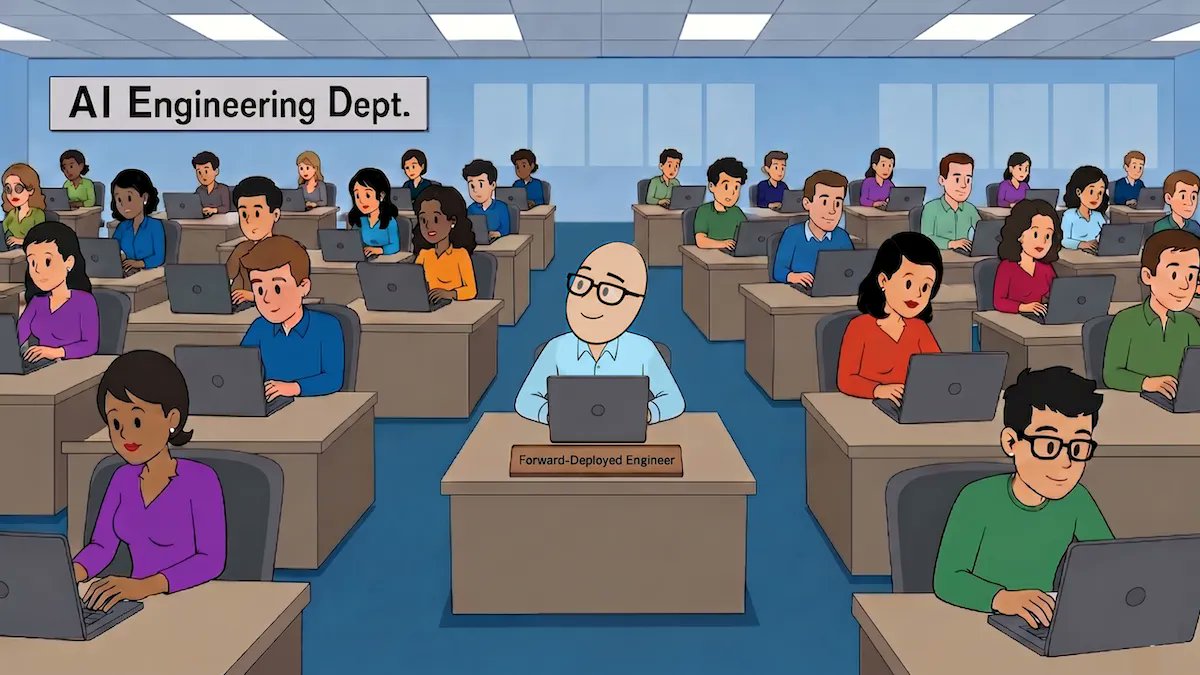
One of the new, buzzy jobs in Silicon Valley is the AI Forward Deployed Engineer (FDE), an engineer who is embedded within a client organization to help customize solutions, such as building and tuning agentic workflows that suit the client’s particular needs. I’ve heard from people who are wondering anew about the FDE career path since OpenAI and Anthropic started building new teams to place FDEs within client organizations.
The rise of FDEs for AI workloads is one way AI is creating new jobs (and why the jobpolcalypse narrative of upcoming job market collapse is false -- there will be many AI and non-AI jobs). However, I believe there will be far more AI Engineer jobs than FDEs, as I explain below.
The FDE role was pioneered about two decades ago by Palantir, which sent engineers to government locations to work on secure, air-gapped networks. In addition to having good technical skills, FDEs need communication skills and sometimes business skills. For example, they may need to speak with clients to understand their needs, formulate a strategy to prioritize projects, explain complex technology, and respectfully push back if a client asks for something unrealistic. They’re enjoying a resurgence because of the amount of work involved in taking an off-the-shelf LLM and building it into a custom agentic workflow that fits particular business needs.
However, I believe the number of AI Engineer jobs will be far larger. A company might accept a few FDEs to be embedded within its organization. But most companies will want far more of their own employees working on their projects. While my organizations do hire FDEs, we hire far more AI Engineers! Also, a common client concern is that it is hard to find vendor-neutral FDEs — they are, after all, there to deeply integrate a particular vendor’s product into a company. In this moment when it’s hard to predict which AI service will be the best one in a year’s time, optionality (the ability to pick whatever vendor turns out to fit best in the future) is very valuable. In contrast, letting FDEs tightly bind a company’s processes significantly reduces optionality.
Right now, I see surging demand for AI Engineers who can build software applications using AI software components (like LLM prompting, agentic frameworks, evals, etc.) and effectively use AI coding agents (like Claude Code, Codex, Antigravity CLI, and OpenCode). As the AI Engineer role matures, I expect it to fragment into more specialized roles, like the generic Software Engineer role from decades ago fragmented into frontend, backend, mobile, data engineering, devops, and so on.
What will be the future, specialized AI engineering roles? I don’t know. Perhaps there will be AI FDEs, LLMOps Engineers, Evals Engineers, AI Data Engineers, Harness Engineers, and other roles we don’t have names for yet. But for now, I see a lot of AI engineers who are generalists create a lot of value. Skilled AI Engineers are in very high demand! As our field continues to mature over the coming decade, I look forward to new specializations within AI Engineering that create even more job opportunities.
[Original text: The Batch newsletter]
320
730
4,478
550,713
clive boulton retweeted

May 29
There’s Never Been a Better Time to Study Computer Science: Even as AI progresses, coders aren’t doomed. theatlantic.com/technology/2… // Never thought I'd see this here, but here it is.
The article asks and answers the question about the value of a CS degree. I think this isn't quite the right question. In fact we've been asking this since CS departments were created in the 1960s and 70s and evolving ever since. Is Computer Science a discipline to be studied independently or a tool used in every discipline, and what is the ratio between those two.
Many CS departments were rooted in math as much as electrical engineering. In the 1960s as many departments were formed the question was always about "affinity"—is CS closer to math or to electrical engineering. Many schools saw the affinity with EE and the major/department was even EECS and course requirements included taking the intro sequences of EE courses. Those students did stuff with wire and multimeters.
Where I went to school, Cornell, the department was somewhat conflicted and while it was physically housed in the Engineering Quad, students in the Arts & Sciences school could major in it. Engineering students ended up taking more physics and chemistry than Arts students, and graduates were BS or BA depending on what school they were from. Employers didn't care and we never talked about it. Our common requirements included more abstract theory than other EECS-rooted departments. Other fields like Physics had unique engineering disciplines such as Applied Engineering Physics with CS being unique among those cross-registered majors. Just a few years ago, Cornell created a stand alone "College of Computing" that straddles the entire university.
Meanwhile every single university department was "using" computers: Statistics, Physics, and more. At Cornell all the Agriculture majors and even the Hotel School took classes in BASIC or Fortran programming.
Universities have long used modifiers on majors to indicate they are "in between" such as Political Science or Food Science (is there a _science_ to politics? is food science a part of chemistry or culinary 'arts'?) To some this signified "soft" or "not really science" while to others this was a signal of interdisciplinary importance. The science modifier often indicates this "softness" of study. It isn't clear to me this has fundamentally changed after almost 60 years.
The rise of AI along with the more modern competitive nature of universities is causing a rush to create, new more marketable majors that include AI in the title. Universities move much faster now than they did with the rise of computing. When I was in school many programs were still figuring out what to do to have a computer science major and many (even) new computer science faculty were trained in EE or Math.
It isn't nearly as clear what these new majors mean as AI has rapidly diffused to every department. There's a legitimate question right now as to what knowledge is foundational versus tactical or transactional.
As the PC and productivity tools like Word and Excel rose—including programming tools like VB and Excel macros—the separation between using a computer and studying computer science became super clear. Taking courses in how to use a spreadsheet or word processor were abundant but not a major in college. Trade skills vs. foundational skills were clear. No one majored in spreadsheets, but you majored in Finance Business, or Economics and used a spreadsheet. No one majored in word processing, but you majored in English, Marketing, or History and used a word processor.
In the 1980s **the big question** about studying computer science was "what programming language to learn?" The brand new AP CS test used Pascal even as many departments were not yet teaching that and it was controversial. The field seemed defined by languages. The joke was if you earned a PhD then you probably created a new language. Most every research group developed a language. Writing a compiler was a rite of passage as was fighting over the "best" programming language. Think I'm kidding, this was one of the earliest USENET memes: "Real Programmers Don't Use Pascal" by the legendary Ed Post. I think just about every computer terminal room and grad student office had a line printer version of this posted. ee.torontomu.ca/~elf/hack/re…
Departments hotly debated the choice of programming language and that choice came to define the rigor of a university. Pascal was good for teaching but no one used it in business where COBOL dominated and those building "systems" used C or those doing math used Fortran. If you got a specialized job in industry like building avionics you might use a language like JOVIAL or myriad others you would learn later at a company. It was also, importantly, viewed as the difference between studying "computer science" versus "computer programming." Science was a lifelong discipline. Programming was something like a trade-school skill.
My very first day of my very first class began with this very first statement from my professor (and later advisor), "In CS 100 you learn to program _into_ a language not _in_ a language." What he meant was we were learning the abstract skill of programming, not the bothersome syntax and paradigm of any single language. Thus my first programming language in school was not even the obscure language PL/1 (the union of Fortran and COBOL from IBM that mostly never took off) but an obscure research variant PL/CS that presumably made it more academic. When we complained about it not being practical, the department just said it didn't matter. I learned PL/1, Fortran, Ada, LISP, C, Pascal, ASM, and a half dozen other esoteric and forgotten languages, scripts, and libraries in the courses I took as well as COBOL during my internship. In addition we used at least a half dozen operating systems, a different one for each advanced course.
So today, this history is pretty important as the entire fields of "EECS" and programming are upended by AI. From 1980-2025 and even today, operating systems seemed to continue on the same path as all the textbooks and certainly whether you use Linux, Mac, Windows, iPhone, Android, or anything else you are using that foundation.
But architectures, processors, chips, networking, languages, even LLMs themselves are in an incredible state of flux. They are not improving on linear paths by any stretch. There are people inventing these new paradigms. Their knowledge and skills are rooted in computer science and EE. These skills are hardly going away. In fact the need for this foundational skill set is now greater than ever.
At the same time the rapid rise of LLMs and Agents has created an incredible demand for the skills to apply these tools/platforms to all the other work that goes on in society.
I double-majored in Chemistry. In the 1980s you didn't actually use a computer to major in chemistry, just goggles and test tubes. When you did use a computing device it was an embedded computer in a machine like a GC/MS. There was literally no programming done as a Chem major. That rapidly changed and in a few specialties—those closest to physics like molecular mechanics or physical chemistry—computing was rapidly becoming core. This was much like how Math was evolving.
AI is exactly like this today. I suspect that 2025 was the last year one could graduate college without a mandatory (implied or otherwise) use of AI, much like 1984 was the last year you could graduate college without using a word processor.
The question of this article is deep but also has an easy answer.
If you want to build the foundational tools for computing then become a computer science major where you'll be working on AI which will perfuse through the field the way programming languages did. If you want to apply AI to other fields then any course you take in those fields will use AI. And that use will look a lot like programming just as majoring in Math or Chemistry transitioned.
And most importantly, the specific AI model, user experience, features, and architecture will be wildly different 5, 10, 30 years into your career, whether you create the next foundation or just use it. I promise. Your major is not your lifelong toolset, but a lifelong foundation for learning.
2
12
47
10,065
clive boulton retweeted

May 24
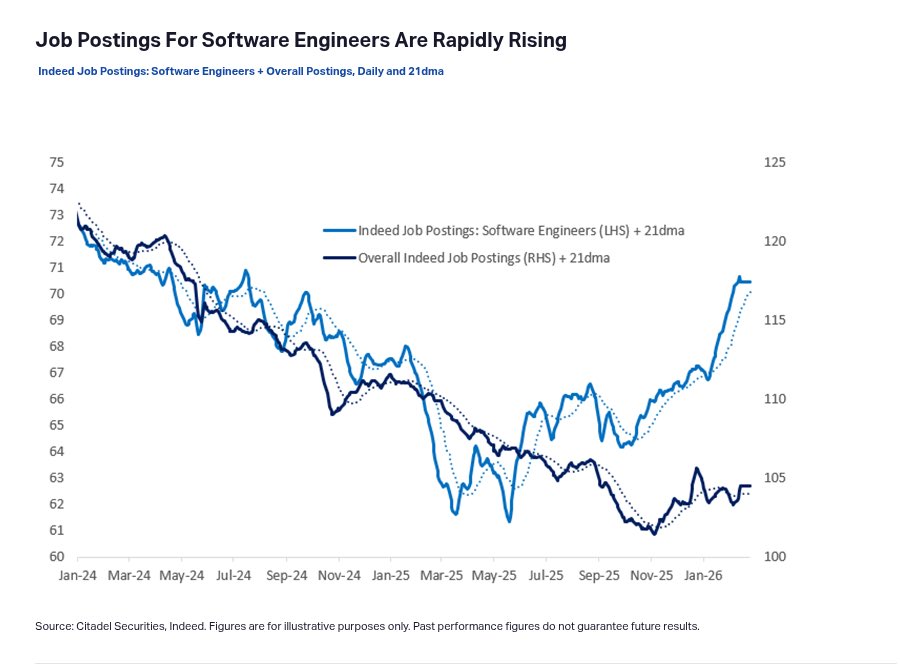
Q: How are job postings for software engineers rising rapidly despite AI agents automating coding?
A: Because there’s far more code to manage than ever before. We’re already seeing a 14x YoY increase in GitHub commits, and it’s accelerating.
AI has dramatically lowered the cost of writing code, so it’s now being used across far more businesses, applications, and use cases.
We’re at the beginning of a massive productivity boom driven by the proliferation of bespoke software throughout the entire economy.
Coding has been AI’s breakout use case this year. The fact that it’s increased demand for software engineers — rather than decreased it — should call into question the entire “AI will cause mass job loss” narrative.
827
1,466
9,113
1,630,717
clive boulton retweeted

May 21
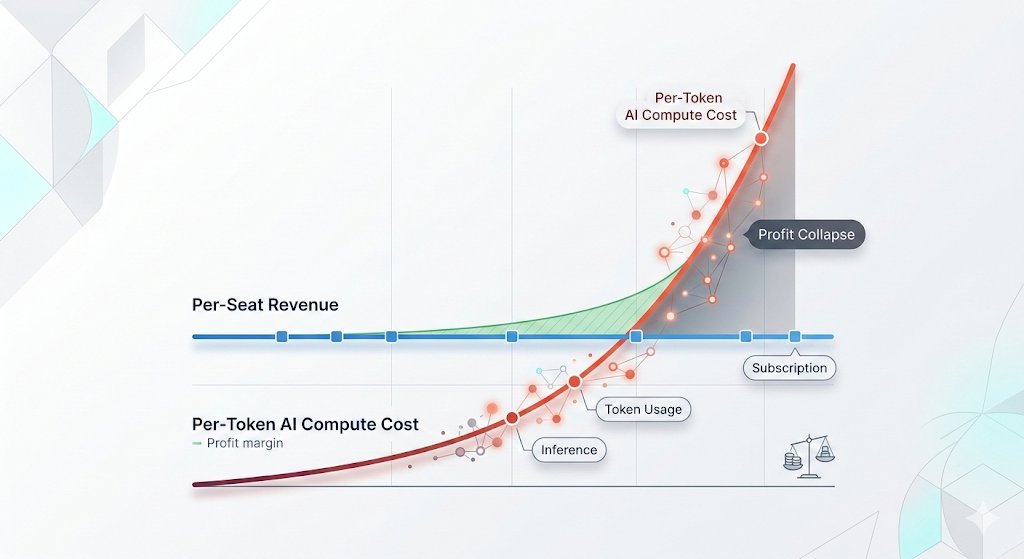
🦔Microsoft canceled its internal Claude Code licenses this week after token-based billing made the cost untenable, even for a company with effectively infinite cloud resources. Uber's CTO sent an internal memo warning the company burned through its entire 2026 AI budget in just four months. American AI software prices have jumped 20% to 37%, and GitHub (owned by Microsoft) is dropping flat-rate plans for usage-based billing across its products.
My Take
The AI subsidy era is ending in real time. The same company that put $13 billion into OpenAI and built the Azure infrastructure powering most of Anthropic's compute just looked at the bill from a competitor's coding tool and decided it was not worth paying. That is not a productivity failure on Anthropic's end. Token-based pricing is forcing every enterprise customer to confront the actual cost of running these models at scale, and the number turns out to be far higher than the flat-rate experiments suggested.
This ties directly to my Gemini Flash post yesterday. Anthropic, OpenAI, and Google all raised effective prices in the last six months. Enterprises that built workflows assuming AI costs would keep falling are now watching annual budgets evaporate in months. Two outcomes look likely from here. Either enterprises scale back AI usage to fit budgets, which slows the revenue ramp the labs need to justify their valuations ahead of IPOs, or the labs cut prices and absorb the losses, which makes the unit economics worse at exactly the wrong moment. Both paths land in the same place, the numbers stop working, and somebody has to take the writedown.
Hedgie🤗
1,076
3,997
19,916
8,325,988
clive boulton retweeted

May 19
C'est aussi époustouflant qu'inquiétant !
Voici la dernière vidéo deepfake en live faite par la boîte Incognia (spécialisée dans la prévention de la fraude).
Un employé superpose le visage de Will Smith sur le sien... en temps réel !
L'identité numérique n'a qu'à bien se tenir !
Les brouteurs ont de très beaux jours devant eux !
Les arnaques aux sentiments vont exploser !
Votre femme, votre mari, vos enfants, vos amis, vos potes, votre conseiller bancaire, tout est peut-être fake derrière une vidéo !
What a time to be alive!
274
2,712
5,948
877,933
May 17
(31:41) AI's impact on software: What SaaS thrives, what SaaS dies? #ensw cc @fscavo @jonerp @olivermarks @holgermu @dealarchitect
tl;dr Big ERP thrives, small erp is superseded
May 15

There is no substitute for bestie @DavidSacks … showed up black-shirted, caffeinated, & fully armed with enough crazy. Besties talked future of enterprise, AI agents that actually work (not just hype), and @chamath has enough truth China bombs to trigger all the Besties. Zero filter. Brilliant El Niño insight from @friedberg. I wasn’t ready for @Jason and neither was the group chat. Buckle up. This one’s XX spicy. 🌶️ 🚀 Check out the full episode here → youtu.be/jJRAvZNGUvI
1
4
233
clive boulton retweeted

I thought playing with LLMs was a time sink until I got a desktop wind tunnel. So much fun to see how the 1:18 scale models perform.

1
1
109
clive boulton retweeted

BREAKING: The Bill and Melinda Gates Foundation has sold 100% of its Microsoft, $MSFT, position which was a total of 7.7 million shares.

620
1,349
8,278
1,640,031
clive boulton retweeted

May 14
Moldova’s entry into the Eurovision Song Contest is called Satoshi. So I guess this is a Trumpian strategy to turn crypto enthusiasts into votes for Moldova.
eurovision.com/stories/satos…
2
7
2,797
clive boulton retweeted

Apr 29
Elon Musk avait dit un truc qui m'avait marqué sur l'allocation de ressources. En substance : passé un certain niveau de richesse, l'argent n'est plus de la consommation, c'est de l'allocation de capital.
Cette phrase change tout.
L'économie, dans le fond, c'est juste un problème d'allocation. Tu as des ressources finies et des usages infinis. Qui décide où va quoi ?
Imagine une cour de récré. 100 enfants, des paquets de cartes Pokémon distribués au hasard. Tu laisses faire. Très vite, un ordre émerge. Les bons joueurs accumulent les cartes rares, les collectionneurs trient, les négociateurs trouvent des deals. Personne n'a planifié. Et pourtant chaque carte finit dans les mains de celui qui en tire le plus de valeur. Le système maximise le bonheur total de la cour. C'est ça, la main invisible.
Maintenant fais entrer la maîtresse. Elle trouve ça injuste. Léo a 50 cartes, Tom en a 3. Elle confisque, redistribue, impose l'égalité. Trois effets immédiats. Les bons joueurs arrêtent de jouer, à quoi bon. Les mauvais n'ont plus de raison de progresser, ils auront leur part. Les échanges s'effondrent. La cour est égale, et morte. Elle a maximisé l'égalité, elle a détruit le bonheur.
Le problème de la maîtresse, c'est qu'elle ne peut pas avoir l'information que la cour avait collectivement. C'est le problème du calcul économique de Mises, formulé en 1920. L'URSS a essayé de le résoudre pendant 70 ans avec le Gosplan. Résultat : pénuries, queues, effondrement. Pas parce que les Soviétiques étaient bêtes, parce que le problème est mathématiquement insoluble en mode centralisé.
Quand Musk a 200 milliards, il ne les consomme pas, il les alloue. SpaceX, Starlink, Neuralink, xAI. Chaque dollar est un pari sur le futur. Et lui a un track record. PayPal, Tesla, SpaceX. Il a démontré qu'il sait identifier des problèmes immenses et y allouer des ressources avec un rendement spectaculaire.
L'État aussi a un track record. Hôpitaux qui s'effondrent, éducation qui décline, dette qui explose, services publics qui se dégradent malgré des budgets en hausse constante. Le marché identifie les bons allocateurs, la politique identifie les bons communicants.
Le profit n'est pas une finalité, c'est un signal. Il dit : tu as alloué des ressources rares vers un usage que les gens valorisent suffisamment pour payer. Plus le profit est gros, plus la création de valeur est grande. Quand Starlink est rentable, ça veut dire que des millions de gens dans des zones rurales ont enfin internet. Quand un ministère est en déficit, ça veut dire qu'il consomme plus qu'il ne produit. L'un crée, l'autre détruit, et on appelle ça redistribution.
Dans nos sociétés il y a deux catégories d'acteurs. Les entrepreneurs et les bureaucrates. L'entrepreneur prend un risque personnel pour identifier un problème, mobiliser des ressources, créer une solution. S'il se trompe il perd. S'il a raison, ses clients gagnent, ses employés gagnent, ses fournisseurs gagnent, l'État collecte des impôts. Il est la cellule de base du progrès humain.
Le bureaucrate ne prend aucun risque personnel. Son salaire est garanti. Au mieux il maintient une rente existante. Au pire il la détruit par excès de réglementation, mauvaise allocation forcée, incitations perverses qui découragent ceux qui produisent. Mais dans aucun cas il ne crée.
Regarde les 50 dernières années. iPhone, internet civil, SpaceX, Tesla, Google, Amazon, Stripe, mRNA, ChatGPT. Toutes des inventions privées, portées par des entrepreneurs, financées par du capital risque. Pas un seul ministère n'a inventé quoi que ce soit qui ait changé ta vie au quotidien.
La France est devenue le laboratoire mondial de la dérive bureaucratique. 57% du PIB en dépenses publiques, record absolu. Une administration tentaculaire, une fiscalité qui pénalise la création de richesse. Résultat : décrochage face aux États-Unis, à l'Allemagne, à la Suisse. Fuite des cerveaux. Désindustrialisation. Dette qui explose.
Et le pire c'est que la mauvaise allocation s'auto-renforce. Plus l'État prélève, moins les entrepreneurs créent. Moins ils créent, moins il y a de base fiscale. Plus l'État s'endette et taxe. Boucle de rétroaction négative parfaite. La maîtresse pense qu'elle aide, et chaque année la cour produit moins.
Dans nos sociétés, ce sont les entrepreneurs, toujours, qui font avancer la civilisation. Les bureaucrates au mieux maintiennent une rente, au pire la détruisent. Aucune société n'a jamais progressé en taxant ses créateurs pour subventionner ses gestionnaires.
La question n'est jamais qui a combien. C'est qui alloue le mieux la prochaine unité de ressource pour maximiser le futur de l'humanité. La réponse depuis 200 ans n'a jamais changé. Ce ne sont pas les fonctionnaires.
3,271
16,374
61,835
81,664,242
clive boulton retweeted

Apr 25
Check out the schedule for today's sessions and events! Hope to see you at LinuxFest Northwest 2026! lfnw.org/schedule/

1
3
301