
An ordinary coder by title, a backend enthusiast by passion, and a data engineer at heart.
Joined October 2015
- Tweets 5,091
- Following 1,829
- Followers 170
- Likes 18,536
200 Photos and videos







Pinned Tweet

2 Jan 2023

1
8
1,278
Prathamesh Mane retweeted

Jun 15
Tomorrow folks
P.S - This will be beneficial only:
1. If you've gone through the syllabus once
2. seen some practice questions
3. Last minute revision

Jun 15

I passed the AWS Solutions architect associate exam last year
I have some decent notes for the famous tricks that are used in the exam
If some folks on my TL are interested, I can write an article about all those tricks (for revision)
It won't be an elaborative one, just a last-minute helper for the exam
2
1
30
586
Prathamesh Mane retweeted
Jun 14
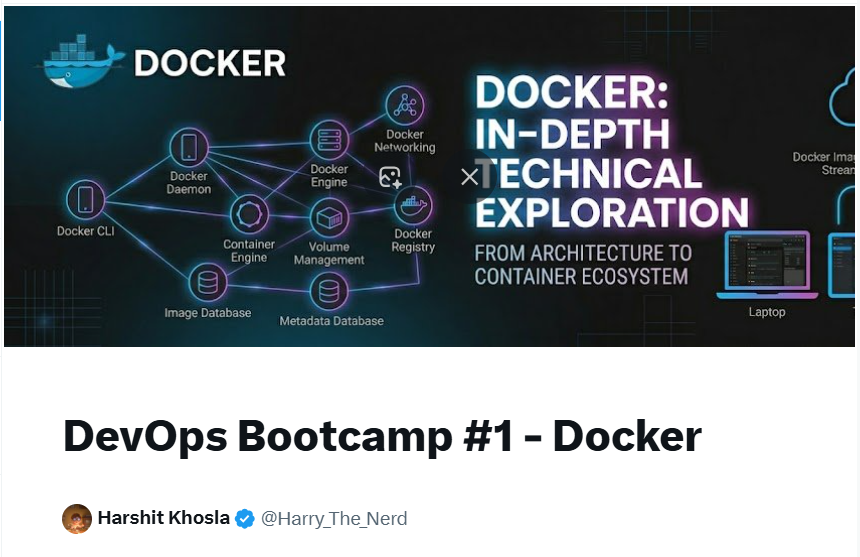
Along with the HLD, LLD, backend series (this will have 5-6 more articles that's it), I'm gonna start working on DevOps-related articles (since I'm a DevOps engineer at work hehe)
11
2
64
1,600
Prathamesh Mane retweeted

Jun 14
If I had 6 months to become an Agentic AI Engineer.
I'd do this.
Stage 1: Python Async Foundations
asyncio, FastAPI, event-driven architecture, error handling, API integration patterns.
Stage 2: LLM Fundamentals for Agents
Context management, model routing, token economics, latency tradeoffs, failure modes.
Stage 3: Tool Calling Structured Outputs
Pydantic validation, function calling schemas, error recovery, dynamic tool discovery.
Stage 4: Memory State Management
Short-term buffers, long-term vector recall, context compression, cross-session sync.
Stage 5: Single Agent Workflows
ReAct loops, plan-and-execute, self-reflection, iteration limits, graceful degradation.
Stage 6: Multi-Agent Orchestration
LangGraph/CrewAI, supervisor patterns, message passing, conflict resolution, handoffs.
Stage 7: Human-in-the-Loop Systems
Uncertainty detection, approval gates, audit trails, resume logic, intervention points.
Stage 8: Evaluation Quality Assurance
Automated eval harnesses, LLM-as-a-judge, regression testing, hallucination metrics.
Stage 9: Observability Tracing
Distributed tracing (LangSmith/Arize), cost dashboards, latency monitoring, alerting.
Stage 10: Security Guardrails
Prompt injection defense, output filtering, PII redaction, sandboxed execution, compliance.
Stage 11: Production Deployment
vLLM/SGLang, Kubernetes scaling, CI/CD for agents, canary releases, rollback strategies.
Stage 12: Open Source Portfolio
Ship autonomous agents publicly, write architecture docs, record demos, contribute to libs.
Most people stay stuck watching tutorials.
Builders get hired.
(Bookmark it)
79
398
2,922
184,479

15 AI founders you should follow on Twitter:
@sama = founded OpenAI
@AravSrinivas = founded Perplexity AI
@karpathy = ex-founding member at OpenAI
@darioamodei = founded Anthropic
@demishassabis = founded DeepMind
@hwchase17 = founded LangChain
@adcock_brett = founded Figure AI
@AndrewYNg = founded DeepLearning. AI
@jeremyphoward = founded fast. ai
@DrJimFan = leads AI robotics at NVIDIA
@natfriedman = ex-CEO of GitHub
@swyx = founded Smol AI
@levelsio = founded PhotoAI
@fchollet = founded Keras
@rasbt = underrated ML educator
54
41
341
30,180
Prathamesh Mane retweeted

Jun 13
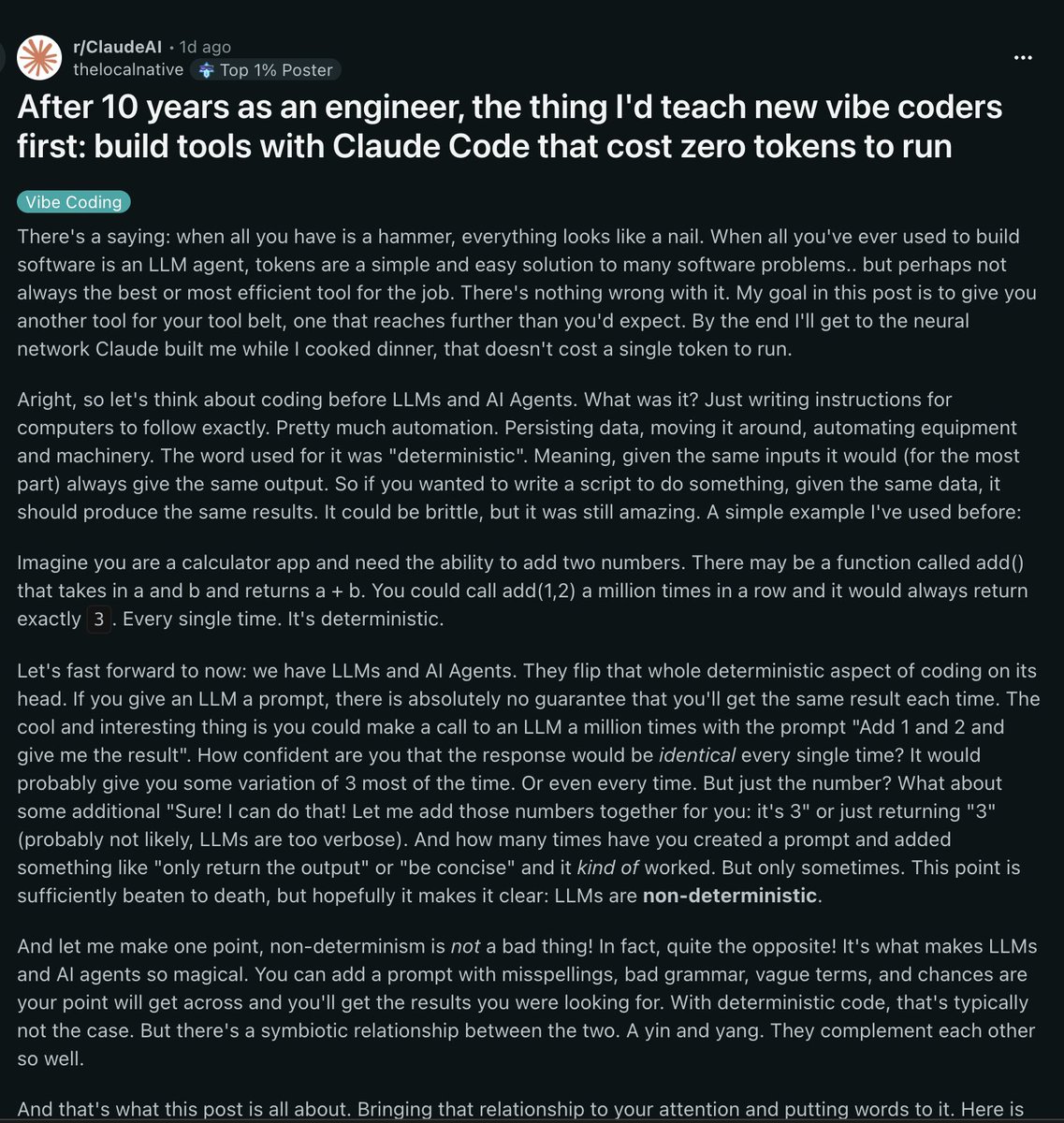
A guy on Reddit with 10 years of engineering experience just shared the one thing he'd teach every vibe coder first.
And it'll save you thousands in AI costs. 🤯
Most people using Claude Code use it the expensive way. They call the AI every time the tool runs. Every run burns tokens. Every token costs money.
His advice: flip it. Use Claude Code to BUILD the tool once. Then run it forever without spending a single token.
Simple example. You want to check a website daily for updates. The expensive way: have an LLM search the site every day. Burns tokens every single time.
The free way: use Claude Code to write a script that scrapes the page and alerts you if anything changed. Build it once. Runs forever. Zero tokens.
Then he took it further. He had Claude Code build him a full neural network something that used to take weeks and years of ML training while he cooked dinner.
It runs for free. No tokens. No API calls. Forever.
Spend tokens once to build it. Run it for free forever.
That's it. That's the insight most vibe coders are missing.
48
261
2,552
140,929
Prathamesh Mane retweeted

Jun 12
9
273
2,223
57,494
Jun 12
RT @ghumare64: If you want to go from AI beginner → AI builder & engineer, don’t just watch tutorials.
Build from great open-source repos.…
91
Prathamesh Mane retweeted

Jun 12
Getting hired as a SWE in 2026:
round 1 - DSA on whiteboard
round 2 - system design for 10M users
round 3 - live debug a prod incident
round 4 - solve P=NP in 45 mins
round 5 - fight the CTO in hand-to-hand combat
Round 6 is on you 👇
42
4
107
4,448
Prathamesh Mane retweeted

Jun 12
I've started a 25-day series on Scaling and Architecture.
One topic per day.
As a Principal Backend Engineer with 12 years of building systems at scale, I want to break down every concept I wish someone explained to me earlier in my career.
Day 1 was Load Balancing.
Today is Day 2: CDN.
Follow along if you're serious about system design. This will be worth your time.
12
40
594
41,616
Prathamesh Mane retweeted

Jun 11
As a Backend Developer, Slap yourself if you cannot clearly explain at least 10 of the following:
TCP congestion control algorithms
TLS 1.3 handshake internals
HTTP/2 multiplexing & HPACK
HTTP/3 QUIC packet loss recovery
Connection pooling pitfalls
Zero-downtime deployment strategies
Database transaction isolation levels (serializable vs snapshot)
B-tree vs LSM-tree index internals
Query planner & cost-based optimization
Deadlock detection & prevention
ACID vs BASE trade-offs
Two-phase commit vs Saga pattern
Distributed locking (Redlock pitfalls)
CAP theorem in practice
CRDTs & conflict-free replicated data types
Eventual consistency anti-patterns
Kafka partition rebalancing & exactly-once semantics
RabbitMQ dead-letter queues & message ordering
gRPC streaming flow control
GraphQL resolver batching & N 1 problem
OAuth2 token introspection vs JWT validation
Rate limiting algorithms (token bucket vs leaky bucket)
Circuit breaker bulkhead patterns
Observability: OpenTelemetry tracing propagation
Prometheus metric cardinality explosion
Log aggregation with sampling
Memory-mapped files vs traditional I/O
Garbage collection tuning (G1 vs ZGC)
Thread pools vs virtual threads (Project Loom)
Actor model vs shared-memory concurrency
Message-driven architecture (Akka / Orleans)
CQRS Event Sourcing projections
Outbox pattern for reliable events
Sharding strategies & hot partition avoidance
Read replicas lag monitoring
Database connection pool exhaustion
Prepared statement caching
Index bloat & vacuum strategies
Kubernetes pod disruption budgets
Service mesh traffic shifting
Serverless cold-start mitigation
API gateway throttling & caching layers
Background job queues (Celery / BullMQ) retry semantics
Distributed cache invalidation (cache-aside vs write-through)
Eventual consistency in cache
Idempotency keys in API design
Optimistic locking with version vectors
Paxos / Raft consensus internals
Byzantine fault tolerance basics
Chaos engineering principles
Database failover & split-brain prevention
Microservices observability (distributed tracing)
API contract testing (Pact / Spring Cloud Contract)
Backward-compatible schema evolution
Protobuf vs JSON performance trade-offs
Binary protocol parsing
Zero-copy networking (sendfile)
epoll / kqueue internals
Syscall overhead & context switching
Memory barriers & CPU cache coherence
Lock-free data structures
Bloom filters & HyperLogLog in practice
Consistent hashing for load balancing
Virtual memory & page faults impact
Container runtime security (seccomp, AppArmor)
Sidecar pattern limitations
Service discovery (Consul vs DNS)
Blue-green vs canary deployments
Feature flags with rollout strategies
Data pipeline backpressure handling
Exactly-once processing guarantees
Idempotent consumers in event streams
And if you only know 10 — kindly return the “Senior Backend Developer” title. 😄
Jun 11

As a Frontend Developer,
Slap yourself if you cannot clearly explain at least 10 of the following:
Pointer events
ARIA live regions internals
Accessibility tree
Idempotent UI actions
Deterministic rendering
Priority inversion in async code
Speculative prerendering
Largest Contentful Paint (LCP)
Cumulative Layout Shift (CLS)
Interaction to Next Paint (INP)
First Input Delay (FID)
Long tasks API
PerformanceObserver API
Garbage collection timing
Detached DOM nodes
Browser memory leak detection
Streaming fetch response handling
AbortController
Backpressure in streams API
WebRTC
CRDT basics for collaboration
Offline conflict resolution
Optimistic UI rollback strategy
Event sourcing in frontend
Finite state modeling
Micro-frontend orchestration
Edge rendering
Server components
Selective hydration
Suspense boundaries
Render waterfalls
Scheduler priorities
Tearing in concurrent UI
Race conditions in UI state
Prototype pollution
DOM clobbering
Trusted Types
Content Security Policy (CSP)
CSRF vs XSS mitigation
SameSite cookie modes
CORS preflight
Preload vs Prefetch vs Preconnect
Priority hints
HTTP/3 and QUIC
ETag vs Cache-Control
Stale-while-revalidate
Cache invalidation strategies
Service Worker lifecycle traps
IndexedDB
MutationObserver cost
ResizeObserver loop limits
IntersectionObserver internals
Subpixel rendering
CSS containment
GPU acceleration in CSS
Paint vs composite vs layout
Browser compositing layers
WebAssembly integration
OffscreenCanvas
Transferable objects
SharedArrayBuffer
Web Workers vs Service Workers
Web Components interoperability
Custom Elements lifecycle
Shadow DOM
Module federation
Dynamic import chunking
Code splitting strategies
Tree shaking internals
Render blocking resources
Critical rendering path
Layout thrashing
Task starvation
Event loop (macro vs microtasks)
Stale closure problem
Memoization pitfalls
Referential equality
Immutable data patterns
Structural sharing
Virtual DOM diffing complexity
Fiber architecture
Reconciliation algorithm
Time slicing
Concurrent rendering
Streaming SSR
Islands architecture
Partial hydration
Hydration
And if you only know 10 — kindly return the "Senior Frontend Developer" title. 😄
56
241
2,162
224,986
Prathamesh Mane retweeted

This is genuinely brilliant fashion advice for Indian men.
16
336
3,109
102,366
Prathamesh Mane retweeted

Jun 7
Best YouTube Channels to Learn Languages & Communication:
1. English – English Addict with Mr Steve
2. Spanish – Dreaming Spanish
3. Japanese – Japanese Pod 101
4. Public Speaking – Charisma on Command
5. Writing – Brandon McNulty
6. Storytelling – Matthew Dicks
7. Debate Skills – Intelligence Squared
8. Body Language – Observe
9. Business Communication – Jeff Su
10. Vocabulary – Merriam-Webster
11. French – Français Authentique
12. German – Easy German
13. Mandarin Chinese – Yoyo Chinese
14. Arabic – Arabic Pod 101
15. Korean – Talk To Me In Korean
16. Italian – Italiano Automatico
17. Portuguese – Practice Portuguese
18. Hindi – Hindi Pod 101
19. Russian – Russian With Max
20. Sign Language – Bill Vicars
21. Accent Reduction – Rachel's English
22. Pronunciation – Sounds American
23. Grammar – English with Lucy
24. Listening Skills – TED Talks
25. Persuasion & Influence – Rhetoric & Persuasion
26. Presentation Skills – Toastmasters International
27. Confidence Building – Brian Tracy
28. Emotional Intelligence – Daniel Goleman Talks
29. Cross-Cultural Communication – Erin Meyer Insights
30. Speed Reading – Howard Berg
31. Memory & Vocabulary Retention – Loci Method
32. Slang & Informal English – English with Greg
33. IELTS Preparation – E2 IELTS
34. TOEFL Preparation – TST Prep
35. Debate & Critical Thinking – Jordan Peterson Lectures
36. Journalism & Reporting – Reuters Training
37. Screenwriting – StudioBinder
38. Poetry & Spoken Word – Button Poetry
39. Negotiation Skills – The Black Swan Group
40. Interviewing & Communication – Big Think
23
1,553
5,446
192,005
Prathamesh Mane retweeted

Jun 6
You need that serious start
🔥🔥
2
35
324
5,403


Prathamesh Mane retweeted

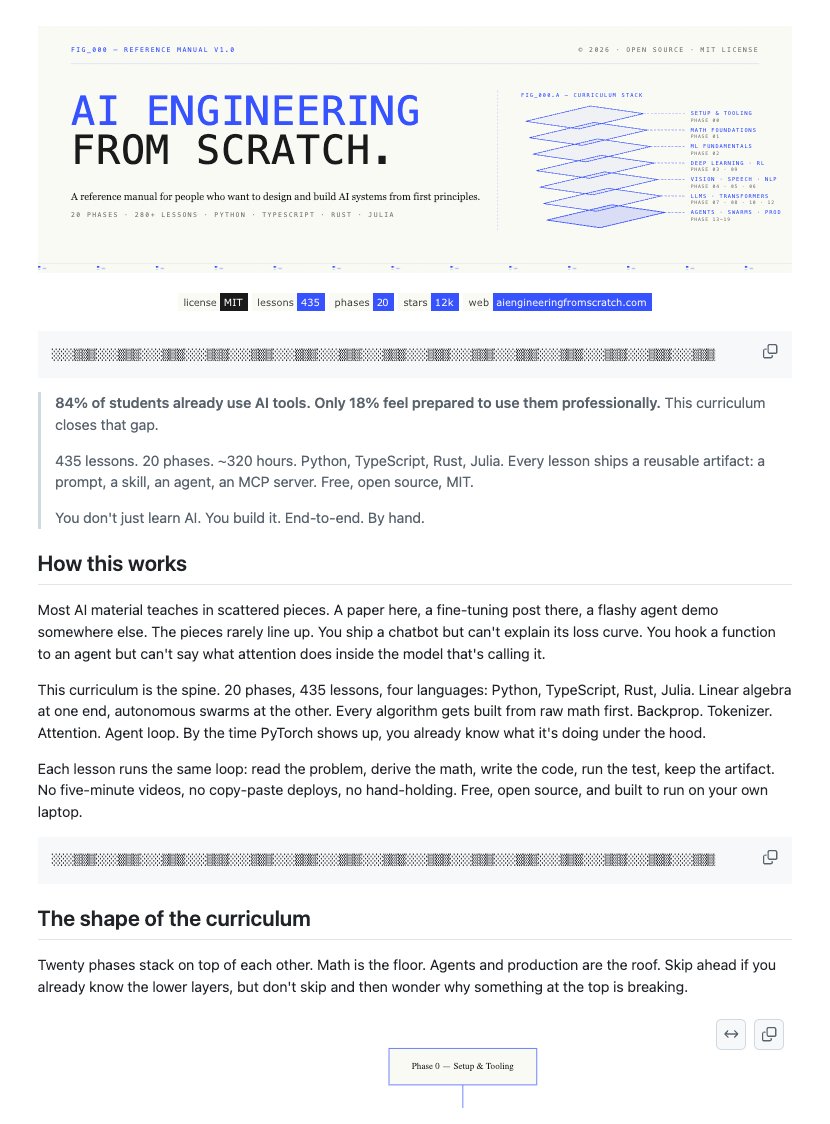
AI Engineering from Scratch.
503 lessons. 20 phases. 320 hours.
github.com/rohitg00/ai-engin…
Phase 00: Setup & Tooling (12 lessons)
Phase 01: Math Foundations (22 lessons)
Phase 02: ML Fundamentals (18 lessons)
Phase 03: Deep Learning Core (13 lessons)
Phase 04: Computer Vision (28 lessons)
Phase 05: NLP (29 lessons)
Phase 06: Speech & Audio (17 lessons)
Phase 07: Transformers Deep Dive (14 lessons)
Phase 08: Generative AI (14 lessons)
Phase 09: Reinforcement Learning (12 lessons)
Phase 10: LLMs from Scratch (22 lessons)
Phase 11: LLM Engineering (15 lessons)
Phase 12: Multimodal AI (25 lessons)
Phase 13: Tools & Protocols (23 lessons)
Phase 14: Agent Engineering (42 lessons)
Phase 15: Autonomous Systems (22 lessons)
Phase 16: Multi-Agent & Swarms (25 lessons)
Phase 17: Infrastructure & Production (28 lessons)
Phase 18: Ethics, Safety & Alignment (30 lessons)
Phase 19: Capstone Projects (85 lessons)
18
247
1,040
48,450
Prathamesh Mane retweeted

Should this resource get viral ?
100 European Tech Companies — Visa Sponsorship Directory
lets-code.co.in/startups-lis…
Canada-Based Remote Companies Hiring
lets-code.co.in/startups-lis…
UK-Based Remote Companies Hiring
lets-code.co.in/startups-lis…
US-Based Remote Companies Hiring
lets-code.co.in/startups-lis…
Germany-Based Remote Companies Hiring
lets-code.co.in/startups-lis…
Bookmark it!
14
53
2,914
Prathamesh Mane retweeted

Jun 4
Offers: 2
Dsa: Striver
DBMS: love babbar
OS: love babbar
CN: Gate Smashers
Oops: kunal kushwaha
Dsa problems solved: 1500
Now it's time to share yours....🦸♂️
18
16
182
7,373
Prathamesh Mane retweeted
Jun 4
If I had 6 months to become an ML Engineer.
I'd do this.
Stage 1: Python Data Engineering
pandas, numpy, SQL, Parquet/Arrow, API ingestion, data validation, pipeline orchestration.
Stage 2: ML Fundamentals Statistics
Linear algebra, probability, bias/variance, supervised/unsupervised learning, evaluation metrics.
Stage 3: Deep Learning Frameworks
PyTorch, training loops, backprop, CNNs/Transformers, optimizers, learning rate schedulers.
Stage 4: Feature Stores Pipelines
Feature engineering, preprocessing, data versioning, DVC, Airflow/Prefect, dbt integration.
Stage 5: Experiment Tracking Tuning
MLflow/Weights & Biases, hyperparameter optimization, cross-validation, reproducibility, model registry.
Stage 6: Model Deployment Serving
FastAPI, Docker, model registries, batch vs real-time inference, REST/gRPC endpoints, scaling.
Stage 7: LLM Integration GenAI
RAG pipelines, fine-tuning (LoRA/QLoRA), prompt engineering, embedding models, vector databases.
Stage 8: MLOps CI/CD
GitHub Actions, automated testing, model validation gates, continuous training, deployment strategies.
Stage 9: Monitoring Drift Detection
Data/concept drift, performance metrics, structured logging, alerting, automated retraining triggers.
Stage 10: Infrastructure Cloud Scale
AWS/GCP ML stacks, distributed training, GPU orchestration, Kubernetes, autoscaling, cost tracking.
Stage 11: Open Source Portfolio
Ship end-to-end ML systems publicly, write architecture docs, record demos, publish benchmarks.
Stage 12: Apply
ML Engineer, MLOps Engineer, AI Infrastructure Engineer, Data Science Engineering roles.
Most people stay stuck watching tutorials.
Builders get hired.
6
32
260
11,331
Prathamesh Mane retweeted

When life gets hard, watch this scene 1000 times.
8
480
2,177
63,245
Prathamesh Mane retweeted

Be a world-class BACKEND ENGINEER once you complete watching all these courses:
23
156
1,092
99,836