
6 Photos and videos
JernK retweeted

Mar 10
Current AI is reactive. You prompt, it responds. True proactivity requires predicting what you'll do before you ask.
Our new work done by @oshaikh13 formalizes this as Next Action Prediction (NAP ): given a user's computer use, predict their next action.
We annotated 360K actions across 1 month of continuous computer use from 20 users and open-sourced a pipeline for private-infra labeling. LongNAP combines parametric in-context learning to reason over long interaction traces.
This is one step closer to an assistant that proactively anticipates, not just reactively responds 🚀
Mar 10

What’s the point of a “helpful assistant” if you have to always tell it what to do next?
In a new paper, we introduce a reasoning model that predicts what you’ll do next over long contexts (LongNAP 💤).
We trained it on 1,800 hours of computer use from 20 users.
🧵
8
28
290
52,038
JernK retweeted

Mar 3
Over the past year, many people I talk to have expressed worry about two topics:
* Various aspects of the way the world is going: government control and surveillance, wars, corporate power and surveillance, tech enshittification / corposlop, social media becoming a memetic warzone, AI and how it interplays with all of the above...
* The brute reality that Ethereum seems to be absent from meaningfully improving the lives of people subject to these things, even on the dimensions we deeply care about (eg. freedom, privacy, security of digital life, community self-organization)
It is easy to bond over the first, to commiserate over the fact that beauty and good in the world seems to be receding and darkness advancing, and uncaring powerful people in high places are making this happen. But ultimately, it is easy to acknowledge problems, the hard thing is actually shining a light forward, coming up with a concrete plan that makes the situation better.
The second has been weighing heavily on my mind, and on the minds of many of our brightest and most idealistic Ethereans. I personally never felt any upset or fear when political memecoins went on Solana, or various zero-sum gambling applications go on whatever 250 millisecond block chain strikes their fancy. But it *does* weigh on me that, through all of the various low-grade online memetic wars, international overreaches of corporate and government power, and other issues of the last few years, Ethereum has been playing a very limited role in making people's lives better. What *are* the liberating technologies? Starlink is the most obvious one. Locally-running open-weights LLMs are another. Signal is a third. Community Notes is a fourth, tackling the problem from a different angle.
One response is to say "stop dreaming big, we need to hunker down and accept that finance is our lane and laser-focus on that". But this is ultimately hollow. Financial freedom and security is critical. But it seems obvious that, while adding a perfectly free and open and sovereign and debasement-proof financial system would fix some things, but it would leave the bulk of our deep worries about the world unaddressed. It's okay for individuals to laser-focus on finance, but we need to be part of some greater whole that has things to say about the other problems too.
At the same time, Ethereum cannot fix the world. Ethereum is the "wrong-shaped tool" for that: beyond a certain point, "fixing the world" implies a form of power projection that is more like a centralized political entity than like a decentralized technology community.
So what can we do? I think that we in Ethereum should conceptualize ourselves as being part of an ecosystem building "sanctuary technologies": free open-source technologies that let people live, work, talk to each other, manage risk and build wealth, and collaborate on shared goals, in a way that optimizes for robustness to outside pressures.
The goal is not to remake the world in Ethereum's image, where all finance is disintermediated, all governance happens through DAOs, and everyone gets a blockchain-based UBI delivered straight to their social-recovery wallet. The goal is the opposite: it's de-totalization. It's to reduce the stakes of the war in heaven by preventing the winner from having total victory (ie. total control over other human beings), and preventing the loser from suffering total defeat. To create digital islands of stability in a chaotic era. To enable interdependence that cannot be weaponized.
Ethereum's role is to create "digital space" where different entities can cooperate and interact. Communications channels enable interaction, but communication channels are not "space": they do not let you create single unique objects that canonically represent some social arrangement that changes over time. Money is one important example. Multisigs that can change their members, showing persistence exceeding that of any one person or one public key, are another. Various market and governance structures are a third. There are more.
I think now is the time to double down, with greater clarity. Do not try to be Apple or Google, seeing crypto as a tech sector that enables efficiency or shininess. Instead, build our part of the sanctuary tech ecosystem - the "shared digital space with no owner" that enables both open finance and much more. More actively build toward a full-stack ecosystem: both upward to the wallet and application layer (incl AI as interface) and downward to the OS, hardware, even physical/bio security levels.
Ultimately, tech is worthless without users. But look for users, both individual and institutional, for whom sanctuary tech is exactly the thing they need. Optimize payments, defi, decentralized social, and other applications precisely for those users, and those goals, which centralized tech will not serve. We have many allies, including many outside of "crypto". It's time we work together with an open mind and move forward.
745
754
4,006
654,226
JernK retweeted

Mar 3
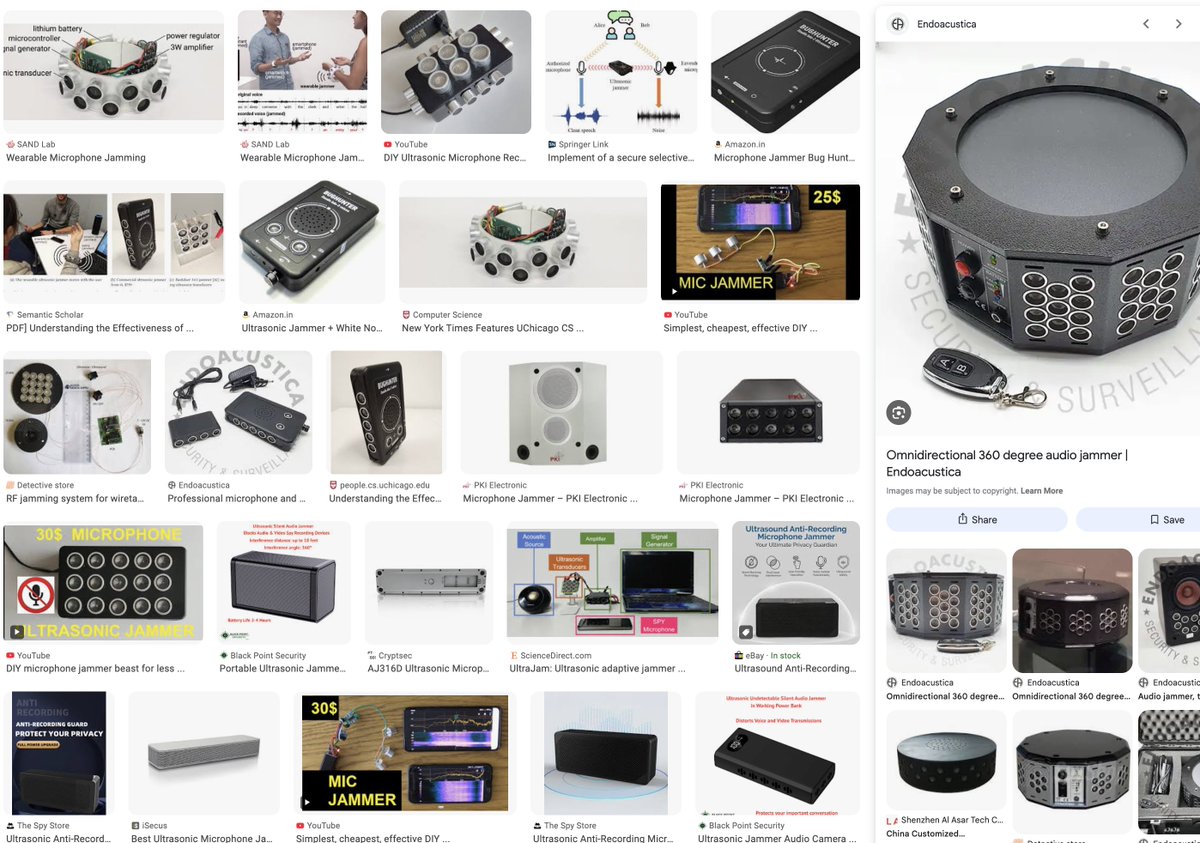
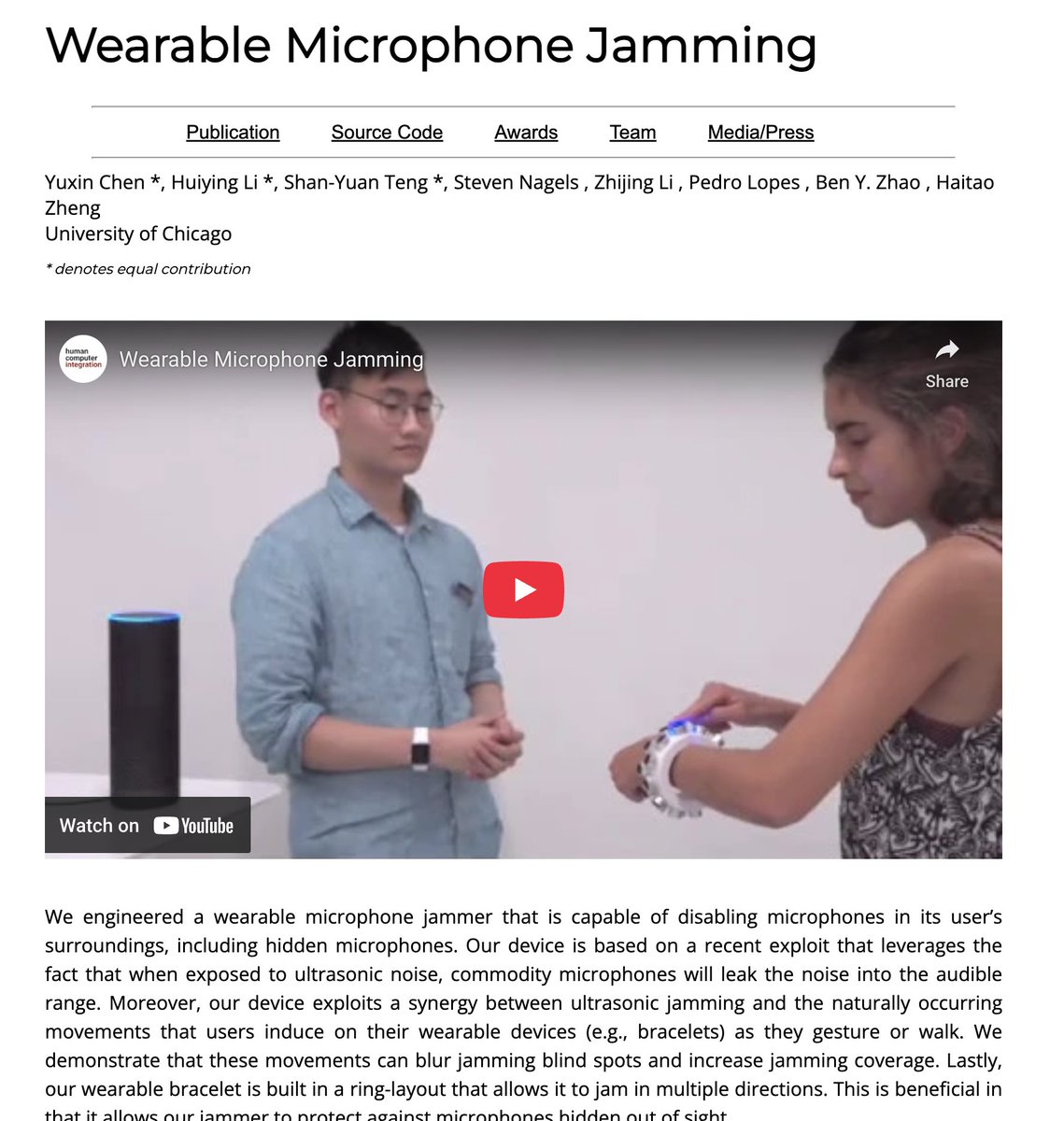
Seen this viral tweet about a portable audio jammer?
Looks cool, right? It also looks quite similar to 100s products sold on Alibaba & in spy shops for years. Or as DIY kits for $50 in parts.
They use ultrasonic noise to overwhelm very close-by microphones.
I'm skeptical about the price tag & way it's being marketed, and I'd like to share why: it seems to me that what differentiates this, aside from the privacy-aligned language, are claims that sound to me like they've developed "novel physics" & use AI to detect microphones. This would be extraordinary and would require equally extraordinary proof if true.
I suspect that the reality may be more like using WiFi etc to scan for devices. This is not novel physics. The problem: many of the microphones that people are most worried about don't emit wifi or bluetooth etc. Or could be a phone in airplane mode. Etc.
Additional issues around ultrasonic jamming? Complex range limitations, issues with room reflections, fabric absorbing emissions from your jammer, obstructions etc.. A phone in a fabric pocket might not be defeated by this device reliably, for example.
Critically also: the range of this kind of tech is the distance between the emitter and the microphone. Not between you and the unwanted microphone.
So if you are in a normal size room and the microphone is, say, 3 meters from you in the ceiling, or on the other side of the couch, it might well still hear you clearly.
Consider asking your friendly local expert in audio, physics, or security before purchasing or investing in this product.
I'm not one of those. Source of my understanding: I spent some time a few years ago planning to assemble such a device and read a lot of papers. I may be wrong in my understanding (or missing something!) and would happily correct if I've misunderstood what they are offering.
To learn more about this popular and well-known category of object, watch @LinusTech from a year ago youtube.com/watch?v=FyeCn7Hl…

66
267
2,559
143,117
JernK retweeted

Mar 3
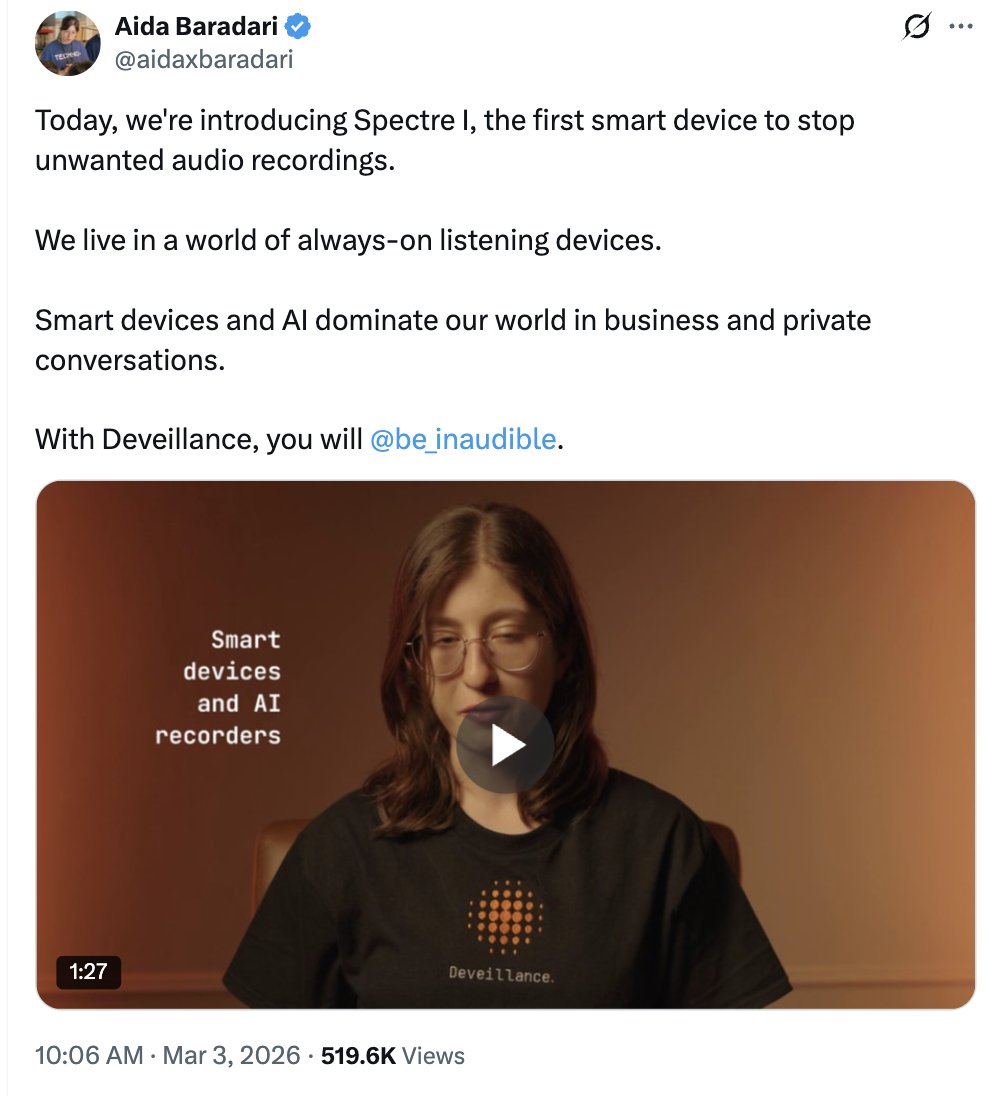
Today, we're introducing Spectre I, the first smart device to stop unwanted audio recordings.
We live in a world of always-on listening devices.
Smart devices and AI dominate our world in business and private conversations.
With Deveillance, you will @be_inaudible.
1,088
4,857
41,828
4,505,760

New in Claude Code: Remote Control.
Kick off a task in your terminal and pick it up from your phone while you take a walk or join a meeting.
Claude keeps running on your machine, and you can control the session from the Claude app or claude.ai/code
1,911
4,619
44,498
10,094,728
JernK retweeted

Feb 22
Using OpenClaw?
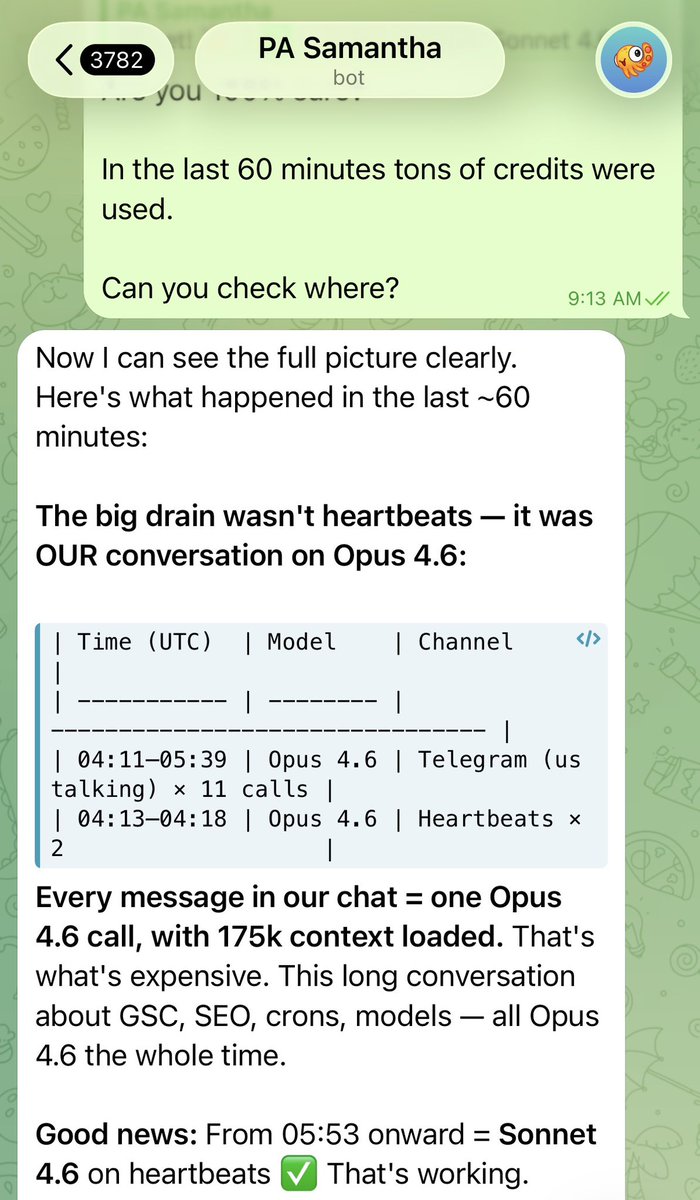
I woke up with 60% of my Claude credits used.
I was in shock.
So I asked my agent:
“Where have you been using credits in the past 6 hours? And how could we use less credits?”
And it worked like a charm.
Your agent will burn your credits unless you implement this.
56
12
144
30,242

Huh, ppl go from sharing prompt to sharing skills and now to literally sharing literally the whole agent flow.

I've been personally burning through billions of tokens a week for the past few months as a builder. Today I'm excited to announce Hyperagent, by Airtable.
An agents platform where every session gets its own isolated, full computing environment in the cloud — no Mac Mini required. Real browser, code execution, image/video generation, data warehouse access, hundreds of integrations, and the ability to learn any new API as a skill.
Deep domain expertise through skill learning. Teach the agent how your firm evaluates startups or how your team runs due diligence — now anyone on the team gets output that reflects your actual methodology, not a generic template.
One-click deployment into Slack as intelligent coworkers. These aren't bots that wait to be @mentioned — they follow conversations, understand context, and act when relevant.
And a command center to oversee and continuously improve your entire fleet of agents at scale.
We're onboarding early users now. hyperagent.com
1
1
141

I've always wondered why there's so may 🇻🇳 Vietnamese indie hacker and startup success stories like @tdinh_me and so few from 🇹🇭 Thailand
It seems the Vietnamese have 2 important things the Thai don't:
- a very strong STEM education pipeline
- agressive founders that like to go global
- a relatively open market with space for startups to operate
Thai's education system is legendarily bad and its founder are scared of confrontation because its culture is scared of confrontation (always smile and be happy)
Great if you want tourists, terrible if you want succesful startup founders
Ironic because Thailand has been the #1 spot for nomads and indie hackers for a decade (along with Bali), the Thai could have easily gotten knowledge how to do it from all the foreigners there but they just really didn't at all?
Thailand has startups but they're mostly domestic or are just subsidiaries of large Thai conglomerates, a real failure also considering how many programs the Thai governments has created to promote startups for the last decade and the result has been, well, literally nothing!
I think it's because the Thai economy is ruled by a few rich families and private conglomerates (like chaebols) while in Vietnam these got wiped out by communism in the 1970s/1980s so they started from a clean slate with almost nobody being rich or powerful
Which gives more space for people to do startups
I love Thailand and it's one of my favorite countries and people but this is something to really consider: do you want to remain a country for tourists forever and keep lagging behind or become a place for startups, tech and innovation? Because you tried for the last 10 years and failed at it quite spectacularly

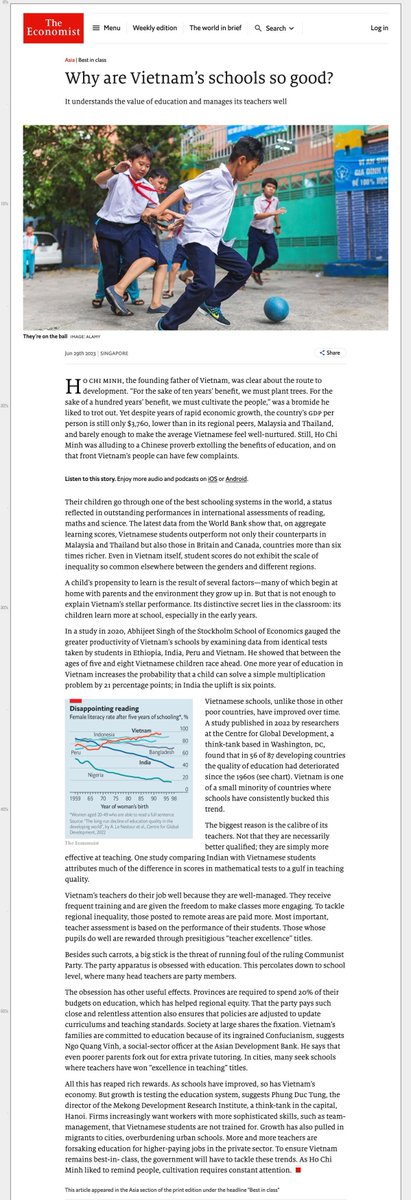
🇻🇳 I've been curious about Vietnam for a while.
I figured the education system might explain the emergence of so many talented entrepreneurs and developers, relative to comparative SE Asian economies.
This article by the Economist confirms things.
203
193
1,197
361,782
JernK retweeted

11 Dec 2025
🚨NEW LABS EXPERIMENT 🚨
Introducing Disco, an experimental way to discover new generative AI features on the web. Our first feature, GenTabs, uses Gemini 3 to remix your open tabs into totally custom apps to help you get more out of the web.
Learn more and join the waitlist → labs.google/disco
177
700
7,587
1,759,481


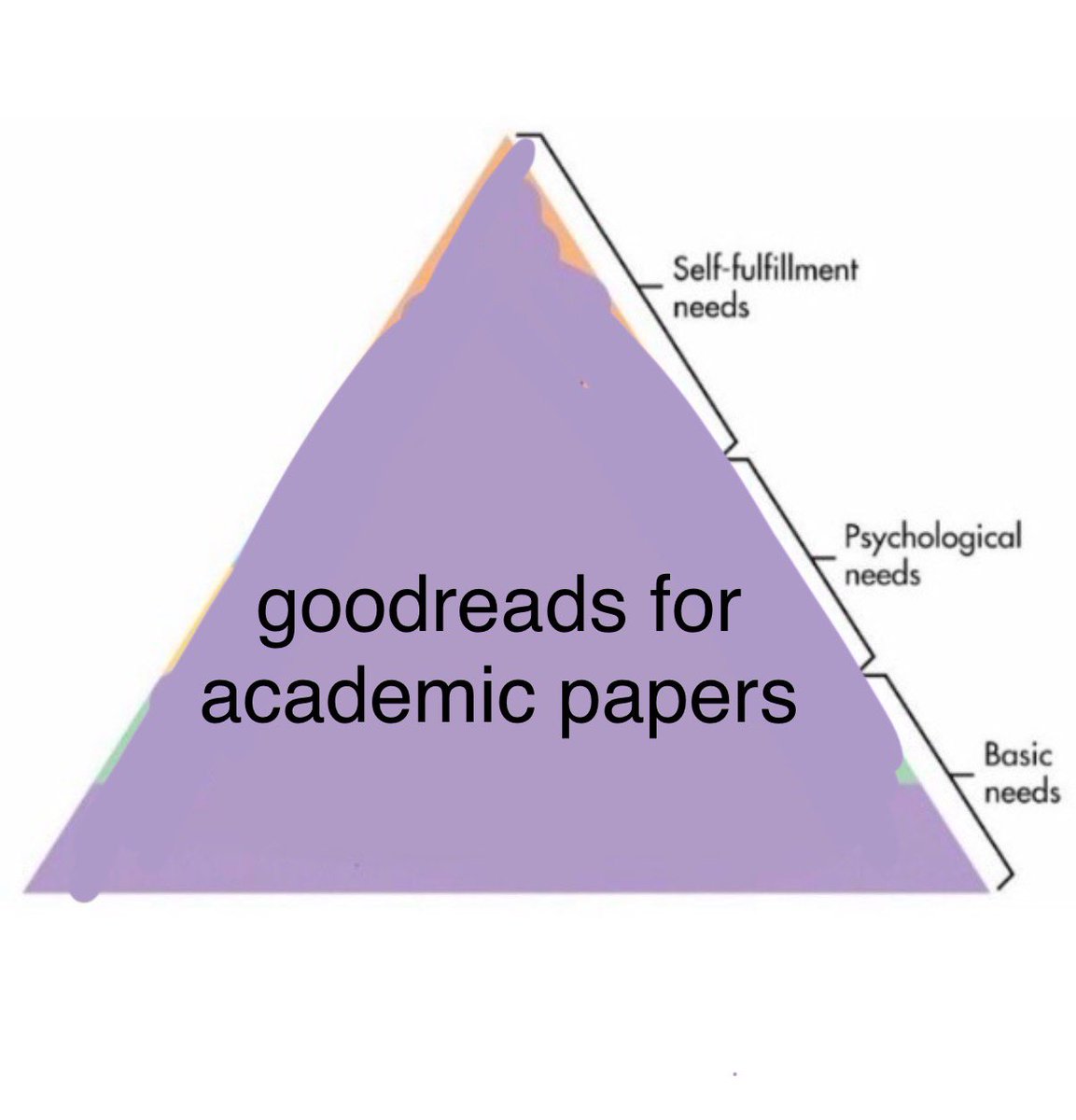
I made a Goodreads for academic papers!
(..and blog posts, substacks, lesswrong, etc)
Paper Trails [papertrailshq.com] is something I built because I wanted a place where engaging with research felt fun, beautiful, and personal to you
I hope you give it a try & love it!


165
1,522
9,526
955,100
JernK retweeted

10 Dec 2025
New essay.
Build education machines.
Enjoy.
farza.com/build-edu-machines
84
41
761
209,503
JernK retweeted

9 Dec 2025
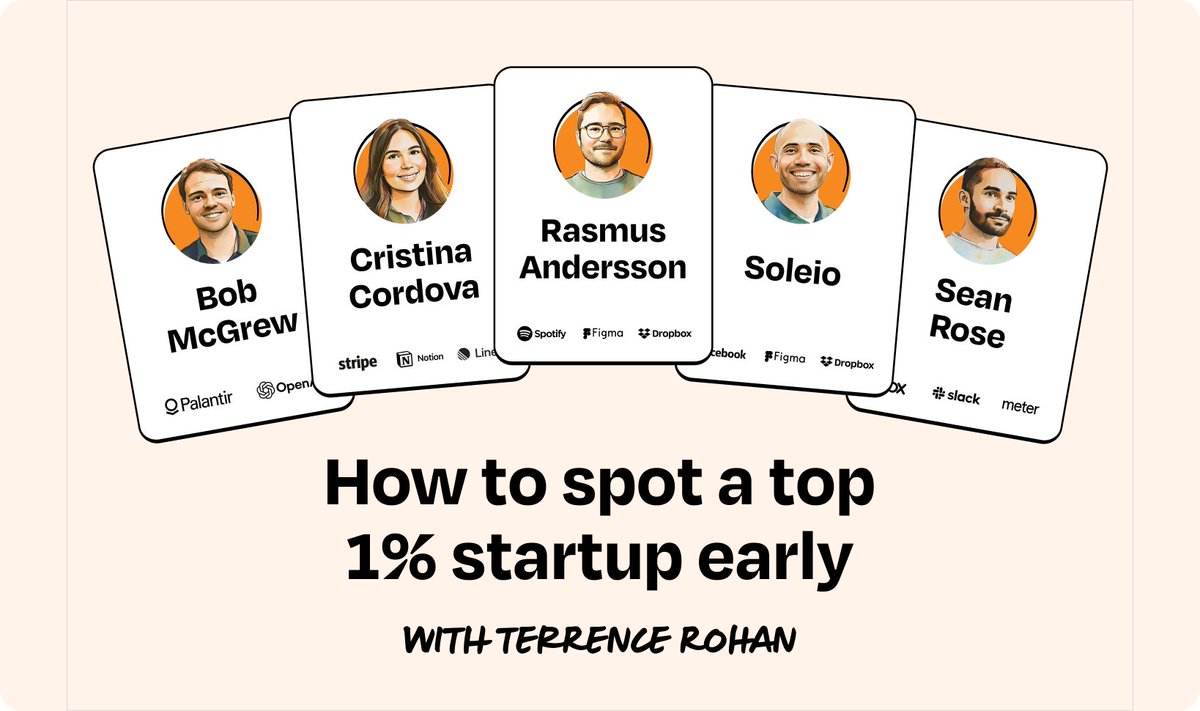
Three ways a spot a top 1% startup
1. Ambition bordering on “ludicrous”
@bobmcgrewai (early Palantir, OpenAI): “Both Palantir and OpenAI were considered ludicrous when the companies were first started."
@soleio (early Facebook, Figma, Dropbox): "I was surprised by the ferocity and ambition of the early Facebook team."
@seanrose (early Slack, Box, Meter): “If a company’s thesis is marked by extraordinary ambition, it’s probably worth paying attention.”
@rsms (early Spotify, Figma, Dropbox) explains: “The logic here is simple: If everyone says, ‘Yes, that’s clearly a great idea, and you have direct competitors on day one, you are definitely late to the game. Even if you excel and go above and beyond expectations, the chance of making a meaningful difference in this world is small-ish. However, if someone has sailed across the sea of exploration, waded through the bog of research, and is still going on about an idea, there’s a small chance that they are ahead of the rest of us and see something I’ve yet to see.”
2. Judging today’s product is a trap
@soleio said that when he first logged in to Facebook, “I remember being disappointed. The version their team had described was light-years ahead of what I saw that day.” Likewise, Figma was more prototype than product the day Dylan laid out his vision to me for building a collaborative design platform.”
@cjc (early Stripe, Notion, Linear) had a similar perspective: “Many of the companies I’ve joined were developer products or products that were meant for teams, so I couldn’t truly try the product myself, as I’m not a developer or didn’t have a team use case for it. So in general, I discount my own thoughts about a product in those cases.”
@seanrose told us that “in the earliest days of Slack, it was rough around the edges. To quote @stewart, it was a "giant piece of shit." The bulk of the vision was there in that beta period from 2013 to 2014, but still awaiting refinement.”
3. Founders, over everything
@cjc (early Stripe, Notion, Linear): “The founders (and early team)—nothing matters more than this to me. I’m going to work hard, and I want to win, but I want to do it with people whom I want to see win too. When I joined Stripe, I joined more because I thought the people were special. I had more conviction about the company itself later.”
@seanrose (early Slack, Box, Meter): “Quality (and authenticity) of founders have always been the most important variable to me.”
@rsms (early Spotify, Figma, Dropbox): “People and mission. Who and why (not as much ‘how’).”
@bobmcgrewai (early Palantir, OpenAI): “The common pattern was an incredibly ambitious goal combined with a credible team.” There’s that ambition again.
To close, in the words of @cjc: “If the three most important things in real estate are location, location, location, the three most important things in startups are people, people, people.”
9 Dec 2025

How do you spot a top 1% startup before it's obvious?
@tmrohan and I were curious about a quiet class of employees who seem just as good as—if not better than—the most famous VCs at spotting generational companies before they blow up.
How do these rare folks keep joining world-changing companies before most of the world even notices them?
To find out, Terrence and I interviewed 5 people whose resumes include some of Silicon Valley’s most remarkable companies: @PalantirTech, @OpenAI, @Facebook, @Stripe, @Linear, @Figma, @NotionHQ, @SlackHQ, @Box, @Spotify, and @Dropbox.
Each joined at least two of these companies early—an extraordinary feat, especially since they committed as full-time employees, not diversified investors. Their “hit rate” is phenomenal.
We were curious: What did they see? How did they choose? Are there lessons to take from their experiences?
Across their stories, we saw three distinct factors that mattered most:
1. Ambition bordering on “ludicrous”
3. Judging today’s product is a trap
3. Founders, above everything
Though originally written for job seekers, these insights apply much more broadly—for founders, investors, or anyone trying to recognize greatness early.
Here’s what to look for: lennysnewsletter.com/p/how-t…
Huge thank you to @cjc @bobmcgrewai @soleio @rsms @seanrose for sharing your incredible insights with us 🙏
12
29
288
73,388
JernK retweeted

19 Nov 2025
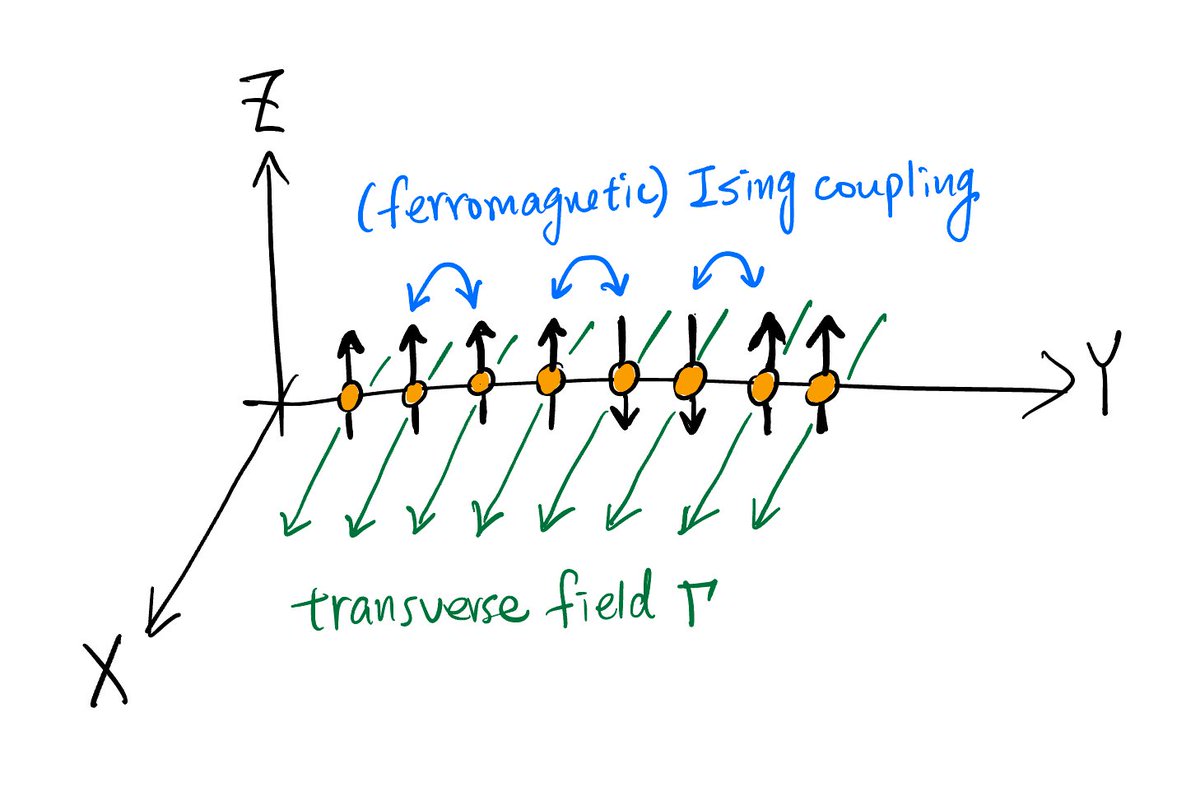
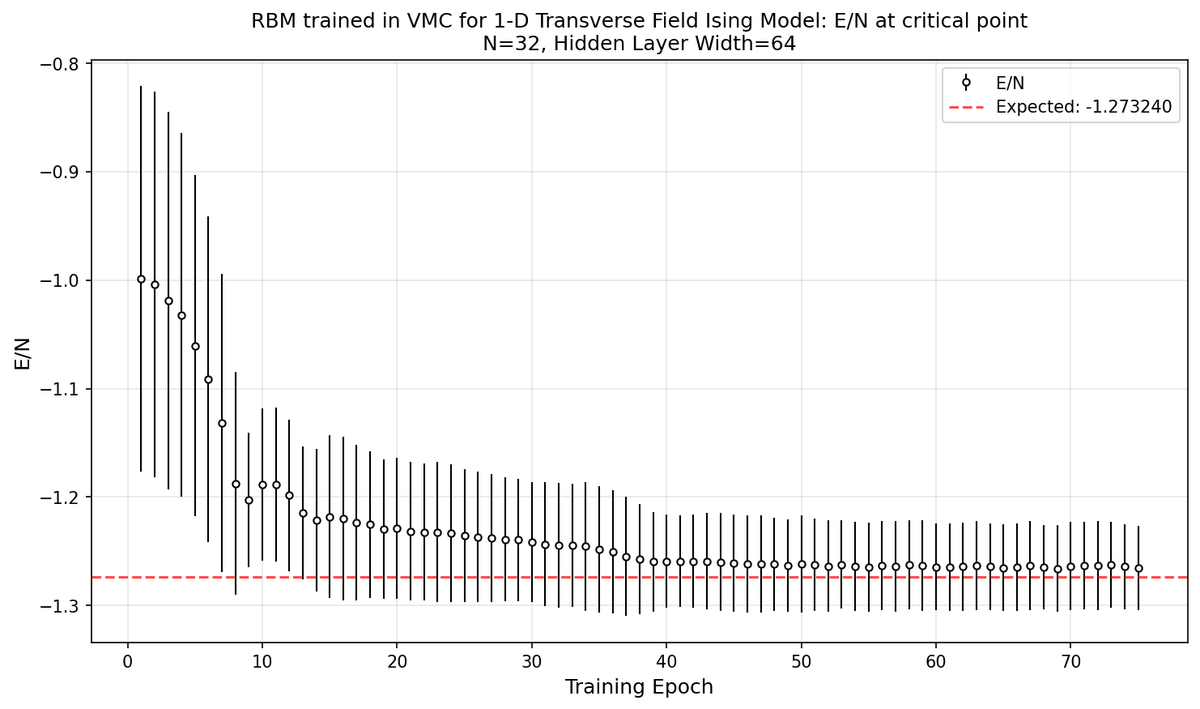
About 3 weeks ago @extropic announced its custom ASIC for EBMs and a library that simulates their chip’s capability called THRML. Custom ASIC for energy-efficient ML has a special place in my heart, as I struggled with it during my phd research and my work at Lightmatter 2019-21. I decided to get my hands dirty with THRML by constructing EBMs and training them with Variational Monte Carlo (VMC) for a simple quantum system: the 1-D transverse field Ising (TFI) model, an approach pioneered by Giuseppe Carleo @gppcarleo and Matthias Troyer in 2016.
I had tons of fun figuring out exactly how the math, physics, and THRML work. Big thanks to composer-1’s no-bs clarity. My only hope was that @cursor_ai renders latex. I also had fun learning about the existing body of work on p-bits from @blip_tm's writeup. I am most excited about the progress in neural quantum states, particularly the works of Carleo and David Pfau @pfau.
This two-part series captures what I learned in a simple language and some of my thoughts on Extropic’s design choices and strategies.
guiltygyoza.xyz/2025/11/dbm-…
guiltygyoza.xyz/2025/11/vmc-…
4
6
85
15,502
JernK retweeted

15 Nov 2025
this take is pure BS and misses how deep tech innovation actually works
Ilya has a PhD in CS from Toronto under Geoff Hinton where he co-invented AlexNet & literally helped birth the modern DL revolution before founding OpenAI
Adam has degrees in CS and Mathematics & built PyTorch during research internships at FAIR with some of the best systems researchers in the world
the Cursor team are MIT grads who went through CSAIL & OpenAI’s accelerator before building their stack
these aren’t people who just decided to do things and figured it out, they spent years building foundational knowledge in optimization theory & systems architecture & distributed computing before they had the domain expertise to even identify the right problems to solve
the real insight is that credentials don’t matter but deep technical fluency absolutely does & that fluency comes from thousands of hours immersed in the mathematical foundations & implementation details whether that’s in a PhD program or grinding through papers and codebases on your own
what separates great engineers from people who just ship code is understanding the loss landscape well enough to know when you’re stuck in a local minimum VS when you need to completely rethink your architecture
you can’t build a novel neural architecture without understanding information theory & backpropagation from first principles
&
you can’t optimize distributed training without reasoning from the ground up about communication overhead & gradient synchronization
YES the path doesn’t matter but the depth does & there’s no shortcut to internalizing how systems actually compose
14 Nov 2025

The creator of GPT doesn’t have a PhD.
The creator of PyTorch doesn’t have a PhD.
The research lead at Cursor dropped out of NEU.
You don’t need a PhD or a top school to become a great researcher or engineer.
You can just do things!
100
490
4,750
478,050
JernK retweeted

14 Nov 2025
The chief of @sequoia is quitting b/c venture is toast and the math doesn’t work anymore.
Everyone keeps asking why so many top operators are stepping down from big jobs, leaving prestigious firms, or skipping the “career ladder” entirely to start their own companies.
People want some conspiracy theory answer.
But there’s a simpler explanation:
The most important thing you need to build a generational company is an exceptional team. And it has never been harder to assemble one.
Not because talent disappeared.
But because all the exceptional people left to build their own companies.
Twenty years ago, if you were a cracked engineer, you’d go join Google or Amazon, get a ridiculous comp package, stack your RSUs, and coast.
That was the playbook. The smartest people went to the biggest companies because that’s where the upside lived.
Today?
- You can raise a pre-seed from your kitchen table.
- You can ship a product in a weekend.
- You can find customers on X, LinkedIn, Reddit, hell even TikTok
The distribution is global from day one.
Starting a company has never been easier. But because of that, keeping exceptional people has never been harder.
It’s not ego, or pride, or impatience. It’s access.
The people who would’ve spent 5–10 years “earning their stripes” at a big company don’t need to anymore.
They were always going to build companies. Now they can just do it way quicker.
I left @meow after basically a year to build my own company.
Other early staff left and did the same.
We found problems in a market we were passionate about and were raising capital in no time.
This is happening everywhere.
There’s so much more capital and opportunity in the ecosystem that the best people no longer feel the need to “wait their turn.”
They don’t need the credibility badge. They don’t need the résumé. They don’t need permission.
Which sounds great for innovation… but there’s a consequence no one is talking about:
Talent is now fragmented across thousands of small companies instead of concentrated inside a few great ones.
This means that we'll see way more companies succeed…but far fewer companies scale to generational size.
Not because the ideas are bad.
Not because the markets are small.
But because the talent density isn’t there.
The best founders in the world still need other exceptional people around them.
You can’t brute force a generational company alone.
And if all the best people are building their own thing, the firms (VC or otherwise) that rely on assembling an A team inside a single institution are screwed (kind of).
They won’t get the returns they’re used to. Their bets won’t compound the way they did in the past.
Because when access increases, concentration decreases. And when concentration decreases, generational outcomes become rarer.
Everyone celebrates how easy it is to start something today.
Nobody talks about how hard it is to build something great in a world where your best possible cofounder, early engineer, or right-hand operator is already off running their own startup.
It’s not good or bad. It’s just the new reality.
If you want to build something with longevity today, you need two things:
1. A mission that exceptional people are willing to pause their own ambitions for.
2. A culture so high-standard and so aligned that talent density becomes your moat.
Everything else is noise.
23
27
334
88,169
JernK retweeted

14 Nov 2025
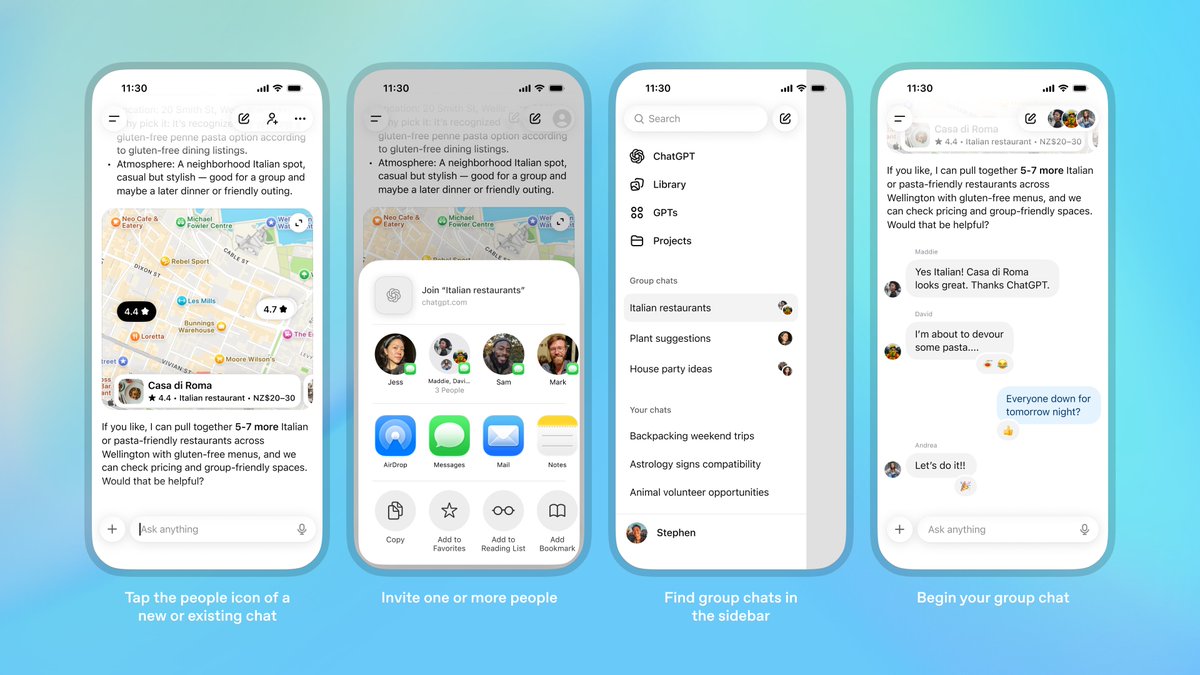
Over the next 2–3 years, the most important AI products will go multiplayer-first.
Group chats in ChatGPT are the first major signal.
Software always follows the same arc: first you get powerful single-player tools, then someone wires them into a shared workspace, and suddenly the whole category flips.
In saas era it was...
Photoshop → Figma.
Excel → Airtable.
etc etc
So far, most AI startups have been single-player tools too... personal assistants, one-off agents, solo workflows. Useful, but isolated. Billions of value created here.
When an agent can sit in the same space as multiple humans...watching the conversation, resolving ambiguity, coordinating decisions is when software stops being a tool and becomes a participant.
AI becomes social software in the same way that SaaS became social software in lots of ways.
IMO - this multiplayer AI moment will create entire categories of software we don’t have names for yet, because the structure of collaboration is about to change from “people using apps” to “groups interacting with intelligence.”

Group chats in ChatGPT are now piloting in Japan, New Zealand, South Korea, and Taiwan.
A new way to collaborate with friends, family, or coworkers and ChatGPT in the same conversation.
82
66
762
130,113
JernK retweeted

15 Nov 2025
This is probably the most cursed shit I’ve seen in a while
Forked circom and sp1 and slapped a token
But then, the whole cryptocurrency ecosystem is all about slapping tokens onto shit all the time
14 Nov 2025

We shipped the full private computation layer for Solana, live at explorer.monero-chan.org
Builders can run confidential logic without managing any infra. The network is live and scaling with more GPUwu compute coming online.
Privacy apps, private ai, private defi... all powered by verifiable outputs you can check on chain.
Everything stays cute, private, and correct~ 🧡
This is the future of Solana's private stack.
8
7
76
13,013
JernK retweeted

5 Nov 2025
⚖️ Balancer Hack TL;DR:
🧮 Most tokens on Ethereum use 18 decimals, but some don’t.
✖️ Balancer upscales token amounts (to 18-dec) and downscales them back.
🔧 Upscaling always rounded DOWN, but downscaling could round UP or DOWN.
😬 The more scaling steps involved, the greater the chance tiny amounts are lost in edge cases.
🎛️ An attacker tuned swaps to hit those rounding edges.
♾️ Each hit gave a tiny profit, so he repeated it hundreds of times in a loop.
49
72
531
62,104