
building @cora_ai | prev @thoughtful_ai @BetterUp
Joined February 2009
- Tweets 2,322
- Following 1,739
- Followers 853
- Likes 8,543
117 Photos and videos





Jun 12
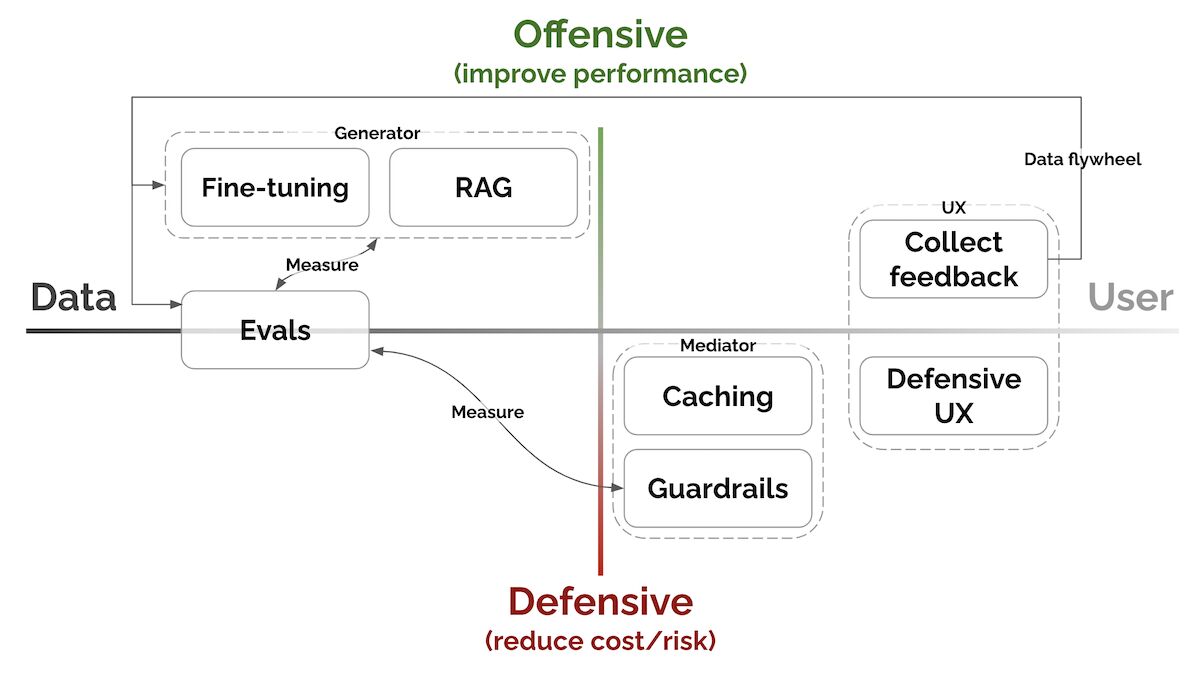
We have been thinking about this a lot at @cora_ai.
We're building this for customer success first because that's where longitudinal account context matters a lot.
But the principle extends to the whole company. To be AI native, organizations will require the right data architecture, and that's exactly what we are building.
Jun 11

Increasingly, I believe companies may need to be rebuilt from the ground up, where you have a single timeline of all observability product metrics file changes laid out in a retrievable system, like Datadog Posthog Google Drive Slack (really unified filesystem of Claude Code chats Codex chats). This might be the new data foundation for any and all companies to maximize AI. Needs to be rebuilt because keeping track of diffs on existing system basically impossible to produce longitudinal information on decisions and rollbacks, something coding agent storage companies are actively trying to figure out, but this should extend to businesses as a whole.
Highly skeptical existing businesses will adopt this though because it means overhauling everything about their instrumentation and business data, but I think businesses built on this foundation probably can execute 100x better and faster
27
Jun 2
2024: prompt engineering
2025: context engineering
2026: harness engineering
2027: engineering
15
Jesal Gadhia retweeted

May 24
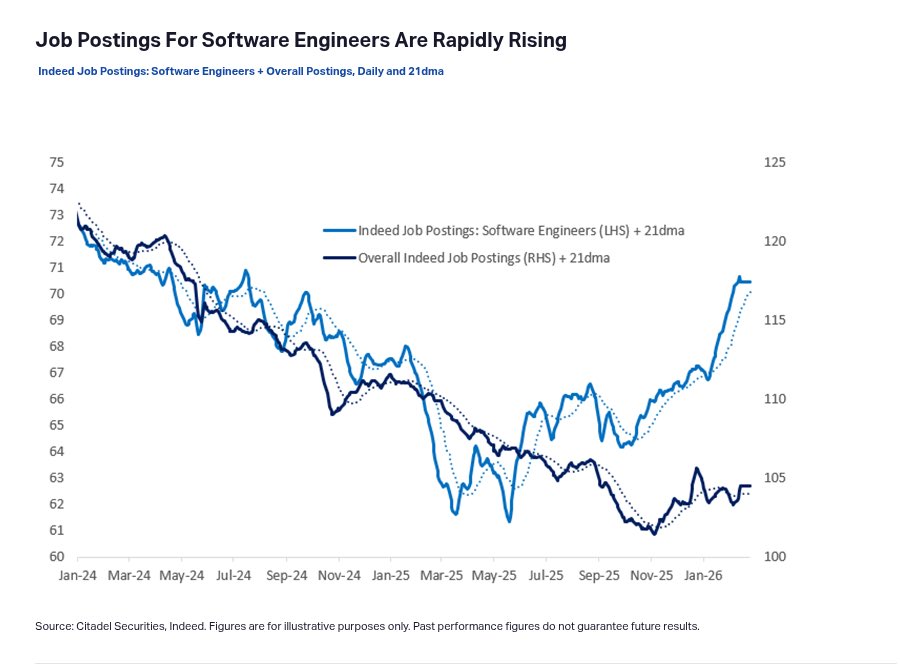
Q: How are job postings for software engineers rising rapidly despite AI agents automating coding?
A: Because there’s far more code to manage than ever before. We’re already seeing a 14x YoY increase in GitHub commits, and it’s accelerating.
AI has dramatically lowered the cost of writing code, so it’s now being used across far more businesses, applications, and use cases.
We’re at the beginning of a massive productivity boom driven by the proliferation of bespoke software throughout the entire economy.
Coding has been AI’s breakout use case this year. The fact that it’s increased demand for software engineers — rather than decreased it — should call into question the entire “AI will cause mass job loss” narrative.
828
1,465
9,113
1,631,676
Jesal Gadhia retweeted

May 5
POD-OF-ONE: THE NEW ORG BUILDING BLOCK
As a @coinbase board member, t’s been a privilege to watch @brian_armstrong @emiliemc, and the Coinbase team build a true AI-native company.
Brian's whole post is worth reading in depth. I want to focus in on one thing that Coinbase is testing: “one-person product teams.”
Most of the AI discourse has focused on one-person companies. The more powerful and more broadly applicable construct will likely be one-person teams inside companies.
The old product org split context across 3 people. The designer held the user experience. The PM held the customer and prioritization context. The engineer held the code and systems context. Coordination was the price you paid to combine those views into one shipping decision.
Agents reduce that coordination cost.
A single high-agency person can now ask agents to draft flows, write code, run QA, summarize customer feedback, generate variants, check edge cases, and produce release notes.
This model rewards a very specific kind of builder:
• Technical enough to inspect the work
• Product-minded enough to choose the right problem
• Tasteful enough to reject mediocre output
• Fast enough to ship before the org forms around the idea
The scarce skill is judgment.
One strong person with customer context and good taste can now do the work of a small pod. One weak person with agents just creates more output for someone else to review.
This changes how early-stage founders should hire.
The most useful hiring question is now: “Can this person own the outcome end-to-end?”
That’s a higher bar than a functional job description. It blends product sense, technical range, design taste, writing clarity, and operating discipline. The title matters less. The span matters more.
Call it pod-of-one thinking.
A pod-of-one builder can go from ambiguous customer pain to shipped v1 without waiting for specs, mocks, tickets, handoffs, or meetings. Agents fill in missing labor. The human carries the context.
Teams still matter. They should form when the surface area is real: multiple customer segments, production risk, complex GTM loops, or enough product depth that specialization pays for itself.
Before that, a pod-of-one may be the fastest shipping unit in the company.
Founders: hire people who can be pods-of-one, who can carry the whole problem in their head and use agents to increase their throughput.

This is an email I sent earlier today to all employees at Coinbase:
Team,
Today I’ve made the difficult decision to reduce the size of Coinbase by ~14%. I want to walk you through why we're doing this now, what it means for those affected, and how this positions us for the future.
Why now
Two forces are converging at the same time. We need to be front footed to respond to both.
First, the market. Coinbase is well-capitalized, has diversified revenue streams, and is well-positioned to weather any storm. Crypto is also on the verge of the next wave of adoption, with stablecoins, prediction markets, tokenization, and more taking off. However, our business is still volatile from quarter to quarter. While we've managed through that cyclicality many times before and come out stronger on the other side, we’re currently in a down market and need to adjust our cost structure now so that we emerge from this period leaner, faster, and more efficient for our next phase of growth.
Second, AI is changing how we work. Over the past year, I’ve watched engineers use AI to ship in days what used to take a team weeks. Non-technical teams are now shipping production code and many of our workflows are being automated. The pace of what's possible with a small, focused team has changed dramatically, and it's accelerating every day.
All of this has led us to an inflection point, not just for Coinbase, but for every company. The biggest risk now is not taking action. We are adjusting early and deliberately to rebuild Coinbase to be lean, fast, and AI-native. We need to return to the speed and focus of our startup founding, with AI at our core.
What this means
To get there, we are not just reducing headcount and cutting costs, we’re fundamentally changing how we operate: rebuilding Coinbase as an intelligence, with humans around the edge aligning it. What does this mean in practice?
- Fewer layers, faster decisions: We are flattening our org structure to 5 layers max below CEO/COO. Layers slow things down and create coordination tax. The future is small, high context teams that can move quickly. Leaders will own much more, with as many as 15 direct reports. Fewer layers also means a leaner cost structure that is built to perform through all market cycles.
- No pure managers: Every leader at Coinbase must also be a strong and active individual contributor. Managers should be like player-coaches, getting their hands dirty alongside their teams.
- AI-native pods: We’ll be concentrating around AI-native talent who can manage fleets of agents to drive outsized impact. We’ll also be experimenting with reduced pod sizes, including “one person teams” with engineers, designers, and product managers all in one role.
In short: AI is bringing a profound shift in how companies operate, and we’re reshaping Coinbase to lead in this new era. This is a new way of working, and we need to leverage AI across every facet of our jobs.
To those who are affected
I know there are real people behind these decisions — talented colleagues who have poured themselves into this company and our mission. To those of you who will be leaving: thank you. You’ve helped build Coinbase into what it is today, and I am sincerely grateful for everything you've done.
All impacted team members will receive an email to their personal account in the next hour with more information, and an invitation to meet with an HRBP and a senior leader in your organization. Coinbase system access has been removed today. I know this feels sudden and harsh, but it is the only responsible choice given our duty to protect customer information.
To those affected, we will be providing a comprehensive package to support you through this transition. US employees will receive a minimum of 16 weeks base pay (plus 2 weeks per year worked), their next equity vest, and 6 months of COBRA. Employees on a work visa will get extra transition support. Those outside of the US will receive similar support, based on local factors and subject to any consultation requirements.
Coinbase prides itself on talent density. Our employees are among the most talented people in the world, and I have no doubt that your skills and experience will be highly sought after as you pursue your next chapters.
How we move forward
To the team that is staying, I know this is a difficult day. We’re saying goodbye to colleagues and friends you've been in the trenches with. But here’s what I want you to know as we move forward together:
Over the past 13 years, we have weathered four crypto winters, gone public, and built the most trusted platform in our industry. We’ve made it this far by making hard decisions and by always staying focused on our mission. This time will be no different – nothing has changed about the long term outlook of our company or industry. And most importantly, our mission has never been more important for the world. Increasing economic freedom requires a new financial system, and we’re building it.
The Coinbase that emerges from this will be more capable than ever to achieve our mission.
Brian
37
34
392
87,140
Jesal Gadhia retweeted

May 4
When an Ex-FAANG Engineer Joins a Startup 😂😂
31
143
2,146
234,322
Jesal Gadhia retweeted

Apr 17
Had a great time chatting with @Dpbrinkm from the @mlopscommunity about the future of software engineering in the age of AI.
Some of the most important takeaways:
- AI agents make senior engineering judgment more valuable, not less
- Agents may become part of how junior engineers learn and close the apprenticeship gap
- Writing code is becoming less of the bottleneck than validating it
- The real limit on autonomous agents is verifiability
- “Run more agents in parallel” is often more hype than reality
- Engineers are being pushed earlier toward planning, delegation, and system-level thinking
1
2
4
420

Movie parody launch videos usually miss.
This one doesn’t 🫶
500 Days of Summer, but SaaS

It's time to break-up with the old way of running post-sales.
@cora_ai - the first proactive AI agents for customer success.
Winning the deal is just Day 0. Cora is the AI for everything that comes next.
2
6
524
Jesal Gadhia retweeted

Mar 10
I have seen how they built this, and it is one of the best examples of applying good taste to agentic business flows.
You can be a company that adds high risk agents like OpenClaw, or you can offload autonomy to a team that gets it.
It's time to break-up with the old way of running post-sales.
@cora_ai - the first proactive AI agents for customer success.
Winning the deal is just Day 0. Cora is the AI for everything that comes next.
3
5
334
Mar 10
Excited to introduce the world to Cora.
@a_ghowsi and I have spent our careers scaling B2B companies. We've tried every post-sales solution out there. Support chatbots, customer success platforms, and custom internal tools.
But in the B2B world, a reactive support chatbot won't save your customer relationship. Neither will more dashboards and CRM fields.
Now we have Cora.
It's time to break-up with the old way of running post-sales.
@cora_ai - the first proactive AI agents for customer success.
Winning the deal is just Day 0. Cora is the AI for everything that comes next.
1
10
95

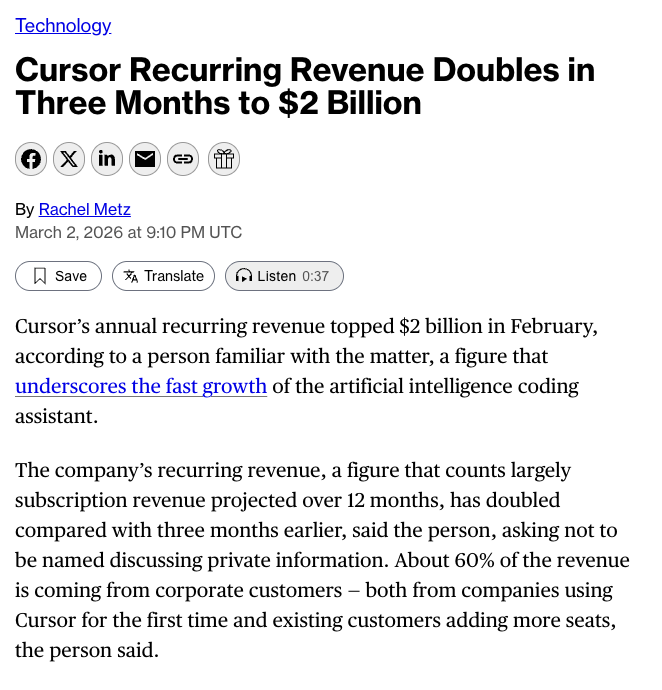
Narrative violation. Cursor goes $1B to $2B in 3mos.
Claude Code went $0 to $2.5B in 8mos.
Everyone in the tech/X bubble think people are wholesale ditching Cursor, but enterprise diffusion is glacial. Most of the world just got a hold of it.
96
52
1,109
414,277
Jesal Gadhia retweeted

Feb 23
LMFAO be anthropic:
> wake up, make coffee
> scroll boomer companies worth billions of dollars
> pick one
> "hi claude make a better version of this make no mistakes ty"
> wait 1 hour
> "looks good"
> *push to prod*
> post tweet about how you just displaced boomer company with new feature
> profit

BREAKING: IBM stock, $IBM, falls over -10% after Anthropic announces that Claude can streamline COBOL code.
It’s becoming increasingly clear how pivotal the times we are in right now truly are.

111
313
6,372
1,114,551
Jesal Gadhia retweeted

Feb 22
Tech careers are now split into 3 tracks
114
822
5,182
511,968
Jesal Gadhia retweeted

10 Sep 2025
People leaving regular companies: Time for a change! Excited for my next chapter!
People leaving AI companies: I have gazed into the endless night and there are shapes out there. We must be kind to one another. I am moving on to study philosophy.
136
923
11,536
565,942
11 Dec 2025
So well put. Small teams win on shared context, not a zoo of services.
Mothership & shuttles are the way to go:
One codebase where everyone can reason end-to-end. Async and bursty work is offloaded to functions that run on serverless runtimes.
Ship a great monolith first. Earn your distributed system later.

Microservices is the software industry’s most successful confidence scam. It convinces small teams that they are “thinking big” while systematically destroying their ability to move at all. It flatters ambition by weaponizing insecurity: if you’re not running a constellation of services, are you even a real company? Never mind that this architecture was invented to cope with organizational dysfunction at planetary scale. Now it’s being prescribed to teams that still share a Slack channel and a lunch table.
Small teams run on shared context. That is their superpower. Everyone can reason end-to-end. Everyone can change anything. Microservices vaporize that advantage on contact. They replace shared understanding with distributed ignorance. No one owns the whole anymore. Everyone owns a shard. The system becomes something that merely happens to the team, rather than something the team actively understands. This isn’t sophistication. It’s abdication.
Then comes the operational farce. Each service demands its own pipeline, secrets, alerts, metrics, dashboards, permissions, backups, and rituals of appeasement. You don’t “deploy” anymore—you synchronize a fleet. One bug now requires a multi-service autopsy. A feature release becomes a coordination exercise across artificial borders you invented for no reason. You didn’t simplify your system. You shattered it and called the debris “architecture.”
Microservices also lock incompetence in amber. You are forced to define APIs before you understand your own business. Guesses become contracts. Bad ideas become permanent dependencies. Every early mistake metastasizes through the network. In a monolith, wrong thinking is corrected with a refactor. In microservices, wrong thinking becomes infrastructure. You don’t just regret it—you host it, version it, and monitor it.
The claim that monoliths don’t scale is one of the dumbest lies in modern engineering folklore. What doesn’t scale is chaos. What doesn’t scale is process cosplay. What doesn’t scale is pretending you’re Netflix while shipping a glorified CRUD app. Monoliths scale just fine when teams have discipline, tests, and restraint. But restraint isn’t fashionable, and boring doesn’t make conference talks.
Microservices for small teams is not a technical mistake—it is a philosophical failure. It announces, loudly, that the team does not trust itself to understand its own system. It replaces accountability with protocol and momentum with middleware. You don’t get “future proofing.” You get permanent drag. And by the time you finally earn the scale that might justify this circus, your speed, your clarity, and your product instincts will already be gone.
1
99

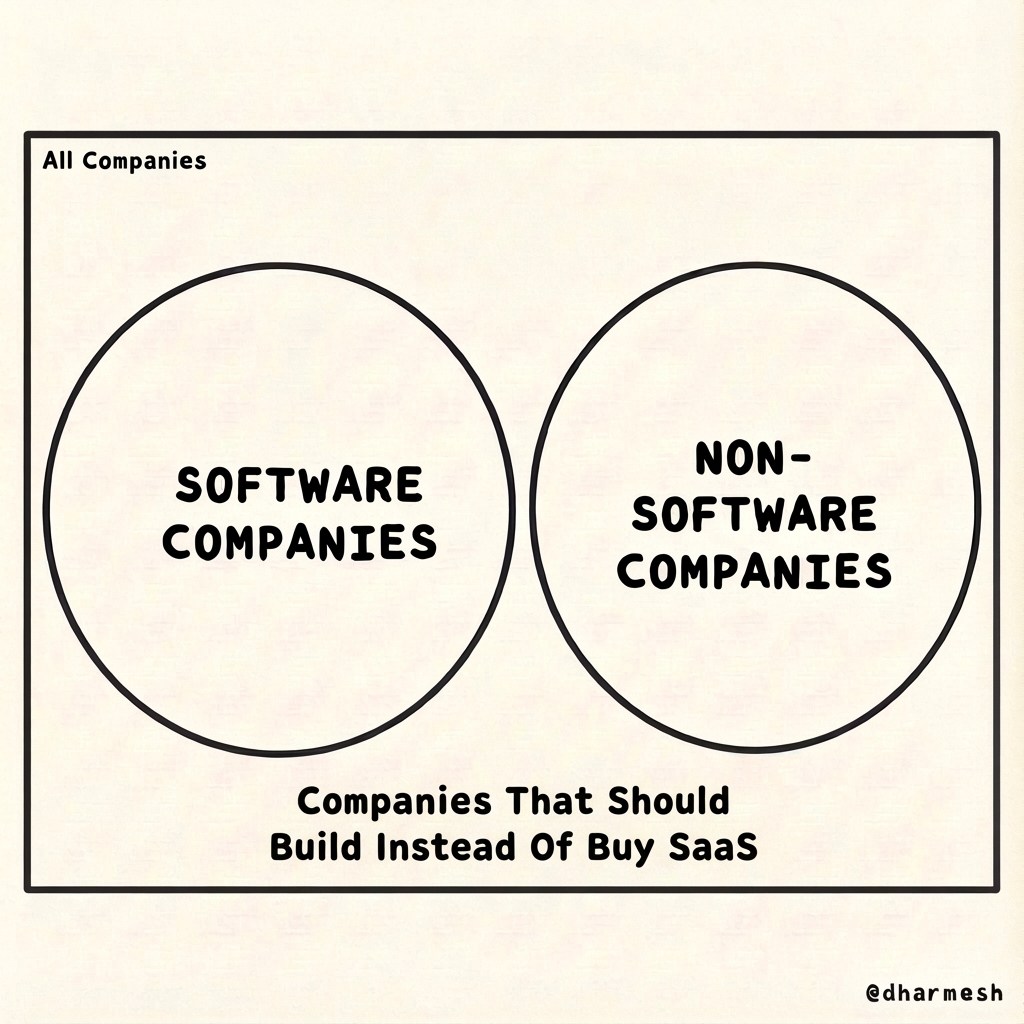
"Why should companies pay for SaaS (HR/CRM/ERP/etc.) when they could just vibe code them?"
I get variations of this question or comment with some regularity (granted, it's sometimes just me talking to myself).
Here are some biased (but hopefully, well-considered) thoughts:
1) I am a big proponent and user of vibe coding (what I call "agentic coding"). I do it every day, 7 days a week, including Sundays. It's amazing.
2) My company, HubSpot is a software company. We have hundreds of professional engineers -- just about all of them use AI for product development too. They are brilliant and know how to build production-grade products.
3) Even with this powerful army of talent, the number of internal, core SaaS applications that we have replaced with a vibe-coded variant is exactly ZERO. The number of applications we plan to replace is also exactly ZERO.
4) It's not the absence of talent that keeps us from rolling our own SaaS apps, it's the presence of focus. It would be silly to try and replace our HR, team collaboration, expense tracking and 100 other SaaS apps we use when we can just buy them. Just doesn't make sense.
5) That's us -- as a software company at some scale. If you're a non-software company it makes even less sense for you. Doesn't matter how good the AI coding tools get. Let's say you *could* vibe code a replacement for that SaaS app you're using, who's going to maintain it? Who's going to keep up with industry trends? What are you going to do when the 20-something genius that vibe coded it over a weekend leaves the company? Who do you call when there's a major bug?
6) If you're a Fortune 500 company at some scale, perhaps you could pull this off for some discrete use cases and the tradeoffs are worth it. You have an IT/Engineering department that is larger than the population of some countries. You can take on the pain in return for the positives.
For the millions of others, my advice is:
Spend every calorie possible on creating value for your customers.
223
198
1,425
220,511
Jesal Gadhia retweeted

24 Nov 2025
We’re starting to get a clearer sign of how vast the surface area of context engineering is going to be.
To build AI agents, in theory, it should be as simple as having a super powerful model, giving it a set of tools, having a really good system prompt, and giving it access to data. Maybe at some point it really will be this simple.
But in practice, to make agents that work today, you’re dealing with a delicate balance of what to give to the global agent vs. a subagent. What things to make agentic vs. just a deterministic tool call. How to handle the inherent limitations of the context window.
You had to figure out how to retrieve the right data for the user’s task, and how much compute to throw at the problem. How to decide what to make fast, and suffer potential quality drops, vs. slow but maybe annoying. And endless other questions.
So far there’s no one right answer for any of this, and there are meaningful tradeoffs for any given approach you take.
And importantly, getting this right requires a deep understanding of the domain you’re solving the problem for. Handling this problem in AI coding is different from law, which is different from healthcare. This is why there’s so much opportunity for AI agent plays right now.
118
107
883
151,638
Jesal Gadhia retweeted

19 Nov 2025
My team: what’s our 2026 plan?
Me:
144
239
3,029
258,521
Jesal Gadhia retweeted
10 Nov 2025
The counter dynamic to the AI model doing everything is that, at least in enterprise, bridging the AI models’ capabilities to the customer’s environment still requires a tremendous amount of long tail work.
The gap between an AI agent working for 90% or 95% of the solution and 100% is usually about 10X more work than most realize.
Getting access to the enterprise data, connecting to the enterprise workflows, delivering the change management that employees need to adopt the technology, handling the regulatory and compliance requirements of that industry, and so on all require some degree of highly dedicated focus in a domain.
There’s a strong analogy to vertical SaaS here actually. One would have thought that horizontal technologies could solve all problems in SaaS. But in fact there are endless very large companies that just hyper focus on a single domain, because that level of specialization is valued by the enterprise.
We will likely see the same play out with AI Agents in the enterprise as well. And in fact these domains will be far larger than traditional software categories because the TAM isn’t software, it’s work to be done.
Very fun debate, but I’m taking the other side.

My AI investment thesis is that every AI application startup is likely to be crushed by rapid expansion of the foundational model providers.
App functionality will be added to the foundational models' offerings, because the big players aren't slow incumbents (it is wrong to apply the analogy of "fast startup, slow incumbent" here), they are just big. Far more so than with any other prior new technology, there is a massive and fast-moving wave that obsoletes every new app almost as fast as it can be invented. There is almost no time to build a company and scale it.
There are two ways AI application startup founders can make money:
- Make a flash-in-the-pan app that generates a ton of cash and bank the cash (my estimate is that you have about 12-18 months cashflow generation)
- Make a good enough app that you get acquired by one of the big players for sufficient equity
The situation is highly unstable - we don't know if it's going to crash or go to the moon but both scenarios make it very unlikely that any AI application startup will independently become a generational supercompany (baseline odds are low to begin with).
The best odds are finding an application niche in a highly specialized field with extremely unique and specific data barriers, ideally ones relating to real atoms (hardware or world-related) data and not software/finance.
54
46
443
123,464