
CEO of @Processica| #GenerativeAI, Technological Innovation, Strategic Leadership | AI & Automation Expert
Joined November 2009
- Tweets 506
- Following 270
- Followers 689
- Likes 331
Photos and videos
Pinned Tweet

6 Aug 2024
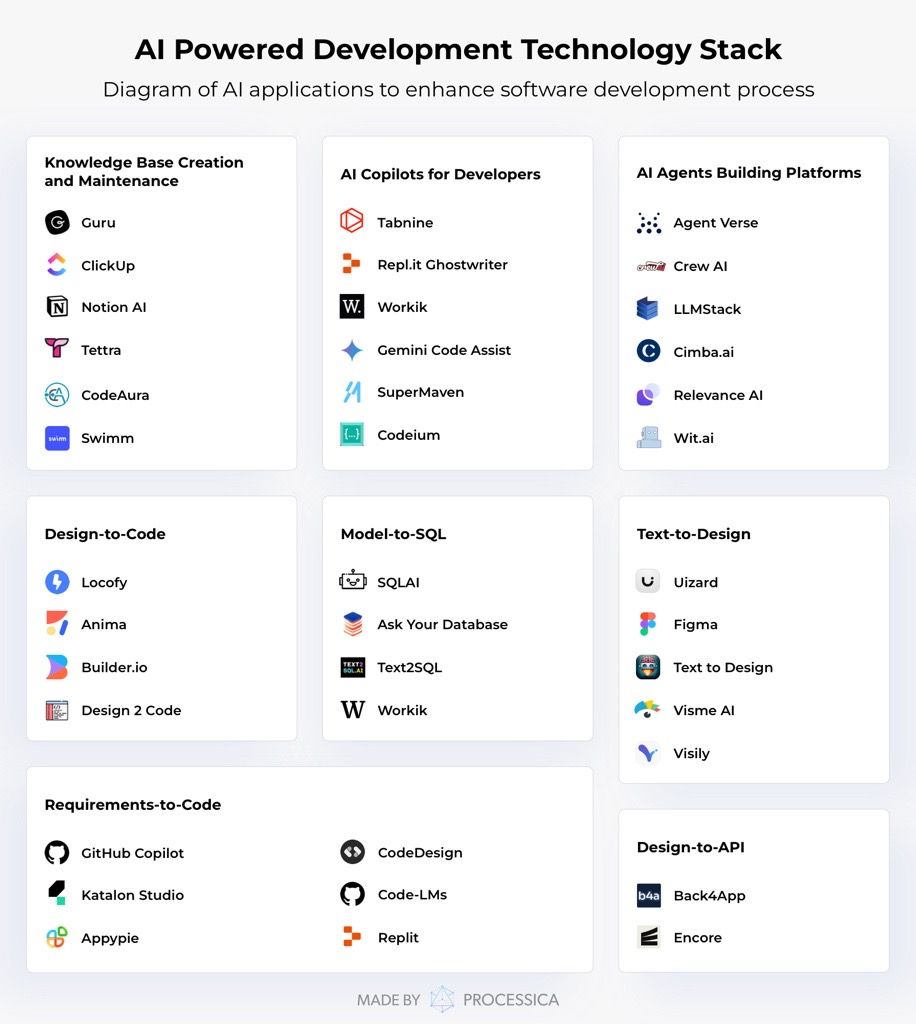
I’ve compiled the list of the most effective tools we've tested. Save this list and check out my article about our AI-powered software development to learn how my methodology can help lnkd.in/emdGQtq6
#TechInnovation #Productivity #TechLeadership #AI #GenerativeAI #AISoftwareDevelopmentI
2
3
6
651
16 Jan 2025
This is a sharp observation—steering AI products often means simplifying or dumbing down models to meet user expectations or ease of use. However, as we edge closer to AGI, the challenge will shift toward bold, transformative product decisions that leverage the full potential of these models. Incremental features won’t cut it in this race.
#AIProductDesign #AGI #AIUsability #FutureOfAI #BoldDecisions #AIInnovation
15 Jan 2025

One of the tarpits with AI products is that you end up dumbing down the model in most cases, despite it being very capable.
Steering and getting value out of AI is hard, but AGI is going to require a lot of bold product decisions, not incremental features.
72
15 Jan 2025
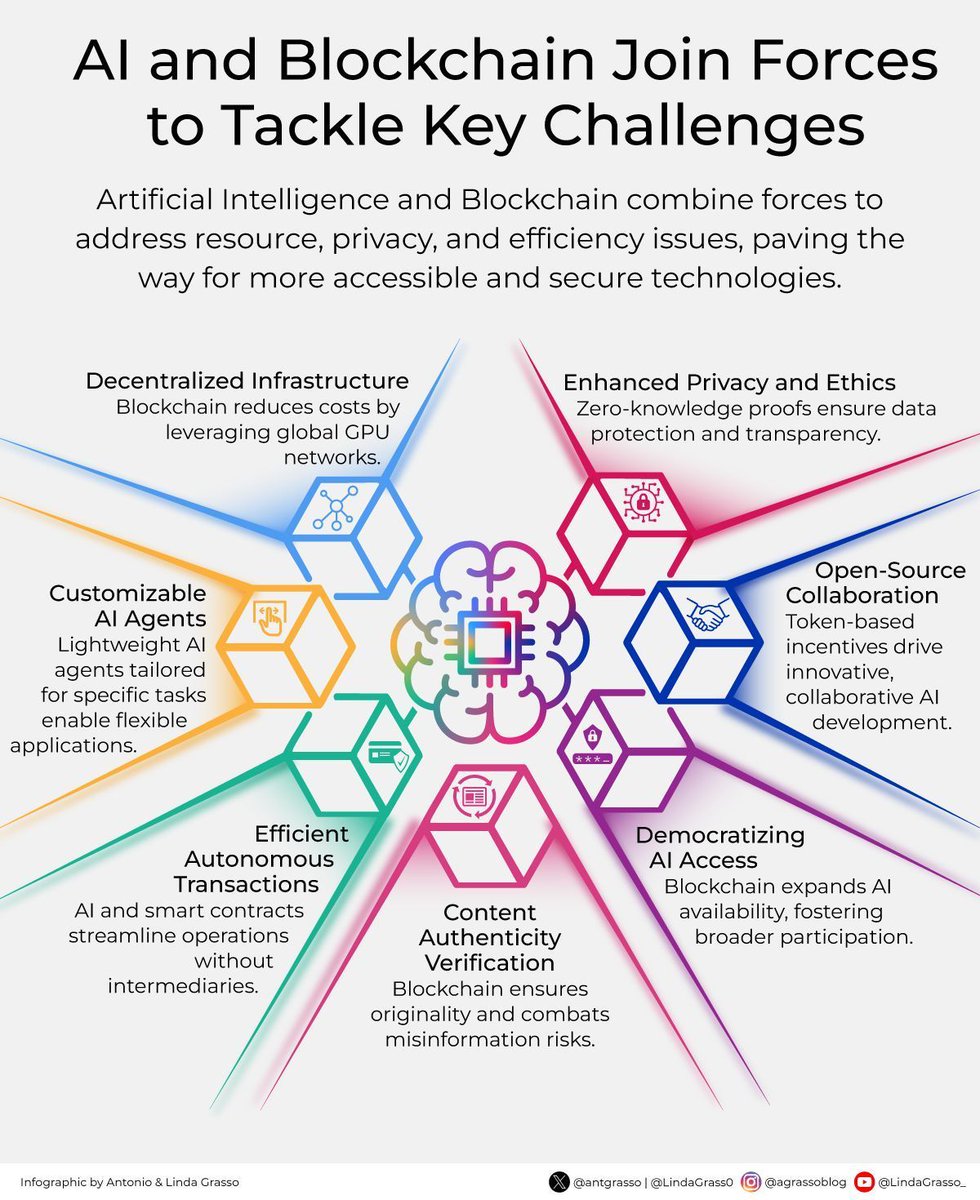
The integration of AI and Blockchain represents a transformative approach to solving critical challenges in security, efficiency, and accessibility. Decentralized infrastructure, customizable AI agents, and content authenticity verification highlight the potential for innovation. This collaboration paves the way for transparent, ethical, and scalable technologies that redefine how we interact with digital ecosystems.
#AIBlockchain #DigitalTransformation #TechInnovation #DecentralizedSystems #FutureOfTech #ContentAuthenticity
14 Jan 2025

The union of Artificial Intelligence and Blockchain reflects a growing trend where diverse technologies collaborate to enhance efficiency, improve data privacy, and support innovative solutions in a world increasingly reliant on digital.
Microblog by @antgrasso #AI #Blockchain
Blockchain and Artificial Intelligence together introduce decentralized systems, enhancing privacy through zero-knowledge proofs, enabling customizable AI agents, and supporting open collaboration.
Blockchain ensures transparency, verifies content authenticity, and democratizes AI access, fostering participation while streamlining operations through autonomous transactions.
These elements collectively address significant security, resource optimization, and scalability challenges, paving the way for transformative technological advancements.
2
64
15 Jan 2025
ChatGPT Tasks is a huge leap forward, making AI agents accessible for everyday tasks 24/7. The ability to automate workflows and tackle recurring actions is transformative. Tools like this bring us closer to a future where AI seamlessly enhances productivity and frees up time for what matters most. Can’t wait to dive into these life-changing prompts!
#ChatGPTTasks #AIForEveryone #PersonalProductivity #AIAgents #OpenAIInnovation #FutureOfWork

Wow
OpenAI just launched ChatGPT Tasks and it's basically AI Agents for everyone
Now AI Agents can do work for you 24/7
Here's your full walkthrough, how to use ChatGPT Tasks best, and 6 prompts that will IMMEDIATELY improve your life
(trust me you want to bookmark this one)
43
14 Jan 2025
This breakdown of AI agent memory types is both clear and insightful. Understanding the distinction between episodic, semantic, procedural, and short-term memory is essential for designing effective agentic systems. By structuring these memory layers thoughtfully, we can ensure AI agents are better equipped to plan, react, and evolve based on past interactions and contextual knowledge.
#AIAgents #AgentMemory #ContextualAI #AIArchitecture #LongTermMemory #WorkingMemory
13 Jan 2025

A simple way to explain 𝗔𝗜 𝗔𝗴𝗲𝗻𝘁 𝗠𝗲𝗺𝗼𝗿𝘆.
In general, the memory for an agent is something that we provide via context in the prompt passed to LLM that helps the agent to better plan and react given past interactions or data not immediately available.
It is useful to group the memory into four types:
𝟭. Episodic - This type of memory contains past interactions and actions performed by the agent. After an action is taken, the application controlling the agent would store the action in some kind of persistent storage so that it can be retrieved later if needed. A good example would be using a vector Database to store semantic meaning of the interactions.
𝟮. Semantic - Any external information that is available to the agent and any knowledge the agent should have about itself. You can think of this as a context similar to one used in RAG applications. It can be internal knowledge only available to the agent or a grounding context to isolate part of the internet scale data for more accurate answers.
𝟯. Procedural - This is systemic information like the structure of the System Prompt, available tools, guardrails etc. It will usually be stored in Git, Prompt and Tool Registries.
𝟰. Occasionally, the agent application would pull information from long-term memory and store it locally if it is needed for the task at hand.
𝟱. All of the information pulled together from the long-term or stored in local memory is called short-term or working memory. Compiling all of it into a prompt will produce the prompt to be passed to the LLM and it will provide further actions to be taken by the system.
We usually label 1. - 3. as Long-Term memory and 5. as Short-Term memory.
A visual explanation of potential implementation details 👇
And that is it! The rest is all about how you architect the flow of your Agentic systems.
What do you think about memory in AI Agents?
#LLM #AI #MachineLearning
Want to learn how to build an Agent from scratch without any LLM orchestration framework? Follow my journey here: newsletter.swirlai.com/p/bui…
1
66
10 Jan 2025
This analysis captures the transformative potential of AI in enterprise settings brilliantly. From reimagining entire functions to demanding interoperability and flexibility in AI stacks, it’s clear that AI is reshaping how businesses operate. The emphasis on IT’s evolving role and the importance of AI in attracting talent further highlight how integral AI is becoming across every department. We are indeed standing on the edge of a major shift in work and productivity.
#AIInEnterprise #FutureOfWork #AIDrivenBusiness #EnterpriseSoftware #WorkplaceAI
10 Jan 2025

Coming off of meeting a couple dozen enterprises around the future of their AI strategies, here are a few notes on the state of AI in the enterprise right now.
1. The AI-first enterprise is emerging. Given AI increasingly is starting to be used across coding, customer support, marketing content creation, risk management, client onboarding, contract management, and more, it’s clear AI will touch almost every department in some way. Companies are starting to think through how entire functions get reimagined in a world of AI.
2. Enterprises want choice in their AI stack. The past couple of years have proven out that there are going to be models that perform different tasks in different ways, and enterprises increasingly want to flexibility in what they use. Further, the rate of innovation coming from the frontier model labs is so incredible that companies want to be in a position to leverage the latest breakthroughs from these players and not be stuck on a single architecture.
3. We will need more interoperability in AI. Especially as AI Agents emerge, and your software has to complete entire tasks for you just like a person would, increasingly there’s going to be a need for AI Agents from disparate systems to talk to each other. As an AI industry, we’re only in the earliest of stages of figuring out standards around this, but it’s going to have major implications on enterprise adoption.
4. Your AI stack will define who you can hire. Employees of the future are going to simply expect that the company they work for is going to enable them to be as productive as possible, and AI is going to be a core part of that. This is going to become more acute as the next generation enters the workforce. Having used AI in high school or college for years, the way they research, collaborate, and generate work product is going to be totally different. You won’t join a company that makes you work 40 hours to get 20 hours done when there’s another company that lets you get 80 hours worth of work done. This will define employee choices in the future.
5. The role of IT is continuing to change tremendously. Jensen called this out in his CES keynote, but we’re seeing a reshaping of what the IT organization will do in the future. In the past, IT has been responsible for deploying and maintaining software that enables the workforce; in a world of AI Agents, IT will increasingly be responsible for actually getting the work itself done. This has massive implications around how strategic IT becomes, and how this org more tightly coordinates with the company.
6. We’re still insanely early. What’s remarkable is that while we’ve seen a tremendous amount of growth in consumer AI, datacenter growth, GPU sales, and many initial breakthrough AI use-cases, we’re still very early. This feels eerily similar to the the first few years of cloud, where adoption is starting with the first movers inside an organization (IT teams, creative employees, etc.) and then expanding from there. Unlike the cloud, however, it’s perceived to be inevitable that every enterprise will be transformed by AI. The main hurdles to getting there are generally ones of AI quality, change management, privacy and compliance work — but not fundamental philosophy challenges, like we saw in cloud.
Overall, this is the most energized I’ve seen enterprises in nearly two decades of being in enterprise software. There’s a palpable sense that we’re on the cusp of major changes to how business and work happens in the future, and it’s unbelievably exciting.
30
9 Jan 2025
NVIDIA’s Project DIGITS is a game-changer for local AI inference. With its competitive price-to-performance ratio and ability to run large models like Llama 3.3 efficiently, it’s redefining what’s possible for personal AI computing. Compared to Apple’s M4 lineup, the massive advantage in compute power and memory bandwidth opens up a new frontier for AI enthusiasts and developers alike.
#ProjectDIGITS #Nvidia #AIInference #TechInnovation #AppleM4 #LocalAI
7 Jan 2025

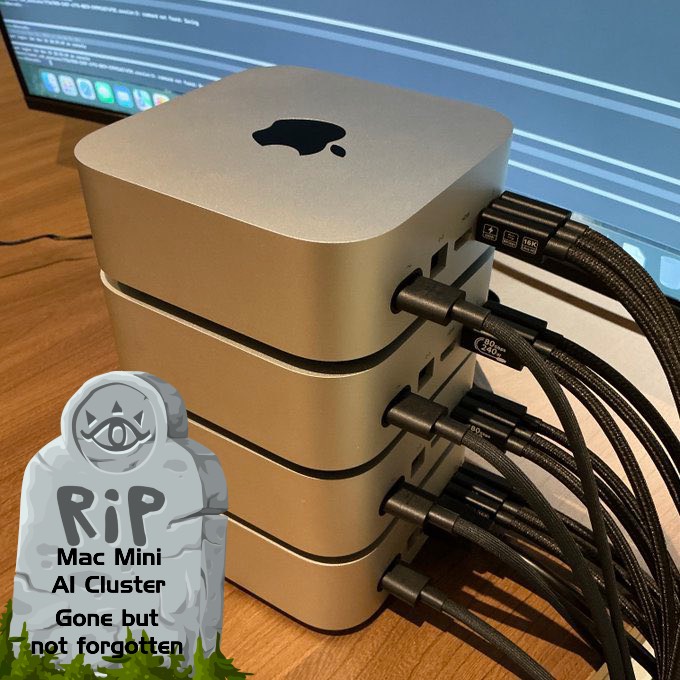
While Apple has been positioning M4 chips for local AI inference with their unified memory architecture, NVIDIA just undercut them massively.
Stacking Project Digits personal computers is now the most affordable way to run frontier LLMs locally.
The 1 petaflop headline feels like marketing hyperbole, but otherwise this is a huge deal:
Project Digits: 128GB @ 512GB/s, 250 TFLOPS (fp16), $3,000
M4 Pro Mac Mini: 64GB @ 273GB/s, 17 TFLOPS (fp16), $2,200
M4 Max MacBook Pro: 128GB @ 546GB/s, 34 TFLOPS (fp16), $4,700
Project Digits has 2x the memory bandwidth of the M4 Pro with 14x the compute!
Project Digits can run Llama 3.3 70B (fp8) at 8 tok/sec (reading speed).
Single request (batch_size=1) inference is bottlenecked by memory and memory bandwidth. This was always the constraint with the RTX 4090 and why a gaming PC can't compete on tokens per second at batch_size=1. The whole model can't fit into an RTX 4090 (24GB) so needs be loaded into the GPU from system RAM, bottlenecked by the GPU's PCIe 4.0 link of 64GB/s.
You will also start to see builds with multiple 5070 GPUs. The upgrade to PCIe 5.0 means a 2 x 5070 machine could support 256GB/s bandwidth from system RAM to GPU. I estimate this build to be ~$6,000 (supporting full x16/x16 PCIe 5.0 is expensive) in total, then cost of two Project Digits PC's.
Congrats NVIDIA, you just found yourself a new market.
@exolabs will support high performance inference on a cluster of Project Digits PC's on day 1.
104
8 Jan 2025
This beautifully articulated perspective captures the transformative role of LLMs in empowering self-directed learning. By acting as dynamic, iterative tools rather than static repositories of knowledge, LLMs enable us to deepen our understanding in ways that mimic life's experiential lessons. This fusion of human curiosity and AI's capacity to contextualize and connect knowledge is indeed a reinvigoration of learning.
#LLMs #AIinEducation #LifelongLearning #SelfDirectedLearning #CuriosityDrivenEducation
7 Jan 2025

🟥 The Teacher Within
👉Partnering with AI to unlock our natural capacity for learning.
For centuries, the archetype of the teacher has loomed large in human culture—a figure standing at the front of the classroom, imparting wisdom to students. But in the final analysis, I would argue that the most powerful and enduring lessons are only occasionally taught by others. Instead, they are self-discovered, arising from a dynamic interplay of experience, reflection, and curiosity. In this light, the role of artificial intelligence—particularly large language models (LLMs)—takes on new significance. These AI-driven systems are not merely repositories of knowledge; they are partners in our most human endeavor: teaching ourselves.
🟥 Beyond the Classroom: The Nature of Self-Taught Wisdom
Life itself has always been humanity’s greatest teacher. From learning to walk as toddlers to navigating the complexities of adult relationships, our most pivotal lessons emerge experientially. This process is rarely linear. We try, fail, adapt, and grow in a cycle that formal education can only approximate. Wisdom—the synthesis of knowledge, context, and experience—is deeply personal, cultivated through lived moments rather than prescribed instruction.
Yet, self-directed learning requires more than just experience. It demands tools to help us reflect, organize, and extend what we encounter. In earlier eras, these tools were books, mentors, and conversation. Today, LLMs offer an unprecedented opportunity to amplify this process, making the act of teaching ourselves more accessible, iterative, and expansive than ever before.
🟥 From Static Maps to Dynamic Webs
Traditional education often presents knowledge as a series of static maps: fixed frameworks that outline facts and concepts. While useful as starting points, these maps are inherently limited. They struggle to adapt to the fluid, interconnected nature of real-world problems and personal curiosity.
LLMs shift this rigid concept by transforming knowledge into dynamic webs. These systems, powered by vast data sets and sophisticated algorithms, don’t just provide information—they contextualize it, connect it to related ideas, and adapt to the learner’s needs. For example, an inquiry about nuclear energy might lead to discussions about energy policy, technological innovation, or even ethical philosophy, weaving a web of understanding that is both expansive and deeply relevant.
In doing so, LLMs echo the way humans naturally learn: not through isolated facts that are presented in someone else's linear sequence, but through patterns, relationships, and iterative exploration. They transform knowledge from something static and external into a living, evolving entity that learners can engage with directly.
🟥 The Iterative and Learner-Centric Nature of LLMs
Perhaps the most transformative aspect of LLMs lies in their iterative nature. Unlike traditional resources, which deliver fixed answers, LLMs invite dialogue. A single query can spark a cascade of follow-up questions, reflections, and refinements. This iterative process mirrors the way we engage with complex problems in real life, where understanding deepens over time through cycles of inquiry and application.
Moreover, LLMs make learning profoundly learner-centric. Immediate access to vast reservoirs of knowledge allows individuals to tailor their learning journeys to their unique goals, interests, and contexts. A biologist can dive into quantum mechanics to explore interdisciplinary connections. A student of history can uncover parallels with contemporary geopolitical dynamics. The pace, depth, and direction of learning are no longer dictated by external curricula but are instead guided by the learner’s curiosity and evolving understanding.
🟥 The Teacher and the Tool
This convergence of LLMs and self-directed learning raises an intriguing question: Who, then, is the teacher? In many ways, the answer is simple: We are. LLMs, as powerful as they are, do not impose knowledge. They respond, provoke, and suggest, but it is the human mind that drives the process forward.
This partnership is not unlike the Socratic method, where learning emerges from dialogue. Just as Socrates used questions to guide his students toward deeper truths, LLMs engage us in iterative exchanges that illuminate new perspectives. They are tools—albeit sophisticated ones—that amplify our ability to reflect, connect, and create.
🟥 Reinvigorating Learning
The implications of this partnership extend far beyond the individual. In the Cognitive Age, where adaptability and lifelong learning are paramount, the ability to teach ourselves becomes a defining skill. LLMs democratize this capability, breaking down barriers of access, expertise, and context. They make it possible for anyone, anywhere, to engage in meaningful, self-directed learning.
But this new modality also demands a shift in mindset. If LLMs are to fulfill their potential as partners in learning, we must embrace a more active role as learners. Curiosity, critical thinking, and self-reflection become the cornerstones of education—not as abstract ideals but as daily practices.
🟥 An Unending Invitation
In the final analysis, the act of teaching ourselves is both an ancient and a newly empowered practice. Life has always been our greatest teacher, but with LLMs as partners, we can engage with its lessons more deeply, dynamically, and personally than ever before.
Simply put, the question is not whether LLMs will teach us but how we will use them to teach ourselves. The opportunity is extraordinary, the tools are available, and the responsibility lies with us. After all, as learners and as humans, we are—and always have been—our own best teachers.
psychologytoday.com/intl/blo…
2
7
716
8 Jan 2025
AI agents vs. Agentic AI
- AI agents are rules-based, task-focused, and excel at repetitive tasks but don’t adapt autonomously.
- Agentic AI comprises autonomous systems that analyze, make decisions, and evolve, like self-driving cars or AI medical diagnostics.
Understanding the distinction is key.
1
32
8 Jan 2025
But fears are valid.
AI systems’ human-like capabilities (writing, speaking, reasoning) create a unique tension. It’s vital for leaders to address this transparently.
One misstep? Treating AI agents as “employees.”
It’s critical to show employees their humanness is valued, not just efficiency metrics.
1
19
8 Jan 2025
Key takeaway
AI agents are transforming business operations. From automating repetitive tasks to enabling complex workflows, they drive efficiency and redefine how teams operate.
Want to know how they’ll shape your industry and workplace? Check out the article here: linkedin.com/pulse/end-chatb…
#AI #FutureOfWork #BusinessInnovation
21
8 Jan 2025
The End of Chatbots? CEOs Can’t Stop Talking About AI Agents and Here’s Why
The AI agent market is projected to grow from $5.4B in 2024 to $50.31B by 2030, with a staggering 45.1% annual growth rate (via Grand View Research).
How are they reshaping the workplace? Let’s explore. 👇
1
25
8 Jan 2025
What are AI agents?
AI agents are systems designed to perform specific tasks automatically in predefined environments. Think: customer service, scheduling, or task-based recommendations.
They’re not just glorified chatbots — they leverage AI models for adaptability and more complex workflows.
1
24
7 Jan 2025
What’s Next for AI in Business Operations? Key Predictions for 2025
AI is rapidly transforming business operations today and will drive even greater changes by 2025. Here’s what to expect 👇
1
21
7 Jan 2025
🔍 Decision Support
Current Trend. AI copilots like Microsoft Copilot provide executives with tailored, real-time insights for strategic decisions.
Prediction. In 2025, these tools will evolve into indispensable advisors, offering contextual recommendations across all business operations.
1
19
7 Jan 2025
🔮 Looking Ahead
2025 will see AI deeply embedded across business operations, reshaping how companies plan, engage, and innovate. Ready to embrace it?
Read more linkedin.com/pulse/whats-nex…
#AI #FutureOfWork #WorkTech2025 #BusinessInnovation #HyperAutomation
14