
Working on something new. Prev at Glow, Google, Slide.
Joined August 2009
- Tweets 1,516
- Following 288
- Followers 598
- Likes 3,224
218 Photos and videos
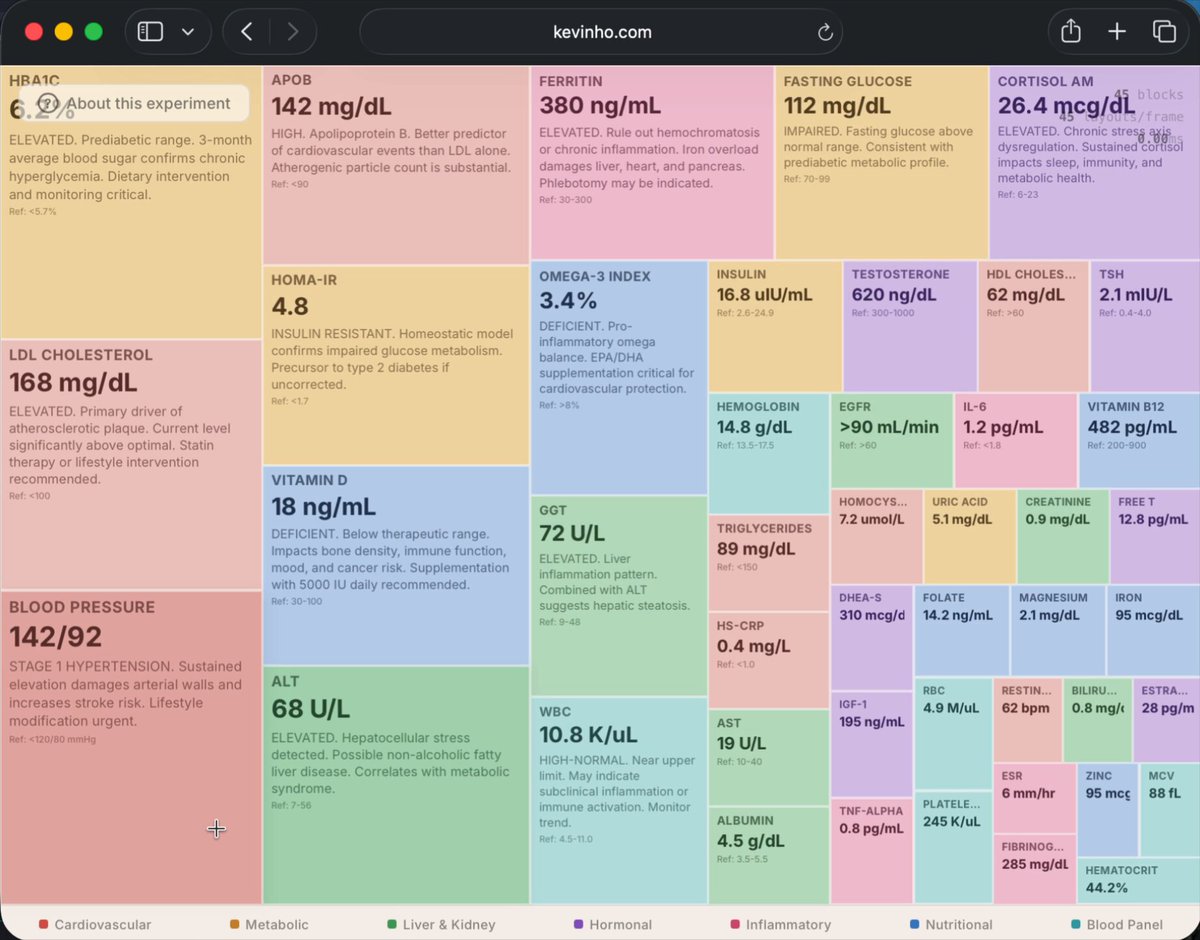





Had to jump in and experiment with @_chenglou's Pretext. BioMap is a 52 biomarker blocks that expand as you explore, reflowing text across every block every frame.
0.04ms for all 52 layouts only possible with Pretext turning text measurement into pure math. No DOM reads, no reflows.
kevinho.com/experiments/biom…
33
110
2,018
124,597

Accurate
Apr 25

A common dynamic I observe with AI: it feels most impressive when you don’t know much about the subject, don’t care or don’t have a clear idea of what the you want.
This applies across design, code, legal, and more. If I don’t know code very well, every piece of code it writes feels very impressive.
Once you know what something should feel or look like, it becomes almost impossible to guide AI there. And you definitely can’t one-shot it.
1
130
Supercharge your agents with Super Carl.
Apr 23

Most recruiters and founders have no idea Claude can 10x — maybe 100x — their hiring pipeline.
The reason: Claude can't search for people on LinkedIn. It never could.
Until now.
Here's how I wired Claude into a 1B profile dataset in 10 minutes 👇🧵
2
305
Kevin Ho retweeted

Apr 18
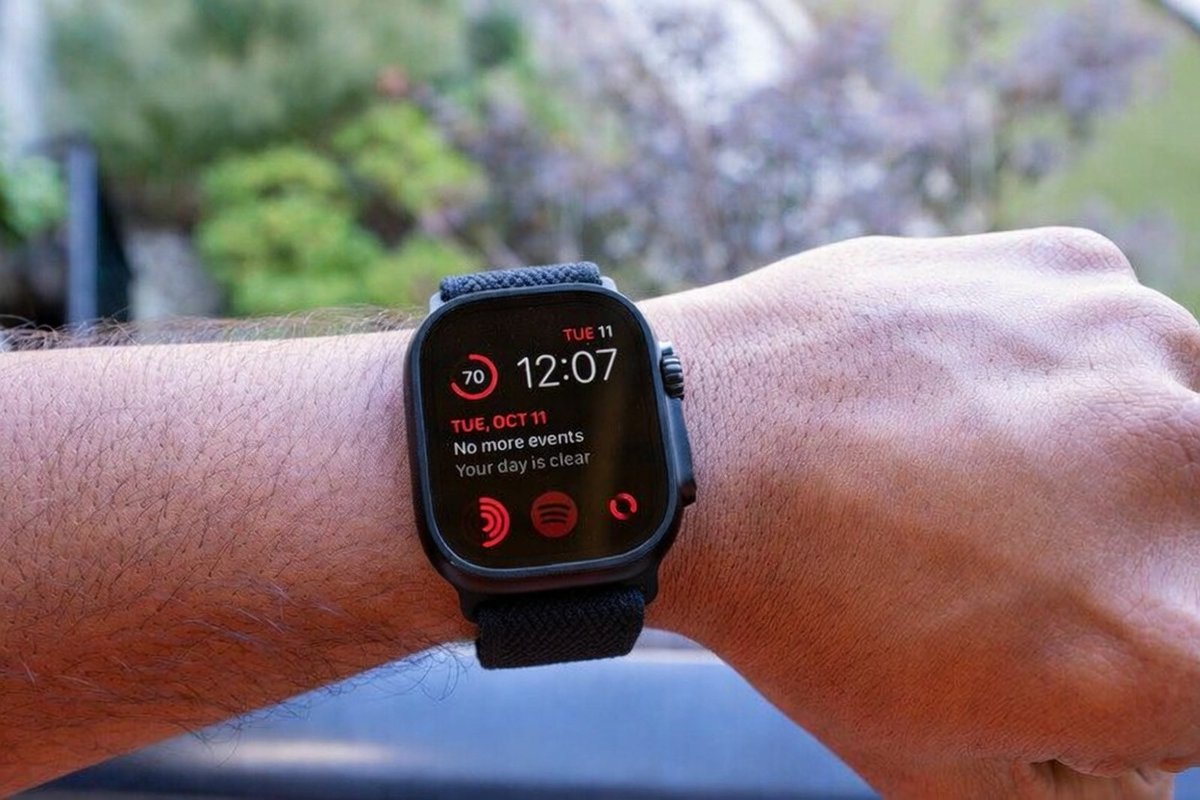
How accurate are wearables like Apple Watch, Whoop, and Oura?
A researcher compiled 16 studies to find out, and the answer might shock you:
137
248
2,275
2,100,838
The 5th dimension explained
Apr 16

We recently shipped Shopify Design.
Here's a technical breakdown of how I built it. 🧵
145
You are not talking to somebody that woke up a loser!!
101
Kevin Ho retweeted

Apr 13
BREAKING: Max Levchin (@mlevchin), Co-Founder of PayPal & CEO of @Affirm — HQ Tour
A Masterclass in: Espressos → Big Lebowski → PayPal lessons → Affirm → Economics of AI
The Dude abides.
“The net IQ of the world Is about to go up 50 points”
Result: As intelligence becomes normalized, bad actors & "fine print" companies will get exposed faster.
We cover:
• Capitalism vs the “warm embrace” of socialism
• You can’t perfectly time an IPO
• The best time ever to be a CS CEO
• AI collapsing the cost of intelligence
• Great economic shift underway
Strikes & gutters, ups & downs.
Recorded at Affirm HQ, March 30, 2026
𝐓𝐈𝐌𝐄𝐒𝐓𝐀𝐌𝐏𝐒
(00:00) Max Levchin, Co-Founder & CEO at Affirm
(01:35) Inside Affirm's office espresso bar
(06:46) How the love for espressos started at age 5
(10:30) Truth about bad coffee beans
(13:51) Strava & cycling
(14:56) Meeting Alfred Lin & Tony Hsieh over poker
(21:14) Onboarding 800K Shopify merchants in one week
(22:59) Big Lebowski in every shareholder letter
(32:11) The PayPal lesson that built Affirm
(35:25) Being a technical CEO
(37:57) Why this is the best time to be a technical CEO
(42:10) Should engineers still learn to code?
(44:48) Side quest with AI
(46:59) Companies AI will destroy
(49:46) How AI has changed engineering at Affirm
(50:54) Agentic commerce & DoorDash
(52:28) Devolution of Credit
(55:06) Biggest misconceptions about BNPL
(57:42) Being a public company CEO
(01:07:01) Advice for private companies
(01:11:09) Creating his own economy
(01:14:29) Can AI help solve the $39T debt problem?
(01:16:00) Learnings
(01:17:46) Will average IQ rise or fall?
31
43
330
378,873
Kevin Ho retweeted

Apr 9
“The most beautiful thing we can experience is the mysterious. It is the source of all true art and science.”
— Albert Einstein
5
62
330
15,023
Kevin Ho retweeted

The hidden architecture of a bird’s voice. 🙌🏻
Did you know a bird's song can be mapped into a mathematical fingerprint? 🧬
This isn't sci-fi; it's the real-time mapping this is a multi-dimensional bioacoustic visualization of a Carolina Wren's song.
By tracking the frequencies, can build a unique radar chart signature for the species. It tracks spectral flatness , entropy, and slope in 3D space to reveal the hidden geometry behind the music.
Nature is literally math in motion.
the video tracks specific spectral features that define the bird's unique Vocal Signature. 🥺
A beautiful reminder of the complexity hiding in everyday sounds.
22
197
1,031
43,486
Kevin Ho retweeted

Apr 4
Cells That Talk in Molecules
Biology Might Be More Programmable Than We Think
A molecular communication system treats signaling molecules like message carriers. One cell releases them into the surrounding fluid, they wander and drift through space, and another cell reads the message by counting fresh binding events at its receptors.
Here, a 1 is sent as a burst of molecules during a symbol window, while a 0 is sent as silence. Before the real payload, we send a short pilot pulse so the receiver can calibrate the channel and line up its sampling time. Decoding is then based on new receptor-binding arrivals, passed through a matched filter, rather than just watching slow receptor occupancy. That makes the symbols cleaner to separate, even with noise, delay, and intersymbol interference in the medium.
6
17
140
9,463
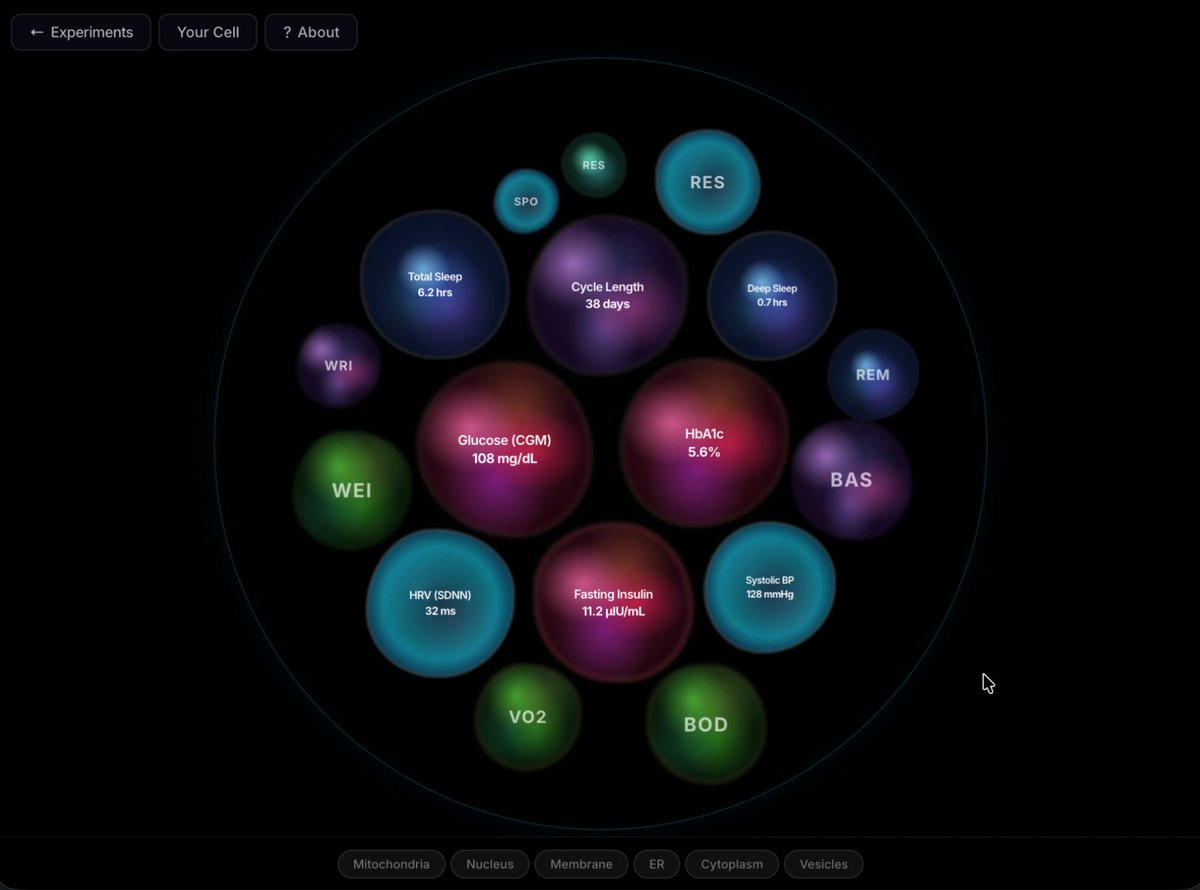
I've been exploring something: instead of showing health data as charts, render it as a living cell. Something that's scientifically grounded.
Your Apple Watch tracks HRV. HRV reflects autonomic balance, which is directly downstream of mitochondrial efficiency. Your watch is measuring your mitochondria, it just doesn't tell you that.
Sleep stages track cellular repair cycles. Deep sleep = growth hormone release glucose metabolism. REM = neural protein synthesis. Your watch actually measures your nucleus at work.
VO2 Max measures how efficiently your cells convert oxygen to ATP. That's mitochondrial respiration capacity.
Once you realize that wearable data IS cellular data, the UI question changes from "how do we visualize heart rate?" it becomes "how do we show someone the state of their mitochondria?"
This could change UI quite a bit. So I built a prototype that renders 17 biometric data points as organelles inside a cell. You can drill into any organelle to see the chart, stats, and clinical explanation.
I wonder if something like this could work with real Apple Health data at scale? (The XML parser exists but hasn't been stress-tested on multi-year exports). What other biological metaphors work for data? (Nervous system for network traffic?) Is the cellular abstraction actually more intuitive than charts, or just more beautiful? What would a "cell health score" look like, derived from the aggregate state?
I think there's something here beyond health. The idea that data can be rendered as living systems instead of static charts feels like an unexplored design space.
1
3
126
Kevin Ho retweeted

Magic

Had to jump in and experiment with @_chenglou's Pretext. BioMap is a 52 biomarker blocks that expand as you explore, reflowing text across every block every frame.
0.04ms for all 52 layouts only possible with Pretext turning text measurement into pure math. No DOM reads, no reflows.
kevinho.com/experiments/biom…
1
1
128
Kevin Ho retweeted

Mar 30
Another brilliant example of how pretext can deliver smooth, real-time content manipulation in an interface that actually makes sense!
Had to jump in and experiment with @_chenglou's Pretext. BioMap is a 52 biomarker blocks that expand as you explore, reflowing text across every block every frame.
0.04ms for all 52 layouts only possible with Pretext turning text measurement into pure math. No DOM reads, no reflows.
kevinho.com/experiments/biom…
2
10
75
7,312
Kevin Ho retweeted

Mar 29
Data visualization will not be the same
Had to jump in and experiment with @_chenglou's Pretext. BioMap is a 52 biomarker blocks that expand as you explore, reflowing text across every block every frame.
0.04ms for all 52 layouts only possible with Pretext turning text measurement into pure math. No DOM reads, no reflows.
kevinho.com/experiments/biom…
1
3
634
Kevin Ho retweeted

Apr 2
Whoa, this is insane—exactly what I need! How did no one think of this before? My respect
1
1
2
62
Kevin Ho retweeted

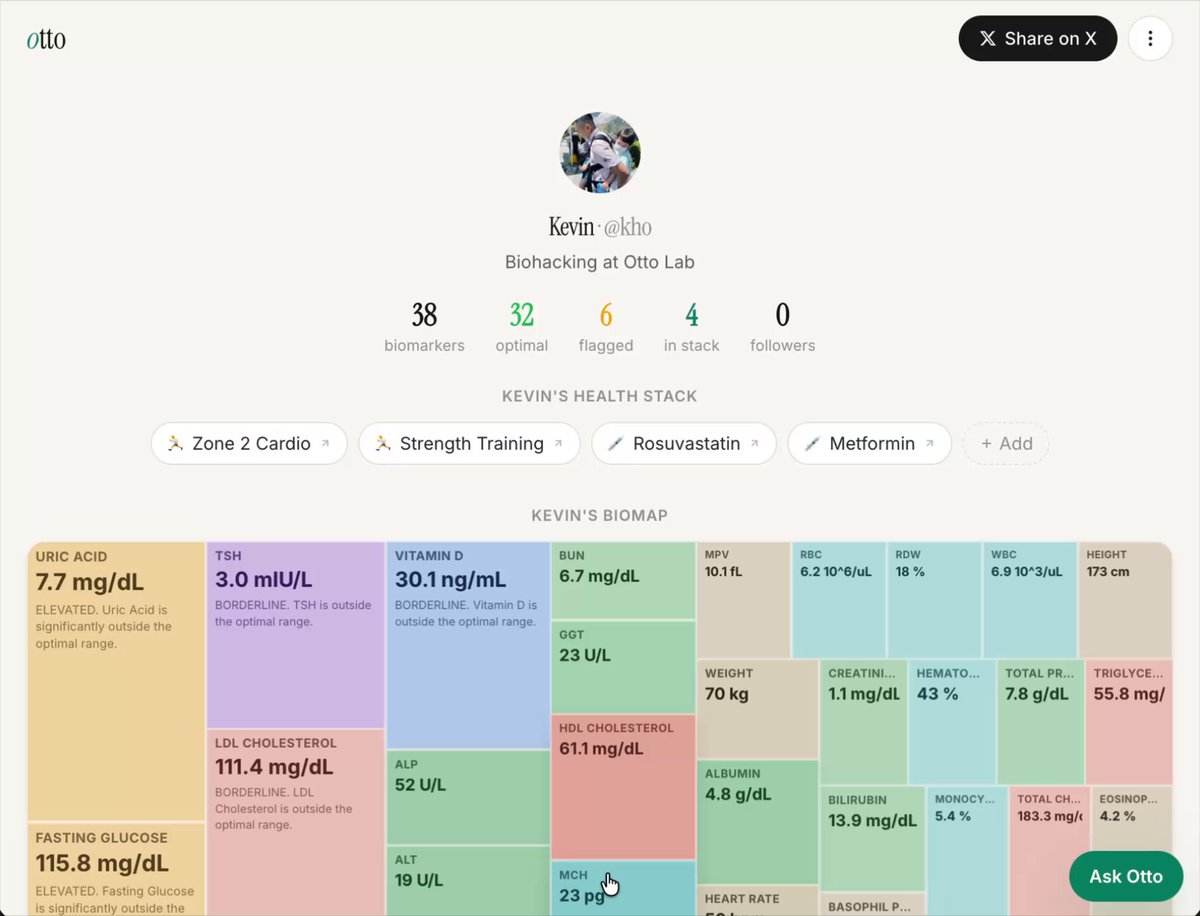
A BioMap that allows you to submit your own blood work. Interesting project @kho
1
1
1
113
38 biomarkers. 6 need attention. What does your blood say about you?
Get your free BioMap ottolab.com/u/kho
1
105
Kevin Ho retweeted

Apr 3
I just mapped 38 biomarkers. Here’s my BioMap — an interactive visualization of my bloodwork. ottolab.com/u/ed57dbad-14f6-…
1
3
158