
21 Photos and videos











MWS⚡ retweeted

Mar 1
PSA: Every single ‘crypto’ token is a scam, intentionally or not.
Bitcoin is something that is fundamentally and categorically different.
If you don’t understand the difference between the two, please
*SHUT THE FUCK UP* as you are disqualified from speaking about the topic.
Mar 1

Fuck off
11
13
211
8,558
MWS⚡ retweeted

31 Dec 2025
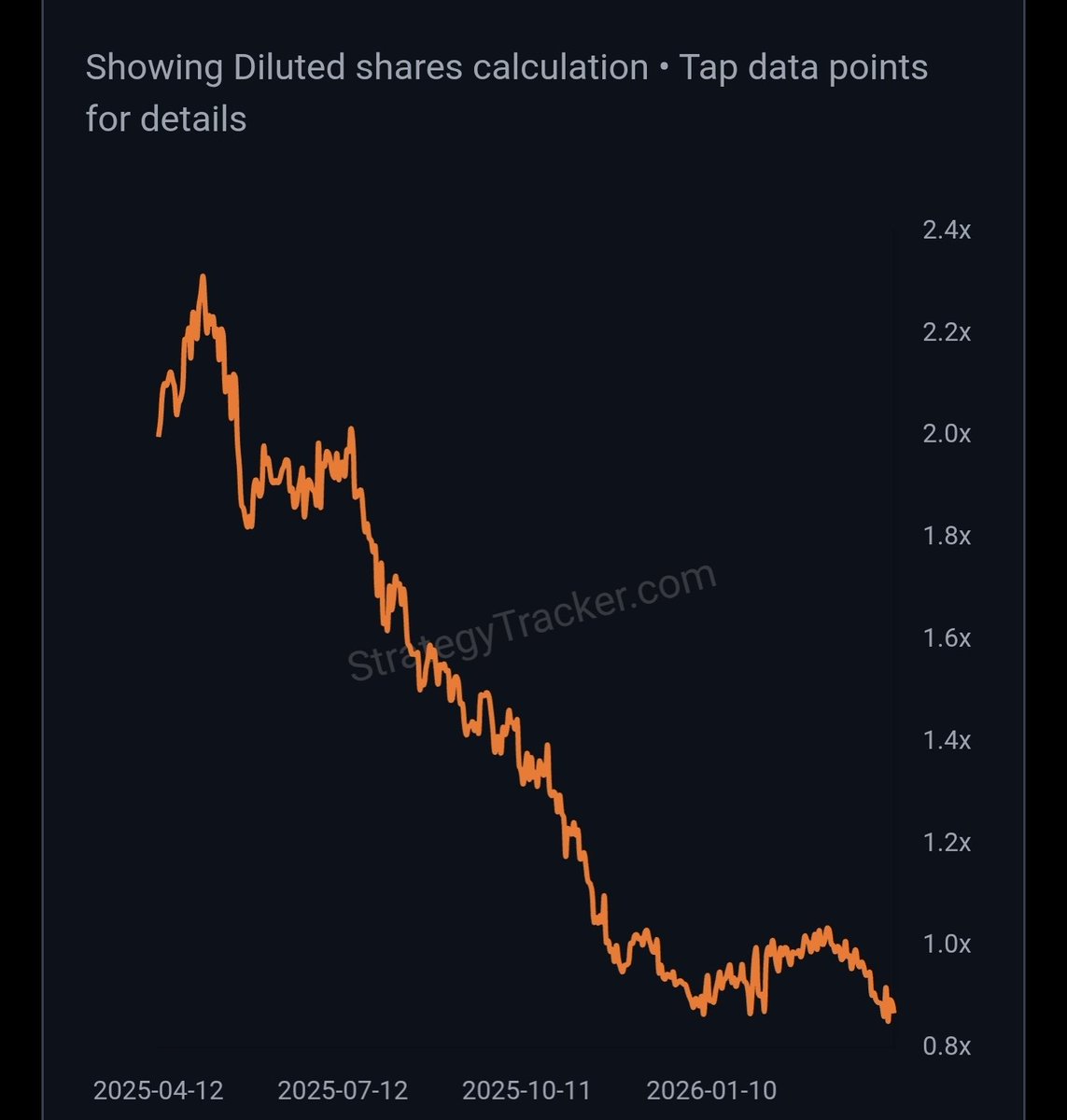
Bitcoin treasury SPACs *should* trade at a large discount to their Bitcoin holdings because:
1. The BTC holdings have a high-cost, parasitic business attached. If the business was strong there wouldn’t be a SPAC - it would just IPO like a normal company. There is no high quality company in history that went public before having a real business.
2. Their business plan hinges on continuing to print shares and dilute shareholders.
3. There are usually PIPE investors who are chomping at the bit to dump on you at a premium to the insider price they got.
4. It is the antithesis of proof of work. They are attempting to multiply the value of their Bitcoin through financial trickery and dumping shares on you.
Don’t fall for the scam.
26
14
198
15,922

16 Oct 2025
Finally, the banana zone!
15 Oct 2025

[ ZOOMER ]
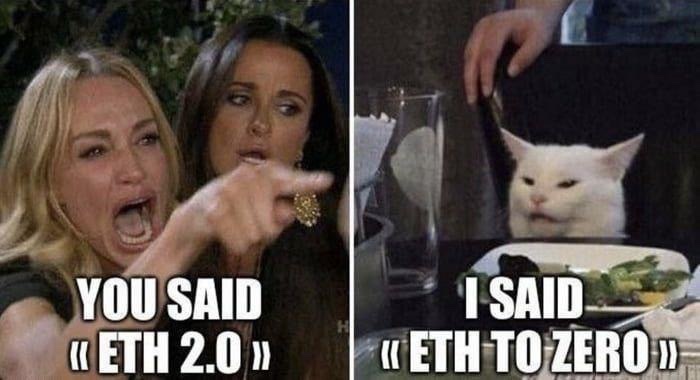
PAYPAL'S PYUSD MINTS $300T ON ETHEREUM
1
5
267

we want bitcoin to become p2p electronic cash and everyday money, as it was designed to be.
15 Aug 2025

1,291
792
8,206
1,102,189
MWS⚡ retweeted

24 Jan 2025
Why we must fight Ripple/XRP:
- centralized shitcoin pretending otherwise
- used celebs to pump, then dump on retail
- funded Greenpeace to demonize bitcoin
- develops financial surveillance tech
- funded Kamala to get CBDC status
=> now trying to sneak their 💩 into Trump's SBR

405
565
3,000
377,395
MWS⚡ retweeted
17 Jan 2025
Ripple are the worst bad actors in the industry and they are courting the Trump admin after attacking Bitcoin and funding Democrats for years. Everyone in the Trump admin needs to understand that Ripple should not be trusted.
590
520
4,250
403,521
MWS⚡ retweeted

17 Jan 2025
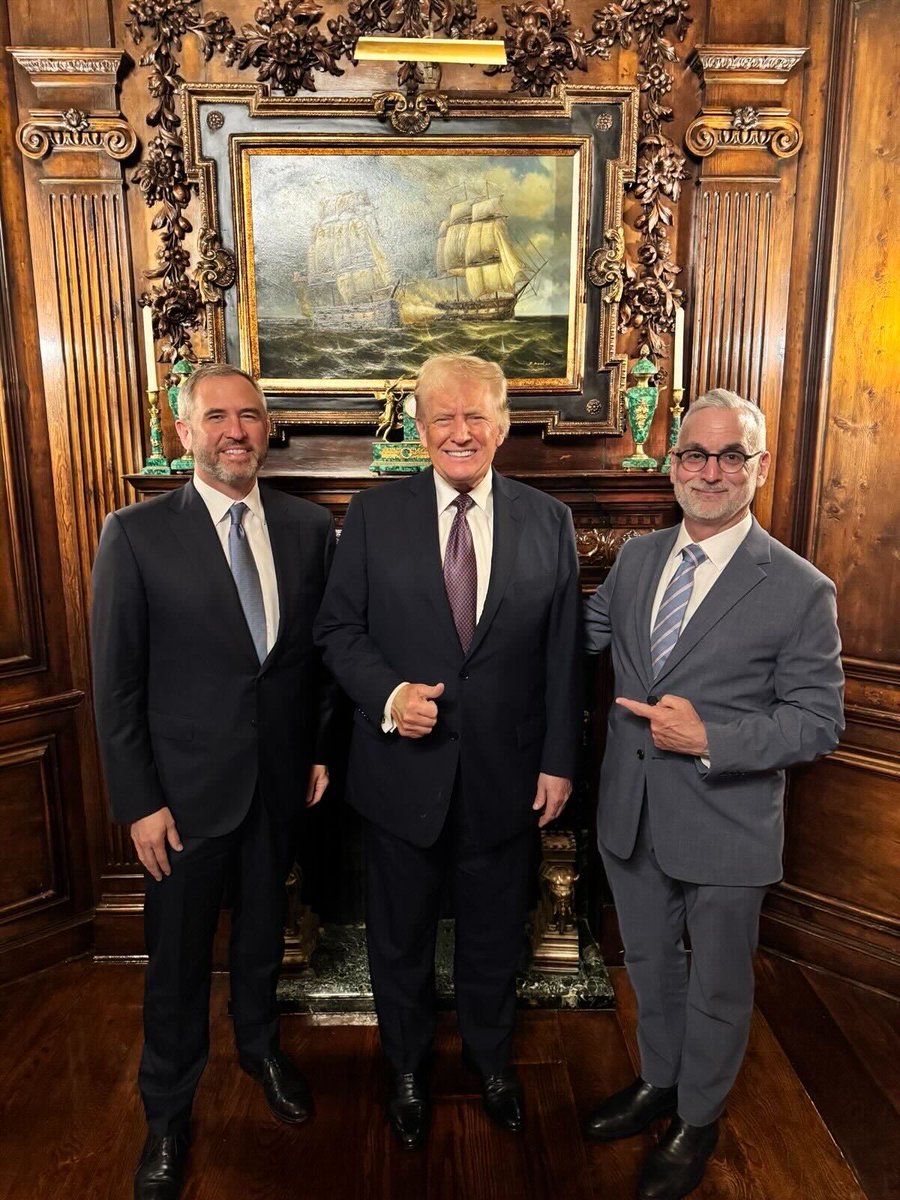
Brad Garlinghouse and Ripple are parasitic leeches coasting off of bitcoin's success to affinity scam the world at one of the most crucial points of human history.
We get freedom or absolute dystopia and Ripple is trying to bring about the latter while trashing bitcoin which enables the former.

655
318
2,746
557,900

As someone who has a master's degree in finance and a master's degree in accounting, had a tax practice, passed level 1 of the CFA exam, was a multiple time CFO, and angel investor, I had never learned or even thought of the two concepts that sent me down the Bitcoin rabbit hole.
Something different clicks for everyone on this thing but one of the things you can't unsee is that the people that this clicked for, who are often met with negative epithets, are from all different walks of life from all over the World have arrived at the same set of thruths independently.
For the most part, they're not cultists or psychopaths (some definitely), they just agree that math works, protocols with network effects are powerful, and something is broken. That's it.
They get a bad rap as well because they speak up when they see something wrong and courage is often met by those that don't have it by projecting unintelligence. I've definitely been that person more than most at times. Instead of saying I don't know I'll talk in circles, instead of admitting fault I'll blame others, instead of speaking up at the risk of looking dumb I look for support from the largest groupthink I can find. Add the topic of money, which we're not supposed to talk about, to those with a projecting propensity and you have a vacuum of intelligent discourse on the topic of Bitcoin.
But these truths that were independently arrived at by Bitcoiners are also so easily verifiable that it's become frustrating. It's frustrating when you run into people that still dismiss math and open source software that is easily verifiable after 16 years of predictability. If you're scoffing at that sentiment then you might not realize you're frustrating to people trying to explain to you what was concept 1 for me, how it affects our future and what exactly is broken which is:
WE. WILL. NEVER. STOP. PRINTING. MONEY.
That means your costs denominated in a currency with an ever increasing supply will go up FOREVER. @DOGE is not gonna save you. $36.2T in debt and $220T in unfunded liabilities is not going to be solved if we get rid of daylight savings time and work from home. Those liabilities will get paid but with printed money or higher inflation.
We're positively reinforced every day that there is nothing wrong with money when it gets us what we want and always has. And when you get good at getting money, nothing is broken. In fact it's the opposite for you if you're able to own assets that go up in value when money is continually created out of thin air.
Checking a money making ego at the door is definitely a prerequisite here if you've been good at the fiat game. Admitting you might have been wrong is also hard. I had to admit that my life was basically trying to stack accredidations for myself to signal that I was smarter than everyone else at finance and then doing everything I could to win at the fiat game where you keep score with how much money you have. So that's how I stumbled into Bitcoin. Trying to make more money. I had no idea we were in a debt spiral as a country and would still have no idea if I didn't go down this rabbit hole. I had to admit I was wrong and didn't understand money.
Concept 2 for me was related to concept 1 in that there is a long history of currencies that fail for the same reason: perpetual money creation that devalues your savings. If there are people that can make more, they will make more and that erodes a necessary property of money. This is the one situation where working harder is not the answer.
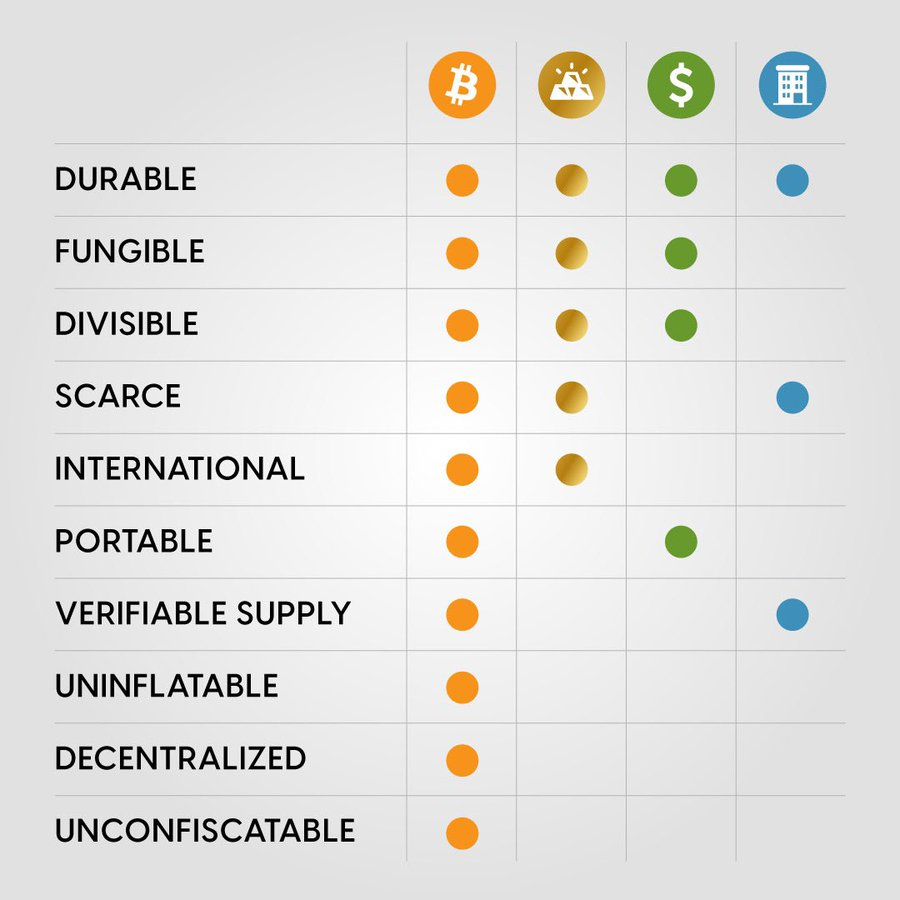
There are properties of money that must be maintained for something to even be considered money. That was an unlock for me. In all the time I spent playing the game I never once came across any books or study material that showed why and how money has to have and maintain certain properties or it can suddenly no longer be money. When you lose the properties of money and there is an alternative money that possesses these properties in superior form, as a species, we do the same exact thing each time. We move to the money available at the time that has the better properties of money. Because you have to.
So money printing and properties of money are the two concepts where I recommend starting if you've not dug in yet and are still dismissing Bitcoin. Verify for yourself whether or not we will stop printing money whether or not money has properties that must be upheld. Maybe I'm full of shit. Do the work to prove it. And yes it's still possible somehow that this thing goes to zero I just am not smart enough to show why and how but maybe you can. That would at least be a more interesting discourse than where we're at now.
Here's a chart on the properties of money from @Mister21st and an article on why money tends towards one with proof to check out in the meantime.
armantheparman.com/onemoney/
172
452
2,255
215,426
MWS⚡ retweeted

16 Aug 2024
In today's writeup of the IMF proposed 85% tax on cryptomining, Cointelegraph act as a megaphone, not a counterweight, to IMF's objectively false and widely debunked claims about Bitcoin mining.
cointelegraph.com/news/imf-c…
For this, Cointelegraph deserve to be held to account. Publicly.
Firstly, can someone please explain why some of the worst FUD on Bitcoin and energy is now coming not from Mainstream media, but from @cointelegraph? - which seems to have become less interested in truth since you left @JoeNakamoto.
They are the only magazine in the crypto-ecosystem who still give a voice to the discredited "research" of Alex de Vries.
They have repeatedly reproduced the state propaganda of the world's 2= most corrupt nation, Venezuela, who say that bitcoin "strains their energy grids. (No, well-documented theft of electricity by the govt of Venezuela destabilized their power grid).
Now in a piece by @JesseCoghlan01 they give an unencumbered stage to an IMF report on Bitcoin mining emissions based on widely discredited sources (here's my rebuttal IMF in case you along with Cointelegraph missed it x.com/DSBatten/status/182412…)
Among the failing of the Cointelegraph article
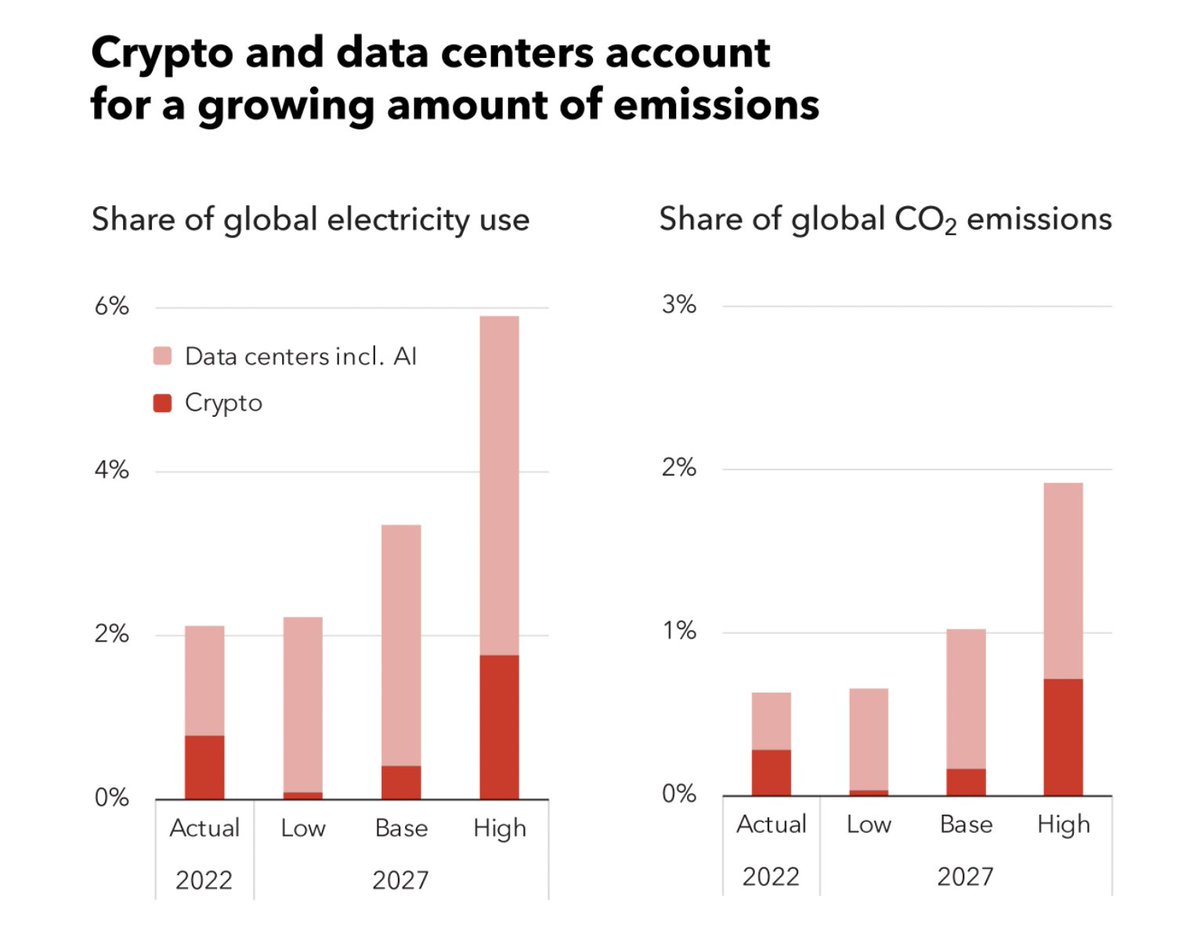
1. Not noticing that IMF's own data shows crypto-mining emissions reducing between 2022-2027
2. Failure to consider the IMF's potential conflict of interest; that an IMF report on Bitcoin has as much credence as a Report by Coke on why Coke is healthier than orange juice.
3. Recycling the flawed "energy use per transaction metric" that has been doubly-debunked.
4. Not inviting a single person knowledgeable on Bitcoin and energy to comment on the IMF report.
Jesse, your work is generally of a good standard. So if you're going to write about an area you are unfamiliar with such as Bitcoin and energy, and you want to enhance rather than reduce the credibility of your own journalism and the magazine you write for, its a good idea to either:
1. take the time to understand Bitcoin and energy, or
2. talk to people who do
Similarly @cointelegraph, why are you not protecting your own journalists from exposing their lack of domain expertise in a public forum, such that they will damage their reputation and yours?
Do better.
15 Aug 2024

Rebuttal of New IMF report on Bitcoin mining emissions
IMF report says "Carbon Emissions from AI and Cryto are surging" then goes on to a detailed report on how regulators should impose "cryptocarbon" tax.
Rebuttal:
Firstly, Bitcion advocates everywhere should pause to reflect on the significance of this moment. With the scientific consensus (9 of the last 10 peer reviewed articles) and mainstream journalism now concluding that Bitcoin mining has significant environmental benefits, those who stand to lose most from mainstream adoption of Bitcoin (IMF, Central Banks) are needing to resort to direct attack-pieces.
Here's a breakdown of why the IMF report is at best poorly researched, at worst propoganda.
imf.org/en/Blogs/Articles/20…
1. Rhetorical technique: "guilt by association". Let's say you want to criticize Larry, but the problem is that Larry is a good citizen. No problem, you find that Ben, a person who has the same day job and is the same age as Larry, is a criminal. Now you don't have to prove that Larry is of unsound character, all you need to do is say "Ben is a criminal, and Larry is just like Ben"
That's what the IMF report does. It's opening line even says "What do crypto assets and artificial intelligence have in common? Both are power-hungry". Straight out of the guilt-by-association playbook. There is no contemporary evidence in the report that Bitcoin mining produces a rising amount of carbon emissions, but plenty of evidence that AI datacenters' carbon emissions are rising. So AI datacenters serves a purpose, but as we will see later, they are really interested in attacking Larry. Ben is just the pawn in a bigger chess-game.
So the article says "AI datacenter emissions are rising, and Bitcoin is just like AI"
The technique is effective and will fool some people. But its also factually incorrect. BPI has already debunked the myth that AI datacenters and Bitcoin mining centers are comparable in a detailed report.
👇
cdn.prod.website-files.com/6…
Further, Rhodes et al showed back in 2021 that flexible datacenters such as Bitcoin mining had a net decarbonizing impact on grids, whereas inflexible datacenters such as AI had a net carbonizing impact.
👇
da-ri.org/science-hub
2. Make apples for oranges comparison
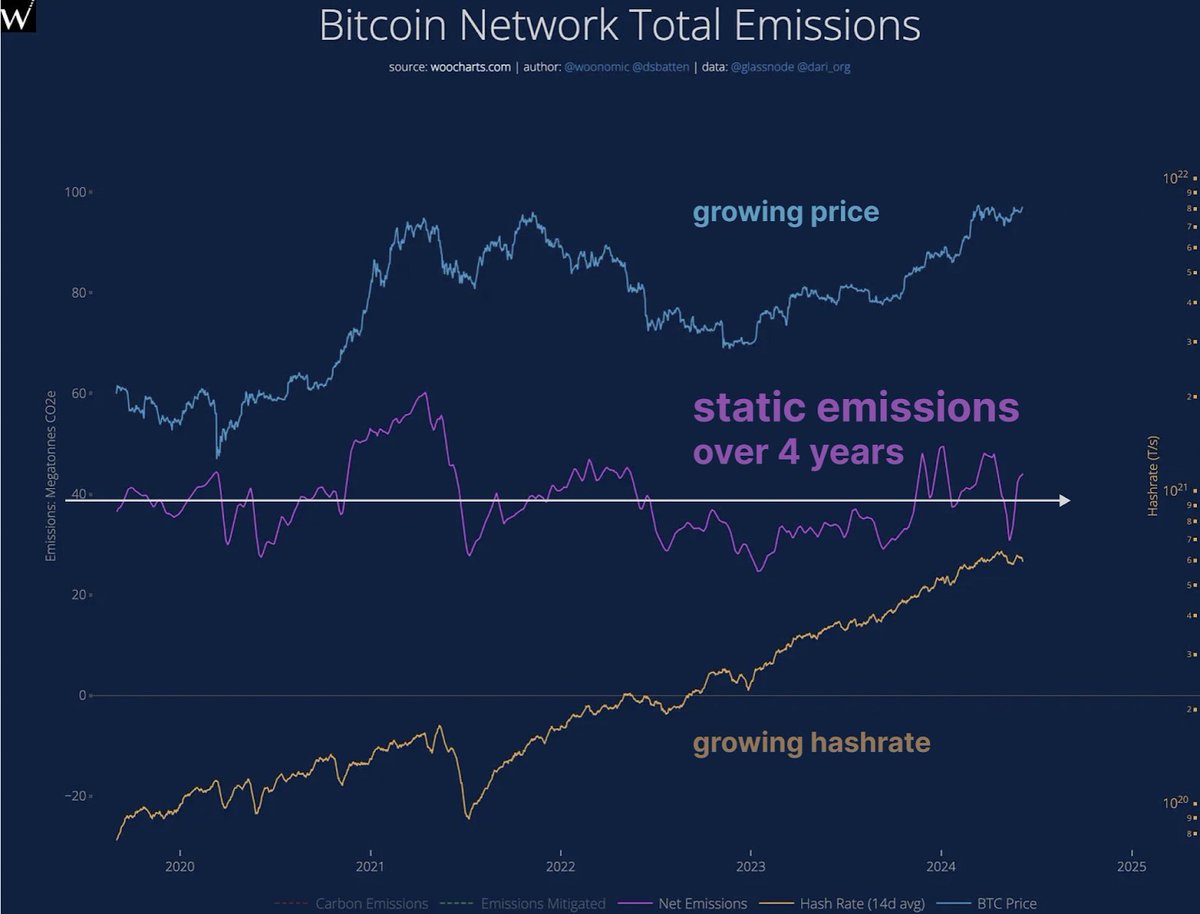
Today, data from a variety of independent sources including the Digital Assets Research Institute shows that as price and hashrate grows, Bitcoin mining emissions have not grown
👇
x.com/dari_org/status/182310…
The IMFs own data sources reveal the same thing. In fact, their data shows that by 2027, crypto's share of global electricity use, and its share of global CO2 emissions will have decreased, while for AI, both will increase.
Hmmm, that was inconvenient! Doesn't really support the thesis they wanted to support which was that Bitcoin was bad for the environment, just like AI.
So what did they do? They created another bar called "high" which indicated the maximum possible range of 2027 projections so that crypto's contribution looked visually higher than it's present-day share.
Where did the "high" estimate come from? Cambridge's hypothetical model of "what would happen if every bitcoin mining operation used coal" (something no industry does, and something Bitcoin mining uses less of than any other industry, and a fuel source Bitcoin mining is moving away from faster than any industry)
See their image from the report below.
They then go on to ask the question in a full length report "Cryptocarbon: How much tax is the corrective tax"
👇
imf.org/en/Publications/WP/I…
If the authors were seriously concerned for the environment, they would have looked at the data and written the paper. "AICarbon: How much tax is the corrective tax". Did they also write this paper? No.
3. Let's look at their detailed report.
11 mentions of the work of Alex de Vries, and a mention of Mora et al. Someone please tell the authors that not even GreenpeaceUSA cite Mora et al's work any more, which was triply-debunked within months of him writing it.
Further, the work of de Vries has been widely discredited, including this peer review article by Sai and Vranken.
👇
sciencedirect.com/science/ar…
The paper goes on to quote Cambridge's emissions and energy figures, despite the fact it is widely known (and stated on Cambridge's website) that theire model is no longer current, as it uses data from 2022.
Until we get intellectual honesty from the IMF, apples-for-apples comparisons, eshewing of already-discredited research, use of contemporary datasets, and an acknowledgement that the scientific consensus shows predominantly positive environmental externalities from Bitcoin mining, any reports from this institute should be disregarded as being of a low research-standard; unusable to policymakers and regulators.
20
96
412
26,204
MWS⚡ retweeted
4 Aug 2024
@gladstein with not one, but two amazing talks at Bitcoin 2024. 🤯 👏 youtu.be/24waV3Fwvow
1
4
13
4,767
MWS⚡ retweeted

14 May 2024
It starts with a leg-in trade of .1 to .5% as they do their research. Then it becomes a small position of 2 to 5% as they begin to understand it. Then with full understanding and realization of perpetual negative real rates on Treasuries, it becomes a full allocation of 10% .
14 May 2024

There are thousands of pension funds in the United States managing ~$27 trillion in assets. They are all going to need some #Bitcoin.
41
146
1,073
182,133
9 May 2024
They are only buying bitcoin with 10% profit from their bitcoin sector, not the whole company.
8 May 2024

Now add about 30 BTC per day from Block ($SQ)
Block says it will buy bitcoin every month with 10% of its gross profit.
Gross profit last quarter was about $2 billion
10% is $200M
🔥🔥🔥
2
4
388
MWS⚡ retweeted

25 Apr 2024
Seriously, bitcoiners need to be aware of the battleground they are on. We are challenging the worlds power structures.
This epoch is when the fight begins.
There are MANY internal forces here to stagger the growth of #bitcoin, no matter how much 'they' sound and look like us..
22
86
470
23,540