
Computational biochemist (he/him), PI of the vanderkampgroup.com. Likes #enzymes & #compchem, #diversity #inclusion.
Joined July 2009
- Tweets 3,337
- Following 720
- Followers 1,629
- Likes 6,912
122 Photos and videos






Pinned Tweet

13 Nov 2024
Interested in multiscale #compchem methods and applications?
Check out
ccpbiosim.ac.uk/multiscale20…
For conference details/speakers.
From March 31 to April 2, in Manchester, UK.
Registration deadline: February 3rd
@ccpbiosim @CCP5UK
3
6
1,111
Great 😡 Instead of racial segregation, we now have gender segregation in the UK. theguardian.com/world/2026/m…
189
Registration is open for the @ccpbiosim Annual Conference, 6-8 July, Bristol, UK!
See: ccpbiosim.ac.uk/bristol2026
Delighted to be hosting the conference @BristolUni, with the theme "Biomolecular simulation across scales, for understanding and design"
#compchem
#compbio
#biodesign
1
4
5
272
NB We have just heard that we can reduce all levels of conference fees by £100!
Bear with us while we adjust the registration process.
1
40
Fees are now reduced!
Early-bird student fee: 100
Early-bird fee: 150
Register by 15/05 for these; prices will rise £50 thereafter.
(For those without funding, we may be able to offer bursaries soon - check back on website in a couple of weeks)
20
marcvanderkamp@bluesky.social retweeted

22 Nov 2025
STOP, don't scroll, read the image and just think about it. ........ Yes it is crazy!
Now read the (X) post.
buff.ly/1FhKQlx

2
4
9
2,365
marcvanderkamp@bluesky.social retweeted

25 Sep 2025
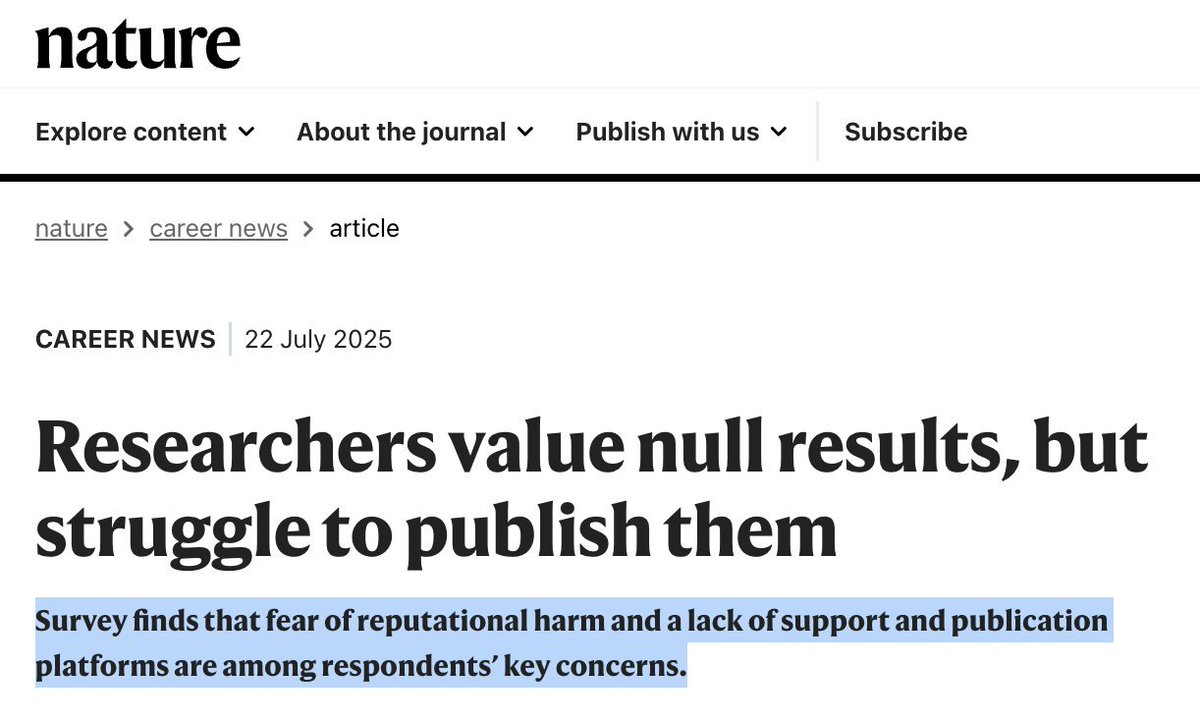
bioRxiv has a dedicated section for negative results.
Use it.
Share negative results.
Your colleagues will appreciate it.
19
389
1,934
186,903
1 Sep 2025
PhD project with GW4 BioMed DTP
available (Sept '26)!
Use #compchem multiscale reaction simulations & experiment to understand and combat antimicrobial resistance by Class C beta-lactamase #enzymes.
More info: gw4biomed.ac.uk/overcoming-%…
Deadline Oct 20th, but contact me by Oct 5th.
7
7
863
marcvanderkamp@bluesky.social retweeted

20 Aug 2025
Latest @ChemRxiv preprint! "Scalable Low-Energy Molecular Conformer Generation with Quantum Mechanical Accuracy" Collaboration w/ @NVIDIAHealth
We created ChEMBL3D, largest dataset of molecular 3D structures with 250M conformers for 1.8M drug-like molecules from ChEMBL. All optimized with QM accuracy and solvent effect.🚀
chemrxiv.org/engage/chemrxiv…
3
13
105
7,965
marcvanderkamp@bluesky.social retweeted

19 Aug 2025
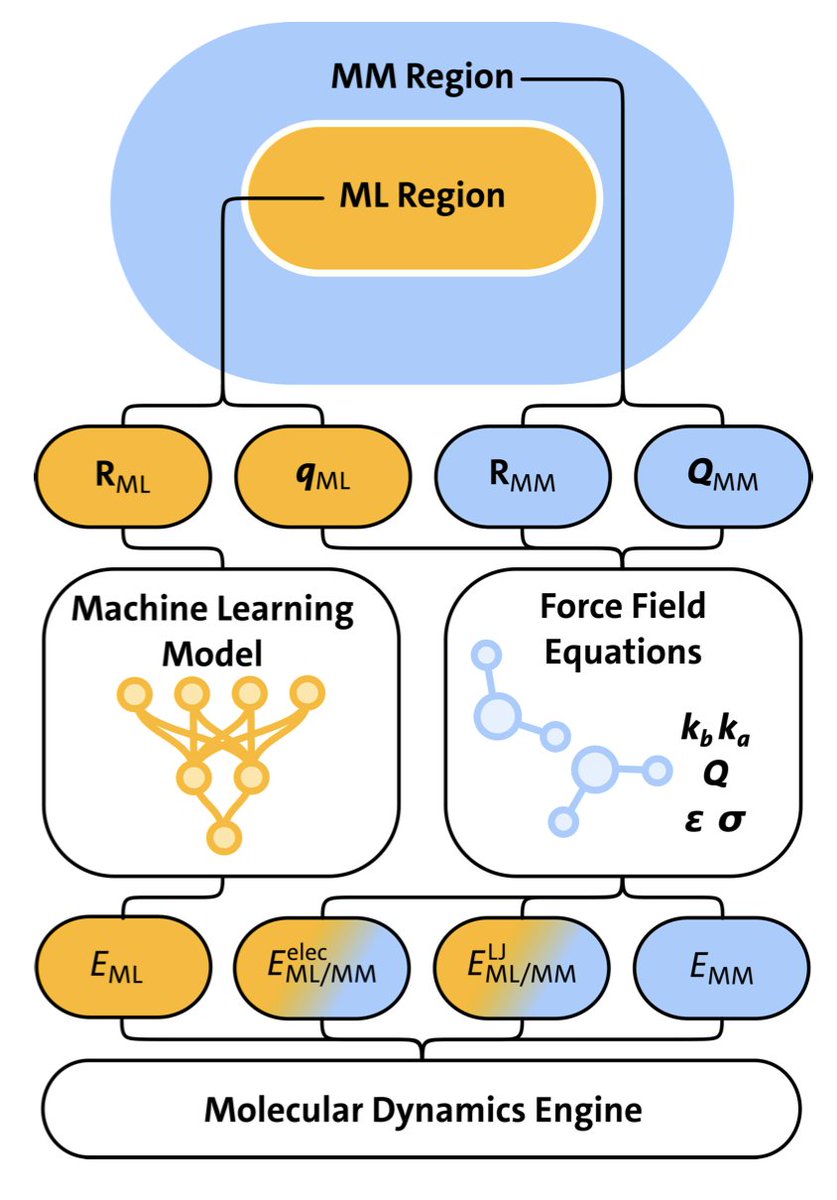
From QM/MM to ML/MM: A New Era in Multiscale Modeling
1. This review article explores the evolution from Quantum Mechanics/Molecular Mechanics (QM/MM) to Machine Learning/Molecular Mechanics (ML/MM) methods, highlighting how ML potentials offer a faster alternative to QM while maintaining accuracy. This transition is crucial for simulating complex biological and condensed-phase environments with reduced computational costs.
2. The article emphasizes the key challenge of coupling ML and MM regions, addressing this through three main strategies: Mechanical Embedding (ME), Polarization-Corrected Mechanical Embedding (PCME), and Environment-Integrated Embedding (EIE). Each strategy offers different trade-offs between accuracy and computational efficiency.
3. Mechanical Embedding (ME) is highlighted as the simplest approach, where the ML region interacts with fixed MM charges via classical electrostatics. This method is computationally efficient but neglects polarization effects, which can be critical in some systems.
4. Polarization-Corrected Mechanical Embedding (PCME) supplements a vacuum-trained ML potential with post-hoc electrostatic corrections. This approach preserves transferability while approximating environment effects, making it suitable for systems where polarization plays a significant role.
5. Environment-Integrated Embedding (EIE) involves training ML potentials with explicit inclusion of MM-derived fields. While this enhances accuracy, it requires specialized data and is more computationally intensive, making it ideal for applications where high fidelity is essential.
6. The review surveys existing ML/MM frameworks, categorizing them based on the embedding strategies used. It also highlights key applications, such as protein-ligand binding and solvation studies, demonstrating the practical utility of ML/MM methods.
7. The article concludes by discussing the current state-of-the-art in ML/MM and outlining future challenges, including the need for more transferable and general-purpose ML potentials, as well as the development of larger and more diverse training datasets.
📜Paper: doi.org/10.26434/chemrxiv-20…
#MultiscaleModeling #MLMM #QM_MM #ComputationalChemistry #MachineLearning #Biophysics
2
17
63
3,564

It's #IndigenousPeoplesDay!
Indigenous women and girls are keepers of invaluable scientific, environmental, and cultural knowledge.
Yet, #AI systems often exclude or misrepresent them, reflecting colonial biases.
To ensure inclusive AI governance, Indigenous women and girls must be empowered not only as users, but also as co-creators and regulators.
#WeAreIndigenous

65
173
371
21,161

marcvanderkamp@bluesky.social retweeted

6 Aug 2025
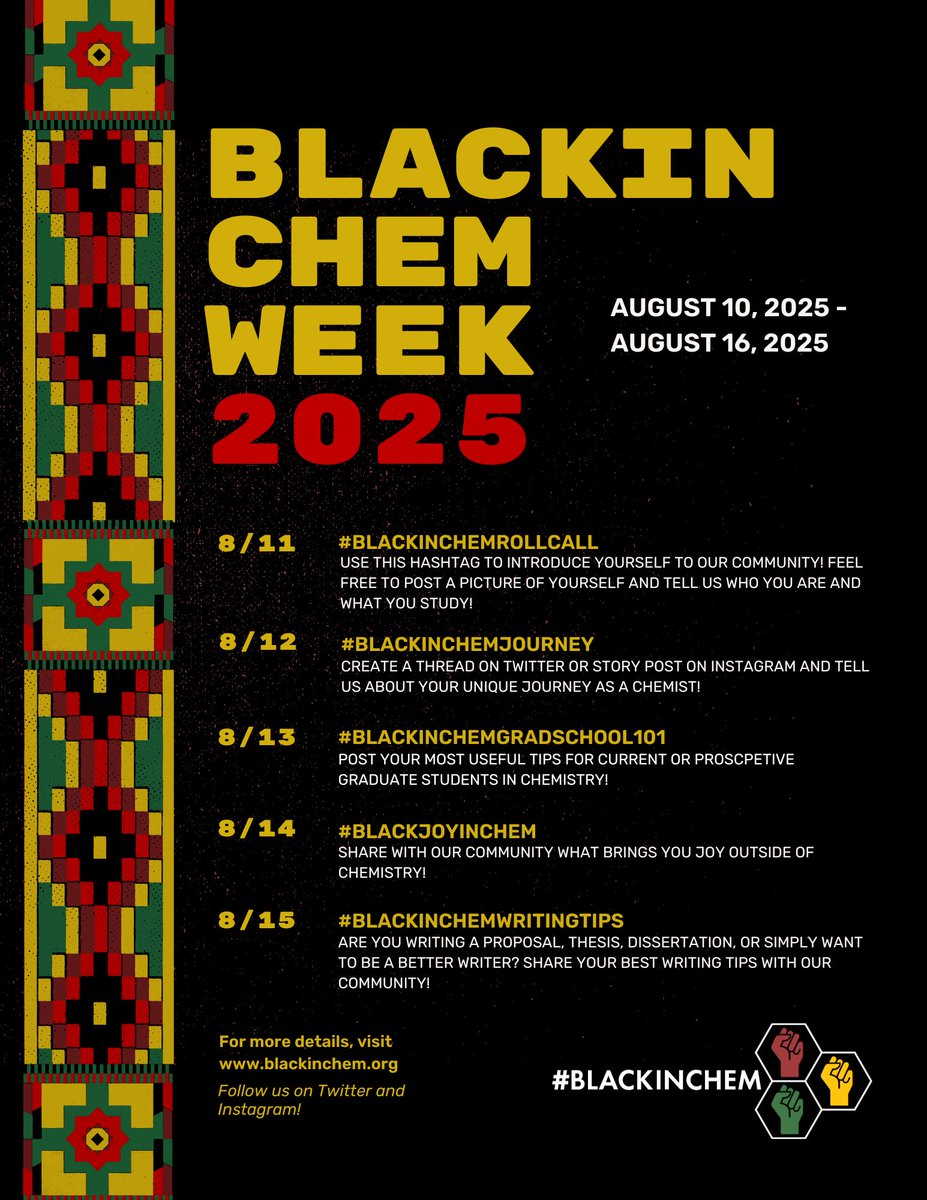
WE’RE BAAACK!!!
#BlackInChemWeek2025 is gearing up for kickoff next week! Join us as we celebrate six years with our community! 🎉🥳
30
57
4,395
marcvanderkamp@bluesky.social retweeted

25 Jul 2025
I’m really happy to share that I’ve passed my PhD viva in Computational Biochemistry! It’s been an exciting journey and I’m profoundly grateful to my supervisors Dr @marcvanderkamp and Dr Deb Shoemark, and my collaborator Dr Richard Sessions for all their support and guidance.

3
1
5
497
marcvanderkamp@bluesky.social retweeted

22 Jul 2025
🎉 Our preprint “Dynamic Behavior ... of the Polymyxin Resistance Determinant MCR-1 ... in the Membrane Environment” in colab with @Spencer_D60 @AdrianMulholla1 @marcvanderkamp is now published in JCIM.
📖 Read it here: pubs.acs.org/doi/10.1021/acs…
2
6
248
marcvanderkamp@bluesky.social retweeted

21 Jul 2025
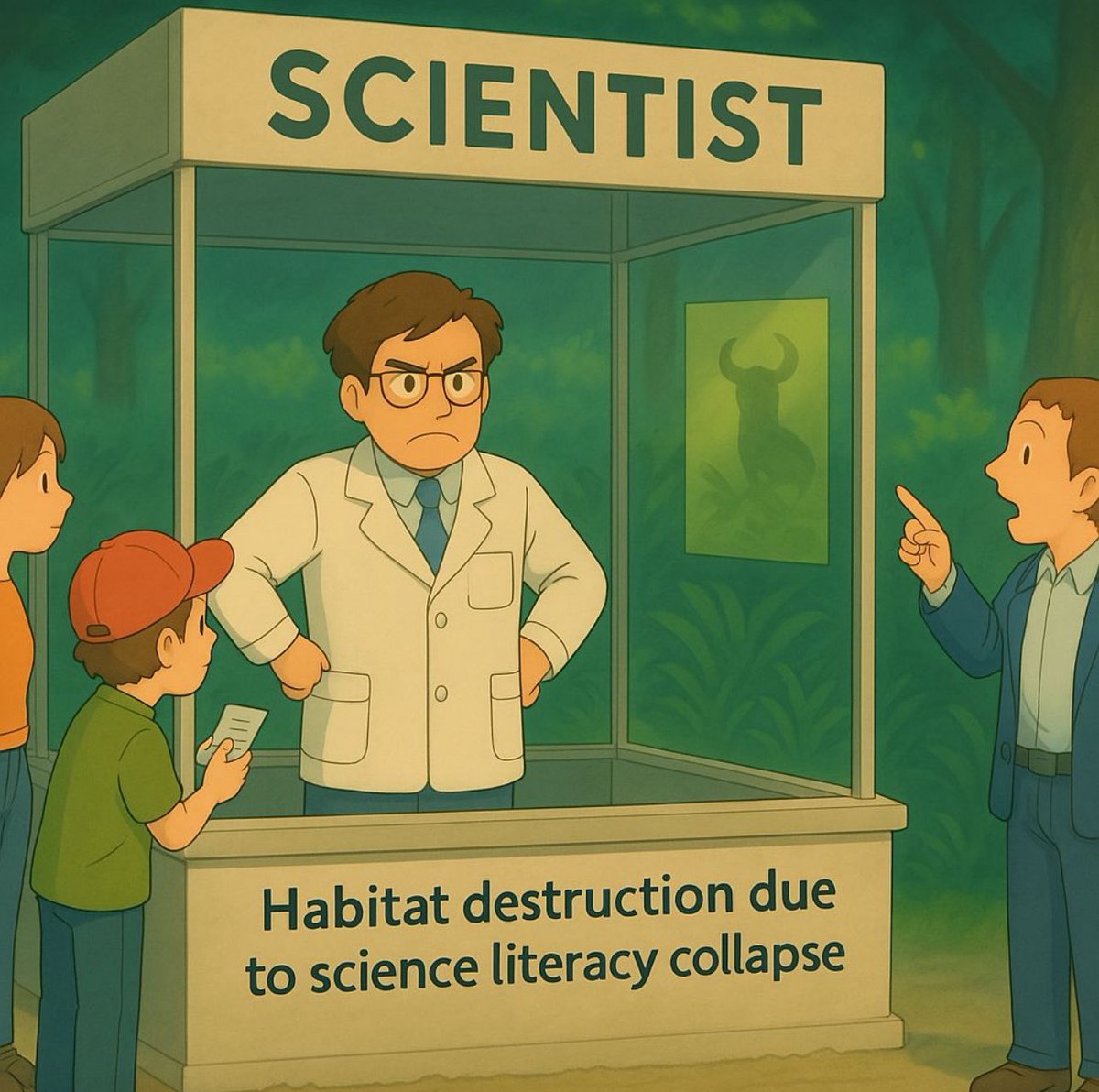
Science literacy is collapsing.
And with it, the foundations of civilization.
People fear vaccines more than viruses. So diseases we once defeated are coming back.
They fear GMOs more than hunger.
So we reject tools that could feed millions.
They fear nuclear more than climate collapse. So we burn more coal.
They trust influencers over scientists.
So truth becomes a matter of opinion.
This isn’t just ignorance.
It’s a threat.
You can’t solve 21st-century problems with 15th-century thinking.
Science isn’t a luxury. It’s survival.
Teach it. Defend it. Demand it.
688
646
2,053
209,461
marcvanderkamp@bluesky.social retweeted

21 Jul 2025
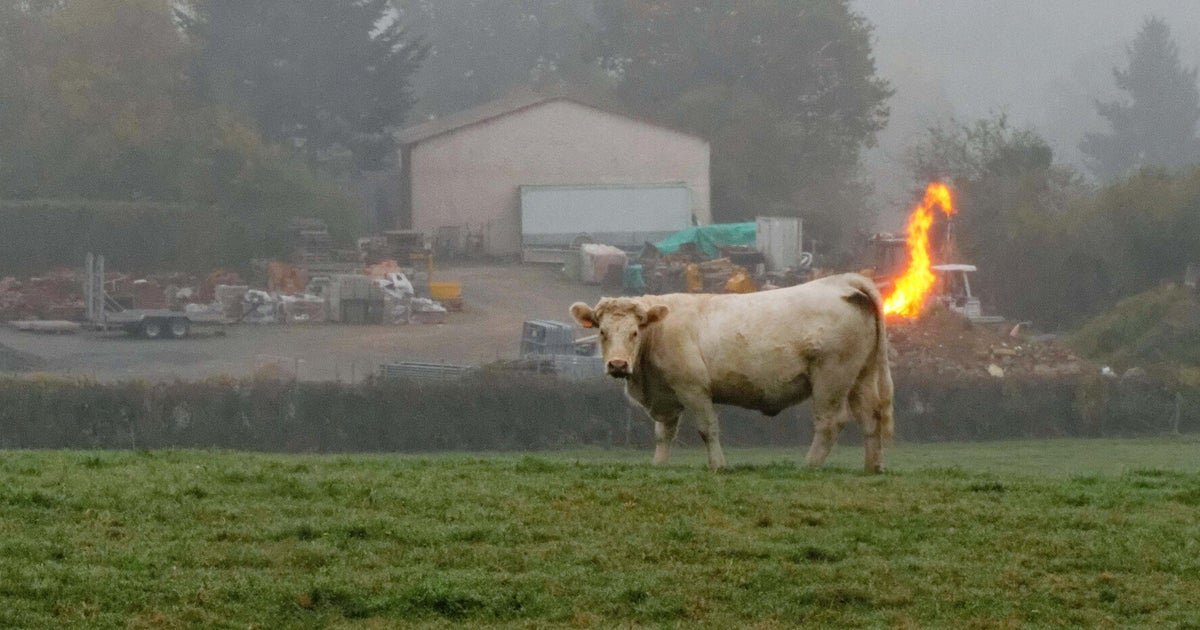
Great picture. Incredibly deceptive and ignorant argument.
Of course cows don't "create" carbon atoms. But they do ensure that roughly 20,000,000,000,000,000,000,000,000,000,000,000,000,000 carbon atoms are in the atmosphere where they help heat the planet instead of in plants where they don't.
If you get rid of cows, replace very single nutrient they provide with plant or non-ruminant animal sources and you offset roughly 30 years of CO2 emissions.
20 Jul 2025

Cows can’t add a single atom of carbon to the atmosphere that a plant hasn’t previously removed.
Carbon is part of a biogenic cycle and can neither be created nor destroyed.
People who try to frame cows as causing climate change don’t understand how science works.
1/2
1
5
30
7,846
marcvanderkamp@bluesky.social retweeted

18 Jul 2025
Our development of machine-learned transferable coarse-grained models in now on Nat Chem! doi.org/10.1038/s41557-025-0…
I am so proud of my group for this work! Particularly first authors Nick Charron, Klara Bonneau, @sayeg84, Andrea Guljas.
3
40
129
9,665
marcvanderkamp@bluesky.social retweeted
5 Jul 2025
🚨 Check out the updated version of our latest preprint with @AdrianMulholla1, @ShakirAliSiddi4, @marcvanderkamp, and many others!
📄 Read it here 👉chemrxiv.org/engage/chemrxiv…
2
4
460
12 May 2025
The #CCPBioSim Biomolecular Simulation Annual Conference will be in Southampton, UK, 14-16 July 2025.
Registration is open!
Early-bird deadline: May 19
Details and the registration link can be found at ccpbiosim.ac.uk/events/upcom…
#compchem #biophysics
5
8
624
marcvanderkamp@bluesky.social retweeted

3 May 2025
Not sure why the gutting of American science funding isn’t a bigger story.
No one voted for it, it reduces American innovation and economic competitiveness in the near-term and long-term, and it isn’t even being done efficiently, if that were in fact the goal.
242
921
4,501
442,887