
Phd student in political science @Columbia studying voter responses to democratic threat in America.
Joined February 2017
- Tweets 2,568
- Following 693
- Followers 696
- Likes 8,039
21 Photos and videos




Pinned Tweet

Apr 22
I am happy to share two pieces of news:
For the 2026-2027 academic year. I will join the Litowitz Center for Enlightened Disagreement @KelloggSchool as a postdoc working with @EliJFinkel and Nour Kteily.
Then, in Fall 2027, I will join @LSEGovernment as an Assistant Professor.
I am incredibly excited about both positions and grateful to friends, family, mentors and co-authors who have helped me along the way.
I am excited to be doing more work on strategic voting, democratic norms, field experiments and many other topics. So please reach out if you are Evanston or London (or anywhere else I suppose).
18
7
118
14,162
May 19
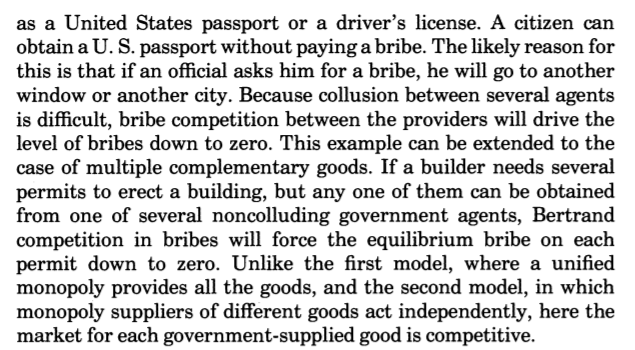
This paper makes by far the best argument for the electoral college.
May 19

From the latest issue of the QJPS, "Electoral College and Electoral Fraud" by Georgy Egorov and @k_sonin. A thread.
1
7
1,039
May 11
This is a very strange argument. If there is a 30% fatality virus spreading in the population the public demand for extreme measures will be overwhelming. No one will care about COVID era grudges about public health.
May 11

You only get one lockdown every 100 years or so. Our public health authorities beclowned themselves and wasted it on a relative nothingburger (for the general population, not the elderly or those with comorbidities), so if/when we get an actual severe pandemic, we’re screwed.
1
1
5
666
Apr 29
Why do state parties that routinely lose all their elections not make even cursory attempts to appeal to their state's median voter?
There are many plausible answers but not clear what combination of them is most accurate.
5
21
16,823
Mar 12
1/ Will voters participate in the primary of a party they oppose to prevent the nomination of a candidate they fear?
In a new paper in AJPS with @HayleyCohen, we study crossover voting using surveys and a large field experiment (N=83,902) in the 2024 New Hampshire Republican presidential primary.
onlinelibrary.wiley.com/doi/…
6
23
76
7,728
Mar 12
5/ The encouragement worked.
Turnout in the competitive Republican primary increased by about 1.6 percentage points, while turnout in the Democratic primary fell by about 0.5 points.
Effects were somewhat smaller among voters living with other Democrats, but effects don’t change by how likely a voter is to support the Democrat in the general election.
1
5
6,557
Mar 12
6/ The broader takeaway: By crossing over and backing moderate candidates, voters can lower the stakes of general elections.
Voters worried about the future of democracy and confronted with an uncompetitive primary in their own party can further pro-democratic candidates by combining a strategic turnout decision and a sincere vote choice.
1
1
9
735
3 Sep 2025
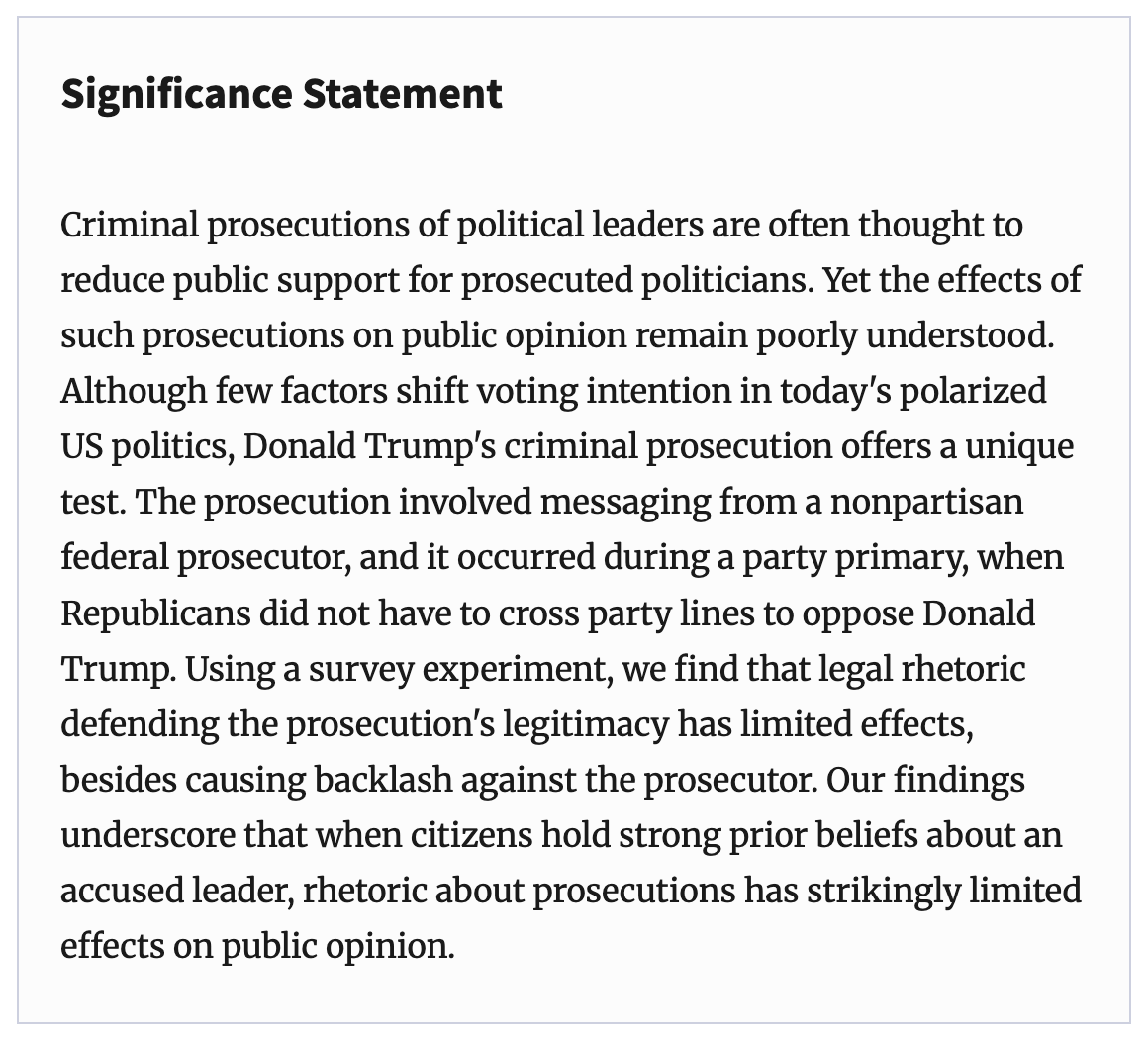
Great thread from @AOD_PhD summarizing our new paper in @PNASNexus.
I think a big takeaway is that partisans have strong priors about party leaders and topics that have been litigiated in partisan media, but very weak priors about many other public servants.
So someone like Jack Smith, who begins as a relatively anonymous prosecutor, rapidly develops a polarizing public reputation, while not making much of an impact on electoral politics.
3 Sep 2025

New article! @markovitis and I examine how prosecutions of political leaders affect public opinion by studying the valuable case of Trump's criminal prosecution. Key finding: rhetoric from Trump's prosecutor marginally ⬇️ intention of voting for Trump but massively ⬆️ backlash 1/
1
1
8
3,404
3 Sep 2025
That being said, we find that a defense of Trump's prosecution weakly hurt him by damaging his standing among Republicans who were hesistant towards him pre-treatment.
So to the extent the prosecution of Trump helped him to consolidate support in the Republican Primary it was probably through his domination of the media environment, not through a "rally around the prosecuted" candidate effect.
1
198
Daniel Markovits retweeted

3 Sep 2025
New article! @markovitis and I examine how prosecutions of political leaders affect public opinion by studying the valuable case of Trump's criminal prosecution. Key finding: rhetoric from Trump's prosecutor marginally ⬇️ intention of voting for Trump but massively ⬆️ backlash 1/
2
7
25
11,923
14 Aug 2025
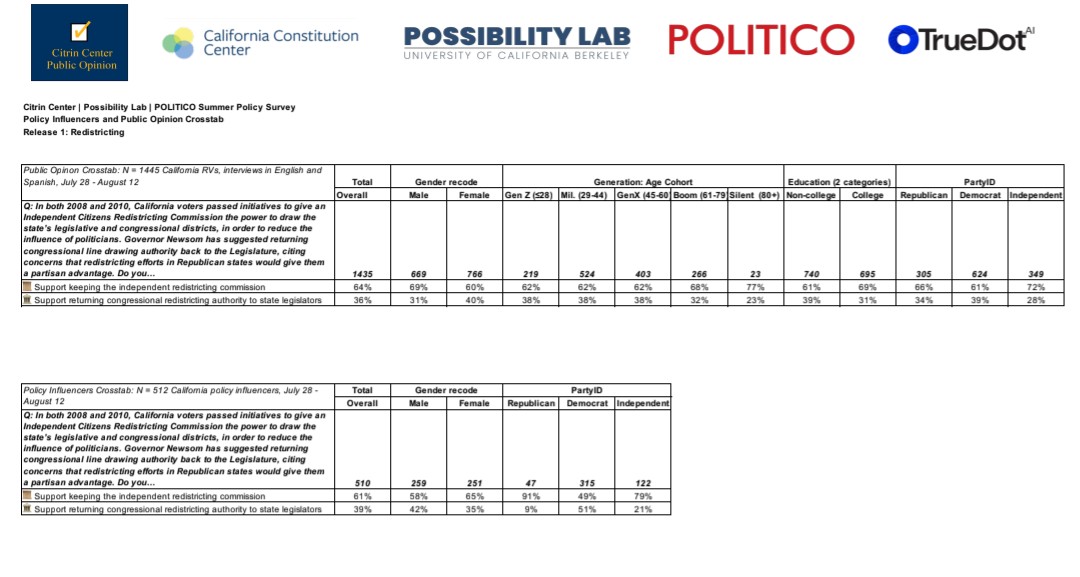
This is a case where the public opinion literature on democratic norms is very practically useful: voters don't like efforts to rig elections in isolation, even as they won't massively punish candidates who back such proposals in general elections (where many other policies are at stake).
Still, "they did it first" is almost certainly the best way for both parties to raise public support for these proposals.
14 Aug 2025

A new POLITICO poll shows California voters prefer keeping an independent line-drawing panel to determine the state’s House seats “by nearly a two-to-one margin” (64%) while only “36% of respondents back returning congressional redistricting authority to state lawmakers
1
11
1,006
5 Aug 2025
Well something has changed! Though it is not clear it is norms eroding so much as members being more willing to take on slightly more risk/disruption to help their party.
5 Aug 2025

On redistricting, it's cute that people think that politicians would adhere to principle.
On this, there is no principle. There is only power.
1
1
288
23 Jul 2025
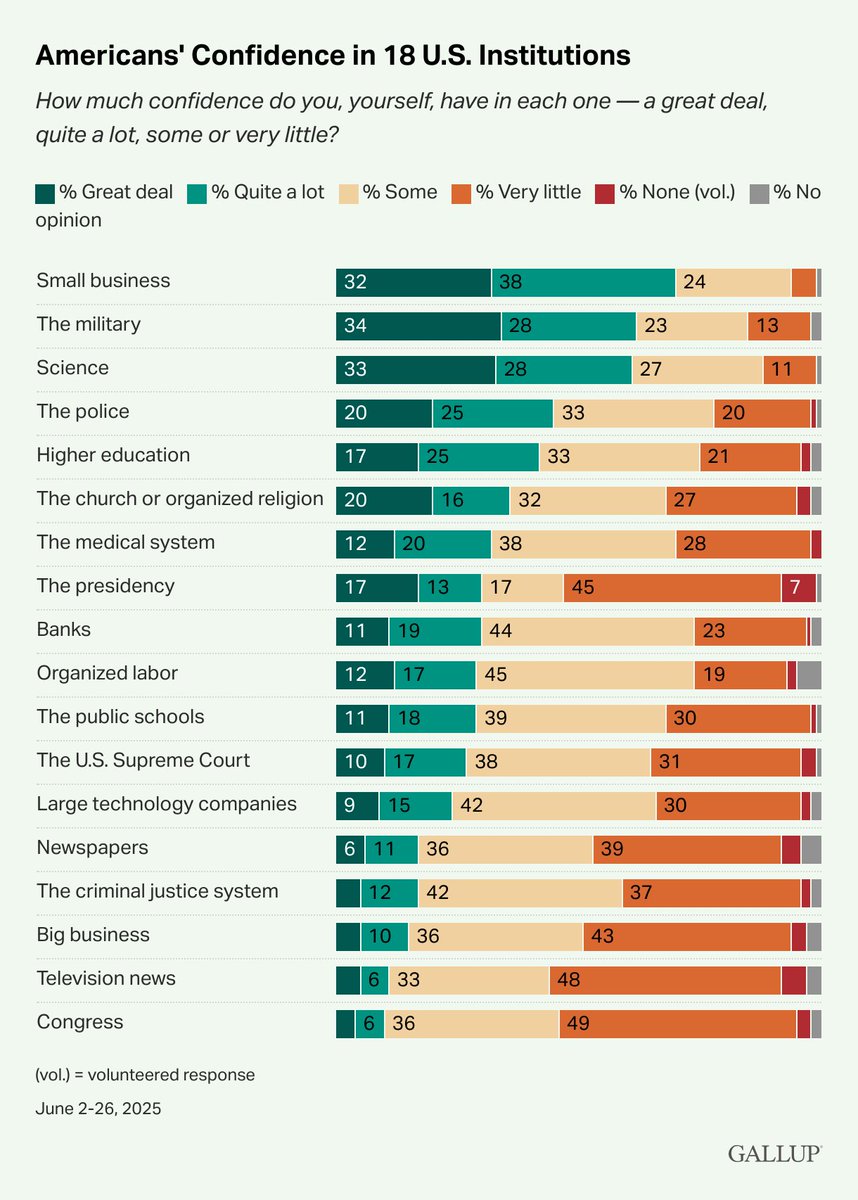
Well, thermostatic public opinion is coming to science and higher education.
22 Jul 2025

"Science" is now the third highest supported institution in the US, after small business and the military. Higher ed is fifth.
2
235
9 Jul 2025
Unlike the primary, this seems like an election that would actually benefit from RCV.
9 Jul 2025

Mamdani gets support from 35 percent of registered voters, followed by Cuomo with 25, Sliwa with 14, Adams at 11 and attorney Jim Walden at 1 percent. Thirteen percent of respondents said they weren’t sure, while 1 percent picked another candidate.
1
165
29 May 2025
Obviously we don't see the ones that don't get covered but it seems like these "test some intra-party fight through slanted polling wording" survey write-ups are pretty good at generating earned media.

Poll: Democratic voters prefer "populism" over "abundance" trib.al/3zUyvIU
2
274
Daniel Markovits retweeted
14 May 2025
Today in @TheAtlantic, I write that Trump is "baiting the courts" — following a strategy that authoritarians from Turkey to Mexico have used to weaken the judiciary.
The key idea behind "court-baiting:" adopting policies that are popular but illegal.
theatlantic.com/ideas/archiv…
8
71
152
19,446