
Economist | Forex Trader | Astro-Timing 🪐 Navigating market cycles via cosmic insights. Stocks & Crypto strategist. Creative lead MargoMDesigns. #DYOR ✨
Joined March 2016
- Tweets 11,222
- Following 1,572
- Followers 1,830
- Likes 29,590
1,023 Photos and videos










GM GN EVERYONE 🌅🌙
The spirit of summer reminds us of one thing:
Do not be satisfied just to drift.
Dream big, but move with purpose.
Work hard, but keep your heart clean.
Stay focused, but choose good people.
Dreams do not come alive by wishing alone.
They require faith, discipline, and the courage to
press forward when the tide tries to pull you away.
Big dreams don't work unless you do.
Keep pressing forward.
May this season bring fruit to the work you
refused to quit. 🌊🕊️✨
14h

GM GN EVERYONE
Dream big, work hard, stay focused, and surround yourself with good people 🌅

23
29
1,309

Jun 13
GM☕✨GN🌙😴 EVERYONE
Later is just the quiet road to never.
Fear and power never shake hands.
The longer you wait to build your ideal self,
the more fear starts dressing itself as logic.
When duty whispers, "you must," answer: "I can."
Stop taking the quiet road to never.
Organize your success today. Do it now.
What is holding you back from your ideal self today? 👇

23
2
32
489
MargoMDesigns🛡️ retweeted

Jun 12
Me refusing to sell my 1 SpaceX IPO share because it might be a Mars boarding pass someday
Jun 12

BREAKING: Thousands of retail investors received just 1 SpaceX share at IPO
283
1,556
42,949
3,589,710

POV: You bought $SPCE because you expected it to benefit from SpaceX IPO
Meanwhile, stock crashed -25%
Cause traders thought its $SPCX ticker…

5 hours before the biggest IPO in history.
From 2001-2025, all major US IPOs combined raised around ~$790B.
SpaceX alone is raising ~$75B.
That’s about 10% of 25 years of IPO money in one deal.
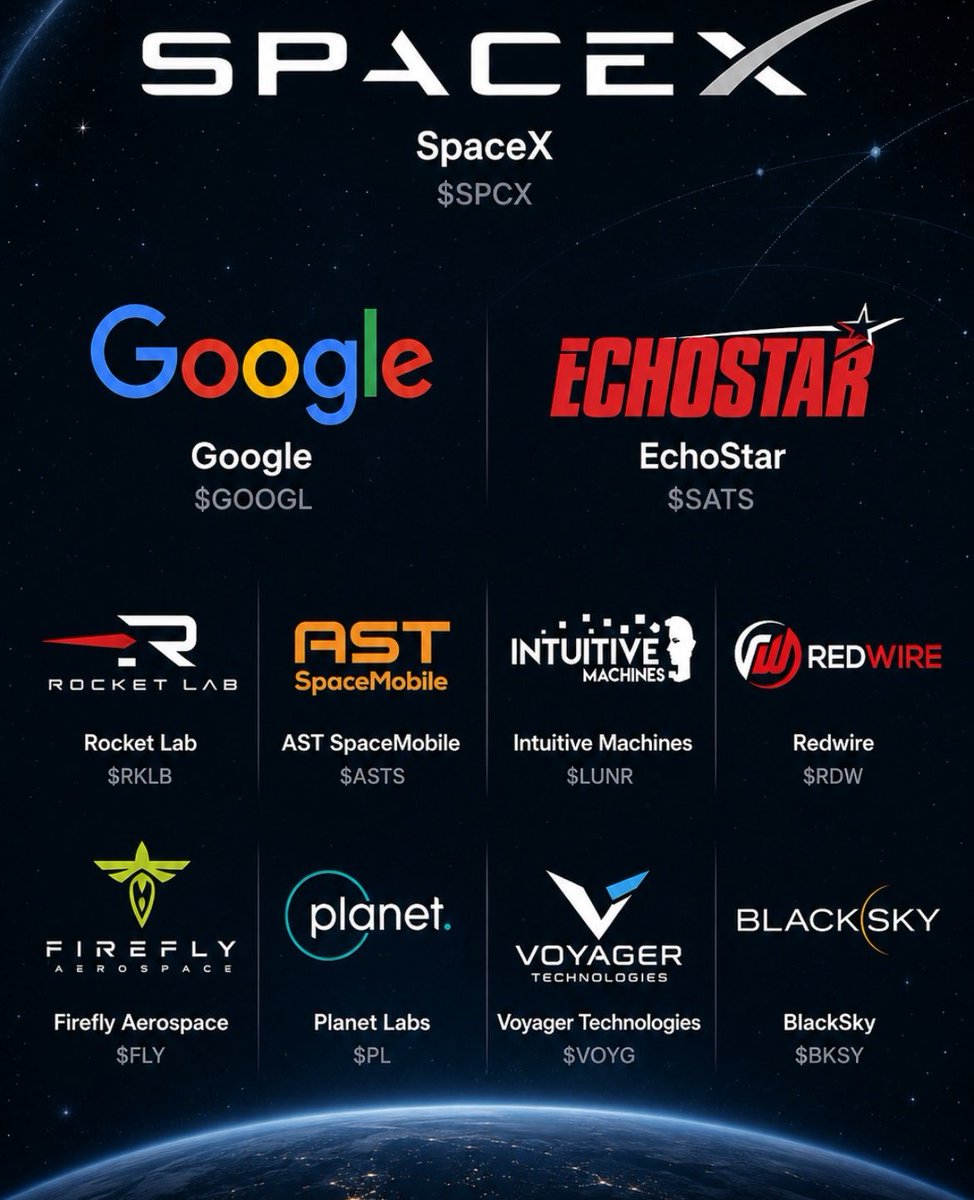
But who actually benefits from $SPCX?
Here’s the list:
• $GOOGL gains from direct SpaceX stake exposure.
Alphabet becomes one of the biggest public-market ways to indirectly own SpaceX upside without buying SPCX directly.
• $SATS gains as the clearest public SpaceX proxy.
EchoStar has direct SpaceX equity exposure plus a Starlink direct-to-cell partnership angle.
• $RKLB gains as the “next SpaceX” trade.
Rocket Lab becomes the cleanest public launch comp when investors start looking for smaller high-beta space names.
• $ASTS gains from the satellite-to-phone narrative.
If Starlink pulls attention into direct-to-device connectivity, AST SpaceMobile becomes one of the first hype names traders chase.
• $LUNR gains from lunar economy rotation.
SpaceX IPO shines more light on NASA, Artemis, moon missions, lunar landers and commercial space infrastructure.
• $RDW gains from space infrastructure demand.
More launches means more need for robotics, components, manufacturing and in-orbit systems.
• $FLY gains as another launch/lunar pure-play.
Firefly rides the “alternative launch provider” narrative as investors search beyond SpaceX.
• $PL gains from satellite data growth.
More satellites in orbit means more demand for Earth imaging, geospatial analytics and AI-driven data products.
• $VOYG gains from orbital infrastructure hype.
Commercial space stations and next-gen space platforms become easier for investors to understand after SPCX.
• $BKSY gains from satellite intelligence demand.
Defense, real-time imagery and space-based analytics become more valuable as the whole sector gets repriced.
SpaceX IPO is not just about SpaceX.
It creates a public valuation benchmark for the entire commercial space economy.
Tesla did it for EVs.
Nvidia did it for AI.
Bitcoin did it for crypto.
Now SpaceX could do it for space.
14
4
46
9,307
MargoMDesigns🛡️ retweeted
Jun 12
Haha hold your horses! 🐎 Dynamic valuation for sure, but let's check the global scoreboard.
At a $2.3T valuation ($175-176 a share), $SPCX is an absolute monster on Day 1, but it's currently sitting at the #6 spot in the US,
right behind Amazon. Globally, it still has to leapfrog
the massive multi-trillion tech giants to crack the top 5
It's a historic launch, but the gravity of that
order book is very real right now.
Are you expecting another squeeze attempt before the 4 PM bell? 🔔👇
3
1
8
406
Jun 12
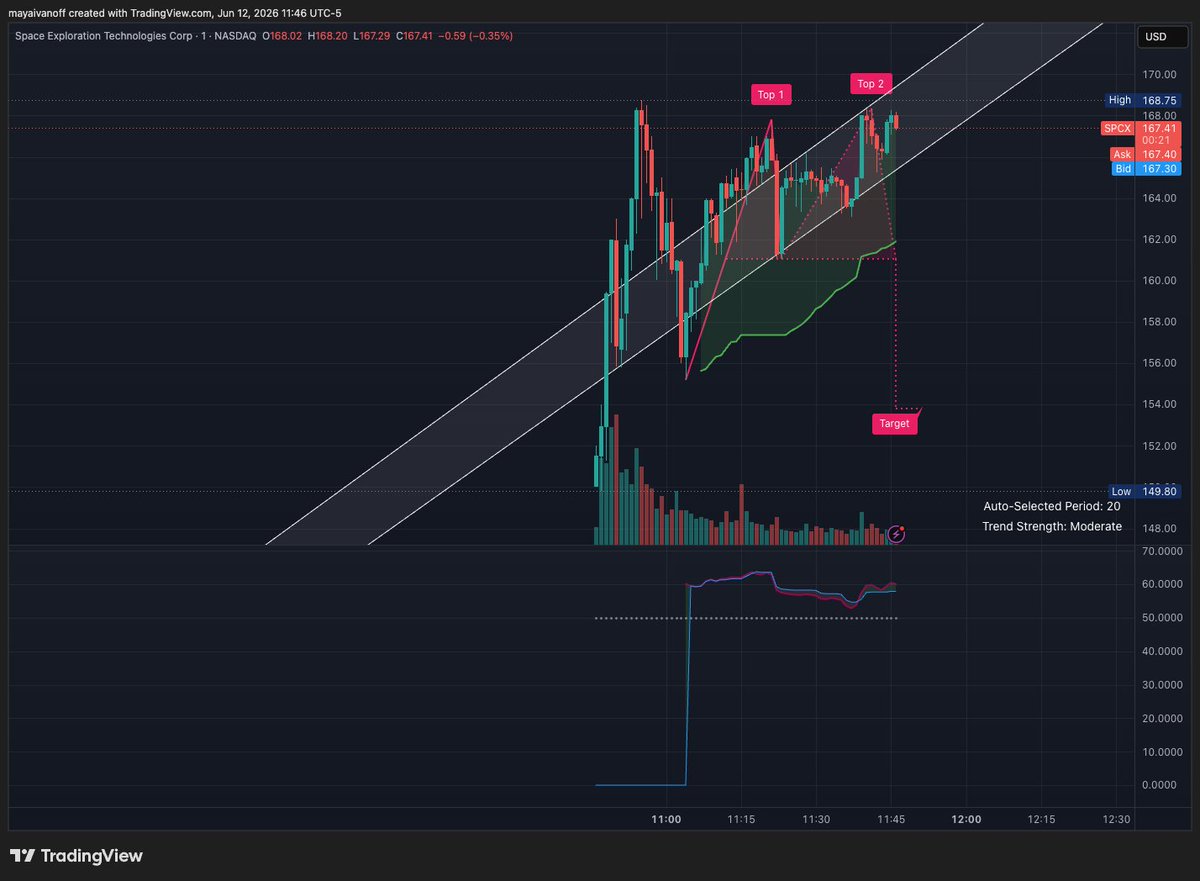
🚨 BREAKING: $SPCX JUST PRINTED A DOUBLE
TOP AT THE HIGH! 🚨
The institutional block orders at $168.75 just held the line like a brick wall. Look at the 1-minute chart right now:
📉 THE PATTERN
We just rejected the channel ceiling for the second time ("Top 1" & "Top 2"). A textbook Double Top is now locked in.
🎯 THE DOWNSIDE TARGET
If the lower channel support snaps, the technical breakdown pattern is projecting an aggressive drop straight down to ~$153.00 (Pink target line).
⚠️ MOMENTUM FLIP
The trend strength just officially flipped to "Moderately Weak." Volume is completely drying up on the green candles, the bulls are running out of steam before lunch.
Are you shorting this rejection, or waiting to buy the blood near $153? 🩸
👇 Where do you think $SPCX closes at 4 PM? Drop your targets!
7
15
170
Jun 12
Are you riding this squeeze to $175 , or waiting for another trap? 🚀👇
2
5
684
5 hours before the biggest IPO in history.
From 2001-2025, all major US IPOs combined raised around ~$790B.
SpaceX alone is raising ~$75B.
That’s about 10% of 25 years of IPO money in one deal.
But who actually benefits from $SPCX?
Here’s the list:
• $GOOGL gains from direct SpaceX stake exposure.
Alphabet becomes one of the biggest public-market ways to indirectly own SpaceX upside without buying SPCX directly.
• $SATS gains as the clearest public SpaceX proxy.
EchoStar has direct SpaceX equity exposure plus a Starlink direct-to-cell partnership angle.
• $RKLB gains as the “next SpaceX” trade.
Rocket Lab becomes the cleanest public launch comp when investors start looking for smaller high-beta space names.
• $ASTS gains from the satellite-to-phone narrative.
If Starlink pulls attention into direct-to-device connectivity, AST SpaceMobile becomes one of the first hype names traders chase.
• $LUNR gains from lunar economy rotation.
SpaceX IPO shines more light on NASA, Artemis, moon missions, lunar landers and commercial space infrastructure.
• $RDW gains from space infrastructure demand.
More launches means more need for robotics, components, manufacturing and in-orbit systems.
• $FLY gains as another launch/lunar pure-play.
Firefly rides the “alternative launch provider” narrative as investors search beyond SpaceX.
• $PL gains from satellite data growth.
More satellites in orbit means more demand for Earth imaging, geospatial analytics and AI-driven data products.
• $VOYG gains from orbital infrastructure hype.
Commercial space stations and next-gen space platforms become easier for investors to understand after SPCX.
• $BKSY gains from satellite intelligence demand.
Defense, real-time imagery and space-based analytics become more valuable as the whole sector gets repriced.
SpaceX IPO is not just about SpaceX.
It creates a public valuation benchmark for the entire commercial space economy.
Tesla did it for EVs.
Nvidia did it for AI.
Bitcoin did it for crypto.
Now SpaceX could do it for space.
17
3
44
9,520
Jun 12
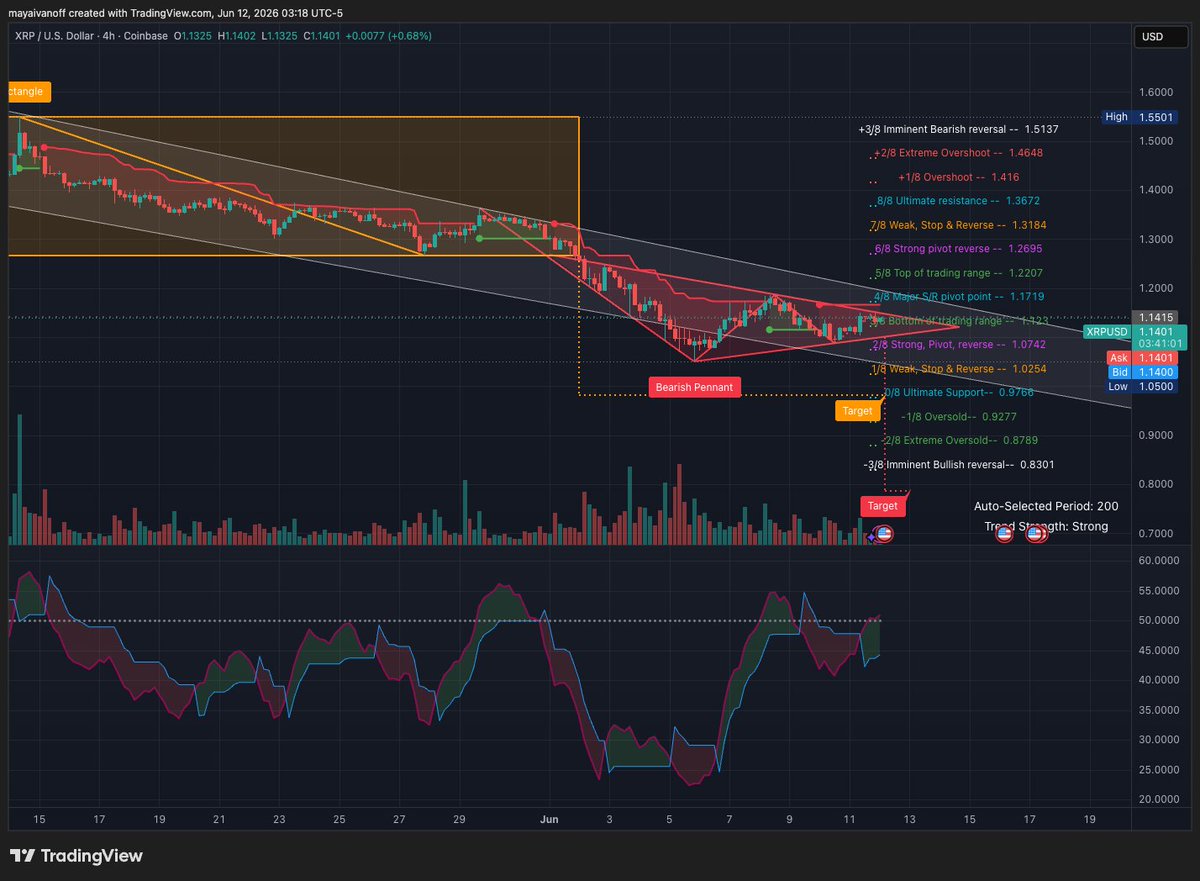
$XRP is caught in a brutal tug-of-war right now. ⚔️
🟢 1H chart: Reclaiming local support, with the trend looking ready for a squeeze higher.
🔴 4H chart: Heavy bearish pennant still in play after the rectangle breakdown.
We are compressing straight into the apex of a heavy Bearish Pennant right below key resistance.
Higher timeframes rarely lie.
The next major daily close could decide the summer trend.
Bulls or bears: Who takes control from here? 👇
21
1
32
295
Jun 12
GM🌅 GN 🌃 EVERYONE
Confucius dropped this truth 2,500 years ago,
and it still hits hard today:✨
"Our greatest glory is not in never falling, but in rising every time we fall."🌌
Society praises the "overnight success."
But the real superpower is resilience.
True progress isn't a straight line.
It's a series of failures met with the refusal to quit.
Every time you stumble, you are just collecting
data on how to win next time.
Let us drop the weight of our uncertainties.
Let us replace "what if I fail"with "what if I fly."
Your potential is not bounded by your current circumstances, but by your current conviction.
Believe in the possibility of tomorrow, act with boldness today, and watch the limits dissolve💥
Jun 11
GM GN EVERYONE
The only limit to our realization of tomorrow will be our doubts of today🦶

27
39
1,127
Jun 12
Big indexing shifts tell you exactly where the smart money is moving
The Nasdaq-100 is officially an #AI infrastructure and space index now. 🚀
Huge news for $RKLB, $CRWV, and $ALAB.
Massive forced institutional buying incoming before June 22.
Which addition are you most bullish on? 👇
Jun 12

4
11
110
MargoMDesigns🛡️ retweeted

Jun 11
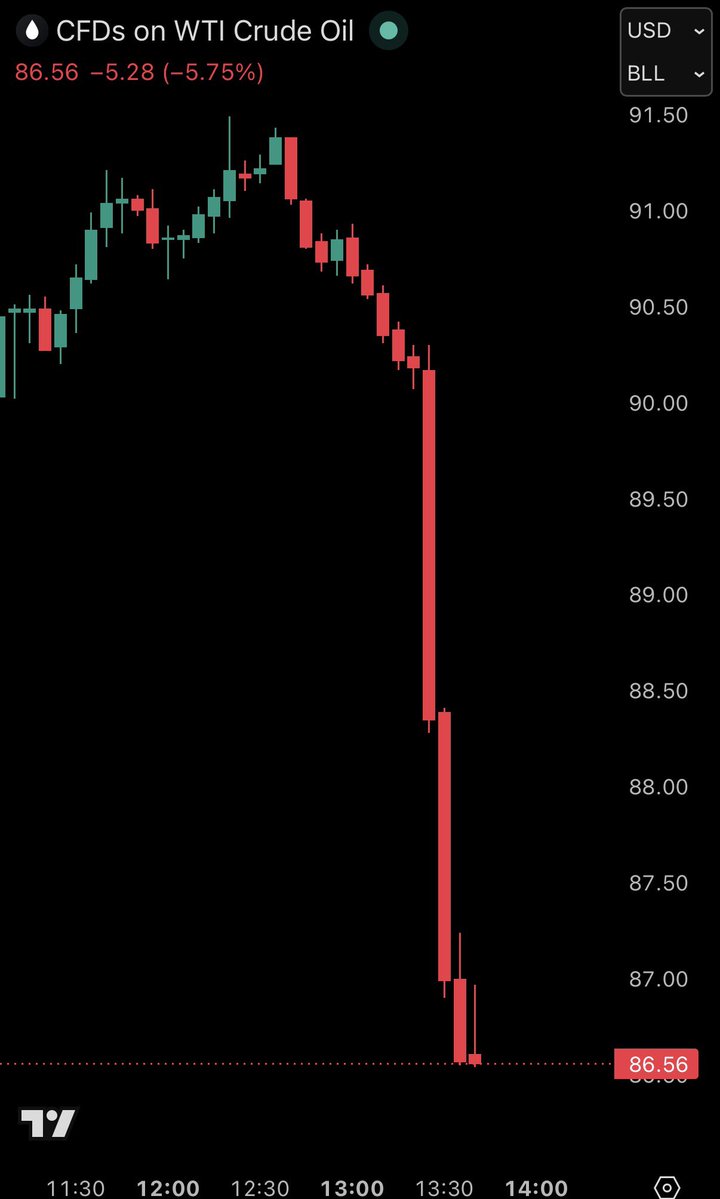
Traders long $OIL right now

BREAKING: US oil prices collapse below $87/barrel after President Trump cancels scheduled strikes on Iran.
12
1
30
1,757
Jun 11
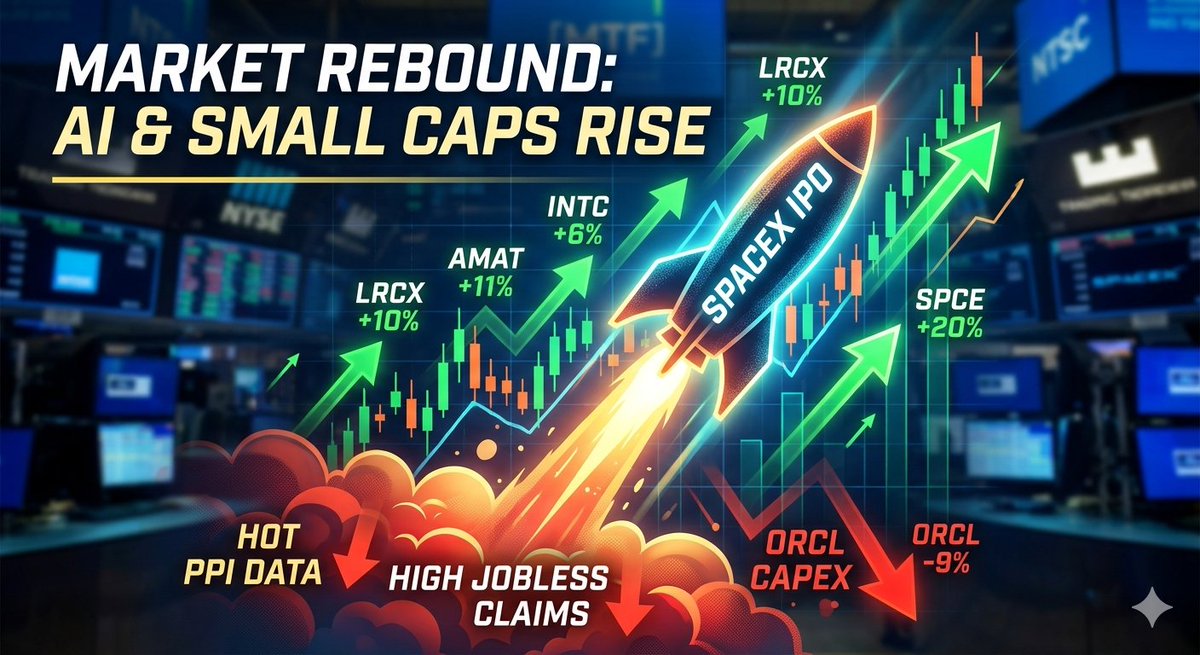
🚀 MARKET REBOUND:
Tech infrastructure and small caps are shrugging
off hot inflation data today as Wall Street gears up
for the massive SpaceX IPO pricing tonight! 🔥
Here is everything you need to know about today's market action:
Hot #PPI.
Higher jobless claims.
Middle East tension still in the background.
And yet…
Stocks are green.
Why?
Because the market is not trading "macro fear" today.
It is trading:
• #AI infrastructure
• Semiconductors
• Small caps
• SpaceX IPO hype
🟢 Chips are leading:
$LRCX, $AMAT, $KLAC are ripping roughly 9–11% as
AI wafer-fab demand keeps pulling money into the hardware side of the market.
$INTC is up ~6% after BofA double-upgraded it from Underperform to Buy and raised the PT to $135.
🟢 Small caps are joining:
$IWM is outperforming, which makes this rebound
feel broader than just the usual mega-cap tech push.
🟢 Space stocks are catching attention:
$SPCE is up ~20% after a $30.5M debt-for-equity swap.
$RKLB is moving with the SpaceX IPO buzz ahead of pricing tonight.
🔴 But not everything is working.
$ORCL is down 9–12% after earnings.
The issue is not the headline beat.
It is the cost of the AI race:
heavy data-center capex and planned debt/equity raises.
Software is lagging while chips, hardware, and infrastructure take the crown.
📊 The real twist:
Markets are completely ignoring bad macro data today.
May PPI printed hot at 1.1% MoM (6.5% YoY) while
Jobless claims rose to 229K, a 4.5-month high.
Are we looking at a sustainable AI-driven rally,
or is the market playing with fire given the hot
inflation data? 🧵
Wall Street ignoring the warning signs again?
What are you buying or selling today?
Drop your tickers below! 👇
13
24
368
MargoMDesigns🛡️ retweeted

Jun 10
hahaha 😅 goodnight friends ❤️
Enjoy a pleasant night rest 😴

7
4
15
191
Jun 11
GM☕️GN 🌃 EVERYONE
Loving what you do is not a destination.
It is an attitude.
A decision.
A way of showing up for yourself.
We search for the star everywhere…
In success.
In love.
In recognition.
In everything outside of us.
But the real magic happens when you change your internal attitude.
When your heart is in the work, even the hard days carry meaning.✨
What's one thing keeping you motivated today? 👇

28
32
565
MargoMDesigns🛡️ retweeted
Jun 10
Regular SpaceX employees after the IPO:
Jun 10
BREAKING: SpaceX's IPO is expected to create 4,000 new millionaires, including some cafeteria workers whose compensation packages include employee stock options, per Bloomberg.
42
29
390
47,307
Jun 10
Most people think they need millions to retire because traditional advisors push low 4% withdrawal rates.
This flips the script.
With a high-yield strategy, $500,000 can buy back your time and fund a comfortable life.
Focus on maximizing cash flow efficiency rather than just stacking a massive net worth.
You don't need to be a multi-millionaire to buy back your time. You just need the right yield strategy. 🧠
$STRC

Retired with $STRC
$500,000 at 11.5% = $51,500 yr
$750,000 at 11.5% = $76,500 yr
$1,000,000 at 11.5% = $115,000 yr
Adjust for taxes.
You don’t need millions to live a comfortable lifestyle.

9
20
335
Jun 10
THIS is the moment crypto actually becomes useful
🔥WalletConnect Pay just went live on #Solana,
pay with solana:So11111111111111111111111111111111111111112 , USDC or USDT for coffee, groceries,
anything. Instant. No bridges. No waiting.
Just tap and done. Real adoption isn’t hype.
It’s spending crypto like cash, but faster.
Solana cooking again ☕️✌️
@WalletConnect @solana
Jun 10

.@WalletConnect Pay is now live on Solana.
Imagine paying for a coffee in seconds, fast, seamless, and fully on-chain.☕️
5
1
17
437
Jun 10
The $1 BILLION milestone is a massive wake-up
call for the skeptics. 🚨 #XRP
Follow the smart money, not the market sentiment.
Another 7.44M flowing into ripple:native ETFs proves that institutional appetite isn't slowing down.
Crossing $1B in net assets will be a major psychological turning point for price action.
Big players are building positions for a reason. 🧠
Are you holding or watching from the sidelines? 👇
Jun 10

🚨 JUST IN: ETF clients purchased $7.44 million worth of $XRP.
Total ETF-held net assets have now climbed to $982.12 million, highlighting continued institutional interest in XRP despite recent market volatility. 📈
The $1 billion milestone is now within reach. 👀


14
1
25
1,384
Jun 10
GM🌅 GN🌃 EVERYONE
"This new day is too dear, with its hopes and
invitations, to waste a moment on the yesterdays."
⏳Time is the ultimate currency.
Don't waste today's potential looking backward.
Look forward, focus up, and win. 🚀
Let's make today the best day yet!
Drop a ❤️ if you're leaving the old noise behind! 👇
Jun 9
GM GN EVERYONE
Write it on your heart that every day is the best day in the year ❤️

21
27
610