
Joined December 2018
- Tweets 2,030
- Following 1,759
- Followers 4,940
- Likes 6,902
46 Photos and videos






Pinned Tweet

31 Mar 2025
I'm honored to be leading @SolanaInstitute as we work to educate policymakers on the incredible potential of decentralized networks like Solana. It's a pivotal moment for our industry, and we need clear rules to unleash the innovators building the digital economy of the future.
31 Mar 2025

🔆 We are excited to announce the launch of Solana Policy Institute (SPI), a new non-partisan, non-profit focused on educating policymakers on how decentralized networks like @solana are the future infrastructure of the digital economy—and why the people building on and using them need legal certainty to flourish. 🧵👇
81
32
358
187,352
Miller retweeted

Jun 12
Incumbents are always going to fear the future. The @CFTC stands ready to address changing landscapes and ensure America remains the crypto capital of the world.
We will continue to work diligently to onshore innovation and bring novel derivatives under the CFTC’s gold standard regulatory framework so that these markets can thrive here at home.
16
49
242
16,436
Miller retweeted

Jun 11
Gary Gensler deliberately sought an intergalactic reach for the CFTC through Dodd Frank. Now he’s saying that didn’t mean a few things he doesn’t like. The law is the law. Exchange-traded event contracts, on all things, are within the agency’s jurisdiction.cnb.cx/4vClc17
6
6
45
4,796
Miller retweeted

Jun 9
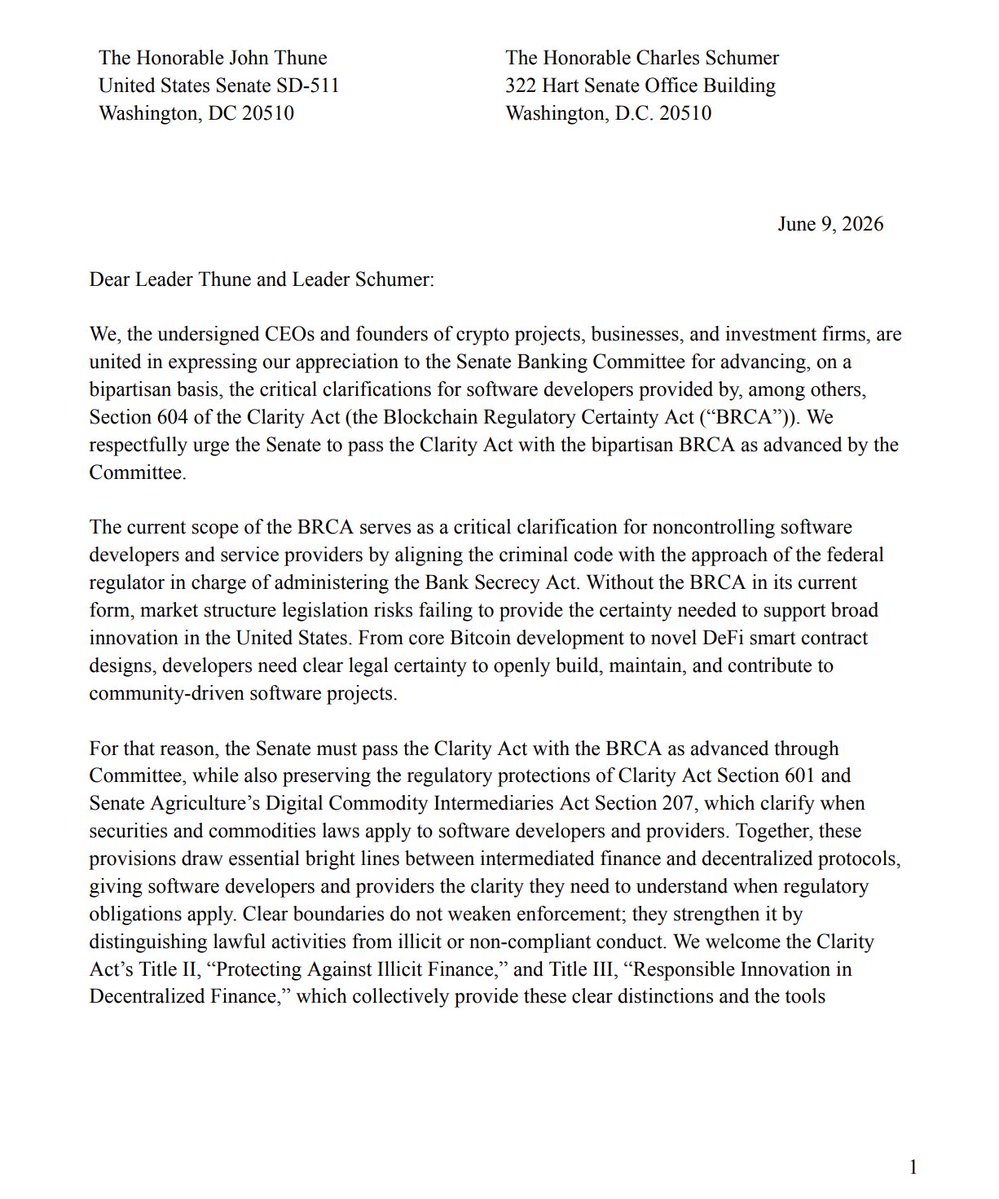
incredibly obvious to support this and happy to sign this letter.
The BRCA explained:
money transmission law assumes you hold customer funds. it requires things only a custodian can do: freeze assets, file reports, return money.
applied to a developer who ships non-custodial code, it's an impossible standard backed by criminal penalties.
the BRCA fixes the mismatch. control funds = regulated intermediary, full stop. write software = developer. nothing about AML changes for anyone who actually custodies money.
it survived the house and senate banking markup. the senate should pass it intact.
This industry takes care of its builders. Thank you to the 60 CEOs and founders who sent a clear message to Senate leadership today: Pass the Clarity Act with developer protections and the BRCA intact.
Developers who do not control user funds are not money transmitters.
Read the full letter: t.ly/iXpDU
17
10
111
15,538
Miller retweeted

Excited to see 60 CEOs and founders deliver this unified message to Senate leadership: the Clarity Act must be passed with developer protections and the BRCA intact.
Clear regulatory certainty for developers is essential to drive innovation and keep America competitive.
This industry takes care of its builders. Thank you to the 60 CEOs and founders who sent a clear message to Senate leadership today: Pass the Clarity Act with developer protections and the BRCA intact.
Developers who do not control user funds are not money transmitters.
Read the full letter: t.ly/iXpDU
1
4
19
999

1inch joined 60 CEOs and founders urging the Senate to pass the Clarity Act with developer protections intact.
A developer who does not control user funds is not a money transmitter. That line matters.
This industry takes care of its builders. Thank you to the 60 CEOs and founders who sent a clear message to Senate leadership today: Pass the Clarity Act with developer protections and the BRCA intact.
Developers who do not control user funds are not money transmitters.
Read the full letter: t.ly/iXpDU
8
6
30
5,614
Miller retweeted

Jun 9
I'm proud that @nathanmccauley and @Anchorage Digital have joined the industry in urging the Senate to keep BRCA in the CLARITY Act.
Builders deserve certainty, and America deserves to keep this innovation at home.
This industry takes care of its builders. Thank you to the 60 CEOs and founders who sent a clear message to Senate leadership today: Pass the Clarity Act with developer protections and the BRCA intact.
Developers who do not control user funds are not money transmitters.
Read the full letter: t.ly/iXpDU
6
32
2,532
Miller retweeted

Jun 9
1/ The Clarity Act has a real shot at passing the Senate.
Getting it right means protecting the developers who build public blockchains. Getting it wrong risks pushing them – and the future of this technology – offshore.
🧵
15
104
932
56,590
Miller retweeted

Jun 9
Today, we are proud to join 60 co-signatories in sending a joint letter urging the Senate to pass the Clarity Act with robust developer protections, reflecting the industry's unified view that developer protections are essential to any workable piece of crypto market structure legislation.
read full letter here: t.ly/iXpDU

This industry takes care of its builders. Thank you to the 60 CEOs and founders who sent a clear message to Senate leadership today: Pass the Clarity Act with developer protections and the BRCA intact.
Developers who do not control user funds are not money transmitters.
Read the full letter: t.ly/iXpDU
1
7
33
2,249
Miller retweeted

Jun 9
I started my career in politics because I believed, in the words of the late great Senator Paul Wellstone, that "politics is about the improvement of people's lives."
I chose to build in DeFi because I believed it enabled us to build better systems -- shared systems that give all participants a greater stake in the new economy.
And did so as a fully doxxed American — at a moment in this country when I knew that no matter how hard I tried to do it right, I risked ending up in jail or being sued by my own government just for building technology.
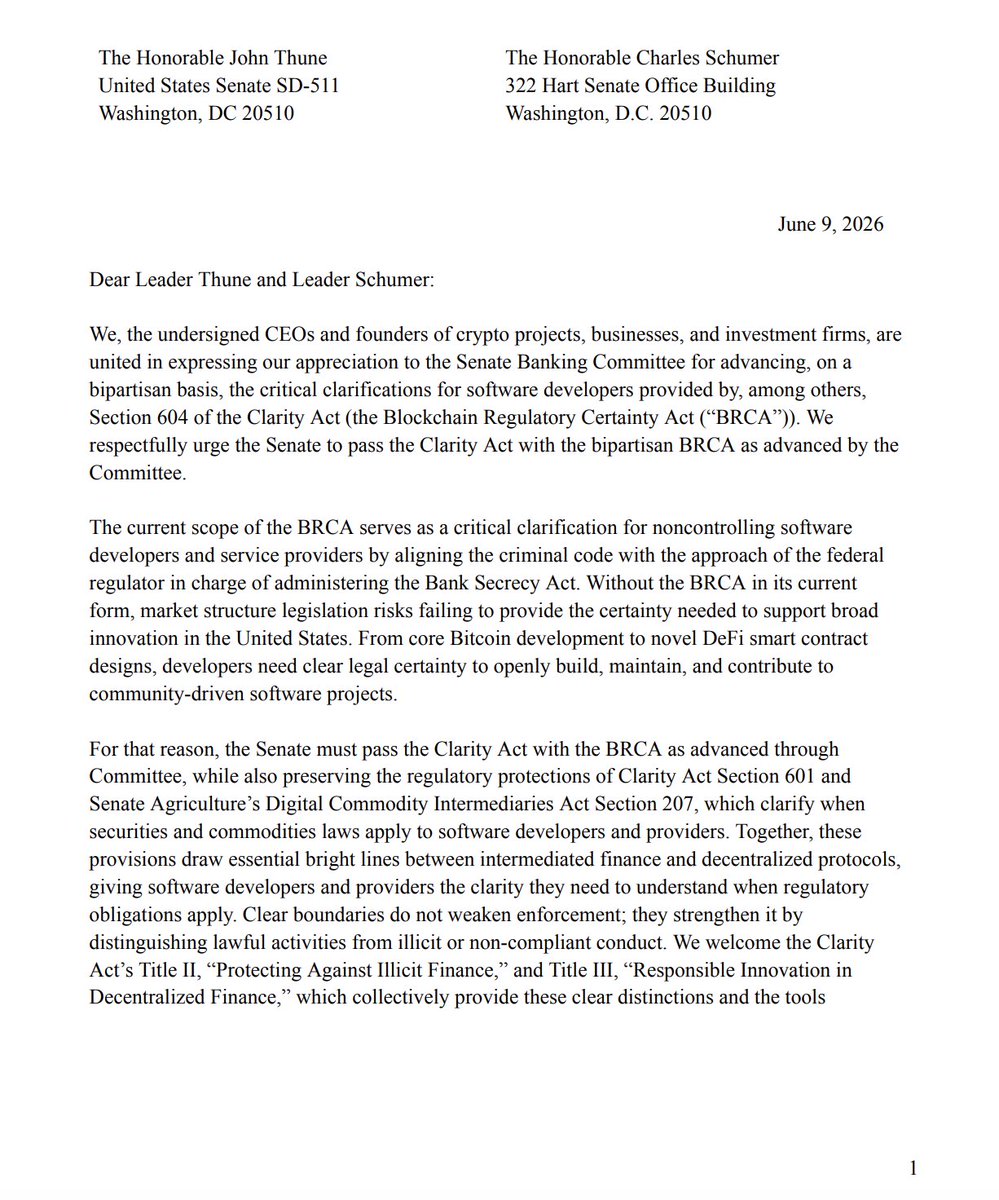
That is why today, I joined 60 CEOs and founders in signing a letter to Senate leaders expressing that developer protections are essential to any workable crypto market structure bill.
On behalf of everyone at @DromosLabs, @VelodromeFi, and @AerodromeFi, we urge the Senate to pass the Clarity Act with robust developer protections.
t.ly/iXpDU
17
27
225
11,585
Jun 9
The Blockchain Regulatory Certainty Act clarifies the issue in law today that most directly affects (and chills) US developers’ day-to-day decision making.
The Senate must follow the Banking Committee’s lead in passing, on a bipartisan basis, the Clarity Act with the BRCA intact!
This industry takes care of its builders. Thank you to the 60 CEOs and founders who sent a clear message to Senate leadership today: Pass the Clarity Act with developer protections and the BRCA intact.
Developers who do not control user funds are not money transmitters.
Read the full letter: t.ly/iXpDU
6
42
2,653
Miller retweeted

Jun 8
Our statement on the UK government’s demand that all content on all devices sold or used in the country be scanned, on the presumption of nudity, using a dystopian combination of age verification and content scanning. This proposal will not safeguard children. It endangers us all.
signal.org/blog/pdfs/2026-06…
737
8,540
41,290
2,716,285
Miller retweeted

Jun 3
Stripping the BRCA from Clarity would not make the bill tougher on industry.
It would not address ethics concerns.
All it would achieve is hurting open source developers.
coincenter.org/the-brca-is-r…
4
9
55
5,253
Jun 3
Policymakers that support developers deserve developers' support!
Thank you @glzavatone for creating the first PAC focused on doing that—and that alone. I'm looking forward to helping build the movement.

🧵Big news today: @defenddevspac has officially launched as the first hybrid PAC dedicated exclusively to championing American crypto developers, DeFi builders, and blockchain technologists.
More information here ⬇️
defenddeveloperspac.org/blog…

3
13
956
Jun 1
1/ We’re closing in on market structure legislation in the U.S. Will the UK follow suit or won’t it? Great catching up with @RossKempsell.
May 29

The British political class is becoming obsessed with crypto rn
So is it right or wrong to criticise the industry and how can working Brits benefit?
Pod with my friend Miller Whitehouse-Levine from DC soon
@solana @SolanaInstitute
1
1
8
1,104
Miller retweeted

May 29
The CFTC’s action related to perps puts us at a unique inflection point in American regulatory history.
Will regulators permit transparent, auditable code to substitute for intermediated human activity?
With the right safeguards, the former is a far superior system.
1
4
544
Miller retweeted
May 29
In my first public remarks as @CFTC Chairman, I made clear that the agency would use the tools at its disposal to onshore crypto asset perpetuals. Today, the @CFTC delivered on that commitment.
This morning, the @CFTC took historic action to permit the listing of a true bitcoin perpetual contract by a CFTC-registered exchange, charting a path for one of the most liquid segments of the crypto asset markets to exist within the US regulatory framework.
274
749
3,713
956,656
Miller retweeted

May 22
If people want to understand what synthetics mean to me in this context, see the staff statement on tokenization, which distinguishes tokenized versions of issuer-sponsored stocks and of stocks that SEC-registered firms hold for their customers from synthetic instruments that provide exposure to stocks. sec.gov/newsroom/speeches-st…
May 21

I appreciate the interest in--but not the hyperbole about--the contemplated innovation exemption for the onchain trading of tokenized NMS stock. Keep in mind: I've always expected that it'd be limited in scope & would facilitate trading only of digital representations of the same underlying equity security that an investor could purchase in the secondary market today, not synthetics.
36
67
342
135,723
Miller retweeted

May 21
Debate continues around the Clarity Act. But the conversation should be grounded in what the bill says rather than exaggerations of what people assume is in there without having read it.
The bill is designed to bring digital asset activity into a clearer regulatory framework. Clarity creates new obligations, supervisory hooks, and agency rulemakings while preserving the core authorities DOJ and federal agencies already use to pursue money laundering, sanctions evasion, fraud, and scams. The bill does not make it easier for criminals to use crypto to launder money.
Framing Clarity as “deregulation” is puzzling, to say the least. The bill includes hundreds of pages of new obligations, registration requirements, disclosures, rulemakings, and compliance undertakings that do not exist today.
The same is true for arguments that the bill lets banks put customer assets at risk. What the bill does is allow regulated financial institutions to responsibly innovate, including by using blockchain technology to perform functions they may otherwise already perform through other means, subject to applicable supervision and regulatory requirements. Banks are not going to be secretly converting customer deposits/assets into crypto because of this bill.
On illicit finance specifically, check out Title II and Title III of Clarity. Those sections cover new obligations relating to illicit finance, protocols, and front ends. And if you’re concerned that the Blockchain Regulatory Certainty Act (BRCA) or other developer protections in Clarity create a money laundering loophole, please point us to the language that does so. The BRCA aligns the scope of money transmission with the longstanding interpretation of the federal agency that administers the Bank Secrecy Act. It does not legalize money laundering, financing of terrorism, evading sanctions, or knowingly facilitating the movement of dirty money.
Clarity does not strip away the rules that apply to other types of investments. In fact, Clarity reflects a basic parity principle that a tokenized security is still a security. Tokenizing something does not magically remove it from the applicable regulations.
The claim that Clarity makes it far more difficult for regulators to crack down on fraud and scams is also impossible to reconcile with the text of the bill. Take Amendment 126, for example, adopted during the Banking markup on a bipartisan basis. That makes clear that unless explicitly addressed by Clarity, existing authorities for fraud, scams, deceptive practices, and similar misconduct remain fully intact and available to regulators. If someone commits fraud, this bill does not give them a free pass.
No part of Clarity authorizes taxpayer bailouts for crypto. The bill includes clarifications about issues like bankruptcy and customer property, but that is not the same thing as putting taxpayers on the hook for crypto bailouts.
There are fair debates around ethics provisions. Those provisions were not included in the Banking markup because of jurisdictional issues, but many remain at the table for ongoing negotiations around ethics language in any final bill.
And yes, crypto participates in politics. So do banks, unions, lawyers, energy companies, consumer groups, tech companies, and every other organized interest in America. Political advocacy does not prove that the underlying policy is wrong.
It is also insulting to suggest that a lawmaker's support for crypto legislation can only be explained by ignorance or corruption. Members and staff have spent years hearing from the industry, its critics, academics, regulators, and many others. Pretending support can only come from bad faith ignores the years of education and policy work that have gone into this debate.
The industry has not been hiding Clarity. We have been talking about this bill for months. Organizations like @BlockchainAssn, @crypto_council, @DigitalChamber, @fund_defi, @standwithcrypto, and so many others have been speaking publicly about the bill and urging people to contact their representatives to explain why regulatory clarity and other specific parts of the text matter. This debate has been happening in public. And it will continue.
May 21

The Senate is nearing a vote on the Clarity Act.
The bill would make it easier for criminals to use crypto to launder money, and doesn't restrict Trump and his family from making billions.
The Act would also deregulate the industry, and let banks put your savings into crypto.
3
18
95
14,486