Joined November 2019
- Tweets 85
- Following 326
- Followers 1,016
- Likes 231
Photos and videos
Pinned Tweet

4 Mar 2021
The Paul Mischel Laboratory has relocated to ChEM-H at Stanford @Stanford_ChEMH.
Paul is Professor and Vice Chair of Research for the Department of Pathology, Stanford University School of Medicine @StanfordMed and Institute Scholar, ChEM-H, Stanford University.
19
6
130
Mischel Lab retweeted

16 Jun 2022
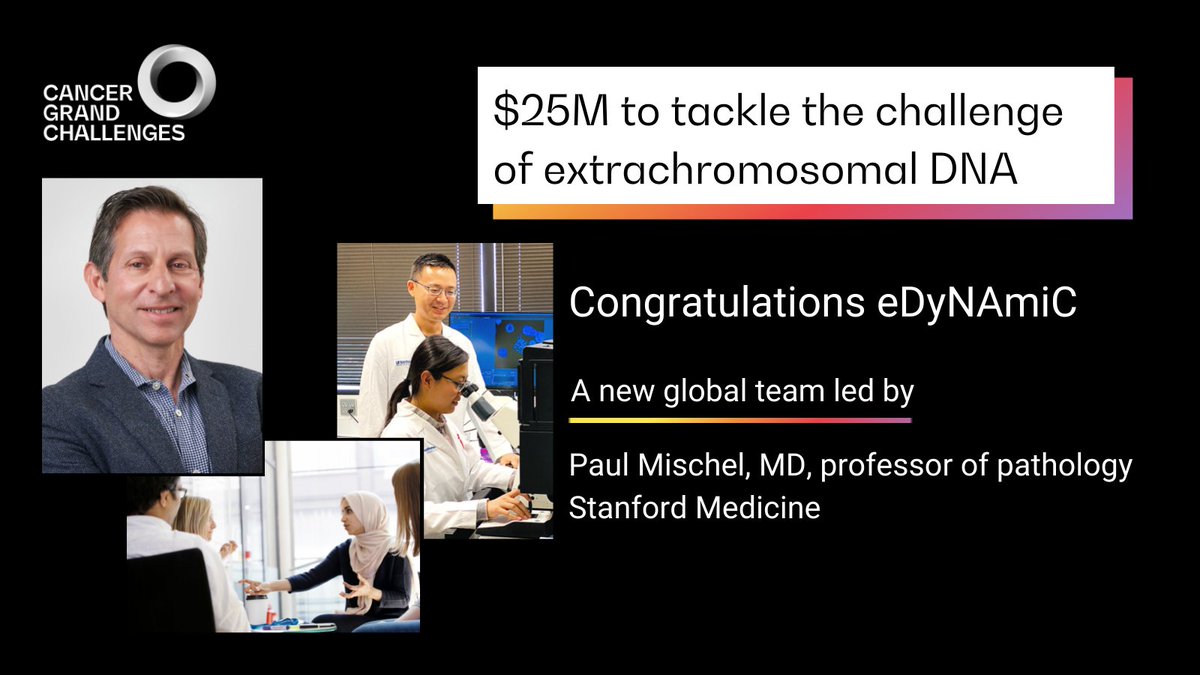
The eDyNAmiC team will investigate #ecDNA, found in around a third of cancers, hoping to develop much needed treatments for people whose cancer is driven in this way
Congratulations Paul Mischel (@mischellab @StanfordMed) and the team, funded by @CR_UK and @theNCI
3/n
1
7
39
Mischel Lab retweeted

16 Jun 2022
It is very exciting to be part of the eDyNAmiC team to take the #CancerGrandChallenges and trackle cancer evolution driven by ecDNA. Thanks for the big support of @CancerGrand @QMULMaths @QMBCI
16 Jun 2022

We are excited to share that the eDyNAmiC team has been chosen as a @CancerGrand, @theNCI & @CR_UK winner! #CancerGrandChallenges
3
3
44
Mischel Lab retweeted

16 Jun 2022
Looking forward to working with @anton_gh, @michelle_monje, @huang_weini, @MariamJHanjani, @SihanSean, @BenjaminWerner_, @HowardYChang, @cbailey_58, @VineetBafna3, and many others.
16 Jun 2022
We are excited to share that the eDyNAmiC team has been chosen as a @CancerGrand, @theNCI & @CR_UK winner! #CancerGrandChallenges
2
6
33
16 Jun 2022
We are excited to share that the eDyNAmiC team has been chosen as a @CancerGrand, @theNCI & @CR_UK winner! #CancerGrandChallenges
16 Jun 2022

Extrachromosomal DNA (ecDNA) are small rings of DNA that help tumours evolve and evade treatment.
The eDyNAmiC team will look at ways to interfere with ecDNA, slow down tumour development & ultimately bring hope to patients whose cancers have become resistant to treatment.
4/6
9
11
95
16 Jun 2022
The team, composed of investigators from 11 institutions across the US, UK, and Germany, will leverage our interdisciplinary expertise to tackle the questions of origin, function, and evolution of ecDNA in cancer.
1
5
16 Jun 2022
We are honored, grateful for the opportunity, and committed to working together to make a difference for patients with ecDNA-driven cancers. It is a thrill to work with such an amazing group of colleagues.
4
24 Nov 2021
Congratulations to @kinglhung, @KatieEYost, @HowardYChang and colleagues on this landmark discovery published today in @Nature. We are thrilled to have worked together with you on this.
24 Nov 2021

Our paper is out in @Nature! Extrachromosomal DNA molecules huddle together in cancer cells to activate oncogene expression (which we call ecDNA hubs). A great collaboration with @KatieEYost, @HowardYChang, @549nm, Zhe Liu, and others. (1/10) nature.com/articles/s41586-0…
2
3
32
Mischel Lab retweeted

2 Nov 2021
Congrats to my former colleague Junfeng Bi @mischellab for the new paper! He found that GBM, the most lethal brain tumor, is sensitive to SMPD1 inhibition. Adding antidepressant fluoxetine to standard-of-care chemotherapy can improve patient survival.
cell.com/cell-reports/fullte…
4
29
2 Nov 2021
Congratulations to postdoc Junfeng Bi on his new paper out today in @CellReports! It has important mechanistic and clinical implications for glioblastoma patients, spanning from fundamental biology, to clinical data.
@Stanford_ChEMH @StanfordPath
cell.com/cell-reports/fullte…
7
25
103
2 Nov 2021
The team found that GBMs are sensitive to SMPD1 inhibition and that fluoxetine can safely and potently shrink GBM tumors in mice. We also used real world data to identify that addition of fluoxetine to standard of care improves patient survival.
1
8
2 Nov 2021
The idea that a safe, inexpensive, and highly brain penetrant drug could make a difference for glioblastoma patients is exciting, compelling, and needs to be further studied! #Glioblastoma #CancerResearch #Cancer
1
12
30 Sep 2021
We are thrilled to join the wonderful @Stanford_ChEMH community to continue our research into extrachromosomal DNA!
29 Sep 2021

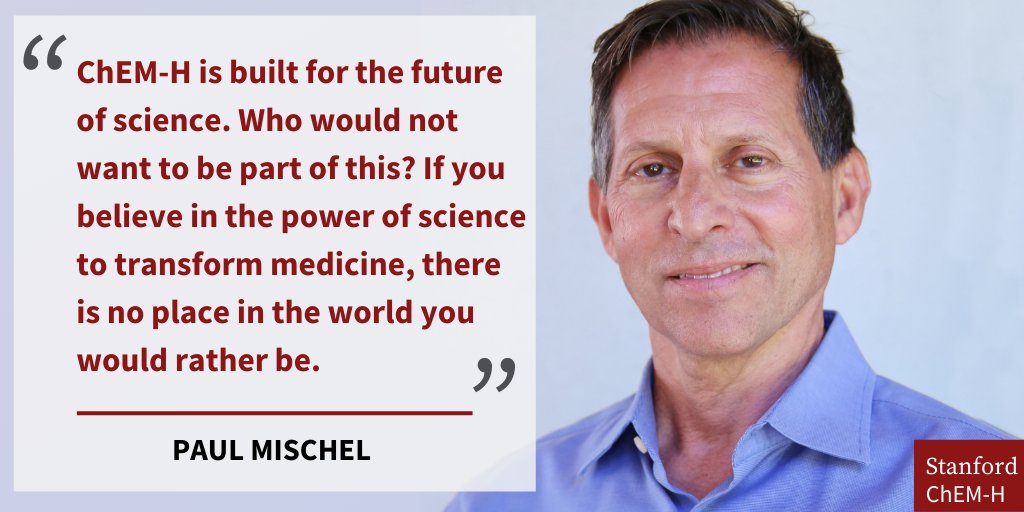
We are delighted to welcome extrachromosomal DNA pioneer Paul Mischel @mischellab to ChEM-H! Mischel spoke to us about looking where the light isn’t being shone and how genetic SpaghettiOs give cancers an advantage: stanford.io/3ii7BJj
@StanfordPath @StanfordMed
1
3
48
Mischel Lab retweeted

27 Sep 2021
Excited to see this paper out. Joint work led by the @CalifanoMd and @VineetBafna3 labs. We characterized frequent human-HPV hybrid circular extrachromosomal DNA #ecDNA in HPV oropharyngeal cancer patients.
clincancerres.aacrjournals.o…
1
12
26
Mischel Lab retweeted

15 Sep 2021
In uveal melanoma, PRC1 loss leads to gene de-repression, chromosome segregation errors, CIN, rupture-prone micronuclei & release of dsDNA into the cytosol, which activates the cGAS-STING pathway to induce inflammatory signalling & confers a poor prognosis nature.com/articles/s41467-0…
6
15
Mischel Lab retweeted

15 Sep 2021
(1/2) Insights from #scRNAseq, coupled with fundamental #cell_biology, reveals loss of #PRC1 in a subset of tumor cells underlies transition of #uveal #melanoma from indolent to #metastatic phenotype. nature.com/articles/s41467-0… A team effort with @Samuel_Bakhoum @mischellab
1
10
30
13 Sep 2021
Congratulations to @MathieuBakhoum on the new paper, which has significant clinical implications for uveal #Melanoma patients, published in @NatureComms.
This work functionally links two hallmarks of cancer #epigenetic dysregulation and chromosomal instability.
#cancerresearch
13 Sep 2021

Uveal #Melanoma can metastasize.
But why do these highly lethal metastases occur in some patients but not others?
In our new paper @NatureComms we describe a novel and unanticipated mechanism.
#epigenetics
@YaleMed @LaughneyLab @Samuel_Bakhoum @mischellab
nature.com/articles/s41467-0…
1
6
13 Sep 2021
This collaborative work was led by @MathieuBakhoum, an alumni of our lab and now a physician scientist @Yale with @LaughneyLab @WeillCornell and @Samuel_Bakhoum @sloan_kettering
#Cancer #Melanoma
2
13 Aug 2021
We are thrilled to announce that @MathieuBakhoum joined @YaleMed as Assistant Professor.
Congratulations Mathieu and best wishes on your next and exciting endeavor @Yale!
His lab is recruiting! Apply if you are interested in #melanoma and #epigenetics
bakhoumlab.org
13 Aug 2021
Delighted to announce that I joined @YaleMed as Assistant Professor in @YaleOph.
My laboratory will focus on two research areas with direct clinical applications.
#AcademicTwitter #ophthotwitter #Ophthalmology #retina
bakhoumlab.org
1/4
16
Mischel Lab retweeted

13 Aug 2021
Thankful for the outstanding mentorship I received from Paul Mischel @mischellab and colleagues @UCSDHealth.
And looking forward to making new friendships and collaborations @Yale.
New Haven, here we come!
4/4
1
2
21 Jun 2021
Very honored that our grant proposal on #ecDNA in cancer is shortlisted for the #CancerGrandChallenges prize!
Grateful to the @CancerGrand.
Thank you to all of our team members! And Looking forward to the exciting work ahead.
21 Jun 2021

BREAKING NEWS: today we announce 11 teams selected to compete for our awards! Winners receive up to £20m each and the freedom to unleash their scientific creativity, conducting research that transcends geography and discipline - bit.ly/3cFyrZa #CancerGrandChallenges
3
4
67