
Builder, Kalmantic Labs. Inference Economics. NemoClaw Infra. SF · Blr
Joined April 2008
- Tweets 10,910
- Following 2,437
- Followers 6,040
- Likes 41,633
403 Photos and videos







Thiyagarajan Maruthavanan (Rajan) retweeted

Fable isn't the first.
In 1999 the department of defense blocked exports of the PowerMac G4 for crossing the 1 gigaflop threshold.
Steve Jobs turned it into an ad.
133
1,065
13,070
910,759
Thiyagarajan Maruthavanan (Rajan) retweeted

You can't use mental models for a horse and carriage to build a space ship.
Unless you orient around AI from first principles, your exploration and understanding of capabilities will be limited.
This requires neuroplasticity!
5
586

Own your model own your fate

We abandoned training our own models at Defog in 2024 (despite 2M huggingface downloads) after o1 was released
Our reasoning at the time - frontier models would get better and cheaper. It was just easier to use them via an API, and see gains automatically, rather than painfully handcraft our own
Fully realizing the risks of that decision today. Going to spend at least a third of my time on fine-tuning frontier open-source models moving forward.
Can't build a business on shifting sands, gotta own your model weights.
1
176
Thiyagarajan Maruthavanan (Rajan) retweeted

Jun 11
The @NVIDIAAI nemotron ecosystem will shape up to be one of the most consequential open-weights ecosystems in the years to come. @trajectorylabs trains a frontier class legal model in 24 hours.
Jun 11

Frontier model performance on an open model, post-trained in under 24 hours. @trajectorylabs is showing what's possible when great open models meet the right training infrastructure. Proud to power the compute behind this work alongside @nvidia .
3
1
18
2,678

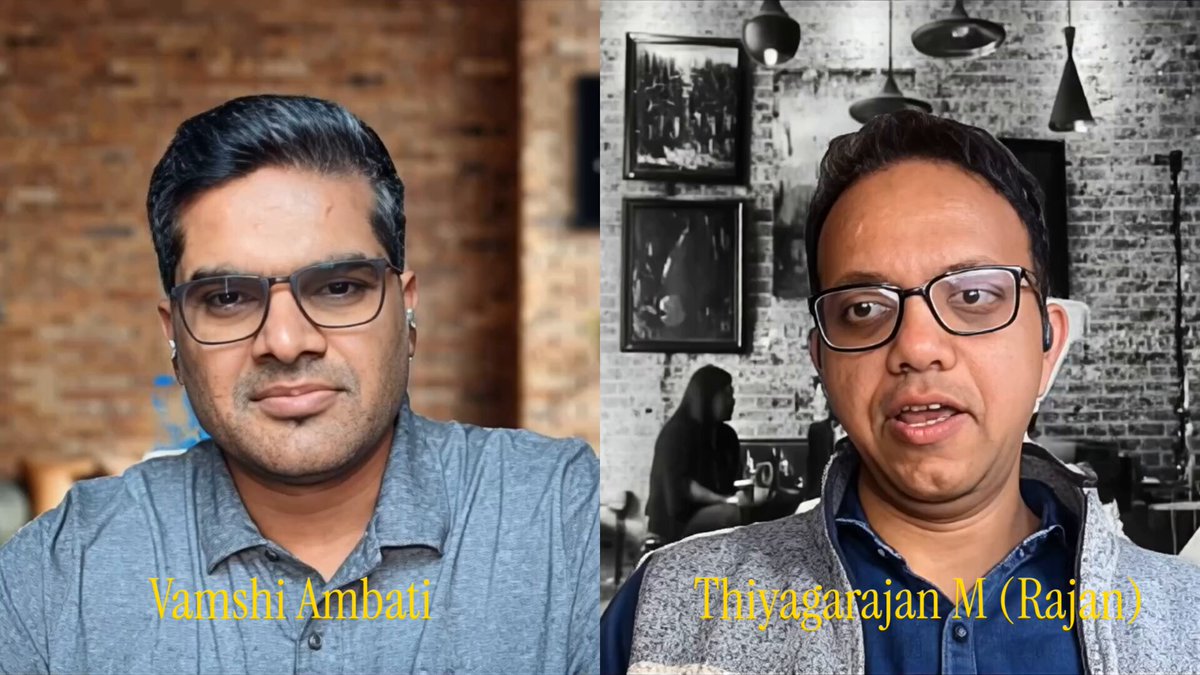
@mtrajan and I started the RK on AI Podcast, now approaching 50,000 views.
In our latest episode, we discuss:
-Hot jobs in AI
-First impressions of Claude Fable
-The reality behind legal AI startups
- What's changing across the AI ecosystem
🎧 youtu.be/2XjUIEHlTzM
1
1
113
Prompt Engineering was just Chapter 1
Loop Engineering might be Chapter 2
Designing feedback loops where AI can self improve could become the next hot skill.
Is #LoopEngineering the next #HotJob in AI?
Interesting conversation with @mtrajan about this
youtube.com/shorts/eIdNWkFP6…
1
117
A company with no eval is at the mercy of whatever model it rents.
OTOH company with a great eval is at the mercy of its own past judgment.
Therefore Build the eval. Then hire its enemy.
Satya at his best.
Jun 10

Everyone Operating At The Frontier
Satya Nadella, Chairman & CEO, Microsoft, interviewed by @saranormous & @eladgil (No Priors) and @swyx (Latent Space)
Crossover special at Microsoft Build 2026.
Summary: Satya reframes Microsoft's AI strategy as an ecosystem play rather than a single model or platform, where the win is any company being able to point to AI it created and operate at the frontier with its own intelligence. Scaling laws held and intelligence still tracks the log of compute, but the value lives in deployment, where private evals become a company's biggest IP and accumulated agent traces start to look like assets on the balance sheet. Take it seriously and SaaS gets unbundled and rebundled, engineering collapses toward generalists who manage agents, and the industry has to earn community permission for the buildout by delivering benefits people can actually see.
1. Ecosystem Over Model. A platform earns its place by how much value other companies build on top of it. Satya wants any company, AI-native or traditional enterprise, to participate as a first-class participant that can point to AI it created, still using other people's models but owning a recipe of its own. He calls this the only tagline that matters for the conference: can everybody operate at the frontier with their own frontier intelligence. Without that, he says, there is no reason to hold a developer conference; you would just "worship at the altar of one model."
2. The Broken IDE. Coding agents worked so well that Microsoft now has to rebuild the IDE around them. When a developer runs a hundred agent sessions at once, the cognitive load lands back on the human and chat as the only artifact stops working, which is why the new interface needs a canvas. Even a fully agentic world still needs UI, because someone has to inspect what the agents did and decide. The lesson generalizes: every workflow handed to long-running agents will need a new surface for the human to supervise it.
3. The Harness Is The Product. The unit that matters is the harness that loops across models, data, and tools. Microsoft runs the same open GitHub harness across GitHub Copilot, security copilot, and science discovery, with progressive disclosure of tools to stay token-efficient and heavy context prep where "the magic is." The harness stays open: bring your own models, tools, and context, or swap in a Llama harness. Nadella points to M-dash finding vulnerabilities the incumbent scanner missed as proof that a multimodal harness can win in the real world.
4. Private Evals As IP. The single most valuable thing a company can own is a private eval. His acid test for control: take your private eval, run it on model A, then switch to model B; if you can still climb, you are in control, and if you cannot, you are not. Because frontier models learn from a few samples rather than mountains of data, the defensible asset is the eval you never leak. This is why Nadella reframes Microsoft's third act from operating systems to cloud to an evals-and-harness company.
5. Agents On The Balance Sheet. The traces between a company's humans and its agents become a trainable asset that belongs on the balance sheet. Human capital never made it onto the balance sheet because tacit knowledge could not be captured, but agent traces collected over time can train a "company veteran" agent that encodes how that specific enterprise creates value. As token capital and human capital both rise, the question becomes how to compound the two. Elad Gil's quip lands the point: the SEC will need accounting standards for token expertise.
6. Unbundle And Rebundle. SaaS gets taken apart and put back together, with the data model and business logic surviving the teardown. A general ledger should stay a general ledger, and a Power BI semantic model is hard-won business logic worth feeding to agents, so the work is repackaging these into new bundles and business models. Work IQ exposes what Nadella calls the most important database in a company, the M365 data that was only ever captive to email and Office apps. Now an agent can read a week of design-meeting transcripts tied to a GitHub repo and come back with a plan to change the code base, something M365 was never built to do.
7. Outcome Pricing's Catch. Per-user pricing is an artifact of buyers needing budget certainty, and it survives even as consumption pricing arrives underneath it. Subscriptions bundle some usage into per-user stacks, then consumption metering sits below, which is exactly the adjustment GitHub made after agent intensity blew past what per-seat assumed. Outcome-based pricing sounds appealing until a customer actually has an outcome and realizes they are giving away a royalty. As Nadella puts it, most people love outcomes until they have one, then they ask to go back to per-user and consumption pricing.
8. The Buy-Or-Build Test. Whether to build software or buy it reduces to a quantifiable rule: acquire it when the marginal cost of building and maintaining it yourself is higher. Maintenance is the part teams forget, because security holes that AI now finds faster also have to be fixed faster, and every fix burns tokens that someone has to own. Satya expects the current agent euphoria, where teams rebuild everything internally, to cool after one full budget cycle. The vendors that last will be the flexible ones; he sees very little tolerance ahead for any vendor that stays rigid.
9. Generalists Win. The biggest returns go to generalists whose scope just grew. LinkedIn restructured into a "full stack builder" discipline that combines design, product, and front-end while keeping each person's original edge, giving people bigger scope instead of one narrow role. Building an app now sits in the same sentence as writing a Word doc or a spreadsheet, so generalist skills suddenly carry, in Satya's words, "a higher leverage." Specialists still exist, and infrastructure science, like building the RL environment where a reward can be learned, becomes one of the hardest and most valuable roles.
10. Meta-Work. The biggest move is to make your work meta: build the agentic system that does the work instead of doing the work. Satya's example is the team running Azure's physical fiber network, who decided their job was not Azure networking but building the agentic system that does Azure networking, complete with a named agent called Miles. That team started asking for tokens instead of headcount to scale their operation. Kevin Scott's line frames why it matters: making hard things easier is one kind of progress, but true ambition is making the impossible possible, and that needs a new conceptual model of what work even is.
11. Earned Permission. The industry only gets to keep building data centers if communities feel the benefits in real ways. Satya argues the buildout has to lower energy prices through a better long-term grid, replenish water through closed-loop systems, and show up as jobs and tax base, with the burden on the industry to earn that through hard work. His read on the politics is blunt: the world will be skeptical of any tech company that says "trust us, the future will be glorious," so you have to deliver tangible benefits people can see in the next 12 to 18 months. Using a lot of energy while creating a lot of value for society has historically been a good story, and he is betting a token economy that drives productivity and broad participation lands on the right side of it.
12. A New University. The next great startup may be a new university. Satya thinks the way we educate, credential, and value those credentials has to change completely now that the means of learning and staying current have shifted so fast. Learning concepts still matters, and he points approvingly to a Stanford AI class drilling students on when to apply softmax rather than just asking a model to fix a training run. The opening he sees is for someone to build a new way of teaching that takes a person through a curriculum and out the other side into real economic opportunity, something that felt impossible for a long time.
1
1
3
1,376
Burning tokens to feed the ego is the new busywork
68
Model ate the harness, so much of last 5 months undone
Jun 9

Fable 5 is the biggest step up I’ve felt in our models since Opus 4.5 back in November. After 4.5 came out I uninstalled my IDE when I realized that I’d been doing 100% of my coding in a terminal for a few weeks. With Fable, it’s felt like Claude has stepped up from being a coding agent to a thought and design partner in building the product. Fable has judgement, taste, and dimensionality in a way that previous models didn’t, leading me to trust it more with the most complex work.
I think the first time I had this realization was when I asked Fable to debug something. It is the first model I have used that was so methodical and precise, taking measurements and adding logs then verifying that it truly fixed the issue before declaring victory.
There’s nothing in claude code’s prompting telling the model to do that, it’s just part of its personality. It really has this “big model smell” that I haven’t felt before.
1
2
372
Thiyagarajan Maruthavanan (Rajan) retweeted

Jun 9
Don't Surrender to the Machine
Tony Fadell, co-creator of the iPod and iPhone, founder of Nest, partner at Build Collective, interviewed by @lennysan (Lenny's Podcast)
Summary: AI makes shipping cheap. That raises the value of taste, judgment, and storytelling. Fadell argues the products people remember are the ones a small group with strong opinions built deliberately, fought for across three generations, and surrounded with the right marketing context. Vibe-coded shortcuts pay short-term and rack up structural debt. Luxury software gets there with humans still in the loop.
1. Cognitive Surrender. Use the machine, never hand it the wheel. Fadell's central rule is that AI can assist coding, copy, prototyping, and inventory counts, while humans still have to decide what gets built and why. The Claude main-loop code that leaked looked brittle to actual engineers because no architect had touched it. Short-term gain, long-term loss is the trade you make when you let the model run unsupervised.
2.Benevolent Dictatorship. 1.0 products get made by one or two people willing to own the opinion-based calls. Committees pulling data on a category that does not exist yet just produce a worse copy of something already in the market. The keyboard fight on the iPhone went on for months; Steve ended it by saying we are going this way and anyone not on board can switch projects. The discomfort is the cost; the product is the return.
3. Pain Plus New Tech. Worthy ideas start at someone's pain and ride a technology that just became possible. The Nest worked because thermostats were arcane to program, 50% of the energy bill ran through them, and AI was finally cheap enough to learn a household's pattern. iPod required portable mass storage plus lithium polymer plus ARM at once. Both halves of the equation have to land at the same time; one-half ideas only produce evolutions.
4. Three Generations. Everything needs three swings: make the product, fix the product, fix the business. The first iPod sold only to Mac geeks (under 1% of the market), the second mostly did the same, the third with iTunes and Windows finally moved volume. Nobody nails margins, reliability, and message in the first build, and the only failure is stopping. Founders quit because they expected one launch to clear all three bars.
5. Micromanage The Decision. Sweat a few details ruthlessly, delegate the rest. Fadell's early mistake was micromanaging operations, which exhausted his team and produced a single bottleneck. The real fight is over the data behind a call (keyboard error rates, hardware-software coupling, the load-bearing visual) and the system-level changes that only land if everyone moves at once. Everything outside that radius is somebody else's job.
6. Marketing Is Product. Customers see the product first through the press release, the first ad, and the storefront. They never see the inside. Apple's same iPod campaign flopped in Europe because European adopters were earlier on the curve and needed a different message. The right move is to write the press release before the build starts, so the three key features and the why are locked before engineering begins.
7. The Story A Thousand Times. Steve Jobs honed the iPhone story every day for two and a half years before stage. Storytelling is the loop that exposes which features matter, which words land, and which version of the truth is actually true. Borrow technique from infomercials: set up the virus of doubt, name the pain, show the relief, and dial off the cheese.
8. Luxury Versus Fast Software. Vibe-coded apps are fast fashion: cheap, throwaway, structurally brittle by version five. Real products are handcrafted, layered, and survive customer feedback for years. Use coding agents to prototype faster and reach an informed gut, then architect the spine yourself and let the model fill scoped subfunctions. The original Flighty got built by humans; a clone could be vibe-coded, but the original could not have been.
9. Flip The Stack. Long-term, voice should be primary input, keyboard secondary, tap-and-swipe tertiary, the opposite of how every smartphone is built today. The display still has to exist: maps, video, and complex visuals need glass, even in the movie Her. Pure-audio devices like Humane failed because removing the screen is "different, not better." The next iPhone is still a slab, just one you mostly talk to.
10. Atoms Beat Bits Long-Term. Hardware founders get laughed at in software cycles, then rewarded when the next platform arrives. Fadell pitched hardware in 1999 and got told it was the stupidest idea ever; the iPod shipped two years later. The durable companies have atoms in the plan: sensors, robots, devices, because software-only categories get vibe-coded into commodity. Waymo is a sensor-stacked electric car, and that is exactly the platform other companies will build on.
11. The Hype Cycle Is A Trap. Buy in before the term is fashionable; hold discipline once round sizes go to ten digits. Fadell was early on Groq and Cerebras because the valuations were small and the bets were obvious to a builder, not a market. By the time a category needs a five-billion-dollar raise to start, the venture math no longer works. Chasing what is hot guarantees showing up late.
12. No Surrender In Ethics Either. When iTunes Video was being scoped, somebody floated porn and Steve killed it on the spot: "is that the world you want your kids to grow up in." Today's analog is companies shipping sex-chat AI to juice engagement; users will feel it and brands will pay. The iPhone is a refrigerator: it stores junk food and good food alike, but the operating system can ship the nutrition labels, the limits, and the tools, and platform owners have so far refused.
21
25
118
23,967
Thiyagarajan Maruthavanan (Rajan) retweeted

Jun 7
Here’s your monthly reminder that you shouldn’t be prompting coding agents anymore.
You should be designing loops that prompt your agents.
1,785
1,368
19,556
8,290,014
Some agent is doing your job right now. You just haven't met them yet
1
2
86
The AI race just got a lot more interesting. New episode out. @mtrajan and have covered key topics
→ China's $30B Moonshot AI bet
→ Kimi 2.6 outpacing Gemini on speed
→ Open-source vs. closed-model warfare
→ Why experts are nervous about Meta
youtu.be/nwAFEq6fCKc
1
139
hard work is performance for an audience that isn't watching.
1
3
143
trust transfers between humans cheaper than through any other channel
1
78
You can't aim at a feeling other people will have about your numbers
1
70
Thiyagarajan Maruthavanan (Rajan) retweeted

Jun 3
Microsoft put a new column on its latest model card : average token usage.
It will become a standard. 🧵
8
8
46
12,994