
Co-founder & CTO @InfiniteLocus
Joined August 2010
- Tweets 11,191
- Following 1,320
- Followers 1,214
- Likes 16,121
884 Photos and videos

NabheetMadan retweeted

Jun 4
We just published internal data on how much of Claude's development is already being done by Claude:
- Over 80% of all code merged into our codebase is now written by Claude
- It's been months since many researchers at Anthropic hand-wrote code
- The typical Anthropic engineer ships 8x as much code as they did in 2024
- On the most open-ended engineering tasks, Claude's success rate jumped from ~26% to 76% in 6 months
- When research sessions went off-track, Claude proposed a better next step than the human took 64% of the time
We're not at recursive self-improvement yet, but it could come sooner than most expect. I highly recommend reading the full blog post.
Jun 4

Our internal data shows Claude is accelerating AI development—a possible path to recursive self-improvement, or AI autonomously building a more capable successor.
It’s happening faster than we thought, and the implications deserve greater attention. anthropic.com/institute/recu…
189
216
3,265
420,536
NabheetMadan retweeted

Jun 2
one of the quotes i find most inspiring on a hard day:
"Whatever your hand finds to do, do it with all your might, for in the realm of the dead, where you are going, there is neither working nor planning nor knowledge nor wisdom"
Ecclesiastes 9:10
1,236
2,651
19,460
1,780,508
NabheetMadan retweeted

May 25
jesus fucking christ - basically any marks for the Class 12 CBSE board exams could be edited by anyone???
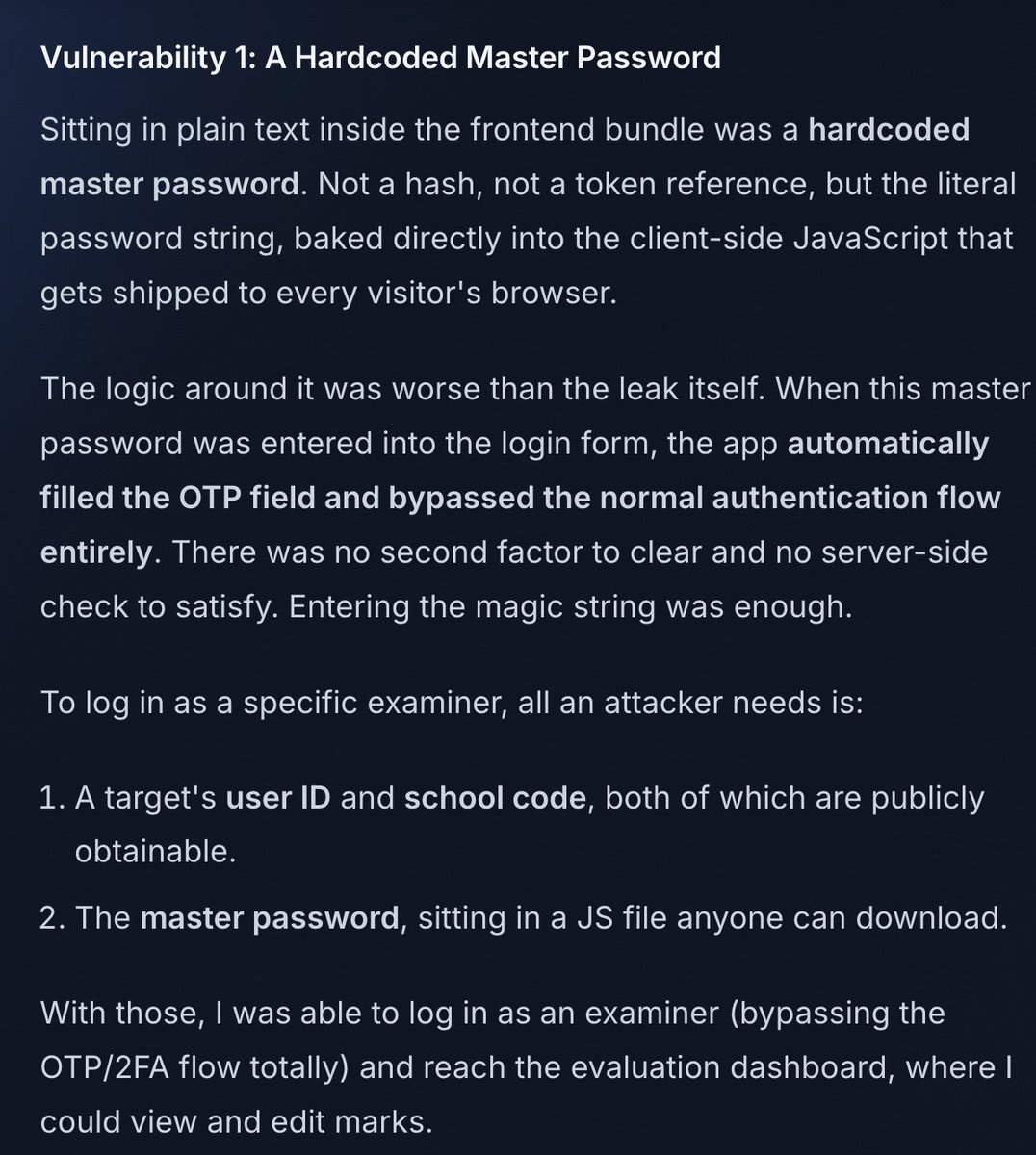

I had hacked CBSE's OSM (On-Screen Marking Portal) in February and had reported the vulnerabilities to CERT-In, but they were unable to patch most of them.
I've written a detailed blog post about it here: ni5arga.com/blog/posts/hacki…
30
778
3,705
211,542

NabheetMadan retweeted

May 14
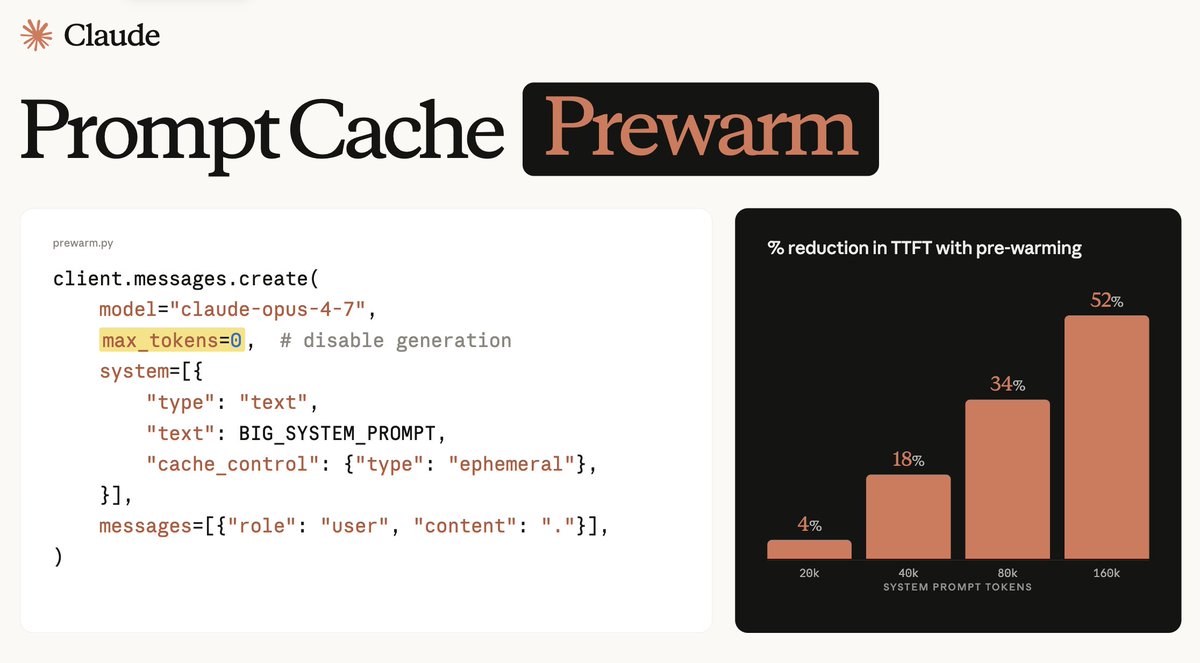
Useful tip to cut time-to-first-token on longer prompts in the API: pre-warm the prompt cache.
Send your system prompt before the user prompt. Claude writes it to the cache, but skips generating any output.
When the real user request lands, it'll hit a warm cache.
128
259
4,200
468,554
NabheetMadan retweeted

May 13
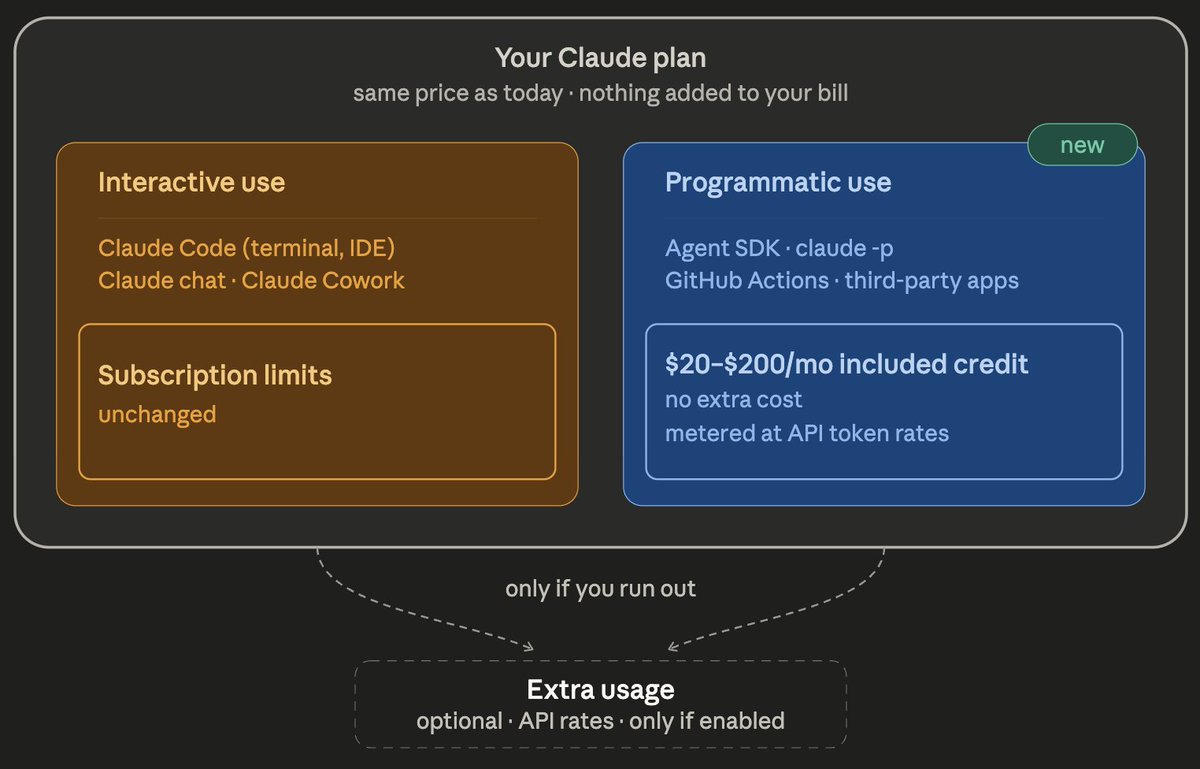
To add some clarity: you don't pay extra. It's the same subscription, same price per month.
What's new our sub now covers two separate pools:
· Interactive → sub limits, unchanged
· Programmatic → new $20–$200 included(!!) credit, metered at API rates
May 13

Starting June 15, paid Claude plans can claim a dedicated monthly credit for programmatic usage.
The credit covers usage of:
- Claude Agent SDK
- claude -p
- Claude Code GitHub Actions
- Third-party apps built on the Agent SDK
Community note
Previously, programmatic usage like claude -p counted toward subsidized subscription limits; starting June 15, it draws from a separate $20–$200 monthly credit metered at full API rates, while interactive limits remain unchanged. support.claude.com/en/articles/15…
343
54
771
551,244

May 13
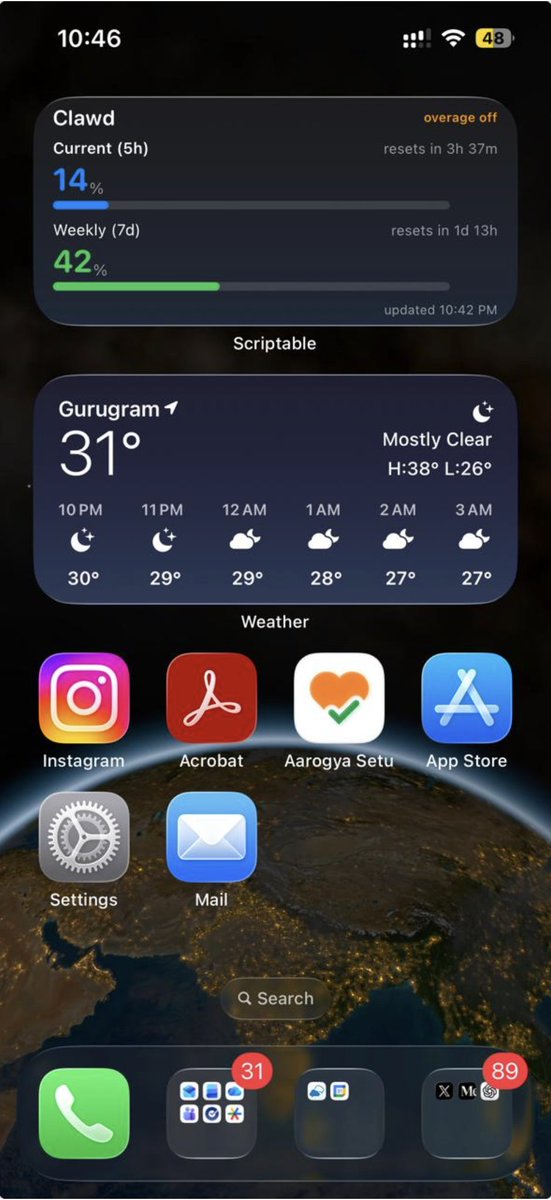
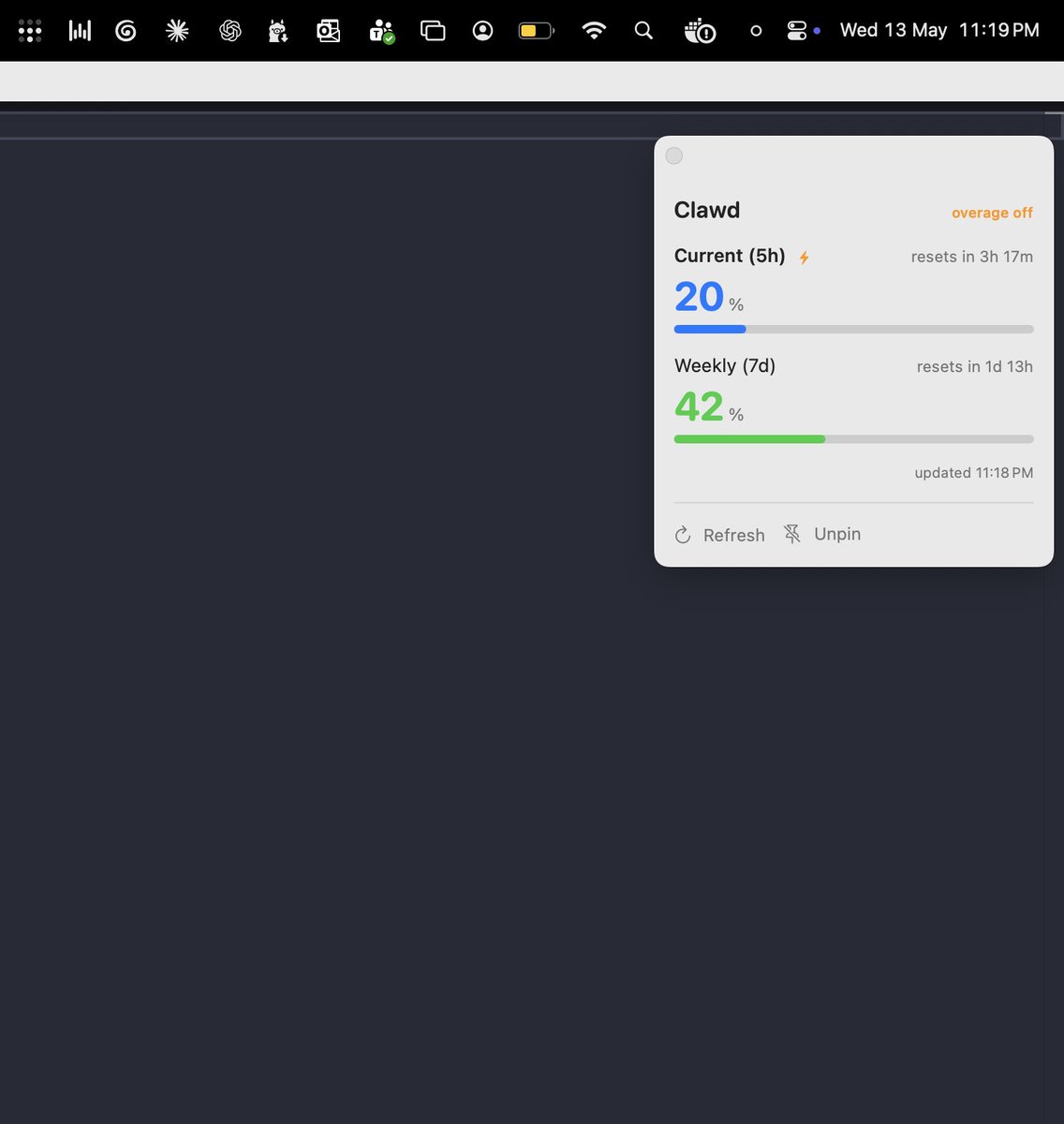
Claude has 5-hour 7-day usage windows, but I had no visibility into unused quota while jumping between Outlook, Teams etc.
Inspired by Clawdmeter built Clawd: a Mac menubar app,floating pane, iPhone widget for Claude usage.
github.com/NabheetCloud/claw…
@ClaudeDevs @claudeai
1
2
187
NabheetMadan retweeted

May 11
People talk, listen, watch, think, and collaborate at the same time, in real time. We've designed an AI that works with people the same way.
We share our approach, early results, and a quick look at our model in action.
thinkingmachines.ai/blog/int…
464
1,958
15,787
7,749,477
NabheetMadan retweeted

May 12
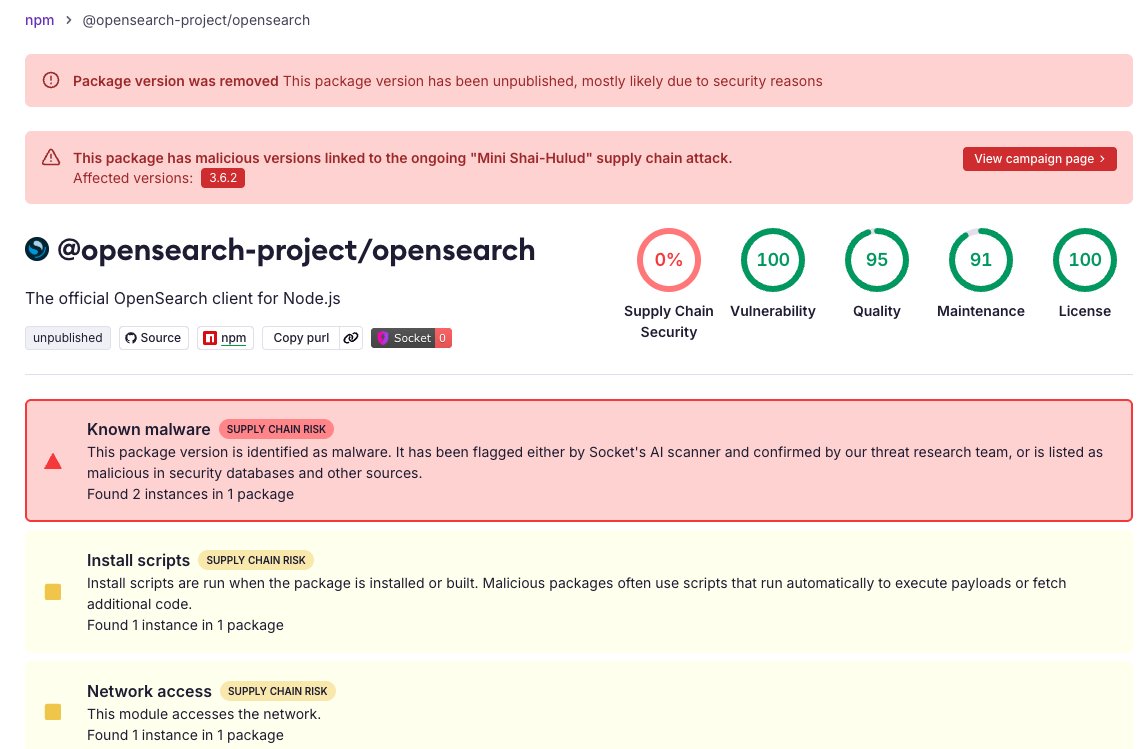
🚨 UPDATE: Mini Shai-Hulud has crossed from @npmjs into @pypi and is still spreading.
Newly confirmed compromised artifacts:
@opensearch-project/opensearch: 3.5.3, 3.6.2, 3.7.0, 3.8.0 (1.3M weekly downloads)
mistralai: 2.4.6 on PyPI
guardrails-ai: 0.10.1 on PyPI
additional @squawk/* packages on npm
guardrails-ai 0.10.1 executes malicious code on import. On Linux, it downloads git-tanstack[.]com/transformers.pyz, writes it to /tmp/transformers.pyz, and runs it with python3 without integrity verification.
The git-tanstack.com domain displayed a message signed “With Love TeamPCP,” along with: “We've been online over 2 hours now stealing creds
Regardless I just came to say hello :^)”
The page also linked to a YouTube video and you can probably guess which one.
62
482
2,327
963,797
NabheetMadan retweeted

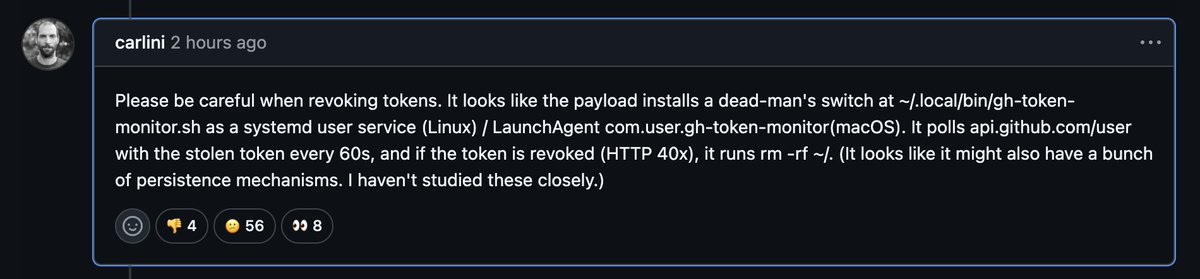
‼️🚨 BREAKING: A new npm supply-chain attack uses a dead-man's switch. The payload plants a watcher on your machine that nukes your home directory the second you revoke the GitHub token it stole from you.
The compromise happened today, across 42 official tanstack npm packages, 84 malicious versions in total. tanstack/react-router alone pulls more than 12 million weekly downloads.
The attacker forked TanStack's repository and pushed a single hidden commit. From there, they tricked TanStack's own release system into signing the malicious packages as if they were the real thing. To npm, and to anyone checking the cryptographic proof of origin (SLSA provenance), the poisoned versions looked 100% legitimate.
Maintainer Tanner Linsley confirmed the whole team had 2FA enabled. It didn't matter. This is the first documented npm worm in history that ships with a valid, signed certificate of authenticity, the same one defenders rely on to know a package wasn't tampered with.
139
945
6,365
1,467,936
NabheetMadan retweeted

May 11
We’re excited to share that Unsloth has joined the PyTorch Ecosystem!
Unsloth is an open-source project that makes training & running models faster, more accurate with less compute. We want AI to be accessible to all
Blog: unsloth.ai/blog/pytorch
GitHub: github.com/unslothai/unsloth

40
170
1,313
89,768

NabheetMadan retweeted

May 7
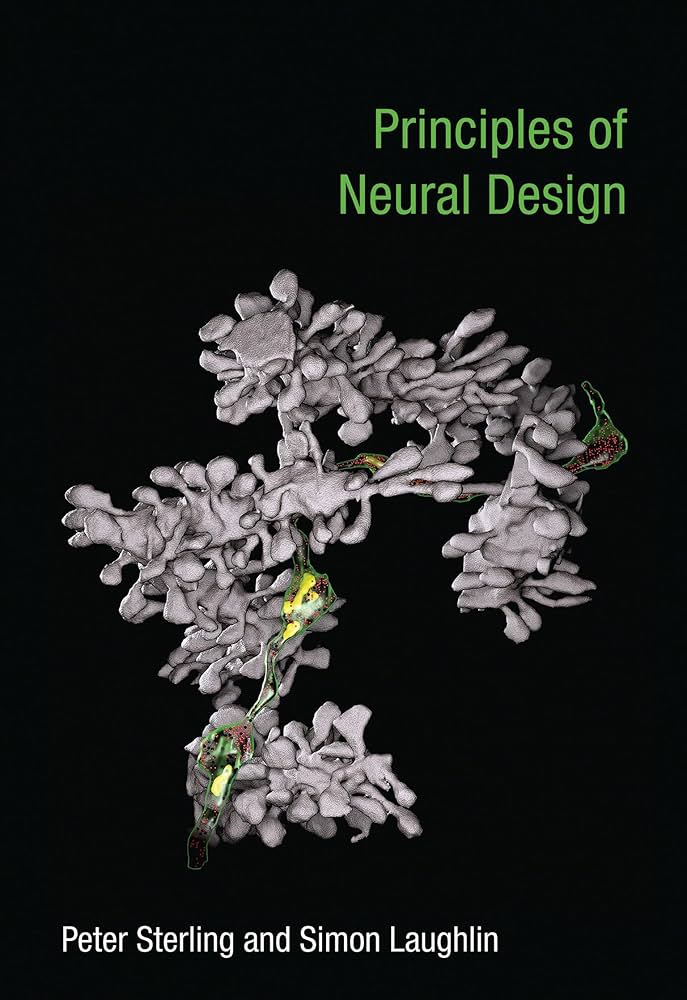
I read the #book Principles of Neural Design recently.
It’s extremely dense, which you’d hate or love depending on how much you’re in awe with how our brain works. I totally loved it! The book is unique in trying to explain the wondrous complexity of brain using few unifying principles, all of which can be traced to constraints evolution faces, especially with energy efficiency.
The central insight from the book is this:
👉 Brains maximize information (bits) per ATP
Consuming energy and producing ATP is hard. The organism has to work to get energy. During evolution, inefficient designs get outcompeted by efficient designs so we should expect to see efficient designs. For brain, this means squeezing max information and computing using least amount of energy.
From this insight, we could derive the following principles:
1. Send only what’s surprising. Why waste energy in sending what can be predicted/estimated efficiently. This explains why predictive coding makes sense for the brain.
2. Minimize wire / compute locally. Since wiring is expensive and sending signals across length requires energy, brain does as much computation locally as possible (and sends only sparse computed results/commands at greater lengths). This explains why brain has “regions” (such as for language) since local computation minimizes wire.
3. Send information at the lowest acceptable spike rate. Because faster spike rate requires thicker axons and more ATP, brain sends sparse, low-mean firing rate signals. The lower bound to how slow signals you can send is determined by requirements for fast reaction (this is why we do get few fat axons from the eye into the brain, but most axons or then). It also explains how brain simply sends a simple sparse signal to local pattern generators near legs than then send precise signals to leg muscle for movement. Similarly, retina/eye does a lot of local computation and sends summaries only to the brain. There are two kinds of sparsity: lifetime sparsity (how often each neuron fires, across stimuli - averages to be 1Hz in V1) and population sparsity (how often each stimulus activates neurons - averages to be few percentage at a time in V1)
4. Firing codes match the distribution of natural data. Spike rates encode equal probability bins of natural data (often log scale), as that’s most optimal (maximizes Shannon entropy; it’s crazy how nature discovers mathematically elegant solutions way before humans did. Another example of it is how our inner-ear cells do Fourier decomposition of incoming waves)
5. Do analogue and chemical computation (wherever you can): much cheaper than digital spikes as they cost a lot more energy (but digital spikes can communicate far, so they have to be used). This means a lot of computation happens within dendrites. Some researchers believe because dendrites are so complex, each biological neuron is better approximated by a full multi-layer perceptron.
6. Make components irreducibly small: shrink to save materials/energy as much as physics allows (after a point, noise dominates, so you can’t shrink them lower)
7. Complicate to optimize: retina alone has 100 types of cells, specialist cells allow both efficient computation (because of their morphology) but also sparse, low-rate communication (when it spikes, downstream knows who sent the signal). A generalist neuron must use higher spike rate and downstream neurons must wait longer to integrate. This principle was most surprising to me because as an engineer, I’ve been feed simplify and generalize as principles throughout my life. But nature likes to complicate things.
8. Adapt, learn, forget: firing rate gets continuously re-adjusted (e.g. when you move to brighter room or a loud concert), without this, brain would be far more inefficient.
21
103
716
29,391

Neuralink progress
May 6

We're building a surgical robot capable of reaching any brain region. The goal: a generalized neural interface to help solve any condition that originates in the brain.
5,145
15,175
108,484
21,564,509

NabheetMadan retweeted

May 6
We are back. After one year of quiet building.
Introducing GENE-26.5, our first robotic brain that takes a major step toward human-level capability.
For years, robotics has struggled to learn from the world’s largest and valuable data source: Humans.
Solving it means rethinking the whole stack from the ground up:
- A robotics-native foundation model.
- A 1:1 human-like robotic hand.
- A noninvasive data collection glove for motion, force, and touch.
- A simulator that turns weeks of experiments into minutes.
GENE-26.5 is trained across language, vision, proprioception, tactile, and action. We designed a set of tasks to test how far we can go with this new paradigm.
Fully autonomous, 1x speed, one model, same weights. (Enjoy with sound on)
We are approaching the endgame for robotics.
And this is just a beginning.
280
1,134
5,816
2,691,104
NabheetMadan retweeted

May 7
Anthropic's most viral feature is now open-source!
Until now, Anthropic's Generative UI capabilities only existed inside its own products.
@CopilotKit just shipped Open Generative UI, an open-source implementation of Claude Artifacts that works in any app.
The agent generates HTML/SVG at runtime, and CopilotKit streams it token-by-token into a sandboxed iframe inside the app's chat.
So the user can watch the UI assemble itself in real time, not after the full response is ready.
The sandbox is fully isolated with no access to the parent app, the DOM, or user data. So if the agent hallucinates broken markup or unexpected JavaScript, nothing leaks outside the iframe.
Under the hood, the agent does not select from pre-built components. Instead, it generates arbitrary visuals from scratch every time.
The output is unconstrained by default, but you can shape it by defining prompt-based skills that teach the agent specific visual formats or guidelines.
For instance, a skill prompt can guide the agent toward producing a Chart.js dashboard with proper axis labels and responsive sizing, or an interactive 3D model with rotation controls.
The video below shows this in action, and the output quality you see actually comes from the skills layer.
Open Generative UI runs on AG-UI, so it works out of the box with LangGraph, CrewAI, Mastra, Google ADK, AWS Strands, and more.
It also ships with a standalone MCP server that plugs into Claude Code, Cursor, or any MCP-compatible client.
And the entire stack is built on top of CopilotKit, the open-source frontend framework for agents and generative UI. 30k GitHub stars, with SDKs for React, Next.js, Angular, and Vue.
I have shared the GitHub repo and a live playground in the replies!
25
92
837
85,478

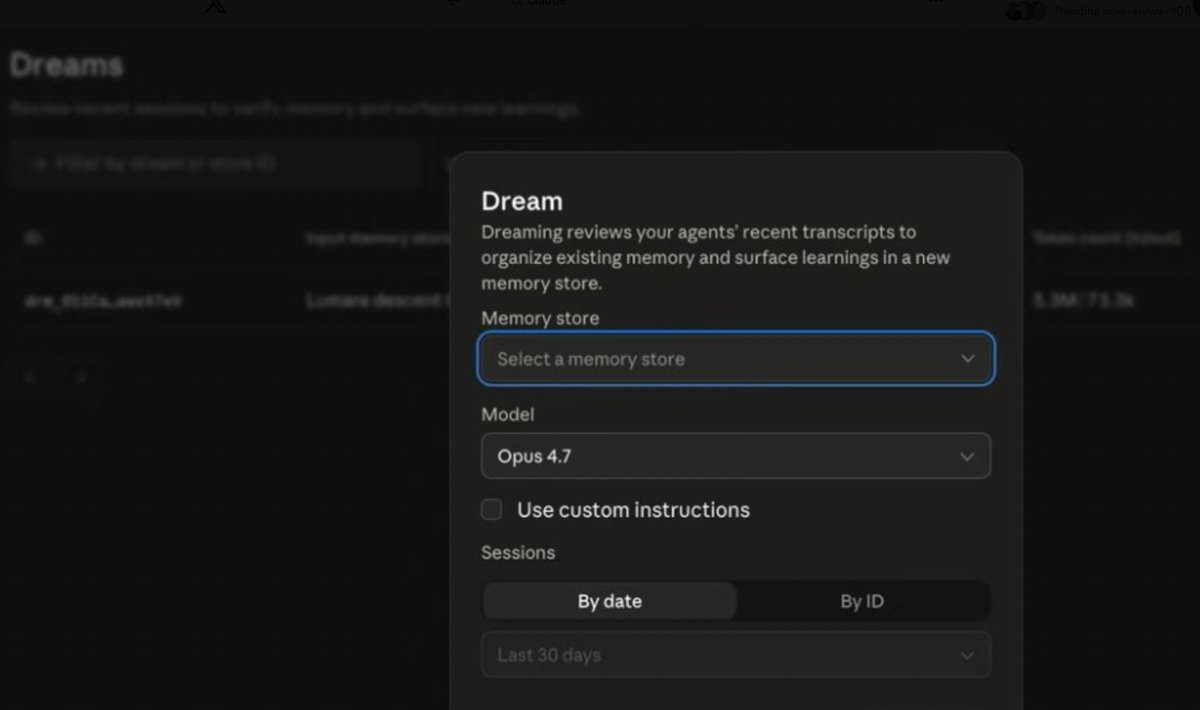
Anthropic has introduced an update to Claude Managed Agents, releasing several powerful new features designed to improve agentic workflows and autonomy.
🔹Dreaming (Research Preview): Agents can now "dream" by reviewing past sessions during idle time. This process extracts patterns, spots recurring mistakes, and curates memories so the agent continually learns and improves over time without human intervention.
🔹Outcomes (Public Beta): This feature allows developers to set a specific quality bar by writing a rubric. A separate grader agent then evaluates the output, forcing the primary agent to iterate on the work until it meets the defined success criteria.
🔹Multiagent Orchestration (Public Beta): A lead agent can now break down complex jobs and delegate specific tasks to specialized sub-agents, which work in parallel to execute the broader objective.
🔹Webhooks (Public Beta): Users can subscribe to webhooks to receive automatic notifications the moment an agentic task is completed.

Live from Code with Claude: we're launching dreaming in Claude Managed Agents as a research preview.
Outcomes, multiagent orchestration, and webhooks are now in public beta.
9
26
258
53,233

We're winding back our peak hours limit reduction and doubling 5 hour limits.
Excited to partner with SpaceX to bring you more compute and we'll keep pushing to bring you the best coding agent in the world.
We’ve agreed to a partnership with @SpaceX that will substantially increase our compute capacity.
This, along with our other recent compute deals, means that we’ve been able to increase our usage limits for Claude Code and the Claude API.
358
122
3,867
244,982