
Joined March 2009
- Tweets 1,789
- Following 1,447
- Followers 2,898
- Likes 2,984
93 Photos and videos

Niru Maheswaranathan retweeted

23 Jul 2025
We’re thrilled to see our advanced ML models and EMG hardware — that transform neural signals controlling muscles at the wrist into commands that seamlessly drive computer interactions — appearing in the latest edition of @Nature.
Read the story: nature.com/articles/s41586-0…
Find more details on this work and the models on @github: github.com/facebookresearch/…
49
267
1,274
169,148
Niru Maheswaranathan retweeted

17 Apr 2024
Excited to speak with this fine gang in St Louis next month, including @neurograce @karimjerbineuro @niru_m @martin_schrimpf @chethan @weixx2 @HombreCerebro . Bring on the future of NeuroAI! transdisciplinaryfutures.wus…
12
73
13,416

15 Feb 2024
How long until there is a feature length film that is completely AI generated? I’m guessing ~2028
15 Feb 2024

here is sora, our video generation model:
openai.com/sora
today we are starting red-teaming and offering access to a limited number of creators.
@_tim_brooks @billpeeb @model_mechanic are really incredible; amazing work by them and the team.
remarkable moment.
5
1,273
26 Aug 2023
I'm incredibly saddened today to hear about the passing of Prof. Craig Henriquez, one of my first research advisors when I was an undergrad. Craig was an incredible mentor, scientist, and compassionate human being; he will be deeply missed. today.duke.edu/2023/08/craig…
2
24
2,307
Niru Maheswaranathan retweeted

14 Aug 2023
1/Our paper @NeuroCellPress "Interpreting the retinal code for natural scenes" develops explainable AI (#XAI) to derive a SOTA deep network model of the retina and *understand* how this net captures natural scenes plus 8 seminal experiments over >2 decades sciencedirect.com/science/ar…

8
237
874
458,340
26 May 2022
cc @ItsNeuronal
25 May 2022

Sometimes I want to be a computational neuroscientist just so that I can make minimalist talks with only keynote drawings and whatever that cool sans serif font is
3
16 Mar 2022
Heading to Lisbon for #cosyne2022! Looking forward to talking science in person!
11 Mar 2022

I'll be in Lisbon along with great team of our scientists including @SussilloDavid @niru_m @CLWarriner @diogo_neuro @DiegoGutnisky @najabam. Long overdue to talk science in person!
10
18 Feb 2022
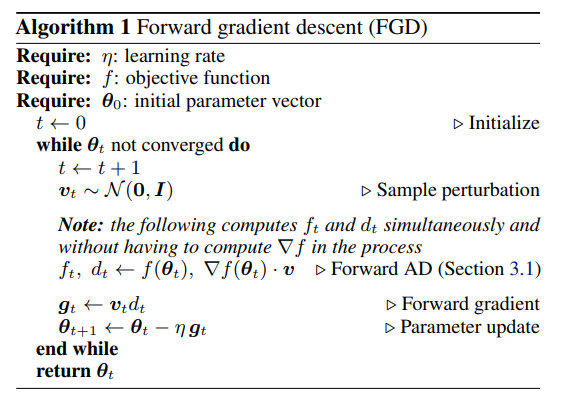
This gradient might look good in expectation, but what about the variance? 🤔
18 Feb 2022

Gradients without Backpropagation
Presents a method to compute gradients based solely on the directional derivative that one can compute exactly and efficiently via the forward mode, entirely eliminating the need for backpropagation in gradient descent.
arxiv.org/abs/2202.08587
8
16 Dec 2021
Interesting paper making connections between representational drift in biological brains and dropout in ANNs!
15 Dec 2021

New work out on bioRxiv (biorxiv.org/content/10.1101/…) on the geometry of representational drift in natural and artificial neural networks. Work done with Marina Garrett (@matchings), Shawn Olsen, and Stefan Mihalas (@Stefan_Mihalas) at the @AllenInstitute. 🧵

2
15
25 May 2021
Some personal news: I recently joined Facebook Reality Labs, working on neural interfaces research with the CTRL labs team. Sad to leave fantastic colleagues at Google Brain, but looking forward to a new challenge! 🧠 💪
11
3
415
1 May 2021
Often in science something seems complicated until you look at it the right way. The hard part is figuring out the right frame of reference!
30 Apr 2021

A classic kinematics example—a pillbug on a spinning disk walks back and forth on (what it thinks is) a straight path.
However, its trajectory looks much more complicated and beautiful to a stationary observer!
1
1
34
22 Mar 2021
"Intuition is the foundation upon which comprehensive understanding is built. But ... unverified intuition can be misleading." A fantastic article on rigorous interpretability research by @leavittron and @arimorcos (arxiv.org/pdf/2010.12016.pdf) h/t @KordingLab for highlighting it!
1
4
30
Niru Maheswaranathan retweeted

26 Feb 2021
taylor expansions are the turtles in the turtles all the way down joke except it isn’t a joke
3
36
16 Feb 2021
Cool result: minimizing activation norms in a network (a proxy for energy efficiency) in a predictable environment yields a network that learns aspects of predictive coding. Would love to see what happens in richer environments and with deeper architectures!
16 Feb 2021

New preprint alert! We show that predictive coding is an emergent property of input-driven RNNs trained to be energy efficient. No hierarchical hard-wiring required. A thread: 1/
biorxiv.org/content/10.1101/…
27
Niru Maheswaranathan retweeted

11 Jan 2021
Are Experts Real? Some thoughts on expertise, credentialism, and feedback loops.
fantasticanachronism.com/202…
4
18
52
12 Jan 2021
The only reason this image is “powerful” is as a reminder of how misleading data visualization can be. It uses a diverging colormap for sequential data, and caps the range at 4% so the UK pops out as if they’ve vaccinated a majority of citizens. Good example of what *not* to do!
33
4 Jan 2021
Really enjoyed this post on Stein's paradox! The writing is impressively clear.
3 Jan 2021

I wrote a blog post that provides some intuition behind one of the weirder results in statistics: Stein's paradox.
joe-antognini.github.io/mach…
1
7
11 Dec 2020
Awesome work! Congrats @basile_cfx et al!
8 Dec 2020

OK, finally our tweeprint for the NeurIPS paper. Here we go. Synaptic plasticity, it's the holy grail of learning and memory. This is work by @basile_cfx, @hisspikeness, @ejagnes, @countzerozz & myself, on how to find the grail, maybe biorxiv.org/content/10.1101/…
3
5 Nov 2020
If you need an escape from politics right now, I'm giving a talk at the DeepMath conference (@deepmath1) this afternoon (2:20pm PST) on understanding the dynamics of learned optimizers. There is a livestream: youtube.com/watch?v=x-VPsHyf… - the talks so far have all been fantastic!
2
17
120