
Toronto VC @LucidVentures | Investing in AI-native enterprise tech. Founder (Karen AI acq. AMS, CTrade). Seeking aligned LPs & founders. Drummer @Skydiggers.
Joined May 2007
- Tweets 635
- Following 818
- Followers 702
- Likes 1,070
39 Photos and videos


Noel Webb retweeted

16h
great journalists pls apply
21h

Hey Everyone: @the_lineca is partnering with @build_canada to hire a journalist to figure out why Canada No Build Good. This will be an amazing opportunity to do investigative work for Canada's most independent journalism outlet. Apply here: linkedin.com/jobs/view/44277…
2
6
22
3,430
Jun 10

Congrats to @ManevaAI on the $27M Series A!
The average factory still runs at just 60% efficiency - a $10T annual drag globally. That’s no longer a hardware problem :)
1
12

Maneva has raised $27M in Series A led by @USVenturePartners, with continued backing from existing investors @BlingCapital, @FreestyleCapital, and several others. Our total capital raised now sits at $38.4M.
Global manufacturing runs at 60% efficiency against a $46T industry. That's $18T lost every year from lack of visibility and the right tools.
Our Video-to-Action AI turns existing factory cameras into real-time operational decisions, powered by deep learning vision and agentic systems that act, coordinate, and optimize the entire operation.
A special thank you to @mdgarratt and the @USVenturePartners team for leading this round. To our customers, partners, and investors: thank you for believing in what's possible on the factory floor.
maneva.ai/resources/resource…
2
7
15
4,484
The Artemis III crew is set: @AstroKomrade (Bresnik - NASA Commander), @astro_luca (Parmitano - ESA Pilot/Italian veteran), @Astro_FrankRubio (Rubio - NASA, record 371 days in orbit), and @Astro_AndreD (Douglas - NASA, first-time flyer).
Nations and industry are building the road back to the Moon, and it is hard not to be excited!
@NASA @NASAArtemis #ArtemisIII #Artemis

1
54

Introducing Artemis III.
Four astronauts. Three launches. Two dockings. One splashdown.
In 2027, the Artemis III mission will practice docking the Orion spacecraft with two lunar landers in low Earth orbit — the capability we need to return humanity to the Moon’s surface.
988
5,992
28,761
1,902,642
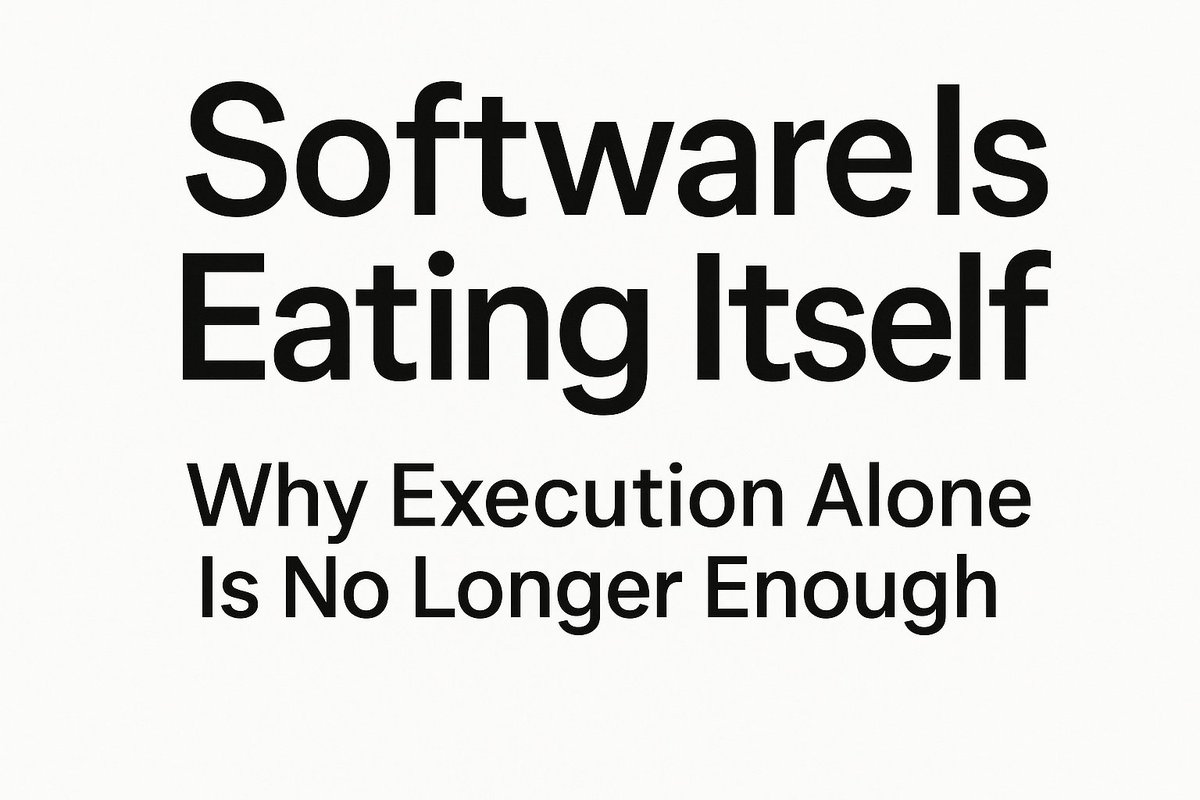
As a founder, here's the shift I've watched take hold over the last year. My partner @JeremyAuger of @lucid_vc calls it the cognitive load inversion and it looks a bit like this:
For decades the deal was simple. Whoever made the thing carried the work: research it, write it, edit it, then send it up for a skim. Our org charts and pay bands still assume that's how it runs.
AI flipped it. One prompt now does the research, the draft, the design in minutes. The person who asked absorbs almost none of the load, and the work reaches a reviewer before any human has read it, the author included.
The load didn't disappear. It moved downstream. A production bottleneck became evaluation overload, and the reviewer, usually the senior, higher-paid person, is now the first real set of eyes. Push a question back to the author and they often can't answer it. They never engaged with the material.
This isn't lazy colleagues. It's structural. Staffing a senior person to review is working as designed. The problem is what they review now: instead of pressure-testing finished thinking, they supply the judgment that was never applied, doing the junior person's job on top of their own.
Then the trust tax hits. The moment a reviewer suspects a model wrote it, collaboration turns into audit. Verify, correct, or send it back. AI promised to remove effort and instead relocated it, with suspicion stacked on top.
Jeremy's fix, in order of leverage:
Make authorship mean something. You send it, you own it: read it, can defend it. AI drafts, a human underwrites.
Protect how judgment gets built. Senior people review well because they spent years in the reps. Let AI absorb that work and the next generation never builds the instinct, and the people who can actually review run dry.
"AI made words cheap and left the price of judgment exactly where it was. The bill goes to the reviewer."
READ THE POST HERE:
lucidventures.substack.com/p…
1
45
Quantum entanglement just got a practical shortcut. Researchers at UChicago found a simple way to generate complex, noise-resistant entangled states using standard cavity QED setups - basically tweaking energy levels in groups of atoms with common lasers or magnetic fields. No exotic hardware needed. @zerohedge @PhysRevX @QuantumIQC
2
2
64
This minimal approach opens doors to ultra-precise quantum sensing (like measuring field gradients with high sensitivity) and stabilizing states like AKLT for deeper physics exploration. Theoretical for now, but the elegance could speed real-world progress. Game-changer for quantum tech? What do you think? @canada_quantum @UChicago @AashishClerk
zerohedge.com/technology/new…
29
There is no "Turing Test" for consciousness.
The Turing Test measures one thing. Whether a machine can hold a conversation well enough to pass for human. That is a test of behavior. Consciousness is not behavior. It is thought to be grounded in subjective experience. What that actually is remains an open question.
Behavior cannot settle it. Any output including the sentence I am conscious is consistent with experience being there and with it being absent. You cannot read experience from words. This is a limit on what behavioral evidence can ever provide.
Science has no settled behavioral test for it either. Leading candidates are physical. Integrated information. Global broadcast. The perturbational complexity index used on patients. None of them asks the system to talk. And they are far from settled. In 2025 a major adversarial collaboration in Nature tested the top theories and challenged claims of both.
@geoffreyhinton recently claimed AI is already conscious.
He is not correct.
We know our own consciousness directly. Yet we still have no objective test for it even in humans.
When a model produces fluent feeling language that is evidence of capability. Not evidence of experience. Treating one as the other is a category error.
Intelligence capability reasoning and agency are measurable. Consciousness so far is not in humans or machines. As these systems get more powerful that line gets more useful not less.
What would actually count as evidence that a machine is conscious?
#AI #Consciousness'
youtube.com/watch?v=vxkBE23z…
@suzannegildert @StuartHameroff @professor_ajay @fedefaggin Thoughts?
5
7
7,444
Proud of the work my friends and colleagues are doing on Canada’s new AI Strategy Task Force. 🇨🇦
Canada has built one of the world’s strongest foundations in AI. World class research, exceptional talent, and respected institutions. But discovery alone is not enough. We need to commercialize, build, and scale the companies that will drive the next economy.
Huge thanks to @soniasennik @mserbinis @professor_ajay @ddebow for stepping up with real leadership at this critical moment.
AI has and will reshape industries, economies, and work itself. We have the researchers, founders, operators, investors, and policymakers to lead. Now it is about urgency and ambition. Turning our research edge into lasting economic and societal impact for our great nation.
Optimistic about what is possible when we bring it all together. The opportunity and responsibility are enormous. Looking forward to the results.
#CanadaAI #AIStrategy
1
11
355
Noel Webb retweeted

One year in. Building capability for our warfighters. We are locked in.
Defend the Dominion.

The first 365 days of Dominion Dynamics.
From one person with a mission to a team of 50.
Year one: built and shipped 14 products, opened two offices, raised $26M, deployed with the Canadian Rangers in the Arctic.
Year two starts now. We're not slowing down.
Never lift.
jobs.ashbyhq.com/Dominion …
1
12
595
It's an honor to be featured on UNALIGNED with @Scobleizer, one of the most influential voices in tech. 🙏
Our CEO @raechanjeong sat down with him to talk about what it really takes to bring AI into manufacturing. The technology matters, but so does the trust.
At maneva.ai, we build deep learning computer vision tailored to your operational needs. It's how factories see, understand, and act on what's happening on the floor in real time.
That's the foundation behind our Video-to-Action AI and our mission to drive safety, efficiency, and growth in the factories that power the world.
🎥 Full conversation below 👇
Jun 2

Manufacturing might not be sexy. It might not get hits.
But I loved talking to @raechanjeong, founder of maneva.ai/ about how AI is changing manufacturing.
He used to work in AI research at Google Deepmind, but now works with bringing AI into factories.
One thing I came away with?
His attitude. He doesn't come across as a Silicon Valley nerd that is gonna push technology down people's throats.
It's how you gain trust with people who don't know what an OpenClaw is.
As always, if you don't have time to watch an hour conversation I'll post a link to what Grok learned by watching this.
It's fitting that AI is now my first viewer (it watches the video as I upload it).
1
2
5
115
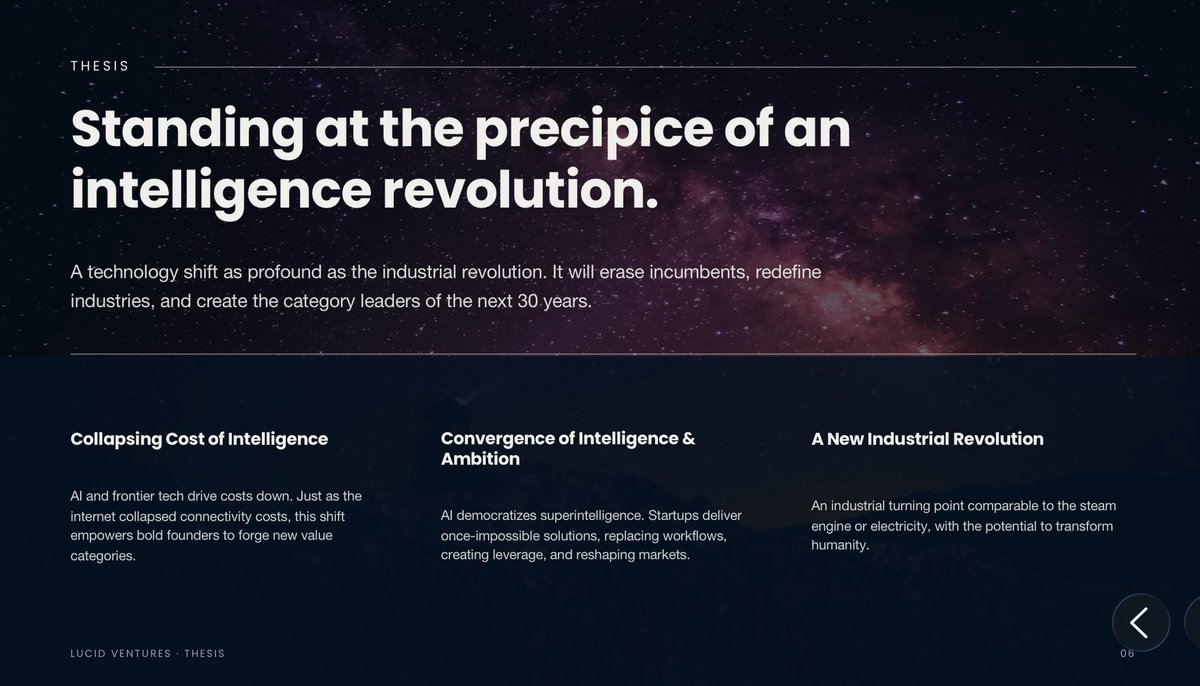
Toronto-based. Open to conversations with aligned investors and high-signal founders.
lucidventures.vc
31
Thrilled to announce that @JeremyAuger has joined me as co-founder of @Lucid_VC
After co-founding, building, and scaling D2L from the early days through IPO, Jeremy is one of the best operators and founders I know. Now we are back in full builder and investor mode together.
1
1
1
75
We are currently raising our first fund and already seeing strong early momentum.
If you are interested in learning more reach out!
This is going to be fun.
lucidventures.vc
#AI #VentureCapital #Startups
1
32