CEO, Debow Musical Instruments ❤️🇨🇦 4x co-founder. Company producer. @Build_Canada
Joined February 2008
- Tweets 17,425
- Following 1,035
- Followers 13,400
- Likes 19,419
574 Photos and videos












Pinned Tweet

9 Jun 2021
Your odds of being great at anything are directly proportional to your willingness to suck at it for a long time.
26
100
622
daniel debow retweeted

The underappreciated divide shaping Canadian politics
A recent academic paper revisits an old question in Canadian politics: Does where one works shape how one votes?
Drawing on data from 16 federal elections between 1968 and 2019, the authors find evidence that Canada’s so-called “sectoral cleavage” remains alive and may even be growing stronger. Public-sector workers are generally more likely than their private-sector counterparts to hold Left-leaning economic views and support parties such as the NDP. The differences are especially pronounced among public-sector professionals and managers.
The paper cannot tell us exactly why these differences exist. It may be that people with more interventionist political preferences disproportionately choose careers in government. It may also be that employment itself shapes political attitudes over time. Most likely, both factors are at work.
Yet the findings are notable because they connect to several of the most important debates in contemporary Canadian politics.
For years, political scientists have understood Canadian politics through the lenses of region, language, class, and ideology. The paper suggests that the employment sector deserves a place on that list. Public- and private-sector workers increasingly appear to constitute distinct political constituencies with different interests, incentives, and policy preferences.
Readers of The Hub will recognize this theme. We’ve explored it previously in debates over the public-sector compensation premium, work-from-home policies, pension arrangements, and government workforce growth.
What often appears on the surface as a dispute about pay, workplace flexibility, or management practices can reflect a deeper divide between those whose livelihoods depend primarily on government spending and those whose livelihoods are more directly exposed to market forces.
This helps explain why debates over government spending, regulation, taxation, and public-sector compensation often feel so contentious. They’re not merely ideological disagreements. They increasingly involve groups whose livelihoods are tied to different parts of the economy.

The findings also resonate with insights from public choice economics, which emphasizes that political actors respond to incentives just as market actors do. The point of course isn’t that public servants are uniquely self-interested. It’s that the interests of those who depend primarily on public budgets may not always align with those whose livelihoods depend on competitive markets, entrepreneurship, investment, and business formation.
Recent controversies over public-sector work-from-home policies offer a useful example. What began as a debate about workplace flexibility quickly became a broader argument about accountability, productivity, and the obligations associated with taxpayer-funded employment. Beneath the surface lay competing assumptions about the role and purpose of public institutions themselves.
None of this means that public- and private-sector workers are destined to be political opponents. But as government employment grows and public spending occupies an ever-larger share of economic activity, the divide identified in this paper may become increasingly important for understanding Canadian politics.
Where one earns a paycheque may not determine one’s political views. But it appears to matter more than many observers once assumed.
18h

.@Sean_Speer: The rest of Canada has a lot to learn from Alberta
thehub.ca/2026/06/12/the-res…
2
7
33
3,889
daniel debow retweeted
We hit the streets of Toronto to ask our upcoming founders: why build in Canada? 🍁
Short answer: abundant talent, a one of a kind community, and a home worth building for.
This is only a fraction of Canada's talent. Which city should we hit next?
8
17
52
6,455
daniel debow retweeted

This pathetic attitude is among the worst things about our political culture in Canada and I cannot reject it enough.
It gets cloaked in the language of progressivism but it is deeply cynical, ugly, and regressive.
Story time!
Growing up, I was hugely inspired by RIM (BlackBerry). It was one of the reasons why I wanted to go to Waterloo.
I thought it was so cool one of the most innovative companies on earth was an hour away from home.
In fact, my program, Nanotechnology Engineering, was able to exist in part due to the philanthropy of Mike Lazaridis, who funded the Institute of Quantum Computing and Nanotechnology (along with the Perimeter Institute for theoretical physics, which is a brilliant asset for the province and country). Balsillie, for his part, has spent tens of not hundreds of millions of his personal wealth on advocacy and institutions to make Canada a better place. But he too was castigated in our media.
Through high school, I saw how Canadas media took an axe to RIM founders (Mike and Jim), and basically cheered on the decline of the business against competition from Apple and Google.
It was a complete disgrace.
Well, in 2013 I got my second co-op job there, just as they rolled out BB10 (the QNX operating system). 6 weeks into my co-op, my entire department was laid off (Modems/Semiconductors).
Nearly every one of my colleagues ended up moving to the US. Some of the most capable talent on earth, poached in weeks. It was loss that was absolutely devastating to witness.
I have no doubt people like Bruce cheered on the spectacle, just like he would cheer the downfall of Shopify if it were to ever happen; despite the champion it’s been for the country, the thousands of good jobs it’s created, and all the spin-off businesses that have created huge wealth for Ontario.
Well let me be clear that I will have none of this nonsense.
Jun 12

Just tag the Shopify guys next time, they might get excited
168
312
2,114
299,512
Jun 12
if someone becomes a trillionaire by creating low-cost drugs that cure cancer…
should we hate them?
9
20
1,637
daniel debow retweeted
Can I just point out how funny this is, given the paper is owned by Canada’s wealthiest billionaire family, all of whom inherited their wealth.
Should we hate them for that? Of course not, because that would be gross.
But, it reflects our tall-poppy syndrome at its finest.
Personally, I’m glad that the Ontario Teachers Pension Plan is getting a nice payout, as will many others who took a big risk investing in SpaceX.
I wish we had more audacious entrepreneurs making big bets and generating great jobs and wealth here in Ontario. I want to create an environment that makes it even more likely.
The world is not zero sum. The size of the pie is not fixed. If we make more, everyone can get a big piece.
Jun 11

Opinion: SpaceX IPO makes Elon Musk the first trillionaire. Here’s how to properly hate him theglobeandmail.com/business…
104
169
1,589
121,853
Jun 12
boris and angela are excellent.
Jun 12

New on The Hard Part:
The Underdog for Underdogs
A long-form profile on Boris Wertz (@bwertz), Angela Tran (@angelatytran), and Version One Ventures (@VersionOneVC).
I spent the last couple of months reporting this, speaking with founders, co-investors, LPs, and people close to the firm.
Version One has backed Jobber, Ada, Coinbase, Uniswap, Shippo, Outreach, Moment Energy, Patch, EtherFi, and more.
But the story is what happened before the companies were obvious.
Link to read below!

3
1
10
1,179
Jun 11
donate to a great cause!
Jun 11

The @torontolibrary gave me my first job and opened a lot of doors for a kid growing up in Scarborough.
Today, @aratisharma and I are matching donations to @TPL_Foundation 2X up to $100,000 to help fund after-school programs across the city.
Donate 📚➡️ tplfoundation.ca/GoodFuture

2
1
12
3,931
daniel debow retweeted

Jun 11
A Toronto police officer was shot and killed in the line of duty this morning.
My deepest condolences to the officer’s family, loved ones, colleagues, and all of the Toronto Police Service.
Today my thoughts are with them, and with all officers in uniform who selflessly put themselves in harm’s way to keep Canadians safe.
Jun 11

Update: A Toronto police officer is dead following an apparent exchange of gunfire during a raid at a highrise building in North York, according to the U.S. ambassador to Canada. trib.al/w23pZVg
213
418
3,058
164,449
Jun 10
seriously, you can just do things.
Jun 10

Absolute privilege to get to compete in the 24h of Le Mans this year.
Bucket list stuff. Wouldn’t have gotten here without @dhh’s encouragement and guidance. Watch this weekend. We are in @TDSRacing_live #14




5
922
daniel debow retweeted

Jun 9
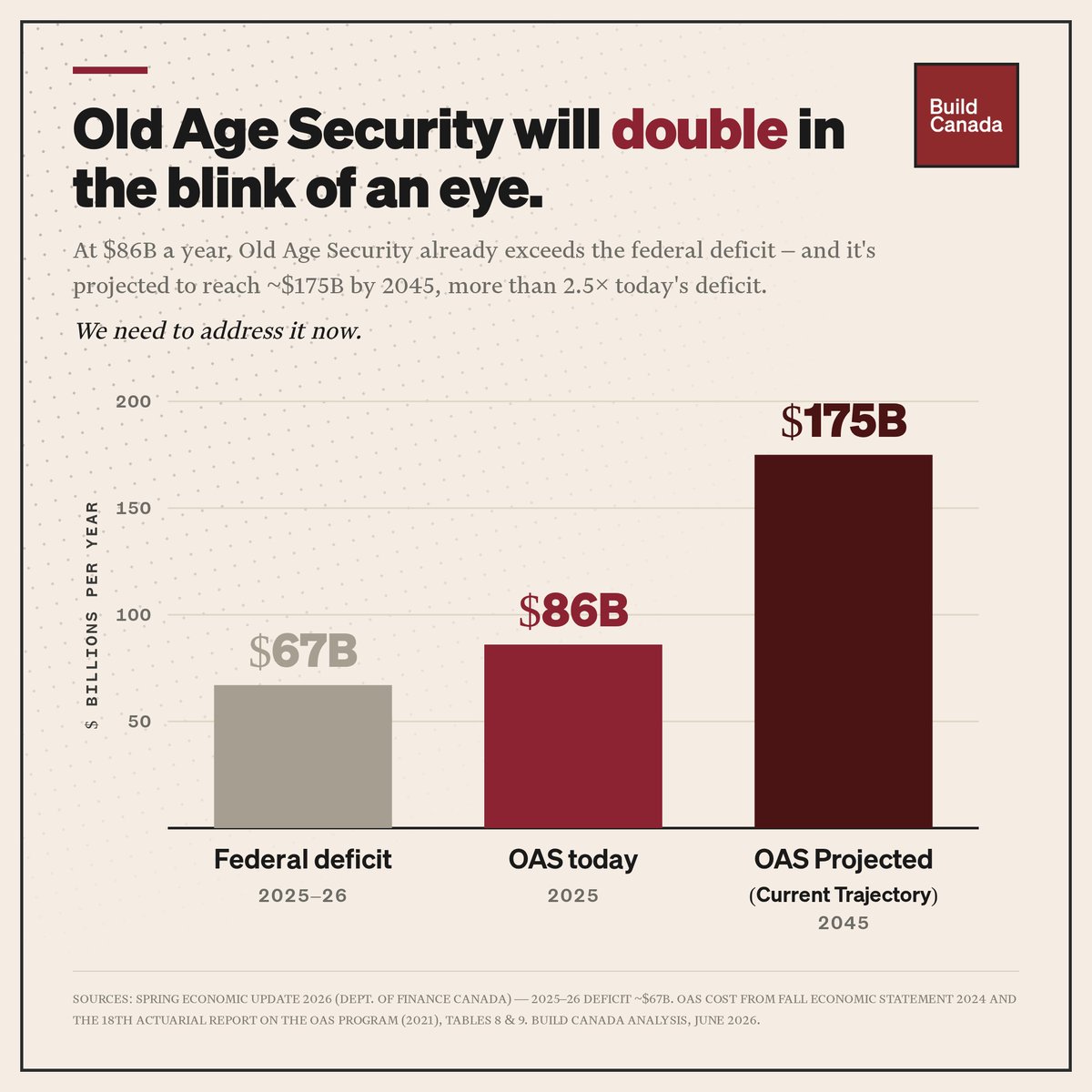
Old Age Security is set to nearly double over the next 20 years. It'll strain us before we see it coming.
We can fix it. We can keep OAS fair and sustainable – while still leaving room for young families to get ahead.
📰👇 @jeffcanadamson lays it out in our latest memo.
11
10
41
15,838
daniel debow retweeted

Jun 8
It is bizarre and sad in 2026 to be making daycare choices for children based on whether there are armed guards. Not rent-a-cops - actually armed, ready to shoot guards.
This is where we are at in Toronto right now.
9
7
94
13,774
daniel debow retweeted

This brought a tear to my eye. My god she’s good.
541
727
8,257
970,225
daniel debow retweeted

Jun 8
It’s a beautiful day to give your haters something new to complain about while you keep building.
32
46
540
46,801
daniel debow retweeted

Jun 6
Absolutely correct: "The fate of the world depends on more people giving Entrepreneurship a shot"
Jun 6

Marc Andreessen: We need to drastically increase the number of founders:
"It's shocking to me how few people actually give entrepreneurship a shot. The fate of the world over the next 1,500 years is riding on the people who actually want to give it a shot."
— @pmarca
51
74
946
132,336
daniel debow retweeted

Jun 5
I'm running for Mayor because I believe Toronto should be safer, more affordable, and easier to get around.
I’m running because Torontonians are tired of excuses from City Hall, and want a Mayor who takes responsibility and puts the work in to make our city better.
Together, we can choose something better, and make Toronto a city that we can be proud of.👇
nationalpost.com/news/toront…
47
30
191
8,010
daniel debow retweeted

Jun 4
The jobs data coming out continues to suggest the opposite of what a lot of people had thought would happen.
Just take engineering, as the prime example of the area with greatest AI impact (and perceived risk). Most companies now have far more software projects than ever before because of AI, and effectively only engineers are going to be the ones doing that work.
You can get by for a while by being non-technical building software, but eventually someone has to understand what the thing is that got built, has to maintain it, has to fix security issues that come up, upgrade the systems beneath it, and so on. That’s all jobs.
Now apply that to a number of other job functions. AI is going to cause companies to hire more in sales because agents can let them process more leads and do more customer research. AI will cause an explosion of new marketing roles because of how much more efficient it is to launch campaigns and target. The list goes on.
AI is going to have the opposite effect that lots of people thought on jobs.

What if AI is actually creating more jobs than it is replacing?
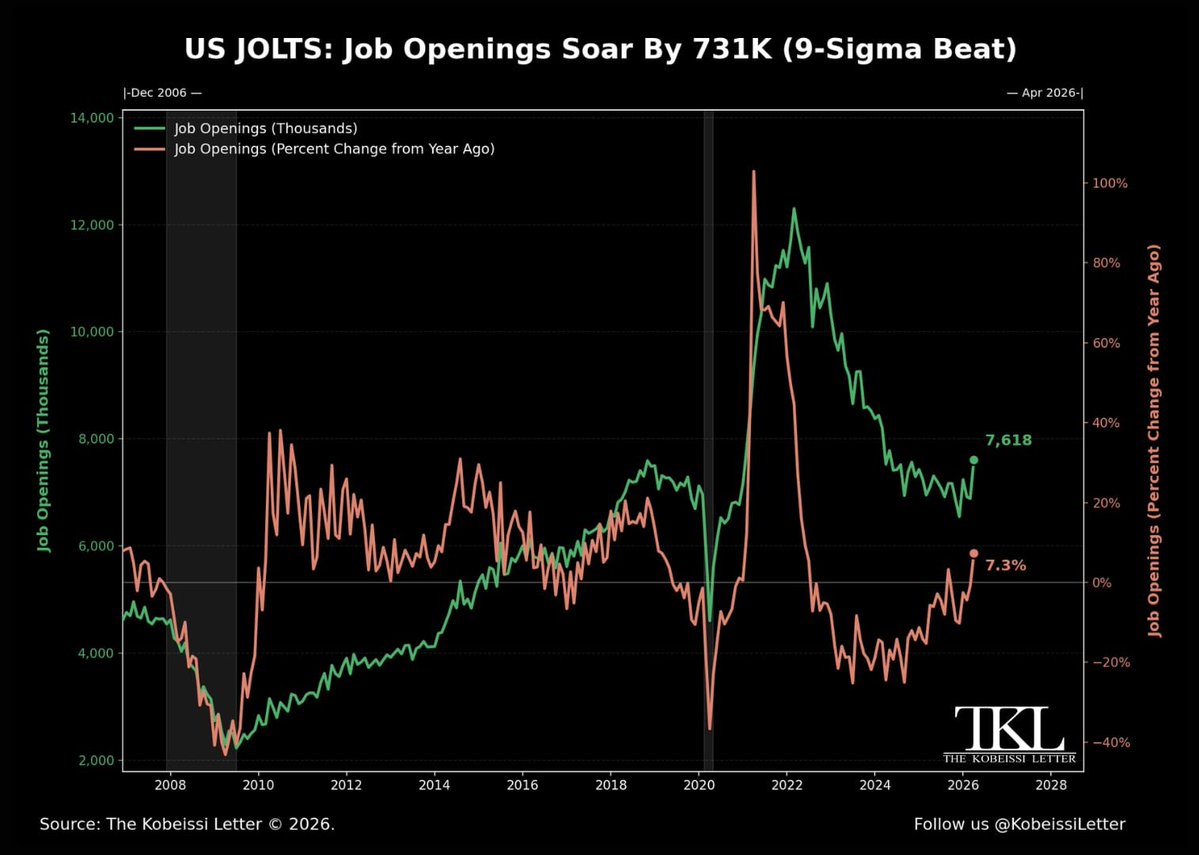
The latest JOLTs data showed that US job openings surged by a massive 731,000 jobs in April.
Markets were expecting no change, resulting in the largest beat in JOLTs history.
As a result, available employment hit 7.6 million for the month, the highest since May 2024.
And, job openings in the professional and business services sector surged by a massive 668,000.
The labor market's bull case from AI is underpriced.
84
86
534
167,062
daniel debow retweeted

Jun 5
“Canada should not be a passive consumer of technology built elsewhere, dragged into whatever future the tech hegemonies believe will make them the most profit. Rather, we should be active participants in how this technology is
built and deployed, ensuring it empowers all people who use it.”
@aidangomez @1vnzh @cohere and I wrote an article about Canada and this moment in tech history
Link below
7
12
127
8,083
Jun 5
I used to be very proud as a @MasseyCollege alumni fellow. No more. Shameful.
Jun 5

This post I'm sharing by @mgeist, and the letter included by Peter Biro might look quite long, but please read it — it's worth the time.
In short, alongside some of the world's leading experts on antisemitism, including @IrwinCotler, @deborahlipstadt, Alan Kessel, @LekhtNaya, and others, I was scheduled to speak at a day-long conference about antisemitism at Massey College in Toronto next September.
That was, until Massey decided that they needed to create an "advisory committee" to oversee and effectively curate the entire program from beginning to end.
I won't drag on about this, but the whole thing is really quite appalling, and it feels like another instance of Jews being forced to prove their trustworthiness and their ability to ensure that any examination of the hatred directed towards them is, as always, balanced. They/we need to show Massey we're some of the good Jews.
All told, Peter has resigned from his role at Massey, and the conference will no longer take place there, but it most certainly will go ahead, and I must say, I'm more delighted than ever to be part of it. Read Michael's post and Peter's letter. You'll be glad you did.
14
2,404
