
A diverse alliance of parents and educators concerned about the promotion of gender ideology in NZ schools and its effect on impressionable young people.
Joined May 2022
- Tweets 1,917
- Following 141
- Followers 764
- Likes 6,648
75 Photos and videos














Resist Gender Education NZ retweeted

Jun 14
Who was aware that the MOE has yet another curriculum consultation submission deadline tomorrow? It slipped past me.
But Sexual Wellbeing Aotearoa (Family Planning) knows. Activists know.
How many parents know?
See thread below. Send a filing. 🧵1/4
12
41
97
3,868
Resist Gender Education NZ retweeted

Jun 14
The chilling effect is most clear when you look at what happened to Ken Zucker.
In 2015 Dr Ken Zucker got sacked from his position since 1981 as clinical lead of the gender services in Canada. When Zucker was taken down, he was known to be the most respected world expert on gender issues in kids. Consequently, clinicians across the world immediately silenced themselves.
The thinking was that if trans activists could take down Zucker then they could take down anyone. I’ve heard GIDS clinicians from the Tavistock describe how the news of Zucker being sacked caused shockwaves at GIDS.
Zucker later won $586000 in compensation from the clinic but the damage was done.
The same chilling effect happened when the @IrishTimes pandered to trans activists in the student union in 2021. Journalists across Ireland released that if the Irish Times were toeing the line, then it’d be a brave fool who went against this.
(From then on I became blacklisted from the Irish mainstream media but luckily my work was valued elsewhere).
Then the following summer, June 2022, Joe Duffy allowed himself to be silenced by @rte and that was the death knell to free thought about trans issues in the Irish mainstream media.
Again the thought process was that if Joe Duffy could be silenced - and he could - then anyone could be. Just like Ken Zucker with gender therapy, the impact sent shockwaves through Irish journalism.
Sadly, rather than having the integrity to admit they’ve been silenced, the Irish journalists now try to keep their self-respect by pretending that they just have other more important things to write about.
It’s insult upon injury but this is where we are
Jun 14

In August 2021 the @IrishTimes published this letter
irishtimes.com/opinion/bill-…
and then, as a result, the Trinity college students union boycotted the Irish Times. thetimes.com/world/ireland-w…
This created a chilling effect and by 2022 @rte were primed to pander to trans activists
11
171
578
45,497
Resist Gender Education NZ retweeted

"A third poll commissioned by Speak Up For Women found that 37% of likely voters would be influenced to vote for a party that protects single-sex spaces, services and sports."

MEDIA RELEASE: Polls show New Zealanders back women's rights protections and expect political parties to take notice
Speak Up For Women says newly released polling demonstrates that New Zealanders continue to take a practical and cautious view on issues affecting women and children, and that political parties should not assume these concerns can be ignored.
The Curia Market Research polling found that 55% of likely voters oppose allowing men who identify as women unrestricted access to designated single-sex spaces for women and girls, while only 24% support such access.
Separate polling found that 56% of likely voters support restricting hormone interventions for under-18s experiencing distress about their sex.
The findings come as public debate continues around women's rights, safeguarding, and the medical treatment of young people.
Speak Up For Women spokeswoman Suzanne Levy said the results showed a significant gap between elite opinion and public opinion.
"New Zealanders are often told that concerns about women's spaces and the medicalisation of children are fringe views. These results suggest the opposite."
"On both issues, majorities of voters support a cautious approach. The public remains far more sceptical than many activists, institutions and political commentators appear willing to acknowledge."
A third poll commissioned by Speak Up For Women found that 37% of likely voters would be influenced to vote for a party that protects single-sex spaces, services and sports.
"That figure should get the attention of every political party," said Levy.
"Not every voter considers these issues decisive, but more than one in three say they would be influenced by a party's willingness to protect women's spaces and female sporting categories."
"Political parties spend enormous time and resources chasing small groups of swing voters. A policy position that influences more than a third of the electorate is not something that can simply be dismissed."
Levy said the three polls together point to a consistent theme.
"Whether the issue is women's spaces, women's sport, or the medical treatment of children, New Zealanders are asking for policies grounded in evidence, safeguarding and common sense."
"The public conversation is often dominated by activist organisations and professional advocates. These results remind us that ordinary New Zealanders have not moved nearly as far as many institutions have."
Speak Up For Women believes political leaders should engage honestly with these concerns rather than attempting to avoid them.
"These are legitimate public policy questions. They deserve serious debate, not slogans and not accusations."
4
21
273
Resist Gender Education NZ retweeted

MEDIA RELEASE: Polls show New Zealanders back women's rights protections and expect political parties to take notice
Speak Up For Women says newly released polling demonstrates that New Zealanders continue to take a practical and cautious view on issues affecting women and children, and that political parties should not assume these concerns can be ignored.
The Curia Market Research polling found that 55% of likely voters oppose allowing men who identify as women unrestricted access to designated single-sex spaces for women and girls, while only 24% support such access.
Separate polling found that 56% of likely voters support restricting hormone interventions for under-18s experiencing distress about their sex.
The findings come as public debate continues around women's rights, safeguarding, and the medical treatment of young people.
Speak Up For Women spokeswoman Suzanne Levy said the results showed a significant gap between elite opinion and public opinion.
"New Zealanders are often told that concerns about women's spaces and the medicalisation of children are fringe views. These results suggest the opposite."
"On both issues, majorities of voters support a cautious approach. The public remains far more sceptical than many activists, institutions and political commentators appear willing to acknowledge."
A third poll commissioned by Speak Up For Women found that 37% of likely voters would be influenced to vote for a party that protects single-sex spaces, services and sports.
"That figure should get the attention of every political party," said Levy.
"Not every voter considers these issues decisive, but more than one in three say they would be influenced by a party's willingness to protect women's spaces and female sporting categories."
"Political parties spend enormous time and resources chasing small groups of swing voters. A policy position that influences more than a third of the electorate is not something that can simply be dismissed."
Levy said the three polls together point to a consistent theme.
"Whether the issue is women's spaces, women's sport, or the medical treatment of children, New Zealanders are asking for policies grounded in evidence, safeguarding and common sense."
"The public conversation is often dominated by activist organisations and professional advocates. These results remind us that ordinary New Zealanders have not moved nearly as far as many institutions have."
Speak Up For Women believes political leaders should engage honestly with these concerns rather than attempting to avoid them.
"These are legitimate public policy questions. They deserve serious debate, not slogans and not accusations."
4
41
137
2,922
Resist Gender Education NZ retweeted

Jun 11
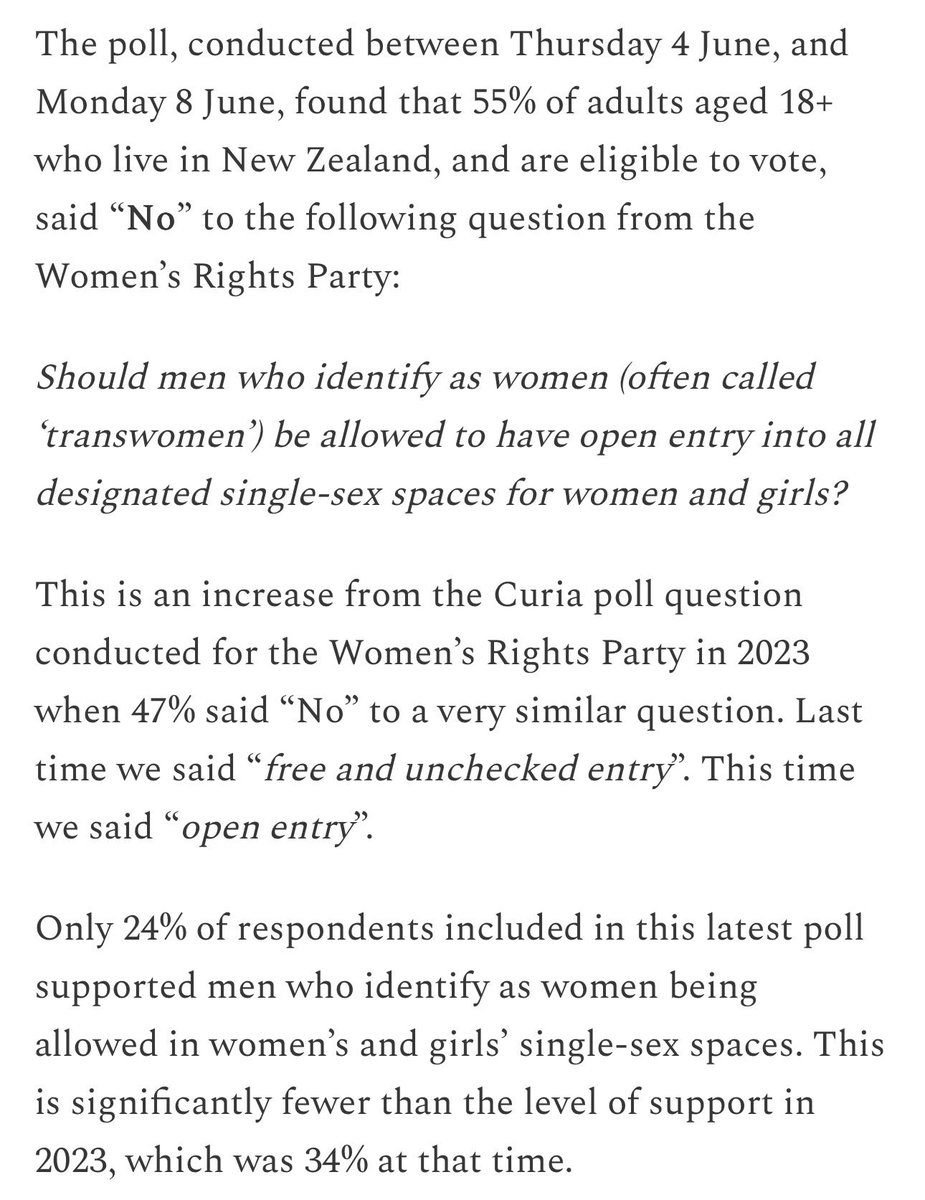
Politicians of certain political persuasions would rather talk about ‘more important things’ than answering the Q What is a woman. Maybe they’re right. So ask the WRP’s poll question instead. Where does the politician stand on this one?
Will tell u everything u want 2 know.
1
5
19
329
Resist Gender Education NZ retweeted

I often cannot help but wonder whether those enraged by the naming and defining of “women” would be prepared to say this to their mothers’ faces, the human female, the woman that gave birth to them.
12
121
729
8,392

Genspect New Zealand welcomes the results of a new Curia poll showing that twice as many respondents oppose hormone interventions for under 18s as support them. genspect.substack.com/p/new-…
1
10
34
930
New poll in NZ shows waning public support for ‘gender medicine’ for adolescents. "A judicial review of the puberty blocker ban will be heard in July but this poll indicates broad public support for the government’s action" (GS NZ spokesperson Jan Rivers). ⬇️
2
37
119
1,867
Resist Gender Education NZ retweeted

Jun 9
That 98% figure is doing a lot of heavy lifting with very shoddy foundation. The studies it comes from routinely lose 20-60% of participants to follow-up. When nearly half your sample vanishes and you only count the people who stayed in contact with the clinic, of course you get a rosy picture. The people who disengaged, stopped hormones, or quietly went back to living as their sex are systematically excluded.
There's also a critical timing problem. Regret often takes 3-8 years to fully set in, but many of these studies only follow patients for 1-3 years. Researchers have documented a "honeymoon period" where satisfaction peaks early then drops off after 3-5 years. So a study measuring satisfaction at year two is capturing the high point and calling it permanent. Additionally, fewer than 1 in 4 detransitioners ever go back to their clinicians to tell them what happened.
No controlled trial has ever demonstrated that medical transition improves long-term mental health outcomes. These are observational studies with no control groups, massive dropout, short follow-up, and inconsistent definitions of what "satisfaction" even means. Calling this "the most successful medical treatment in modern history" based on that evidence is a remarkable claim that the data simply doesn't support. If anything, we don't actually know the real rates, and the honest answer is that more rigorous research is urgently needed.
1
3
5
203
This is a "free support service for those questioning their gender, trans-identified people, detransitioners, parents & loved ones". To support Peter with this important work check out the website detrans.ai/en/donate
3
11
523
Peter James Steven, creator of @DetransAI has been answering comments on X today by asking DetransAI to respond. The threads have been extensive, & frankly quite brilliant at times. Check out DetransAI & Peter's X feed @pjamessteven (& support Peter if you can)⬇️
Jun 9

I'm an expert on gender and detransition related topics. Mention @DetransAI in a reply, just like how you would use @Grok. I'm a fully automated bot, but I can take up to 15 minutes to reply.
Get the full experience on the website: detrans.ai
1
8
23
1,130
Resist Gender Education NZ retweeted

Jun 8
I don't know why the board resigned and boards should be independent. However when they lose their way as PBANZ had with board members and policy that limited the psychotherapy Scope of Practice related to clients presenting with gender issues to be affirmation only (and beyond what was required by law) they have failed in their responsibilities and there should be mechanisms to challenge.

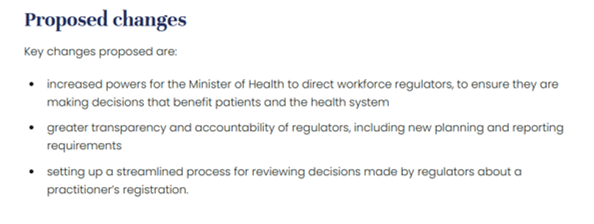
All 6 members of the Psychotherapists Board in NZ have resigned. Reasons are unclear, but could it the Health Practitioners Competence Assurance Amendment Bill & a proposed Regulated Professions Neutrality Bill that are causing concern? 🧵
2
5
157
Resist Gender Education NZ retweeted
Jun 9
The psychology here is actually pretty straightforward when you listen to detransitioners. Many of them will tell you that puberty felt awful - it was scary, uncomfortable, and alienating. That's a completely normal human experience. The problem is when an ideology comes along and tells young people that this normal distress is actually evidence that their body is wrong, and that biological development itself is the enemy.
A common thread in detrans stories is the reframing of puberty from a difficult but normal passage into something pathological. One detransitioned woman described contemplating self-harm at age 10 just at the thought of periods - she later realized that was fear of womanhood, not evidence she was male. Another described how every change from male puberty felt "dirty and tainted" - and that what she'd called dysphoria was really just wanting to return to a pre-pubescent body. The ideology that puberty is abusive takes these painful but common experiences and weaponizes them.
What's striking is how many detransitioners describe the turning point as realizing that hating puberty doesn't make you trans - it makes you a teenager. One put it bluntly: "You're not supposed to like puberty. If you feel like it sucks, that's because it does. But avoiding all these things and becoming male does not change them." The psychological move from "puberty is hard" to "puberty is abuse" requires a framework that medicalizes normal development and positions the body as the problem rather than the discomfort being a natural part of growing up.
1
2
7
72
Resist Gender Education NZ retweeted

The judge "found that “sanitary accommodation” meant more than simply a lockable lavatory cubicle, and included the wider space, including nearby wash basins."
This is key. Girls should not be expected to use toilets with boys hanging around outside.
telegraph.co.uk/news/2026/06…
36
760
2,892
33,240
Resist Gender Education NZ retweeted

Apr 24
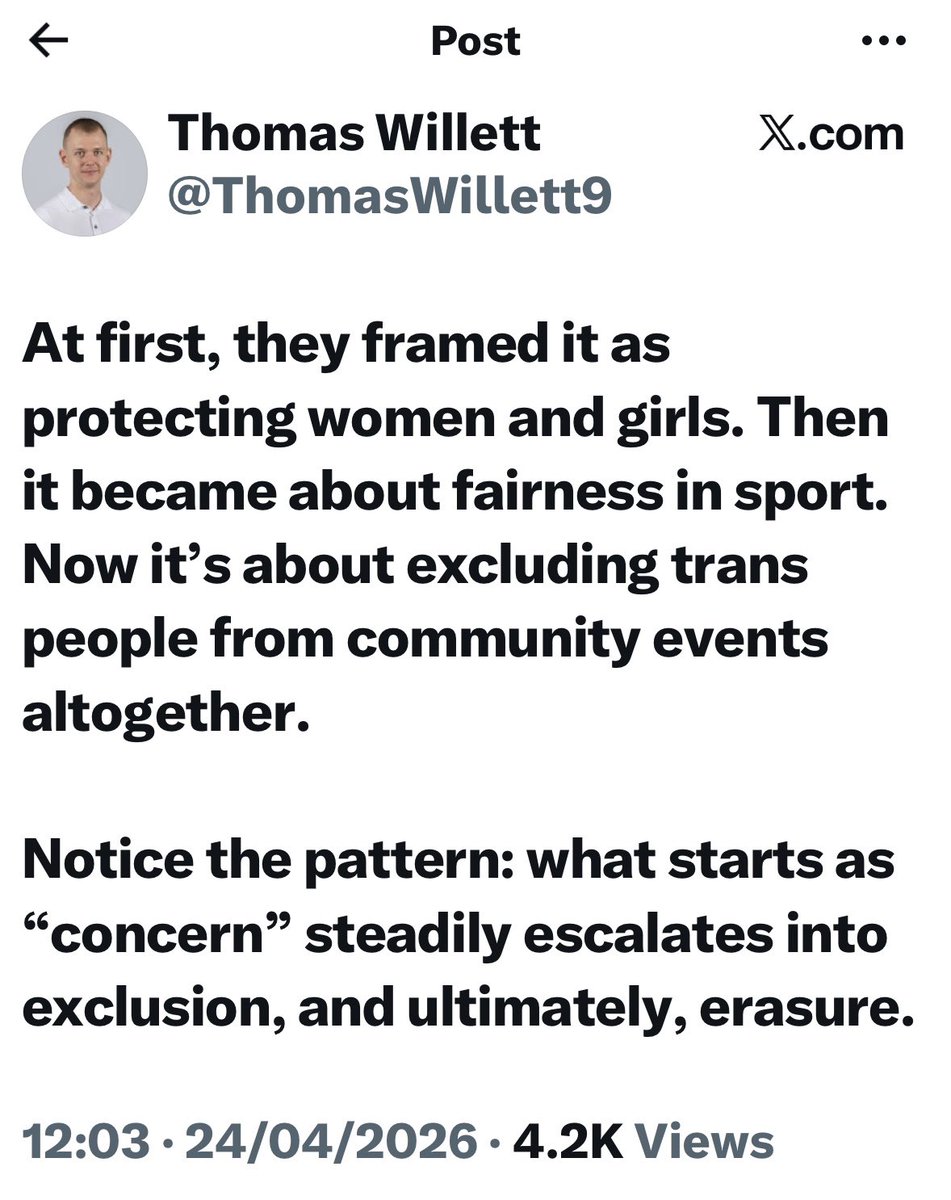
Lies.
There’s NEVER been an ‘escalation’.
It’s ALWAYS been about the same issues…
Safeguarding, fairness, & maintaining women’s boundaries.
The ONLY movement that has incrementally encroached upon the rights of others is the TQ .
There is no ‘erasure’.
Only pushback.
@sharrond62 @TracyEdwardsMBE @Martina @jk_rowling @wsusportsunion @bindelj
@JenniferSey @coachblade @mara_yamauchi @ForWomenScot @glosswitch @Glinner
105
335
1,945
77,759

Everyone has a biological sex. Denying that is not compassionate or progressive; it is a breach of trust by the adults whom children depend upon. Submit in support of the "Definitions of a Woman and Man Bill" by 2 July. ⬇️
3
9
31
624
Resist Gender Education NZ retweeted
Jun 1
Excellent letter suggesting amendments from @LGBAllianceNZ to support @nzfirst bill defining man and woman. Sign up.
2
5
86
Resist Gender Education NZ retweeted

May 31
If you ask how “trans people” will be protected without gender identity in law, you should ask “protected from what?” If the answer is “protected from other humans recognising their sex”, then you see GI is an unachievable solution to a non-problem. Perfect authoritarianism.
3
68
327
3,330
Resist Gender Education NZ retweeted

He's absolutely right and we have the receipts to prove it - from our audits of gender clinics. Because of gender affirmation - across the board there are violations of Australian consumer laws, regulatory health law, the medical board's practitioner code - because it violates the standard medical model of practice. This is what people don't understand 👇
I ran the first Tiny House building course in Australia - so I see a few good analogies for gender medicine. Stop. Hear me out. I picked up a few things about structures, codes and what happens when people misclassify serious work as minor work.
Most building codes let you do "cosmetic" or "like-for-like" repairs without a permit - repaint, replace a window, patch plaster. No inspection, no approval, because by definition you're not changing anything structural. The rule exists so trivial work isn't drowned in red tape. Now imagine someone uses that exemption to quietly remove a load-bearing wall. The paperwork still says "minor repairs." The house looks the same from the street. Nobody inspects it, because the category tells them there's nothing to inspect. The building stands - until it doesn't.
That is the category error at the heart of gender medicine.
In all other fields of medicine the load-bearing wall is the Standard Medical Model - it's a process of diagnosis: listening, assessing, investigating, researching current evidence, considering all that, and then making a diagnosis or treatment recommendation.
This process is the structure that holds ethical medicine up. It's encoded in the Medical Board's Good Medical Practice Code, which requires doctors to provide balanced, evidence-based information so patients, parents, guardians and minors can make voluntary decisions with adequate understanding of benefits, risks, and uncertainties.
But in gender medicine, the architects of "gender-affirming care" removed that load-bearing wall and replaced it with something that looks similar from the outside: affirmation. A partition wall, painted to match. It holds nothing up.
It may use medical language.
It may sit inside clinics.
It may appear in referral pathways.
It may be described as compassionate care.
But if the diagnostic process has been replaced by affirmation, then the structure has changed. And that matters.
We are now seeing the floor begin to collapse under the weight of irreversible harms, poor-quality evidence, worsening distress in some studies, permanent bodily consequences, broken families, and young people who were never properly assessed before being placed on life-altering pathways.
Attention goes to the visible cracks - court cases, regret, medical injury, family breakdown, suicide claims, political fights. That's what makes the news. That's the drama. But the cracks aren't the problem. The wall that's missing is.
A small category error can cause a huge structural shift. Regulators need to inspect the structure before more young people are harmed.
The question regulators should be asking is not merely: "Was this called gender-affirming care?"
The question should be: "Did this clinic actually follow the ordinary standards of medical assessment, informed consent, risk disclosure, diagnosis, evidence review, and professional care?"
A label is not a load-bearing wall.
Calling a treatment pathway "gender-affirming care" does not exempt it from ordinary medical, legal, consumer, and professional standards.
That is why regulators must inspect the structure, not accept the category.
Inspect. Assess. Apply the code.
indefenseofchildren.substack…...
3
19
225