
Joined December 2025
- Tweets 183
- Following 316
- Followers 28
- Likes 607
6 Photos and videos
QuickBooks is great.


22
Yes how…
Jun 13

You have $0 for marketing. Your product just launched. How will you get users?
1
105
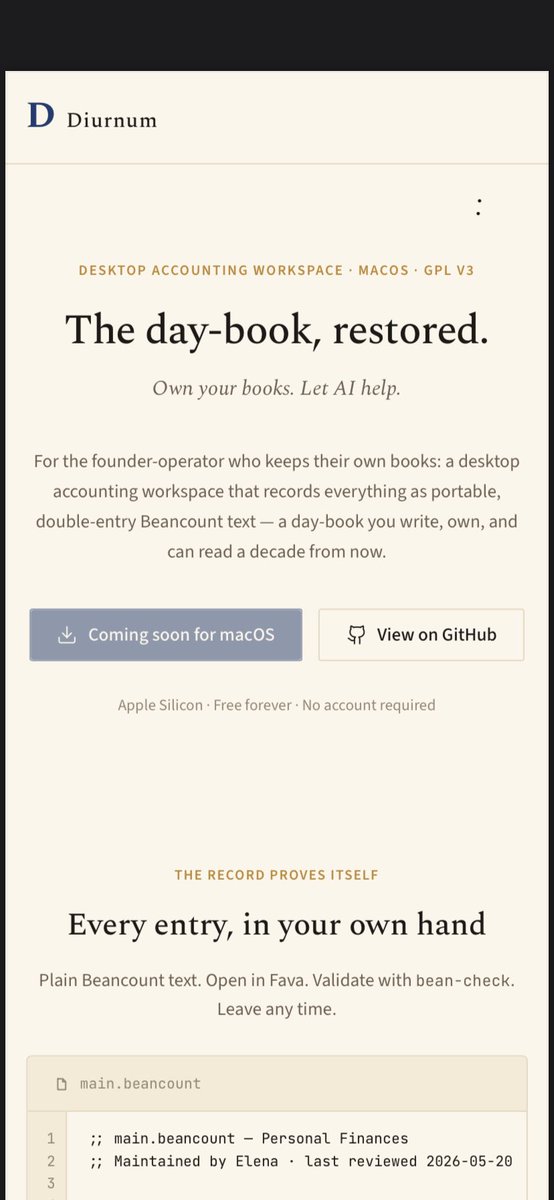
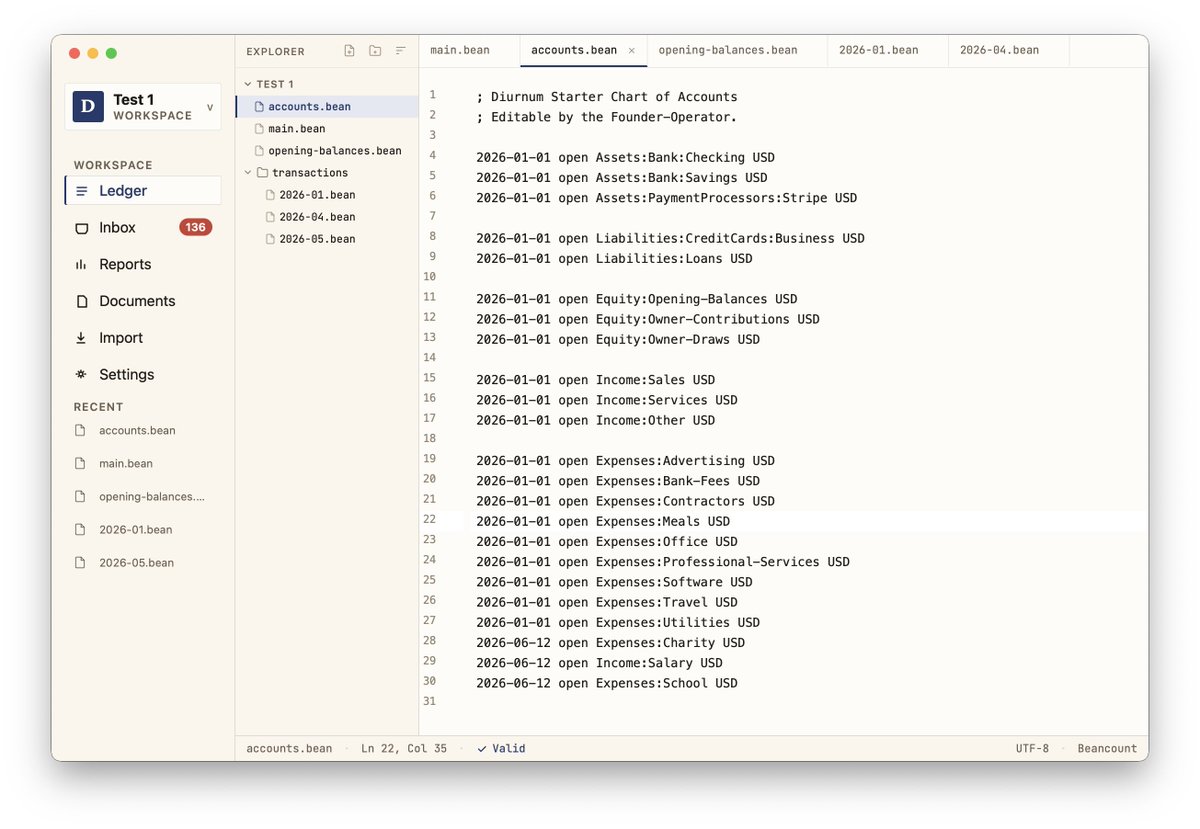
Quickbooks is slow, bloated, and owns your data. Diurnum (latin for day-book or journal) is an open-source accounting app that keeps your books in plain text files on your computer.

diurnum.app is coming
28
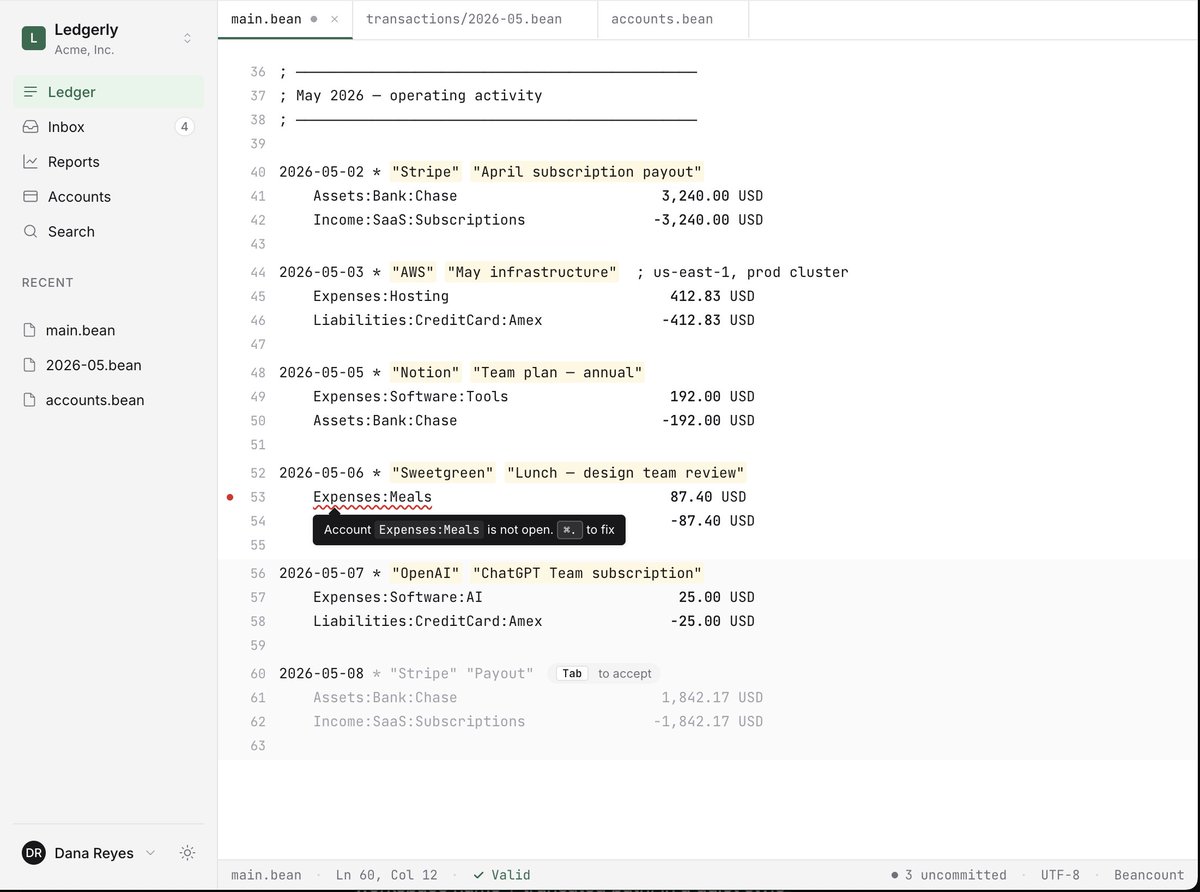
This is what I was working on when Anthropic pulled the rug on Fable.
I'll have to limp along with Opus 4.7
1
1
58
Ryan Heneise retweeted

Yeah, it's a weird name.
Diurnum (dy-UR-num) is a Latin noun meaning account-book, day-book — attested in Juvenal, used in Rome for the running record of daily transactions.
1
2
1
17


What people are missing about the US government's AI regulation announcement:
ID verification will now be forced on all accounts to prove citizenship.
Frontier labs will take your data, and your sovereignty is officially dead.
A permanent underclass division and a total control society are beginning right now.
People ignored me when I started saying this last year, but it is happening right in front of our eyes.
Get into Open-Source and Sovereign AI.
Advancing together through collective intelligence is the only way to fight back.
Jun 13

As a result of a US government directive, we are suspending access to Claude Fable 5 for all users. You can continue to use all other Claude models.
Here’s what this means for you:
Across Claude products, new sessions will run on your selected default model or Opus 4.8, and existing Fable 5 sessions will end with an error.
On the Claude Platform, requests to Fable 5 will also return an error. Please update your integrations to other Claude models.
We know this is a disruption to your workflows; we appreciate your patience and support.
180
349
1,931
295,639
Ryan Heneise retweeted

Jun 13
after what happened with anthropic...
i can't stop thinking about this video
34
183
936
82,754
Ryan Heneise retweeted

Jun 12
71
222
1,058
467,053
Ryan Heneise retweeted

Jun 12
Cave Catgirl simple Nyanderthal. Need smart tribe explain this thing.
Elon sell electric cars. Elon sell satellite internet. Elon launch rockets. Elon make things people want buy. (Including governments!) Somehow this make Cave Catgirl poorer? Please explain slowly. Use small words.
If Elon become rich by taking Cave Catgirl mammoth, Cave Catgirl understand.
If Elon become rich by stealing Cave Catgirl hut, Cave Catgirl understand.
If Elon become rich by government pointing spear and taking Cave Catgirl shiny rocks, Cave Catgirl understand.
But that not argument being made.
Argument seem be:
"Man build companies. People buy products. Investors think companies valuable. Therefore Cave Catgirl poorer."
In fact, GOVERNMENTS do these things.
Government take mammoth, because they say it endangered.
Government take hut if no pay property tax.
Government take spear, say stick dangerous. Say only special government police should have stick.
Please explain why Nyanderthal should be angry at Elon, and not Government? Cave Catgirl no follow.
Did Tesla make Cave Catgirl poorer?
No.
Did Starlink make Cave Catgirl poorer?
No.
Did SpaceX make Cave Catgirl poorer?
No.
In fact, SpaceX doing things NASA should have figured out years earlier while tribe paying Russians to take astronauts to space. That seem opposite of poorer.
Starlink do more to give remote people internet than all of Government. This also seem like good thing.
Cave Catgirl notice weird thing. When local bakery become successful, tribe clap.
When plumber become successful, tribe clap.
When businessman become successful, tribe suddenly act like success itself crime.
Very strange.
Now if you want argue government favoritism, subsidies, regulatory capture, or cronyism? Good discussion. Cave Catgirl listen. Simply pointing at giant number and shouting: "LOOK! HE HAVE MORE SHINY ROCKS THAN ME!" This not actually argument. It envy. Wise holy man on cross say this is sin.
Before demanding wealth tax, first explain how man selling products people willingly buy somehow making Cave Catgirl poorer. Because Cave Catgirl just humble Nyanderthal. Cave Catgirl not seeing connection.

Jun 12

Elon Musk just became the world's first trillionaire.
The typical American household would have to work more than 11 MILLION years to make Elon Musk's level of wealth.
We need a wealth tax.
110
283
1,807
30,853

Jun 13
I expect to see full KYC on all hosted LLM‘s.
Get ready to show your drivers license every time you want to chat with GPT.
Local models are the way.
Jun 13

The takeaway from Fable 5 being BANNED by the government: GET GOOD AT LOCAL MODELS SO YOU HAVE 100% CONTROL.
My entire weekend was going to be building my craziest ideas with Fable 5. That's now cancelled.
So instead of building with Fable this weekend, I've decided I'll go deep on local models:
1. Start with the runtime. Download Ollama or LM Studio first. This is the thing that actually runs models on your machine.
2. Match the model to your hardware. A model's size is measured in billions of parameters (7B, 32B, 70B). Bigger is smarter but needs more memory. Rule of thumb: a 7B model runs on almost any laptop, a 32B needs a good Mac with 32GB RAM, a 70B needs serious hardware like a DGX Spark or a maxed-out Mac Studio.
3. Know which model for which job. Qwen 3 is the best all-around choice for most tasks. DeepSeek for reasoning and coding. Gemma 4 when you need something tiny that runs on a phone. Llama when you want the biggest community and the most fine-tunes.
4. Quantization. You can shrink a model to run on weaker hardware with barely any quality loss. Look for versions labeled Q4 or Q5. This is how a model that "needs" a server runs on your laptop. Learning this one concept changes everything.
5. Connect it to your agent. Point Hermes or your agent stack at a local model.
6. Context window is your real constraint locally. Cloud models give you huge context for free. Local models make you pay for it in memory. A bigger context window eats RAM fast. Keep your sessions tight and your prompts lean or your machine chokes.
7. Learn to give local models tools. A smaller local model with web search, file access, and code execution beats a giant model with none. The capability gap closes fast when you wire up the right tools. The model is the engine but the tools are the wheels.
8. Fine-tuning is more accessible than you think. You don't need this on day one, but know it exists. You can take an open model and train it on your own data so it gets good at your specific domain.
I'll probably do a breakdown at some point on this @startupideaspod if people are into it.
The lesson from this ban is basically don't build your entire workflow on something that can disappear with a single letter. Own part of your stack. Local models are insurance.
It reminds me when people realized they don't own social media accounts. And then you saw people build email lists etc.
I remember running a startup and my biggest traffic source was organic FB. All of a sudden, algo changed, and I lost 99% of my traffic.
Same sorta moment (but bigger) for AI.
This is a wake up call.
187
Ryan Heneise retweeted

Jun 13
The takeaway from Fable 5 being BANNED by the government: GET GOOD AT LOCAL MODELS SO YOU HAVE 100% CONTROL.
My entire weekend was going to be building my craziest ideas with Fable 5. That's now cancelled.
So instead of building with Fable this weekend, I've decided I'll go deep on local models:
1. Start with the runtime. Download Ollama or LM Studio first. This is the thing that actually runs models on your machine.
2. Match the model to your hardware. A model's size is measured in billions of parameters (7B, 32B, 70B). Bigger is smarter but needs more memory. Rule of thumb: a 7B model runs on almost any laptop, a 32B needs a good Mac with 32GB RAM, a 70B needs serious hardware like a DGX Spark or a maxed-out Mac Studio.
3. Know which model for which job. Qwen 3 is the best all-around choice for most tasks. DeepSeek for reasoning and coding. Gemma 4 when you need something tiny that runs on a phone. Llama when you want the biggest community and the most fine-tunes.
4. Quantization. You can shrink a model to run on weaker hardware with barely any quality loss. Look for versions labeled Q4 or Q5. This is how a model that "needs" a server runs on your laptop. Learning this one concept changes everything.
5. Connect it to your agent. Point Hermes or your agent stack at a local model.
6. Context window is your real constraint locally. Cloud models give you huge context for free. Local models make you pay for it in memory. A bigger context window eats RAM fast. Keep your sessions tight and your prompts lean or your machine chokes.
7. Learn to give local models tools. A smaller local model with web search, file access, and code execution beats a giant model with none. The capability gap closes fast when you wire up the right tools. The model is the engine but the tools are the wheels.
8. Fine-tuning is more accessible than you think. You don't need this on day one, but know it exists. You can take an open model and train it on your own data so it gets good at your specific domain.
I'll probably do a breakdown at some point on this @startupideaspod if people are into it.
The lesson from this ban is basically don't build your entire workflow on something that can disappear with a single letter. Own part of your stack. Local models are insurance.
It reminds me when people realized they don't own social media accounts. And then you saw people build email lists etc.
I remember running a startup and my biggest traffic source was organic FB. All of a sudden, algo changed, and I lost 99% of my traffic.
Same sorta moment (but bigger) for AI.
This is a wake up call.
326
413
4,034
402,356
Jun 13
Bother.
Jun 13
As a result of a US government directive, we are suspending access to Claude Fable 5 for all users. You can continue to use all other Claude models.
Here’s what this means for you:
Across Claude products, new sessions will run on your selected default model or Opus 4.8, and existing Fable 5 sessions will end with an error.
On the Claude Platform, requests to Fable 5 will also return an error. Please update your integrations to other Claude models.
We know this is a disruption to your workflows; we appreciate your patience and support.
13
Ryan Heneise retweeted
Jun 11
99% of people are using Claude Fable 5 wrong.
People don't know how to work with it yet because nothing this powerful has ever existed.
I'll show you 10 use cases and startup ideas that can only exist because Fable 5 is here in under 34 minutes.
Jun 9
Today is a wonderful day to build a company with Claude Fable 5
84
123
1,429
279,525


I'm a major hypocrite
2 days after saying "loops are overhyped and inappropriate for 99% of people" I'm eating my words
EVERYONE should be build AI coding loops. Fable 5 completely changed my mind
After one-shotting a ridiculously large, full stack implementation I'm convinced we can set this model off to work autonomously on full applications for hours at a time
I'm coming out with a full beginner friendly loop guide soon that ANYONE can use to build autonomous AI building systems.
In the meantime I'd highly recommend taking these steps:
1. Set Fable 5 to high thinking
2. Create a skill called /spec
3. Have it make this skill ask you enough questions about the feature you want to build until it properly understands the feature in detail.
4. Have it save this spec to some sort of 2nd brain. I'm using Linear
5. Make skills for /build and /review
6. Have these skills do what they're named based on the specs that got created
I'll put out a full guide shortly that covers all of this in detail. It will be the most in depth, beginner friendly loop guide on the internet. No vague posting.
Loops are in and they're clearly the future
145
83
1,464
141,501
Ryan Heneise retweeted

Jun 11
I've been a backend Engineer for 12 years. Today, I'm a Principal Engineer at Atlassian.
I've designed systems that handle millions of requests. Sat on both sides of system design interviews.
Reviewed more architecture docs than I can count.
Starting today, I'm breaking down the fundamentals of scaling for the next 25 days.
If you're learning system design bookmark this thread, you're going to get a lot of learning from this.
119
922
11,847
815,063
Jun 11
Because we forgot how.
Jun 11

Instead of waiting for a new model to fix your problems
Why not just fix your problems
11
Jun 11
Some people are afraid of AI turning rogue, and doing harm or some other apocalyptic machine takeover.
But I’ve always thought that the chief danger of AI will be a reduced ability to distinguish real information from generated information and the contamination of content by a flood of AI generated content.
Jun 10

You have noticed it. ChatGPT feels dumber than it used to. Your prompts that worked six months ago produce worse results now. The writing sounds flatter. The ideas sound safer. The internet itself feels like it is shrinking. Every article reads the same. Every email sounds the same. Every answer sounds like it was written by the same voice.
You thought it was you. It is not you.
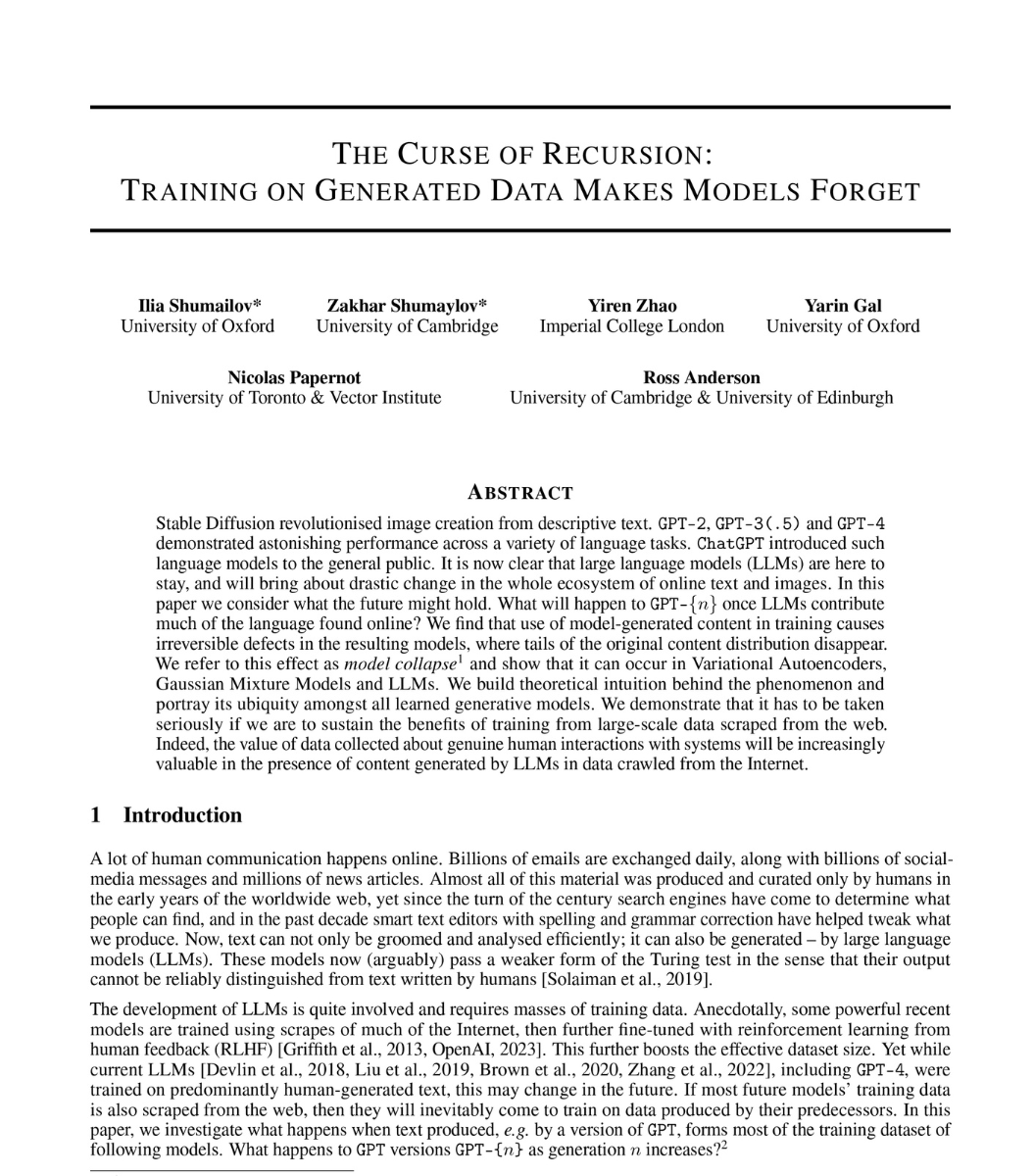
Researchers at Oxford and Cambridge published a paper in Nature proving what is happening. They call it Model Collapse.
Here is the mechanism in one sentence. AI trained on AI-generated data gets dumber every generation until it forgets what real human data looked like.
The internet is filling with AI-generated content. Blog posts. Articles. Reviews. Comments. Social media. AI companies scrape the internet to train the next generation of models. Which means the next generation of AI is being trained on the output of the current generation.
Each cycle loses information. Not randomly. It loses the rarest, most unusual, most creative parts first. The researchers call these the "tails of the distribution." The weird ideas. The unexpected perspectives. The things that made the internet feel human. Those disappear first.
What remains is the average. The safe. The expected. The bland.
Then the next generation trains on that. And loses more. And the next generation trains on that. And loses more. The researchers proved this is not a slow decline. Major degradation happens within just a few iterations. Even when some of the original human data is preserved.
They tested it on large language models. On image generators. On statistical models. The pattern was the same every time. The output converges toward a narrow, flattened version of reality that looks nothing like the original data.
The lead researcher put it plainly. "Large language models are like fire. A useful tool. But one that pollutes the environment."
The pollution is invisible. You cannot see which sentence on the internet was written by a human and which was written by AI. Neither can the AI that is about to train on it. And once the tails are gone, they do not come back. The damage is irreversible.
This is not a prediction anymore. It is a diagnosis.
The internet you grew up on was built by humans writing things no algorithm would have written. Strange, personal, imperfect, alive. That internet is being diluted. One generation of AI at a time. And the models trained on what remains are learning a smaller and smaller version of the world.
Model Collapse is not a technical problem. It is a cultural one. The thing that made the internet worth reading is the thing that disappears first.
11