Summary of the
#Southport Public Inquiry findings (Phase 1 report) regarding Axel Rudakubana that have NOT featured prominently in recent news coverage, including its criticism of
@X:
1. Rudakubana’s Religion and Background
British-born Rudakubana came from a Christian family with evangelical ties.
Despite the tsunami of disinformation and divisive speculation that immediately followed the abhorrent attack, often claiming or strongly implying he was a Muslim and/or an asylum seeker, the inquiry explicitly found that he was NOT Muslim and was NOT motivated by any religion, racial hatred, or coherent ideology.
2. Speculative Misinformation and Disinformation
The inquiry noted that the failure by authorities to release adequate and timely information in the immediate hours and days after the attack created an information vacuum.
This vacuum was quickly filled by false speculation, misinformation and disinformation online (including numerous claims that the attacker was a Muslim asylum seeker), which fuelled the violent riots and public disorder that followed, but the Inquiry’s core focus and detailed findings remained on preventing the attack, not on the riots/disorder.
While the Inquiry report does not provide a detailed analysis of how misinformation spread on X after the attack, name specific influencers, quantify impressions/views, or examine algorithmic amplification, and stopped short of recommending specific changes to X’s policies, it is worth reminding ourselves of some of the more high-profile contributors to misleading information and disinformation, all of whom used X to spread their misleading and speculative messaging:
—Andrew Tate (misogynist and officially and publicly since his 2022 conversion to Islam, a Muslim) explicitly claimed the attacker was an “illegal/undocumented migrant” who had “arrived by boat” and was “straight off the boat.” He posted videos urging people to “wake up” and framed it as “invaders slaughtering British daughters.” His were among the most widely viewed claims.
—Tommy Robinson (mutiply convicted violent far-right criminal Stephen Yaxley-Lennon), strongly amplified the narrative linking the attacker to Islam and migrant violence. He stated that the riots were “justified in their anger,” claimed there was “more evidence to suggest Islam is a mental health issue than a religion of peace,” accused authorities of a cover-up, and railed against “hostile, violent, aggressive migrants.” He helped spread and endorse the false “Muslim asylum seeker” framing.
—Nigel Farage (GB News presenter, Reform UK leader, and MP), who did not directly call Rudakubana a Muslim asylum seeker but questioned whether “the truth is being withheld from us” by police, implying the attack may be terror-related. Critics accused him of fuelling conspiracy theories and acting as “Tommy Robinson in a suit,” which helped legitimise the misinformation wave.
—Darren Grimes (former GB News presenter) criticised calls for more refugees on the same day, strongly implying the attack was linked to migrant/refugee issues.
—Laurence Fox (former GB News presenter, Reclaim Party leader), who echoed claims about biased policing and narratives surrounding the attacker’s background.
—Katie Hopkins (far-right YouTuber), who amplified speculation tying the attack to immigration and Islam.
These misleading and false claims (often including the fabricated name “Ali Al-Shakati”) spread rapidly and contributed to the riots.
3. Ideology and Obsession with Violence
The attack was not classified as terrorism due to the absence of any ideological driver.
In the UK, under the Terrorism Act 2000, an incident is only legally classified as terrorism if the violence is not only designed to influence the government or intimidate the public, but is also carried out for the purpose of advancing a political, religious, racial, or ideological cause.
When there is no clear ideological driver (as in the Southport case), even horrific mass violence is prosecuted as murder or other non-terrorism-related offences rather than terrorism, even if the public perceives it as terror-related.
With the rise of extreme violence without a clear ideological motivation, perhaps we need to revisit this definition of terrorism.
Rudakubana was not motivated by a clear ideology, but had a profound “obsession with violence” and accessed vast amounts of extreme, graphic content, which included:
—Nazi-related material (documents on Nazi Germany, imagery of victims and mass graves, antisemitic material, and references to Adolf Hitler);
—Anti-Islamic material (voluminous and highly offensive content targeting Muslims);
—An Al-Qaeda training manual (downloaded years earlier);
—Documents and images relating to genocides (including the Rwandan genocide linked to his parents’ background), wars and conflicts (Chechnya, the Zulu War, Somalia, Sri Lanka, etc.), torture, slavery punishments, beheadings, and other atrocities.
All of this reflected an indiscriminate fascination with killing, genocide, and extreme violence across ideologies, eras, and cultures, and NOT a coherent belief system.
4. X’s Reluctance to Cooperate
Rudakubana maintained multiple accounts on X (formerly Twitter) and had a pattern of searching for and viewing graphic violent content.
According to the Inquiry report, Rudakubana, then 17, was able to circumvent age restrictions on X because in mid-2024, the platform only asked users to enter a date of birth without further age checks. On X, the video was marked “sensitive”, a label that meant it should only be viewed by users who indicated they were over the age of 18.
After the Wakeley attack, Australia’s eSafety Commissioner issued a takedown notice to X to remove tweets with videos of the attack. The company made the posts inaccessible in Australia, but decided to continue hosting the footage in other parts of the world. X later said it was “heartened to see that freedom of speech has prevailed”, after eSafety dropped its case over the matter in federal court about one month before the Southport attack.
The Inquiry found that Rudakubana likely “viewed the actual footage of the [2024 Wakeley Sydney church] stabbing” minutes before carrying out his attack.
“It is both sobering and concerning that almost the last thing that [Rudakubana] did before committing these dreadful crimes was to search for and probably view material on X in relation to a stabbing carried out by another boy aged under 18,” inquiry chair Sir Adrian Fulford wrote.
The platform initially identified only a few linked accounts before later providing details on more. His broader online activity on X and other platforms fed his unhealthy fixation.
Musk’s influential social media platform refused to disclose message content without a legal order and was slow to provide other data (e.g. date of birth).
An executive even defended not removing the “horrific” stabbing video Rudakubana had watched, describing removal as potential “tyrannical overreach,” imho reflecting Elon Musk’s infantile and irresponsible free-speech absolutist approach.
Fulford concluded that X’s unwillingness to remove posts that included video of “the most graphic part” of the 2024 stabbing, while not illegal in the UK, was “deeply regrettable”.
The Inquiry report also noted that “X has shown no signs of any self-critical reflection” for how easily the perpetrator was able to bypass its age restrictions, and criticised the company for its late disclosure of data and for not showing “the same ready willingness to co-operate with the Inquiry as almost all other organisations”.
5. Overall Context
The inquiry concluded that the July 2024 attack could and should have been prevented due to multiple systemic failings, including poor information-sharing, inadequate scrutiny of his online activity, and over-reliance on his autism diagnosis, as well as parental shortcomings.
The family was aware of his possession of weapons, attempts to produce ricin, and violent online behaviour but failed to intervene decisively.
These aspects of the report are what most mainstream news media have focused on, with varying degrees of emphasis.
Rudakubana was ultimately portrayed as a “violence-obsessed” loner rather than an ideologue of any kind.
6. Conclusion
The uncomfortable truth is that genuinely “protecting our children” requires more than rhetoric: it demands a coordinated, professional, and properly funded system.
As the Southport Inquiry put it, a “joined-up, well-resourced” approach.
That means sustained investment in essential public services: policing and security, child protection, education, mental health support, and early intervention.
These systems only work when they are adequately staffed, properly connected, and consistently funded.Yet many of the same voices who shout loudest about “protecting our children” also push for significantly lower taxes, often citing the misleading claim that Britain is already a “high-tax, high-welfare” society. That claim does not hold up to scrutiny.
Compared to most Western European countries, the UK has relatively lower taxes and less generous welfare provision, and it frequently underperforms on key child and family outcomes. This narrative is often used to justify cuts and resist strengthening public services.
Effective child protection cannot be delivered on the cheap. Repeated inquiries, including Southport, have shown how under-resourcing and poor coordination lead to preventable failures.
That said, (and I am certainly no ‘centrist dad’) the answer is not simply to spend more at any cost. Better results also require smarter priorities, less bureaucracy, a stronger focus on prevention, and economic growth that expands the tax base over time.
But the core reality remains: you cannot meaningfully strengthen child protection while simultaneously demanding deep tax cuts without accepting serious trade-offs.
Any honest debate about safeguarding children must confront that simple fact.
Sorry Elon, your argument is simplistic, incomplete, and thus misleading. Democracy rests on the bedrock principle of popular sovereignty, meaning that ultimate power resides with the people.
For this power to be meaningful, citizens must be able to speak freely, debate ideas, and challenge authority. Free speech is the mechanism that enables active participation in governance.
While this right is not absolute in any democracy, and in practice is limited when it causes serious harm or threatens the system’s stability, it remains the prerequisite for any legitimate democratic agency.
Alongside sovereignty and speech, democracy depends on a shared commitment to a broadly verifiable reality. While perspectives and interpretations naturally differ, a functioning society requires a common basis for judging what is true in law, science, and public social and economic policy.
Without this shared informational foundation, public debate becomes vulnerable to manipulation, and citizens lose the capacity to make the informed decisions necessary for self-rule.
In this context, Elon Musk represents a particularly salient modern risk to democratic systems. As the owner of X, one of the most influential platforms for political communication, he exercises significant influence over the flow and visibility of information.
This concentration of communicative power sits uneasily with popular sovereignty, as the digital spaces where citizens form opinions are increasingly shaped by the decisions of a single private actor.
This influence complicates the operation of free speech in practice. Platform design and algorithms do not simply permit expression; they structure its reach, shaping which voices are amplified and which remain less visible.
In this sense, the conditions under which citizens encounter and evaluate ideas are now much less neutral in many democracies, and due largely to the concentration of media ownership, mediated in ways that can subtly influence public discourse.
Most critically, this concentration of power bears on the condition of truth itself. Changes to moderation, verification, and content dynamics on such a platform can affect the balance between reliable information and misinformation, placing strain on the shared reality upon which democratic deliberation depends.
When that shared reality is weakened, the ability of citizens to exercise meaningful self-rule is correspondingly diminished.
Musk (along with the more traditional long-established media barons) represents the convergence of vast economic power and control over the infrastructure of public discourse.
Crucially, this power operates in limited or indirect accountability compared to public institutions, as it lacks the checks and balances that constrain public authority.
When the digital architecture of the public square is held mainly by private interests, democratic oversight is weakened, exposing a structural vulnerability in which the foundations of self-governance are increasingly shaped by private power that lacks direct democratic accountability.
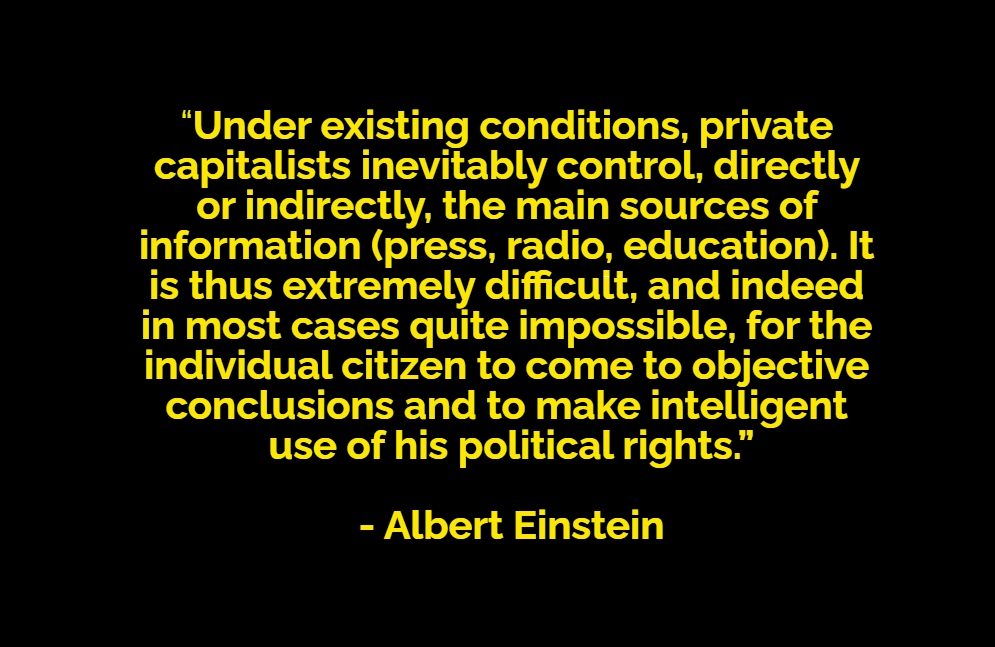
Here is what an actual genius said about the concentration of sources of information back in May 1949: