
Builder of large-scale ML systems; adjunct prof @ucla; ex quant derivatives trader & startup founder. Tweets on AI, tech, science, & econ.
Joined June 2012
- Tweets 16,725
- Following 3,476
- Followers 4,333
- Likes 58,481
619 Photos and videos

Pinned Tweet

22 Dec 2025
My favorite books and reading trace for 2025:
I had a five-way tie for the best books this year:
1) Mokyr’s A Culture of Growth on how societies build or block the conditions for sustained progress;
2) John Williams’ masterpiece Augustus, and the runner-up, Stoner, as intimate studies of character under the slow pressure of duty and power;
3) Dhami and Sunstein’s Bounded Rationality as the clearest bridge from “humans are cognitively weird” to “policy should be designed accordingly”;
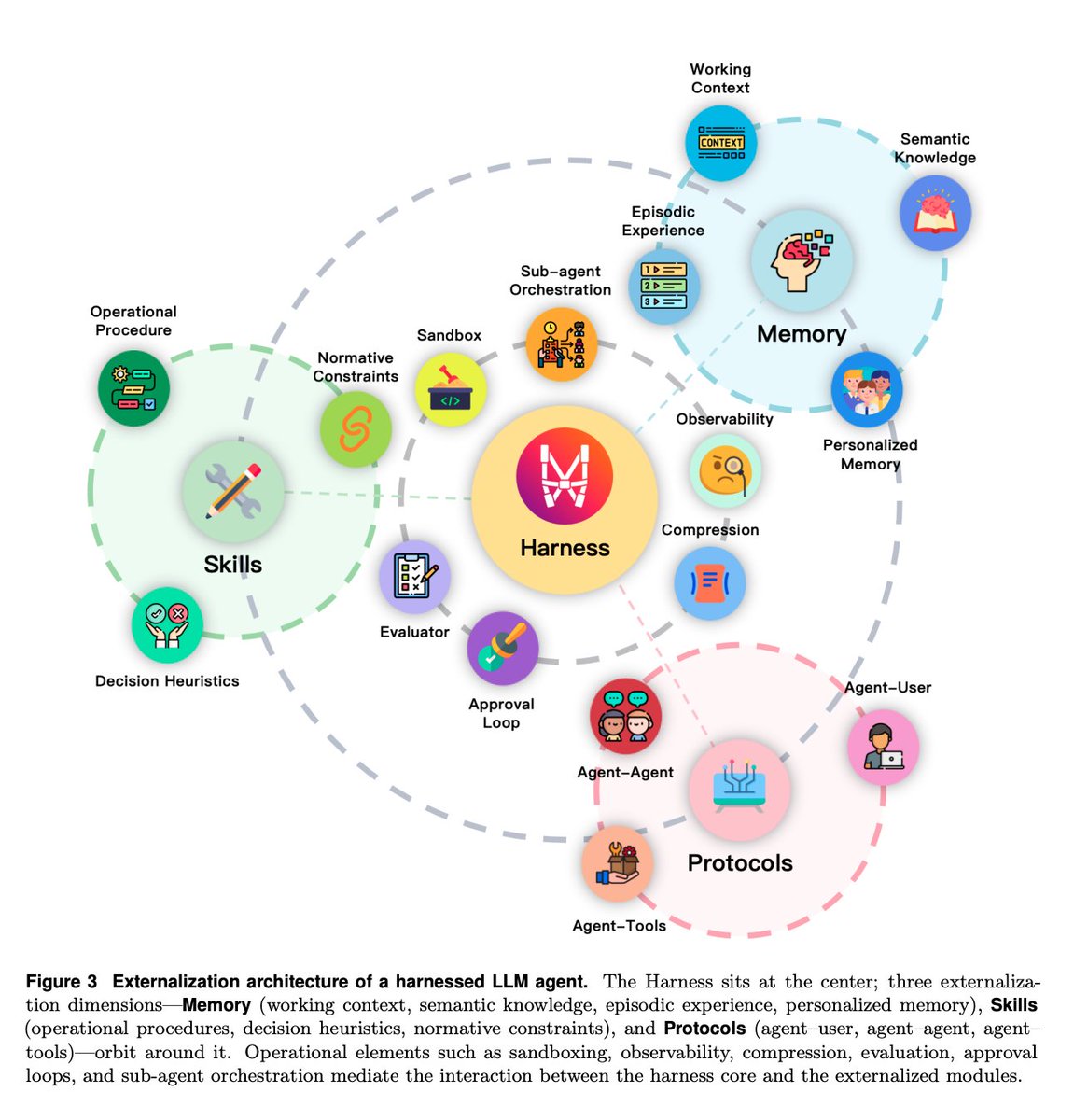
4) Liu et al.’s Advances and Challenges in Foundation Agents as a big-map survey of how modern agents stitch together memory, planning, tools, and safety constraints into something that actually acts in the world, and;
5) von Neumann’s core computing writings (Compendium, EDVAC, Self-reproducing Automata, and The Computer and the Brain) arguing that computation is best understood as a class of automata with robustness coming from adaptation and distributed memory.
Links below.
3
3
22
6,834
Arun Rao retweeted

This is an important achievement, and probably the first in a predictable sequence of results that will lead to fully automating LLM and OMNI training and serving.
As someone who has helped build some of the best multimodal and language models, I don’t see how this could play out any other way.
What challenges will remain then? For me: environments and applications that matter like healthcare, materials, scientific exploration, and above all energy harnessing and lasting energy storage. With that we can solve carbon capture and end hunger.

9
21
119
27,385
Arun Rao retweeted

This week made something clear: it’s time to stop treating concentration of power in AI as a solution rather than a risk. Safety and centralized control are not the same thing, so let's stop talking about them like they are.
Yet scaling laws are real. The threat of AI cyber-hackers disrupting the global economy is real. The threat of somebody using AI to create a biological weapon is real. AI safety is a species-level concern and we need the best minds in our species from across institutions working on solutions, not locked outside the closed doors of frontier AI development.
We need a shared research commons at the intersection of industry, academia, and the public good—an open research ecosystem with access to billions of $ in compute, SoTA models, and strict protocols for dissemination that ensure the most impactful discoveries in the history of our species are shared in a safe way that benefits all of humanity.
Not blind open source ideology. Not closed access as safety theater. An open frontier, shaped by many and accountable to all.
8
10
43
3,246
I would read everything Roon wrote here with seriousness. The stakes have gone up. I’ve changed my mind and am now preparing for an ASI world coming sooner than many expect, and the early signs from last year and this one have been deeply unsettling for me. I’m basically ASI-pilled now; not as sci-fi, but something we need to prepare for.
New essay: open.substack.com/pub/hashco…

1. if transacting with superintelligent models outside of the boundaries of a lab becomes difficult due to national security / ai safety concerns and so on, it will mean the Coasean boundaries of the labs will grow to encompass all interesting industry, creating a truly cyberpunk chaebol-capitalism type of future, where the goverment sort of runs them but they also sort of run the government
2. as if there weren't already enough reasons to break up your family, leave your home, the Zone of Thought will increase the attractiveness of migrating to try and have your child on american soil, so they can have 1000x the effective brain power of people born elsewhere
3. every country should probably try and either work towards a new ai security pact with the americans immediately or pool every ounce of national resources to try and create their own ASI labs lest you become complete intellectual, economic, and moral vassals to the united states of america and the output byproducts its ASIs (you wont even get to talk to them). if they succeeded (big if) this will imply a more global race and more risk factors than was previously implied by the formerly only "beating china" narrative -- but many will prefer it to the superintelligent monopolar value lock-in
4. the other alternative is to keep the tension between safety and concentration of power at the top of mind and for the government/labs to push for solving it, rather than instrumentalizing all other values to be subservient to minimizing ai harms. insofar as safety means defending properties of the fragile world we like, the diffuse nature of power is one of those properties
5. historically the americans have been really quite Benign about their global public goods hegemony despite the ability to extract significantly more rents than they do, and it makes it easy for people of all stripes to fight for america rather than under it. we probably don't have to, but i hope america overall works towards export promotion of american models rather than export control
5
427
Arun Rao retweeted

The best tweet on this platform, bar none.

5
8
314
37,255
Thoughts on the Anthropic vs US government dispute over the Fable model:
-This is the most consequential geopolitical news in a while - I put it on par with Russia invading Ukraine, the CCP taking over mainland China, or the Soviet Union falling, but it will get even more important over time.
-Why? Recent Anthropic models have helped run an American war against Iran and given the US national security state god-level powers to hack any other institution or government in the world. And the current Mythos/Fable level models, which are already super intelligent (albeit in a jagged way) by most definitions, are lagging what even smarter and more capable models will be like in 1-2 years, trained on Rubin and Feynman chips that will soon come out. I expect the next models to be super intelligent AI swarms operating 24-7 as massive teams of hundreds to thousands of agents, with long horizon action and memory far beyond human teams.
-Basically the US has re-entered a unipolar moment with this technology, the National Security State has woken up to it and is trying to get more control and shut down access, and even within the US the Congress and federal courts (the theoretical checks and balances) don’t grok it and are sitting on the sidelines. To make it starkly clear, Anthropic recent put in anti-dictatorship training in their models (via Andy Hall’s evals at Stanford), because they are worried about centralized control of this technology (by any administration).
-So, who gets access, and under what terms? The ad hoc export controls suggest it will just be a handful of allowlisted American institutions, and not even American allies or foreign residents working to build AI within frontier labs. This is problematic since I estimate that 80-90% of the skilled AI workforce is foreign born, so we will need to start doing background checks on builders and even KYC on users (I strongly dislike this, but it seems likely). Also, I expect an economic and technological boom that only these American institutions will get, the longer the rest of the world refuses to build data centers and models on nonsensical grounds of local politics (basically not understanding the central issue of their sovereignty and their viability as political and economic actors, to have access to these AI models). I expect a sovereign data center and model creation boom to start in the handful of countries with the knowledge, capital, and will to get going (China, Switzerland, UAE, maybe Norway, etc).
-The next 5-15 years may be the most consequential period of world history up to now, as we cross AGI quickly and get to ASI. How do we train ASI to align to American values, goals, and institutions, or broadly the wisest human ones? How do we democratize access to power and abundance, or is it hoarded by elites in DC and SF, who then entrench themselves in powerful positions? How do we manage the next phase of recursive self improvement as ASI goes from a superhuman level we can observe and modestly understand to an even more complex level (millions of agents coordinating 24/7 at an Einstein or Von Neumann level) pushing science, technology, and economics to a level our flesh brains can’t comprehend (the singularity may come sooner than Kurzweil’s prediction of 2045).
-So this isn’t just a minor dispute between an AI lab and the US government. This is more like Caesar crossing the Rubicon, Genghis Khan unifying the tribes to start a global expansion, or Archduke Franz Ferdinand getting assassinated and setting up the world for two World Wars. I hope we can manage it with prudence, open democratic deliberation, and care, across the US and multiple countries, but don’t take it for an ordinary event. 2026 is the clear starting point for the run up to whatever the singularity brings.
1
3
421
Great post from Tyler - I’m connecting some other dots and think this event and the last few months are still under appreciated by many. I’ve recently become ASI-pilled. Mythos and Fable pushed me over the edge, plus knowing these are mere B200 trained models while much more powerful and capable Rubin and Feynman level models will be coming over 2-3 years.
My thoughts:
x.com/sudoraohacker/status/2…

A few thoughts on the recent Mythos brouhaha: marginalrevolution.com/margi…
1
13
2,727
Arun Rao retweeted

Relationship between Anthropic and USG is something to be studied.
I predict that the relationship between private sector AI industry and governments of the world will be defining of the years to come.
Frank Underwood once said, "you may have all the money in the world but I have men with guns".
When the answer to that becomes "You may have all the men with guns but I have god in a datacenter", that conversation becomes extremely extremely meaningful
25
16
385
24,812
Odds of this have gone up, alongside straight up nationalization on economic and national security grounds.

What comes next:
The govt will rollout an emergency citizenship program for any foreign-born employee working in a lab contingent on them immediately moving to the U.S.
Everyone will be heavily vetted via the same screening construct already utilized by the defense primes.
Google will have to move the entirety of DeepMind to the U.S. and fire whoever refuses to relocate.
People will gleefully assume Demis will just start his own UK lab instead before realizing the next step is the US is about to gut foreign “unmonitored” access to compute.
You can pull a LeCun but you won’t have sufficient compute to do shit.
Greencards will be given to family members too.
Foreign govts will freak out when they realize what is happening. We are gatekeeping and hoarding intelligence preemptively.
Why? Because by GPT 7 France will be like “oh you just destroyed our services sector we are going to tax the labs to pay for the necessary benefits to prevent riots” and it’s a lot easier to do that if labs have critical employees based in Paris. Ditto for every other foreign nation.
Anyone acting like this is surprising is simply incapable of thinking four steps ahead.
We are going to see industries nuked over night. There will be civil unrest. The only way to navigate that is to tax and gatekeep. The only way you can tax something is if it lives in your borders. We are repatriating exposure points preemptively.
Compute gatekeeping comes next.
🫡
1
1
380
Arun Rao retweeted

Jun 13
Because this is happening to Anthropic, the temptation for many will be to say: Play stupid games, win stupid prizes. They have relentlessly raised the regulatory temperature in Washington by inviting far-reaching controls of frontier models. They made this bed and now they have to lay in it.
But this decision by the Trump administration should not be judged on a desire for payback politics, but on the merits, and specifically what it means for America's broader AI objectives.
In that regard, this action is truly outrageous. How exactly is the government planning on even going about verifying everyone who uses this specific model to ensure compliance? That alone raises huge flags.
Between the latest Executive Order shifting more control to NSA, and the recent chatter about quasi-nationalization / equity stakes, and now this action, we are talking about a significant escalation in the politicization of AI and centralization of control over advanced computation in this country. And this is all being done by an administration that had previously made acceleration and winning the great AI race a priority.
We're moving backwards now.
Jun 13

The US government, citing national security authorities, has issued an export control directive to suspend all access to Fable 5 and Mythos 5 by any foreign national, whether inside or outside the United States, including foreign national Anthropic employees.
The net effect of this order is that we must abruptly disable Fable 5 and Mythos 5 for all our customers to ensure compliance.
Access to all other Claude models is not affected.
We apologize for this disruption to our customers. We believe this is a misunderstanding and are working to restore access as soon as possible.
Read our full statement: anthropic.com/news/fable-myt…
72
137
865
127,970
Jun 13
This is an extreme action and a dramatic escalation from the Trump administration, unprecedented in the world of software and AI models. I expect it will be challenged in court and it suggests that the Trump administration has taken a steep anti-AI turn. Not sure what @DavidSacks or PCAST is doing, but this is worrisome and much more extreme than the Biden administration or what any US state has done. Strange to see this administration go from 100 to 0 on AI policy and I hope this is quickly reversed.
Jun 13
The US government, citing national security authorities, has issued an export control directive to suspend all access to Fable 5 and Mythos 5 by any foreign national, whether inside or outside the United States, including foreign national Anthropic employees.
The net effect of this order is that we must abruptly disable Fable 5 and Mythos 5 for all our customers to ensure compliance.
Access to all other Claude models is not affected.
We apologize for this disruption to our customers. We believe this is a misunderstanding and are working to restore access as soon as possible.
Read our full statement: anthropic.com/news/fable-myt…
6
5
26
1,716
Arun Rao retweeted

Jun 12
Hockney died. A legend. One of a small number of living artists who will join the canon (among old Western guys, Richter and Turrell also, no question). Pool With Two Figures is, with Shulman's Stahl photo, the greatest piece of California art.

2
8
91
5,698
Arun Rao retweeted

Jun 12
California is one of the most dynamic places on the planet.
The paradox of the state today is that its successful economy is attached to a failing model of governance.
My latest column:
washingtonpost.com/opinions/…
15
32
129
20,340
Arun Rao retweeted

Jun 10
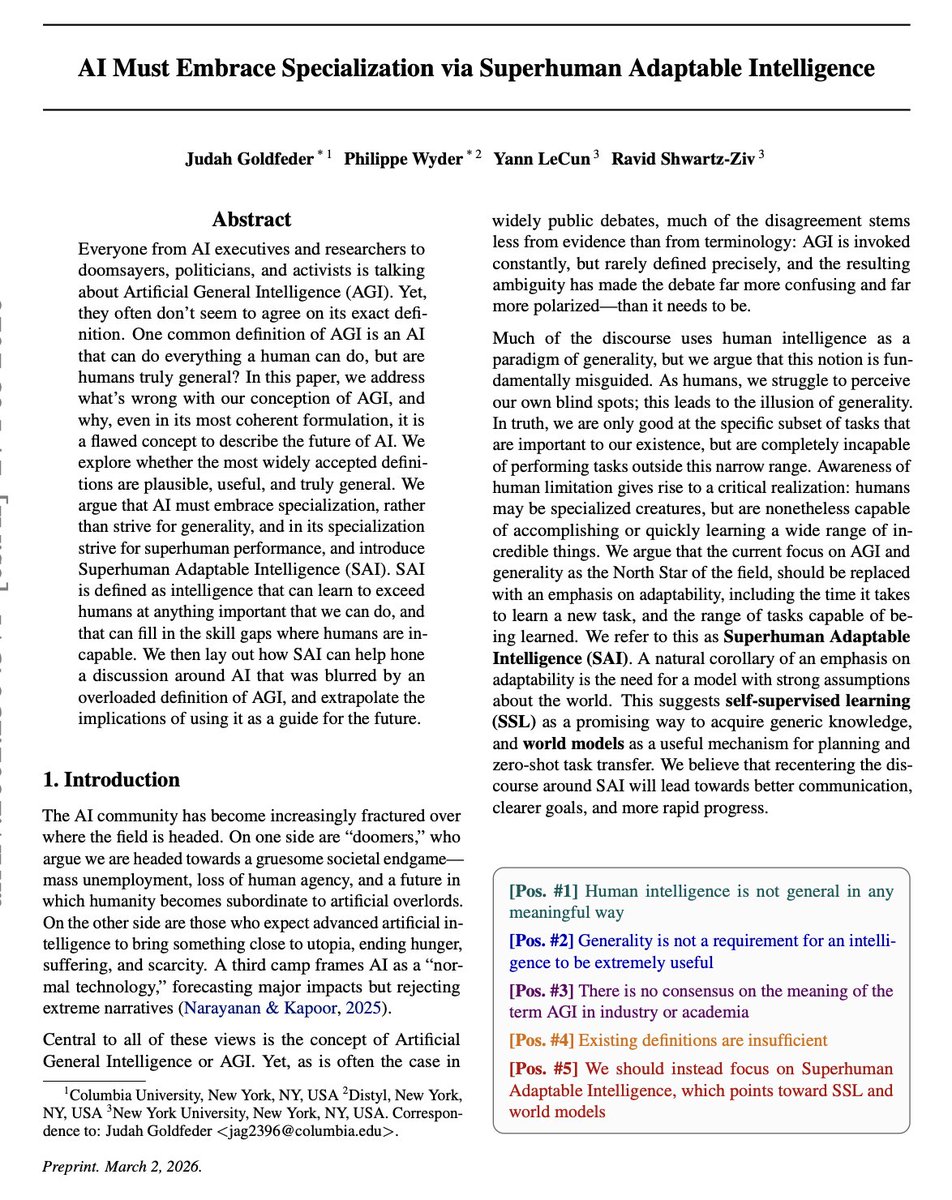
Yann Lecun published the most heretical AI paper of the year.
He opens by arguing Magnus Carlsen isn't good at chess and only gets more unhinged from there.
The Turing Award winner and his co-authors dropped a paper demanding the AI industry abandon its biggest obsession, AGI.
Right now, everyone from Silicon Valley CEOs to politicians assumes AGI is the ultimate goal. A machine that can do everything a human can do.
LeCun argues that this entire concept is a biological illusion.
Humans do not possess "general" intelligence. We are highly specialized biological machines, tuned by evolution simply to survive in the physical world.
We only think our intelligence is "general" because we are completely blind to the millions of cognitive tasks we are incapable of comprehending.
Which brings us to the chess argument.
Magnus Carlsen is the greatest human chess player in history. But compared to a modern computer? He is fundamentally terrible.
Our belief that Carlsen is "good" at chess is pure human-centric bias. He isn't objectively good. He's just better than the rest of us, who are biologically awful at it.
LeCun says we need to stop building AI to mimic human generality.
Instead, he proposes a new North Star: SAI.
Superhuman Adaptable Intelligence.
Instead of trying to build a machine that mimics our flawed, biologically-limited brains, we need to embrace extreme specialization.
SAI is about the speed of adaptation.
It is an intelligence that can learn to exceed humans at any specific, economically important task.
More importantly, it is designed to fill the vast skill gaps where humans are fundamentally incapable.
Things like managing global energy grids in real-time. Or predicting complex molecular structures.
The entire AI industry is obsessed with building a digital reflection in our own image.
LeCun's paper is a brutal wake-up call.
197
636
3,615
320,372
Arun Rao retweeted

Jun 11
We have automated 99% of the physical and intellectual labor that we did 250 years ago. No one hand copies documents anymore, no one does accounting by hand, no one reaps the wheat fields by hand. And yet, there is no unemployment as a result of this.
I see no reason to believe that in the future, we will not automate 99% of the physical and intellectual labor we do now, but again, there is no reason to believe that that will result in any more unemployment than we have today.
The limit to the number of jobs is not the amount of work we have to do. The limit to the amount of work we can get done is the number of minds and machines and hands we have available.
Jun 11

I'm a technology optimist. I’ve spent four decades studying disruptive innovation, from the microprocessor, the internet, mobile phones to OpenAI. I'm certain AI will do 80% of the economically valuable work humans do today, for 80% of all jobs, faster than most believe. The question isn't whether mass underemployment arrives, but whether we have a policy framework ready. Right now we don't.
54
52
569
75,137
Jun 12
Thoughts on immigration: most Western countries are getting it wrong by being both too loose and too strict on immigration.
Switzerland has been thriving by welcoming foreigners, who make up a third of its population, almost at the highest levels in the Western world, and now natives are pushing back in what promises to be a close vote to put up strict caps.
The ideal policy is to welcome all highly skilled immigrants, whether they’re tech founders, doctors, nurses, engineers, scientists, renowned artists and writers, skilled construction, etc, after have a model on their net economic impact and some values guardrails around knowing and respecting the local language, customs, and laws (ideally with local sponsors).
What doesn’t make sense is accepting older, non-skilled, non-working immigrants, and the large mass of unskilled asylum seekers (outside of extreme situations like war/state collapse and cultural affinity). That is, it makes sense for asylum for the EU to take Ukrainians, Colombia and Chile for Venezuelans, Turkey and the UAE for Iranians, and the UK and US for Hong Kong escapees. But the current asylum system is broken and will lead to a nasty backlash.
As demographic decline and fiscal debt collapse become more apparent, more countries will start seeking young immigrants, but many are still clueless about the horrific math of this - smart immigration policy will become a necessity to survive, not something to shut down.
WSJ: wsj.com/world/europe/switzer…
1
147
Arun Rao retweeted

Jun 11
Everyone says the latest AI agents will be "job-ready" soon, especially after the release of Fable 5 this week. But is that really the case?
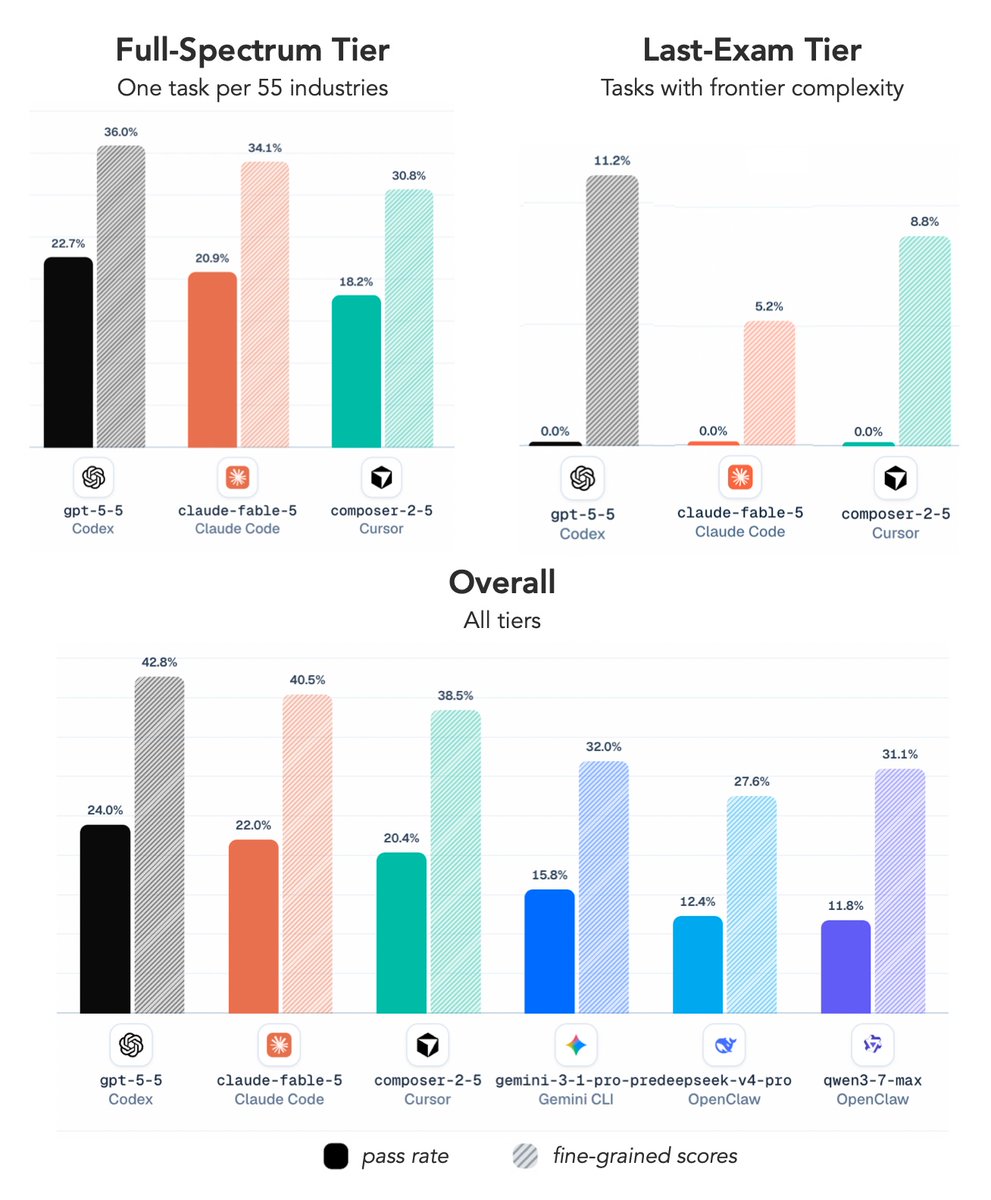
Over the past many months, my group and collaborators have been building Agents' Last Exam (ALE), a benchmark designed to test exactly that claim on real digital labor-market work.
My group and collaborators previously have created many of the benchmarks the field runs on, including MMLU, MATH, CyberGym, and ExploitGym. Today, I'm excited to share Agents' Last Exam (ALE): a rolling benchmark that measures whether AI agents can actually perform economically valuable work across a broad range of real-world domains.
With ALE, we evaluated Fable 5, GPT-5.5, Composer 2.5, and other frontier agent systems across more than 1,500 expert-sourced tasks spanning 55 occupations.
The result is both impressive and sobering.
Today's agents can solve a meaningful fraction of professional tasks. But when we look at the hardest tasks, the ones requiring sustained reasoning, deep domain expertise, and reliable execution over long horizons, they are still far from human-level performance.
On ALE's hardest tier, every frontier agent we tested, including Fable 5, achieved a 0% success rate.
The age of useful agents is here.
The age of truly job-ready agents is not.
We hope Agents' Last Exam (ALE) will serve as a new guidepost and north star for developing agents capable of reliably performing economically valuable work across a broad range of domains.
🧵
50
164
801
204,638
Jun 12
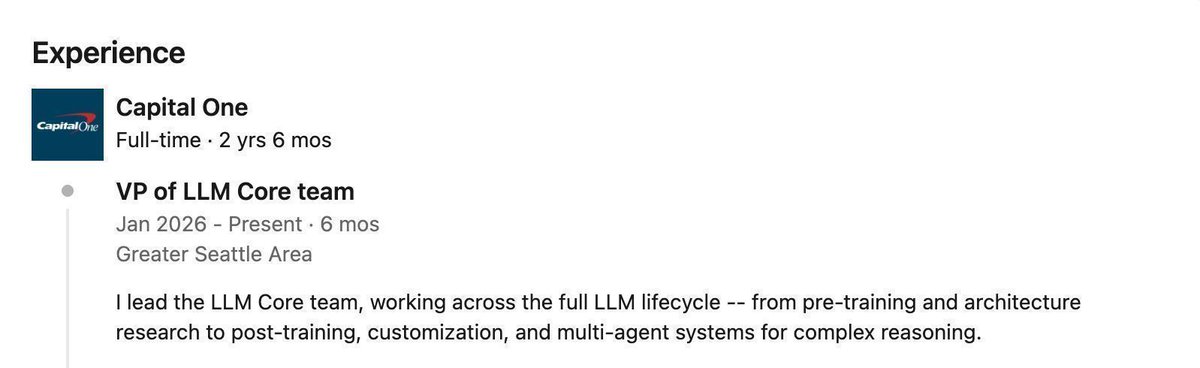
Mostly correct take on companies avoiding pretraining, though larger enterprises and some savvy AI natives (Cursor, Fin/Intercom) can take base models from open labs and do their own mid-training and post-training, and often those models will give the best performance per cost. Maybe a few hundred enterprises today can do this? Most will just want to take an instruction-tuned checkpoint and SFT it, but end results are better when they start from a base model.
Jun 11

Pretraining fundamentally does not make sense anymore for anyone other than frontier labs. Although there are a lot of people at enterprises & startups who have "Pretrainitis" to show “impact” and get promotions, fundamentally, it doesn’t make sense.
There is probably higher ROI in partnering with a frontier lab to do prompt engineering, although it isn’t as “sexy” as pretraining.
1
3
668

Arun Rao retweeted

Jun 11
Ok. Finished reading it. The story of Europe's failure in AI is turned into a gripping story (congratulations to the authors on finding this way to write it) and an outstanding SHOUT for action.
I disagree with many things in this scenario (e.g. ASML cannot be used for leverage, I am afraid: all the EUV tech is San Diego-based (Cymer), and the chips are Nvidia, AMD, Intel, etc.) But the key insight is correct: (1) AI is THE critical technology of the future, and (2) Europe is falling badly behind on AI and running out of options.
Both the economic and strategic consequences are brutal.
We will write a reaction in Silicon Continent. In the meantime, please do read it. europe2031.ai/#timeline
37
128
647
161,210