
Joined February 2011
- Tweets 211,814
- Following 5,008
- Followers 11,312
- Likes 57,358
32 Photos and videos






Pinned Tweet

Feb 21
My statements about transparency can be summarized as:
In the presence of transparency, buyer and seller can Trust, but Verify the stories told by the issuer/Wall Street.
They have the info they need to assess the risk/reward/value of a security. Their independent assessments are close enough so they are willing to engage in a trade without any governmental assistance even during a financial crisis.
Worth repeating: trading in markets with transparency doesn't freeze.
In the presence of opacity, buyers and sellers cannot Trust, but Verify the valuation stories told by the issuer/Wall Street.
When the valuation story told by Wall Street is called into doubt, buyer and seller assessments can be so far apart no trade is possible and the market freezes. Government intervention is required to "unfreeze" the market.
Perhaps more importantly, to the extent owners of opaque securities can, they "run" to get their money back when the valuation story is called into doubt. This is true for all opaque securities.
These observations find their theoretical support in the Information Matrix.
The Information Matrix underlies 100% of finance and most economic theories. These theories don't state their assumption trades happen in the "Perfect Information" quadrant - perfect information here being buyer and seller have the necessary info they need to know what they own.
instituteforfinancialtranspa…
2
3
10
2,562
Richard Field retweeted

Jun 4
White House cheers ADP number, silent on this
Jun 4

U.S. JOBLESS CLAIMS SURGE TO HIGHEST LEVEL SINCE FEBRUARY, SIGNALING SOFTENING LABOR MARKET CONDITIONS.
1
1
16
3,883

This should have changed the trajectory of our relationship…..but it didn’t……and here we are. What do we do next?
Jun 4

A rare photo of the aftermath of the Tiananmen Square massacre of June 4th 1989.

4
4
30
1,120
Tell me more….
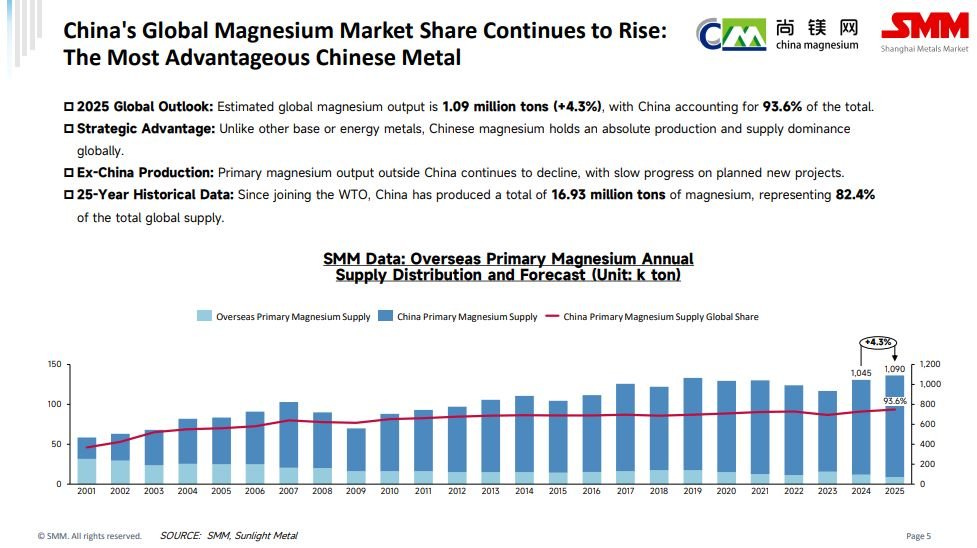
(Narrator: before 2000, the USA was the #1 producer of magnesium….and the most used alloys were developed by Dow Corporation in the 1940s 🤔)
Jun 4

Just over the US-Canada border in Montreal last month, the International Magnesium Association annual conference hosted hundreds of Chinese salespeople marketing their metal to the West.
Bragging about how magnesium is a "Chinese metal", even citing China's joining the WTO as the beginning of their dominance of this insanely important material that underpins trillions of dollars of trade. Our national security impossible without it.
This is the problem we're solving at @magratheametals.
1
7
815
Jun 4
Been talking about how outsourcing high unemployment to other countries is important to China's leadership staying in power ... high unemployment IN China leads to leadership change ...

Thousands of honest workers are losing their livelihoods every single month to a ruthless economic weapon. In an eye-opening analysis for The Atlantic, journalist Michael Schuman reveals how China’s export-driven manufacturing model under Xi Jinping has transformed into a destabilizing global force. Instead of fostering a thriving domestic middle class to buy global goods, Beijing is intentionally flooding international markets with artificially cheap electric vehicles, steel, and solar panels. This aggressive strategy, fueled by massive government subsidies, suppressed wages, and deliberate currency policies, is triggering a wave of "forced deindustrialization" across advanced economies. It is already costing Germany an estimated 10,000 manufacturing jobs every single month and threatening hundreds of thousands of garment workers in Indonesia.
The most tragic irony is that this brutal economic machine is built directly on the backs of suffering Chinese citizens. Xi Jinping's model ruthlessly prioritizes state-backed producers over ordinary consumers, forcing domestic households to effectively subsidize global shoppers while their own quality of life plummets. Domestically, China is trapped in a multi-year economic nightmare characterized by a collapsing property market, fierce job competition, underemployment, and persistent deflation spanning roughly ten quarters. Yet, instead of passing reforms to lift up his own citizens, Xi is doubling down on overinvesting in unprofitable factories to secure global dominance in tech, green energy, and robotics, all to give Beijing strategic leverage to suspend exports and force foreign nations into dependence.
As China’s manufactured goods trade surplus shatters records at a staggering $1.2 trillion, the rest of the world is frantically trying to erect economic defenses. The European Union has already retaliated with heavy anti-subsidy tariffs on Chinese electric vehicles, while leading economists warn of potentially "catastrophic" impacts on American automotive, semiconductor, and robotics industries if overcapacity is left unchecked. Despite these severe warnings, political responses remain dangerously volatile. During a May 2026 summit in Beijing, Donald Trump offered mixed signals by softening his previous tariff stance, calling Xi a "friend," and establishing a "board of trade". Ultimately, unless Beijing shifts away from absolute state control to boost domestic consumption, rampant nationalism and rising global protectionism risk weakening economies everywhere.
#GlobalEconomy #ChinaTrade #Manufacturing #EconomicWarfare #XiJinping #Deindustrialization #TheAtlantic
theatlantic.com/internationa…
1
3
256
Richard Field retweeted
Jun 4
If only someone warned you about what was happening concerning Trump and Albania 2 years ago….
29 Apr 2024

Rama's key supporter, Kastrati, met with Trump about 2 months ago just prior to this investment announcement in Albania. Its in the south near Vlore.
2
5
53
6,179
Richard Field retweeted

Jun 4
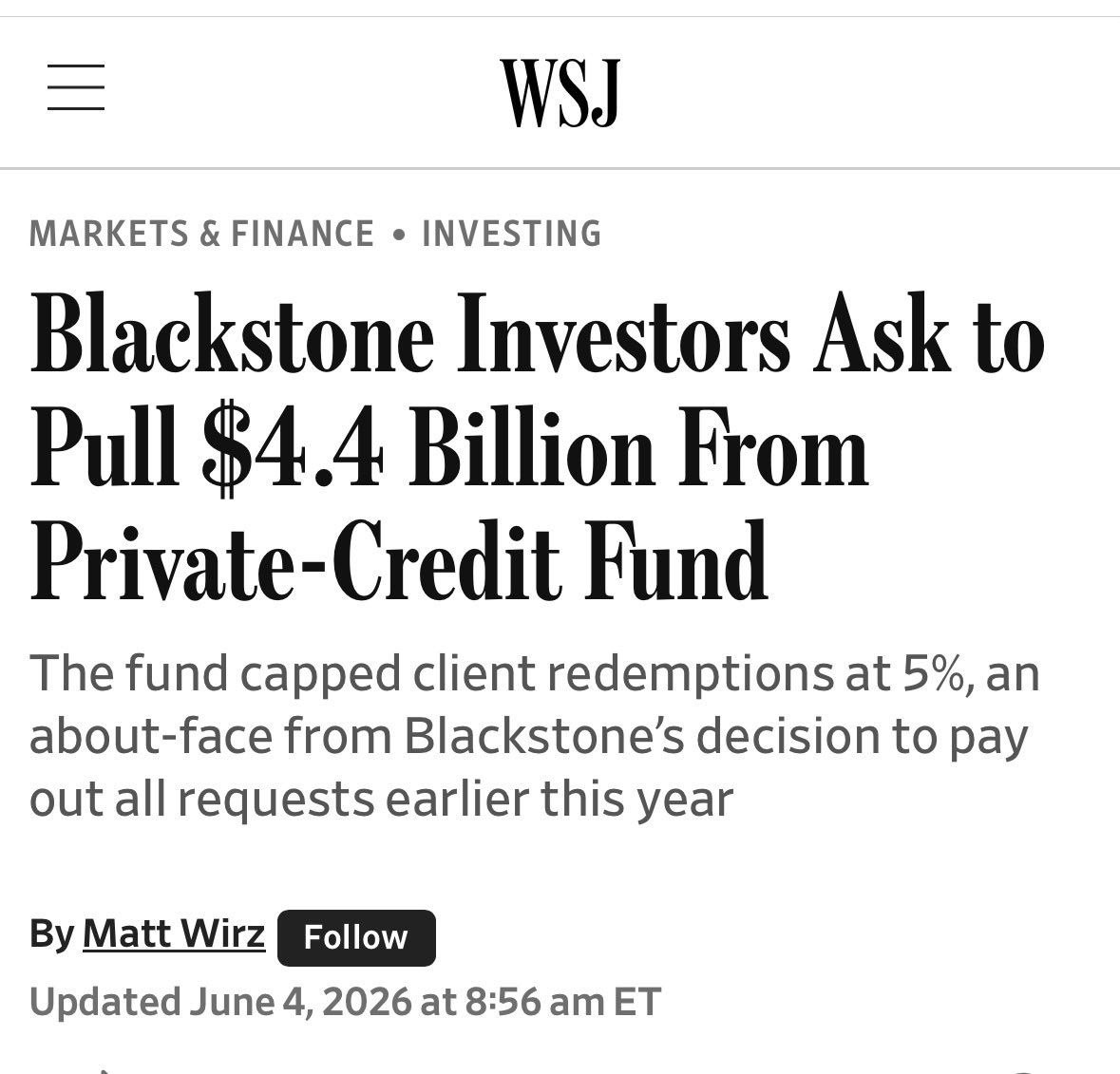
The giant sucking sound of retail money exiting private credit continues..
BCRED: 10% redemption requests, 5% cap
6
12
95
18,605
Richard Field retweeted
Jun 4
Trump threatened tariffs of 10–12.5% on 60 trading partners including the UK, EU, Canada and Australia over alleged forced labour failures, in a move designed to circumvent court rulings that struck down his earlier tariff measures. The EU pushed back, arguing the proposed levies breach a trade deal reached last July.
1
5
32
2,750
Richard Field retweeted

Jun 3
Beige Book: "middle-income households were described as “squeezing more life out of every dollar before deciding to spend it,” and low-income consumers showed greater financial strain."
74
26
212
67,598
Richard Field retweeted

Jun 4
Maybe nationalizing the bubble is a bad idea

"In a lot of ways, companies are losing more money today implementing this technology than they were two years ago," said Goldman Sachs' head of global equity research, Jim Covello. bit.ly/4dXc4x0
10
65
538
28,906
Richard Field retweeted

Jun 3
The federal government just banned bison from public land in Montana.
Not cattle.
Bison.
Interior Secretary Burgum revoked grazing permits for 950 bison
on 63,000 acres of federal land in northeastern Montana.
The reason?
Bison raised for conservation don't count as livestock
under a 1934 law.
Bison raised for meat and milk? Fine.
Bison raised to restore a native species to its native land? Get out.
Meanwhile, cattle ranchers across the West keep grazing on your land.
For $1.69 a month.
One cow. One calf. Thirty days. $1.69.
On land that belongs to every American.
The Cheyenne River Sioux. The Coalition of Large Tribes —
50 Native nations. Defenders of Wildlife.
They all filed formal protests.
They called it exactly what it is.
"DEI for cows."
The bison have until September 30 to be gone.
Who decided cattle belong on public land more than bison do?
#DemsUnited

ALT An elk crosses a winding gravel road through open Montana grasslands at dusk, with several bison grazing in the distance. Rolling hills lead to rugged blue-gray mountains beneath a cloudy evening sky, creating a peaceful scene of wildlife moving across a vast prairie landscape.
382
4,798
8,386
362,229
Richard Field retweeted

Let’s feed them bespoke, complex alts and crypto. Should be fine.

Americans' financial literacy slumps to a 10-year low, new study finds. cbsn.ws/4uM24Oo
1
5
857
Richard Field retweeted

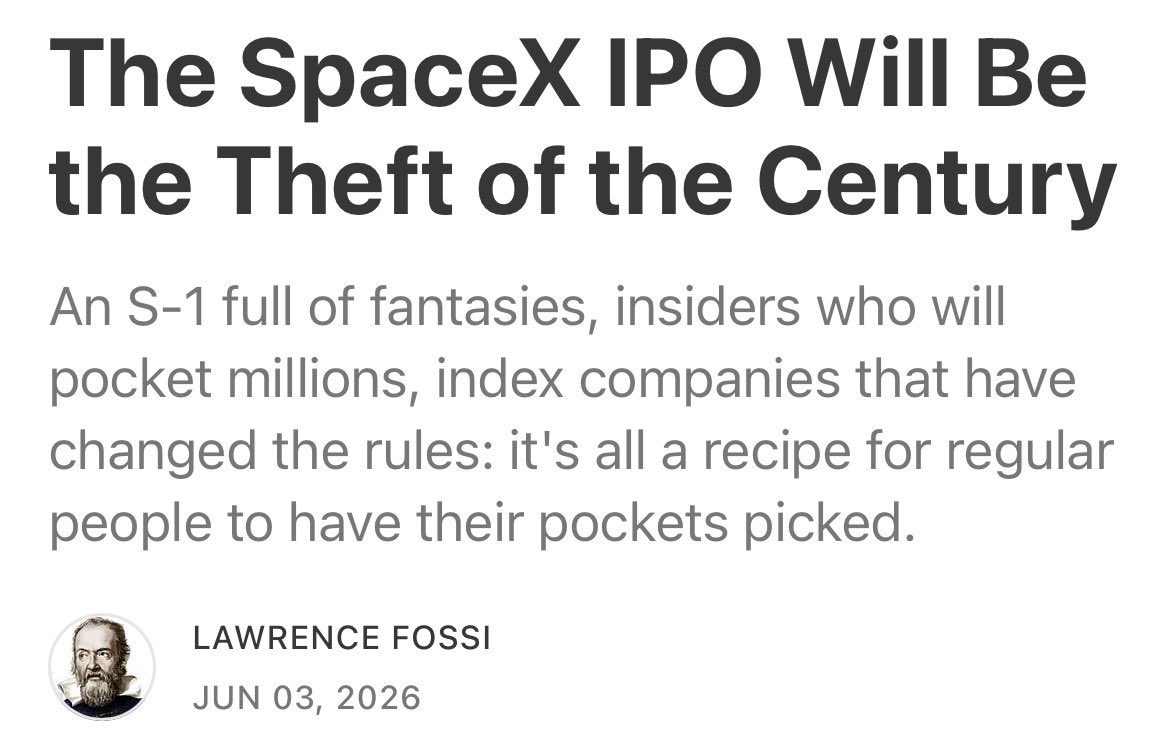
Oligarchs buy rules that profit them. NASDAQ and SEC complicit.
Jun 3

“Not only did Nasdaq gut its “seasoning” requirement to allow SpaceX into its index only 15 days after its IPO, it also changed how it adjusts its weighting in the Nasdaq 100 index for “low-float” stocks.”
“SpaceX will be a very low-float stock, with only 5% of its shares available for sale, yet Nasdaq will weight the stock as if the float were 25% of total SpaceX shares.”
“Once the 180-day lock up period for insiders ends, and the SpaceX float exceeds 20%, Nasdaq will weight the stock based on 100% of the shares outstanding.” 👇🏼
montanaskeptic.substack.com/…
3
54
201
7,623
Richard Field retweeted
“Don’t ask, Don’t tell” is making a comeback.
Stock trading can also be anonymous. Banking. All of finance could be.
This isn’t about the technology, it’s about dodging rules.
Jun 3

Sen. Cynthia Lummis says developers "should be protected from liability since they don't know who the user is."
Lummis also called out the banks: "We have AML and BSA standards in this bill for digital assets contrary to what the banks are saying." 📜
1
2
2
912
Jun 4
RT @ericnuttall: This morning I’m reading “alarmingly low US distillate stocks” ~7MM bbls above operationally challenging levels, and Mercu…
197
Jun 4
RT @chigrl: Trafigura Warns Oil at ‘Critical Juncture’ as Buffers Run Out
Trafigura Group said energy markets are at a “critical juncture,…
67
Richard Field retweeted

Beijing thought it could hold the entire global tech industry hostage by locking down rare earth minerals, but Western innovators just broke the CCP’s chokehold. A Wall Street Journal report highlights a massive wave of optimism as industries successfully eliminate their reliance on Chinese critical minerals. For decades, Beijing controlled up to 90% of global rare earth processing, using that monopoly as political leverage. However, its recent aggressive export restrictions backfired completely, triggering an unprecedented boom in non-Chinese processing and substitution technologies that cannot be undone.
Leading this technological rebellion is Minnesota-based startup Niron Magnetics, which has engineered the world’s first high-performance, rare-earth-free permanent magnets using iron nitride. By utilizing iron and nitrogen, which are abundant, cheap, and entirely domestic raw materials, Niron completely bypasses the dirty refining loops controlled by China. This breakthrough has attracted massive backing from automotive giants like GM Ventures, Stellantis, and Volvo, alongside defense partnerships to build military hardware. Demand is already outstripping supply, forcing Niron to expand from a pilot facility to a massive 190,000-square-foot production plant to fulfill its contracts.
At the same time, startups like Conifer are transforming electric motors by swapping out rare earths for standard, abundant ferrite magnets. Conifer’s proprietary design slashes motor size and weight by up to 50% while boosting vehicle range and operating efficiency by up to 30%. These clean motors seamlessly drop into everything from delivery vehicles and robotics to data center cooling systems. By trying to weaponize its mineral monopoly, the CCP has accidentally forced the West to build a resilient, localized supply chain that leaves authoritarian chokeholds in the past.
#RareEarths #SupplyChain #NationalSecurity #CleanTech #ChinaDecoupling #Innovation #Geopolitics #NironMagnetics
wsj.com/world/does-the-world…
26
203
677
70,563
Richard Field retweeted

The below story about Chinese tech involution is really insightful. I think it perfectly explains why China has had such difficulty reinvesting capital into the West (beyond purely financial assets or assets it wants to strategically sabotage).
Chinese FDI fell quite sharply post 2018 and it’s not just because Western countries became more wary of Chinese control and influence.
The documentary ‘American Factory’ perfectly illustrated the beginnings of the involution problem. The Chinese factory model (when powered by cheap exploited labour) simply can’t be replicated competitively in the West. At least, not without making the West visibly poorer, something that would likely trigger a political backlash.
The documentary tracks the successive attempts by the Chinese owners to block American unionisation to protect profitability. The Chinese managers are also regularly bewildered by American labour norms.
But the reason their investments eventually fail has little to do with Americans being lazy or overly unionised. On the contrary, it’s because when one’s comparative advantage is cheap labour and repression, it’s impossible to make that model work anywhere that doesn’t abide the same norms. This limits Chinese corporate expansion to jurisdictions with poor worker protections and standards, or non democracies.
This is why China’s American investments were eventually abandoned in favor of BRI countries: jurisdictions where China had more clout and influence over local governments and thus greater ability to run exploitative models. It also helped that these populations were generally poorer and had to take terms as presented.
But even that strategy is becoming increasingly politically contentious.
This has left China with no choice but to compete technologically. After all, the only alternatives at this point are: 1) bankrupting its primary customer and trade partner, aka the force that powers what growth it has, 2) writing off the wealth it thought it had on grounds it is no longer materialisable, a move that essentially locks its own people into exploitative conditions for the long term or 3) annexing foreign countries so that foreign populations can be forced to work in exploitative conditions instead. Aka actual old school colonial imperialism.
So far China is opting for the technological path.
But as the below story illustrates, the more China gives up on using its true comparative advantage (large cheap workforces) in favor of technological advances, the more likely it is to run into involution. This is because without a natural input cost advantage it has to compete on actual merit and non human labour cost control.
The problem for China is that simply shifting towards automation and technology is no guarantee of success, especially if the overall operation is far more capital or energy intensive than the old way of doing things. It might not even guarantee greater efficiency, since foreign competition will no longer be put off by an inability to emulate exploitative working practices their systems won’t tolerate. On the contrary China will now be the one constrained by its own inability to adopt Western practices, notably the art of yielding to consumer feedback and power, cost control and respect for hard budget constraints.

1/4
Yicai: "As profit margins shrink in China’s auto industry, auto parts makers are increasingly turning to robotics as a new growth engine, tapping their manufacturing, supply chain, and component expertise to enter a potentially massive future market."
yicaiglobal.com/news/chinese…
57
35
167
78,986
Richard Field retweeted

Jun 3

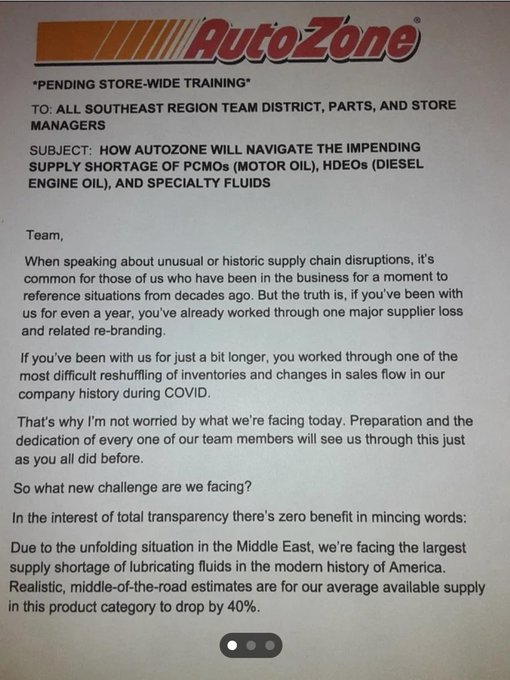
Supply chains are starting to break down
- motor oil, diesel oil, and specialty fluids categories to drop by 40%
- 70% of the dollar value of goods shipped in the US are transported by truck
Less motor oil and specialty fluids mean supply chains are becoming more fragile and more expensive.
Critical maintenance products become scarce, transportation costs rise, equipment downtime increases, and bottlenecks start to appear throughout the economy.
Meanwhile markets are at all time highs
1
1
2
765
Richard Field retweeted
So we could have a tokenized "stock" with no rights or reporting obligations siphoning money away from the real stock market (and issuers), but with direct negative impacts on stock market participants. It destroys market efficiency, stability and integrity.
14/
1
1
510
Richard Field retweeted
None of the main fights in the crypto bill are about regulating spot Bitcoin or true crypto.
The fights are about some "crypto" firms using blockchain to magically win new, lighter rules for traditional financial activities -- like stock trading or banking.
10/
1
1
1
457